Research Report: Team Learning Impact on Education Industry, Malaysia
VerifiedAdded on 2020/07/22
|19
|5294
|36
Report
AI Summary
This research report investigates the impact of team learning on team performance within the education industry, specifically focusing on Sri Dasmesh International School in Kuala Lumpur, Malaysia. The study aims to identify the influence of continuous learning, knowledge generation and sharing, systems thinking capacity, employee participation and accountability, and supportive culture and structure on team performance. The report includes a literature review defining key concepts such as team performance, learning, knowledge generation, systems thinking capacity, employee participation, and supportive culture. It critically reviews relevant theories and models, exploring the relationships between employee participation, supportive culture, continuous learning, knowledge sharing, and systems thinking on team performance. The research employs a case study approach to assess these factors within the educational context, offering valuable insights into how team learning strategies can enhance overall team effectiveness and contribute to organizational success. The report also includes a summary table of the literature review and concludes with research limitations and areas for future study.
Research methods
for business
and management
1
for business
and management
1

Paraphrase This Document
Need a fresh take? Get an instant paraphrase of this document with our AI Paraphraser
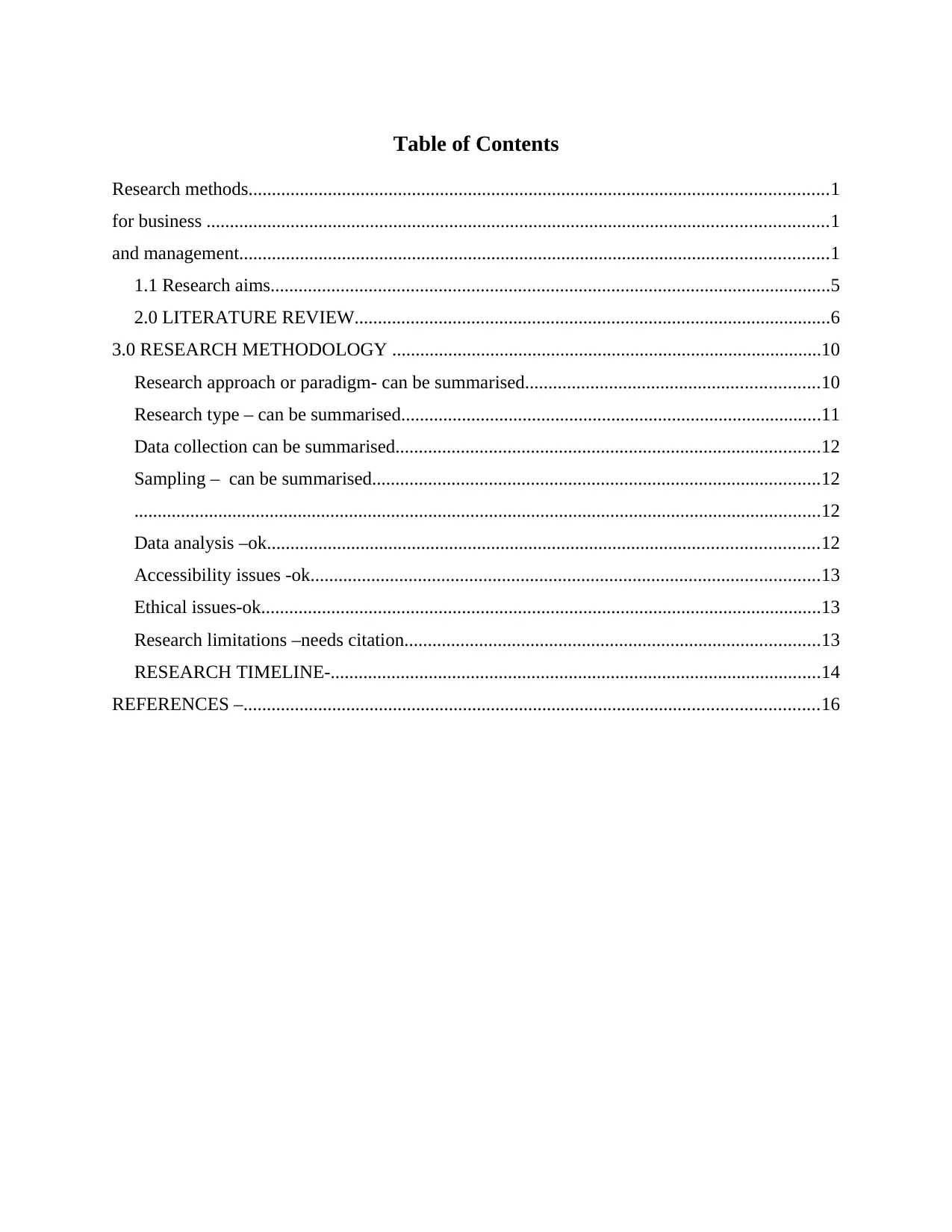
Table of Contents
Research methods............................................................................................................................1
for business .....................................................................................................................................1
and management..............................................................................................................................1
1.1 Research aims........................................................................................................................5
2.0 LITERATURE REVIEW......................................................................................................6
3.0 RESEARCH METHODOLOGY ............................................................................................10
Research approach or paradigm- can be summarised...............................................................10
Research type – can be summarised..........................................................................................11
Data collection can be summarised...........................................................................................12
Sampling – can be summarised................................................................................................12
...................................................................................................................................................12
Data analysis –ok......................................................................................................................12
Accessibility issues -ok.............................................................................................................13
Ethical issues-ok........................................................................................................................13
Research limitations –needs citation.........................................................................................13
RESEARCH TIMELINE-.........................................................................................................14
REFERENCES –...........................................................................................................................16
Research methods............................................................................................................................1
for business .....................................................................................................................................1
and management..............................................................................................................................1
1.1 Research aims........................................................................................................................5
2.0 LITERATURE REVIEW......................................................................................................6
3.0 RESEARCH METHODOLOGY ............................................................................................10
Research approach or paradigm- can be summarised...............................................................10
Research type – can be summarised..........................................................................................11
Data collection can be summarised...........................................................................................12
Sampling – can be summarised................................................................................................12
...................................................................................................................................................12
Data analysis –ok......................................................................................................................12
Accessibility issues -ok.............................................................................................................13
Ethical issues-ok........................................................................................................................13
Research limitations –needs citation.........................................................................................13
RESEARCH TIMELINE-.........................................................................................................14
REFERENCES –...........................................................................................................................16
IMPACT OF TEAM LEARNING ON TEAM PERFORMANCE IN EDUCATION
INDUSTRY IN KUALA LUMPUR, MALAYSIA
1.0 INTRODUCTION
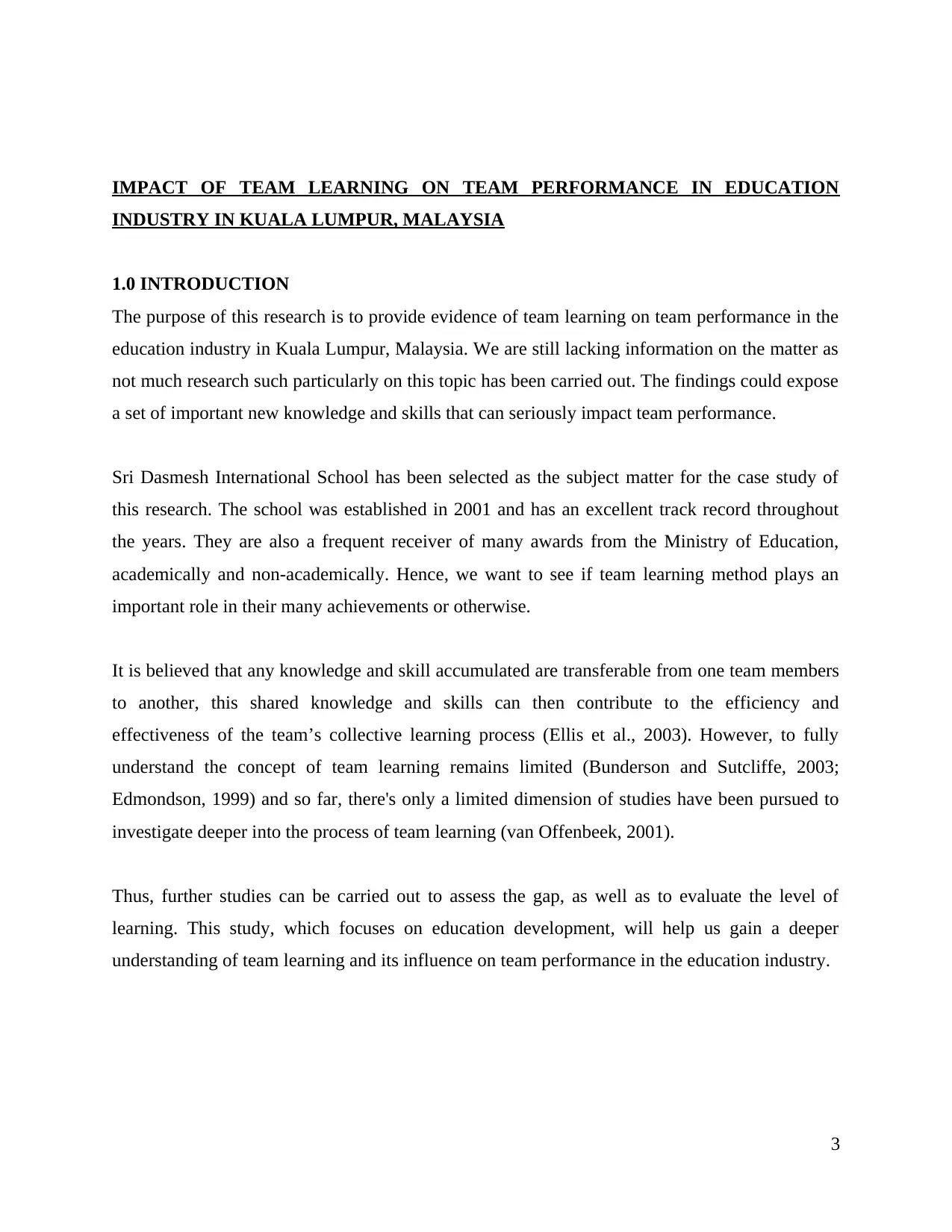
The purpose of this research is to provide evidence of team learning on team performance in the
education industry in Kuala Lumpur, Malaysia. We are still lacking information on the matter as
not much research such particularly on this topic has been carried out. The findings could expose
a set of important new knowledge and skills that can seriously impact team performance.
Sri Dasmesh International School has been selected as the subject matter for the case study of
this research. The school was established in 2001 and has an excellent track record throughout
the years. They are also a frequent receiver of many awards from the Ministry of Education,
academically and non-academically. Hence, we want to see if team learning method plays an
important role in their many achievements or otherwise.
It is believed that any knowledge and skill accumulated are transferable from one team members
to another, this shared knowledge and skills can then contribute to the efficiency and
effectiveness of the team’s collective learning process (Ellis et al., 2003). However, to fully
understand the concept of team learning remains limited (Bunderson and Sutcliffe, 2003;
Edmondson, 1999) and so far, there's only a limited dimension of studies have been pursued to
investigate deeper into the process of team learning (van Offenbeek, 2001).
Thus, further studies can be carried out to assess the gap, as well as to evaluate the level of
learning. This study, which focuses on education development, will help us gain a deeper
understanding of team learning and its influence on team performance in the education industry.
3
INDUSTRY IN KUALA LUMPUR, MALAYSIA
1.0 INTRODUCTION
The purpose of this research is to provide evidence of team learning on team performance in the
education industry in Kuala Lumpur, Malaysia. We are still lacking information on the matter as
not much research such particularly on this topic has been carried out. The findings could expose
a set of important new knowledge and skills that can seriously impact team performance.
Sri Dasmesh International School has been selected as the subject matter for the case study of
this research. The school was established in 2001 and has an excellent track record throughout
the years. They are also a frequent receiver of many awards from the Ministry of Education,
academically and non-academically. Hence, we want to see if team learning method plays an
important role in their many achievements or otherwise.
It is believed that any knowledge and skill accumulated are transferable from one team members
to another, this shared knowledge and skills can then contribute to the efficiency and
effectiveness of the team’s collective learning process (Ellis et al., 2003). However, to fully
understand the concept of team learning remains limited (Bunderson and Sutcliffe, 2003;
Edmondson, 1999) and so far, there's only a limited dimension of studies have been pursued to
investigate deeper into the process of team learning (van Offenbeek, 2001).
Thus, further studies can be carried out to assess the gap, as well as to evaluate the level of
learning. This study, which focuses on education development, will help us gain a deeper
understanding of team learning and its influence on team performance in the education industry.
3
⊘ This is a preview!⊘
Do you want full access?
Subscribe today to unlock all pages.

Trusted by 1+ million students worldwide
1.1 Research aims
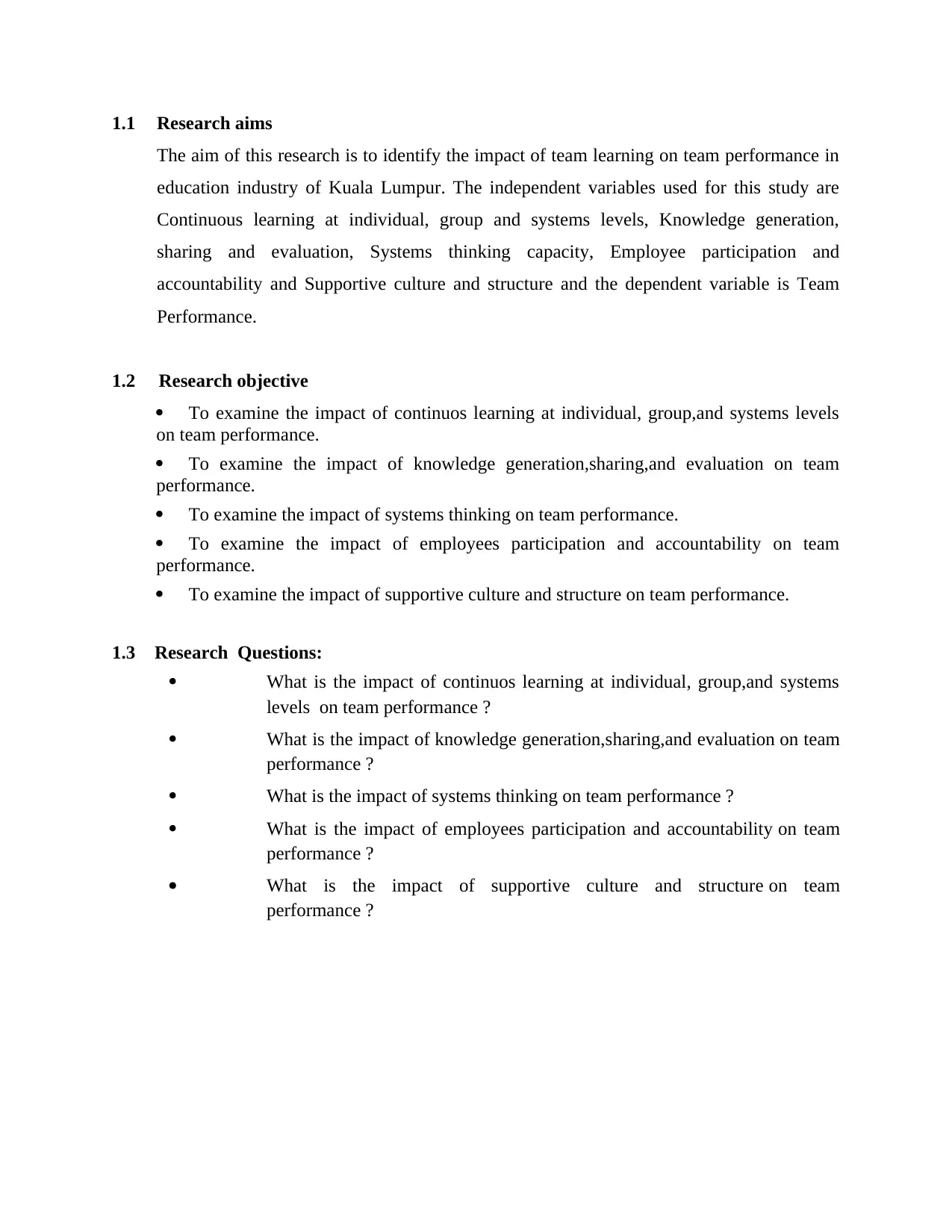
The aim of this research is to identify the impact of team learning on team performance in
education industry of Kuala Lumpur. The independent variables used for this study are
Continuous learning at individual, group and systems levels, Knowledge generation,
sharing and evaluation, Systems thinking capacity, Employee participation and
accountability and Supportive culture and structure and the dependent variable is Team
Performance.
1.2 Research objective
To examine the impact of continuos learning at individual, group,and systems levels
on team performance.
To examine the impact of knowledge generation,sharing,and evaluation on team
performance.
To examine the impact of systems thinking on team performance.
To examine the impact of employees participation and accountability on team
performance.
To examine the impact of supportive culture and structure on team performance.
1.3 Research Questions:
What is the impact of continuos learning at individual, group,and systems
levels on team performance ?
What is the impact of knowledge generation,sharing,and evaluation on team
performance ?
What is the impact of systems thinking on team performance ?
What is the impact of employees participation and accountability on team
performance ?
What is the impact of supportive culture and structure on team
performance ?
The aim of this research is to identify the impact of team learning on team performance in
education industry of Kuala Lumpur. The independent variables used for this study are
Continuous learning at individual, group and systems levels, Knowledge generation,
sharing and evaluation, Systems thinking capacity, Employee participation and
accountability and Supportive culture and structure and the dependent variable is Team
Performance.
1.2 Research objective
To examine the impact of continuos learning at individual, group,and systems levels
on team performance.
To examine the impact of knowledge generation,sharing,and evaluation on team
performance.
To examine the impact of systems thinking on team performance.
To examine the impact of employees participation and accountability on team
performance.
To examine the impact of supportive culture and structure on team performance.
1.3 Research Questions:
What is the impact of continuos learning at individual, group,and systems
levels on team performance ?
What is the impact of knowledge generation,sharing,and evaluation on team
performance ?
What is the impact of systems thinking on team performance ?
What is the impact of employees participation and accountability on team
performance ?
What is the impact of supportive culture and structure on team
performance ?
Paraphrase This Document
Need a fresh take? Get an instant paraphrase of this document with our AI Paraphraser
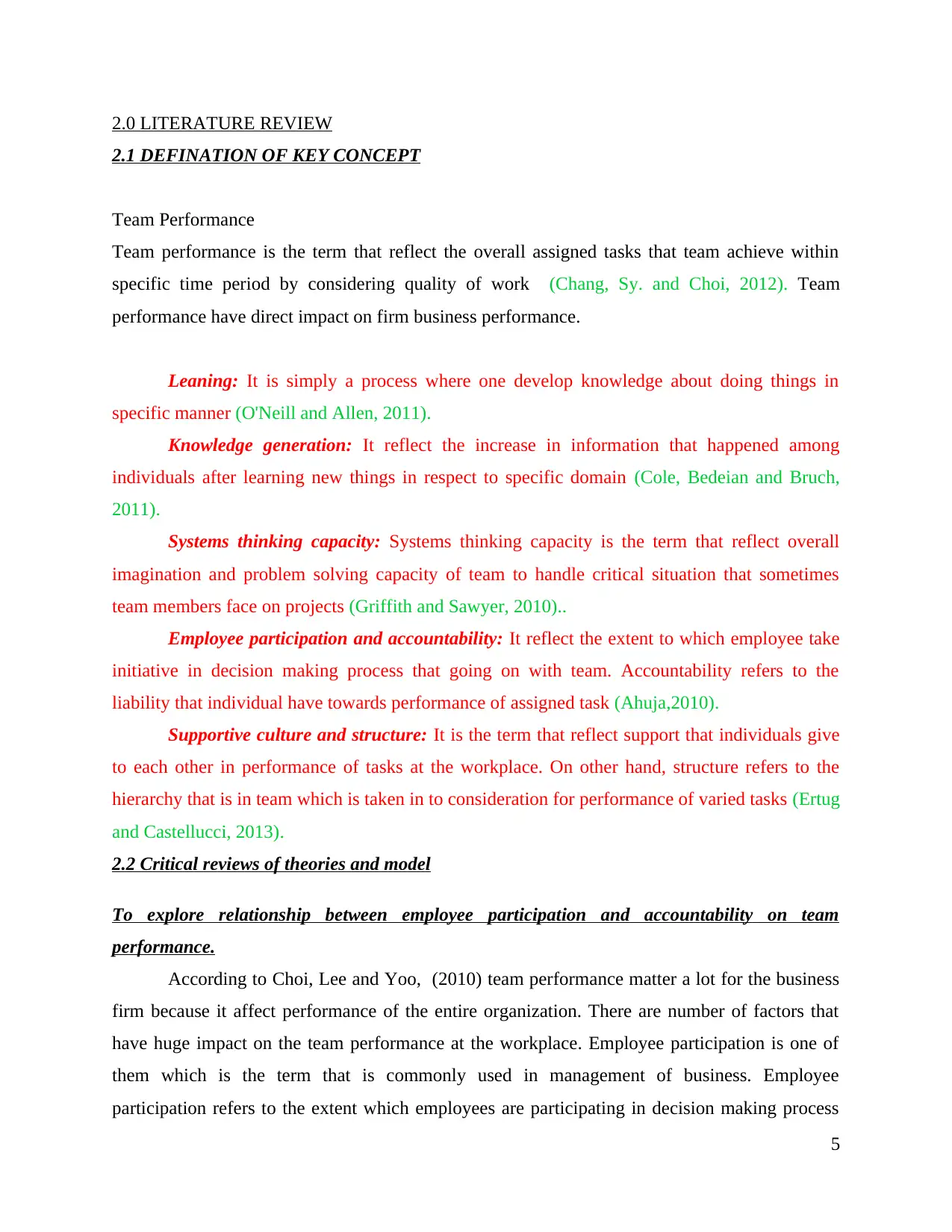
2.0 LITERATURE REVIEW
2.1 DEFINATION OF KEY CONCEPT
Team Performance
Team performance is the term that reflect the overall assigned tasks that team achieve within
specific time period by considering quality of work (Chang, Sy. and Choi, 2012). Team
performance have direct impact on firm business performance.
Leaning: It is simply a process where one develop knowledge about doing things in
specific manner (O'Neill and Allen, 2011).
Knowledge generation: It reflect the increase in information that happened among
individuals after learning new things in respect to specific domain (Cole, Bedeian and Bruch,
2011).
Systems thinking capacity: Systems thinking capacity is the term that reflect overall
imagination and problem solving capacity of team to handle critical situation that sometimes
team members face on projects (Griffith and Sawyer, 2010)..
Employee participation and accountability: It reflect the extent to which employee take
initiative in decision making process that going on with team. Accountability refers to the
liability that individual have towards performance of assigned task (Ahuja,2010).
Supportive culture and structure: It is the term that reflect support that individuals give
to each other in performance of tasks at the workplace. On other hand, structure refers to the
hierarchy that is in team which is taken in to consideration for performance of varied tasks (Ertug
and Castellucci, 2013).
2.2 Critical reviews of theories and model
To explore relationship between employee participation and accountability on team
performance.
According to Choi, Lee and Yoo, (2010) team performance matter a lot for the business
firm because it affect performance of the entire organization. There are number of factors that
have huge impact on the team performance at the workplace. Employee participation is one of
them which is the term that is commonly used in management of business. Employee
participation refers to the extent which employees are participating in decision making process
5
2.1 DEFINATION OF KEY CONCEPT
Team Performance
Team performance is the term that reflect the overall assigned tasks that team achieve within
specific time period by considering quality of work (Chang, Sy. and Choi, 2012). Team
performance have direct impact on firm business performance.
Leaning: It is simply a process where one develop knowledge about doing things in
specific manner (O'Neill and Allen, 2011).
Knowledge generation: It reflect the increase in information that happened among
individuals after learning new things in respect to specific domain (Cole, Bedeian and Bruch,
2011).
Systems thinking capacity: Systems thinking capacity is the term that reflect overall
imagination and problem solving capacity of team to handle critical situation that sometimes
team members face on projects (Griffith and Sawyer, 2010)..
Employee participation and accountability: It reflect the extent to which employee take
initiative in decision making process that going on with team. Accountability refers to the
liability that individual have towards performance of assigned task (Ahuja,2010).
Supportive culture and structure: It is the term that reflect support that individuals give
to each other in performance of tasks at the workplace. On other hand, structure refers to the
hierarchy that is in team which is taken in to consideration for performance of varied tasks (Ertug
and Castellucci, 2013).
2.2 Critical reviews of theories and model
To explore relationship between employee participation and accountability on team
performance.
According to Choi, Lee and Yoo, (2010) team performance matter a lot for the business
firm because it affect performance of the entire organization. There are number of factors that
have huge impact on the team performance at the workplace. Employee participation is one of
them which is the term that is commonly used in management of business. Employee
participation refers to the extent which employees are participating in decision making process
5
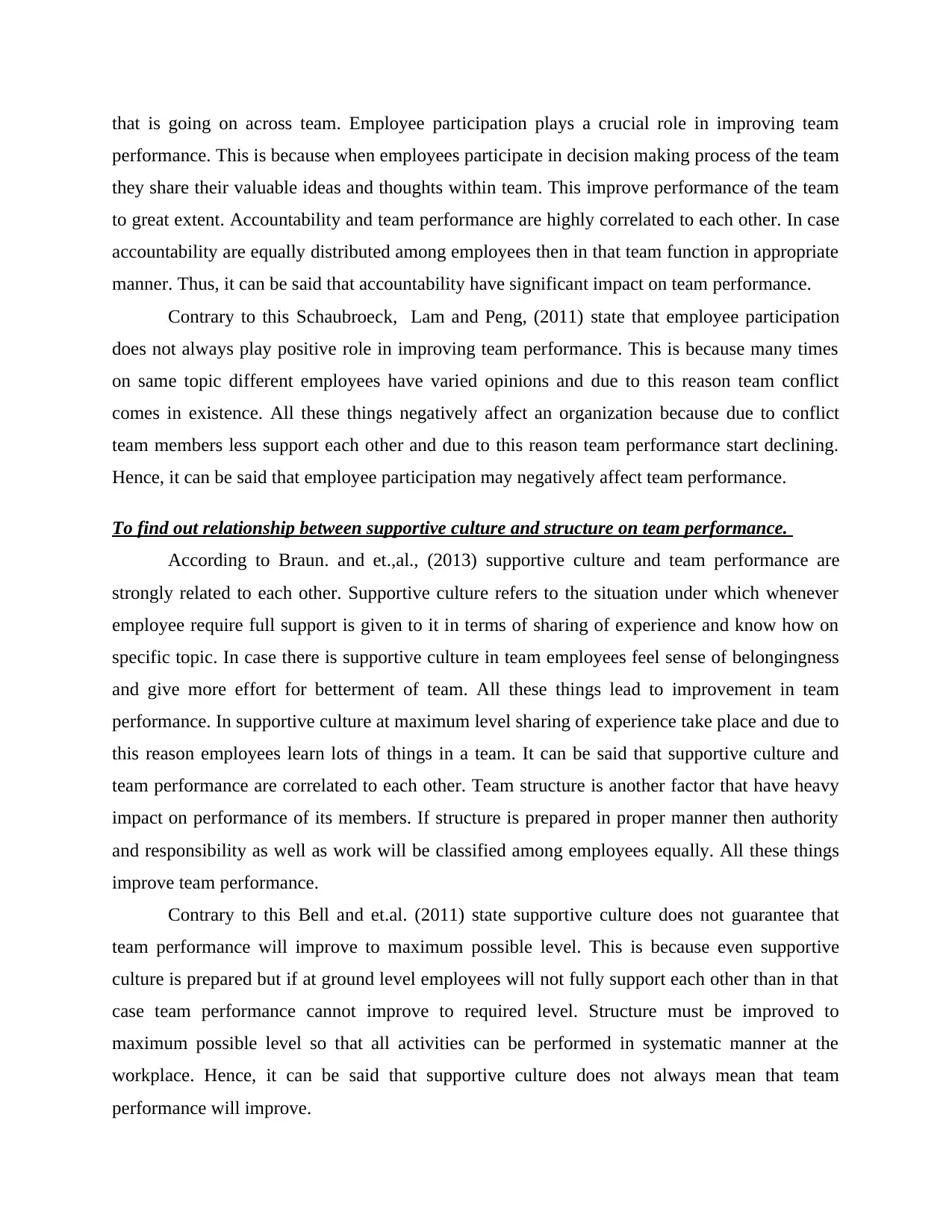
that is going on across team. Employee participation plays a crucial role in improving team
performance. This is because when employees participate in decision making process of the team
they share their valuable ideas and thoughts within team. This improve performance of the team
to great extent. Accountability and team performance are highly correlated to each other. In case
accountability are equally distributed among employees then in that team function in appropriate
manner. Thus, it can be said that accountability have significant impact on team performance.
Contrary to this Schaubroeck, Lam and Peng, (2011) state that employee participation
does not always play positive role in improving team performance. This is because many times
on same topic different employees have varied opinions and due to this reason team conflict
comes in existence. All these things negatively affect an organization because due to conflict
team members less support each other and due to this reason team performance start declining.
Hence, it can be said that employee participation may negatively affect team performance.
To find out relationship between supportive culture and structure on team performance.
According to Braun. and et.,al., (2013) supportive culture and team performance are
strongly related to each other. Supportive culture refers to the situation under which whenever
employee require full support is given to it in terms of sharing of experience and know how on
specific topic. In case there is supportive culture in team employees feel sense of belongingness
and give more effort for betterment of team. All these things lead to improvement in team
performance. In supportive culture at maximum level sharing of experience take place and due to
this reason employees learn lots of things in a team. It can be said that supportive culture and
team performance are correlated to each other. Team structure is another factor that have heavy
impact on performance of its members. If structure is prepared in proper manner then authority
and responsibility as well as work will be classified among employees equally. All these things
improve team performance.
Contrary to this Bell and et.al. (2011) state supportive culture does not guarantee that
team performance will improve to maximum possible level. This is because even supportive
culture is prepared but if at ground level employees will not fully support each other than in that
case team performance cannot improve to required level. Structure must be improved to
maximum possible level so that all activities can be performed in systematic manner at the
workplace. Hence, it can be said that supportive culture does not always mean that team
performance will improve.
performance. This is because when employees participate in decision making process of the team
they share their valuable ideas and thoughts within team. This improve performance of the team
to great extent. Accountability and team performance are highly correlated to each other. In case
accountability are equally distributed among employees then in that team function in appropriate
manner. Thus, it can be said that accountability have significant impact on team performance.
Contrary to this Schaubroeck, Lam and Peng, (2011) state that employee participation
does not always play positive role in improving team performance. This is because many times
on same topic different employees have varied opinions and due to this reason team conflict
comes in existence. All these things negatively affect an organization because due to conflict
team members less support each other and due to this reason team performance start declining.
Hence, it can be said that employee participation may negatively affect team performance.
To find out relationship between supportive culture and structure on team performance.
According to Braun. and et.,al., (2013) supportive culture and team performance are
strongly related to each other. Supportive culture refers to the situation under which whenever
employee require full support is given to it in terms of sharing of experience and know how on
specific topic. In case there is supportive culture in team employees feel sense of belongingness
and give more effort for betterment of team. All these things lead to improvement in team
performance. In supportive culture at maximum level sharing of experience take place and due to
this reason employees learn lots of things in a team. It can be said that supportive culture and
team performance are correlated to each other. Team structure is another factor that have heavy
impact on performance of its members. If structure is prepared in proper manner then authority
and responsibility as well as work will be classified among employees equally. All these things
improve team performance.
Contrary to this Bell and et.al. (2011) state supportive culture does not guarantee that
team performance will improve to maximum possible level. This is because even supportive
culture is prepared but if at ground level employees will not fully support each other than in that
case team performance cannot improve to required level. Structure must be improved to
maximum possible level so that all activities can be performed in systematic manner at the
workplace. Hence, it can be said that supportive culture does not always mean that team
performance will improve.
⊘ This is a preview!⊘
Do you want full access?
Subscribe today to unlock all pages.
Trusted by 1+ million students worldwide
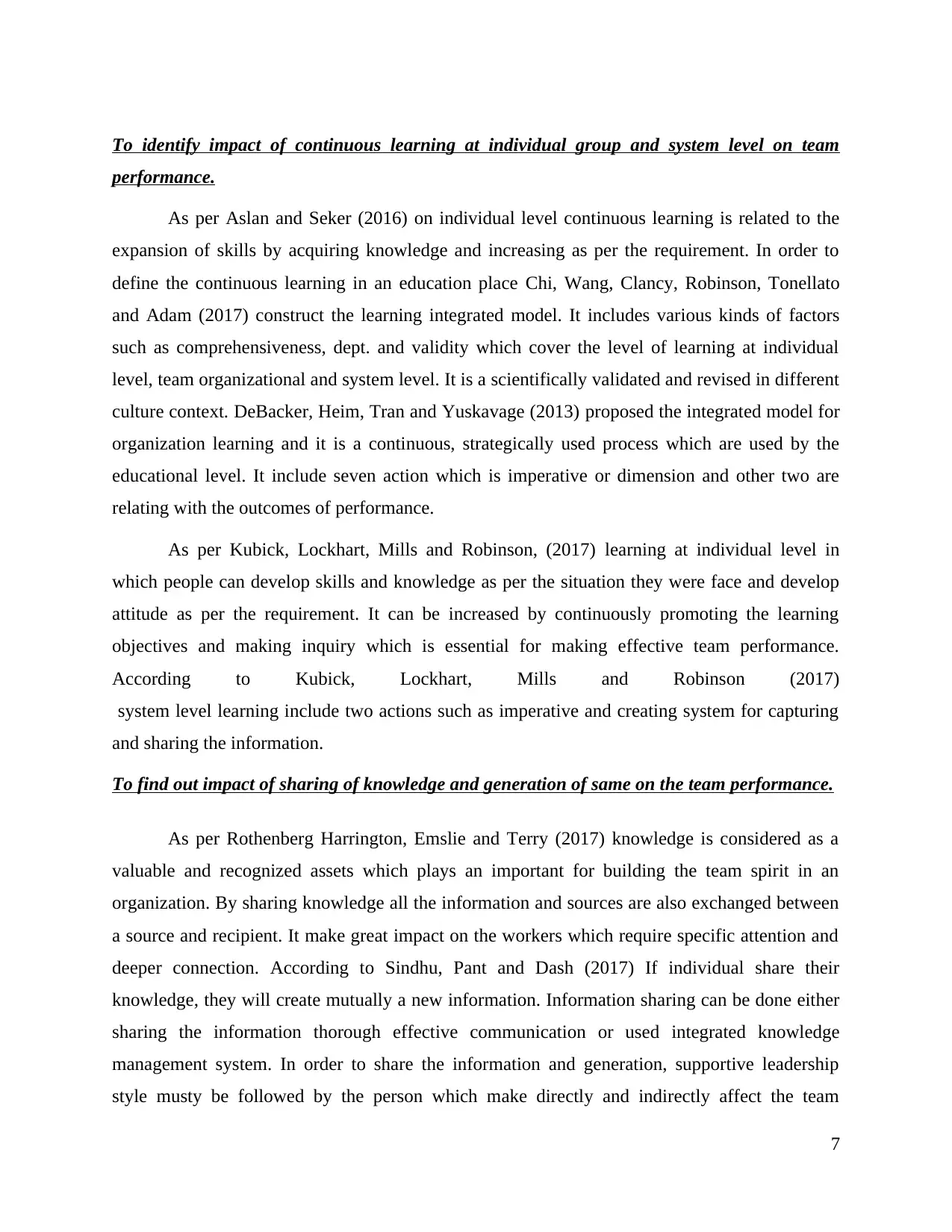
To identify impact of continuous learning at individual group and system level on team
performance.
As per Aslan and Seker (2016) on individual level continuous learning is related to the
expansion of skills by acquiring knowledge and increasing as per the requirement. In order to
define the continuous learning in an education place Chi, Wang, Clancy, Robinson, Tonellato
and Adam (2017) construct the learning integrated model. It includes various kinds of factors
such as comprehensiveness, dept. and validity which cover the level of learning at individual
level, team organizational and system level. It is a scientifically validated and revised in different
culture context. DeBacker, Heim, Tran and Yuskavage (2013) proposed the integrated model for
organization learning and it is a continuous, strategically used process which are used by the
educational level. It include seven action which is imperative or dimension and other two are
relating with the outcomes of performance.
As per Kubick, Lockhart, Mills and Robinson, (2017) learning at individual level in
which people can develop skills and knowledge as per the situation they were face and develop
attitude as per the requirement. It can be increased by continuously promoting the learning
objectives and making inquiry which is essential for making effective team performance.
According to Kubick, Lockhart, Mills and Robinson (2017)
system level learning include two actions such as imperative and creating system for capturing
and sharing the information.
To find out impact of sharing of knowledge and generation of same on the team performance.
As per Rothenberg Harrington, Emslie and Terry (2017) knowledge is considered as a
valuable and recognized assets which plays an important for building the team spirit in an
organization. By sharing knowledge all the information and sources are also exchanged between
a source and recipient. It make great impact on the workers which require specific attention and
deeper connection. According to Sindhu, Pant and Dash (2017) If individual share their
knowledge, they will create mutually a new information. Information sharing can be done either
sharing the information thorough effective communication or used integrated knowledge
management system. In order to share the information and generation, supportive leadership
style musty be followed by the person which make directly and indirectly affect the team
7
performance.
As per Aslan and Seker (2016) on individual level continuous learning is related to the
expansion of skills by acquiring knowledge and increasing as per the requirement. In order to
define the continuous learning in an education place Chi, Wang, Clancy, Robinson, Tonellato
and Adam (2017) construct the learning integrated model. It includes various kinds of factors
such as comprehensiveness, dept. and validity which cover the level of learning at individual
level, team organizational and system level. It is a scientifically validated and revised in different
culture context. DeBacker, Heim, Tran and Yuskavage (2013) proposed the integrated model for
organization learning and it is a continuous, strategically used process which are used by the
educational level. It include seven action which is imperative or dimension and other two are
relating with the outcomes of performance.
As per Kubick, Lockhart, Mills and Robinson, (2017) learning at individual level in
which people can develop skills and knowledge as per the situation they were face and develop
attitude as per the requirement. It can be increased by continuously promoting the learning
objectives and making inquiry which is essential for making effective team performance.
According to Kubick, Lockhart, Mills and Robinson (2017)
system level learning include two actions such as imperative and creating system for capturing
and sharing the information.
To find out impact of sharing of knowledge and generation of same on the team performance.
As per Rothenberg Harrington, Emslie and Terry (2017) knowledge is considered as a
valuable and recognized assets which plays an important for building the team spirit in an
organization. By sharing knowledge all the information and sources are also exchanged between
a source and recipient. It make great impact on the workers which require specific attention and
deeper connection. According to Sindhu, Pant and Dash (2017) If individual share their
knowledge, they will create mutually a new information. Information sharing can be done either
sharing the information thorough effective communication or used integrated knowledge
management system. In order to share the information and generation, supportive leadership
style musty be followed by the person which make directly and indirectly affect the team
7
Paraphrase This Document
Need a fresh take? Get an instant paraphrase of this document with our AI Paraphraser
performance. As per Tseng, Kano and Hsu (2014) it encourage the employees and contribute to
the initiation and effectiveness of knowledge sharing. It can be said that by transferring the
information by generation to next, it will create and add on new thought which make an effectual
working in a workplace.
To identify impact of system thinking capacity on team performance.
According to the view of Tseng, Kano and Hsu (2014) system thinking capacity plays a very
crucial role in the business enterprise by which all employees can able to share their knowledge,
idea, ability and creativity about the working. With assistance of this aspect, people can improve
their quality of working, productivity and efficiency of the working related to the business.
While within the firm, system thinking capacity bring and arise then its direct impact on the
performance of employees in the team. They more able to give their contribution and efforts to
attain the business target. With help of this, employees can able to attain the objective within a
time period.
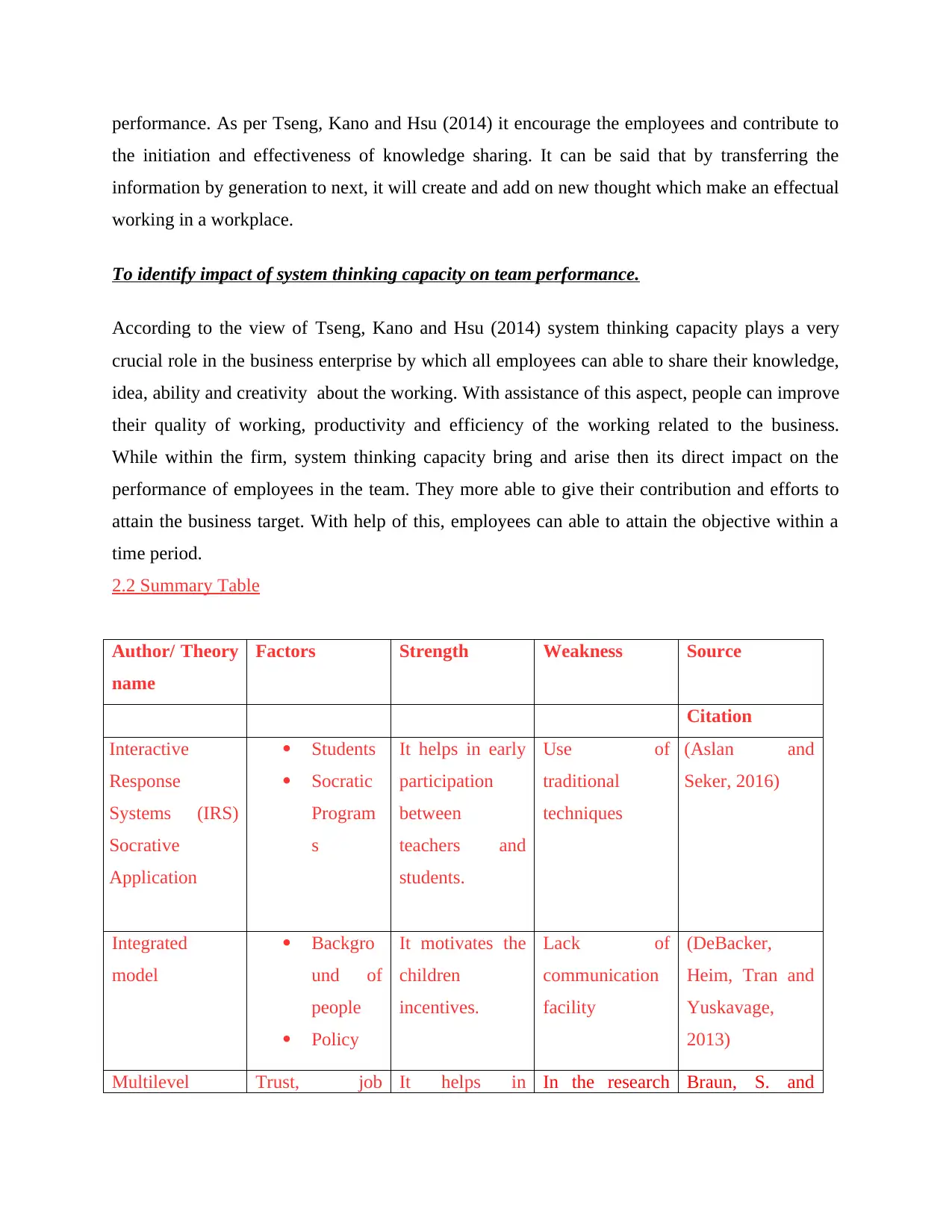
2.2 Summary Table
Author/ Theory
name
Factors Strength Weakness Source
Citation
Interactive
Response
Systems (IRS)
Socrative
Application
Students
Socratic
Program
s
It helps in early
participation
between
teachers and
students.
Use of
traditional
techniques
(Aslan and
Seker, 2016)
Integrated
model
Backgro
und of
people
Policy
It motivates the
children
incentives.
Lack of
communication
facility
(DeBacker,
Heim, Tran and
Yuskavage,
2013)
Multilevel Trust, job It helps in In the research Braun, S. and
the initiation and effectiveness of knowledge sharing. It can be said that by transferring the
information by generation to next, it will create and add on new thought which make an effectual
working in a workplace.
To identify impact of system thinking capacity on team performance.
According to the view of Tseng, Kano and Hsu (2014) system thinking capacity plays a very
crucial role in the business enterprise by which all employees can able to share their knowledge,
idea, ability and creativity about the working. With assistance of this aspect, people can improve
their quality of working, productivity and efficiency of the working related to the business.
While within the firm, system thinking capacity bring and arise then its direct impact on the
performance of employees in the team. They more able to give their contribution and efforts to
attain the business target. With help of this, employees can able to attain the objective within a
time period.
2.2 Summary Table
Author/ Theory
name
Factors Strength Weakness Source
Citation
Interactive
Response
Systems (IRS)
Socrative
Application
Students
Socratic
Program
s
It helps in early
participation
between
teachers and
students.
Use of
traditional
techniques
(Aslan and
Seker, 2016)
Integrated
model
Backgro
und of
people
Policy
It motivates the
children
incentives.
Lack of
communication
facility
(DeBacker,
Heim, Tran and
Yuskavage,
2013)
Multilevel Trust, job It helps in In the research Braun, S. and
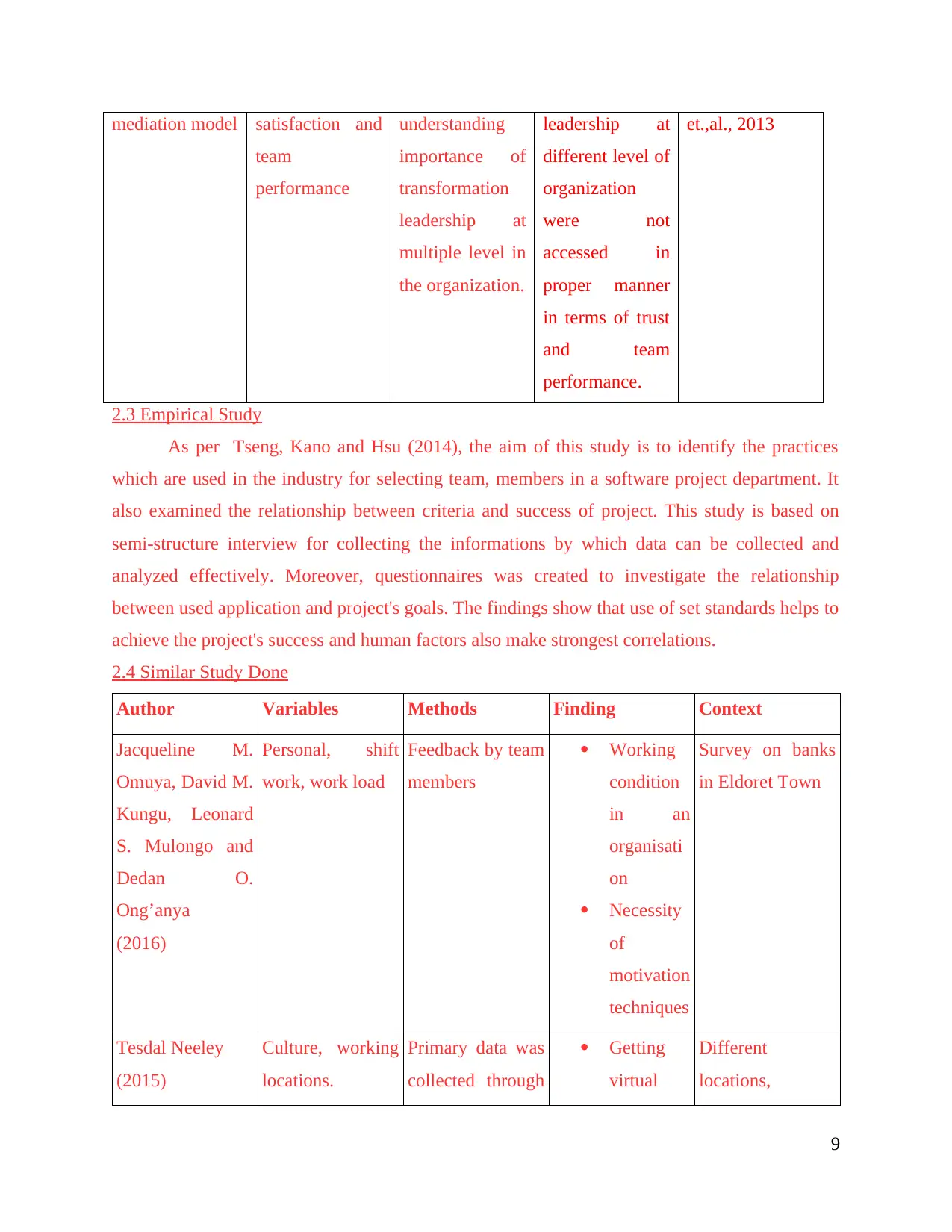
mediation model satisfaction and
team
performance
understanding
importance of
transformation
leadership at
multiple level in
the organization.
leadership at
different level of
organization
were not
accessed in
proper manner
in terms of trust
and team
performance.
et.,al., 2013
2.3 Empirical Study
As per Tseng, Kano and Hsu (2014), the aim of this study is to identify the practices
which are used in the industry for selecting team, members in a software project department. It
also examined the relationship between criteria and success of project. This study is based on
semi-structure interview for collecting the informations by which data can be collected and
analyzed effectively. Moreover, questionnaires was created to investigate the relationship
between used application and project's goals. The findings show that use of set standards helps to
achieve the project's success and human factors also make strongest correlations.
2.4 Similar Study Done
Author Variables Methods Finding Context
Jacqueline M.
Omuya, David M.
Kungu, Leonard
S. Mulongo and
Dedan O.
Ong’anya
(2016)
Personal, shift
work, work load
Feedback by team
members
Working
condition
in an
organisati
on
Necessity
of
motivation
techniques
Survey on banks
in Eldoret Town
Tesdal Neeley
(2015)
Culture, working
locations.
Primary data was
collected through
Getting
virtual
Different
locations,
9
team
performance
understanding
importance of
transformation
leadership at
multiple level in
the organization.
leadership at
different level of
organization
were not
accessed in
proper manner
in terms of trust
and team
performance.
et.,al., 2013
2.3 Empirical Study
As per Tseng, Kano and Hsu (2014), the aim of this study is to identify the practices
which are used in the industry for selecting team, members in a software project department. It
also examined the relationship between criteria and success of project. This study is based on
semi-structure interview for collecting the informations by which data can be collected and
analyzed effectively. Moreover, questionnaires was created to investigate the relationship
between used application and project's goals. The findings show that use of set standards helps to
achieve the project's success and human factors also make strongest correlations.
2.4 Similar Study Done
Author Variables Methods Finding Context
Jacqueline M.
Omuya, David M.
Kungu, Leonard
S. Mulongo and
Dedan O.
Ong’anya
(2016)
Personal, shift
work, work load
Feedback by team
members
Working
condition
in an
organisati
on
Necessity
of
motivation
techniques
Survey on banks
in Eldoret Town
Tesdal Neeley
(2015)
Culture, working
locations.
Primary data was
collected through
Getting
virtual
Different
locations,
9
⊘ This is a preview!⊘
Do you want full access?
Subscribe today to unlock all pages.
Trusted by 1+ million students worldwide
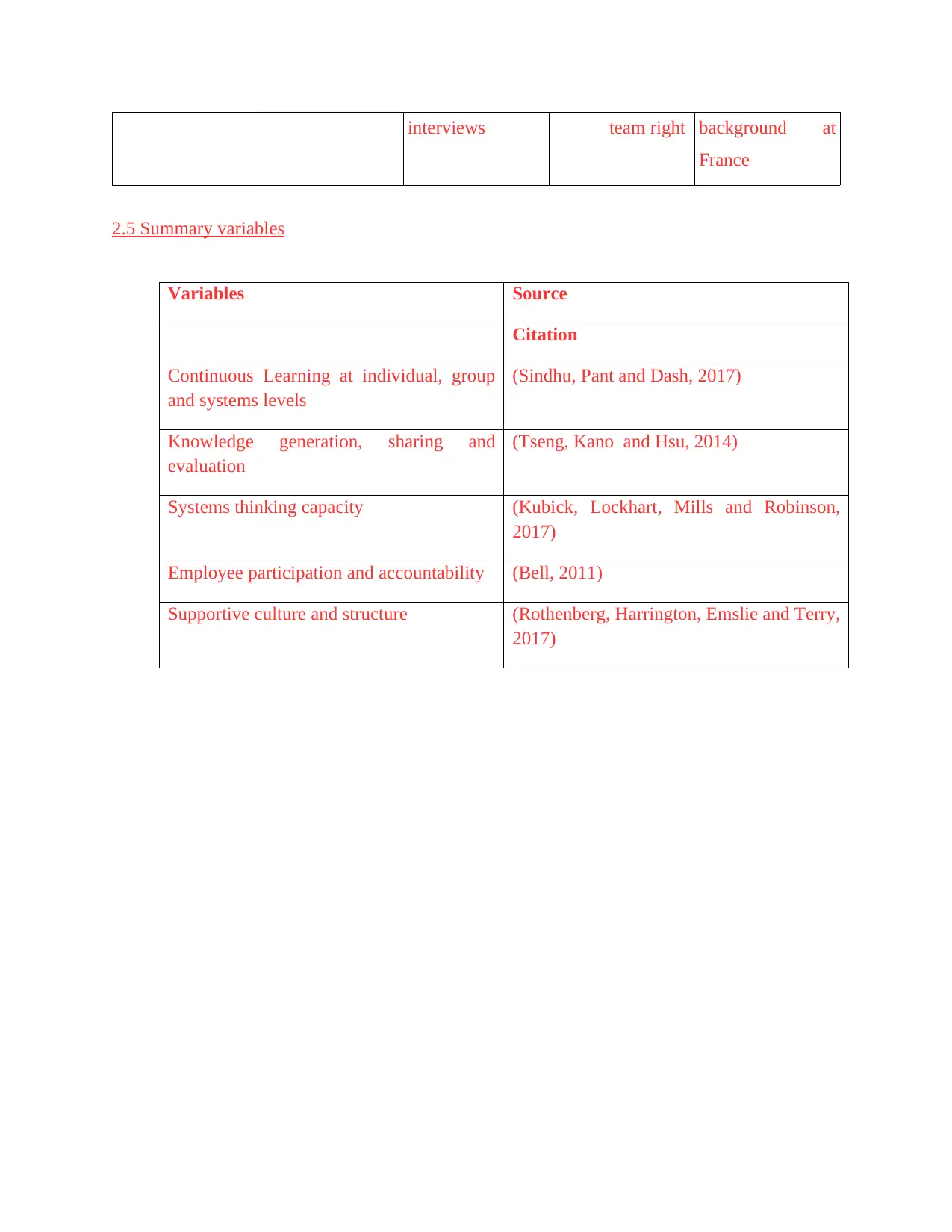
interviews team right background at
France
2.5 Summary variables
Variables Source
Citation
Continuous Learning at individual, group
and systems levels
(Sindhu, Pant and Dash, 2017)
Knowledge generation, sharing and
evaluation
(Tseng, Kano and Hsu, 2014)
Systems thinking capacity (Kubick, Lockhart, Mills and Robinson,
2017)
Employee participation and accountability (Bell, 2011)
Supportive culture and structure (Rothenberg, Harrington, Emslie and Terry,
2017)
France
2.5 Summary variables
Variables Source
Citation
Continuous Learning at individual, group
and systems levels
(Sindhu, Pant and Dash, 2017)
Knowledge generation, sharing and
evaluation
(Tseng, Kano and Hsu, 2014)
Systems thinking capacity (Kubick, Lockhart, Mills and Robinson,
2017)
Employee participation and accountability (Bell, 2011)
Supportive culture and structure (Rothenberg, Harrington, Emslie and Terry,
2017)
Paraphrase This Document
Need a fresh take? Get an instant paraphrase of this document with our AI Paraphraser
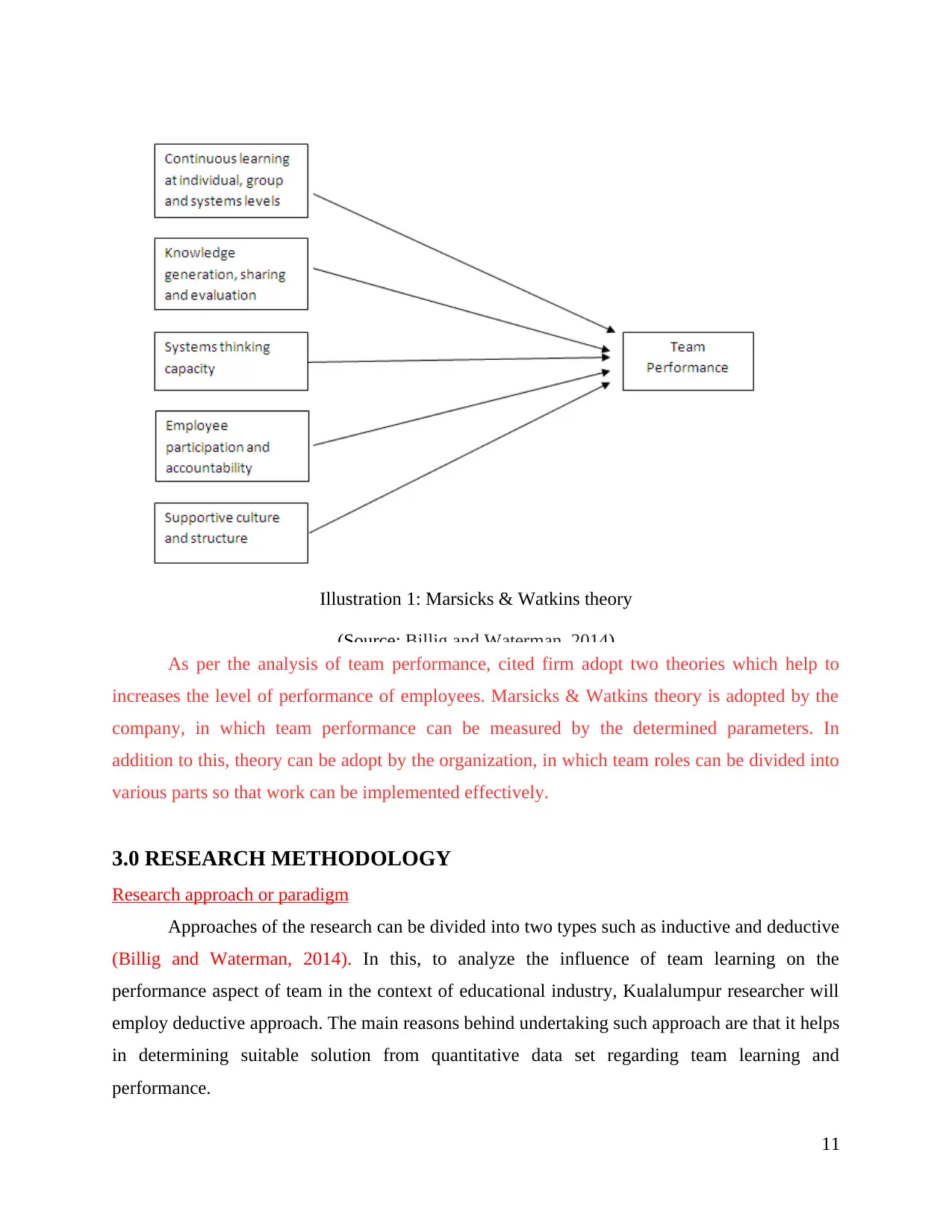
Illustration 1: Marsicks & Watkins theory
(Source: Billig and Waterman, 2014)
As per the analysis of team performance, cited firm adopt two theories which help to
increases the level of performance of employees. Marsicks & Watkins theory is adopted by the
company, in which team performance can be measured by the determined parameters. In
addition to this, theory can be adopt by the organization, in which team roles can be divided into
various parts so that work can be implemented effectively.
3.0 RESEARCH METHODOLOGY
Research approach or paradigm
Approaches of the research can be divided into two types such as inductive and deductive
(Billig and Waterman, 2014). In this, to analyze the influence of team learning on the
performance aspect of team in the context of educational industry, Kualalumpur researcher will
employ deductive approach. The main reasons behind undertaking such approach are that it helps
in determining suitable solution from quantitative data set regarding team learning and
performance.
11
(Source: Billig and Waterman, 2014)
As per the analysis of team performance, cited firm adopt two theories which help to
increases the level of performance of employees. Marsicks & Watkins theory is adopted by the
company, in which team performance can be measured by the determined parameters. In
addition to this, theory can be adopt by the organization, in which team roles can be divided into
various parts so that work can be implemented effectively.
3.0 RESEARCH METHODOLOGY
Research approach or paradigm
Approaches of the research can be divided into two types such as inductive and deductive
(Billig and Waterman, 2014). In this, to analyze the influence of team learning on the
performance aspect of team in the context of educational industry, Kualalumpur researcher will
employ deductive approach. The main reasons behind undertaking such approach are that it helps
in determining suitable solution from quantitative data set regarding team learning and
performance.
11
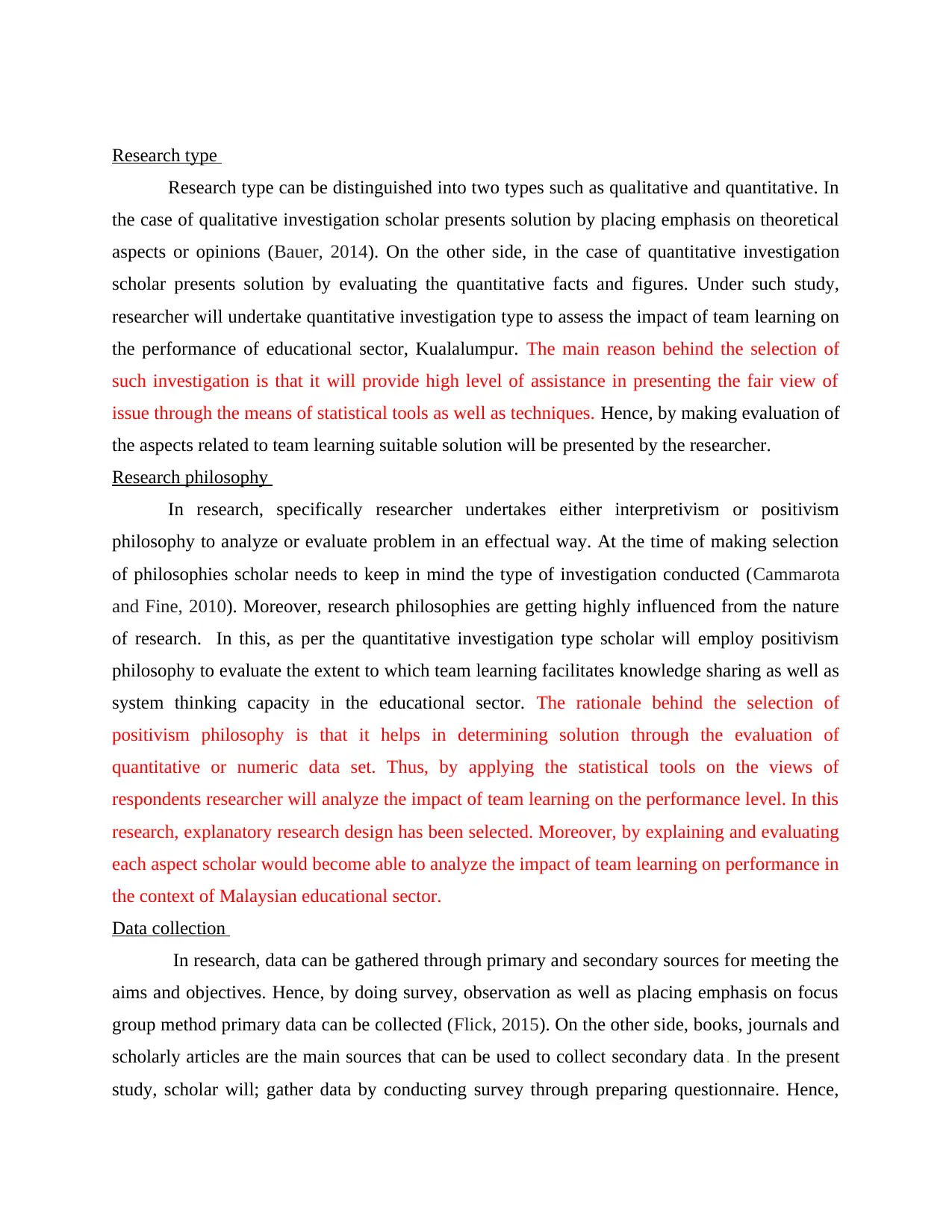
Research type
Research type can be distinguished into two types such as qualitative and quantitative. In
the case of qualitative investigation scholar presents solution by placing emphasis on theoretical
aspects or opinions (Bauer, 2014). On the other side, in the case of quantitative investigation
scholar presents solution by evaluating the quantitative facts and figures. Under such study,
researcher will undertake quantitative investigation type to assess the impact of team learning on
the performance of educational sector, Kualalumpur. The main reason behind the selection of
such investigation is that it will provide high level of assistance in presenting the fair view of
issue through the means of statistical tools as well as techniques. Hence, by making evaluation of
the aspects related to team learning suitable solution will be presented by the researcher.
Research philosophy
In research, specifically researcher undertakes either interpretivism or positivism
philosophy to analyze or evaluate problem in an effectual way. At the time of making selection
of philosophies scholar needs to keep in mind the type of investigation conducted (Cammarota
and Fine, 2010). Moreover, research philosophies are getting highly influenced from the nature
of research. In this, as per the quantitative investigation type scholar will employ positivism
philosophy to evaluate the extent to which team learning facilitates knowledge sharing as well as
system thinking capacity in the educational sector. The rationale behind the selection of
positivism philosophy is that it helps in determining solution through the evaluation of
quantitative or numeric data set. Thus, by applying the statistical tools on the views of
respondents researcher will analyze the impact of team learning on the performance level. In this
research, explanatory research design has been selected. Moreover, by explaining and evaluating
each aspect scholar would become able to analyze the impact of team learning on performance in
the context of Malaysian educational sector.
Data collection
In research, data can be gathered through primary and secondary sources for meeting the
aims and objectives. Hence, by doing survey, observation as well as placing emphasis on focus
group method primary data can be collected (Flick, 2015). On the other side, books, journals and
scholarly articles are the main sources that can be used to collect secondary data. In the present
study, scholar will; gather data by conducting survey through preparing questionnaire. Hence,
Research type can be distinguished into two types such as qualitative and quantitative. In
the case of qualitative investigation scholar presents solution by placing emphasis on theoretical
aspects or opinions (Bauer, 2014). On the other side, in the case of quantitative investigation
scholar presents solution by evaluating the quantitative facts and figures. Under such study,
researcher will undertake quantitative investigation type to assess the impact of team learning on
the performance of educational sector, Kualalumpur. The main reason behind the selection of
such investigation is that it will provide high level of assistance in presenting the fair view of
issue through the means of statistical tools as well as techniques. Hence, by making evaluation of
the aspects related to team learning suitable solution will be presented by the researcher.
Research philosophy
In research, specifically researcher undertakes either interpretivism or positivism
philosophy to analyze or evaluate problem in an effectual way. At the time of making selection
of philosophies scholar needs to keep in mind the type of investigation conducted (Cammarota
and Fine, 2010). Moreover, research philosophies are getting highly influenced from the nature
of research. In this, as per the quantitative investigation type scholar will employ positivism
philosophy to evaluate the extent to which team learning facilitates knowledge sharing as well as
system thinking capacity in the educational sector. The rationale behind the selection of
positivism philosophy is that it helps in determining solution through the evaluation of
quantitative or numeric data set. Thus, by applying the statistical tools on the views of
respondents researcher will analyze the impact of team learning on the performance level. In this
research, explanatory research design has been selected. Moreover, by explaining and evaluating
each aspect scholar would become able to analyze the impact of team learning on performance in
the context of Malaysian educational sector.
Data collection
In research, data can be gathered through primary and secondary sources for meeting the
aims and objectives. Hence, by doing survey, observation as well as placing emphasis on focus
group method primary data can be collected (Flick, 2015). On the other side, books, journals and
scholarly articles are the main sources that can be used to collect secondary data. In the present
study, scholar will; gather data by conducting survey through preparing questionnaire. Hence,
⊘ This is a preview!⊘
Do you want full access?
Subscribe today to unlock all pages.
Trusted by 1+ million students worldwide

1 out of 19


Related Documents


Your All-in-One AI-Powered Toolkit for Academic Success.
+13062052269
info@desklib.com
Available 24*7 on WhatsApp / Email
![[object Object]](/_next/static/media/star-bottom.7253800d.svg)
Unlock your academic potential
Copyright © 2020–2026 A2Z Services. All Rights Reserved. Developed and managed by ZUCOL.