The Impact of Workplace Distractions: Single-Subject Study Report
VerifiedAdded on 2021/12/17
|10
|2196
|184
Report
AI Summary
This report details a single-subject study investigating the impact of workplace distractions on task-switching performance. The study employed an AB design, examining the response time of a participant in two phases: a baseline phase without distractions and an intervention phase with music as a distraction. The research question explored whether distractions, such as loud music, affect the response time and difficulty in switching tasks. Independent variables included letters, numbers, shapes, and colors representing different tasks, while the dependent variable was the response time. The methodology involved an online toolkit for task-switching experiments. The results, while limited by the single-subject design, indicated that music acted as a stimulus, potentially enhancing concentration. The study highlights the importance of controlling workplace distractions to improve employee efficiency. The report also discusses the limitations of the study due to the single subject study, which may not be generalizable to a larger population, and references relevant literature on experimental design and research methods.
Running head: RESEARCH THEORY, DESIGN, AND METHODS
1
Research theory, design, and methods
Single-subject study design
Student’s Name
Institutional Affiliation
Professor’s Name
Date
1
Research theory, design, and methods
Single-subject study design
Student’s Name
Institutional Affiliation
Professor’s Name
Date

Paraphrase This Document
Need a fresh take? Get an instant paraphrase of this document with our AI Paraphraser
RESEARCH THEORY, DESIGN, AND METHODS
2
Single-subject study design
Research question
Does the distraction in a workplace such as loud music or noise determine the difficulties
and the response time taken to switch from one task to another among male and female
employees?
Hypothesis
The null hypothesis, H0: Female participants incur a shorter response time and minimal
difficulty in switching between tasks than their counterpart male participants in a noisy working
environment.
The alternative hypothesis, H1: Female participants do not incur a short response time
and minimal difficulty in switching between tasks than their counterpart male participants in a
noisy working environment.
Variables
Independent variables (IV)
In the first phase of the test, the independent variables (IV) used in testing the hypothesis
are the combination of the letters and the numbers that represent different tasks in the other task
switching under a noise distraction such as music in the background. The variables will be placed
in a quadrant figure where the participant is required to respond to a letter (IV) in the top
quadrants and a number (IV) in the bottom two quadrants. These independent variables are
classified as the nominal variables since the respondent is expected to distinguish whether the
alphabetical letters are the vowels or the consonants while for the numerical values the
2
Single-subject study design
Research question
Does the distraction in a workplace such as loud music or noise determine the difficulties
and the response time taken to switch from one task to another among male and female
employees?
Hypothesis
The null hypothesis, H0: Female participants incur a shorter response time and minimal
difficulty in switching between tasks than their counterpart male participants in a noisy working
environment.
The alternative hypothesis, H1: Female participants do not incur a short response time
and minimal difficulty in switching between tasks than their counterpart male participants in a
noisy working environment.
Variables
Independent variables (IV)
In the first phase of the test, the independent variables (IV) used in testing the hypothesis
are the combination of the letters and the numbers that represent different tasks in the other task
switching under a noise distraction such as music in the background. The variables will be placed
in a quadrant figure where the participant is required to respond to a letter (IV) in the top
quadrants and a number (IV) in the bottom two quadrants. These independent variables are
classified as the nominal variables since the respondent is expected to distinguish whether the
alphabetical letters are the vowels or the consonants while for the numerical values the
RESEARCH THEORY, DESIGN, AND METHODS
3
participant is expected to categorize as odd and even. The second phase of the test is the cued-
task switching where the independent variables are different shapes and colors representing
different tasks. The variables are the nominal types of data whereby the respondent is to identify
the shape as either rectangular or circle while the color as either blue or yellow. During the
second phase, the respondents were exposed to a condition, which is the sound of music playing
in the background to determine if it can be used to manipulate the results. However, the response
had a choice to either conduct a test under the condition or not.
Dependent variables (DV)
The dependent variable in the tests for both the first phase and the second phase is the
response time taken by the participant in switching between the tasks. The dependent variable
can be termed as an interval scale due to the meaningful difference that can be drawn between
the scores or a ratio scale when taken in relation to a certain measure. However, the response
time can be considered as a covariate variable as it was recorded in single-task blocks, mixed
block for task-repeat trials, mixed block for task-switch trials, and the task cost switch, which is
the difference between the response time for task-repeat trials and the task-switch trials in
milliseconds.
Methodology
Design
For the single-subject study, the baseline design was deployed to focus on the behavior of
a single respondent. In the study, the action of interest was repeated in two phases for two tests
over a period to create a behavioral baseline. However, after the respondents were exposed to the
3
participant is expected to categorize as odd and even. The second phase of the test is the cued-
task switching where the independent variables are different shapes and colors representing
different tasks. The variables are the nominal types of data whereby the respondent is to identify
the shape as either rectangular or circle while the color as either blue or yellow. During the
second phase, the respondents were exposed to a condition, which is the sound of music playing
in the background to determine if it can be used to manipulate the results. However, the response
had a choice to either conduct a test under the condition or not.
Dependent variables (DV)
The dependent variable in the tests for both the first phase and the second phase is the
response time taken by the participant in switching between the tasks. The dependent variable
can be termed as an interval scale due to the meaningful difference that can be drawn between
the scores or a ratio scale when taken in relation to a certain measure. However, the response
time can be considered as a covariate variable as it was recorded in single-task blocks, mixed
block for task-repeat trials, mixed block for task-switch trials, and the task cost switch, which is
the difference between the response time for task-repeat trials and the task-switch trials in
milliseconds.
Methodology
Design
For the single-subject study, the baseline design was deployed to focus on the behavior of
a single respondent. In the study, the action of interest was repeated in two phases for two tests
over a period to create a behavioral baseline. However, after the respondents were exposed to the
⊘ This is a preview!⊘
Do you want full access?
Subscribe today to unlock all pages.

Trusted by 1+ million students worldwide
RESEARCH THEORY, DESIGN, AND METHODS
4
experiments of switching tasks, there would be an introduction of a condition such as a musical
distraction to examine the trends in the response under this condition. The condition is aimed to
act as a control experiment to the previous test as the response time was compared to the study
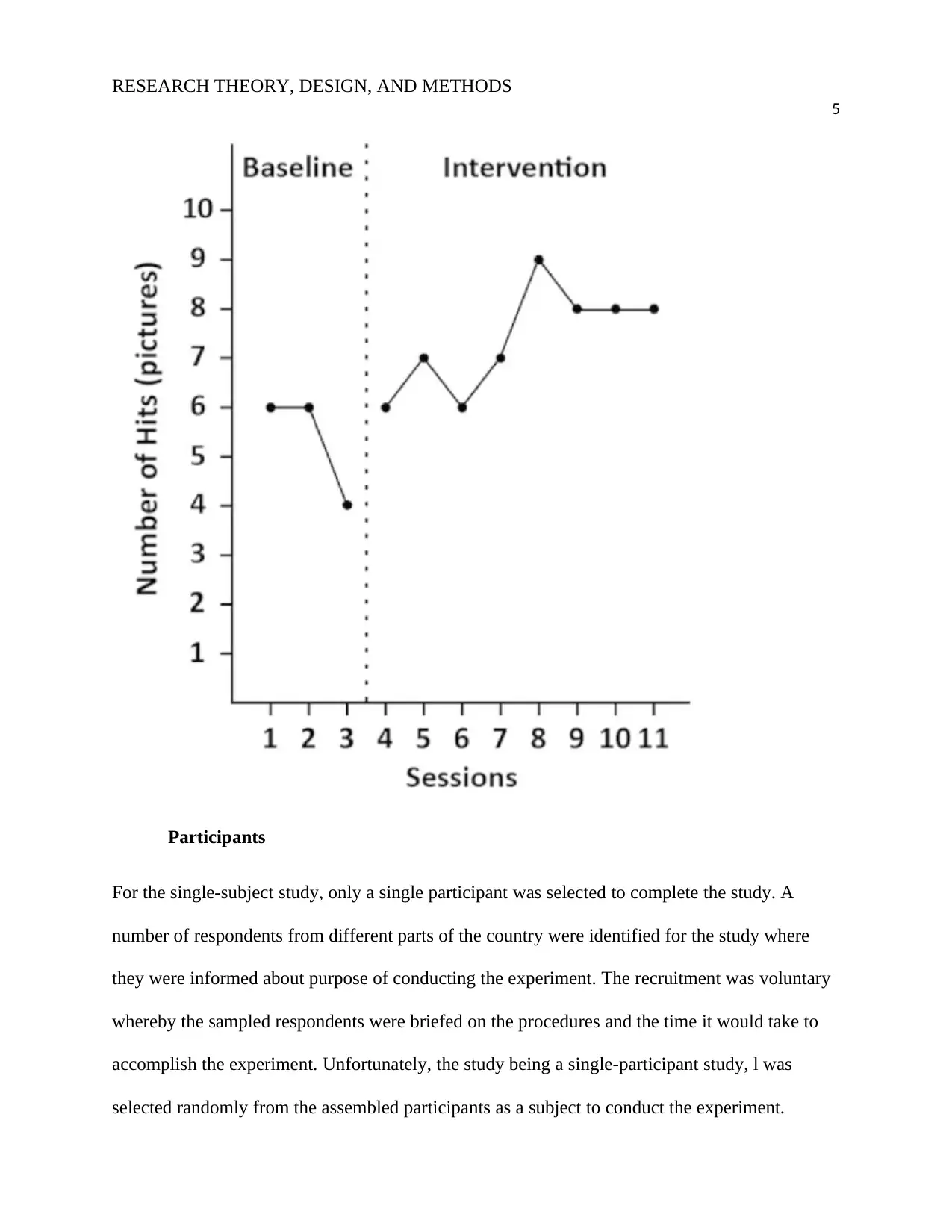
that was conducted without the condition. The approach that was deployed was the AB design
where A represents the first phase while B the second phase of the experiment. However, the
first phase was regarded as the baseline phase of the study where there was no condition induced
in the experiment while the second phase, B was the intervention experiment for the study where
the music was introduced as a manipulation. (Gast, Ledford, and Severini, 2018) pointed out that
the AB design is suitable for the single subject studies as the second phase acts as a control to the
baseline or the initial test in the study. The AB design can be demonstrated using the diagram
below that shows the baseline and its corresponding intervention.
4
experiments of switching tasks, there would be an introduction of a condition such as a musical
distraction to examine the trends in the response under this condition. The condition is aimed to
act as a control experiment to the previous test as the response time was compared to the study
that was conducted without the condition. The approach that was deployed was the AB design
where A represents the first phase while B the second phase of the experiment. However, the
first phase was regarded as the baseline phase of the study where there was no condition induced
in the experiment while the second phase, B was the intervention experiment for the study where
the music was introduced as a manipulation. (Gast, Ledford, and Severini, 2018) pointed out that
the AB design is suitable for the single subject studies as the second phase acts as a control to the
baseline or the initial test in the study. The AB design can be demonstrated using the diagram
below that shows the baseline and its corresponding intervention.
Paraphrase This Document
Need a fresh take? Get an instant paraphrase of this document with our AI Paraphraser
RESEARCH THEORY, DESIGN, AND METHODS
5
Participants
For the single-subject study, only a single participant was selected to complete the study. A
number of respondents from different parts of the country were identified for the study where
they were informed about purpose of conducting the experiment. The recruitment was voluntary
whereby the sampled respondents were briefed on the procedures and the time it would take to
accomplish the experiment. Unfortunately, the study being a single-participant study, l was
selected randomly from the assembled participants as a subject to conduct the experiment.
5
Participants
For the single-subject study, only a single participant was selected to complete the study. A
number of respondents from different parts of the country were identified for the study where
they were informed about purpose of conducting the experiment. The recruitment was voluntary
whereby the sampled respondents were briefed on the procedures and the time it would take to
accomplish the experiment. Unfortunately, the study being a single-participant study, l was
selected randomly from the assembled participants as a subject to conduct the experiment.
RESEARCH THEORY, DESIGN, AND METHODS
6
Materials
The research was based on experimental tasks involving two tests whereby the first was
the response time without any manipulation while the second one the response time cued study
where the manipulation was introduced a measure for the response time taken. The study aimed
at determining the response time taken during tasks switching with an allowance of three seconds
set aside for errors using a psychology toolkit that can be accessed through
(https://www.psytoolkit.org/cgi-bin/psy2.5.2/survey?s=CbU2N ) in a web-based study (Ramsey,
Thompson, McKenzie, and Rosenbaum, 2016, pp.354-360). The use of an online toolkit, which
displayed the tests to be undertaken, were shown on the screen. However, the tests on the
questions were similar across all the questionnaires whereby someone can recognize the type of
information they was responding to as a requirement of the measure of face validity in research.
Additionally, the tasks portrayed the content validity through the assurance of the desired
information to be found in the questions in the description before every test.
Furthermore, the instructions in the first and second tasks of the experiment aimed at
helping the participant to use minimal response time thus ensuring that the study exhibited the
required content validity. For a construct validity to exist, there must be a content validity to
ensure the items being used are the right types and then adds a question to relate to the content.
The construct validity in research ensures that the attempt to organize and make sense of
behavioral and the psychological processes in the experiment is followed for the achievement of
the desired results (Goodwin and Goodwin, 2016). Another important aspect is the discriminant
validity among the materials used.
6
Materials
The research was based on experimental tasks involving two tests whereby the first was
the response time without any manipulation while the second one the response time cued study
where the manipulation was introduced a measure for the response time taken. The study aimed
at determining the response time taken during tasks switching with an allowance of three seconds
set aside for errors using a psychology toolkit that can be accessed through
(https://www.psytoolkit.org/cgi-bin/psy2.5.2/survey?s=CbU2N ) in a web-based study (Ramsey,
Thompson, McKenzie, and Rosenbaum, 2016, pp.354-360). The use of an online toolkit, which
displayed the tests to be undertaken, were shown on the screen. However, the tests on the
questions were similar across all the questionnaires whereby someone can recognize the type of
information they was responding to as a requirement of the measure of face validity in research.
Additionally, the tasks portrayed the content validity through the assurance of the desired
information to be found in the questions in the description before every test.
Furthermore, the instructions in the first and second tasks of the experiment aimed at
helping the participant to use minimal response time thus ensuring that the study exhibited the
required content validity. For a construct validity to exist, there must be a content validity to
ensure the items being used are the right types and then adds a question to relate to the content.
The construct validity in research ensures that the attempt to organize and make sense of
behavioral and the psychological processes in the experiment is followed for the achievement of
the desired results (Goodwin and Goodwin, 2016). Another important aspect is the discriminant
validity among the materials used.
⊘ This is a preview!⊘
Do you want full access?
Subscribe today to unlock all pages.
Trusted by 1+ million students worldwide
RESEARCH THEORY, DESIGN, AND METHODS
7
In discriminant validity, the researcher examines the degree of operationalization through
the correlate scores to determine if the operation is similar or not. In this case, the correlate
scores are 0.94 and 0.95 for experiment one and two respectively. These scores are high
indicating that there is evidence of low discriminant validity in the tests. (Byrne, 2016)
acknowledges that discriminant validity can be viewed in ways as convergent and divergent
validities. The author explains that when the correlation scores are high, it indicates that the test
exhibits the convergent validity whereby the test correlates with other similar constructs.
However, when the correlation scores are too low, the test exhibits divergent validity implying
that the test does not correlate with the measures of the other tests thus has different constructs.
Basing on the explaining, we can deduce that the two experiments in the study are convergent
due to the high correlation degree.
Procedure
The participant was required to access the web-study survey through the link
https://www.psytoolkit.org/cgi-bin/psy2.5.2/survey?s=CbU2N to begin phase one of the
experiment. After clicking on the link, the participant selected either the male or the female
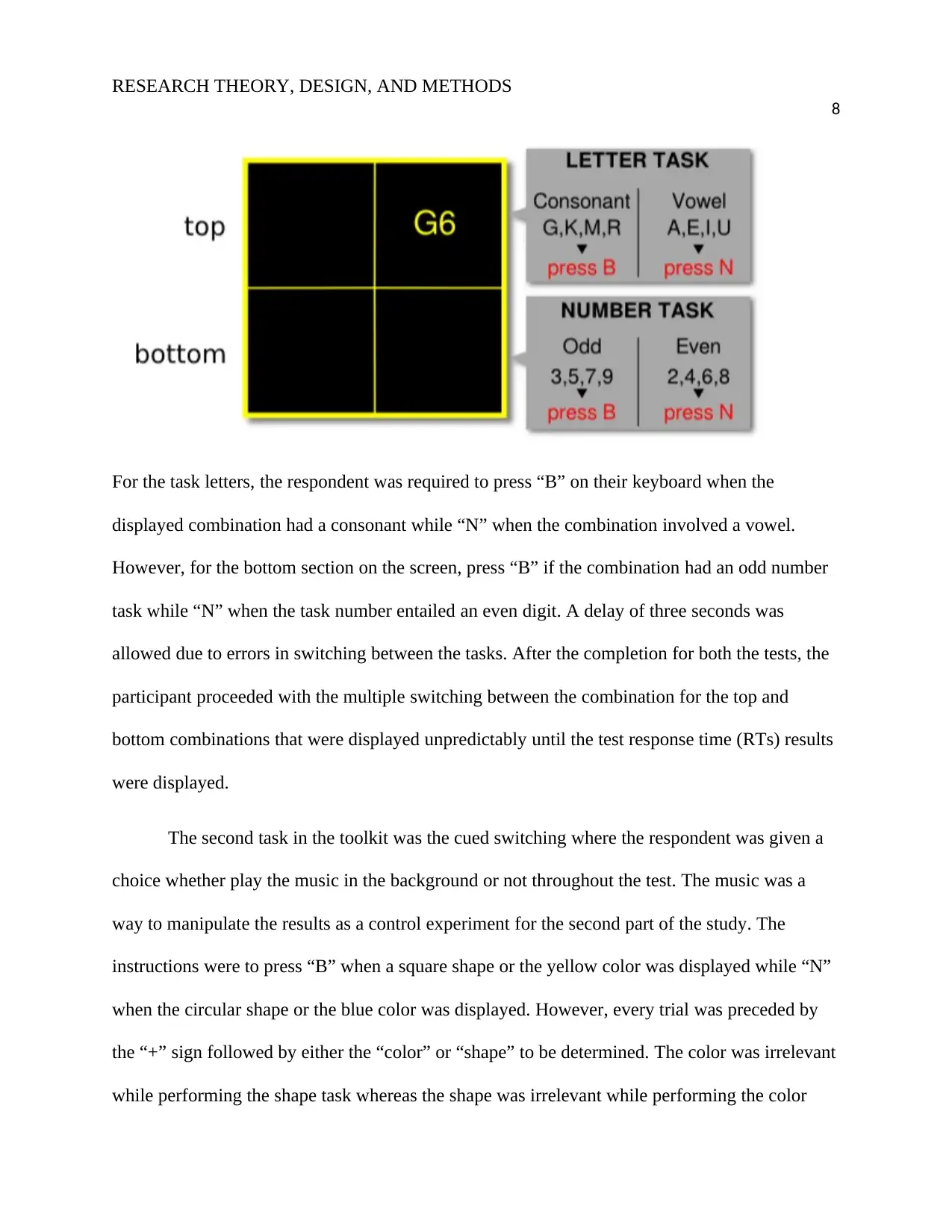
button to continue to the experiment. On the toolkit, there was a combination of letters and
numbers where you are needed to respond to the letter on the upper screen while the numbers on
the lower screen in the combination in the survey toolkit as displayed below.
7
In discriminant validity, the researcher examines the degree of operationalization through
the correlate scores to determine if the operation is similar or not. In this case, the correlate
scores are 0.94 and 0.95 for experiment one and two respectively. These scores are high
indicating that there is evidence of low discriminant validity in the tests. (Byrne, 2016)
acknowledges that discriminant validity can be viewed in ways as convergent and divergent
validities. The author explains that when the correlation scores are high, it indicates that the test
exhibits the convergent validity whereby the test correlates with other similar constructs.
However, when the correlation scores are too low, the test exhibits divergent validity implying
that the test does not correlate with the measures of the other tests thus has different constructs.
Basing on the explaining, we can deduce that the two experiments in the study are convergent
due to the high correlation degree.
Procedure
The participant was required to access the web-study survey through the link
https://www.psytoolkit.org/cgi-bin/psy2.5.2/survey?s=CbU2N to begin phase one of the
experiment. After clicking on the link, the participant selected either the male or the female
button to continue to the experiment. On the toolkit, there was a combination of letters and
numbers where you are needed to respond to the letter on the upper screen while the numbers on
the lower screen in the combination in the survey toolkit as displayed below.
Paraphrase This Document
Need a fresh take? Get an instant paraphrase of this document with our AI Paraphraser
RESEARCH THEORY, DESIGN, AND METHODS
8
For the task letters, the respondent was required to press “B” on their keyboard when the
displayed combination had a consonant while “N” when the combination involved a vowel.
However, for the bottom section on the screen, press “B” if the combination had an odd number
task while “N” when the task number entailed an even digit. A delay of three seconds was
allowed due to errors in switching between the tasks. After the completion for both the tests, the
participant proceeded with the multiple switching between the combination for the top and
bottom combinations that were displayed unpredictably until the test response time (RTs) results
were displayed.
The second task in the toolkit was the cued switching where the respondent was given a
choice whether play the music in the background or not throughout the test. The music was a
way to manipulate the results as a control experiment for the second part of the study. The
instructions were to press “B” when a square shape or the yellow color was displayed while “N”
when the circular shape or the blue color was displayed. However, every trial was preceded by
the “+” sign followed by either the “color” or “shape” to be determined. The color was irrelevant
while performing the shape task whereas the shape was irrelevant while performing the color
8
For the task letters, the respondent was required to press “B” on their keyboard when the
displayed combination had a consonant while “N” when the combination involved a vowel.
However, for the bottom section on the screen, press “B” if the combination had an odd number
task while “N” when the task number entailed an even digit. A delay of three seconds was
allowed due to errors in switching between the tasks. After the completion for both the tests, the
participant proceeded with the multiple switching between the combination for the top and
bottom combinations that were displayed unpredictably until the test response time (RTs) results
were displayed.
The second task in the toolkit was the cued switching where the respondent was given a
choice whether play the music in the background or not throughout the test. The music was a
way to manipulate the results as a control experiment for the second part of the study. The
instructions were to press “B” when a square shape or the yellow color was displayed while “N”
when the circular shape or the blue color was displayed. However, every trial was preceded by
the “+” sign followed by either the “color” or “shape” to be determined. The color was irrelevant
while performing the shape task whereas the shape was irrelevant while performing the color
RESEARCH THEORY, DESIGN, AND METHODS
9
task. Thereafter the toolkit required you to prompt the Q button to complete the test and the
results were recorded as the average RT in all correct trials, RT in task repeat trials, RT in task
switching trials, task-cost, RT in task congruent trials, RT in task incongruent trials, and the RT
in task interference.
Results
Qualitative reflection
In the study, the use of a qualitative approach has been limited to the explanations in the
toolkit. This is because the data collected based on quantitative data as the response time taken in
switching between different tasks. With the manipulation using the soothing music, it was
observed that the individual participants took lesser time in completing the assessment. The
induced music acted as a stimulus that was noticed as a control measure to boost the
concentration of the participants in the experiments. During the intervention phase, it was
observed that the l was more engaged to the tasks and l could take less time in accomplishing the
tasks faster in comparison with the first time in the baseline phase. Manipulation in experimental
design is a control mechanism that seeks to influence the response or the subject behavior as
pointed out by (Ritter, Barnard-Brak, Richman, and Grubb, 2018, pp.1-22).
Limitation
The study has a weakness since the single subject research is based on one sample of the
respondents, which makes it inappropriate to replicate to a larger population (Hill et al., 2018,
p.271).
9
task. Thereafter the toolkit required you to prompt the Q button to complete the test and the
results were recorded as the average RT in all correct trials, RT in task repeat trials, RT in task
switching trials, task-cost, RT in task congruent trials, RT in task incongruent trials, and the RT
in task interference.
Results
Qualitative reflection
In the study, the use of a qualitative approach has been limited to the explanations in the
toolkit. This is because the data collected based on quantitative data as the response time taken in
switching between different tasks. With the manipulation using the soothing music, it was
observed that the individual participants took lesser time in completing the assessment. The
induced music acted as a stimulus that was noticed as a control measure to boost the
concentration of the participants in the experiments. During the intervention phase, it was
observed that the l was more engaged to the tasks and l could take less time in accomplishing the
tasks faster in comparison with the first time in the baseline phase. Manipulation in experimental
design is a control mechanism that seeks to influence the response or the subject behavior as
pointed out by (Ritter, Barnard-Brak, Richman, and Grubb, 2018, pp.1-22).
Limitation
The study has a weakness since the single subject research is based on one sample of the
respondents, which makes it inappropriate to replicate to a larger population (Hill et al., 2018,
p.271).
⊘ This is a preview!⊘
Do you want full access?
Subscribe today to unlock all pages.
Trusted by 1+ million students worldwide
RESEARCH THEORY, DESIGN, AND METHODS
10
References
Byrne, B. M. (2016). Structural equation modeling with AMOS: Basic concepts, applications,
and programming. London: Routledge.
Gast, D. L., Ledford, J. R., & Severini, K. E. (2018). Withdrawal and reversal designs. In Single
case research methodology (pp. 215-238). London: Routledge.
Goodwin, C. J., & Goodwin, K. A. (2016). Research in psychology methods and design. New
Jersey: John Wiley & Sons.
Hill, A. J., McFaline-Figueroa, J. L., Starita, L. M., Gasperini, M. J., Matreyek, K. A., Packer, J.,
... & Trapnell, C. (2018). On the design of CRISPR-based single-cell molecular
screens. Nature methods, 15(4), 271.
Ramsey, S. R., Thompson, K. L., McKenzie, M., & Rosenbaum, A. (2016). Psychological
research in the internet age: The quality of web-based data. Computers in Human
Behavior, 58, 354-360.
Ritter, W. A., Barnard-Brak, L., Richman, D. M., & Grubb, L. M. (2018). The influence of
function, topography, and setting on noncontingent reinforcement effect sizes for
reduction in problem behavior: a meta-analysis of single-case experimental design
data. Journal of Behavioral Education, 27(1), 1-22.
10
References
Byrne, B. M. (2016). Structural equation modeling with AMOS: Basic concepts, applications,
and programming. London: Routledge.
Gast, D. L., Ledford, J. R., & Severini, K. E. (2018). Withdrawal and reversal designs. In Single
case research methodology (pp. 215-238). London: Routledge.
Goodwin, C. J., & Goodwin, K. A. (2016). Research in psychology methods and design. New
Jersey: John Wiley & Sons.
Hill, A. J., McFaline-Figueroa, J. L., Starita, L. M., Gasperini, M. J., Matreyek, K. A., Packer, J.,
... & Trapnell, C. (2018). On the design of CRISPR-based single-cell molecular
screens. Nature methods, 15(4), 271.
Ramsey, S. R., Thompson, K. L., McKenzie, M., & Rosenbaum, A. (2016). Psychological
research in the internet age: The quality of web-based data. Computers in Human
Behavior, 58, 354-360.
Ritter, W. A., Barnard-Brak, L., Richman, D. M., & Grubb, L. M. (2018). The influence of
function, topography, and setting on noncontingent reinforcement effect sizes for
reduction in problem behavior: a meta-analysis of single-case experimental design
data. Journal of Behavioral Education, 27(1), 1-22.

1 out of 10


Your All-in-One AI-Powered Toolkit for Academic Success.
+13062052269
info@desklib.com
Available 24*7 on WhatsApp / Email
![[object Object]](/_next/static/media/star-bottom.7253800d.svg)
Unlock your academic potential
Copyright © 2020–2026 A2Z Services. All Rights Reserved. Developed and managed by ZUCOL.