Research Paper Critique: Nutrition Risk in Older Māori Study
VerifiedAdded on 2023/04/24
|9
|2158
|130
Report
AI Summary
This report presents a comprehensive critique of a research paper by North et al. (2018) focusing on the high nutrition risk among older Māori. The critique evaluates the methodology, including sample size, data collection methods, and study design, identifying both strengths and weaknesses. The results section is analyzed for clarity and the connection to the study's hypothesis. The report also assesses the overall impression of the article, highlighting areas for improvement such as the format and the inclusion of a conceptual framework. Finally, the critique discusses the impact of the findings on nursing practice in New Zealand, particularly in relation to screening, dietary recommendations, and health workforce education, concluding that the study's strengths outweigh its weaknesses and will significantly help to address the risks associated with high nutrition among the older Māori population.
Running head: RESEARCH PAPER CRITIQUE 1
Research Paper Critique
Name
Institution
Research Paper Critique
Name
Institution
Paraphrase This Document
Need a fresh take? Get an instant paraphrase of this document with our AI Paraphraser

RESEARCH PAPER CRITIQUE 2
Research Paper Critique
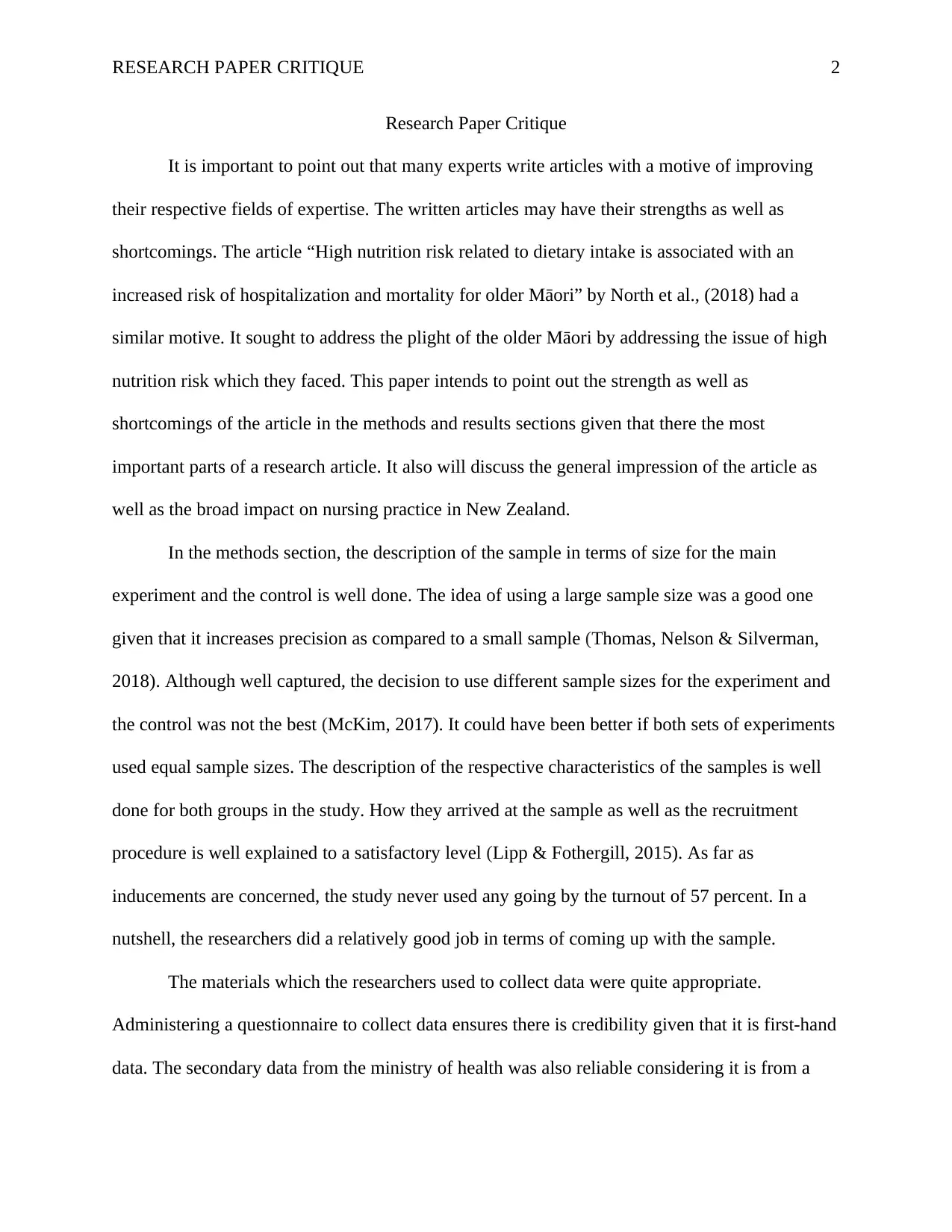
It is important to point out that many experts write articles with a motive of improving
their respective fields of expertise. The written articles may have their strengths as well as
shortcomings. The article “High nutrition risk related to dietary intake is associated with an
increased risk of hospitalization and mortality for older Māori” by North et al., (2018) had a
similar motive. It sought to address the plight of the older Māori by addressing the issue of high
nutrition risk which they faced. This paper intends to point out the strength as well as
shortcomings of the article in the methods and results sections given that there the most
important parts of a research article. It also will discuss the general impression of the article as
well as the broad impact on nursing practice in New Zealand.
In the methods section, the description of the sample in terms of size for the main
experiment and the control is well done. The idea of using a large sample size was a good one
given that it increases precision as compared to a small sample (Thomas, Nelson & Silverman,
2018). Although well captured, the decision to use different sample sizes for the experiment and
the control was not the best (McKim, 2017). It could have been better if both sets of experiments
used equal sample sizes. The description of the respective characteristics of the samples is well
done for both groups in the study. How they arrived at the sample as well as the recruitment
procedure is well explained to a satisfactory level (Lipp & Fothergill, 2015). As far as
inducements are concerned, the study never used any going by the turnout of 57 percent. In a
nutshell, the researchers did a relatively good job in terms of coming up with the sample.
The materials which the researchers used to collect data were quite appropriate.
Administering a questionnaire to collect data ensures there is credibility given that it is first-hand
data. The secondary data from the ministry of health was also reliable considering it is from a
Research Paper Critique
It is important to point out that many experts write articles with a motive of improving
their respective fields of expertise. The written articles may have their strengths as well as
shortcomings. The article “High nutrition risk related to dietary intake is associated with an
increased risk of hospitalization and mortality for older Māori” by North et al., (2018) had a
similar motive. It sought to address the plight of the older Māori by addressing the issue of high
nutrition risk which they faced. This paper intends to point out the strength as well as
shortcomings of the article in the methods and results sections given that there the most
important parts of a research article. It also will discuss the general impression of the article as
well as the broad impact on nursing practice in New Zealand.
In the methods section, the description of the sample in terms of size for the main
experiment and the control is well done. The idea of using a large sample size was a good one
given that it increases precision as compared to a small sample (Thomas, Nelson & Silverman,
2018). Although well captured, the decision to use different sample sizes for the experiment and
the control was not the best (McKim, 2017). It could have been better if both sets of experiments
used equal sample sizes. The description of the respective characteristics of the samples is well
done for both groups in the study. How they arrived at the sample as well as the recruitment
procedure is well explained to a satisfactory level (Lipp & Fothergill, 2015). As far as
inducements are concerned, the study never used any going by the turnout of 57 percent. In a
nutshell, the researchers did a relatively good job in terms of coming up with the sample.
The materials which the researchers used to collect data were quite appropriate.
Administering a questionnaire to collect data ensures there is credibility given that it is first-hand
data. The secondary data from the ministry of health was also reliable considering it is from a

RESEARCH PAPER CRITIQUE 3
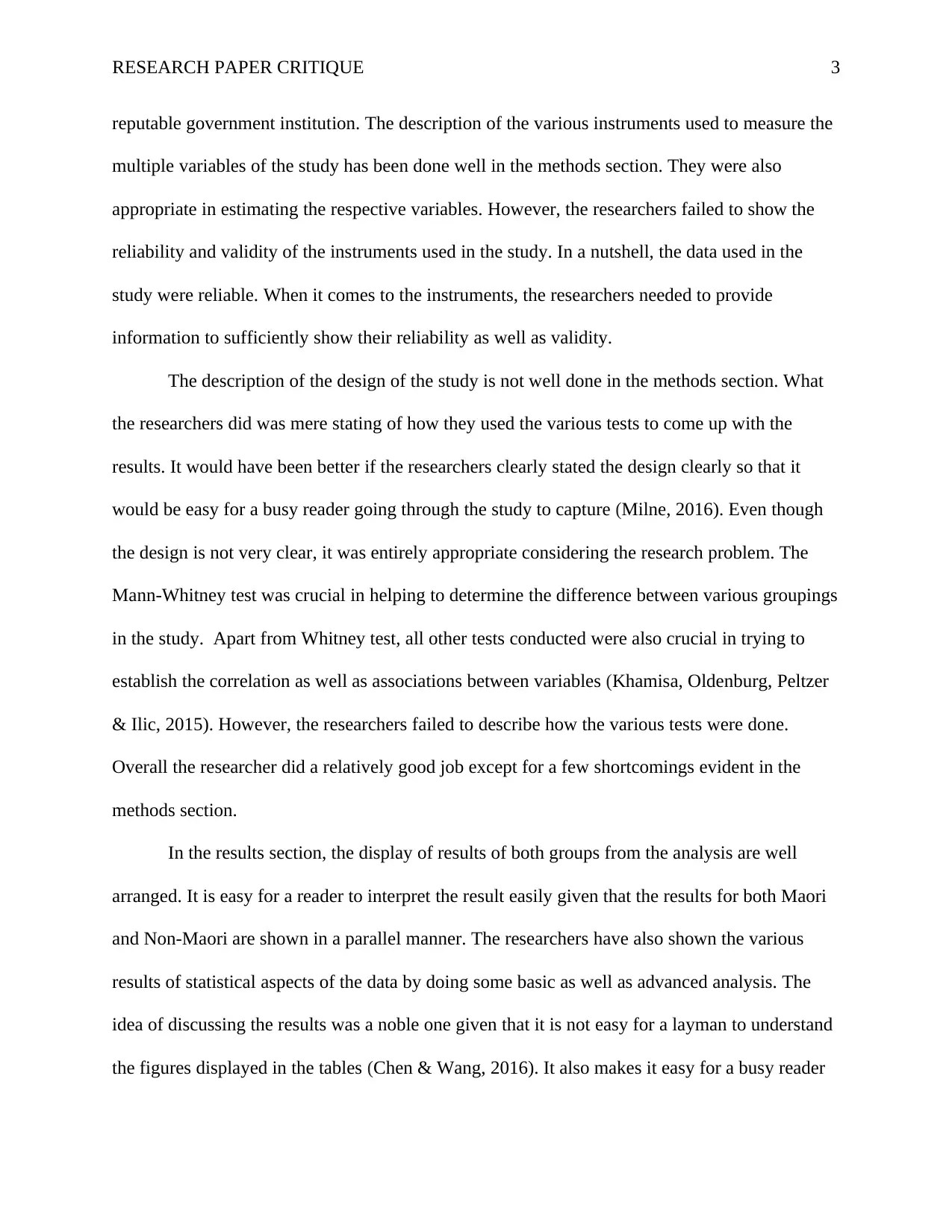
reputable government institution. The description of the various instruments used to measure the
multiple variables of the study has been done well in the methods section. They were also
appropriate in estimating the respective variables. However, the researchers failed to show the
reliability and validity of the instruments used in the study. In a nutshell, the data used in the
study were reliable. When it comes to the instruments, the researchers needed to provide
information to sufficiently show their reliability as well as validity.
The description of the design of the study is not well done in the methods section. What
the researchers did was mere stating of how they used the various tests to come up with the
results. It would have been better if the researchers clearly stated the design clearly so that it
would be easy for a busy reader going through the study to capture (Milne, 2016). Even though
the design is not very clear, it was entirely appropriate considering the research problem. The
Mann-Whitney test was crucial in helping to determine the difference between various groupings
in the study. Apart from Whitney test, all other tests conducted were also crucial in trying to
establish the correlation as well as associations between variables (Khamisa, Oldenburg, Peltzer
& Ilic, 2015). However, the researchers failed to describe how the various tests were done.
Overall the researcher did a relatively good job except for a few shortcomings evident in the
methods section.
In the results section, the display of results of both groups from the analysis are well
arranged. It is easy for a reader to interpret the result easily given that the results for both Maori
and Non-Maori are shown in a parallel manner. The researchers have also shown the various
results of statistical aspects of the data by doing some basic as well as advanced analysis. The
idea of discussing the results was a noble one given that it is not easy for a layman to understand
the figures displayed in the tables (Chen & Wang, 2016). It also makes it easy for a busy reader
reputable government institution. The description of the various instruments used to measure the
multiple variables of the study has been done well in the methods section. They were also
appropriate in estimating the respective variables. However, the researchers failed to show the
reliability and validity of the instruments used in the study. In a nutshell, the data used in the
study were reliable. When it comes to the instruments, the researchers needed to provide
information to sufficiently show their reliability as well as validity.
The description of the design of the study is not well done in the methods section. What
the researchers did was mere stating of how they used the various tests to come up with the
results. It would have been better if the researchers clearly stated the design clearly so that it
would be easy for a busy reader going through the study to capture (Milne, 2016). Even though
the design is not very clear, it was entirely appropriate considering the research problem. The
Mann-Whitney test was crucial in helping to determine the difference between various groupings
in the study. Apart from Whitney test, all other tests conducted were also crucial in trying to
establish the correlation as well as associations between variables (Khamisa, Oldenburg, Peltzer
& Ilic, 2015). However, the researchers failed to describe how the various tests were done.
Overall the researcher did a relatively good job except for a few shortcomings evident in the
methods section.
In the results section, the display of results of both groups from the analysis are well
arranged. It is easy for a reader to interpret the result easily given that the results for both Maori
and Non-Maori are shown in a parallel manner. The researchers have also shown the various
results of statistical aspects of the data by doing some basic as well as advanced analysis. The
idea of discussing the results was a noble one given that it is not easy for a layman to understand
the figures displayed in the tables (Chen & Wang, 2016). It also makes it easy for a busy reader
⊘ This is a preview!⊘
Do you want full access?
Subscribe today to unlock all pages.

Trusted by 1+ million students worldwide

RESEARCH PAPER CRITIQUE 4
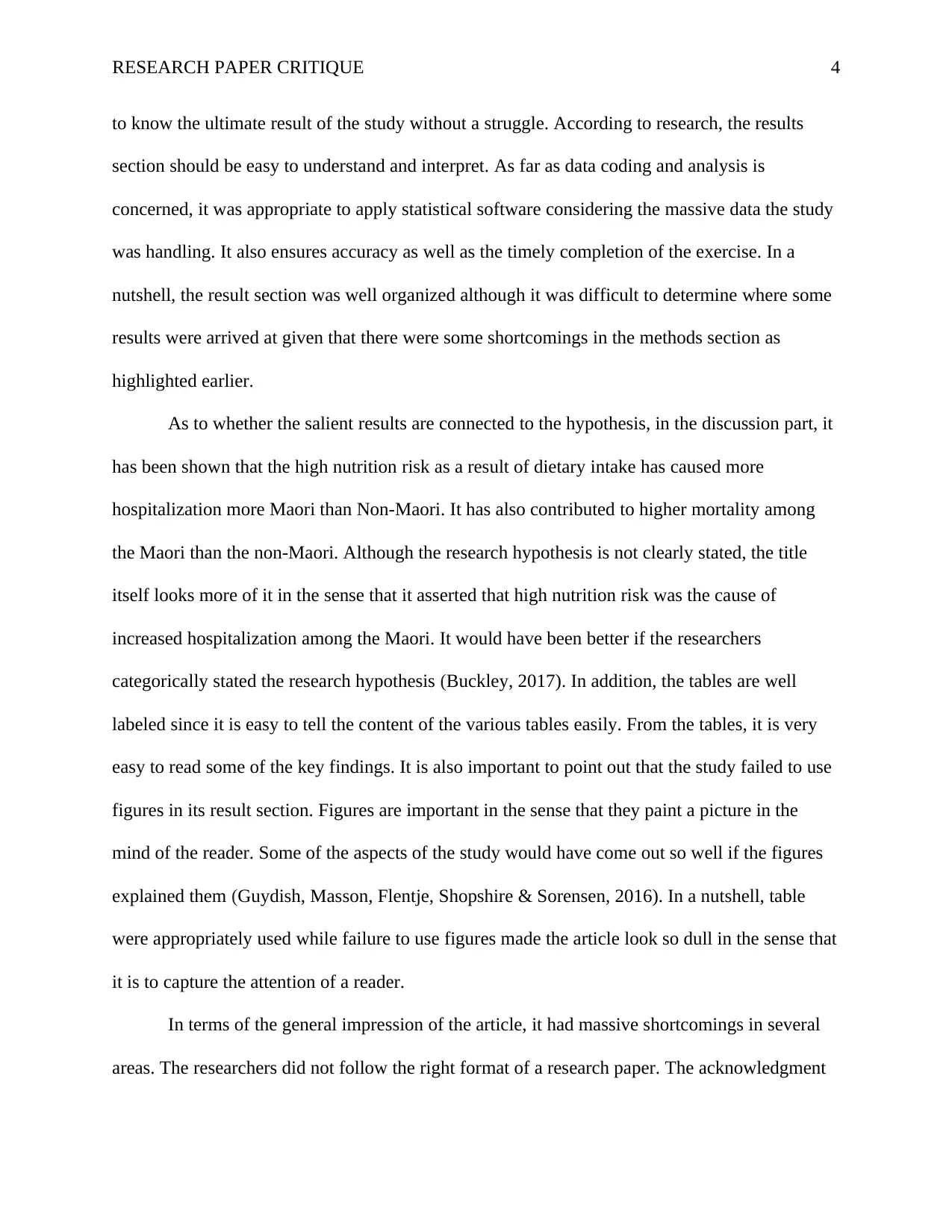
to know the ultimate result of the study without a struggle. According to research, the results
section should be easy to understand and interpret. As far as data coding and analysis is
concerned, it was appropriate to apply statistical software considering the massive data the study
was handling. It also ensures accuracy as well as the timely completion of the exercise. In a
nutshell, the result section was well organized although it was difficult to determine where some
results were arrived at given that there were some shortcomings in the methods section as
highlighted earlier.
As to whether the salient results are connected to the hypothesis, in the discussion part, it
has been shown that the high nutrition risk as a result of dietary intake has caused more
hospitalization more Maori than Non-Maori. It has also contributed to higher mortality among
the Maori than the non-Maori. Although the research hypothesis is not clearly stated, the title
itself looks more of it in the sense that it asserted that high nutrition risk was the cause of
increased hospitalization among the Maori. It would have been better if the researchers
categorically stated the research hypothesis (Buckley, 2017). In addition, the tables are well
labeled since it is easy to tell the content of the various tables easily. From the tables, it is very
easy to read some of the key findings. It is also important to point out that the study failed to use
figures in its result section. Figures are important in the sense that they paint a picture in the
mind of the reader. Some of the aspects of the study would have come out so well if the figures
explained them (Guydish, Masson, Flentje, Shopshire & Sorensen, 2016). In a nutshell, table
were appropriately used while failure to use figures made the article look so dull in the sense that
it is to capture the attention of a reader.
In terms of the general impression of the article, it had massive shortcomings in several
areas. The researchers did not follow the right format of a research paper. The acknowledgment
to know the ultimate result of the study without a struggle. According to research, the results
section should be easy to understand and interpret. As far as data coding and analysis is
concerned, it was appropriate to apply statistical software considering the massive data the study
was handling. It also ensures accuracy as well as the timely completion of the exercise. In a
nutshell, the result section was well organized although it was difficult to determine where some
results were arrived at given that there were some shortcomings in the methods section as
highlighted earlier.
As to whether the salient results are connected to the hypothesis, in the discussion part, it
has been shown that the high nutrition risk as a result of dietary intake has caused more
hospitalization more Maori than Non-Maori. It has also contributed to higher mortality among
the Maori than the non-Maori. Although the research hypothesis is not clearly stated, the title
itself looks more of it in the sense that it asserted that high nutrition risk was the cause of
increased hospitalization among the Maori. It would have been better if the researchers
categorically stated the research hypothesis (Buckley, 2017). In addition, the tables are well
labeled since it is easy to tell the content of the various tables easily. From the tables, it is very
easy to read some of the key findings. It is also important to point out that the study failed to use
figures in its result section. Figures are important in the sense that they paint a picture in the
mind of the reader. Some of the aspects of the study would have come out so well if the figures
explained them (Guydish, Masson, Flentje, Shopshire & Sorensen, 2016). In a nutshell, table
were appropriately used while failure to use figures made the article look so dull in the sense that
it is to capture the attention of a reader.
In terms of the general impression of the article, it had massive shortcomings in several
areas. The researchers did not follow the right format of a research paper. The acknowledgment
Paraphrase This Document
Need a fresh take? Get an instant paraphrase of this document with our AI Paraphraser

RESEARCH PAPER CRITIQUE 5
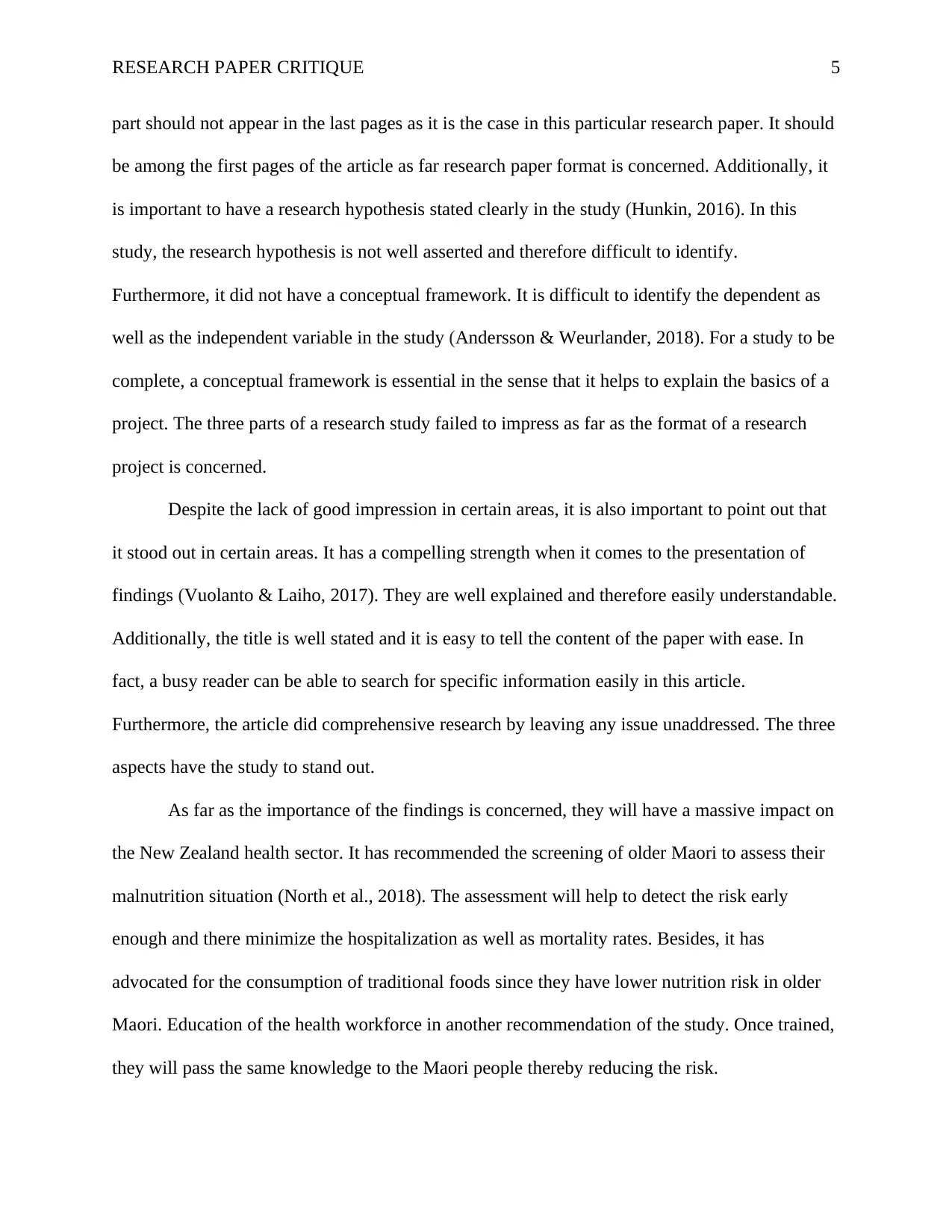
part should not appear in the last pages as it is the case in this particular research paper. It should
be among the first pages of the article as far research paper format is concerned. Additionally, it
is important to have a research hypothesis stated clearly in the study (Hunkin, 2016). In this
study, the research hypothesis is not well asserted and therefore difficult to identify.
Furthermore, it did not have a conceptual framework. It is difficult to identify the dependent as
well as the independent variable in the study (Andersson & Weurlander, 2018). For a study to be
complete, a conceptual framework is essential in the sense that it helps to explain the basics of a
project. The three parts of a research study failed to impress as far as the format of a research
project is concerned.
Despite the lack of good impression in certain areas, it is also important to point out that
it stood out in certain areas. It has a compelling strength when it comes to the presentation of
findings (Vuolanto & Laiho, 2017). They are well explained and therefore easily understandable.
Additionally, the title is well stated and it is easy to tell the content of the paper with ease. In
fact, a busy reader can be able to search for specific information easily in this article.
Furthermore, the article did comprehensive research by leaving any issue unaddressed. The three
aspects have the study to stand out.
As far as the importance of the findings is concerned, they will have a massive impact on
the New Zealand health sector. It has recommended the screening of older Maori to assess their
malnutrition situation (North et al., 2018). The assessment will help to detect the risk early
enough and there minimize the hospitalization as well as mortality rates. Besides, it has
advocated for the consumption of traditional foods since they have lower nutrition risk in older
Maori. Education of the health workforce in another recommendation of the study. Once trained,
they will pass the same knowledge to the Maori people thereby reducing the risk.
part should not appear in the last pages as it is the case in this particular research paper. It should
be among the first pages of the article as far research paper format is concerned. Additionally, it
is important to have a research hypothesis stated clearly in the study (Hunkin, 2016). In this
study, the research hypothesis is not well asserted and therefore difficult to identify.
Furthermore, it did not have a conceptual framework. It is difficult to identify the dependent as
well as the independent variable in the study (Andersson & Weurlander, 2018). For a study to be
complete, a conceptual framework is essential in the sense that it helps to explain the basics of a
project. The three parts of a research study failed to impress as far as the format of a research
project is concerned.
Despite the lack of good impression in certain areas, it is also important to point out that
it stood out in certain areas. It has a compelling strength when it comes to the presentation of
findings (Vuolanto & Laiho, 2017). They are well explained and therefore easily understandable.
Additionally, the title is well stated and it is easy to tell the content of the paper with ease. In
fact, a busy reader can be able to search for specific information easily in this article.
Furthermore, the article did comprehensive research by leaving any issue unaddressed. The three
aspects have the study to stand out.
As far as the importance of the findings is concerned, they will have a massive impact on
the New Zealand health sector. It has recommended the screening of older Maori to assess their
malnutrition situation (North et al., 2018). The assessment will help to detect the risk early
enough and there minimize the hospitalization as well as mortality rates. Besides, it has
advocated for the consumption of traditional foods since they have lower nutrition risk in older
Maori. Education of the health workforce in another recommendation of the study. Once trained,
they will pass the same knowledge to the Maori people thereby reducing the risk.

RESEARCH PAPER CRITIQUE 6
In conclusion, the strengths outweigh the weaknesses. Despite the failings, the article has
achieved massive in terms of impact on nursing practice in New Zealand. The findings in this
study will go a long way in helping to address the risk associated with high nutrition among the
older Maori. It is therefore essential for health workforce among the Maori to deal with the risk
decisively with the help of findings of this study.
In conclusion, the strengths outweigh the weaknesses. Despite the failings, the article has
achieved massive in terms of impact on nursing practice in New Zealand. The findings in this
study will go a long way in helping to address the risk associated with high nutrition among the
older Maori. It is therefore essential for health workforce among the Maori to deal with the risk
decisively with the help of findings of this study.
⊘ This is a preview!⊘
Do you want full access?
Subscribe today to unlock all pages.

Trusted by 1+ million students worldwide

RESEARCH PAPER CRITIQUE 7
References
North, S. M., Wham, C. A., Teh, R., Moyes, S. A., Rolleston, A., & Kerse, N. (2018). High
nutrition risk related to dietary intake is associated with an increased risk of
hospitalisation and mortality for older Māori: LiLACS NZ. Australian and New Zealand
journal of public health, 42(4), 375-381.
Thomas, J. R., Nelson, J. K., & Silverman, S. J. (2018). Research methods in physical activity.
Human kinetics.
McKim, C. A. (2017). The value of mixed methods research: A mixed methods study. Journal of
Mixed Methods Research, 11(2), 202-222.
Milne, E. J. (2016). Critiquing participatory video: experiences from around the world. Area,
48(4), 401-404.
Lipp, A., & Fothergill, A. (2015). A guide to critiquing a research paper. Methodological
appraisal of a paper on nurses in abortion care. Nurse education today, 35(3), e14-e17.
Chen, L., & Wang, F. (2016, July). An eye-tracking study: implication to implicit critiquing
feedback elicitation in recommender systems. In Proceedings of the 2016 Conference on
User Modeling Adaptation and Personalization (pp. 163-167). ACM.
Buckley, L. (2017). Critiquing research papers? Neigh bother, any RVN can do it!. Veterinary
Nursing Journal, 32(4), 115-117.
Guydish, J., Masson, C., Flentje, A., Shopshire, M., & Sorensen, J. L. (2016). Scientific writing
seminar for early-stage investigators in substance abuse research. Substance abuse, 37(1),
238-241.
Hunkin, E. (2016). Deploying Foucauldian genealogy: Critiquing ‘quality’reform in early
childhood policy in Australia. Power and Education, 8(1), 35-53.
References
North, S. M., Wham, C. A., Teh, R., Moyes, S. A., Rolleston, A., & Kerse, N. (2018). High
nutrition risk related to dietary intake is associated with an increased risk of
hospitalisation and mortality for older Māori: LiLACS NZ. Australian and New Zealand
journal of public health, 42(4), 375-381.
Thomas, J. R., Nelson, J. K., & Silverman, S. J. (2018). Research methods in physical activity.
Human kinetics.
McKim, C. A. (2017). The value of mixed methods research: A mixed methods study. Journal of
Mixed Methods Research, 11(2), 202-222.
Milne, E. J. (2016). Critiquing participatory video: experiences from around the world. Area,
48(4), 401-404.
Lipp, A., & Fothergill, A. (2015). A guide to critiquing a research paper. Methodological
appraisal of a paper on nurses in abortion care. Nurse education today, 35(3), e14-e17.
Chen, L., & Wang, F. (2016, July). An eye-tracking study: implication to implicit critiquing
feedback elicitation in recommender systems. In Proceedings of the 2016 Conference on
User Modeling Adaptation and Personalization (pp. 163-167). ACM.
Buckley, L. (2017). Critiquing research papers? Neigh bother, any RVN can do it!. Veterinary
Nursing Journal, 32(4), 115-117.
Guydish, J., Masson, C., Flentje, A., Shopshire, M., & Sorensen, J. L. (2016). Scientific writing
seminar for early-stage investigators in substance abuse research. Substance abuse, 37(1),
238-241.
Hunkin, E. (2016). Deploying Foucauldian genealogy: Critiquing ‘quality’reform in early
childhood policy in Australia. Power and Education, 8(1), 35-53.
Paraphrase This Document
Need a fresh take? Get an instant paraphrase of this document with our AI Paraphraser

RESEARCH PAPER CRITIQUE 8
Vuolanto, P., & Laiho, A. (2017). The Gender Perspective in Nursing Research: A Theoretical
Treasure Chest or a ‘Thorn’in the Side?. Minerva, 55(3), 371-390.
Andersson, M., & Weurlander, M. (2018). Peer review of laboratory reports for engineering
students. European Journal of Engineering Education, 1-12.
Khamisa, N., Oldenburg, B., Peltzer, K., & Ilic, D. (2015). Work related stress, burnout, job
satisfaction and general health of nurses. International journal of environmental research
and public health, 12(1), 652-666.
Vuolanto, P., & Laiho, A. (2017). The Gender Perspective in Nursing Research: A Theoretical
Treasure Chest or a ‘Thorn’in the Side?. Minerva, 55(3), 371-390.
Andersson, M., & Weurlander, M. (2018). Peer review of laboratory reports for engineering
students. European Journal of Engineering Education, 1-12.
Khamisa, N., Oldenburg, B., Peltzer, K., & Ilic, D. (2015). Work related stress, burnout, job
satisfaction and general health of nurses. International journal of environmental research
and public health, 12(1), 652-666.

RESEARCH PAPER CRITIQUE 9
⊘ This is a preview!⊘
Do you want full access?
Subscribe today to unlock all pages.

Trusted by 1+ million students worldwide
1 out of 9
Related Documents
Your All-in-One AI-Powered Toolkit for Academic Success.
+13062052269
info@desklib.com
Available 24*7 on WhatsApp / Email
Unlock your academic potential
Copyright © 2020–2025 A2Z Services. All Rights Reserved. Developed and managed by ZUCOL.