Research Process: Data Collection, Analysis, and Interpretation

Verified

Added on  2020/03/16

|2
|346
|57
Homework Assignment
AI Summary
This assignment provides a detailed overview of the research process, starting with the definition of a research problem. It covers the importance of a literature review in understanding existing knowledge and identifying gaps. The assignment then discusses the formulation of a hypothesis, which guides the research. Following this, it explains the role of research design in collecting relevant data efficiently. The document further explores data collection methods to gather information to address the research problem and the subsequent data analysis phase to derive meaningful insights and test the hypothesis. Finally, the assignment concludes with the interpretation of the data and the writing of a research report, emphasizing how the findings relate to the initial objectives and hypothesis.
Document Page
Running head: RESEARCH PROCESS
Research Process
Student Name
Institution Name
tabler-icon-diamond-filled.svg

Paraphrase This Document

Need a fresh take? Get an instant paraphrase of this document with our AI Paraphraser
Document Page
RESEARCH PROCESS 2
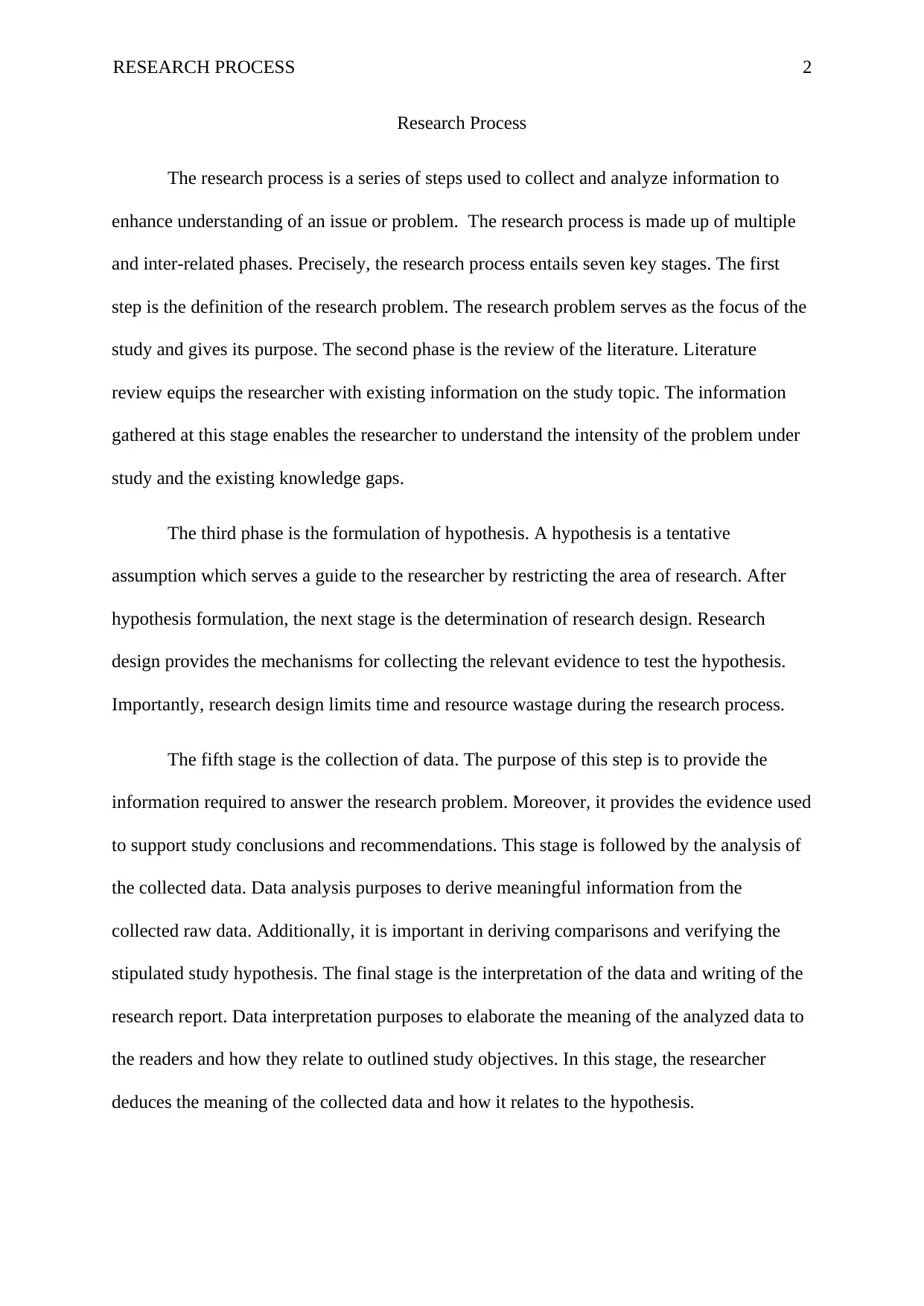
Research Process
The research process is a series of steps used to collect and analyze information to
enhance understanding of an issue or problem. The research process is made up of multiple
and inter-related phases. Precisely, the research process entails seven key stages. The first
step is the definition of the research problem. The research problem serves as the focus of the
study and gives its purpose. The second phase is the review of the literature. Literature
review equips the researcher with existing information on the study topic. The information
gathered at this stage enables the researcher to understand the intensity of the problem under
study and the existing knowledge gaps.
The third phase is the formulation of hypothesis. A hypothesis is a tentative
assumption which serves a guide to the researcher by restricting the area of research. After
hypothesis formulation, the next stage is the determination of research design. Research
design provides the mechanisms for collecting the relevant evidence to test the hypothesis.
Importantly, research design limits time and resource wastage during the research process.
The fifth stage is the collection of data. The purpose of this step is to provide the
information required to answer the research problem. Moreover, it provides the evidence used
to support study conclusions and recommendations. This stage is followed by the analysis of
the collected data. Data analysis purposes to derive meaningful information from the
collected raw data. Additionally, it is important in deriving comparisons and verifying the
stipulated study hypothesis. The final stage is the interpretation of the data and writing of the
research report. Data interpretation purposes to elaborate the meaning of the analyzed data to
the readers and how they relate to outlined study objectives. In this stage, the researcher
deduces the meaning of the collected data and how it relates to the hypothesis.
chevron_up_icon
1 out of 2
circle_padding
hide_on_mobile
zoom_out_icon
[object Object]