Research Proposal on Project Management in the UAE Construction
VerifiedAdded on 2023/04/21
|15
|5171
|447
Report
AI Summary
This research proposal investigates project management methodologies within the UAE's construction industry, focusing on optimizing project lifecycles and procurement strategies. It addresses recurring issues causing construction delays and their economic impact. The proposal outlines the aim to analyze process groups, identify areas for calibration, and enhance project management effectiveness. Objectives include categorizing process groups, analyzing their impacts, modifying processes for optimized output, increasing procurement management efficiency, and implementing better-suited methodologies. Research questions explore performance impact analysis, hierarchy management contributions, and the need for developing procurement strategies. The literature review explores the causes and effects of delays, referencing studies on delays, economic impacts, and classifications of delay factors. The research will employ questionnaires and interviews to gather data, with ethical considerations addressed.

Running head: RESEARCH PROPOSAL
TASK 1: Research Proposal
[Name of the Student]
[Name of the University]
[Author note]
TASK 1: Research Proposal
[Name of the Student]
[Name of the University]
[Author note]

Paraphrase This Document
Need a fresh take? Get an instant paraphrase of this document with our AI Paraphraser
1RESEARCH PROPOSAL
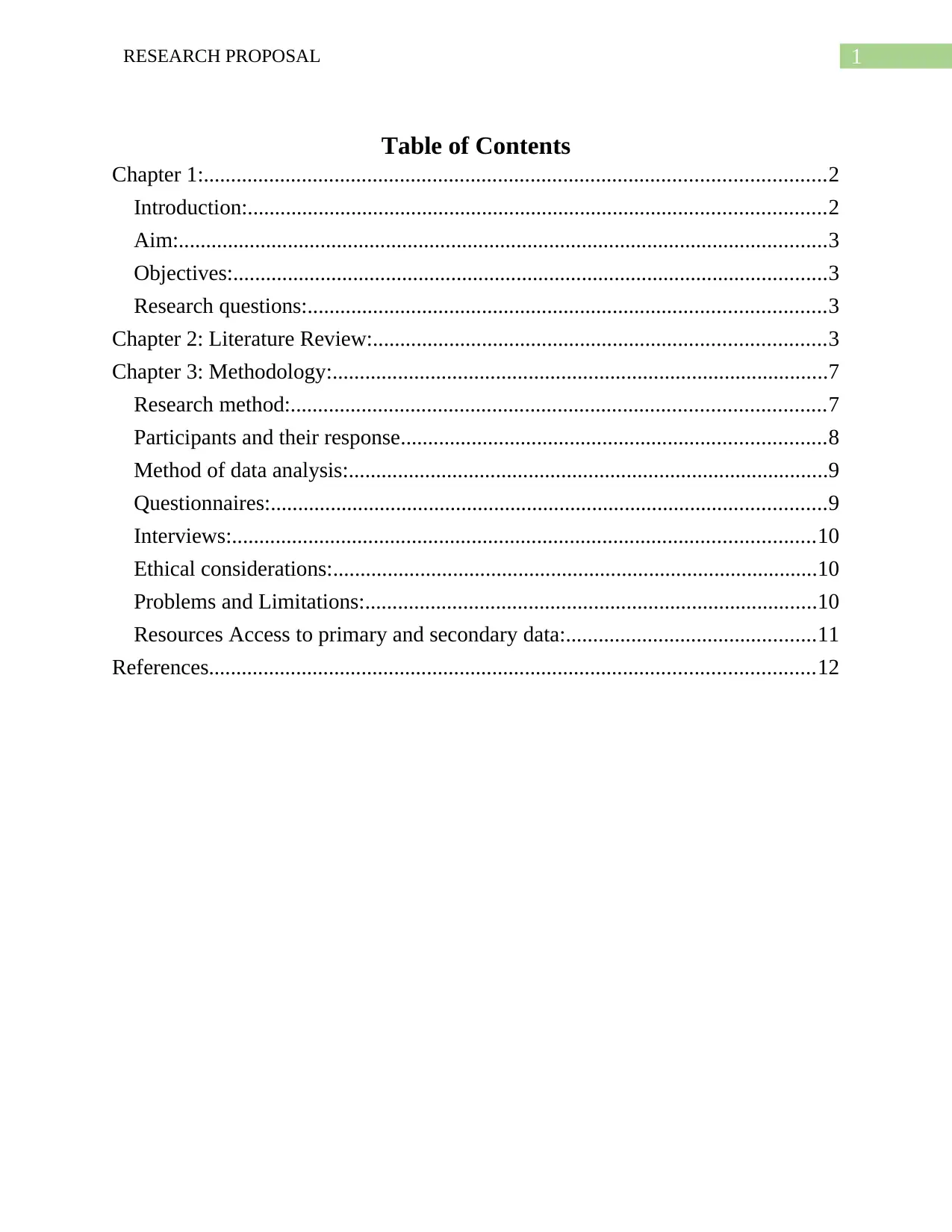
Table of Contents
Chapter 1:..................................................................................................................2
Introduction:..........................................................................................................2
Aim:.......................................................................................................................3
Objectives:.............................................................................................................3
Research questions:...............................................................................................3
Chapter 2: Literature Review:...................................................................................3
Chapter 3: Methodology:...........................................................................................7
Research method:..................................................................................................7
Participants and their response..............................................................................8
Method of data analysis:........................................................................................9
Questionnaires:......................................................................................................9
Interviews:...........................................................................................................10
Ethical considerations:.........................................................................................10
Problems and Limitations:...................................................................................10
Resources Access to primary and secondary data:..............................................11
References...............................................................................................................12
Table of Contents
Chapter 1:..................................................................................................................2
Introduction:..........................................................................................................2
Aim:.......................................................................................................................3
Objectives:.............................................................................................................3
Research questions:...............................................................................................3
Chapter 2: Literature Review:...................................................................................3
Chapter 3: Methodology:...........................................................................................7
Research method:..................................................................................................7
Participants and their response..............................................................................8
Method of data analysis:........................................................................................9
Questionnaires:......................................................................................................9
Interviews:...........................................................................................................10
Ethical considerations:.........................................................................................10
Problems and Limitations:...................................................................................10
Resources Access to primary and secondary data:..............................................11
References...............................................................................................................12
2RESEARCH PROPOSAL
Chapter 1:
Introduction:
Delays in construction are generally caused due to the recurring problems which occur in
the construction industry. Besides this delays are having an adverse impact upon the success of
the projects related to the cost, time, quality and lastly the safety. Besides this the effect of the
construction delays are not only confined in the construction industry but is also having a huge
influence upon the overall economy of the country such as the UAE, where the role played by
construction is considered to be huge in the development and is associated with contributing
around 14% of the GDP (Burr 2016). For all this reason it is very much essential the most basic
reasons lying behind the delays in the construction industry. This is essential to be done so as to
avoid or minimize the impact on the construction projects.
The main of this proposal includes the discussion about the construction industry in the
Gulf region which has been associated with facing ups and downs since the year of 2009. Each
and every contracting company existing in the UAE has been associated with thriving in the
competitive market by having one notion in its perspective. This notion included the providing of
a service which is much more reliable and better than the other competitors existing in the
market so as to generate profits and become prominent in the market. As more and more new
companies are emerging in the Gulf region, the need for calibrating by the civil contractors are
also increasing in their process of managing the project management methodologies and the
procurement strategies. This is done so as to stay a step ahead in the competitive market. The
different groups of the process which are existing in the project management are associated with
holding a key place for having a successful take-off and project closure. Besides this, in the
execution stage, the process of procurement management is associated with playing a very a vital
role process of procurement management which is seen to be having equal importance to the
process of handling the entire schedule of the project. So it can be stated that is dissertation is
going to help a lot in the process of determining the influence of the workflow as well as the cost
associated with the entire lifecycle of the project.
Chapter 1:
Introduction:
Delays in construction are generally caused due to the recurring problems which occur in
the construction industry. Besides this delays are having an adverse impact upon the success of
the projects related to the cost, time, quality and lastly the safety. Besides this the effect of the
construction delays are not only confined in the construction industry but is also having a huge
influence upon the overall economy of the country such as the UAE, where the role played by
construction is considered to be huge in the development and is associated with contributing
around 14% of the GDP (Burr 2016). For all this reason it is very much essential the most basic
reasons lying behind the delays in the construction industry. This is essential to be done so as to
avoid or minimize the impact on the construction projects.
The main of this proposal includes the discussion about the construction industry in the
Gulf region which has been associated with facing ups and downs since the year of 2009. Each
and every contracting company existing in the UAE has been associated with thriving in the
competitive market by having one notion in its perspective. This notion included the providing of
a service which is much more reliable and better than the other competitors existing in the
market so as to generate profits and become prominent in the market. As more and more new
companies are emerging in the Gulf region, the need for calibrating by the civil contractors are
also increasing in their process of managing the project management methodologies and the
procurement strategies. This is done so as to stay a step ahead in the competitive market. The
different groups of the process which are existing in the project management are associated with
holding a key place for having a successful take-off and project closure. Besides this, in the
execution stage, the process of procurement management is associated with playing a very a vital
role process of procurement management which is seen to be having equal importance to the
process of handling the entire schedule of the project. So it can be stated that is dissertation is
going to help a lot in the process of determining the influence of the workflow as well as the cost
associated with the entire lifecycle of the project.
⊘ This is a preview!⊘
Do you want full access?
Subscribe today to unlock all pages.

Trusted by 1+ million students worldwide
3RESEARCH PROPOSAL
Aim:
The main aim of this dissertation is to analyze the various process groups which are
generally associated with the project life cycle. Besides this, the dissertation is also aimed at
determining the areas where it is possible to calibrate the process groups so as to increase the
effectiveness that the project management and the procurement strategies in order to have an
optimized output.
Objectives:
The objectives have been listed below:
1. To categorize the various process groups along with the creation of the organizational
chart for the purpose of determining the hierarchy of the leadership.
2. To analyze the different process groups as well as their impacts upon the entire project
3. To determine the particular process in the process group which can be modified so as to
achieve an output that would be optimized and would be helping in the reduction of the risks at
the time of execution.
4. To increase the procurement management efficiency by making use of the new strategies.
5. To implement the new methodologies which would be better suited for the workflow and
would be helping in increasing the margin of profit of the organization.
Research questions:
1. How can the benchmark of performance impact and the analysis be done during the
process of implementing the new methodology in the workflow of the project?
2. Do the changes taking place in the process of managing the hierarchy have a kind of
contribution towards the improved project initiation and the planning?
3. Is there any need for developing the procurement strategies so as provide profit or to
become prominent in the competitive market or for both?
Aim:
The main aim of this dissertation is to analyze the various process groups which are
generally associated with the project life cycle. Besides this, the dissertation is also aimed at
determining the areas where it is possible to calibrate the process groups so as to increase the
effectiveness that the project management and the procurement strategies in order to have an
optimized output.
Objectives:
The objectives have been listed below:
1. To categorize the various process groups along with the creation of the organizational
chart for the purpose of determining the hierarchy of the leadership.
2. To analyze the different process groups as well as their impacts upon the entire project
3. To determine the particular process in the process group which can be modified so as to
achieve an output that would be optimized and would be helping in the reduction of the risks at
the time of execution.
4. To increase the procurement management efficiency by making use of the new strategies.
5. To implement the new methodologies which would be better suited for the workflow and
would be helping in increasing the margin of profit of the organization.
Research questions:
1. How can the benchmark of performance impact and the analysis be done during the
process of implementing the new methodology in the workflow of the project?
2. Do the changes taking place in the process of managing the hierarchy have a kind of
contribution towards the improved project initiation and the planning?
3. Is there any need for developing the procurement strategies so as provide profit or to
become prominent in the competitive market or for both?
Paraphrase This Document
Need a fresh take? Get an instant paraphrase of this document with our AI Paraphraser
4RESEARCH PROPOSAL
Chapter 2: Literature Review:
A successful project is delivered only if it has been completed within the time assigned as
well as with the budget and meets the specific quality standards and besides this in accordance to
Faridi and El‐Sayegh (2006), the construction industry of the Gulf region is considered to be a
very complex, fragmented and resource-driven industry. Besides this, the paper has also had
been associated with depicting the fact that the timely completion of the project is considered to
be a major criterion of the successful project. Besides this, the construction industry is generally
considered to be the backbone for economic development. According to Abu-Eishah, El-Dieb,
and Bedir (2012), the role that is played by the construction sector is undeniable in economic
development. Besides this, it has also been noticed that the technology that has been used in the
last 100 years have developed at a drastic rate and has become the base of the modern
construction projects by providing scientific designs. There exist numerous construction projects
all across the Gulf region which is responsible for driving the growth of the nation’s economy.
New small and big companies are entering the market day by day (Menassa and Hanna 2014).
The construction industry is a labor-intensive industry which also requires a good management
style, and the major reason behind this is due to the existence of the difficult site conditions and
the usage of bulky materials.
According to Kerzner and Kerzner (2017), despite all these best practices, predicting the
outcomes of the project is still considered to be a major issue. According to the author some of
the major reasons due to which this type of issues arises include the incapability of the project
team in finishing the project within the assigned time, cost and not meeting the quality which has
been specified. Menassa and Hanna (2014), depicted the fact that all these reasons are initially
responsible for the unexpected impacts upon the project. Besides this, the paper also stated that if
the project meets the technical performance and is associated with achieving the high level of
satisfaction amongst the key players and the various stakeholders, then the project is considered
to have achieved overall success. Apart from this, the authors also stated that one of the
important aspects of success is the perception. Besides this, the reasons lying behind the success
and delays of the project are generally attributable to the various differing as well to the vested
interests of the participants as well as the stakeholders. It has been observed in most of the cases
Chapter 2: Literature Review:
A successful project is delivered only if it has been completed within the time assigned as
well as with the budget and meets the specific quality standards and besides this in accordance to
Faridi and El‐Sayegh (2006), the construction industry of the Gulf region is considered to be a
very complex, fragmented and resource-driven industry. Besides this, the paper has also had
been associated with depicting the fact that the timely completion of the project is considered to
be a major criterion of the successful project. Besides this, the construction industry is generally
considered to be the backbone for economic development. According to Abu-Eishah, El-Dieb,
and Bedir (2012), the role that is played by the construction sector is undeniable in economic
development. Besides this, it has also been noticed that the technology that has been used in the
last 100 years have developed at a drastic rate and has become the base of the modern
construction projects by providing scientific designs. There exist numerous construction projects
all across the Gulf region which is responsible for driving the growth of the nation’s economy.
New small and big companies are entering the market day by day (Menassa and Hanna 2014).
The construction industry is a labor-intensive industry which also requires a good management
style, and the major reason behind this is due to the existence of the difficult site conditions and
the usage of bulky materials.
According to Kerzner and Kerzner (2017), despite all these best practices, predicting the
outcomes of the project is still considered to be a major issue. According to the author some of
the major reasons due to which this type of issues arises include the incapability of the project
team in finishing the project within the assigned time, cost and not meeting the quality which has
been specified. Menassa and Hanna (2014), depicted the fact that all these reasons are initially
responsible for the unexpected impacts upon the project. Besides this, the paper also stated that if
the project meets the technical performance and is associated with achieving the high level of
satisfaction amongst the key players and the various stakeholders, then the project is considered
to have achieved overall success. Apart from this, the authors also stated that one of the
important aspects of success is the perception. Besides this, the reasons lying behind the success
and delays of the project are generally attributable to the various differing as well to the vested
interests of the participants as well as the stakeholders. It has been observed in most of the cases
5RESEARCH PROPOSAL
that completing the project within the time as well as within the budget and to the specifications
of the project can be considered to be the basic aspects of a successful project.
According to Al-Sabah, Menassa, and Hanna (2014), the delays in the construction are
not only restricted to the construction industry but is also associated with having a huge impact
upon the economy of the country. There exist very few studies associated with discussing major
causes of delays, and one of the major objectives of this study is to discuss, identify and
categorize the factors responsible for the delays based upon the impacts.
There also exist studies which have provided articles upon the delays and the effects as a
whole, However, they are not focused upon the commercial buildings or are least focused upon
the UAE, and there also exist others works related to the delays within UAE but this studies are
generally centered around a case study so as to reach a conclusion (Randereeand Ghaffar
Chaudhry 2012).
According to the study conducted by the Emirates NBD on sector economics showed that
the Dubai is the only one which is associated with contributing around 43.6% in the year of 2014
which is seen to be much more than the previous year results of 2012 and 2009 where it was
around 36% and 12% respectively (Fass et al. 2017). This, in turn, was associated with showing
the fact that the amount of development and growth has been induced in Dubai only. Besides
this, it can also be inferred from the above report that Dubai is associated with playing a very
vital role in the construction industry and this sector would be benefitting a lot due to the
expansions taking place in different sectors like tourism, hospitality, and transport.
Delays in the project are considered to be an indefinite effect on construction projects.
According to Kabir, Al-Shayeb, and Khan (2016), some of the major categories responsible for
the delays in the construction industry of Ghana and this mainly included the improper
scheduling, financial matters, and materials. The study related to the delays taking place in the
construction projects of Turkey by Asif (2016), found out certain factors responsible for causing
delays or time overrun and this factors included three major things that change in the design,
delays in the payments and lastly the flow of cash. Besides this, the economic impact is generally
that completing the project within the time as well as within the budget and to the specifications
of the project can be considered to be the basic aspects of a successful project.
According to Al-Sabah, Menassa, and Hanna (2014), the delays in the construction are
not only restricted to the construction industry but is also associated with having a huge impact
upon the economy of the country. There exist very few studies associated with discussing major
causes of delays, and one of the major objectives of this study is to discuss, identify and
categorize the factors responsible for the delays based upon the impacts.
There also exist studies which have provided articles upon the delays and the effects as a
whole, However, they are not focused upon the commercial buildings or are least focused upon
the UAE, and there also exist others works related to the delays within UAE but this studies are
generally centered around a case study so as to reach a conclusion (Randereeand Ghaffar
Chaudhry 2012).
According to the study conducted by the Emirates NBD on sector economics showed that
the Dubai is the only one which is associated with contributing around 43.6% in the year of 2014
which is seen to be much more than the previous year results of 2012 and 2009 where it was
around 36% and 12% respectively (Fass et al. 2017). This, in turn, was associated with showing
the fact that the amount of development and growth has been induced in Dubai only. Besides
this, it can also be inferred from the above report that Dubai is associated with playing a very
vital role in the construction industry and this sector would be benefitting a lot due to the
expansions taking place in different sectors like tourism, hospitality, and transport.
Delays in the project are considered to be an indefinite effect on construction projects.
According to Kabir, Al-Shayeb, and Khan (2016), some of the major categories responsible for
the delays in the construction industry of Ghana and this mainly included the improper
scheduling, financial matters, and materials. The study related to the delays taking place in the
construction projects of Turkey by Asif (2016), found out certain factors responsible for causing
delays or time overrun and this factors included three major things that change in the design,
delays in the payments and lastly the flow of cash. Besides this, the economic impact is generally
⊘ This is a preview!⊘
Do you want full access?
Subscribe today to unlock all pages.
Trusted by 1+ million students worldwide
6RESEARCH PROPOSAL
determined in accordance to the level of economic activity which is generally caused due to the
changes in a particular region (Taylor, Bogdanand DeVault, 2015). For those cases, the changes
would be mainly caused because of the delays in commercial projects.
The literature review of the various articles has been associated with helping in the
process of exploring the link that exists between the causes and the effects of the delays upon the
construction industry of the Gulf region and this mainly includes six major effects of delays. The
effects include the overrun of cost, overrun of time, dispute, arbitration, and total abandonment
and lastly the Litigation (Jarkas 2015). Besides this, it has also been highlighted that the
improper planning along with poor management clients inability to make payments for the works
which have been completed, the inadequate experience of the customers are some of the major
causes responsible for the delays. The effects which the delays are having upon the construction
industry is considered to be huge which is consequently responsible for having a negative impact
upon the country’s economy (Atout 2016). The study is also focused upon the effects of the
delays along with focusing upon the relationship that exists amongst the delays taking place in
the construction industry which in turn is associated with having a huge impact upon the
economy of the country. The study conducted by Kaiser(2017), have been associated with
classifying the delays into four major groups which include the consultant related, contractors
related, client, related and lastly the external factors related. The paper has also been associated
with suggesting the fact that the consultant related delays are mainly responsible for the delays in
schedule, project planning in a proper way, availability of adequate equipment, labor along with
materials which are very critical for the decision making and are critical factors responsible for
the delays. Besides this, the study by Govindan, Shankar, and Kannan (2016), mentions that the
fluctuations in the price of the materials, changes in the weather, disputes in labor, and lastly
changes in the government legislation are some of the major issues which fall in this category.
In accordance to the paper by Alhowaish (2015), time overrun is having a significant
effect upon the delays and besides this, time overrun is considered in the majority of the projects
which has been surveyed in this research. Time overrun is initially responsible for causing cost
overrun which is initially responsible for making the clients to be forced to hold the further
payments because of the time as well as the cost constraints (Wippel, Bromber and Krawietz
determined in accordance to the level of economic activity which is generally caused due to the
changes in a particular region (Taylor, Bogdanand DeVault, 2015). For those cases, the changes
would be mainly caused because of the delays in commercial projects.
The literature review of the various articles has been associated with helping in the
process of exploring the link that exists between the causes and the effects of the delays upon the
construction industry of the Gulf region and this mainly includes six major effects of delays. The
effects include the overrun of cost, overrun of time, dispute, arbitration, and total abandonment
and lastly the Litigation (Jarkas 2015). Besides this, it has also been highlighted that the
improper planning along with poor management clients inability to make payments for the works
which have been completed, the inadequate experience of the customers are some of the major
causes responsible for the delays. The effects which the delays are having upon the construction
industry is considered to be huge which is consequently responsible for having a negative impact
upon the country’s economy (Atout 2016). The study is also focused upon the effects of the
delays along with focusing upon the relationship that exists amongst the delays taking place in
the construction industry which in turn is associated with having a huge impact upon the
economy of the country. The study conducted by Kaiser(2017), have been associated with
classifying the delays into four major groups which include the consultant related, contractors
related, client, related and lastly the external factors related. The paper has also been associated
with suggesting the fact that the consultant related delays are mainly responsible for the delays in
schedule, project planning in a proper way, availability of adequate equipment, labor along with
materials which are very critical for the decision making and are critical factors responsible for
the delays. Besides this, the study by Govindan, Shankar, and Kannan (2016), mentions that the
fluctuations in the price of the materials, changes in the weather, disputes in labor, and lastly
changes in the government legislation are some of the major issues which fall in this category.
In accordance to the paper by Alhowaish (2015), time overrun is having a significant
effect upon the delays and besides this, time overrun is considered in the majority of the projects
which has been surveyed in this research. Time overrun is initially responsible for causing cost
overrun which is initially responsible for making the clients to be forced to hold the further
payments because of the time as well as the cost constraints (Wippel, Bromber and Krawietz
Paraphrase This Document
Need a fresh take? Get an instant paraphrase of this document with our AI Paraphraser
7RESEARCH PROPOSAL
2016). All these are responsible for the reduced amount of profits for the contractors which
might sometimes be associated with leading to litigation as well as disputes or sometimes might
be leading to complete abandonment of the projects.
According to Wippel, Bromber and Krawietz (2016), have been associated with depicting
the difference which generally exists between the contract sum and the final cost of the project
can be expressed as a ration, and in case if the ratio is more than one then would lead to cost
overrun. Besides this, the contract related factors which might be included in the changes or
mistakes or discrepancies in the contract document are some of the major reason leading to cost
overrun. Another author According to Silverman (2016), have been associated with claiming the
fact that the time overrun is eventually responsible for cost overrun. This type of overrun is
associated with affecting the contractors as well as the clients who might sometimes be
associated with causing disputes or litigations.
According to Silverman (2016), Arbitration is generally caused whenever the contractor’s
contract is terminated by the client or whenever a middleman is hired for the purpose of settling
the amount which is to be paid to the contractors for the amount of work that has been
completed. This is very unlikely to happen as this is one of the unhealthiest practice for both of
the parties and would eventually be leading to negotiations so as to reach a common conclusion.
Whereas according to Alwan, Greenwood, and Gledson (2015), disputes are having a
higher chance of occurrence in comparison to the Arbitration. It has also been stated that the
making of decision slowly by the clients or the escalations in the price of the materials or the
changes taking place in the scope are generally the main causes of disputes.
Lastly, in accordance to Kadry, Osman and Georgy (2016), whenever a dispute occurs
between the parties is accelerated, and there seems no solution, or when there seem no chances
of reaching an agreement, then the last solution which can be implemented is the litigation.
2016). All these are responsible for the reduced amount of profits for the contractors which
might sometimes be associated with leading to litigation as well as disputes or sometimes might
be leading to complete abandonment of the projects.
According to Wippel, Bromber and Krawietz (2016), have been associated with depicting
the difference which generally exists between the contract sum and the final cost of the project
can be expressed as a ration, and in case if the ratio is more than one then would lead to cost
overrun. Besides this, the contract related factors which might be included in the changes or
mistakes or discrepancies in the contract document are some of the major reason leading to cost
overrun. Another author According to Silverman (2016), have been associated with claiming the
fact that the time overrun is eventually responsible for cost overrun. This type of overrun is
associated with affecting the contractors as well as the clients who might sometimes be
associated with causing disputes or litigations.
According to Silverman (2016), Arbitration is generally caused whenever the contractor’s
contract is terminated by the client or whenever a middleman is hired for the purpose of settling
the amount which is to be paid to the contractors for the amount of work that has been
completed. This is very unlikely to happen as this is one of the unhealthiest practice for both of
the parties and would eventually be leading to negotiations so as to reach a common conclusion.
Whereas according to Alwan, Greenwood, and Gledson (2015), disputes are having a
higher chance of occurrence in comparison to the Arbitration. It has also been stated that the
making of decision slowly by the clients or the escalations in the price of the materials or the
changes taking place in the scope are generally the main causes of disputes.
Lastly, in accordance to Kadry, Osman and Georgy (2016), whenever a dispute occurs
between the parties is accelerated, and there seems no solution, or when there seem no chances
of reaching an agreement, then the last solution which can be implemented is the litigation.
8RESEARCH PROPOSAL
Chapter 3: Methodology:
Research method:
The entire research work has been conducted by following a pragmatic approach, and this
has been done by determining the processes in project management by making use of the
descriptive and predictive methods (Robertson and Sibley 2018). The information which is
generally required is gathered by means of face-to-face interviews, telephonic conversation,
emails and by using other modes so as to communicate with the consultants, managers and the
staffs of the respective departments (Nobanee and Ellili 2015). A qualitative, as well as
quantitative approach, has been implemented so as to gather the information related to the
procurement strategies and is also done by means of the surveys and telephonic interviews with
the procurement as well as with the sales managers.
The pragmatic approach has been selected as this is associated with making the pragmatic
researchers in giving themselves the freedom of using any kind of methods, techniques, and
procedures which are associated with the quantitative and the qualitative research (Kumar 2019).
However, there is a certain weakness in this type of approach and the major one is it is time-
consuming and expensive along with which the entire process of designing the research is a very
complex process. There is also a need for more resources so as to plan and implement this type
of particular research. The planning and the implementation of one method by drawing the
findings from another one is also very difficult. The process of resolving the conflicts might also
seem to be unclear which generally arises at the time of interpretation of the findings. There are
also difficulties in finding a researcher who is having experience in both qualitative and
quantitative research and the researchers also have to learn multiple methods and should be
capable of knowing how to mix each of the methods effectively. Besides this, the researchers
would also become capable of recognizing that each and every method is having its limitations
and helps in understanding the fact that different approaches are complementary. The pragmatic
approach would be followed by the mixed method research which is a methodology that is used
for the conducting the research, and this involves the collection, analysis, and integration of the
quantitative and the qualitative researches (Mackey and Gass 2015). This is the particular
approach to the research which is mainly used because the combination would be associated with
providing a better understanding of the research problems.
Chapter 3: Methodology:
Research method:
The entire research work has been conducted by following a pragmatic approach, and this
has been done by determining the processes in project management by making use of the
descriptive and predictive methods (Robertson and Sibley 2018). The information which is
generally required is gathered by means of face-to-face interviews, telephonic conversation,
emails and by using other modes so as to communicate with the consultants, managers and the
staffs of the respective departments (Nobanee and Ellili 2015). A qualitative, as well as
quantitative approach, has been implemented so as to gather the information related to the
procurement strategies and is also done by means of the surveys and telephonic interviews with
the procurement as well as with the sales managers.
The pragmatic approach has been selected as this is associated with making the pragmatic
researchers in giving themselves the freedom of using any kind of methods, techniques, and
procedures which are associated with the quantitative and the qualitative research (Kumar 2019).
However, there is a certain weakness in this type of approach and the major one is it is time-
consuming and expensive along with which the entire process of designing the research is a very
complex process. There is also a need for more resources so as to plan and implement this type
of particular research. The planning and the implementation of one method by drawing the
findings from another one is also very difficult. The process of resolving the conflicts might also
seem to be unclear which generally arises at the time of interpretation of the findings. There are
also difficulties in finding a researcher who is having experience in both qualitative and
quantitative research and the researchers also have to learn multiple methods and should be
capable of knowing how to mix each of the methods effectively. Besides this, the researchers
would also become capable of recognizing that each and every method is having its limitations
and helps in understanding the fact that different approaches are complementary. The pragmatic
approach would be followed by the mixed method research which is a methodology that is used
for the conducting the research, and this involves the collection, analysis, and integration of the
quantitative and the qualitative researches (Mackey and Gass 2015). This is the particular
approach to the research which is mainly used because the combination would be associated with
providing a better understanding of the research problems.
⊘ This is a preview!⊘
Do you want full access?
Subscribe today to unlock all pages.
Trusted by 1+ million students worldwide
9RESEARCH PROPOSAL
Participants and their response
The research would be done by combining the two social research tools, and this includes
questionnaires and interviews. The questionnaire would be distributed amongst the various
participants from several companies which have been used as an art element as part of their
management techniques as well as amongst the employees who have been selected carefully
from the same companies. As a complementary method interview would be conducted associated
with an equal number of representatives of each group, the advantages and disadvantages would
be discussed in the later sections.
Once the quantitative and qualitative data is gathered, it would be mixed at the same time or one
after the other, and while doing so, the emphasis is to be put upon them equally or unequally.
This method is mainly used for comparing the results that are obtained from the
quantitative as well as from the qualitative research and for using the qualitative research for
helping in the process of examining the quantitative findings (Quinlan et al. 2019). Besides this,
this approach is also selected so as to explore the entire work by using the qualitative research
which is followed by the generalization of the findings to a large population by making use of
the quantitative research.
Method of data analysis:
The analysis of the entire questionnaire would be done by means of the thematic analysis.
The major reason behind this is the smaller number of respondents and the diverse design and the
answer sets of the questions, and due to conducting of the qualitative research no such statistical
software such as the SPSS or the STRATA is to be used. Besides this, the results of the
interviews are also to be analyzed manually where it would be aimed at detecting the common
words, phrases, and groups or the cloud them together so as to become capable of determining
the latest trends and the tendencies provided in the answers of the respondents.
The results that are to be obtained from the questionnaires are to be presented in the table or
chart format.
Participants and their response
The research would be done by combining the two social research tools, and this includes
questionnaires and interviews. The questionnaire would be distributed amongst the various
participants from several companies which have been used as an art element as part of their
management techniques as well as amongst the employees who have been selected carefully
from the same companies. As a complementary method interview would be conducted associated
with an equal number of representatives of each group, the advantages and disadvantages would
be discussed in the later sections.
Once the quantitative and qualitative data is gathered, it would be mixed at the same time or one
after the other, and while doing so, the emphasis is to be put upon them equally or unequally.
This method is mainly used for comparing the results that are obtained from the
quantitative as well as from the qualitative research and for using the qualitative research for
helping in the process of examining the quantitative findings (Quinlan et al. 2019). Besides this,
this approach is also selected so as to explore the entire work by using the qualitative research
which is followed by the generalization of the findings to a large population by making use of
the quantitative research.
Method of data analysis:
The analysis of the entire questionnaire would be done by means of the thematic analysis.
The major reason behind this is the smaller number of respondents and the diverse design and the
answer sets of the questions, and due to conducting of the qualitative research no such statistical
software such as the SPSS or the STRATA is to be used. Besides this, the results of the
interviews are also to be analyzed manually where it would be aimed at detecting the common
words, phrases, and groups or the cloud them together so as to become capable of determining
the latest trends and the tendencies provided in the answers of the respondents.
The results that are to be obtained from the questionnaires are to be presented in the table or
chart format.
Paraphrase This Document
Need a fresh take? Get an instant paraphrase of this document with our AI Paraphraser
10RESEARCH PROPOSAL
Questionnaires:
The question set that is to be designed would be consisting of twenty open questions
which are related to construction industry performance. The first section of this questionnaire
would be consisting of demographic questions such as the gender, age and questions which are
related to the professional role that are played by the respondents like the experience that they
are having and other related information. The core questions would be categorized in different
groups so as have clarity, and for addressing the main objectives of the research. Besides this the
questions would also be designed for addressing the core competencies as well.
Interviews:
The script for the interview would consist of 6 open questions but in brief. The questions
would be designed in such a way so as to discuss the detailed leadership as well as the
performance. The questions would also be reflecting the experience of the respondent’s related
to bound management and for addressing specific components.
Ethical considerations:
There always exists several types of ethical issues which needs to be considered by eth
researcher. The most important one is the informed consent of the participants. It is necessary to
be made sure that all the respondents are being informed in advance regarding the purpose of the
project and they should be associated with providing their written consent to participate in the
entire process. The identity, as well as the name of the organizations in which they work, would
be kept confidential so as to meet the codes of ethics.
Additionally, the privacy along with the confidentiality policy that each and every
company is having needs to be considered and the major reason behind this is that the
organizations are having strict policy related to the accessing of the employees for different
research purposes. For this reason the researchers had to sign consent forms related to
confidentiality and privacy with the companies from where the respondents have been selected
for taking active participation.
Questionnaires:
The question set that is to be designed would be consisting of twenty open questions
which are related to construction industry performance. The first section of this questionnaire
would be consisting of demographic questions such as the gender, age and questions which are
related to the professional role that are played by the respondents like the experience that they
are having and other related information. The core questions would be categorized in different
groups so as have clarity, and for addressing the main objectives of the research. Besides this the
questions would also be designed for addressing the core competencies as well.
Interviews:
The script for the interview would consist of 6 open questions but in brief. The questions
would be designed in such a way so as to discuss the detailed leadership as well as the
performance. The questions would also be reflecting the experience of the respondent’s related
to bound management and for addressing specific components.
Ethical considerations:
There always exists several types of ethical issues which needs to be considered by eth
researcher. The most important one is the informed consent of the participants. It is necessary to
be made sure that all the respondents are being informed in advance regarding the purpose of the
project and they should be associated with providing their written consent to participate in the
entire process. The identity, as well as the name of the organizations in which they work, would
be kept confidential so as to meet the codes of ethics.
Additionally, the privacy along with the confidentiality policy that each and every
company is having needs to be considered and the major reason behind this is that the
organizations are having strict policy related to the accessing of the employees for different
research purposes. For this reason the researchers had to sign consent forms related to
confidentiality and privacy with the companies from where the respondents have been selected
for taking active participation.
11RESEARCH PROPOSAL
Problems and Limitations:
There exist a different type of problems as well as challenges that are likely to be
encountered at the time of research, and this includes the following:
The first challenge that is encountered is the recruiting of the appropriate and a sufficient number
of participants.
Secondly, the restrictions posed by the cost and the time allotted for the entire research.
Limitations in the selection of the appropriate methodology. The first limitation is the
small sample followed by the data that is collected and the findings which cannot be extrapolated
on a border scale.
Resources Access to primary and secondary data:
In order to conduct the study primarily as well as the secondary data has been used. The
primary data is collected from the persons involved in the construction industry. Besides this, the
secondary data is collected from the records of the construction industry, retailers and the
dealers. All the past data have been collected, and the primary and the secondary data have been
collected so as to cover each and every aspect of the study (Silverman 2016). The primary data is
generally related to the behaviors of the individuals associated with the construction industry
whereas the secondary data shows the current and past state of the construction industry of the
Gulf region. This data are merits as well as having demerits and is associated with serving the
purpose of the research study. Primary data are generally original and are related directly with
the issues or the problems and the current data. Primary data is the type of data which is
collected by the researchers by making use of different kind of methods like the interviews,
surveys, questionnaires and many more (Bresler and Stake 2017). The secondary data which are
available might be written or typed or in electronic forms. There exists a variety of secondary
information sources which are available to the researchers for the purpose of gathering the data
regarding the construction industry. This type of data is also used for the purpose of gaining an
insight into the various problems faced by the research process. External secondary data are
generally collected from outside sources like Google Scholar and many more (Flick 2015). Some
of the instruments which are going to be used for the purpose of collecting the data includes the
Problems and Limitations:
There exist a different type of problems as well as challenges that are likely to be
encountered at the time of research, and this includes the following:
The first challenge that is encountered is the recruiting of the appropriate and a sufficient number
of participants.
Secondly, the restrictions posed by the cost and the time allotted for the entire research.
Limitations in the selection of the appropriate methodology. The first limitation is the
small sample followed by the data that is collected and the findings which cannot be extrapolated
on a border scale.
Resources Access to primary and secondary data:
In order to conduct the study primarily as well as the secondary data has been used. The
primary data is collected from the persons involved in the construction industry. Besides this, the
secondary data is collected from the records of the construction industry, retailers and the
dealers. All the past data have been collected, and the primary and the secondary data have been
collected so as to cover each and every aspect of the study (Silverman 2016). The primary data is
generally related to the behaviors of the individuals associated with the construction industry
whereas the secondary data shows the current and past state of the construction industry of the
Gulf region. This data are merits as well as having demerits and is associated with serving the
purpose of the research study. Primary data are generally original and are related directly with
the issues or the problems and the current data. Primary data is the type of data which is
collected by the researchers by making use of different kind of methods like the interviews,
surveys, questionnaires and many more (Bresler and Stake 2017). The secondary data which are
available might be written or typed or in electronic forms. There exists a variety of secondary
information sources which are available to the researchers for the purpose of gathering the data
regarding the construction industry. This type of data is also used for the purpose of gaining an
insight into the various problems faced by the research process. External secondary data are
generally collected from outside sources like Google Scholar and many more (Flick 2015). Some
of the instruments which are going to be used for the purpose of collecting the data includes the
⊘ This is a preview!⊘
Do you want full access?
Subscribe today to unlock all pages.
Trusted by 1+ million students worldwide

1 out of 15


Related Documents


Your All-in-One AI-Powered Toolkit for Academic Success.
+13062052269
info@desklib.com
Available 24*7 on WhatsApp / Email
![[object Object]](/_next/static/media/star-bottom.7253800d.svg)
Unlock your academic potential
Copyright © 2020–2026 A2Z Services. All Rights Reserved. Developed and managed by ZUCOL.