A Research Proposal: Sustainable Accounting Practices in Education
VerifiedAdded on 2023/06/10
|13
|4504
|480
Report
AI Summary
This research proposal investigates sustainable accounting practices within the education sector, focusing on their impact on student learning and overall educational efficacy. It highlights the significance of incorporating sustainability into accounting curricula, drawing on literature reviews and conceptual frameworks. The proposal outlines a methodology employing positivism to analyze data and address research questions related to the definition, impact, and promotion of sustainable accounting in education. It also touches upon the limitations and ethical considerations of the study, aiming to provide insights into enhancing sustainable education practices and developing crucial skills for future accounting professionals.
Research proposal

Paraphrase This Document
Need a fresh take? Get an instant paraphrase of this document with our AI Paraphraser
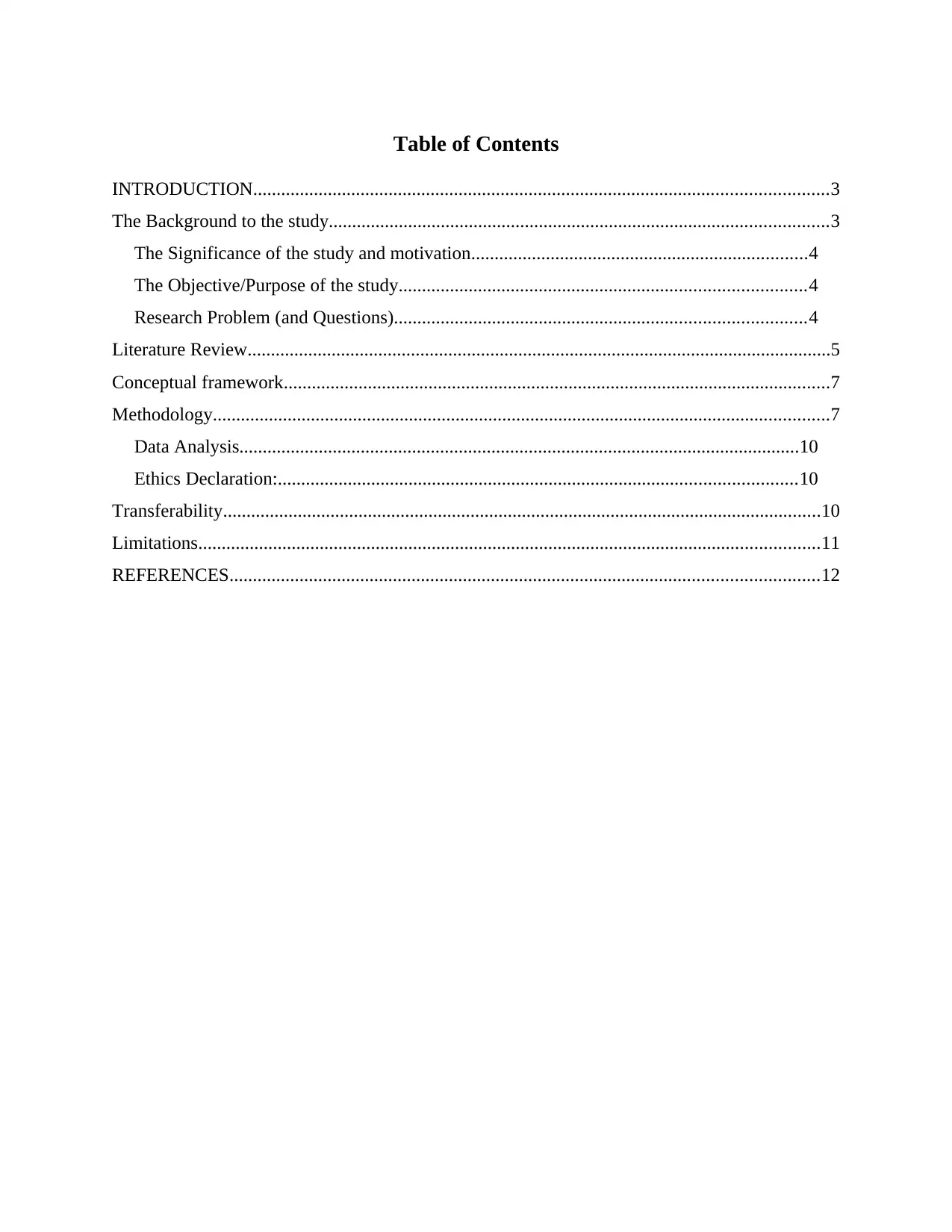
Table of Contents
INTRODUCTION...........................................................................................................................3
The Background to the study...........................................................................................................3
The Significance of the study and motivation........................................................................4
The Objective/Purpose of the study.......................................................................................4
Research Problem (and Questions)........................................................................................4
Literature Review.............................................................................................................................5
Conceptual framework.....................................................................................................................7
Methodology....................................................................................................................................7
Data Analysis........................................................................................................................10
Ethics Declaration:...............................................................................................................10
Transferability................................................................................................................................10
Limitations.....................................................................................................................................11
REFERENCES..............................................................................................................................12
INTRODUCTION...........................................................................................................................3
The Background to the study...........................................................................................................3
The Significance of the study and motivation........................................................................4
The Objective/Purpose of the study.......................................................................................4
Research Problem (and Questions)........................................................................................4
Literature Review.............................................................................................................................5
Conceptual framework.....................................................................................................................7
Methodology....................................................................................................................................7
Data Analysis........................................................................................................................10
Ethics Declaration:...............................................................................................................10
Transferability................................................................................................................................10
Limitations.....................................................................................................................................11
REFERENCES..............................................................................................................................12
INTRODUCTION
The Background to the study
Sustainable education practice within accounting curriculum is related with developing
effective learning strategies within learning so that easy access to education can be made. The
educational system is changing by every passing of year and at the same time advanced
technologies are being used within the system. Therefore this is significant for the education
system that to acquire such strategies so that by choosing significant practices learning processes
can be made adequate. The current research is going to reveal regarding different sustainable
practices used within the learning processes so that student can understand their learning material
in easy manner (Wyness and Dalton, 2018). The reason behind choosing of sustainable education
is related with providing synergy to understand behaviour of individual and learners. Using such
educational system learning abilities within individual can be enhanced in which accounting
professionals.
The current research will focus upon the methods that can be used by universities so that
to manage importance of sustainable practices in which positive benefits can be acquired.
Sustainable accounting practices are related with giving future profits to the students so that they
can incorporate sustainable measurement (Peyrovan, 2019). Using sustainable practices main
substance within study can be covered so that using minimal resources optimal benefits can be
acquired. Sustainability within accounting course is added for the objective of coping up with
accounting subject alone so that within individual several other skills can also be developed.
Student of digital age is needed to be aware of usage of new trends so that the same can be
assimilated in their study material and at the same time proper benefit can be acquired
For student this can be used in order to summarise their difficult course in such a manner
that easy understanding can be rendered. Short time within teaching will not yield higher benefits
for the students in which using sustainable education the learning process can be made simpler
and at the same time grasping abilities of students can also be increased. The involvement of
sustainable learning in education appropriate skills within individual can be developed so that
effective and beneficial results can be acquired.
The Background to the study
Sustainable education practice within accounting curriculum is related with developing
effective learning strategies within learning so that easy access to education can be made. The
educational system is changing by every passing of year and at the same time advanced
technologies are being used within the system. Therefore this is significant for the education
system that to acquire such strategies so that by choosing significant practices learning processes
can be made adequate. The current research is going to reveal regarding different sustainable
practices used within the learning processes so that student can understand their learning material
in easy manner (Wyness and Dalton, 2018). The reason behind choosing of sustainable education
is related with providing synergy to understand behaviour of individual and learners. Using such
educational system learning abilities within individual can be enhanced in which accounting
professionals.
The current research will focus upon the methods that can be used by universities so that
to manage importance of sustainable practices in which positive benefits can be acquired.
Sustainable accounting practices are related with giving future profits to the students so that they
can incorporate sustainable measurement (Peyrovan, 2019). Using sustainable practices main
substance within study can be covered so that using minimal resources optimal benefits can be
acquired. Sustainability within accounting course is added for the objective of coping up with
accounting subject alone so that within individual several other skills can also be developed.
Student of digital age is needed to be aware of usage of new trends so that the same can be
assimilated in their study material and at the same time proper benefit can be acquired
For student this can be used in order to summarise their difficult course in such a manner
that easy understanding can be rendered. Short time within teaching will not yield higher benefits
for the students in which using sustainable education the learning process can be made simpler
and at the same time grasping abilities of students can also be increased. The involvement of
sustainable learning in education appropriate skills within individual can be developed so that
effective and beneficial results can be acquired.
⊘ This is a preview!⊘
Do you want full access?
Subscribe today to unlock all pages.

Trusted by 1+ million students worldwide
The Significance of the study and motivation
The major significance of this research study is to gather understanding regarding with
new topic of sustainable learning abilities. In the current time the trend of using sustainable
learning within accounting is increasing which means that students are highly inclined towards
using of such aspects (Grimm, 2021). Using such methods within learning students are able to
cope up with real time situations. The practices of sustainable eduction is helping the students to
develop their skills by which they can manage their accounting curriculum in appropriate
manner. Education entails regarding taking significant decision making so that they can use their
skills for betterment of society and economy. Education entails development of students so that
they can be productive and manage responsibility of society, consumers and learners. Using
sustainable concepts within accounting learners personal and mental abilities of individual can be
enhanced so that productive response can be given to the society.
The Objective/Purpose of the study
The objective of executing the current research is that to increase understanding on the
concept of sustainable education within accounting so that new trending topic can be examined
in appropriate manner. For a student this is significant that they use and include emerging topics
and trends in their education so that they get to know regarding such new aspects and can cover
the same into their study material. Sustainable accounting methods are helpful in determining
their needs and requirements in such a manner that in overall manner development opportunities
can be seen (Gunarathne and Rajasooriya, 2019). The research will lead into acquiring various
skills within individual such as research skills, communication skills, analytical skills and many
others so that individual may get assistance in managing their future and career perspective. The
demand of sustainability within education is high in which the research report is going to fill the
distance between learner and tutor in which appropriate education and learnings can be given.
The research report is going to highlight various measurement in which student can gather their
skills and use the same in acquiring differential aspects within their career. In the terms of
fundamental skills the research would lead in understanding differential concepts within their
education so that futuristic goals can be acquired.
Research Problem (and Questions)
As this research is being conducted, the highlighted problem is connected to sustainable
accounting. This is one of the poor practises that may be found in an organisation, and it can lead
The major significance of this research study is to gather understanding regarding with
new topic of sustainable learning abilities. In the current time the trend of using sustainable
learning within accounting is increasing which means that students are highly inclined towards
using of such aspects (Grimm, 2021). Using such methods within learning students are able to
cope up with real time situations. The practices of sustainable eduction is helping the students to
develop their skills by which they can manage their accounting curriculum in appropriate
manner. Education entails regarding taking significant decision making so that they can use their
skills for betterment of society and economy. Education entails development of students so that
they can be productive and manage responsibility of society, consumers and learners. Using
sustainable concepts within accounting learners personal and mental abilities of individual can be
enhanced so that productive response can be given to the society.
The Objective/Purpose of the study
The objective of executing the current research is that to increase understanding on the
concept of sustainable education within accounting so that new trending topic can be examined
in appropriate manner. For a student this is significant that they use and include emerging topics
and trends in their education so that they get to know regarding such new aspects and can cover
the same into their study material. Sustainable accounting methods are helpful in determining
their needs and requirements in such a manner that in overall manner development opportunities
can be seen (Gunarathne and Rajasooriya, 2019). The research will lead into acquiring various
skills within individual such as research skills, communication skills, analytical skills and many
others so that individual may get assistance in managing their future and career perspective. The
demand of sustainability within education is high in which the research report is going to fill the
distance between learner and tutor in which appropriate education and learnings can be given.
The research report is going to highlight various measurement in which student can gather their
skills and use the same in acquiring differential aspects within their career. In the terms of
fundamental skills the research would lead in understanding differential concepts within their
education so that futuristic goals can be acquired.
Research Problem (and Questions)
As this research is being conducted, the highlighted problem is connected to sustainable
accounting. This is one of the poor practises that may be found in an organisation, and it can lead
Paraphrase This Document
Need a fresh take? Get an instant paraphrase of this document with our AI Paraphraser
to a reduction in students and other people's productivity. Sustainable accounting may expose the
company's reputation in the marketplace since employees will be unable to offer their all in order
to meet commercial objectives if they are approach against. So the issue is that the organisation
should implement policies that avoid gender discrimination and offer employees’ value.
What do you mean when you say sustainable accounting in the education industry?
What effect does sustainable accounting have on the productivity of student learning in
the education industry?
What strategies may be employed to promote sustainable accounting in the education
industry's workplace?
Literature Review
One of the most essential factors that contributes to a student's efficiency and the overall
efficacy of the educational system is sustainability. Various scholars from various nations and
eras have examined why it is critical to have sustainability in accounting curriculum instruction
(Abhayawansa et al., 2019). Researchers also discuss the advantages and need of include such
topics in accounting classes in schools and universities. The importance of incorporating and
improving sustainability into accounting curricula is critical all across the world.
According to Sharma et al., (2021), enhancement of environmental education in the field of
accountancy is one of most instructional strategies that is very beneficial for increasing the
effectiveness of the whole education process, the researchers "examined the sustainable
development coursework in the accounting profession and then using the Delta Business School
in New Zealand" for a thorough understanding of the situation. For acquiring data from students
and courses controllers, researchers employ the semi-structured interviewing method (Al et al.,
2019). Students and instructors who were heavily active in the school's sustainability courses
were chosen by the researchers.
The findings of the study show that courses that devote a significant amount of time to
teaching sustainability improve students' critical thinking and abilities, whereas short periods of
time in such teaching procedures are ineffective, and they have faced several challenges as a
result (Almagtome et al., 2020). The entire study also demonstrated that there is a shortage of
long-term education in the DBS accounting paper. Mentality shifts are one of the most important
factors in the education system's long-term success. Many lecturers still believe that knowledge
growth is the most essential thing, according to this study, and they emphasise the education
company's reputation in the marketplace since employees will be unable to offer their all in order
to meet commercial objectives if they are approach against. So the issue is that the organisation
should implement policies that avoid gender discrimination and offer employees’ value.
What do you mean when you say sustainable accounting in the education industry?
What effect does sustainable accounting have on the productivity of student learning in
the education industry?
What strategies may be employed to promote sustainable accounting in the education
industry's workplace?
Literature Review
One of the most essential factors that contributes to a student's efficiency and the overall
efficacy of the educational system is sustainability. Various scholars from various nations and
eras have examined why it is critical to have sustainability in accounting curriculum instruction
(Abhayawansa et al., 2019). Researchers also discuss the advantages and need of include such
topics in accounting classes in schools and universities. The importance of incorporating and
improving sustainability into accounting curricula is critical all across the world.
According to Sharma et al., (2021), enhancement of environmental education in the field of
accountancy is one of most instructional strategies that is very beneficial for increasing the
effectiveness of the whole education process, the researchers "examined the sustainable
development coursework in the accounting profession and then using the Delta Business School
in New Zealand" for a thorough understanding of the situation. For acquiring data from students
and courses controllers, researchers employ the semi-structured interviewing method (Al et al.,
2019). Students and instructors who were heavily active in the school's sustainability courses
were chosen by the researchers.
The findings of the study show that courses that devote a significant amount of time to
teaching sustainability improve students' critical thinking and abilities, whereas short periods of
time in such teaching procedures are ineffective, and they have faced several challenges as a
result (Almagtome et al., 2020). The entire study also demonstrated that there is a shortage of
long-term education in the DBS accounting paper. Mentality shifts are one of the most important
factors in the education system's long-term success. Many lecturers still believe that knowledge
growth is the most essential thing, according to this study, and they emphasise the education
system's current process (Cai, 2021). In this light, it is critical to note that as time passes, the
entire educational system has evolved, and sustainable development is one of the most
significant factors in properly developing the entire system.
Other New Zealand universities have achieved significant progress in sustainable education,
according to their accounting paper. The research also finds that more than half of New Zealand
institutions do not provide distinct undergraduate and postgraduate sustainability accounting
courses. As a result, it is reasonable to conclude that this sector requires special attention in order
to improve its efficiency (Giorgino et al., 2020).
According to Rasnick (2013) the sustainability practise in the management accounting
curriculum can be quite successful for motivating future accountants and executives to use such
information in corporate decision making. One of the most important qualities for everybody is
the capacity to make appropriate decisions. An organization's effectiveness may be boosted by
having the right decision-making skills. With growing inefficiency, an organization's
productivity and profitability rise, which are linked. As a result, it may be claimed that as an
organization's productivity rises, so does its profitability. As a result, research appears that one of
the most important factors in developing organisational decision-making abilities among students
is sustainability. Building these abilities in pupils at a young age can be extremely beneficial to
their future development.
Instead of only being consumers and learners, education comprises preparing students to be
productive citizens who take responsibility for society. Students are given the knowledge and
skills to appreciate the importance of long-term sustainability. A sustainable planet may easily
standardise the economy as a knowledge-driven economy rather than a commodity-driven one in
the future. Rather than pursuing business with no improvement aims, the economy's primary job
is to assist individuals in communities in improving their living. Currently, the economy is
founded on a variety of factors other than resource exploitation (Jackson et al., 2021).
According to Sharma et al., (2020) trying to integrate sustainability Education further into
accounting field is one of the most essential things for the appropriate and successful growth of
students and the entire system, The perspective of key stakeholders on the incorporation of
sustainability education into the accounting curriculum was explored in the study report. The
researcher gathered information and conducted the entire study using the "Salient Stakeholder
Theory." The "salient stakeholder theory" defines and investigates managers' importance in
entire educational system has evolved, and sustainable development is one of the most
significant factors in properly developing the entire system.
Other New Zealand universities have achieved significant progress in sustainable education,
according to their accounting paper. The research also finds that more than half of New Zealand
institutions do not provide distinct undergraduate and postgraduate sustainability accounting
courses. As a result, it is reasonable to conclude that this sector requires special attention in order
to improve its efficiency (Giorgino et al., 2020).
According to Rasnick (2013) the sustainability practise in the management accounting
curriculum can be quite successful for motivating future accountants and executives to use such
information in corporate decision making. One of the most important qualities for everybody is
the capacity to make appropriate decisions. An organization's effectiveness may be boosted by
having the right decision-making skills. With growing inefficiency, an organization's
productivity and profitability rise, which are linked. As a result, it may be claimed that as an
organization's productivity rises, so does its profitability. As a result, research appears that one of
the most important factors in developing organisational decision-making abilities among students
is sustainability. Building these abilities in pupils at a young age can be extremely beneficial to
their future development.
Instead of only being consumers and learners, education comprises preparing students to be
productive citizens who take responsibility for society. Students are given the knowledge and
skills to appreciate the importance of long-term sustainability. A sustainable planet may easily
standardise the economy as a knowledge-driven economy rather than a commodity-driven one in
the future. Rather than pursuing business with no improvement aims, the economy's primary job
is to assist individuals in communities in improving their living. Currently, the economy is
founded on a variety of factors other than resource exploitation (Jackson et al., 2021).
According to Sharma et al., (2020) trying to integrate sustainability Education further into
accounting field is one of the most essential things for the appropriate and successful growth of
students and the entire system, The perspective of key stakeholders on the incorporation of
sustainability education into the accounting curriculum was explored in the study report. The
researcher gathered information and conducted the entire study using the "Salient Stakeholder
Theory." The "salient stakeholder theory" defines and investigates managers' importance in
⊘ This is a preview!⊘
Do you want full access?
Subscribe today to unlock all pages.
Trusted by 1+ million students worldwide
considering the demands of competing stakeholders in their decision-making process (Sathe et al
2021).
Stakeholder theory tries to identify an organization's stakeholders, as well as their wants and
expectations as a group that is determined by the company. This idea identifies or gives
information on the relevance of stakeholders. This also implies that managers pay attention to
each stakeholder's demands as well as their expectations on a frequent basis (Toosi et al., 2021).
The inclusion of ESD in accounting and business academic curriculum is critical for overall
progress in the field of sustainable accounting education. Accountants are also seen as one of the
major determinants of long-term viability (Wang et al., 2020). The stakeholder community now
has a significant need for sustainability reporting.
The absence of sustainability accounting in business schools, on the other hand, limits the
implementation of complete sustainable accounting (Volodymyr et al., 2020). As a result,
stakeholders play a key role in the acceptance of sustainable education in the business and
accounting curriculum. One of the most important goals of incorporating sustainable education
into the business and accounting curriculum is to improve general accountability and
transparency. As a result of business education, this also falls within the key and required criteria
for enhancing the capacity of future managers.
Conceptual framework
Gender discrimination in the workplace has a direct influence on culture, organisational
commitment, and employee performance, according to this theory. It has been discovered that
when employees are denied appropriate chances due to their gender, their performance suffers.
When prejudice exists in the workplace, the workplace culture becomes bad, and the company's
goals remain unmet.
Methodology
Research methodology is understood as a combination of strategies for determining and
analysing information about a topic, as well as allowing the reader to assess the material's overall
dependability. 2021, Sustainable Styles as Well as how to Discover Their Own. This technique
provides suitable processes for analysing information on a topic, and it is a vital essential to the
research project since it assists the researcher in establishing the data analysis process. Various
gathering techniques, statistical analysis, and general observations are all part of such
2021).
Stakeholder theory tries to identify an organization's stakeholders, as well as their wants and
expectations as a group that is determined by the company. This idea identifies or gives
information on the relevance of stakeholders. This also implies that managers pay attention to
each stakeholder's demands as well as their expectations on a frequent basis (Toosi et al., 2021).
The inclusion of ESD in accounting and business academic curriculum is critical for overall
progress in the field of sustainable accounting education. Accountants are also seen as one of the
major determinants of long-term viability (Wang et al., 2020). The stakeholder community now
has a significant need for sustainability reporting.
The absence of sustainability accounting in business schools, on the other hand, limits the
implementation of complete sustainable accounting (Volodymyr et al., 2020). As a result,
stakeholders play a key role in the acceptance of sustainable education in the business and
accounting curriculum. One of the most important goals of incorporating sustainable education
into the business and accounting curriculum is to improve general accountability and
transparency. As a result of business education, this also falls within the key and required criteria
for enhancing the capacity of future managers.
Conceptual framework
Gender discrimination in the workplace has a direct influence on culture, organisational
commitment, and employee performance, according to this theory. It has been discovered that
when employees are denied appropriate chances due to their gender, their performance suffers.
When prejudice exists in the workplace, the workplace culture becomes bad, and the company's
goals remain unmet.
Methodology
Research methodology is understood as a combination of strategies for determining and
analysing information about a topic, as well as allowing the reader to assess the material's overall
dependability. 2021, Sustainable Styles as Well as how to Discover Their Own. This technique
provides suitable processes for analysing information on a topic, and it is a vital essential to the
research project since it assists the researcher in establishing the data analysis process. Various
gathering techniques, statistical analysis, and general observations are all part of such
Paraphrase This Document
Need a fresh take? Get an instant paraphrase of this document with our AI Paraphraser
procedures.
Research philosophy:
This is defined as a framework that guides people in understanding the nature of reality
and how information is collected and assessed. Positivism and interpretivism are the two forms
of inquiry. As part of this study endeavour, positivism will be considered since it is more reliable
and aims to describe and anticipate the research process. It aids in the gathering of data that will
aid in the reduction of research issues. This will assist the researcher in working autonomously in
order to gather and evaluate data. Interpretivism was not selected for the study because it has a
lower degree of dependability than optimism.
Research approach: It includes the preparations for the goal that include broad expectations
about data collecting and evaluation, and it is described as a series of plans that are applied to
achieve the data collection process easier. Inductive and deductive research approaches are two
forms of research methods. The logical strategy will be chosen for this assignment since it
clarifies the idea and takes less time. Inductive approaches focus on creating a theory, which is
why they are not appropriate for research.
Research choice: It illustrates how the performed research is classified into two categories:
qualitative and quantitative. Research method is being explored for the project. The major goal
of this pick is to aid in the concentration of information facts that are beneficial for better
analysis. The following are the several sorts of research methodologies:
Quantitative Research- It's the process of gathering quantitative facts which will be utilised
to generate assumptions in order to obtain outcomes from a larger population. It also solves
the problems by focusing on actual facts. This study also allows you to concentrate on a
certain set of data.
Qualitative Research- Such research is characterised as a non-numerical comparison in the
study that focuses on acquiring data through open-ended dialogue. This study is not as
dependable as the previous research, but it is also utilised to gather in-depth knowledge in
order to produce fresh ideas.
Research strategy: Qualitative interviews, case studies, surveys, action-oriented research, and
many more methodologies are available. For the goal of research strategy, it is separated into
numerous elements such as case studies and surveys. Surveys will be chosen based on the
project's requirements. Because surveys represent a large population and may be delivered in a
Research philosophy:
This is defined as a framework that guides people in understanding the nature of reality
and how information is collected and assessed. Positivism and interpretivism are the two forms
of inquiry. As part of this study endeavour, positivism will be considered since it is more reliable
and aims to describe and anticipate the research process. It aids in the gathering of data that will
aid in the reduction of research issues. This will assist the researcher in working autonomously in
order to gather and evaluate data. Interpretivism was not selected for the study because it has a
lower degree of dependability than optimism.
Research approach: It includes the preparations for the goal that include broad expectations
about data collecting and evaluation, and it is described as a series of plans that are applied to
achieve the data collection process easier. Inductive and deductive research approaches are two
forms of research methods. The logical strategy will be chosen for this assignment since it
clarifies the idea and takes less time. Inductive approaches focus on creating a theory, which is
why they are not appropriate for research.
Research choice: It illustrates how the performed research is classified into two categories:
qualitative and quantitative. Research method is being explored for the project. The major goal
of this pick is to aid in the concentration of information facts that are beneficial for better
analysis. The following are the several sorts of research methodologies:
Quantitative Research- It's the process of gathering quantitative facts which will be utilised
to generate assumptions in order to obtain outcomes from a larger population. It also solves
the problems by focusing on actual facts. This study also allows you to concentrate on a
certain set of data.
Qualitative Research- Such research is characterised as a non-numerical comparison in the
study that focuses on acquiring data through open-ended dialogue. This study is not as
dependable as the previous research, but it is also utilised to gather in-depth knowledge in
order to produce fresh ideas.
Research strategy: Qualitative interviews, case studies, surveys, action-oriented research, and
many more methodologies are available. For the goal of research strategy, it is separated into
numerous elements such as case studies and surveys. Surveys will be chosen based on the
project's requirements. Because surveys represent a large population and may be delivered in a
number of methods, they have a significant amount of competence. It also aids in the successful
presentation of research because information is gathered through questionnaires. Research
papers, on the other hand, are ineffective since they give a smaller population basis.
Research design: It is claimed to be selected by the investigator and it serves as a foundation for
market research, allowing the analyst to employ a variety of methodologies appropriate to the
situation. Furthermore, it is described as the frameworks chosen by the researcher and classified
into two types: descriptive and exploratory. According to the project, descriptive design is
selected since it aids in effective data analysis. The purposeful sampling, on the other hand, only
focuses on research difficulties during the beginning stages of inquiry, that's why it would not be
employed in the study.
Sampling: It is described as the technique of using and analysing statistical data by watching a
wider population. It also picks sampling from a large population using two different
methodologies: probability and non-probability. Sampling techniques will be used in this
research since it aids the investigation process by picking a particular number of people. The
survey's participants are chosen from among 40 people. Non-probability sampling, on the other
hand, utilises non-random groups to engage in research, which is why it will not be studied.
Time horizon: It generally pertains to the research's time range. It is separated into two types:
crossing sectional and continuous. It is described as the length and delivery options of the study
in which the research is performed. According to the study project, the longitudinal time horizon
was chosen since it helps to understand the modifications and development that occur over time
by collecting data. Include this data, but at the other hand, is used to gather data across a period
of time, such as days, weeks, or months, but it is not employed for research purposes.
Data collection: This is the foundation in research in which numerous methodologies are used,
and it is further separated into primary and secondary research. In line with the research project,
qualitative data is preferred because the data is acquired from diverse original sources, ensuring
greater accuracy and dependability. Research study is not included since gathering information in
specified ways is extremely challenging.
Instruments: It is separated into interviews and questionnaires and relates to the many means
via which research is supported. According to this study, a questionnaire will be chosen since it
will allow researchers to examine other people's viewpoints. The interview is not included in the
study since the interviewer ensures that the responses are kept private.
presentation of research because information is gathered through questionnaires. Research
papers, on the other hand, are ineffective since they give a smaller population basis.
Research design: It is claimed to be selected by the investigator and it serves as a foundation for
market research, allowing the analyst to employ a variety of methodologies appropriate to the
situation. Furthermore, it is described as the frameworks chosen by the researcher and classified
into two types: descriptive and exploratory. According to the project, descriptive design is
selected since it aids in effective data analysis. The purposeful sampling, on the other hand, only
focuses on research difficulties during the beginning stages of inquiry, that's why it would not be
employed in the study.
Sampling: It is described as the technique of using and analysing statistical data by watching a
wider population. It also picks sampling from a large population using two different
methodologies: probability and non-probability. Sampling techniques will be used in this
research since it aids the investigation process by picking a particular number of people. The
survey's participants are chosen from among 40 people. Non-probability sampling, on the other
hand, utilises non-random groups to engage in research, which is why it will not be studied.
Time horizon: It generally pertains to the research's time range. It is separated into two types:
crossing sectional and continuous. It is described as the length and delivery options of the study
in which the research is performed. According to the study project, the longitudinal time horizon
was chosen since it helps to understand the modifications and development that occur over time
by collecting data. Include this data, but at the other hand, is used to gather data across a period
of time, such as days, weeks, or months, but it is not employed for research purposes.
Data collection: This is the foundation in research in which numerous methodologies are used,
and it is further separated into primary and secondary research. In line with the research project,
qualitative data is preferred because the data is acquired from diverse original sources, ensuring
greater accuracy and dependability. Research study is not included since gathering information in
specified ways is extremely challenging.
Instruments: It is separated into interviews and questionnaires and relates to the many means
via which research is supported. According to this study, a questionnaire will be chosen since it
will allow researchers to examine other people's viewpoints. The interview is not included in the
study since the interviewer ensures that the responses are kept private.
⊘ This is a preview!⊘
Do you want full access?
Subscribe today to unlock all pages.
Trusted by 1+ million students worldwide
Analysis: The information is a valuable aspect of the study, and it outlines the numerous
procedures that are utilised to demonstrate the research methods. It's divided into two categories:
theme evaluation and frequency distribution. Frequency analysis is being considered for this
project because it aids in the depiction of data via graphical representations. Because the words
employed in this analysis do not represent the meaning accurately, qualitative method is not
considered.
Data Analysis
According to the findings of the aforementioned paper, business environment analysis is
critical for any company's success since it gives the company access to market opportunities.
This is known as interaction, and it aids in the strengthening of the company's resources. It acts
as a conduit for communication between businesses and the factors in which they must function.
It is simple to find areas of development and expansion activities when there is contact between
the firm and its surroundings. Because the business environment is changing and ever-changing,
it is critical to monitor and encourage innovation and creativity inside the organisation for long-
term success. Brand value may be enhanced by demonstrating sensitivity to business issues. In
order to function in a business environment, it is also necessary to build powerful and successful
plans. They aid in the creation of a thorough study that may quickly identify opportunities for
expansion and growth. Business considerations are extremely competitive, and all organisations
must confront and conquer these components in order to maintain successful market
performance.
Ethics Declaration:
Ethics are adequately examined and honest comments are obtained from respondents
when conducting this study. No one in the study was required to answer any questions. They
were given the opportunity to express their own opinions on the questions in the survey. On this
foundation, legitimate and meaningful research outputs are identified.
Transferability
It's important to note that, regardless of the topic, every scientific publication summarises
the findings of this inquiry in some way. A theoretical worldview is a collection of beliefs about
reality that directs our questions and conclusions. It is vital to have a theoretical approach when
conducting research. It helps us organise our thoughts and ideas and communicate them to
procedures that are utilised to demonstrate the research methods. It's divided into two categories:
theme evaluation and frequency distribution. Frequency analysis is being considered for this
project because it aids in the depiction of data via graphical representations. Because the words
employed in this analysis do not represent the meaning accurately, qualitative method is not
considered.
Data Analysis
According to the findings of the aforementioned paper, business environment analysis is
critical for any company's success since it gives the company access to market opportunities.
This is known as interaction, and it aids in the strengthening of the company's resources. It acts
as a conduit for communication between businesses and the factors in which they must function.
It is simple to find areas of development and expansion activities when there is contact between
the firm and its surroundings. Because the business environment is changing and ever-changing,
it is critical to monitor and encourage innovation and creativity inside the organisation for long-
term success. Brand value may be enhanced by demonstrating sensitivity to business issues. In
order to function in a business environment, it is also necessary to build powerful and successful
plans. They aid in the creation of a thorough study that may quickly identify opportunities for
expansion and growth. Business considerations are extremely competitive, and all organisations
must confront and conquer these components in order to maintain successful market
performance.
Ethics Declaration:
Ethics are adequately examined and honest comments are obtained from respondents
when conducting this study. No one in the study was required to answer any questions. They
were given the opportunity to express their own opinions on the questions in the survey. On this
foundation, legitimate and meaningful research outputs are identified.
Transferability
It's important to note that, regardless of the topic, every scientific publication summarises
the findings of this inquiry in some way. A theoretical worldview is a collection of beliefs about
reality that directs our questions and conclusions. It is vital to have a theoretical approach when
conducting research. It helps us organise our thoughts and ideas and communicate them to
Paraphrase This Document
Need a fresh take? Get an instant paraphrase of this document with our AI Paraphraser
others. One of the most important parts of a research study is the section on probable
implications. It's where an organisation may explore the implications for everyone it represents.
If appropriate, the user may declare the implications, value judgements, outcomes, and
estimations while writing implications.
Limitations
The researcher's main concern with the research study is its efficacy, so that all of the
research's needs may be satisfied effectively in the conclusion. The research primarily focuses on
techniques to define brand value as seen by customers through various characteristics, and how
this may be appraised on an individual basis of company consumers owing to various persistence
elements. The study has a number of additional restrictions, including time constraints, financial
constraints, and demographic constraints, among others. The study is being undertaken using a
random sample of 100 people from the general community.
implications. It's where an organisation may explore the implications for everyone it represents.
If appropriate, the user may declare the implications, value judgements, outcomes, and
estimations while writing implications.
Limitations
The researcher's main concern with the research study is its efficacy, so that all of the
research's needs may be satisfied effectively in the conclusion. The research primarily focuses on
techniques to define brand value as seen by customers through various characteristics, and how
this may be appraised on an individual basis of company consumers owing to various persistence
elements. The study has a number of additional restrictions, including time constraints, financial
constraints, and demographic constraints, among others. The study is being undertaken using a
random sample of 100 people from the general community.
REFERENCES
Books and journals
Grimm, S.D., 2021. Junkyard Planet: Using Stories to Teach Managerial Accounting with a
Sustainability Theme. Issues in Accounting Education, 36(4), pp.253-280.
Gunarathne, A.N. and Rajasooriya, S., 2019. Reflections on sustainability accounting education
in a public university in Sri Lanka. Prioritizing Sustainability Education: A
Comprehensive Approach, p.82.
Peyrovan, A., 2019. Sustainability and accounting education: the students’ perspective.
Wyness, L. and Dalton, F., 2018. The value of problem-based learning in learning for
sustainability: Undergraduate accounting student perspectives. Journal of Accounting
Education, 45, pp.1-19.
Abhayawansa, S., Guthrie, J., & Bernardi, C. (2019). Intellectual capital accounting in the age of
integrated reporting: a commentary. Journal of Intellectual Capital.
Al-Hazaima, H., Low, M., & Sharma, U. (2021). Perceptions of salient stakeholders on the
integration of sustainability education into the accounting curriculum: a Jordanian
study. Meditari Accountancy Research, 29(2), 371-402. https://doi.org/10.1108/medar-
02-2020-0708
Al-HASHIMY, M. N. H., & Al-hashimy, H. N. H. (2019). Strategic Accounting in the
Profitability of Construction Engineering Projects Management Companies in Iraq.
Journal of Engineering and Applied Sciences, 14(3), 941-944.
Almagtome, A. H., Al-Yasiri, A. J., Ali, R. S., Kadhim, H. L., & Bekheet, H. N. (2020). Circular
economy initiatives through energy accounting and sustainable energy performance
under an integrated reporting framework. International Journal of Mathematical,
Engineering and Management Sciences, 5(6), 1032-1045.
Cai, C. W. (2021). Triple‐entry accounting with blockchain: How far have we come? Accounting
& Finance, 61(1), 71-93.
Giorgino, M. C., Barnabè, F., & Kunc, M. (2020). Integrating qualitative system dynamics with
accounting practices: The case of integrated reporting and resource mapping. Systems
Research and Behavioral Science, 37(1), 97-118.
Haghighi, R., Bagherpour Velashani, M. A., & Saei, M. J. (2019). Establishment of Integrated
Accounting Information Systems in an Emerging Market-Problems and Barriers.
International Journal of Business and Development Studies, 11(1), 83-97.
Hilorme, T., Tkach, K., Dorenskyi, O., Katerna, O., & Durmanov, A. (2019). Decision-making
model of introducing energy-saving technologies based on the analytic hierarchy
process. Journal of Management Information and Decision Sciences, 22(4), 489-494.
Jackson, D., & Meek, S. (2021). Embedding work-integrated learning into accounting education:
the state of play and pathways to future implementation. Accounting Education, 30(1),
63-85.
Kosova, T., Malovychko, A., & Poddubnіak, D. (2021). THEORETICAL AND APPLIED
ASPECTS OF SUSTAINABILITY ACCOUNTING, NON-FINANCIAL
(INTEGRATED) REPORTING OF BUSINESS ENTITIES, AND ITS AUDIT.
ECONOMICS, MANAGEMENT, AND ADMINISTRATION IN THE
COORDINATES OF SUSTAINABLE DEVELOPMENT, 616.
Sathe, R., & Yu, W. (2021). Experiential Learning in the Classroom: An Accounting Cycle
Simulation Project. Journal of Higher Education Theory & Practice, 21(7).
Books and journals
Grimm, S.D., 2021. Junkyard Planet: Using Stories to Teach Managerial Accounting with a
Sustainability Theme. Issues in Accounting Education, 36(4), pp.253-280.
Gunarathne, A.N. and Rajasooriya, S., 2019. Reflections on sustainability accounting education
in a public university in Sri Lanka. Prioritizing Sustainability Education: A
Comprehensive Approach, p.82.
Peyrovan, A., 2019. Sustainability and accounting education: the students’ perspective.
Wyness, L. and Dalton, F., 2018. The value of problem-based learning in learning for
sustainability: Undergraduate accounting student perspectives. Journal of Accounting
Education, 45, pp.1-19.
Abhayawansa, S., Guthrie, J., & Bernardi, C. (2019). Intellectual capital accounting in the age of
integrated reporting: a commentary. Journal of Intellectual Capital.
Al-Hazaima, H., Low, M., & Sharma, U. (2021). Perceptions of salient stakeholders on the
integration of sustainability education into the accounting curriculum: a Jordanian
study. Meditari Accountancy Research, 29(2), 371-402. https://doi.org/10.1108/medar-
02-2020-0708
Al-HASHIMY, M. N. H., & Al-hashimy, H. N. H. (2019). Strategic Accounting in the
Profitability of Construction Engineering Projects Management Companies in Iraq.
Journal of Engineering and Applied Sciences, 14(3), 941-944.
Almagtome, A. H., Al-Yasiri, A. J., Ali, R. S., Kadhim, H. L., & Bekheet, H. N. (2020). Circular
economy initiatives through energy accounting and sustainable energy performance
under an integrated reporting framework. International Journal of Mathematical,
Engineering and Management Sciences, 5(6), 1032-1045.
Cai, C. W. (2021). Triple‐entry accounting with blockchain: How far have we come? Accounting
& Finance, 61(1), 71-93.
Giorgino, M. C., Barnabè, F., & Kunc, M. (2020). Integrating qualitative system dynamics with
accounting practices: The case of integrated reporting and resource mapping. Systems
Research and Behavioral Science, 37(1), 97-118.
Haghighi, R., Bagherpour Velashani, M. A., & Saei, M. J. (2019). Establishment of Integrated
Accounting Information Systems in an Emerging Market-Problems and Barriers.
International Journal of Business and Development Studies, 11(1), 83-97.
Hilorme, T., Tkach, K., Dorenskyi, O., Katerna, O., & Durmanov, A. (2019). Decision-making
model of introducing energy-saving technologies based on the analytic hierarchy
process. Journal of Management Information and Decision Sciences, 22(4), 489-494.
Jackson, D., & Meek, S. (2021). Embedding work-integrated learning into accounting education:
the state of play and pathways to future implementation. Accounting Education, 30(1),
63-85.
Kosova, T., Malovychko, A., & Poddubnіak, D. (2021). THEORETICAL AND APPLIED
ASPECTS OF SUSTAINABILITY ACCOUNTING, NON-FINANCIAL
(INTEGRATED) REPORTING OF BUSINESS ENTITIES, AND ITS AUDIT.
ECONOMICS, MANAGEMENT, AND ADMINISTRATION IN THE
COORDINATES OF SUSTAINABLE DEVELOPMENT, 616.
Sathe, R., & Yu, W. (2021). Experiential Learning in the Classroom: An Accounting Cycle
Simulation Project. Journal of Higher Education Theory & Practice, 21(7).
⊘ This is a preview!⊘
Do you want full access?
Subscribe today to unlock all pages.
Trusted by 1+ million students worldwide

1 out of 13


Related Documents


Your All-in-One AI-Powered Toolkit for Academic Success.
+13062052269
info@desklib.com
Available 24*7 on WhatsApp / Email
![[object Object]](/_next/static/media/star-bottom.7253800d.svg)
Unlock your academic potential
Copyright © 2020–2026 A2Z Services. All Rights Reserved. Developed and managed by ZUCOL.