Research Protocol on Broccoli and Liver Cancer
VerifiedAdded on 2020/03/04
|9
|2119
|45
AI Summary
This research protocol investigates the impact of broccoli consumption on liver cancer among young adults aged 30 to 40. It highlights the importance of fruits and vegetables in preventing chronic diseases and identifies gaps in existing research. The study aims to improve broccoli intake and assess its nutritional benefits, ultimately contributing to reduced liver cancer prevalence and mortality rates.
Running head: RESEARCH PROTOCOL AND DESIGN 1
Research protocol and design
Name
Institution
Research protocol and design
Name
Institution

Paraphrase This Document
Need a fresh take? Get an instant paraphrase of this document with our AI Paraphraser
RESEARCH PROTOCOL AND DESIGN 2
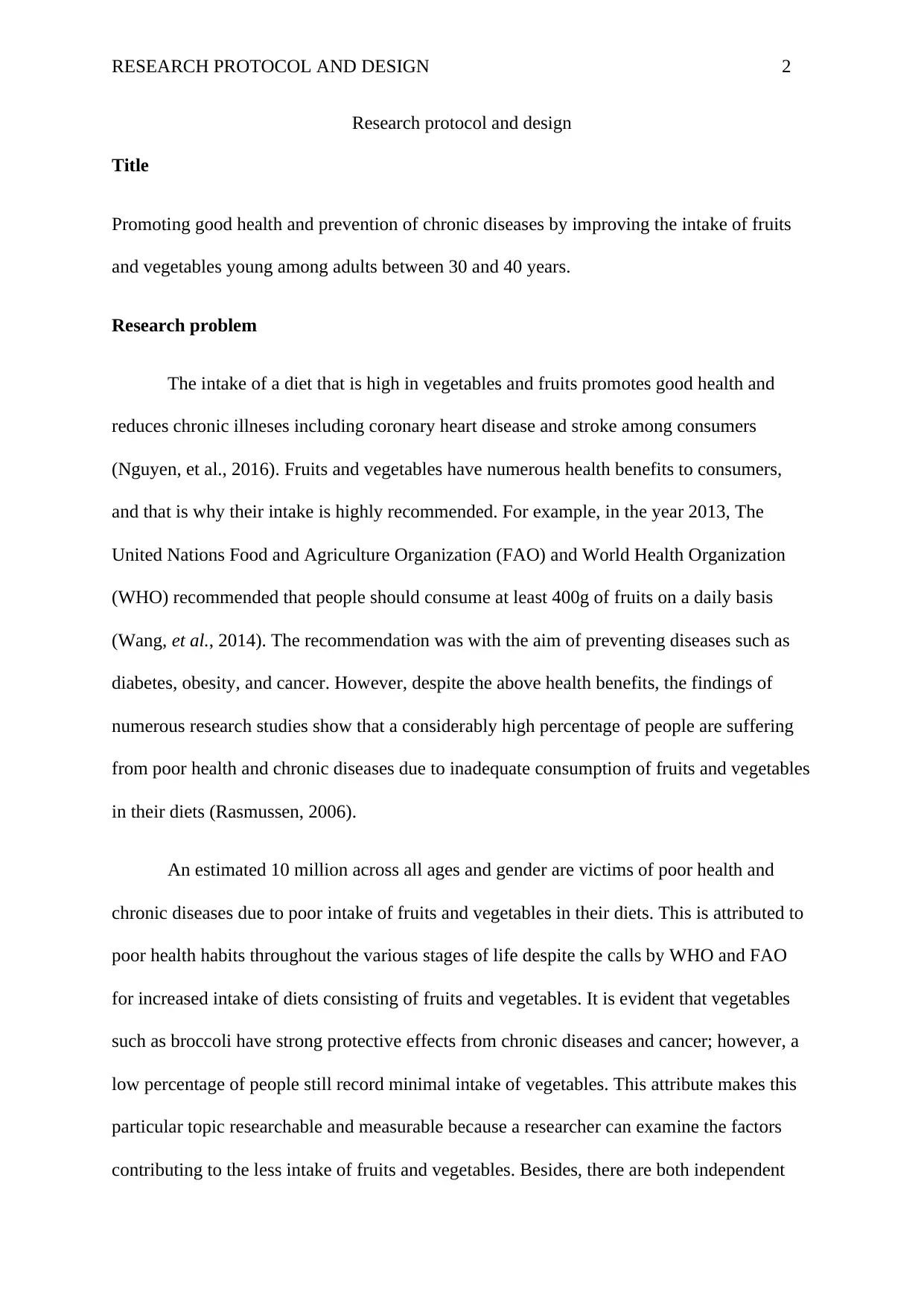
Research protocol and design
Title
Promoting good health and prevention of chronic diseases by improving the intake of fruits
and vegetables young among adults between 30 and 40 years.
Research problem
The intake of a diet that is high in vegetables and fruits promotes good health and
reduces chronic illneses including coronary heart disease and stroke among consumers
(Nguyen, et al., 2016). Fruits and vegetables have numerous health benefits to consumers,
and that is why their intake is highly recommended. For example, in the year 2013, The
United Nations Food and Agriculture Organization (FAO) and World Health Organization
(WHO) recommended that people should consume at least 400g of fruits on a daily basis
(Wang, et al., 2014). The recommendation was with the aim of preventing diseases such as
diabetes, obesity, and cancer. However, despite the above health benefits, the findings of
numerous research studies show that a considerably high percentage of people are suffering
from poor health and chronic diseases due to inadequate consumption of fruits and vegetables
in their diets (Rasmussen, 2006).
An estimated 10 million across all ages and gender are victims of poor health and
chronic diseases due to poor intake of fruits and vegetables in their diets. This is attributed to
poor health habits throughout the various stages of life despite the calls by WHO and FAO
for increased intake of diets consisting of fruits and vegetables. It is evident that vegetables
such as broccoli have strong protective effects from chronic diseases and cancer; however, a
low percentage of people still record minimal intake of vegetables. This attribute makes this
particular topic researchable and measurable because a researcher can examine the factors
contributing to the less intake of fruits and vegetables. Besides, there are both independent
Research protocol and design
Title
Promoting good health and prevention of chronic diseases by improving the intake of fruits
and vegetables young among adults between 30 and 40 years.
Research problem
The intake of a diet that is high in vegetables and fruits promotes good health and
reduces chronic illneses including coronary heart disease and stroke among consumers
(Nguyen, et al., 2016). Fruits and vegetables have numerous health benefits to consumers,
and that is why their intake is highly recommended. For example, in the year 2013, The
United Nations Food and Agriculture Organization (FAO) and World Health Organization
(WHO) recommended that people should consume at least 400g of fruits on a daily basis
(Wang, et al., 2014). The recommendation was with the aim of preventing diseases such as
diabetes, obesity, and cancer. However, despite the above health benefits, the findings of
numerous research studies show that a considerably high percentage of people are suffering
from poor health and chronic diseases due to inadequate consumption of fruits and vegetables
in their diets (Rasmussen, 2006).
An estimated 10 million across all ages and gender are victims of poor health and
chronic diseases due to poor intake of fruits and vegetables in their diets. This is attributed to
poor health habits throughout the various stages of life despite the calls by WHO and FAO
for increased intake of diets consisting of fruits and vegetables. It is evident that vegetables
such as broccoli have strong protective effects from chronic diseases and cancer; however, a
low percentage of people still record minimal intake of vegetables. This attribute makes this
particular topic researchable and measurable because a researcher can examine the factors
contributing to the less intake of fruits and vegetables. Besides, there are both independent
RESEARCH PROTOCOL AND DESIGN 3
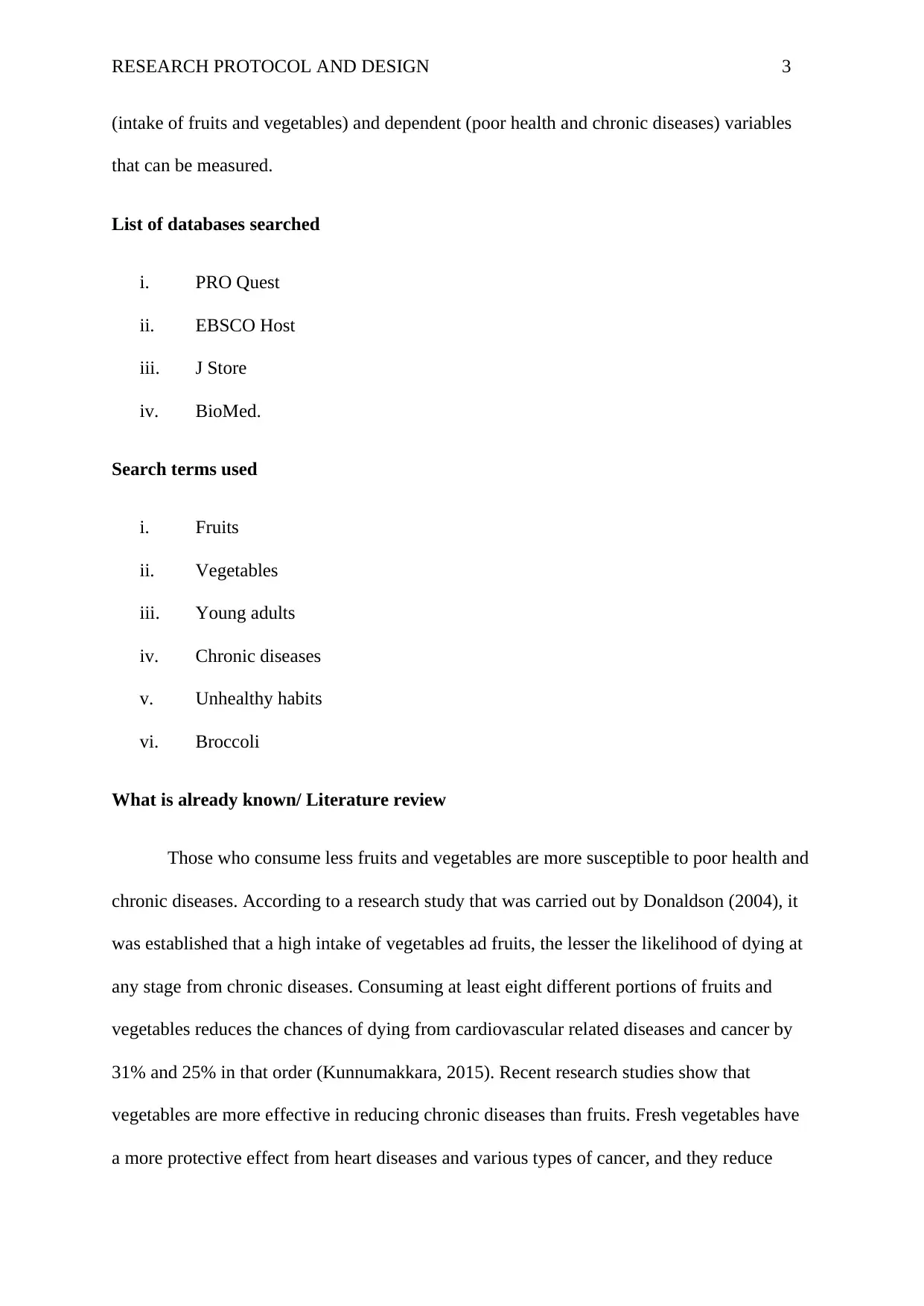
(intake of fruits and vegetables) and dependent (poor health and chronic diseases) variables
that can be measured.
List of databases searched
i. PRO Quest
ii. EBSCO Host
iii. J Store
iv. BioMed.
Search terms used
i. Fruits
ii. Vegetables
iii. Young adults
iv. Chronic diseases
v. Unhealthy habits
vi. Broccoli
What is already known/ Literature review
Those who consume less fruits and vegetables are more susceptible to poor health and
chronic diseases. According to a research study that was carried out by Donaldson (2004), it
was established that a high intake of vegetables ad fruits, the lesser the likelihood of dying at
any stage from chronic diseases. Consuming at least eight different portions of fruits and
vegetables reduces the chances of dying from cardiovascular related diseases and cancer by
31% and 25% in that order (Kunnumakkara, 2015). Recent research studies show that
vegetables are more effective in reducing chronic diseases than fruits. Fresh vegetables have
a more protective effect from heart diseases and various types of cancer, and they reduce
(intake of fruits and vegetables) and dependent (poor health and chronic diseases) variables
that can be measured.
List of databases searched
i. PRO Quest
ii. EBSCO Host
iii. J Store
iv. BioMed.
Search terms used
i. Fruits
ii. Vegetables
iii. Young adults
iv. Chronic diseases
v. Unhealthy habits
vi. Broccoli
What is already known/ Literature review
Those who consume less fruits and vegetables are more susceptible to poor health and
chronic diseases. According to a research study that was carried out by Donaldson (2004), it
was established that a high intake of vegetables ad fruits, the lesser the likelihood of dying at
any stage from chronic diseases. Consuming at least eight different portions of fruits and
vegetables reduces the chances of dying from cardiovascular related diseases and cancer by
31% and 25% in that order (Kunnumakkara, 2015). Recent research studies show that
vegetables are more effective in reducing chronic diseases than fruits. Fresh vegetables have
a more protective effect from heart diseases and various types of cancer, and they reduce
⊘ This is a preview!⊘
Do you want full access?
Subscribe today to unlock all pages.

Trusted by 1+ million students worldwide
RESEARCH PROTOCOL AND DESIGN 4
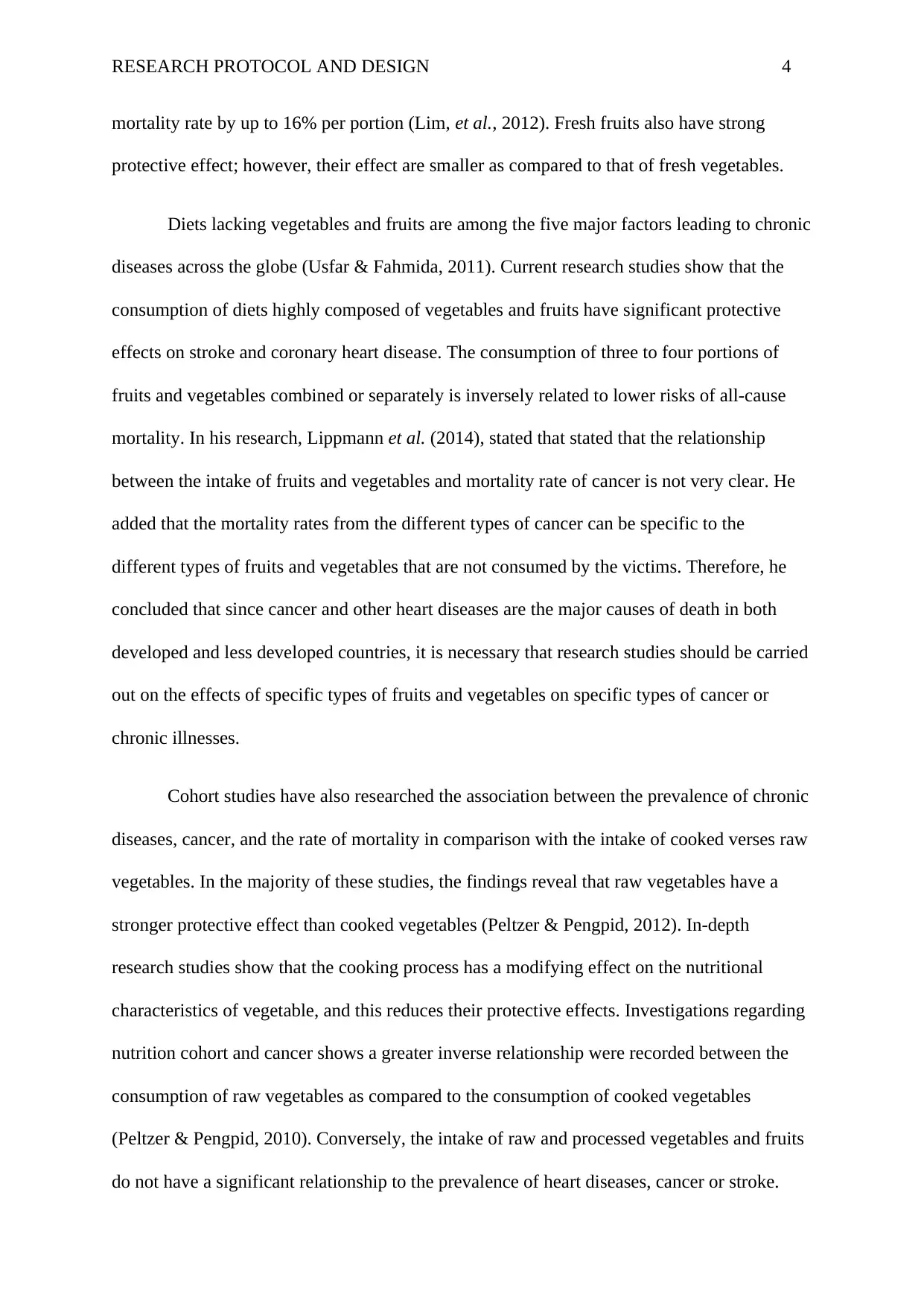
mortality rate by up to 16% per portion (Lim, et al., 2012). Fresh fruits also have strong
protective effect; however, their effect are smaller as compared to that of fresh vegetables.
Diets lacking vegetables and fruits are among the five major factors leading to chronic
diseases across the globe (Usfar & Fahmida, 2011). Current research studies show that the
consumption of diets highly composed of vegetables and fruits have significant protective
effects on stroke and coronary heart disease. The consumption of three to four portions of
fruits and vegetables combined or separately is inversely related to lower risks of all-cause
mortality. In his research, Lippmann et al. (2014), stated that stated that the relationship
between the intake of fruits and vegetables and mortality rate of cancer is not very clear. He
added that the mortality rates from the different types of cancer can be specific to the
different types of fruits and vegetables that are not consumed by the victims. Therefore, he
concluded that since cancer and other heart diseases are the major causes of death in both
developed and less developed countries, it is necessary that research studies should be carried
out on the effects of specific types of fruits and vegetables on specific types of cancer or
chronic illnesses.
Cohort studies have also researched the association between the prevalence of chronic
diseases, cancer, and the rate of mortality in comparison with the intake of cooked verses raw
vegetables. In the majority of these studies, the findings reveal that raw vegetables have a
stronger protective effect than cooked vegetables (Peltzer & Pengpid, 2012). In-depth
research studies show that the cooking process has a modifying effect on the nutritional
characteristics of vegetable, and this reduces their protective effects. Investigations regarding
nutrition cohort and cancer shows a greater inverse relationship were recorded between the
consumption of raw vegetables as compared to the consumption of cooked vegetables
(Peltzer & Pengpid, 2010). Conversely, the intake of raw and processed vegetables and fruits
do not have a significant relationship to the prevalence of heart diseases, cancer or stroke.
mortality rate by up to 16% per portion (Lim, et al., 2012). Fresh fruits also have strong
protective effect; however, their effect are smaller as compared to that of fresh vegetables.
Diets lacking vegetables and fruits are among the five major factors leading to chronic
diseases across the globe (Usfar & Fahmida, 2011). Current research studies show that the
consumption of diets highly composed of vegetables and fruits have significant protective
effects on stroke and coronary heart disease. The consumption of three to four portions of
fruits and vegetables combined or separately is inversely related to lower risks of all-cause
mortality. In his research, Lippmann et al. (2014), stated that stated that the relationship
between the intake of fruits and vegetables and mortality rate of cancer is not very clear. He
added that the mortality rates from the different types of cancer can be specific to the
different types of fruits and vegetables that are not consumed by the victims. Therefore, he
concluded that since cancer and other heart diseases are the major causes of death in both
developed and less developed countries, it is necessary that research studies should be carried
out on the effects of specific types of fruits and vegetables on specific types of cancer or
chronic illnesses.
Cohort studies have also researched the association between the prevalence of chronic
diseases, cancer, and the rate of mortality in comparison with the intake of cooked verses raw
vegetables. In the majority of these studies, the findings reveal that raw vegetables have a
stronger protective effect than cooked vegetables (Peltzer & Pengpid, 2012). In-depth
research studies show that the cooking process has a modifying effect on the nutritional
characteristics of vegetable, and this reduces their protective effects. Investigations regarding
nutrition cohort and cancer shows a greater inverse relationship were recorded between the
consumption of raw vegetables as compared to the consumption of cooked vegetables
(Peltzer & Pengpid, 2010). Conversely, the intake of raw and processed vegetables and fruits
do not have a significant relationship to the prevalence of heart diseases, cancer or stroke.
Paraphrase This Document
Need a fresh take? Get an instant paraphrase of this document with our AI Paraphraser
RESEARCH PROTOCOL AND DESIGN 5
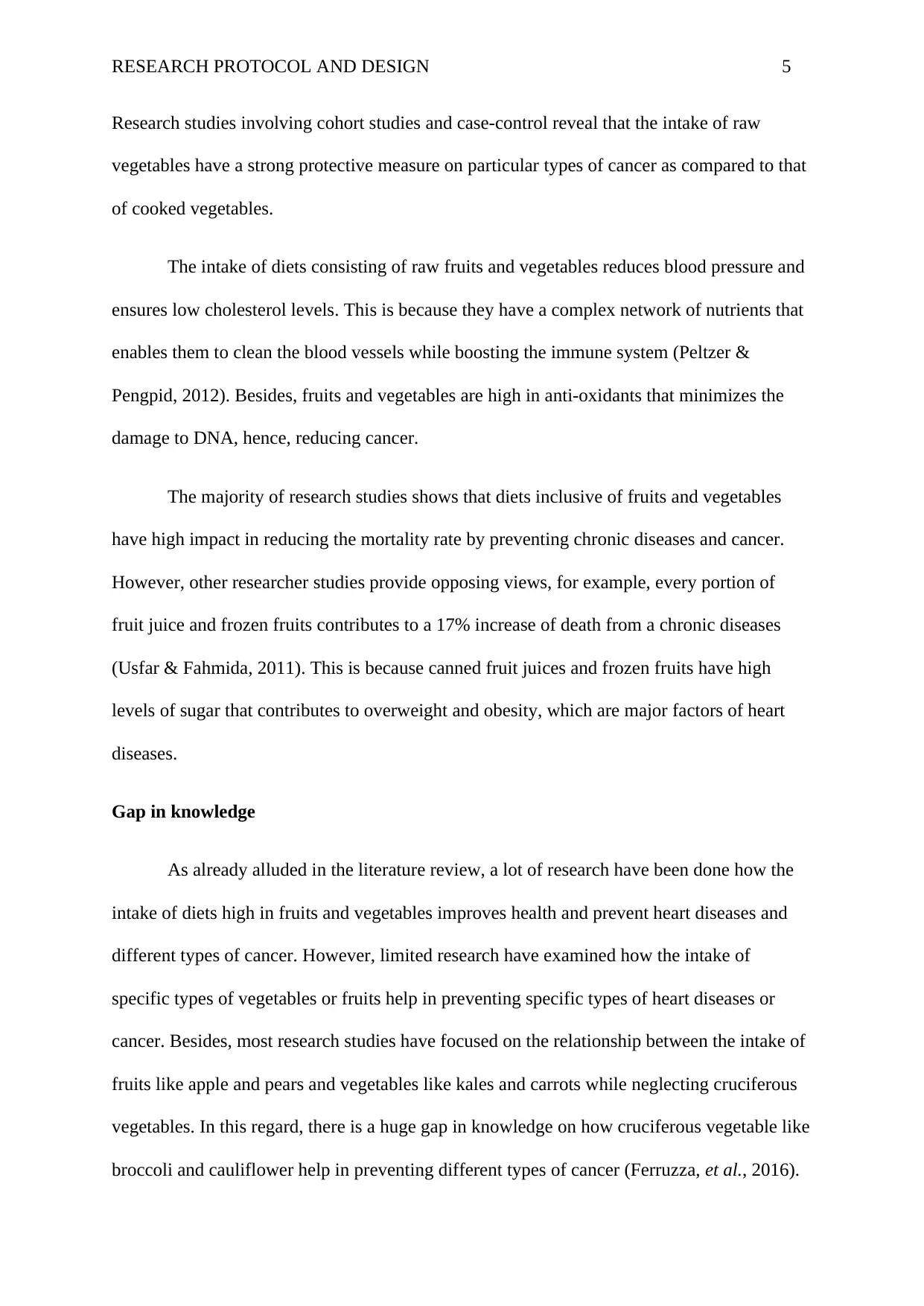
Research studies involving cohort studies and case-control reveal that the intake of raw
vegetables have a strong protective measure on particular types of cancer as compared to that
of cooked vegetables.
The intake of diets consisting of raw fruits and vegetables reduces blood pressure and
ensures low cholesterol levels. This is because they have a complex network of nutrients that
enables them to clean the blood vessels while boosting the immune system (Peltzer &
Pengpid, 2012). Besides, fruits and vegetables are high in anti-oxidants that minimizes the
damage to DNA, hence, reducing cancer.
The majority of research studies shows that diets inclusive of fruits and vegetables
have high impact in reducing the mortality rate by preventing chronic diseases and cancer.
However, other researcher studies provide opposing views, for example, every portion of
fruit juice and frozen fruits contributes to a 17% increase of death from a chronic diseases
(Usfar & Fahmida, 2011). This is because canned fruit juices and frozen fruits have high
levels of sugar that contributes to overweight and obesity, which are major factors of heart
diseases.
Gap in knowledge
As already alluded in the literature review, a lot of research have been done how the
intake of diets high in fruits and vegetables improves health and prevent heart diseases and
different types of cancer. However, limited research have examined how the intake of
specific types of vegetables or fruits help in preventing specific types of heart diseases or
cancer. Besides, most research studies have focused on the relationship between the intake of
fruits like apple and pears and vegetables like kales and carrots while neglecting cruciferous
vegetables. In this regard, there is a huge gap in knowledge on how cruciferous vegetable like
broccoli and cauliflower help in preventing different types of cancer (Ferruzza, et al., 2016).
Research studies involving cohort studies and case-control reveal that the intake of raw
vegetables have a strong protective measure on particular types of cancer as compared to that
of cooked vegetables.
The intake of diets consisting of raw fruits and vegetables reduces blood pressure and
ensures low cholesterol levels. This is because they have a complex network of nutrients that
enables them to clean the blood vessels while boosting the immune system (Peltzer &
Pengpid, 2012). Besides, fruits and vegetables are high in anti-oxidants that minimizes the
damage to DNA, hence, reducing cancer.
The majority of research studies shows that diets inclusive of fruits and vegetables
have high impact in reducing the mortality rate by preventing chronic diseases and cancer.
However, other researcher studies provide opposing views, for example, every portion of
fruit juice and frozen fruits contributes to a 17% increase of death from a chronic diseases
(Usfar & Fahmida, 2011). This is because canned fruit juices and frozen fruits have high
levels of sugar that contributes to overweight and obesity, which are major factors of heart
diseases.
Gap in knowledge
As already alluded in the literature review, a lot of research have been done how the
intake of diets high in fruits and vegetables improves health and prevent heart diseases and
different types of cancer. However, limited research have examined how the intake of
specific types of vegetables or fruits help in preventing specific types of heart diseases or
cancer. Besides, most research studies have focused on the relationship between the intake of
fruits like apple and pears and vegetables like kales and carrots while neglecting cruciferous
vegetables. In this regard, there is a huge gap in knowledge on how cruciferous vegetable like
broccoli and cauliflower help in preventing different types of cancer (Ferruzza, et al., 2016).
RESEARCH PROTOCOL AND DESIGN 6
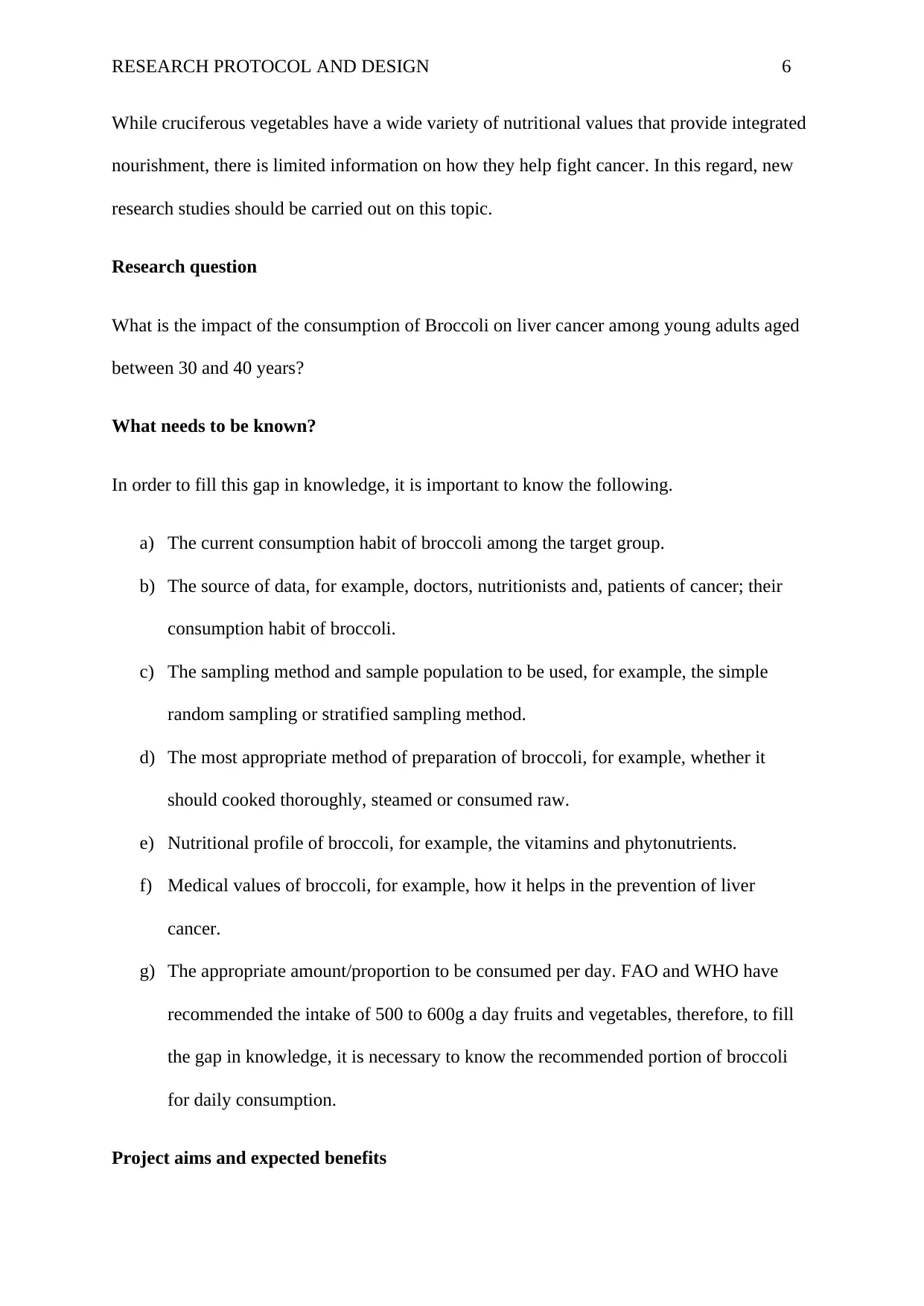
While cruciferous vegetables have a wide variety of nutritional values that provide integrated
nourishment, there is limited information on how they help fight cancer. In this regard, new
research studies should be carried out on this topic.
Research question
What is the impact of the consumption of Broccoli on liver cancer among young adults aged
between 30 and 40 years?
What needs to be known?
In order to fill this gap in knowledge, it is important to know the following.
a) The current consumption habit of broccoli among the target group.
b) The source of data, for example, doctors, nutritionists and, patients of cancer; their
consumption habit of broccoli.
c) The sampling method and sample population to be used, for example, the simple
random sampling or stratified sampling method.
d) The most appropriate method of preparation of broccoli, for example, whether it
should cooked thoroughly, steamed or consumed raw.
e) Nutritional profile of broccoli, for example, the vitamins and phytonutrients.
f) Medical values of broccoli, for example, how it helps in the prevention of liver
cancer.
g) The appropriate amount/proportion to be consumed per day. FAO and WHO have
recommended the intake of 500 to 600g a day fruits and vegetables, therefore, to fill
the gap in knowledge, it is necessary to know the recommended portion of broccoli
for daily consumption.
Project aims and expected benefits
While cruciferous vegetables have a wide variety of nutritional values that provide integrated
nourishment, there is limited information on how they help fight cancer. In this regard, new
research studies should be carried out on this topic.
Research question
What is the impact of the consumption of Broccoli on liver cancer among young adults aged
between 30 and 40 years?
What needs to be known?
In order to fill this gap in knowledge, it is important to know the following.
a) The current consumption habit of broccoli among the target group.
b) The source of data, for example, doctors, nutritionists and, patients of cancer; their
consumption habit of broccoli.
c) The sampling method and sample population to be used, for example, the simple
random sampling or stratified sampling method.
d) The most appropriate method of preparation of broccoli, for example, whether it
should cooked thoroughly, steamed or consumed raw.
e) Nutritional profile of broccoli, for example, the vitamins and phytonutrients.
f) Medical values of broccoli, for example, how it helps in the prevention of liver
cancer.
g) The appropriate amount/proportion to be consumed per day. FAO and WHO have
recommended the intake of 500 to 600g a day fruits and vegetables, therefore, to fill
the gap in knowledge, it is necessary to know the recommended portion of broccoli
for daily consumption.
Project aims and expected benefits
⊘ This is a preview!⊘
Do you want full access?
Subscribe today to unlock all pages.
Trusted by 1+ million students worldwide
RESEARCH PROTOCOL AND DESIGN 7
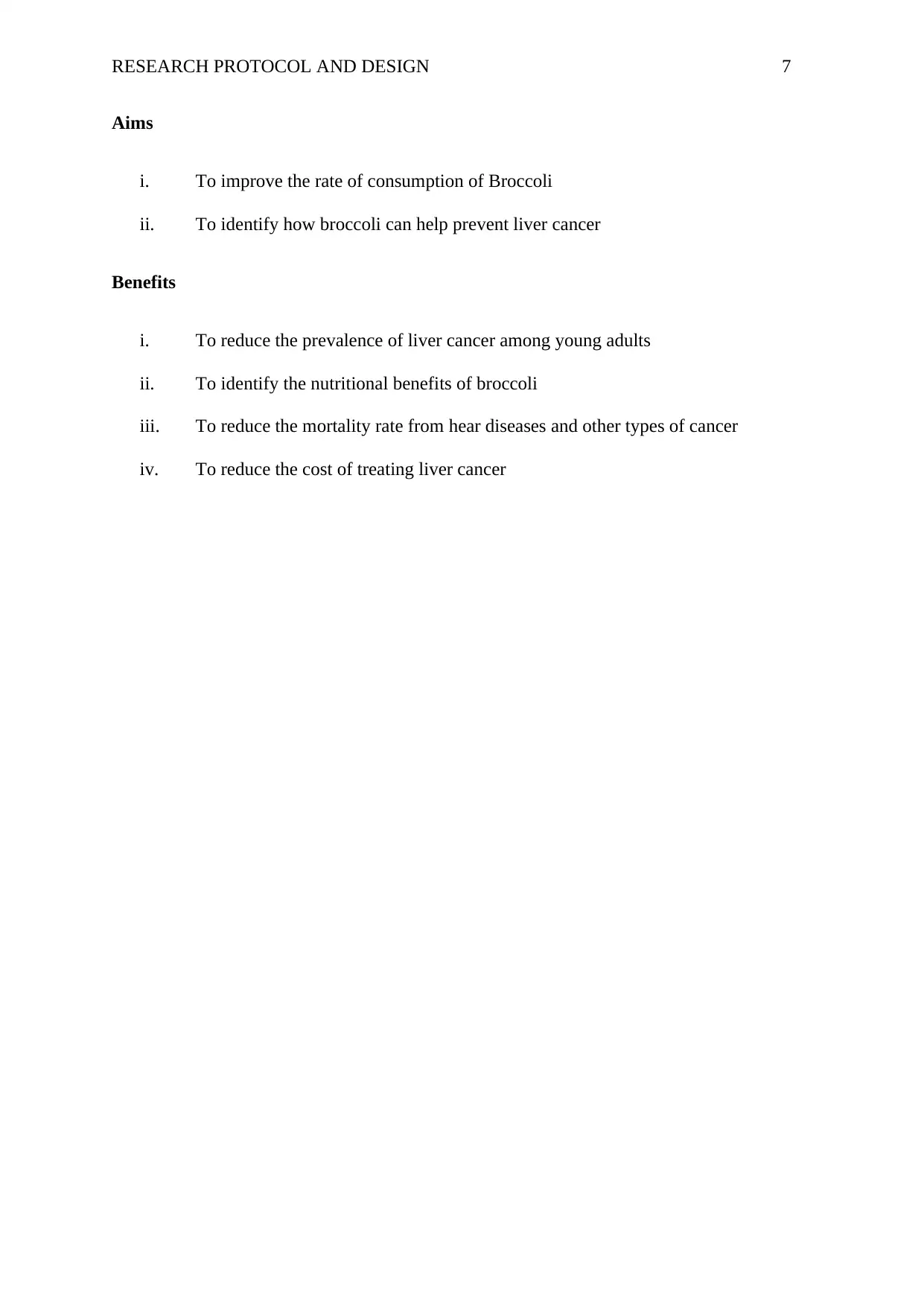
Aims
i. To improve the rate of consumption of Broccoli
ii. To identify how broccoli can help prevent liver cancer
Benefits
i. To reduce the prevalence of liver cancer among young adults
ii. To identify the nutritional benefits of broccoli
iii. To reduce the mortality rate from hear diseases and other types of cancer
iv. To reduce the cost of treating liver cancer
Aims
i. To improve the rate of consumption of Broccoli
ii. To identify how broccoli can help prevent liver cancer
Benefits
i. To reduce the prevalence of liver cancer among young adults
ii. To identify the nutritional benefits of broccoli
iii. To reduce the mortality rate from hear diseases and other types of cancer
iv. To reduce the cost of treating liver cancer
Paraphrase This Document
Need a fresh take? Get an instant paraphrase of this document with our AI Paraphraser
RESEARCH PROTOCOL AND DESIGN 8
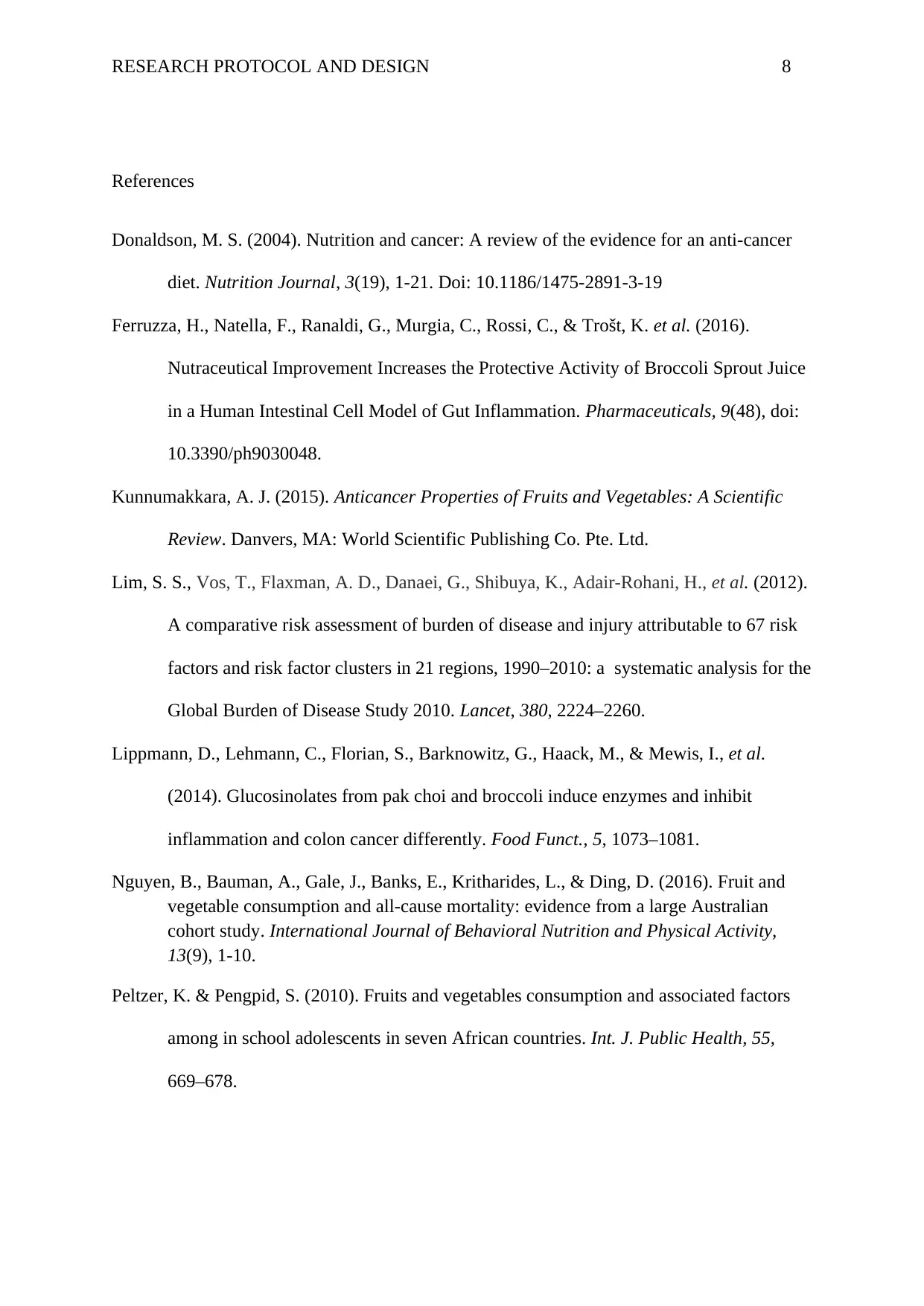
References
Donaldson, M. S. (2004). Nutrition and cancer: A review of the evidence for an anti-cancer
diet. Nutrition Journal, 3(19), 1-21. Doi: 10.1186/1475-2891-3-19
Ferruzza, H., Natella, F., Ranaldi, G., Murgia, C., Rossi, C., & Trošt, K. et al. (2016).
Nutraceutical Improvement Increases the Protective Activity of Broccoli Sprout Juice
in a Human Intestinal Cell Model of Gut Inflammation. Pharmaceuticals, 9(48), doi:
10.3390/ph9030048.
Kunnumakkara, A. J. (2015). Anticancer Properties of Fruits and Vegetables: A Scientific
Review. Danvers, MA: World Scientific Publishing Co. Pte. Ltd.
Lim, S. S., Vos, T., Flaxman, A. D., Danaei, G., Shibuya, K., Adair-Rohani, H., et al. (2012).
A comparative risk assessment of burden of disease and injury attributable to 67 risk
factors and risk factor clusters in 21 regions, 1990–2010: a systematic analysis for the
Global Burden of Disease Study 2010. Lancet, 380, 2224–2260.
Lippmann, D., Lehmann, C., Florian, S., Barknowitz, G., Haack, M., & Mewis, I., et al.
(2014). Glucosinolates from pak choi and broccoli induce enzymes and inhibit
inflammation and colon cancer differently. Food Funct., 5, 1073–1081.
Nguyen, B., Bauman, A., Gale, J., Banks, E., Kritharides, L., & Ding, D. (2016). Fruit and
vegetable consumption and all-cause mortality: evidence from a large Australian
cohort study. International Journal of Behavioral Nutrition and Physical Activity,
13(9), 1-10.
Peltzer, K. & Pengpid, S. (2010). Fruits and vegetables consumption and associated factors
among in school adolescents in seven African countries. Int. J. Public Health, 55,
669–678.
References
Donaldson, M. S. (2004). Nutrition and cancer: A review of the evidence for an anti-cancer
diet. Nutrition Journal, 3(19), 1-21. Doi: 10.1186/1475-2891-3-19
Ferruzza, H., Natella, F., Ranaldi, G., Murgia, C., Rossi, C., & Trošt, K. et al. (2016).
Nutraceutical Improvement Increases the Protective Activity of Broccoli Sprout Juice
in a Human Intestinal Cell Model of Gut Inflammation. Pharmaceuticals, 9(48), doi:
10.3390/ph9030048.
Kunnumakkara, A. J. (2015). Anticancer Properties of Fruits and Vegetables: A Scientific
Review. Danvers, MA: World Scientific Publishing Co. Pte. Ltd.
Lim, S. S., Vos, T., Flaxman, A. D., Danaei, G., Shibuya, K., Adair-Rohani, H., et al. (2012).
A comparative risk assessment of burden of disease and injury attributable to 67 risk
factors and risk factor clusters in 21 regions, 1990–2010: a systematic analysis for the
Global Burden of Disease Study 2010. Lancet, 380, 2224–2260.
Lippmann, D., Lehmann, C., Florian, S., Barknowitz, G., Haack, M., & Mewis, I., et al.
(2014). Glucosinolates from pak choi and broccoli induce enzymes and inhibit
inflammation and colon cancer differently. Food Funct., 5, 1073–1081.
Nguyen, B., Bauman, A., Gale, J., Banks, E., Kritharides, L., & Ding, D. (2016). Fruit and
vegetable consumption and all-cause mortality: evidence from a large Australian
cohort study. International Journal of Behavioral Nutrition and Physical Activity,
13(9), 1-10.
Peltzer, K. & Pengpid, S. (2010). Fruits and vegetables consumption and associated factors
among in school adolescents in seven African countries. Int. J. Public Health, 55,
669–678.
RESEARCH PROTOCOL AND DESIGN 9
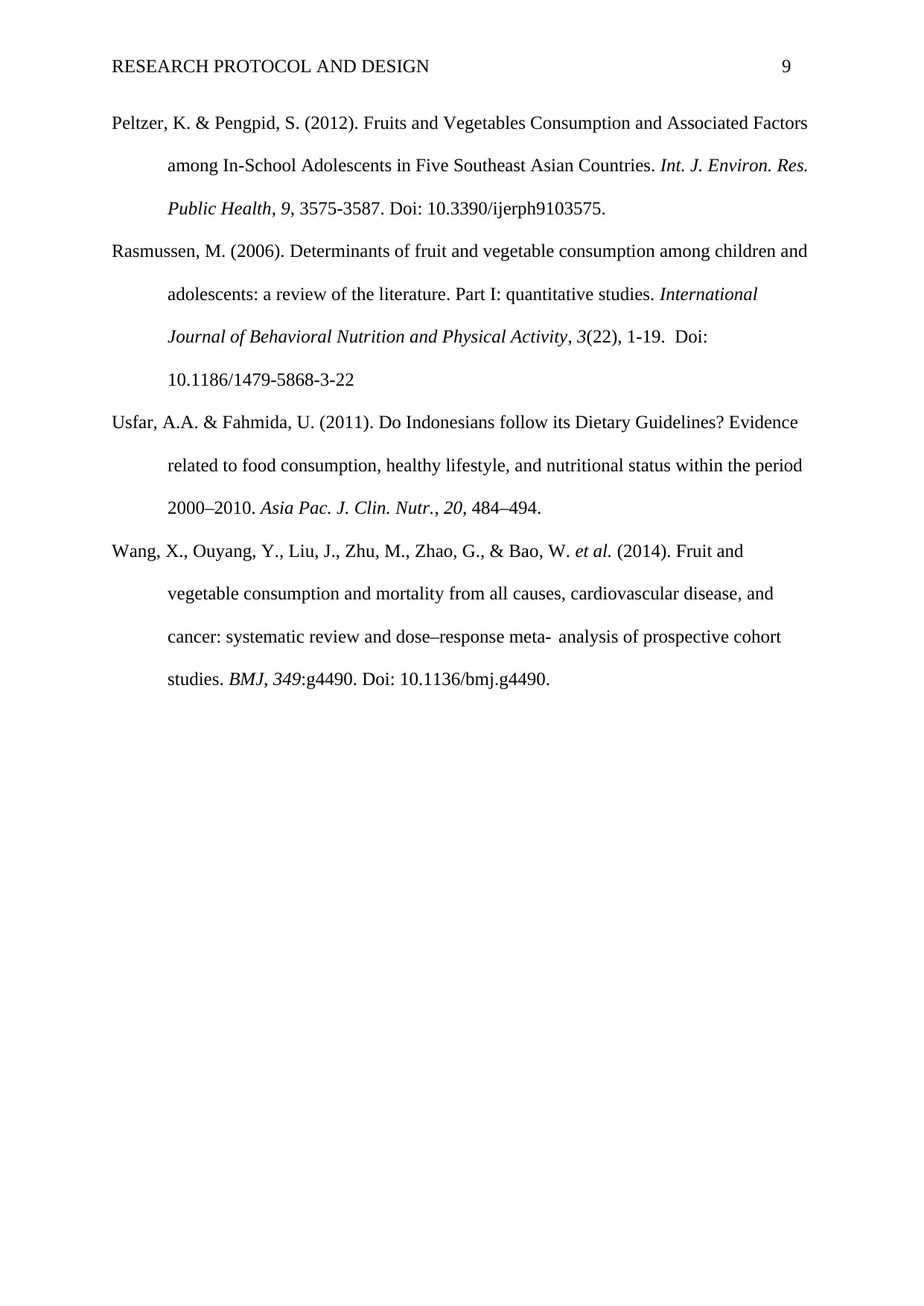
Peltzer, K. & Pengpid, S. (2012). Fruits and Vegetables Consumption and Associated Factors
among In-School Adolescents in Five Southeast Asian Countries. Int. J. Environ. Res.
Public Health, 9, 3575-3587. Doi: 10.3390/ijerph9103575.
Rasmussen, M. (2006). Determinants of fruit and vegetable consumption among children and
adolescents: a review of the literature. Part I: quantitative studies. International
Journal of Behavioral Nutrition and Physical Activity, 3(22), 1-19. Doi:
10.1186/1479-5868-3-22
Usfar, A.A. & Fahmida, U. (2011). Do Indonesians follow its Dietary Guidelines? Evidence
related to food consumption, healthy lifestyle, and nutritional status within the period
2000–2010. Asia Pac. J. Clin. Nutr., 20, 484–494.
Wang, X., Ouyang, Y., Liu, J., Zhu, M., Zhao, G., & Bao, W. et al. (2014). Fruit and
vegetable consumption and mortality from all causes, cardiovascular disease, and
cancer: systematic review and dose–response meta- analysis of prospective cohort
studies. BMJ, 349:g4490. Doi: 10.1136/bmj.g4490.
Peltzer, K. & Pengpid, S. (2012). Fruits and Vegetables Consumption and Associated Factors
among In-School Adolescents in Five Southeast Asian Countries. Int. J. Environ. Res.
Public Health, 9, 3575-3587. Doi: 10.3390/ijerph9103575.
Rasmussen, M. (2006). Determinants of fruit and vegetable consumption among children and
adolescents: a review of the literature. Part I: quantitative studies. International
Journal of Behavioral Nutrition and Physical Activity, 3(22), 1-19. Doi:
10.1186/1479-5868-3-22
Usfar, A.A. & Fahmida, U. (2011). Do Indonesians follow its Dietary Guidelines? Evidence
related to food consumption, healthy lifestyle, and nutritional status within the period
2000–2010. Asia Pac. J. Clin. Nutr., 20, 484–494.
Wang, X., Ouyang, Y., Liu, J., Zhu, M., Zhao, G., & Bao, W. et al. (2014). Fruit and
vegetable consumption and mortality from all causes, cardiovascular disease, and
cancer: systematic review and dose–response meta- analysis of prospective cohort
studies. BMJ, 349:g4490. Doi: 10.1136/bmj.g4490.
⊘ This is a preview!⊘
Do you want full access?
Subscribe today to unlock all pages.
Trusted by 1+ million students worldwide

1 out of 9


Related Documents


Your All-in-One AI-Powered Toolkit for Academic Success.
+13062052269
info@desklib.com
Available 24*7 on WhatsApp / Email
![[object Object]](/_next/static/media/star-bottom.7253800d.svg)
Unlock your academic potential
Copyright © 2020–2026 A2Z Services. All Rights Reserved. Developed and managed by ZUCOL.