401080 Research Protocol: Menopause Symptoms, Culture & Management

Verified

Added on  2023/06/15

|7
|1878
|185
Report
AI Summary
This research report delves into various aspects of menopause, including its definition, epidemiology, and the physiological processes involved. It explores cultural variations and traditional beliefs surrounding menopause, highlighting differences in symptom experiences across cultures. The report discusses both early and late symptoms, pharmacological and non-pharmacological interventions, and the relationship between menopause and cancer risks. It also addresses the knowledge gap concerning the diverse symptoms and the need for further research into the causes, specificity, and prognosis of menopause across different ethnicities and locations. The research aims to improve women's health by addressing misconceptions, increasing public awareness, and improving symptom management during menopause. The research questions focus on the impact of miscellaneous symptoms, cultural differences in menopause experiences, and effective management strategies, emphasizing the importance of public awareness and non-pharmacological approaches.
Document Page
Running head: Menopause 1
Menopause
(Author’s name)
(Institutional Affiliation)
tabler-icon-diamond-filled.svg

Paraphrase This Document

Need a fresh take? Get an instant paraphrase of this document with our AI Paraphraser
Document Page
Menopause 2
Menopause
Research problem
The aim of this study is to explore and discuss details of various aspects of the
menopause period. These include the definition, epidemiology, physiology behind the process,
cultural variations and various traditions and beliefs associated with the period (Alvis & S,
2013). In addition to that this research seeks to discuss early and short-term symptoms, late and
long-term symptoms, both nonpharmacological and pharmacological interventions plus
menopause relations to cancer (Alvis & S, 2013).
Background information
According to the International Menopause Society in 5th March 2018, at National
Conference of the Indian Menopausal Society, the term menopause is elaborated as cessation or
a period where menstrual periods stop following twelve consecutive months due to loss of
female reproductive follicular activity of which there is the absence of both physiological and
pathological cause (Tomkins, 2018). The World Health Organization (WHO) describes the
physiology of menopause period to be divided into three major parts. These include peri-
menopause, menopause and post-menopause (Nendaz, 2014).
Peri-menopause is the period prior to menopause transition begins which involves at least
one year after menopause (Tomkins, 2018). This is the time where various aspects of hormonal,
physical clinical characteristics and biological changes start to portray ("The Menopause Years",
2015). On the other hand, pre-menopause mostly refer to three to four years before menopause
(Nendaz, 2014). During the whole process, various physiological changes occur. First, there is a
decrease in ovarian functions that lead to irregular menstrual cycles. This leads to increase in
Document Page
Menopause 3
poor feedback to the pituitary gland and hypothalamus as a result of a decrease in hormones
productions (Tomkins, 2018). The progesterone levels fall bit by bit but estrogen levels fall
drastically (Tomkins, 2018).
Due to these processes, the intervals between the menstrual cycles shorten as well as the
follicular phases which increase the menstrual distribution distance as a result of long inter-
menstrual intervals ("The Menopause Years", 2015). During the process of cessation, the
gonadotrophins and steroid hormones change drastically although the production remains until
the age of sixty-five years. Specifically, the estradiol hormones levels decreases and the follicle
stimulating hormones increase (Nendaz, 2014). However, as the age goes by progesterone and
estrogens ceases being produced but about half levels of aldosterone continues to be produced
(Tomkins, 2018).
The menopause period has been drastically been related to various multicultural and
traditional variations (Sievert, 2013). Differences in cultures have been the major issues affecting
the menopause periods in terms of how the whole process is viewed (Sievert, 2013). Cultures
that have negative attitudes towards menopause stage end up having more menopause symptoms
being reported as compared to those who have positive attitudes and perceptions (Sievert, 2013).
Some of the positive attitudes include physical exercises, appropriate diet, and proper medical
care. A study by WHO in 2015 indicated that in the culture of The United States of America,
women are supposed to be in menopause between the age of forty years and the age of fifty-five
years (Sievert, 2013). In Japan and China, women are less likely to exhibit more symptoms as
compared to African who more are likely to experience more hot flashes (Alvis & S, 2013). The
study concluded that there is a big gap and a lot of variation when comparing different cultures
and behaviors when it comes to menopause period (Alvis & S, 2013).
Document Page
Menopause 4
One of the major short-term symptoms of menopause especially at peri-menopause
period is irregular bleeding (Freedman, 2014). The study indicated that most of the women
experience irregular menses at a gap of one to ten years of length before the menopause. Most of
these episodes of bleeding normally occur in more than twenty-one days for the heavy bleeding
and the rest in two to ten days following periods of amenorrhea (Alvis & S, 2013).The other
most common symptom is hot flashes (Alvis & S, 2013). Hot flashes have been reported to occur
in about 75 percent of all women undergoing menopause. Various risk factors like smoking, lack
of physical exercises, obesity, depressions, poor physical health, poor dieting, alcoholism,
caffeine and climatic changes have been associated with hot flashes (Freedman, 2014). However,
about 10 to 20 percent of women experiencing hot flashes have been caused by unknown origins
(Alvis & S, 2013). Other symptoms include genitourinary symptoms mostly due to hormonal
changes and depression due to psychological distress (Alvis & S, 2013).
The long-term symptoms affect the great percentage of women after menopause period.
A study was done in 2002 by WHO indicated that about 7.7 million women develop osteoporosis
due to menopause when they reach an age of around 50 year ("Menopause", 2012)s. The same
study indicated that about 21.8 millions of women in the USA develop osteopenia of which the
number was projected to increase by 10.5 million by the year 2020 ("Menopause", 2012). In
Europe and other developed countries, most women die due to cardiovascular diseases when they
grow old than men (Nendaz, 2014). What the physicians assume is that the delay in coronary
diseases in women has been attributed due to the fact that estrogen has beneficial effects in the
circulation before menopaus (Nendaz, 2014)e.
Management of women in menopause should go hand in hand with public health
education, awareness and counseling ("Nonhormonal management of menopause-associated
tabler-icon-diamond-filled.svg

Paraphrase This Document

Need a fresh take? Get an instant paraphrase of this document with our AI Paraphraser
Document Page
Menopause 5
vasomotor symptoms", 2015). Psychological assurance has proved to bring better results other
than pharmacological medications only. Other than that, the treatment and management should
include a well-detailed health history especially menstrual history and review of systems
("Nonhormonal management of menopause-associated vasomotor symptoms", 2015). Most of
the symptoms of bleeding and hot rashes are treated by estrogen since the symptoms are
primarily brought by hormonal imbalances ("Menopause;Diagnosis and management", 2015).
Behavioral techniques like physical exercises and proper diet have also demonstrated great
progress ("Menopause;Diagnosis and management", 2015). Patient education on the aggravating
factors like smoking, alcoholism and increase intake of caffeine have also led to better
improvements ("Menopause;Diagnosis and management", 2015).
The gap in the Knowledge
Due to cultural variations, many misconceptions about the exact trend have been
avoided. More research needs to be done to address the issue (Pines, 2013). The causes,
specificity of trends and prognosis of treatment and management in various location, races and
ethnic communities should be looked into to reduce the occurrence of various symptoms like hot
rashes in African women ("Nonhormonal management of menopause-associated vasomotor
symptoms", 2015). Other than that, public awareness and counseling of women and community
at large should be put on the first level of management other than focusing too much on
pharmacological interventions. There are various miscellaneous symptoms which have been
associated with menopause period. Most of these symptoms occur in almost all women
undergoing menopause but unfortunately, these have never been looked into (Pines, 2013).
These symptoms include feeling fatigued, palpitations, change in bowel habits, headaches, poor
skin integrity, chest pains and increase joint pains (Pines, 2013). I
Document Page
Menopause 6
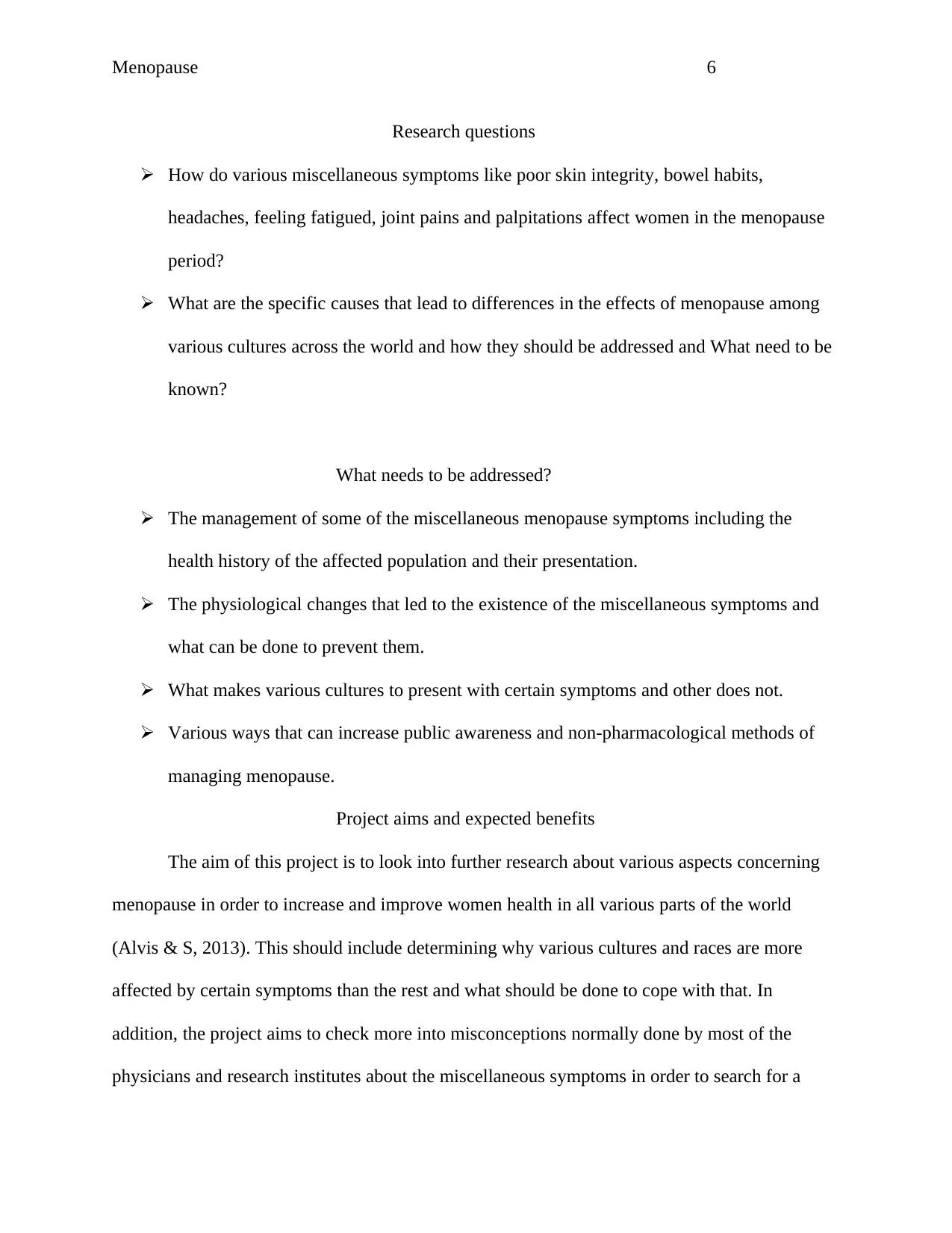
Research questions
How do various miscellaneous symptoms like poor skin integrity, bowel habits,
headaches, feeling fatigued, joint pains and palpitations affect women in the menopause
period?
What are the specific causes that lead to differences in the effects of menopause among
various cultures across the world and how they should be addressed and What need to be
known?
What needs to be addressed?
The management of some of the miscellaneous menopause symptoms including the
health history of the affected population and their presentation.
The physiological changes that led to the existence of the miscellaneous symptoms and
what can be done to prevent them.
What makes various cultures to present with certain symptoms and other does not.
Various ways that can increase public awareness and non-pharmacological methods of
managing menopause.
Project aims and expected benefits
The aim of this project is to look into further research about various aspects concerning
menopause in order to increase and improve women health in all various parts of the world
(Alvis & S, 2013). This should include determining why various cultures and races are more
affected by certain symptoms than the rest and what should be done to cope with that. In
addition, the project aims to check more into misconceptions normally done by most of the
physicians and research institutes about the miscellaneous symptoms in order to search for a
Document Page
Menopause 7
better way of symptoms management can be improved during the menopause period (Alvis & S,
2013).
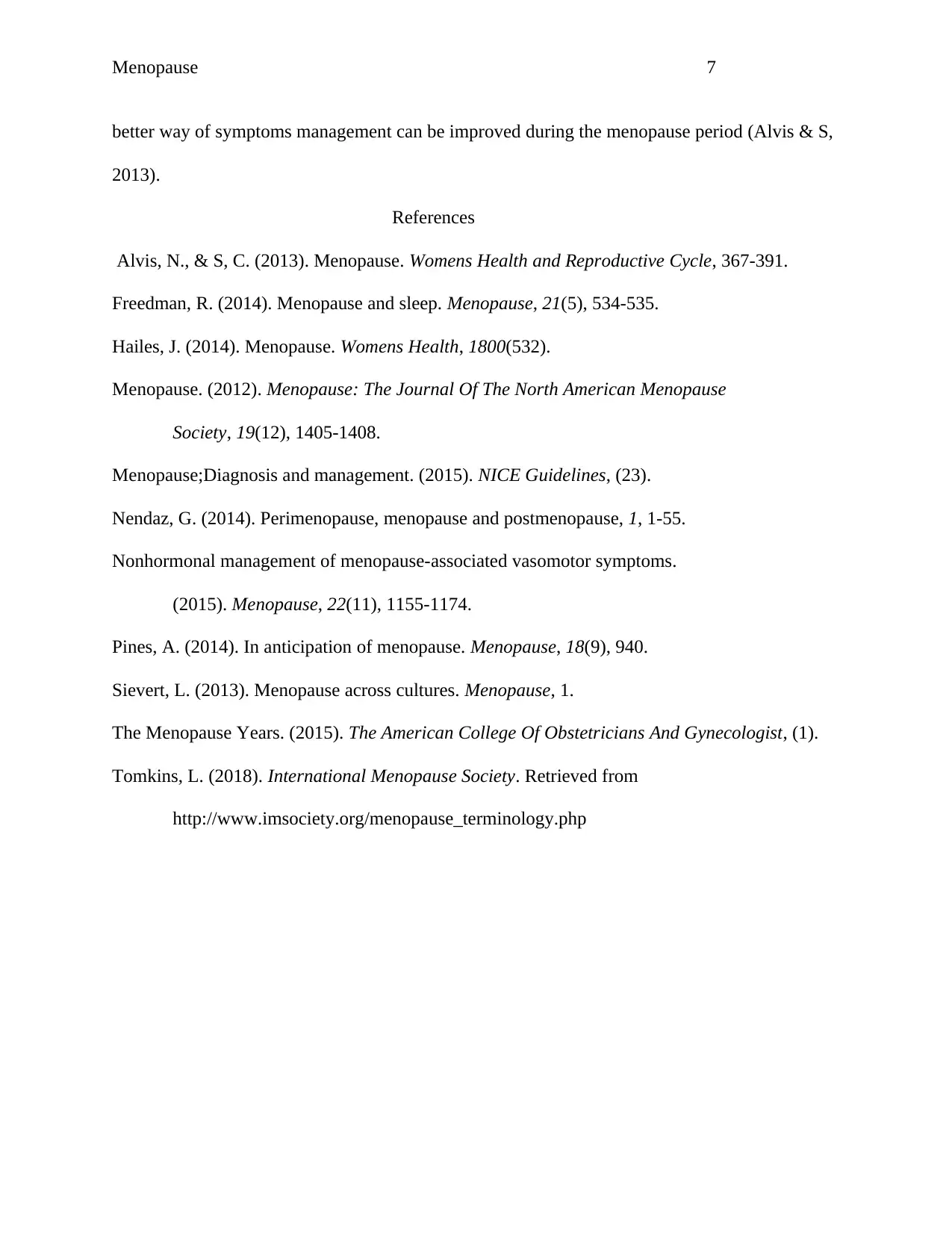
References
Alvis, N., & S, C. (2013). Menopause. Womens Health and Reproductive Cycle, 367-391.
Freedman, R. (2014). Menopause and sleep. Menopause, 21(5), 534-535.
Hailes, J. (2014). Menopause. Womens Health, 1800(532).
Menopause. (2012). Menopause: The Journal Of The North American Menopause
Society, 19(12), 1405-1408.
Menopause;Diagnosis and management. (2015). NICE Guidelines, (23).
Nendaz, G. (2014). Perimenopause, menopause and postmenopause, 1, 1-55.
Nonhormonal management of menopause-associated vasomotor symptoms.
(2015). Menopause, 22(11), 1155-1174.
Pines, A. (2014). In anticipation of menopause. Menopause, 18(9), 940.
Sievert, L. (2013). Menopause across cultures. Menopause, 1.
The Menopause Years. (2015). The American College Of Obstetricians And Gynecologist, (1).
Tomkins, L. (2018). International Menopause Society. Retrieved from
http://www.imsociety.org/menopause_terminology.php
chevron_up_icon
1 out of 7
circle_padding
hide_on_mobile
zoom_out_icon
[object Object]