Contemporary Issues in Sports Management: Research and Analysis Report
VerifiedAdded on 2023/04/22
|9
|2276
|458
Report
AI Summary
This report delves into the contemporary issue of declining live attendance at sports venues, a significant challenge in sports management. It justifies the issue's importance, emphasizing the impact of technological advancements that allow fans to watch events remotely, leading to decreased stadium attendance and potential profit losses. The report formulates a research question, aims, and objectives to analyze factors contributing to declining attendance and explore effective measures to attract more spectators. It critically evaluates four journal articles, discussing methodologies, key findings, and arguments, while highlighting similarities and differences between them. The articles emphasize customer engagement, consumer satisfaction, and team identification as crucial elements. The report also touches on the theoretical frameworks, such as the Transtheoretical model and brand creation theory, that are relevant to understanding audience behavior and suggests that strong relationships with sports consumers are key to addressing the issue.
Running head: CONTEMPORARY ISSUES IN SPORTS MANAGEMENT
CONTEMPORARY ISSUES IN SPORTS MANAGEMENT
Name of the Student
Name of the University
Author Note
CONTEMPORARY ISSUES IN SPORTS MANAGEMENT
Name of the Student
Name of the University
Author Note

Paraphrase This Document
Need a fresh take? Get an instant paraphrase of this document with our AI Paraphraser
1CONTEMPORARY ISSUES IN SPORTS MANAGEMENT
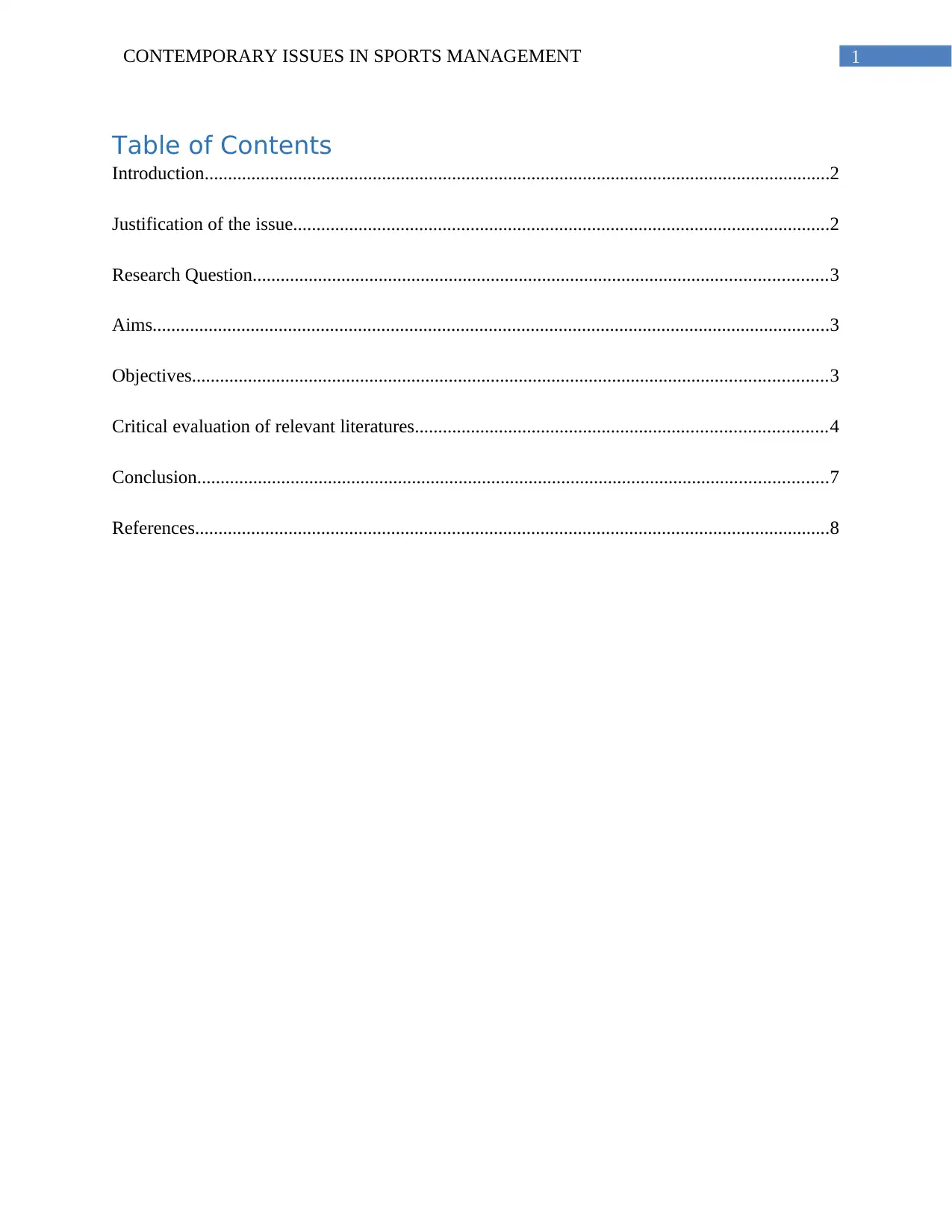
Table of Contents
Introduction......................................................................................................................................2
Justification of the issue...................................................................................................................2
Research Question...........................................................................................................................3
Aims.................................................................................................................................................3
Objectives........................................................................................................................................3
Critical evaluation of relevant literatures........................................................................................4
Conclusion.......................................................................................................................................7
References........................................................................................................................................8
Table of Contents
Introduction......................................................................................................................................2
Justification of the issue...................................................................................................................2
Research Question...........................................................................................................................3
Aims.................................................................................................................................................3
Objectives........................................................................................................................................3
Critical evaluation of relevant literatures........................................................................................4
Conclusion.......................................................................................................................................7
References........................................................................................................................................8
2CONTEMPORARY ISSUES IN SPORTS MANAGEMENT
Introduction
The study is focused on finding a significant issue that is relevant at present times in the
field of sports or event management. Subsequently the study aims to find the various reasons that
make this identified issue worthy of essential research. Sports management is selected as the
contextual basis of the study. The issue in sports management that is selected is the challenge in
actually attracting live audiences to the sports venues at times of rapidly developing information
technology.
Justification of the issue
In sports management research is a vital aspect as it helps to assess the operational
environments of the organizations involved. Research is needed more often in cases of rapidly
developing operational environments. Presently one of the significant challenges being faced by
the sports management organizations are in relation to attracting the larger number of live
audiences to the sport venues. The main reason why this problem has been chosen is its far
reaching potential impact on the sports industry. Present technological advancements have made
it far easier for people to view and follow sports events from the comfort of their homes. Events
can be viewed in multiple devices ranging from television to laptops to smartphones. This has
created a significant lowering of the number of people that actually visit stadiums to view
matches. Hence, significant amounts of potential lowered profits can be witnessed by stadiums in
the future. Attracting live audiences to the sports venues has thus become an import issue in
sports management in the contemporary world. It has been seen over the past few years that
game attendance has been decreasing for various sports events. This is a trend that can be seen in
any sports discipline but more marked in team sports. If major sports events are considered then
the FIFA World Cup 2018 saw a decline in venue attendance by 28% when compared with it
Introduction
The study is focused on finding a significant issue that is relevant at present times in the
field of sports or event management. Subsequently the study aims to find the various reasons that
make this identified issue worthy of essential research. Sports management is selected as the
contextual basis of the study. The issue in sports management that is selected is the challenge in
actually attracting live audiences to the sports venues at times of rapidly developing information
technology.
Justification of the issue
In sports management research is a vital aspect as it helps to assess the operational
environments of the organizations involved. Research is needed more often in cases of rapidly
developing operational environments. Presently one of the significant challenges being faced by
the sports management organizations are in relation to attracting the larger number of live
audiences to the sport venues. The main reason why this problem has been chosen is its far
reaching potential impact on the sports industry. Present technological advancements have made
it far easier for people to view and follow sports events from the comfort of their homes. Events
can be viewed in multiple devices ranging from television to laptops to smartphones. This has
created a significant lowering of the number of people that actually visit stadiums to view
matches. Hence, significant amounts of potential lowered profits can be witnessed by stadiums in
the future. Attracting live audiences to the sports venues has thus become an import issue in
sports management in the contemporary world. It has been seen over the past few years that
game attendance has been decreasing for various sports events. This is a trend that can be seen in
any sports discipline but more marked in team sports. If major sports events are considered then
the FIFA World Cup 2018 saw a decline in venue attendance by 28% when compared with it
⊘ This is a preview!⊘
Do you want full access?
Subscribe today to unlock all pages.

Trusted by 1+ million students worldwide
3CONTEMPORARY ISSUES IN SPORTS MANAGEMENT
attendance figures in 1994 (Damgaard 2019). Similarly, it was found that Basketball, Ice
Hockey, Baseball and Football teams across North America had witnessed a decline of over 10%
attendance over the last decade. Baseball, one of the most popular sports in the US and the world
presently has the lowest attendance figures in 15 years. The issue is not only being caused by the
quicker online access from literally any place with an internet connection but the tendency to
quit following and moving on to other sports among Millenials (Grenier-Hemphill 2015).
Research is required to find how this can be changed though effective methods to improve the
attendance figures greatly in the various sports events in the age of digitization.
Research Question
The research question being considered is how can sports management organizations tackle the
various challenges that are decreasing the number of people visiting sports venues on sports
events?
Aims
The aim of the study is to analyze the various factors that are currently leading to the
decreasing attendance figures across various sports venues and events around the world.
Subsequently, the aim is to explore the various effective measures that can be taken to positively
increase the number of live spectators visiting the stadiums in sports events.
Objectives
To find the various factors leading to decreasing attendance figures in various sports
events
To explore the most effective ways in which people can be attracted to the sports venues
To find out the sports event consumption patterns among the youths and millenials
attendance figures in 1994 (Damgaard 2019). Similarly, it was found that Basketball, Ice
Hockey, Baseball and Football teams across North America had witnessed a decline of over 10%
attendance over the last decade. Baseball, one of the most popular sports in the US and the world
presently has the lowest attendance figures in 15 years. The issue is not only being caused by the
quicker online access from literally any place with an internet connection but the tendency to
quit following and moving on to other sports among Millenials (Grenier-Hemphill 2015).
Research is required to find how this can be changed though effective methods to improve the
attendance figures greatly in the various sports events in the age of digitization.
Research Question
The research question being considered is how can sports management organizations tackle the
various challenges that are decreasing the number of people visiting sports venues on sports
events?
Aims
The aim of the study is to analyze the various factors that are currently leading to the
decreasing attendance figures across various sports venues and events around the world.
Subsequently, the aim is to explore the various effective measures that can be taken to positively
increase the number of live spectators visiting the stadiums in sports events.
Objectives
To find the various factors leading to decreasing attendance figures in various sports
events
To explore the most effective ways in which people can be attracted to the sports venues
To find out the sports event consumption patterns among the youths and millenials
Paraphrase This Document
Need a fresh take? Get an instant paraphrase of this document with our AI Paraphraser
4CONTEMPORARY ISSUES IN SPORTS MANAGEMENT
To explore the various research methods that can be utilized to gain essential information
about the challenges related to attendance of sports venues.
Critical evaluation of relevant literatures
Decreasing attendance in sport venues during sports events have become a major
challenge in the context of contemporary sports management. According to Tsiotsou (2016) it
has now become much important that sports services are optimized in accordance with the
greater goals of organizations incorporating greater customer management. Learning in a
systematic manner about the effective engagement of customers and the employees to create a
more collaborative design of sports services. The article had taken into consideration the present
literatures on the context of sports management to put forward their significant outcomes in
terms of innovative ideas to boost sports management functions. The article is based mostly on
the general aspects that are related to sports management. As opined by Biscaia (2015) the
experiences of spectators becomes very important in determining more attendance at sports
events. The study was conducted on the basis of case studies of some of the most supported sport
clubs across the world. This helped to make the recommendations based on facts that were very
much relevant in the context of contemporary sports management. The findings suggest that the
best strategies that can be implemented to increase stadium attendances are respecting the
emotions of the fans concerning honor of the team; maintenance of high functional quality
standards; creating an environment of aesthetic pleasure; trigger positive emotions among the
spectators and helping the supporters to create favorable opinions of the brand associations of the
favorable team. Better engagement with the supporters were found to be the key to improving
attendance figures.
To explore the various research methods that can be utilized to gain essential information
about the challenges related to attendance of sports venues.
Critical evaluation of relevant literatures
Decreasing attendance in sport venues during sports events have become a major
challenge in the context of contemporary sports management. According to Tsiotsou (2016) it
has now become much important that sports services are optimized in accordance with the
greater goals of organizations incorporating greater customer management. Learning in a
systematic manner about the effective engagement of customers and the employees to create a
more collaborative design of sports services. The article had taken into consideration the present
literatures on the context of sports management to put forward their significant outcomes in
terms of innovative ideas to boost sports management functions. The article is based mostly on
the general aspects that are related to sports management. As opined by Biscaia (2015) the
experiences of spectators becomes very important in determining more attendance at sports
events. The study was conducted on the basis of case studies of some of the most supported sport
clubs across the world. This helped to make the recommendations based on facts that were very
much relevant in the context of contemporary sports management. The findings suggest that the
best strategies that can be implemented to increase stadium attendances are respecting the
emotions of the fans concerning honor of the team; maintenance of high functional quality
standards; creating an environment of aesthetic pleasure; trigger positive emotions among the
spectators and helping the supporters to create favorable opinions of the brand associations of the
favorable team. Better engagement with the supporters were found to be the key to improving
attendance figures.
5CONTEMPORARY ISSUES IN SPORTS MANAGEMENT
It is argued by Ramchandani, Coleman and Bingham (2017) that in order to attract more
audiences towards sporting events, the more sporty audiences need to be very importantly
considered. The research was conducted with the help of surveys among 4590 respondents across
7 sporting events in the UK. The major findings were that more than 91% of the respondents
were engaged in some form of sport at the given time. On the other hand only 8.9% of the
respondents were found to be non-participants of any sports. The authors put more emphasis on
inspiring people towards sports rather than building a better engagement of the supporters with
the sports teams. Moreover, the article was able to highlight the various stakeholders that were to
be considered when organizing major sports events. These were found to be the organizers,
funders, agencies of sports development and the national governing bodies for sports. The
authors point pot that there were greater needs for cohesive working among these stakeholders to
optimally improve the number of participants at sports events.
Lee and Kang (2015) focus on the aspect of satisfaction that can be derived from sporting
events that can eventually increase the identification with the team leading to development of
revisit intent. The authors based their study on primary data collected from 224 spectators from a
men’s professional basketball event in Korea. The results show that the intent among the
audiences to revisit any event depends on the performance related factors above any other
factors. Only performance aspects of the teams were found to affect the revisit intent of the
spectators to the sporting events. However, there were no marked influence that were found from
the event related satisfactions that were derived. The results differed from the other articles
concerning the ways in which the spectators were involved. In this case it was found that in
major sporting events some of the most important factors that make people return to the stadiums
are the performance of the teams they support above everything else. However, it can be said that
It is argued by Ramchandani, Coleman and Bingham (2017) that in order to attract more
audiences towards sporting events, the more sporty audiences need to be very importantly
considered. The research was conducted with the help of surveys among 4590 respondents across
7 sporting events in the UK. The major findings were that more than 91% of the respondents
were engaged in some form of sport at the given time. On the other hand only 8.9% of the
respondents were found to be non-participants of any sports. The authors put more emphasis on
inspiring people towards sports rather than building a better engagement of the supporters with
the sports teams. Moreover, the article was able to highlight the various stakeholders that were to
be considered when organizing major sports events. These were found to be the organizers,
funders, agencies of sports development and the national governing bodies for sports. The
authors point pot that there were greater needs for cohesive working among these stakeholders to
optimally improve the number of participants at sports events.
Lee and Kang (2015) focus on the aspect of satisfaction that can be derived from sporting
events that can eventually increase the identification with the team leading to development of
revisit intent. The authors based their study on primary data collected from 224 spectators from a
men’s professional basketball event in Korea. The results show that the intent among the
audiences to revisit any event depends on the performance related factors above any other
factors. Only performance aspects of the teams were found to affect the revisit intent of the
spectators to the sporting events. However, there were no marked influence that were found from
the event related satisfactions that were derived. The results differed from the other articles
concerning the ways in which the spectators were involved. In this case it was found that in
major sporting events some of the most important factors that make people return to the stadiums
are the performance of the teams they support above everything else. However, it can be said that
⊘ This is a preview!⊘
Do you want full access?
Subscribe today to unlock all pages.
Trusted by 1+ million students worldwide
6CONTEMPORARY ISSUES IN SPORTS MANAGEMENT
the study ignores the various other factors that can actually lead to more people visiting the
stadiums. In many cases it has been found that various sports leagues have had significant
attendance figures despite the fact that many of the teams were not performing well.
The similarities of the articles are that they all essentially consider customer engagement
and consumer satisfaction at sporting events. Team identification was also a significant similarity
that can be noticed among the various studies. The differences were noticed in the views related
to the exact motivational aspects that the spectators should ideally derive from the sport event.
Some of the articles connected the derivation of identity among the spectators based on their own
participation in sports. On the other hand authors like Biscaia (2015) promoted the value of
identification with the team rather than the sporting event. Hence, it can be said that there is a
general difference in regards to the identification of needs of various audiences. However,
performance related factors of the teams or the individuals whom the spectators actually went to
witness performing or cheer were found to be very important motivators for the spectators to
return to the stadiums for future matches. It is important to note that given the easy accessibility
of the sporting events over a wide ranges of devices has brought forward many options in front
of the people that form the consumers of these events. Good performances of the supported team
or individual sportspersons can provide good motivations to the audience to actually come to
witness the matches.
The theoretical frameworks that have been normally consulted in the work are related to
Transtheoretical model. This is one of the most important theories that has been explored in the
majority of the articles. According to this theory individual tend to move systematically through
six essential stages. These are pre-contemplation, contemplation, preparation, action,
maintenance and termination (Prochaska, Redding and Evers 2015). These stages of change were
the study ignores the various other factors that can actually lead to more people visiting the
stadiums. In many cases it has been found that various sports leagues have had significant
attendance figures despite the fact that many of the teams were not performing well.
The similarities of the articles are that they all essentially consider customer engagement
and consumer satisfaction at sporting events. Team identification was also a significant similarity
that can be noticed among the various studies. The differences were noticed in the views related
to the exact motivational aspects that the spectators should ideally derive from the sport event.
Some of the articles connected the derivation of identity among the spectators based on their own
participation in sports. On the other hand authors like Biscaia (2015) promoted the value of
identification with the team rather than the sporting event. Hence, it can be said that there is a
general difference in regards to the identification of needs of various audiences. However,
performance related factors of the teams or the individuals whom the spectators actually went to
witness performing or cheer were found to be very important motivators for the spectators to
return to the stadiums for future matches. It is important to note that given the easy accessibility
of the sporting events over a wide ranges of devices has brought forward many options in front
of the people that form the consumers of these events. Good performances of the supported team
or individual sportspersons can provide good motivations to the audience to actually come to
witness the matches.
The theoretical frameworks that have been normally consulted in the work are related to
Transtheoretical model. This is one of the most important theories that has been explored in the
majority of the articles. According to this theory individual tend to move systematically through
six essential stages. These are pre-contemplation, contemplation, preparation, action,
maintenance and termination (Prochaska, Redding and Evers 2015). These stages of change were
Paraphrase This Document
Need a fresh take? Get an instant paraphrase of this document with our AI Paraphraser
7CONTEMPORARY ISSUES IN SPORTS MANAGEMENT
actually found to affect the perceptions of the audiences when it comes to visiting stadiums. In
the first state people do not intend to take actions. In the second contemplation stage people
develop the intent to start the healthy behavior. The third stage is preparation and people are
ready to change their actions. The fourth stage is the action stage where people change their
behavior. The fifth stage is maintenance and people maintain the behavior that they have
sustained. In this case it can be said that people are more inclined towards visiting stadiums. The
last stage is termination, where people leave their habit. This is not a desirable stage concerning
the actual identified problem. Another important theory is the brand creation theory where
audiences keep going to the stadiums to identify with their brands. Hence, it can be said that the
most important thing is the creation of value for the audience and the constant focus towards
calling the audiences to the stadiums. The key here is to develop strong and lasting relationships
with the sports consumers that go beyond merely following teams on smartphones or computers.
Conclusion
The implications point to the fact that lack of spectator audience in sports is a significant
issue that affect contemporary sports management. Through better audience reach it can be made
possible that more people come to visit the sports events. Branding strategies can be helpful
along with the strategies for identification with the teams.
actually found to affect the perceptions of the audiences when it comes to visiting stadiums. In
the first state people do not intend to take actions. In the second contemplation stage people
develop the intent to start the healthy behavior. The third stage is preparation and people are
ready to change their actions. The fourth stage is the action stage where people change their
behavior. The fifth stage is maintenance and people maintain the behavior that they have
sustained. In this case it can be said that people are more inclined towards visiting stadiums. The
last stage is termination, where people leave their habit. This is not a desirable stage concerning
the actual identified problem. Another important theory is the brand creation theory where
audiences keep going to the stadiums to identify with their brands. Hence, it can be said that the
most important thing is the creation of value for the audience and the constant focus towards
calling the audiences to the stadiums. The key here is to develop strong and lasting relationships
with the sports consumers that go beyond merely following teams on smartphones or computers.
Conclusion
The implications point to the fact that lack of spectator audience in sports is a significant
issue that affect contemporary sports management. Through better audience reach it can be made
possible that more people come to visit the sports events. Branding strategies can be helpful
along with the strategies for identification with the teams.
8CONTEMPORARY ISSUES IN SPORTS MANAGEMENT
References
Abeza, G., O’Reilly, N., Kashuck, K., Law, J. and Speck, A., 2018. College Sport and Declining
Stadium Attendance: Designing Adaptive Strategies. Case Studies in Sport Management, 7(1),
pp.4-10.
Biscaia, R., 2015. Spectators’ experiences at the sport and entertainment facility: The key for
increasing attendance over the season. Sport & Entertainment Review, 1(2), pp.57-64.
Damgaard, M. (2019). Why Is Game Attendance Declining When Fans Are Becoming Super
Fans?. [online] Blog.mapspeople.com. Available at:
https://blog.mapspeople.com/mapsindoors/why-is-game-attendance-declining-when-fans-are-
becoming-super-fans
Grenier-Hemphill, R., 2015. Declining Attendance Trends in Collegiate and Professional
Sports (Doctoral dissertation, University of Oregon).
Lee, J.S. and Kang, J.H., 2015. Effects of sport event satisfaction on team identification and
revisit intent. Sport Marketing Quarterly, 24(4), p.225.
Prochaska, J.O., Redding, C.A. and Evers, K.E., 2015. The transtheoretical model and stages of
change. Health behavior: Theory, research, and practice, pp.125-148.
Ramchandani, G., Coleman, R.J. and Bingham, J., 2017. Sport participation behaviours of
spectators attending major sports events and event induced attitudinal changes towards
sport. International Journal of Event and Festival Management, 8(2), pp.121-135.
Tsiotsou, R.H., 2016. Developing a service research agenda in sports. The Service Industries
Journal, 36(11-12), pp.473-477.
References
Abeza, G., O’Reilly, N., Kashuck, K., Law, J. and Speck, A., 2018. College Sport and Declining
Stadium Attendance: Designing Adaptive Strategies. Case Studies in Sport Management, 7(1),
pp.4-10.
Biscaia, R., 2015. Spectators’ experiences at the sport and entertainment facility: The key for
increasing attendance over the season. Sport & Entertainment Review, 1(2), pp.57-64.
Damgaard, M. (2019). Why Is Game Attendance Declining When Fans Are Becoming Super
Fans?. [online] Blog.mapspeople.com. Available at:
https://blog.mapspeople.com/mapsindoors/why-is-game-attendance-declining-when-fans-are-
becoming-super-fans
Grenier-Hemphill, R., 2015. Declining Attendance Trends in Collegiate and Professional
Sports (Doctoral dissertation, University of Oregon).
Lee, J.S. and Kang, J.H., 2015. Effects of sport event satisfaction on team identification and
revisit intent. Sport Marketing Quarterly, 24(4), p.225.
Prochaska, J.O., Redding, C.A. and Evers, K.E., 2015. The transtheoretical model and stages of
change. Health behavior: Theory, research, and practice, pp.125-148.
Ramchandani, G., Coleman, R.J. and Bingham, J., 2017. Sport participation behaviours of
spectators attending major sports events and event induced attitudinal changes towards
sport. International Journal of Event and Festival Management, 8(2), pp.121-135.
Tsiotsou, R.H., 2016. Developing a service research agenda in sports. The Service Industries
Journal, 36(11-12), pp.473-477.
⊘ This is a preview!⊘
Do you want full access?
Subscribe today to unlock all pages.
Trusted by 1+ million students worldwide

1 out of 9


Your All-in-One AI-Powered Toolkit for Academic Success.
+13062052269
info@desklib.com
Available 24*7 on WhatsApp / Email
![[object Object]](/_next/static/media/star-bottom.7253800d.svg)
Unlock your academic potential
Copyright © 2020–2026 A2Z Services. All Rights Reserved. Developed and managed by ZUCOL.