Macquarie University EDU101: Research Study Critique Report

Verified

Added on  2023/06/07

|6
|1395
|477
Report
AI Summary
This report provides a critical analysis of the research article "Perceptions of primary to secondary school transitions: Challenge or threat?" by Mackenzie, McMaugh, and O'Sullivan (2012). The study investigated female students' perceptions of the transition from primary to secondary school using a mixed-method approach. This report critically examines the article's literature review, methodology, research questions, results, and conclusions. The analysis focuses on the strengths and weaknesses of the research design, data collection methods, and statistical analysis. The report identifies potential gaps in the argument and evidence presented, offering insights into the study's overall quality and contribution to the field of educational research. The critique evaluates the effectiveness of the research questions, the validity of the results, and the soundness of the conclusions, while also examining the limitations of the study and suggesting areas for further research. The report also includes a discussion of the study's implications for educators and the cognitive-transactional theory of stress.
Document Page
Running head: RESEARCH STUDY CRITIQUE
Research Study Critique
Name
Institution
Course
Date
tabler-icon-diamond-filled.svg

Paraphrase This Document

Need a fresh take? Get an instant paraphrase of this document with our AI Paraphraser
Document Page
RESEARCH STUDY CRITIQUE 2
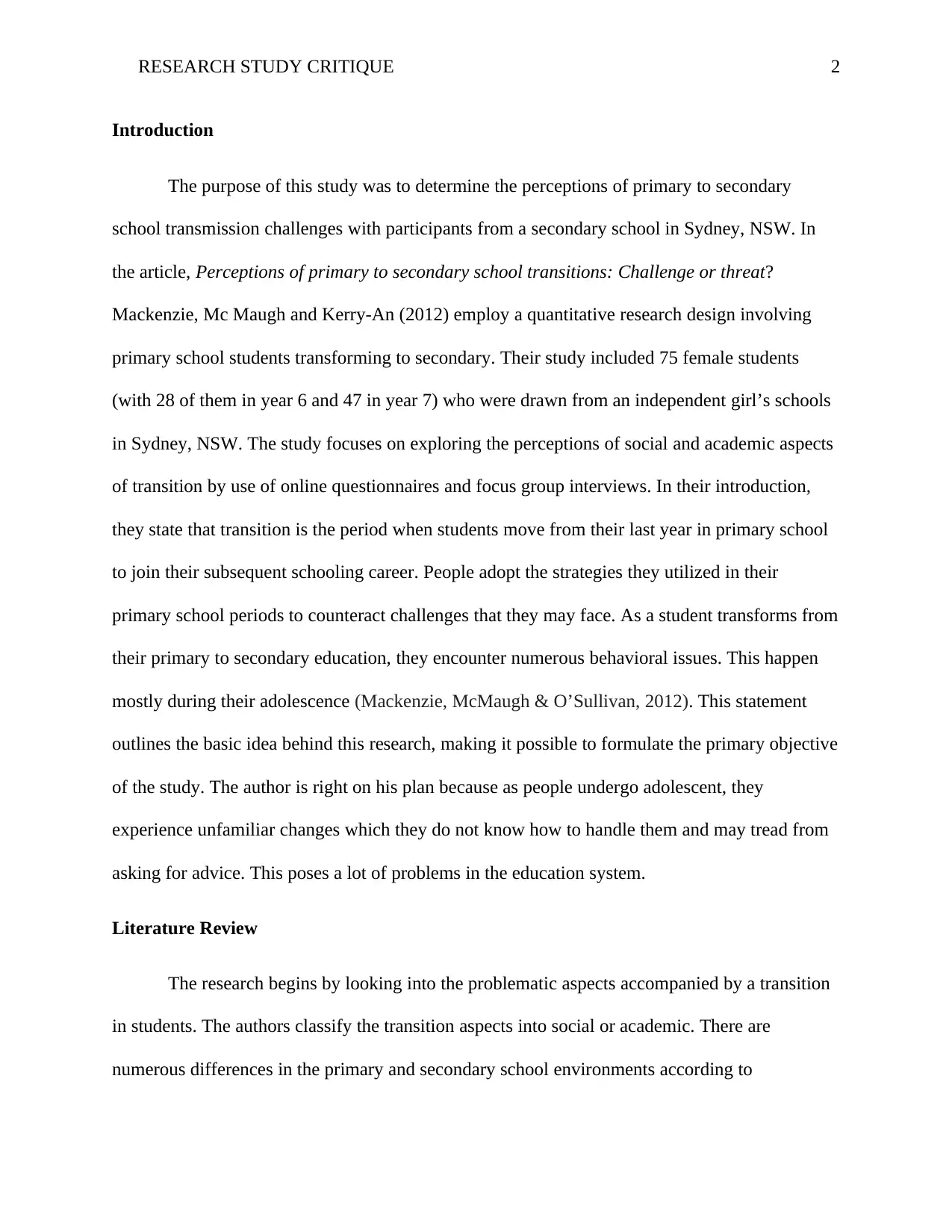
Introduction
The purpose of this study was to determine the perceptions of primary to secondary
school transmission challenges with participants from a secondary school in Sydney, NSW. In
the article, Perceptions of primary to secondary school transitions: Challenge or threat?
Mackenzie, Mc Maugh and Kerry-An (2012) employ a quantitative research design involving
primary school students transforming to secondary. Their study included 75 female students
(with 28 of them in year 6 and 47 in year 7) who were drawn from an independent girl’s schools
in Sydney, NSW. The study focuses on exploring the perceptions of social and academic aspects
of transition by use of online questionnaires and focus group interviews. In their introduction,
they state that transition is the period when students move from their last year in primary school
to join their subsequent schooling career. People adopt the strategies they utilized in their
primary school periods to counteract challenges that they may face. As a student transforms from
their primary to secondary education, they encounter numerous behavioral issues. This happen
mostly during their adolescence (Mackenzie, McMaugh & O’Sullivan, 2012). This statement
outlines the basic idea behind this research, making it possible to formulate the primary objective
of the study. The author is right on his plan because as people undergo adolescent, they
experience unfamiliar changes which they do not know how to handle them and may tread from
asking for advice. This poses a lot of problems in the education system.
Literature Review
The research begins by looking into the problematic aspects accompanied by a transition
in students. The authors classify the transition aspects into social or academic. There are
numerous differences in the primary and secondary school environments according to
Document Page
RESEARCH STUDY CRITIQUE 3
(Mackenzie, McMaugh & O’Sullivan, 2012). Social concerns are paramount during the
transition period. Australian researchers conducted a study on the topic that ended up concluding
that the key challenges that students face are making friends, fitting in and handling bullying
issues. The changing environment increases the impacts of social concerns from primary to
secondary school and stimulates stress.
On the positive transition experiences, the research concentrated on external factors that
ascribed to the students. A supportive environment at home and the accessibility of teachers
within the school environment and strong peer connection and sibling were identified as part of
the factors that contributed to positive transitions (Pautasso, 2013). The researchers also
evaluated the effect on the cognitive transactional-theory to transition for students.
By examining the literature review, it is clear that the researchers focused on some
factors that could contribute to students’ transition. The literature review is well detailed as it
borrows ideas from other studies that researched the same area (Maier, 2013). The literature
review details facts that can be deducted by other researchers in future studies.
Methodology
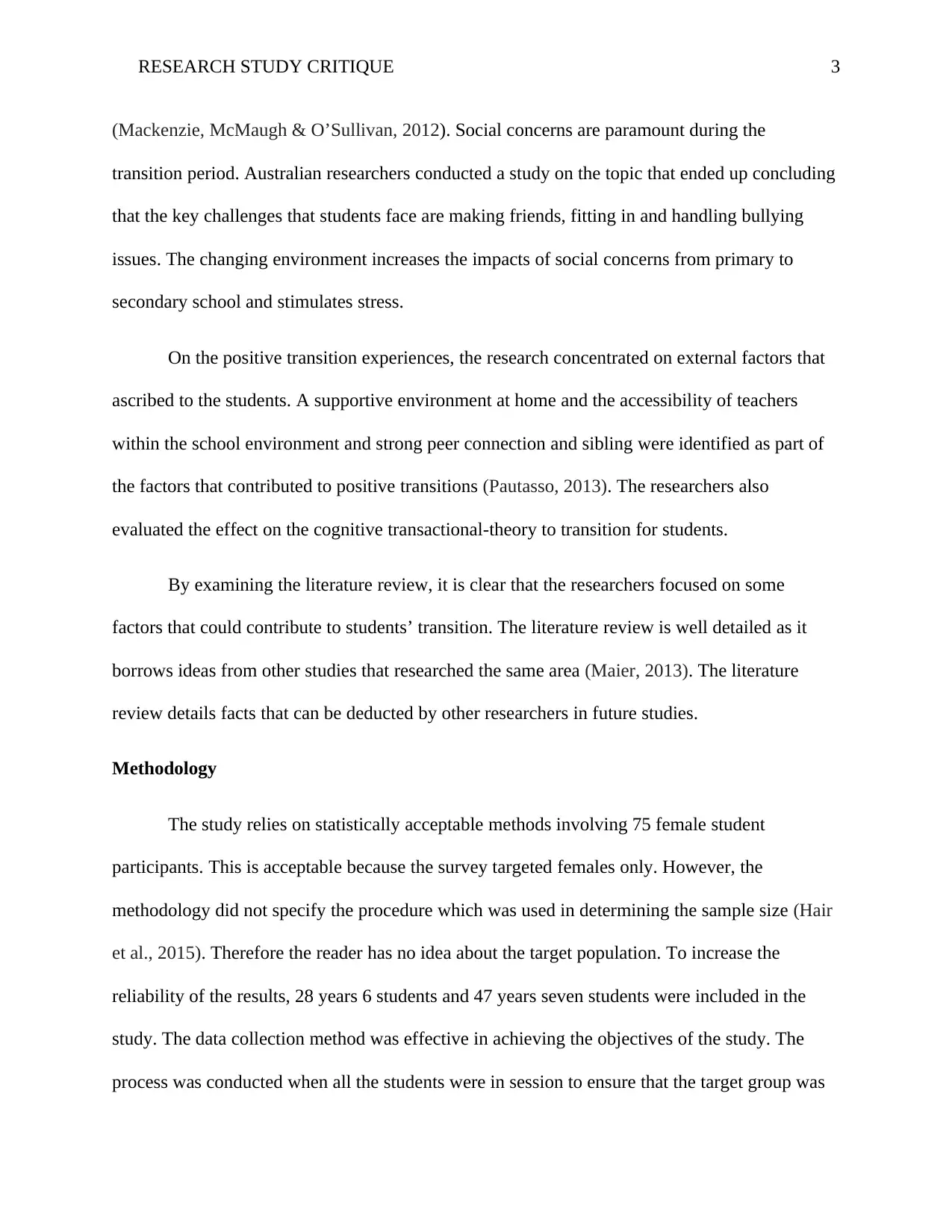
The study relies on statistically acceptable methods involving 75 female student
participants. This is acceptable because the survey targeted females only. However, the
methodology did not specify the procedure which was used in determining the sample size (Hair
et al., 2015). Therefore the reader has no idea about the target population. To increase the
reliability of the results, 28 years 6 students and 47 years seven students were included in the
study. The data collection method was effective in achieving the objectives of the study. The
process was conducted when all the students were in session to ensure that the target group was
Document Page
RESEARCH STUDY CRITIQUE 4
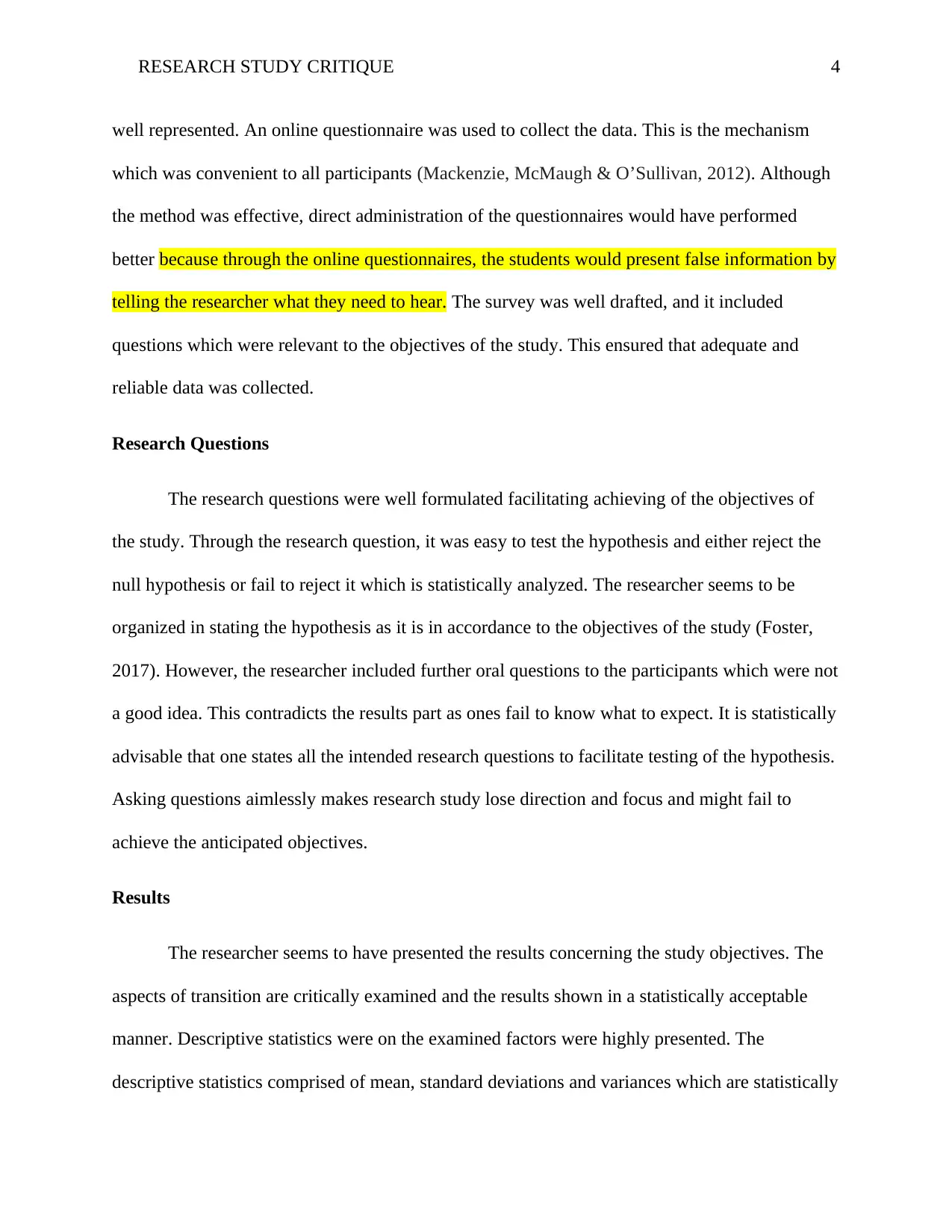
well represented. An online questionnaire was used to collect the data. This is the mechanism
which was convenient to all participants (Mackenzie, McMaugh & O’Sullivan, 2012). Although
the method was effective, direct administration of the questionnaires would have performed
better because through the online questionnaires, the students would present false information by
telling the researcher what they need to hear. The survey was well drafted, and it included
questions which were relevant to the objectives of the study. This ensured that adequate and
reliable data was collected.
Research Questions
The research questions were well formulated facilitating achieving of the objectives of
the study. Through the research question, it was easy to test the hypothesis and either reject the
null hypothesis or fail to reject it which is statistically analyzed. The researcher seems to be
organized in stating the hypothesis as it is in accordance to the objectives of the study (Foster,
2017). However, the researcher included further oral questions to the participants which were not
a good idea. This contradicts the results part as ones fail to know what to expect. It is statistically
advisable that one states all the intended research questions to facilitate testing of the hypothesis.
Asking questions aimlessly makes research study lose direction and focus and might fail to
achieve the anticipated objectives.
Results
The researcher seems to have presented the results concerning the study objectives. The
aspects of transition are critically examined and the results shown in a statistically acceptable
manner. Descriptive statistics were on the examined factors were highly presented. The
descriptive statistics comprised of mean, standard deviations and variances which are statistically
tabler-icon-diamond-filled.svg

Paraphrase This Document

Need a fresh take? Get an instant paraphrase of this document with our AI Paraphraser
Document Page
RESEARCH STUDY CRITIQUE 5
embraced in making inferences (Collis & Hussey, 2013). The researcher conducted variations
which were useful in making comparisons, therefore, facilitating the achievement of the study
objectives. In the part of the results, the study was helpful as it remained with the brackets for
achieving the goals. The results were also presented in a statistically acceptable manner making
them easily understandable.
Discussions
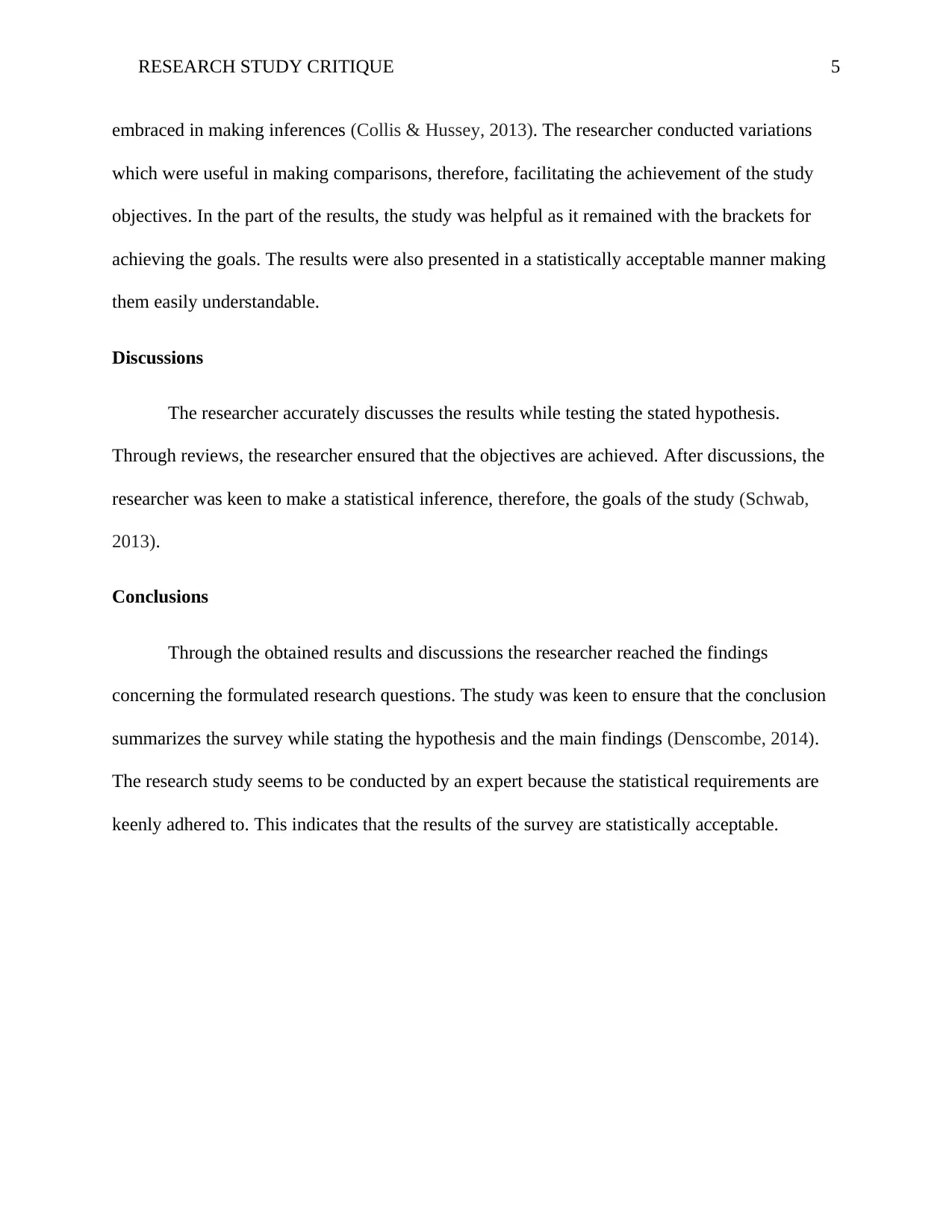
The researcher accurately discusses the results while testing the stated hypothesis.
Through reviews, the researcher ensured that the objectives are achieved. After discussions, the
researcher was keen to make a statistical inference, therefore, the goals of the study (Schwab,
2013).
Conclusions
Through the obtained results and discussions the researcher reached the findings
concerning the formulated research questions. The study was keen to ensure that the conclusion
summarizes the survey while stating the hypothesis and the main findings (Denscombe, 2014).
The research study seems to be conducted by an expert because the statistical requirements are
keenly adhered to. This indicates that the results of the survey are statistically acceptable.
Document Page
RESEARCH STUDY CRITIQUE 6
References
Collis, J., & Hussey, R. (2013). Business research: A practical guide for undergraduate and
postgraduate students. Macmillan International Higher Education.
Denscombe, M. (2014). The good research guide: for small-scale social research projects.
McGraw-Hill Education (UK).
Foster, D. (2017). Writing and learning in cross-national perspective: Transitions from secondary
to higher education. Routledge.
Hair Jr, J. F., Wolfinbarger, M., Money, A. H., Samouel, P., & Page, M. J. (2015). Essentials of
business research methods. Routledge.
Mackenzie, E., McMaugh, A., & O'Sullivan, K. (2012). Perceptions of primary to secondary
school transitions: Challenge or threat?. Issues in Educational Research, 22(3), 298-314.
Maier, H. R. (2013). What constitutes a good literature review and why does its quality
matter?. Environmental Modelling and Software, 43, 3-4.
Pautasso, M. (2013). Ten simple rules for writing a literature review. PLoS computational
biology, 9(7), e1003149.
Schwab, D. P. (2013). Research methods for organizational studies. Psychology Press.
chevron_up_icon
1 out of 6
circle_padding
hide_on_mobile
zoom_out_icon
[object Object]