Analysis and Summaries of Key Public Health Research Studies

Verified

Added on  2022/11/04

|2
|417
|28
Report
AI Summary
This report summarizes three key public health research studies. The first study, by Hebert-Beirne (2018), investigates the impact of immigration on community health in Chicago's La Villita, a Mexican immigrant neighborhood, using a community-driven, participatory qualitative approach. The findings reveal health-promoting assets within the ethnic enclave, chronic stressors related to resources, and stress among immigrants due to local fears. The second study, by Jolly (2018), evaluates the effectiveness of telephone health coaching for self-management in patients with mild COPD, concluding that coaching leads to behavioral changes in primary care patients. The study highlights the potential of early interventions through telephone coaching. The third study, by Sherriff and Coleman (2012), examines work-based health promotion initiatives for smoking cessation among routine and manual workers, identifying the need for accessible smoking cessation programs in workplaces and the awareness of the adverse effects of smoking among employees. The report provides a synthesis of the methodologies, findings, and implications of each study, emphasizing their relevance to public health practice and policy.
Document Page
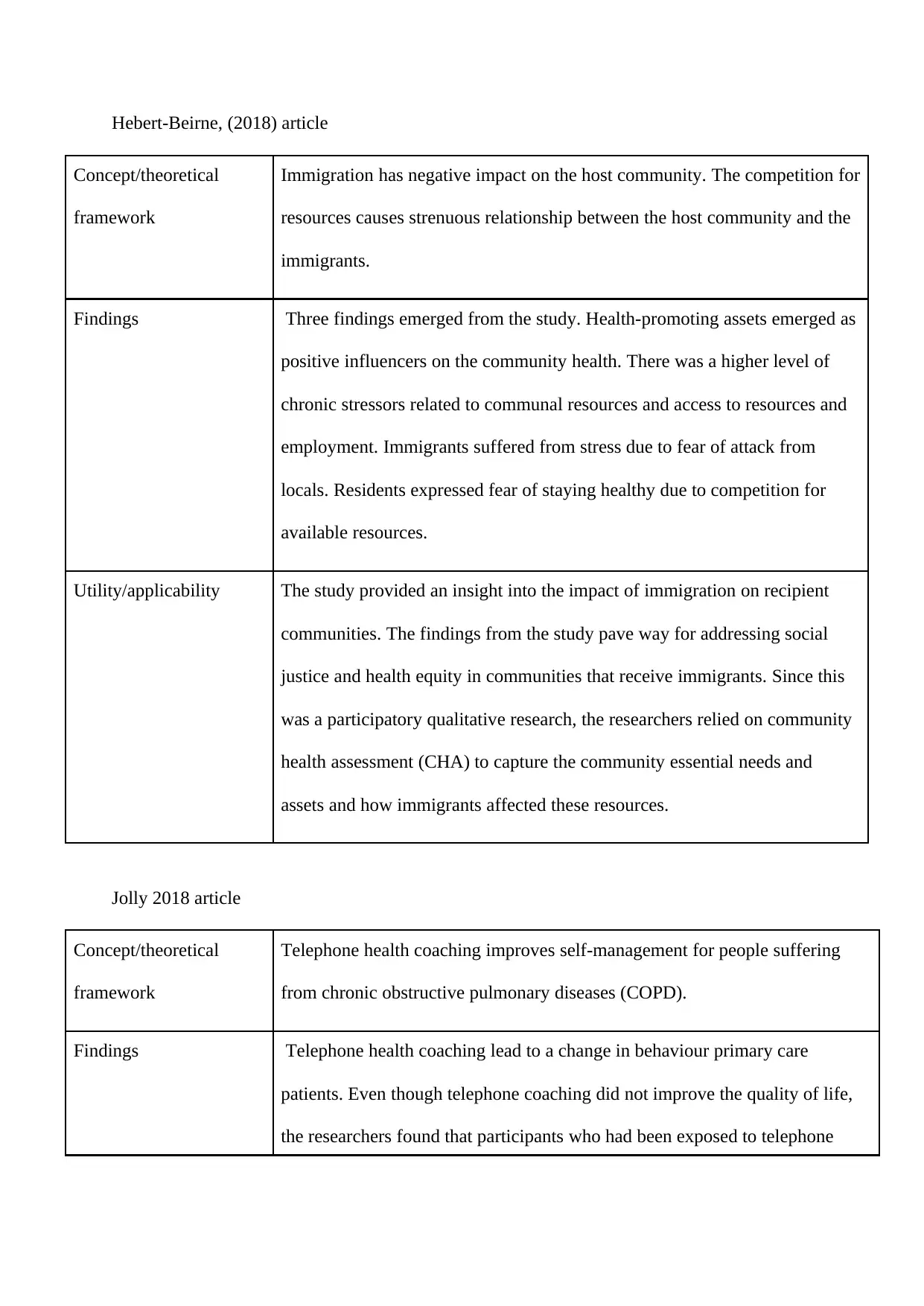
Hebert-Beirne, (2018) article
Concept/theoretical
framework
Immigration has negative impact on the host community. The competition for
resources causes strenuous relationship between the host community and the
immigrants.
Findings Three findings emerged from the study. Health-promoting assets emerged as
positive influencers on the community health. There was a higher level of
chronic stressors related to communal resources and access to resources and
employment. Immigrants suffered from stress due to fear of attack from
locals. Residents expressed fear of staying healthy due to competition for
available resources.
Utility/applicability The study provided an insight into the impact of immigration on recipient
communities. The findings from the study pave way for addressing social
justice and health equity in communities that receive immigrants. Since this
was a participatory qualitative research, the researchers relied on community
health assessment (CHA) to capture the community essential needs and
assets and how immigrants affected these resources.
Jolly 2018 article
Concept/theoretical
framework
Telephone health coaching improves self-management for people suffering
from chronic obstructive pulmonary diseases (COPD).
Findings Telephone health coaching lead to a change in behaviour primary care
patients. Even though telephone coaching did not improve the quality of life,
the researchers found that participants who had been exposed to telephone
tabler-icon-diamond-filled.svg

Paraphrase This Document

Need a fresh take? Get an instant paraphrase of this document with our AI Paraphraser
Document Page
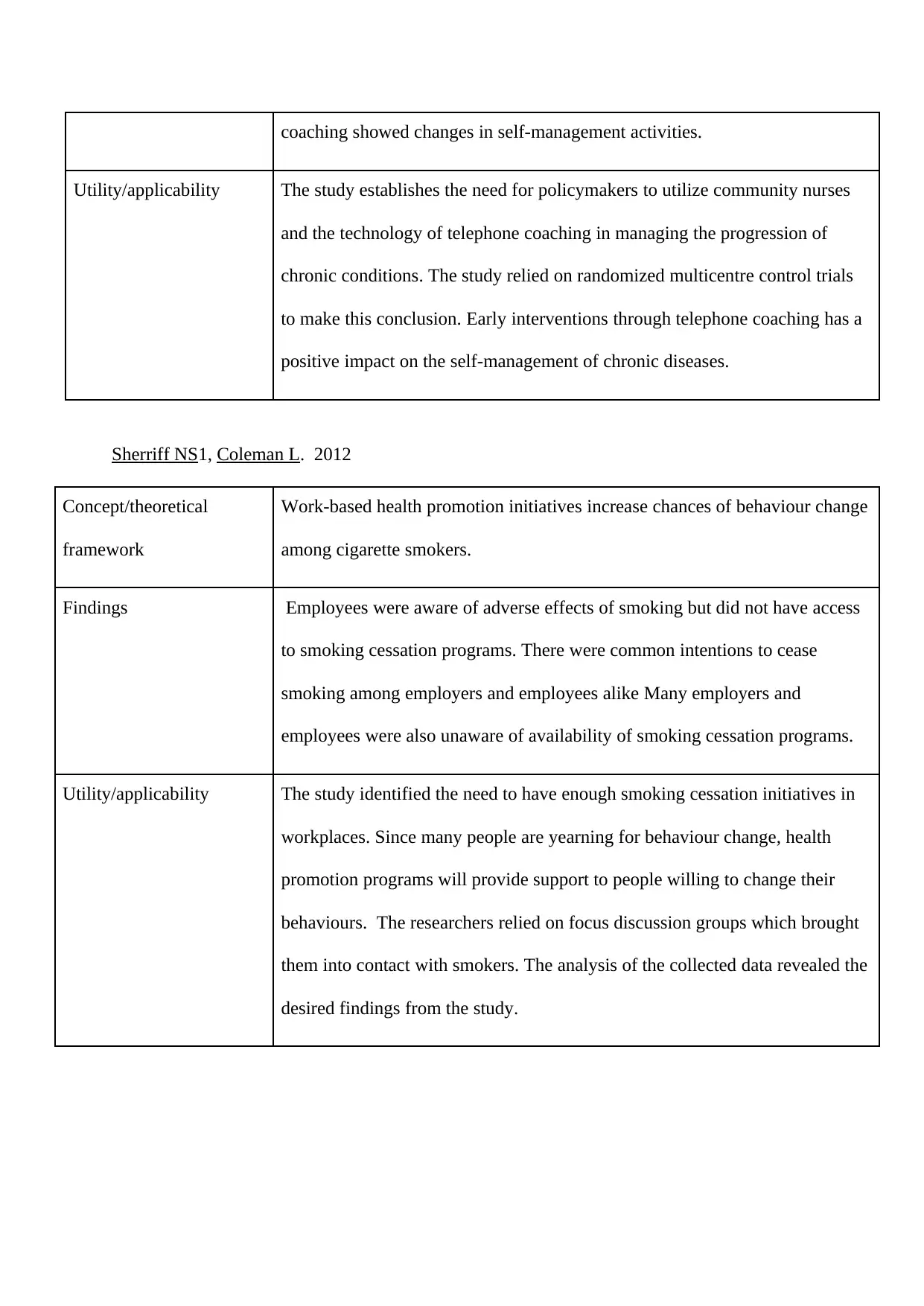
coaching showed changes in self-management activities.
Utility/applicability The study establishes the need for policymakers to utilize community nurses
and the technology of telephone coaching in managing the progression of
chronic conditions. The study relied on randomized multicentre control trials
to make this conclusion. Early interventions through telephone coaching has a
positive impact on the self-management of chronic diseases.
Sherriff NS1, Coleman L. 2012
Concept/theoretical
framework
Work-based health promotion initiatives increase chances of behaviour change
among cigarette smokers.
Findings Employees were aware of adverse effects of smoking but did not have access
to smoking cessation programs. There were common intentions to cease
smoking among employers and employees alike Many employers and
employees were also unaware of availability of smoking cessation programs.
Utility/applicability The study identified the need to have enough smoking cessation initiatives in
workplaces. Since many people are yearning for behaviour change, health
promotion programs will provide support to people willing to change their
behaviours. The researchers relied on focus discussion groups which brought
them into contact with smokers. The analysis of the collected data revealed the
desired findings from the study.
chevron_up_icon
1 out of 2
circle_padding
hide_on_mobile
zoom_out_icon
[object Object]