BUACC5931 Assignment 1: Research Techniques Analysis
VerifiedAdded on 2022/10/11
|11
|2912
|13
Report
AI Summary
This report provides a detailed analysis of research techniques, focusing on sample size, sampling methods, and the measurement of variables within a business context. It examines the importance of sample size determination, exploring the formula for calculating the ideal sample size and comparing it to the case study's approach. The report also discusses different sampling methods, particularly simple random sampling, outlining its advantages and disadvantages. Furthermore, it delves into the measurement of variables, emphasizing reliability, validity, and the collection of social demographics. The report also provides an understanding of research design, discussing the framework of methods and techniques adopted by researchers.
Running head: RESEARCH TECHNIQUES
RESEARCH TECHNIQUES
Name of the Student
Name of the University
Author Note
RESEARCH TECHNIQUES
Name of the Student
Name of the University
Author Note

Paraphrase This Document
Need a fresh take? Get an instant paraphrase of this document with our AI Paraphraser
1RESEARCH TECHNIQUES
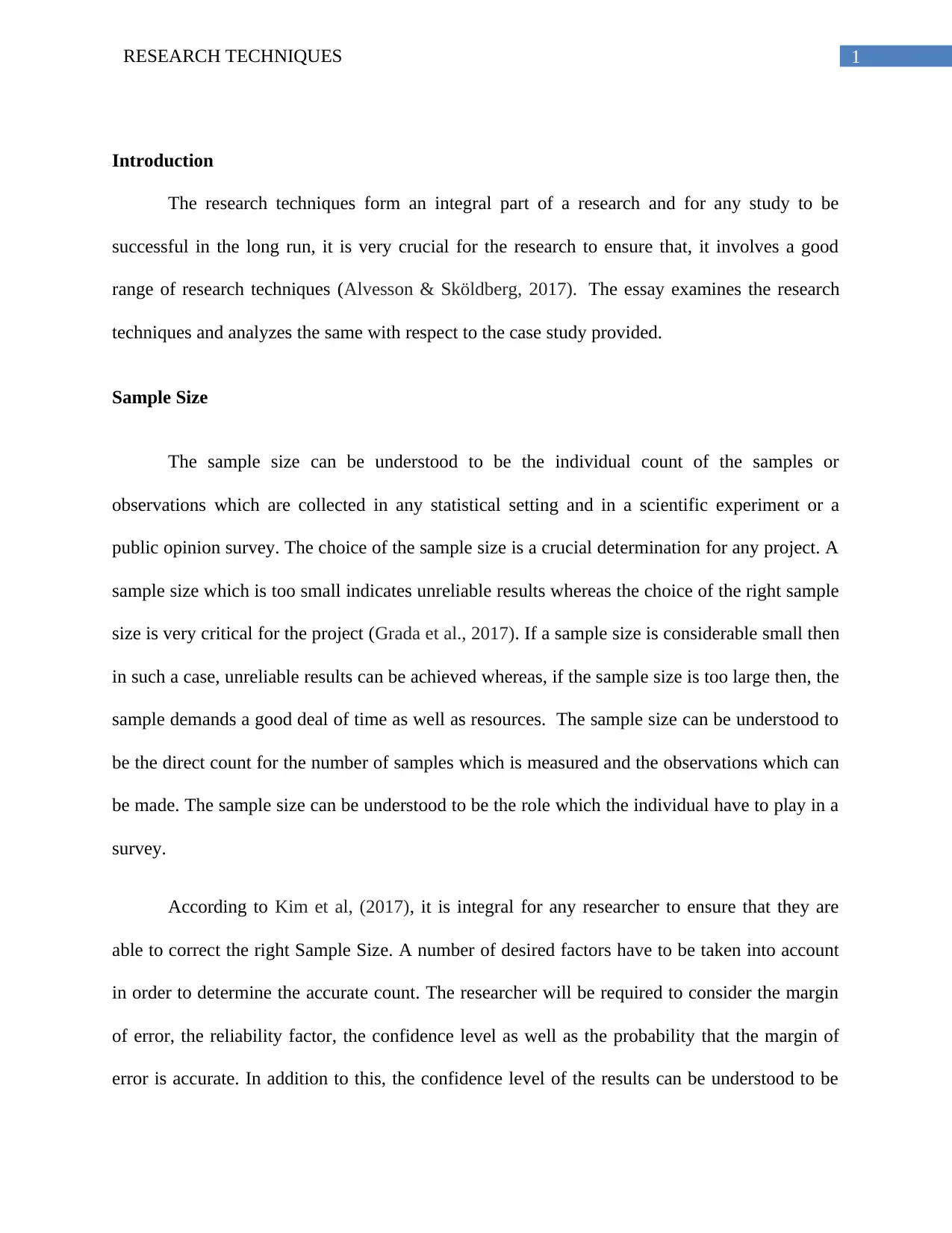
Introduction
The research techniques form an integral part of a research and for any study to be
successful in the long run, it is very crucial for the research to ensure that, it involves a good
range of research techniques (Alvesson & Sköldberg, 2017). The essay examines the research
techniques and analyzes the same with respect to the case study provided.
Sample Size
The sample size can be understood to be the individual count of the samples or
observations which are collected in any statistical setting and in a scientific experiment or a
public opinion survey. The choice of the sample size is a crucial determination for any project. A
sample size which is too small indicates unreliable results whereas the choice of the right sample
size is very critical for the project (Grada et al., 2017). If a sample size is considerable small then
in such a case, unreliable results can be achieved whereas, if the sample size is too large then, the
sample demands a good deal of time as well as resources. The sample size can be understood to
be the direct count for the number of samples which is measured and the observations which can
be made. The sample size can be understood to be the role which the individual have to play in a
survey.
According to Kim et al, (2017), it is integral for any researcher to ensure that they are
able to correct the right Sample Size. A number of desired factors have to be taken into account
in order to determine the accurate count. The researcher will be required to consider the margin
of error, the reliability factor, the confidence level as well as the probability that the margin of
error is accurate. In addition to this, the confidence level of the results can be understood to be
Introduction
The research techniques form an integral part of a research and for any study to be
successful in the long run, it is very crucial for the research to ensure that, it involves a good
range of research techniques (Alvesson & Sköldberg, 2017). The essay examines the research
techniques and analyzes the same with respect to the case study provided.
Sample Size
The sample size can be understood to be the individual count of the samples or
observations which are collected in any statistical setting and in a scientific experiment or a
public opinion survey. The choice of the sample size is a crucial determination for any project. A
sample size which is too small indicates unreliable results whereas the choice of the right sample
size is very critical for the project (Grada et al., 2017). If a sample size is considerable small then
in such a case, unreliable results can be achieved whereas, if the sample size is too large then, the
sample demands a good deal of time as well as resources. The sample size can be understood to
be the direct count for the number of samples which is measured and the observations which can
be made. The sample size can be understood to be the role which the individual have to play in a
survey.
According to Kim et al, (2017), it is integral for any researcher to ensure that they are
able to correct the right Sample Size. A number of desired factors have to be taken into account
in order to determine the accurate count. The researcher will be required to consider the margin
of error, the reliability factor, the confidence level as well as the probability that the margin of
error is accurate. In addition to this, the confidence level of the results can be understood to be
2RESEARCH TECHNIQUES
crucial to consider. The standard deviation is an aspect which is deemed to be crucial and the
different researchers would be required to ensure that, the individual pieces of data do not vary
much and that the average data can be measured accordingly (McCusker & Gunaydin, 2015).
The population size has a key role to play in any business scenario and if the researcher
wants to determine the right kind of a sample size for the population then in such a case, the total
population has a key role to play in the decision making (Kumar, 2019). Hence, in order to
understand the manner in which the right sample size can be determined, the following formula
can be used:
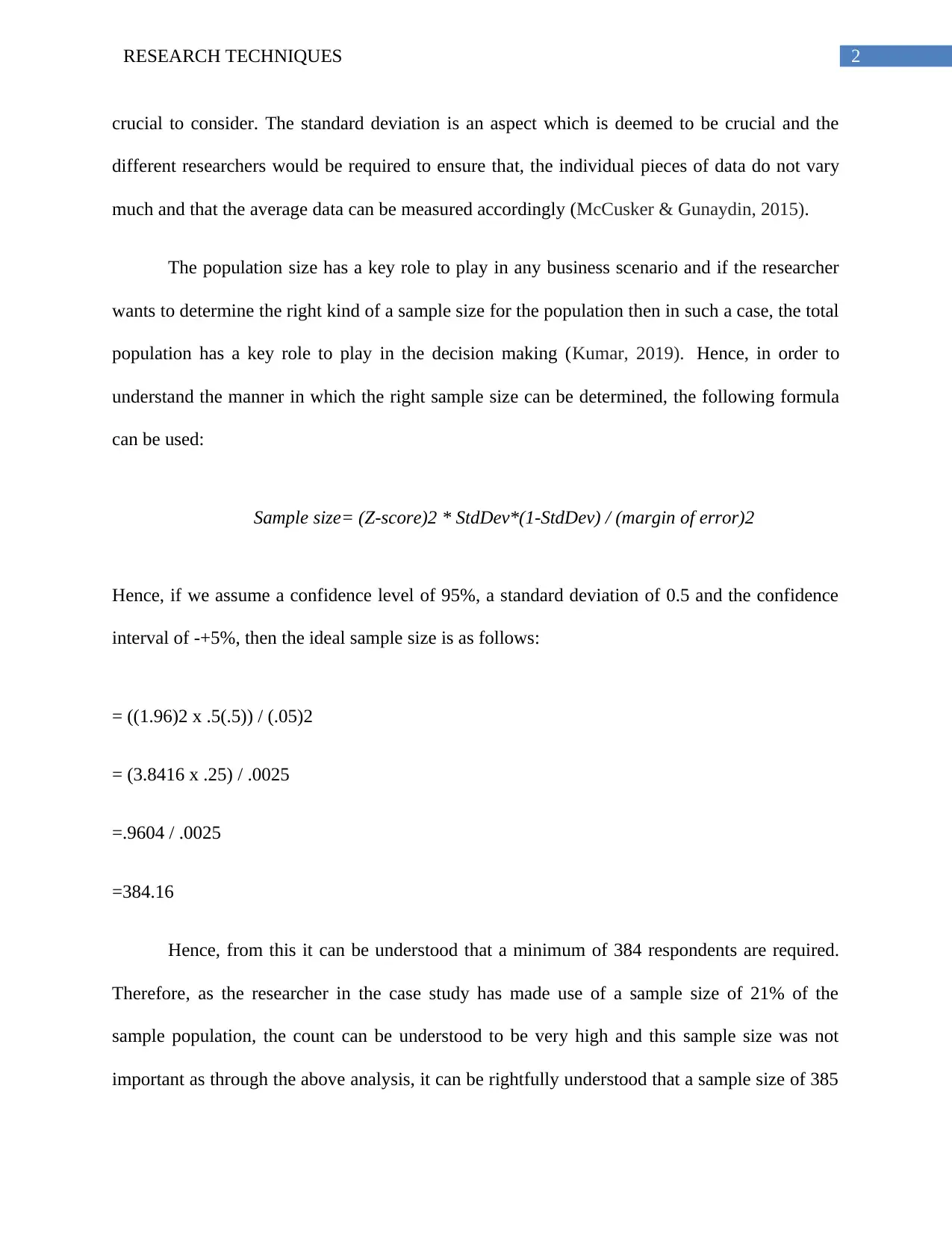
Sample size= (Z-score)2 * StdDev*(1-StdDev) / (margin of error)2
Hence, if we assume a confidence level of 95%, a standard deviation of 0.5 and the confidence
interval of -+5%, then the ideal sample size is as follows:
= ((1.96)2 x .5(.5)) / (.05)2
= (3.8416 x .25) / .0025
=.9604 / .0025
=384.16
Hence, from this it can be understood that a minimum of 384 respondents are required.
Therefore, as the researcher in the case study has made use of a sample size of 21% of the
sample population, the count can be understood to be very high and this sample size was not
important as through the above analysis, it can be rightfully understood that a sample size of 385
crucial to consider. The standard deviation is an aspect which is deemed to be crucial and the
different researchers would be required to ensure that, the individual pieces of data do not vary
much and that the average data can be measured accordingly (McCusker & Gunaydin, 2015).
The population size has a key role to play in any business scenario and if the researcher
wants to determine the right kind of a sample size for the population then in such a case, the total
population has a key role to play in the decision making (Kumar, 2019). Hence, in order to
understand the manner in which the right sample size can be determined, the following formula
can be used:
Sample size= (Z-score)2 * StdDev*(1-StdDev) / (margin of error)2
Hence, if we assume a confidence level of 95%, a standard deviation of 0.5 and the confidence
interval of -+5%, then the ideal sample size is as follows:
= ((1.96)2 x .5(.5)) / (.05)2
= (3.8416 x .25) / .0025
=.9604 / .0025
=384.16
Hence, from this it can be understood that a minimum of 384 respondents are required.
Therefore, as the researcher in the case study has made use of a sample size of 21% of the
sample population, the count can be understood to be very high and this sample size was not
important as through the above analysis, it can be rightfully understood that a sample size of 385
⊘ This is a preview!⊘
Do you want full access?
Subscribe today to unlock all pages.

Trusted by 1+ million students worldwide
3RESEARCH TECHNIQUES
employees would have been adequate to get the right results and such a large sample size will
only add up to the calculation errors.
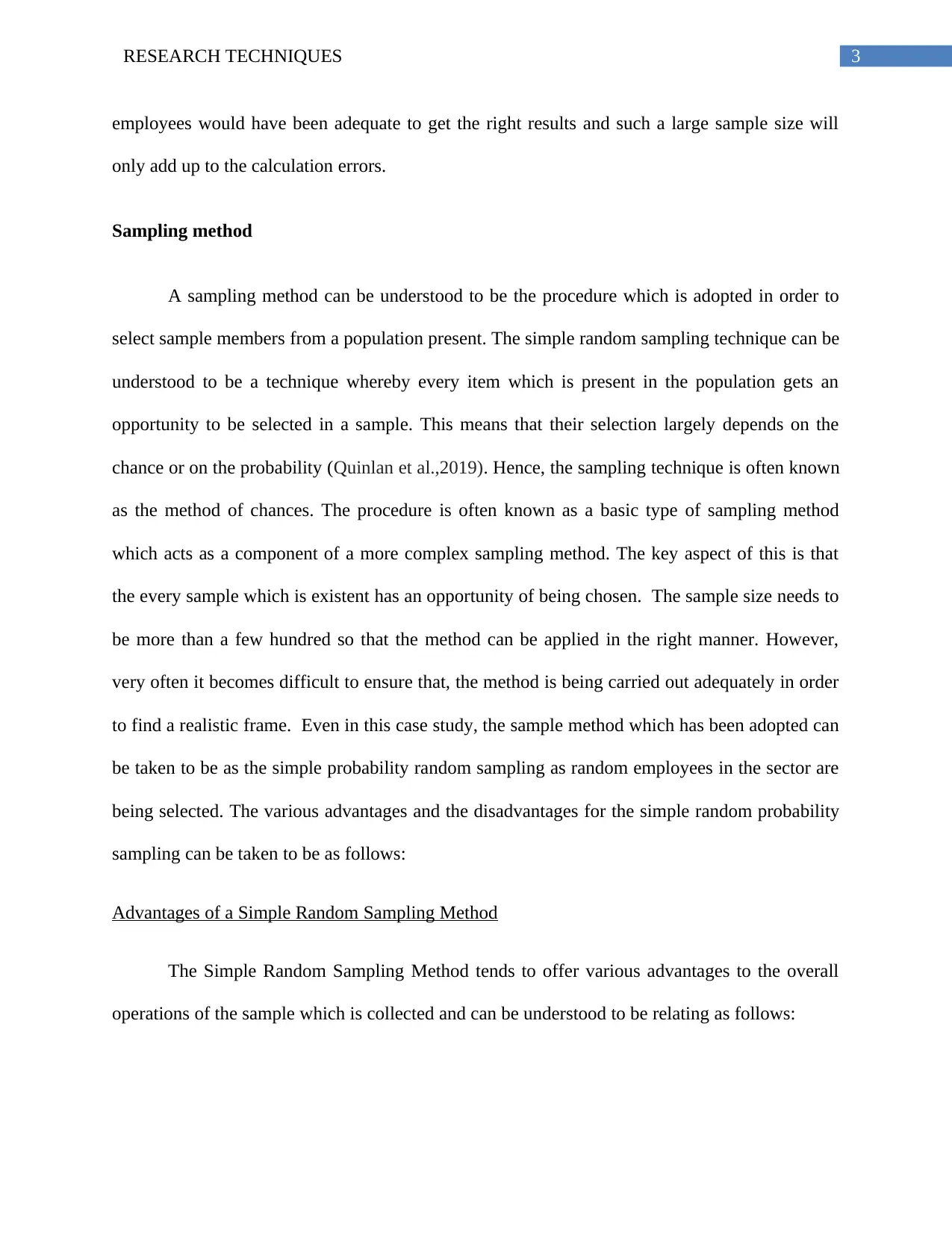
Sampling method
A sampling method can be understood to be the procedure which is adopted in order to
select sample members from a population present. The simple random sampling technique can be
understood to be a technique whereby every item which is present in the population gets an
opportunity to be selected in a sample. This means that their selection largely depends on the
chance or on the probability (Quinlan et al.,2019). Hence, the sampling technique is often known
as the method of chances. The procedure is often known as a basic type of sampling method
which acts as a component of a more complex sampling method. The key aspect of this is that
the every sample which is existent has an opportunity of being chosen. The sample size needs to
be more than a few hundred so that the method can be applied in the right manner. However,
very often it becomes difficult to ensure that, the method is being carried out adequately in order
to find a realistic frame. Even in this case study, the sample method which has been adopted can
be taken to be as the simple probability random sampling as random employees in the sector are
being selected. The various advantages and the disadvantages for the simple random probability
sampling can be taken to be as follows:
Advantages of a Simple Random Sampling Method
The Simple Random Sampling Method tends to offer various advantages to the overall
operations of the sample which is collected and can be understood to be relating as follows:
employees would have been adequate to get the right results and such a large sample size will
only add up to the calculation errors.
Sampling method
A sampling method can be understood to be the procedure which is adopted in order to
select sample members from a population present. The simple random sampling technique can be
understood to be a technique whereby every item which is present in the population gets an
opportunity to be selected in a sample. This means that their selection largely depends on the
chance or on the probability (Quinlan et al.,2019). Hence, the sampling technique is often known
as the method of chances. The procedure is often known as a basic type of sampling method
which acts as a component of a more complex sampling method. The key aspect of this is that
the every sample which is existent has an opportunity of being chosen. The sample size needs to
be more than a few hundred so that the method can be applied in the right manner. However,
very often it becomes difficult to ensure that, the method is being carried out adequately in order
to find a realistic frame. Even in this case study, the sample method which has been adopted can
be taken to be as the simple probability random sampling as random employees in the sector are
being selected. The various advantages and the disadvantages for the simple random probability
sampling can be taken to be as follows:
Advantages of a Simple Random Sampling Method
The Simple Random Sampling Method tends to offer various advantages to the overall
operations of the sample which is collected and can be understood to be relating as follows:
Paraphrase This Document
Need a fresh take? Get an instant paraphrase of this document with our AI Paraphraser
4RESEARCH TECHNIQUES
Lack of Bias: As the individuals who form a sub set of the larger group, it needs to be
critically understood that, there exists no biasness as the individual population is selected
randomly and all the members of the population have the same probability of being
selected(Silverman, 2016). Hence, this tends to create a balanced sub set which carries a
good potential to represent a larger group as a whole.
Simplicity: The simple random probability sampling reflects simplicity in its methods
and can be considered to be much less than the other methods of sampling. Hence, in this
case, the individuals are selected randomly and hence, this sampling method is easier to
carryout.
However, this sampling method has various disadvantages as well. These can be
understood to be as follows:
The difficulty in accessing the full population list: In the simple random sampling, in
order to collect the sampling on a random basis, it is crucial for the researcher to ensure
that he has adequate access to the list of the entire population which would assist in
selecting the participants in a random manner (Taylor, Bogdan & DeVault, 2015). Many
organizations and institutes are often not willing to provide a list of the entire sampling
population and it is with respect to this that it may become considerably difficult for the
researcher, to carry out the research in the right manner.
Time consuming: This research method can also be understood to be very time
consuming in nature as the individuals who attempt to conduct the simple random
sampling must gather information accordingly and hence, this entire procedure becomes
very time consuming in nature.
Lack of Bias: As the individuals who form a sub set of the larger group, it needs to be
critically understood that, there exists no biasness as the individual population is selected
randomly and all the members of the population have the same probability of being
selected(Silverman, 2016). Hence, this tends to create a balanced sub set which carries a
good potential to represent a larger group as a whole.
Simplicity: The simple random probability sampling reflects simplicity in its methods
and can be considered to be much less than the other methods of sampling. Hence, in this
case, the individuals are selected randomly and hence, this sampling method is easier to
carryout.
However, this sampling method has various disadvantages as well. These can be
understood to be as follows:
The difficulty in accessing the full population list: In the simple random sampling, in
order to collect the sampling on a random basis, it is crucial for the researcher to ensure
that he has adequate access to the list of the entire population which would assist in
selecting the participants in a random manner (Taylor, Bogdan & DeVault, 2015). Many
organizations and institutes are often not willing to provide a list of the entire sampling
population and it is with respect to this that it may become considerably difficult for the
researcher, to carry out the research in the right manner.
Time consuming: This research method can also be understood to be very time
consuming in nature as the individuals who attempt to conduct the simple random
sampling must gather information accordingly and hence, this entire procedure becomes
very time consuming in nature.
5RESEARCH TECHNIQUES
Costs: Hence, in relation to this, it is integral to understand that, the Simple random
probability method can be understood to be considerably expensive in nature and in
relation to this, lot of costs are involved in the same.
Measures of variable
The measurement of the variables tends to involve assigning scores to the individuals in
order to ensure that the represent characteristic of the individuals. However, it often becomes
very difficult for the researcher to ensure that the scores which are being used by them tend to
represent the characteristic especially with respect to the self-esteem, intelligence, depression or
related working memory capacity (Rosskam, 2018). In such a case, it becomes considerably
crucial for the firm to ensure that the score is based on the understanding of the construct which
is being measured. The reliability can be understood to be the consistency of a measure which is
required to be adopted. The reliability can be understood to be the degree to which an assessment
tool produces stable as well as consistent results. According to Rosskam (2018), the Test retest
reliability can be understood to be a crucial measure of reliability which is usually used to assess
the overall manner in which the scores can remain consistent at all times. Another type of
reliability test can be understood to be the internal consistency (Walliman, 2017). This means
that, there exists adequate consistency of the individual responses across the items on a multiple
item method.
Validity can also understood to be a common aspect of the research, in relation to which,
it measures the extent to which the scores tend to arise from a measure representing the overall
variable which they are intended to. In relation to this, it can be rightfully understood that, when
a measure has a good test retest reliability as well as internal consistency, then in such a case, the
Costs: Hence, in relation to this, it is integral to understand that, the Simple random
probability method can be understood to be considerably expensive in nature and in
relation to this, lot of costs are involved in the same.
Measures of variable
The measurement of the variables tends to involve assigning scores to the individuals in
order to ensure that the represent characteristic of the individuals. However, it often becomes
very difficult for the researcher to ensure that the scores which are being used by them tend to
represent the characteristic especially with respect to the self-esteem, intelligence, depression or
related working memory capacity (Rosskam, 2018). In such a case, it becomes considerably
crucial for the firm to ensure that the score is based on the understanding of the construct which
is being measured. The reliability can be understood to be the consistency of a measure which is
required to be adopted. The reliability can be understood to be the degree to which an assessment
tool produces stable as well as consistent results. According to Rosskam (2018), the Test retest
reliability can be understood to be a crucial measure of reliability which is usually used to assess
the overall manner in which the scores can remain consistent at all times. Another type of
reliability test can be understood to be the internal consistency (Walliman, 2017). This means
that, there exists adequate consistency of the individual responses across the items on a multiple
item method.
Validity can also understood to be a common aspect of the research, in relation to which,
it measures the extent to which the scores tend to arise from a measure representing the overall
variable which they are intended to. In relation to this, it can be rightfully understood that, when
a measure has a good test retest reliability as well as internal consistency, then in such a case, the
⊘ This is a preview!⊘
Do you want full access?
Subscribe today to unlock all pages.
Trusted by 1+ million students worldwide
6RESEARCH TECHNIQUES
researchers are more confident about their research and the overall result is consistent (Smith,
2015).
Hence, from the given case, it can be understood that, the assessment of reliability and
validity is an ongoing procedure and in order to ensure that the study which is conducted is
reliable and valid in nature, the patterns of data need to be assessed accordingly. In the given
case study, it can be rightfully understood that, both quantitative and qualitative job insecurity
has been used which means that, both the aspects were taken into consideration. In addition to
this, the Cronbach s alpha revealed a score of 0.89 and 0.87 respectively which can be considred
to be a relevant score (Taylor, Bogdan & DeVault, 2015). The demographics were used as the
control variables which came in useful. Additionally, Job satisfaction and Psychological distress
were also taken into measures with work related factors which contribute to the fact that, their
measurement is reliable.
Collection on social demographics
As seen from the given case study, the data has been collected for the purpose of the
analysis and amongst this data which has been collected, the data for the demographics of the
different customers has also been collected and in relation to this, it can be understood that, the
Demographic data tends to include anything which identifies as well as differentiates a customer.
This comprises of aspects like the age, location and other such aspects (Flick, 2015). The
demographic data becomes less important when building out a dataset for any research as
present. The key benefit of collecting the demographic data can be considered to be the aspect
such as, it provides a useful insight into the overall purchasing behavior and patterns.
researchers are more confident about their research and the overall result is consistent (Smith,
2015).
Hence, from the given case, it can be understood that, the assessment of reliability and
validity is an ongoing procedure and in order to ensure that the study which is conducted is
reliable and valid in nature, the patterns of data need to be assessed accordingly. In the given
case study, it can be rightfully understood that, both quantitative and qualitative job insecurity
has been used which means that, both the aspects were taken into consideration. In addition to
this, the Cronbach s alpha revealed a score of 0.89 and 0.87 respectively which can be considred
to be a relevant score (Taylor, Bogdan & DeVault, 2015). The demographics were used as the
control variables which came in useful. Additionally, Job satisfaction and Psychological distress
were also taken into measures with work related factors which contribute to the fact that, their
measurement is reliable.
Collection on social demographics
As seen from the given case study, the data has been collected for the purpose of the
analysis and amongst this data which has been collected, the data for the demographics of the
different customers has also been collected and in relation to this, it can be understood that, the
Demographic data tends to include anything which identifies as well as differentiates a customer.
This comprises of aspects like the age, location and other such aspects (Flick, 2015). The
demographic data becomes less important when building out a dataset for any research as
present. The key benefit of collecting the demographic data can be considered to be the aspect
such as, it provides a useful insight into the overall purchasing behavior and patterns.
Paraphrase This Document
Need a fresh take? Get an instant paraphrase of this document with our AI Paraphraser
7RESEARCH TECHNIQUES
In line with this, it helps in predicting the overall actions of the existing customers which
will help in forming better strategies for the future of the business or the overall research.
According to Mackey and Gass (2015), the population demographics is also useful in
understanding the long range trends involved in the business and in addition to this, also
contribute towards understanding the positioning products technique and the analysis of the
distribution. Hence, in relation to this, it can be rightfully understood that there are aspects like
the age and gender which are generally controlled for every statistical model. According to
Bresler & Stake (2017), these variables are usually controlled specifically but it become crucial
to understand that they are required to be controlled but the purpose might differ accordingly.
These social demographics are generally made use of as the control variables because, they tend
to contribute towards understanding whether, the element will change throughout the experiment
or not and it also helps in understanding whether the unchanging stated can be better utilized in
order to ensure that the results can be tested in a better manner.
Research design
The research design can be understood to be the set defined framework of methods as
well as the other techniques which are generally adopted by a researcher in order to combine the
different components of a research in a logical manner so that the research problem which is
being discussed can be managed adequately (Alvesson & Sköldberg, 2017). The different types
of research design which are generally present in a study can be understood to be as the
descriptive research design, correlational research design, experimental and the quasi
experimental design. The research design which has been collected in the given scenario can be
understood to be the descriptive research design (Ledford & Gast, 2018). The descriptive
In line with this, it helps in predicting the overall actions of the existing customers which
will help in forming better strategies for the future of the business or the overall research.
According to Mackey and Gass (2015), the population demographics is also useful in
understanding the long range trends involved in the business and in addition to this, also
contribute towards understanding the positioning products technique and the analysis of the
distribution. Hence, in relation to this, it can be rightfully understood that there are aspects like
the age and gender which are generally controlled for every statistical model. According to
Bresler & Stake (2017), these variables are usually controlled specifically but it become crucial
to understand that they are required to be controlled but the purpose might differ accordingly.
These social demographics are generally made use of as the control variables because, they tend
to contribute towards understanding whether, the element will change throughout the experiment
or not and it also helps in understanding whether the unchanging stated can be better utilized in
order to ensure that the results can be tested in a better manner.
Research design
The research design can be understood to be the set defined framework of methods as
well as the other techniques which are generally adopted by a researcher in order to combine the
different components of a research in a logical manner so that the research problem which is
being discussed can be managed adequately (Alvesson & Sköldberg, 2017). The different types
of research design which are generally present in a study can be understood to be as the
descriptive research design, correlational research design, experimental and the quasi
experimental design. The research design which has been collected in the given scenario can be
understood to be the descriptive research design (Ledford & Gast, 2018). The descriptive
8RESEARCH TECHNIQUES
research design can be described as a research design which is used to explain the characteristics
of a population or the phenomenon which is being studied. It does not answer any question but it
helps in understanding the characteristics which take place. The advantages are as follows:
The Descriptive research design is rather varied in nature. This means that, it does not
rely on only one type of data but relies on both quantitative as well as qualitative data (Fletcher,
2017). Another advantage of the same is that, it is very relatable in nature which means that, it
offers a strong argument for the thesis which is present and is rather applicable which assists in
finding the reasons behind certain phenomenons. On the negative side, the descriptive research
design is potentially subjective in nature.
Summary
Therefore, the given essay undertook to research various aspects of the case study which
was provided and provided an overview of the different research methods, designs and sampling
techniques utilized.
research design can be described as a research design which is used to explain the characteristics
of a population or the phenomenon which is being studied. It does not answer any question but it
helps in understanding the characteristics which take place. The advantages are as follows:
The Descriptive research design is rather varied in nature. This means that, it does not
rely on only one type of data but relies on both quantitative as well as qualitative data (Fletcher,
2017). Another advantage of the same is that, it is very relatable in nature which means that, it
offers a strong argument for the thesis which is present and is rather applicable which assists in
finding the reasons behind certain phenomenons. On the negative side, the descriptive research
design is potentially subjective in nature.
Summary
Therefore, the given essay undertook to research various aspects of the case study which
was provided and provided an overview of the different research methods, designs and sampling
techniques utilized.
⊘ This is a preview!⊘
Do you want full access?
Subscribe today to unlock all pages.
Trusted by 1+ million students worldwide
9RESEARCH TECHNIQUES
References
Alvesson, M., & Sköldberg, K. (2017). Reflexive methodology: New vistas for qualitative
research. Sage.
Bresler, L., & Stake, R. E. (2017). Qualitative research methodology in music education.
In Critical Essays in Music Education (pp. 113-128). Routledge.
Fletcher, A. J. (2017). Applying critical realism in qualitative research: methodology meets
method. International Journal of Social Research Methodology, 20(2), 181-194.
Flick, U. (2015). Introducing research methodology: A beginner's guide to doing a research
project. Sage.
Grada, A., Otero-Vinas, M., Prieto-Castrillo, F., Obagi, Z., & Falanga, V. (2017). Research
techniques made simple: analysis of collective cell migration using the wound healing
assay. Journal of Investigative Dermatology, 137(2), e11-e16.
Kim, N., Fischer, A. H., Dyring-Andersen, B., Rosner, B., & Okoye, G. A. (2017). Research
techniques made simple: choosing appropriate statistical methods for clinical
research. Journal of Investigative Dermatology, 137(10), e173-e178.
Kumar, R. (2019). Research methodology: A step-by-step guide for beginners. Sage Publications
Limited.
Ledford, J. R., & Gast, D. L. (2018). Single case research methodology: Applications in special
education and behavioral sciences. Routledge.
References
Alvesson, M., & Sköldberg, K. (2017). Reflexive methodology: New vistas for qualitative
research. Sage.
Bresler, L., & Stake, R. E. (2017). Qualitative research methodology in music education.
In Critical Essays in Music Education (pp. 113-128). Routledge.
Fletcher, A. J. (2017). Applying critical realism in qualitative research: methodology meets
method. International Journal of Social Research Methodology, 20(2), 181-194.
Flick, U. (2015). Introducing research methodology: A beginner's guide to doing a research
project. Sage.
Grada, A., Otero-Vinas, M., Prieto-Castrillo, F., Obagi, Z., & Falanga, V. (2017). Research
techniques made simple: analysis of collective cell migration using the wound healing
assay. Journal of Investigative Dermatology, 137(2), e11-e16.
Kim, N., Fischer, A. H., Dyring-Andersen, B., Rosner, B., & Okoye, G. A. (2017). Research
techniques made simple: choosing appropriate statistical methods for clinical
research. Journal of Investigative Dermatology, 137(10), e173-e178.
Kumar, R. (2019). Research methodology: A step-by-step guide for beginners. Sage Publications
Limited.
Ledford, J. R., & Gast, D. L. (2018). Single case research methodology: Applications in special
education and behavioral sciences. Routledge.
Paraphrase This Document
Need a fresh take? Get an instant paraphrase of this document with our AI Paraphraser
10RESEARCH TECHNIQUES
Mackey, A., & Gass, S. M. (2015). Second language research: Methodology and design.
Routledge.
McCusker, K., & Gunaydin, S. (2015). Research using qualitative, quantitative or mixed
methods and choice based on the research. Perfusion, 30(7), 537-542.
Quinlan, C., Babin, B., Carr, J., & Griffin, M. (2019). Business research methods. South Western
Cengage.
Rosskam, E. (2018). Using participatory action research methodology to improve worker health.
In Unhealthy Work(pp. 211-228). Routledge.
Silverman, D. (Ed.). (2016). Qualitative research. Sage.
Smith, J. A. (Ed.). (2015). Qualitative psychology: A practical guide to research methods. Sage.
Taylor, S. J., Bogdan, R., & DeVault, M. (2015). Introduction to qualitative research methods: A
guidebook and resource. John Wiley & Sons.
Walliman, N. (2017). Research methods: The basics. Routledge.
Mackey, A., & Gass, S. M. (2015). Second language research: Methodology and design.
Routledge.
McCusker, K., & Gunaydin, S. (2015). Research using qualitative, quantitative or mixed
methods and choice based on the research. Perfusion, 30(7), 537-542.
Quinlan, C., Babin, B., Carr, J., & Griffin, M. (2019). Business research methods. South Western
Cengage.
Rosskam, E. (2018). Using participatory action research methodology to improve worker health.
In Unhealthy Work(pp. 211-228). Routledge.
Silverman, D. (Ed.). (2016). Qualitative research. Sage.
Smith, J. A. (Ed.). (2015). Qualitative psychology: A practical guide to research methods. Sage.
Taylor, S. J., Bogdan, R., & DeVault, M. (2015). Introduction to qualitative research methods: A
guidebook and resource. John Wiley & Sons.
Walliman, N. (2017). Research methods: The basics. Routledge.

1 out of 11


Related Documents


Your All-in-One AI-Powered Toolkit for Academic Success.
+13062052269
info@desklib.com
Available 24*7 on WhatsApp / Email
![[object Object]](/_next/static/media/star-bottom.7253800d.svg)
Unlock your academic potential
Copyright © 2020–2026 A2Z Services. All Rights Reserved. Developed and managed by ZUCOL.