Exploring Tropical Architecture in Malaysia: A Research Proposal
VerifiedAdded on 2022/11/29
|17
|4463
|306
Report
AI Summary
This research report investigates the discourse of tropical architecture in Malaysia, aiming to identify alternative tropicalities that integrate modernism with postcolonial Asian identity. The study delves into the challenges posed by the tropical climate, characterized by high solar radiation and humidity, which has led to a reliance on energy-intensive mechanical systems. The research employs a qualitative methodology, utilizing observation, interviews, questionnaires, and literature analysis to determine the current discourse on tropical architecture and explore alternative approaches that combine tropical modernist principles with the unique identity of Malaysia. The report examines the evolution of tropical architecture, its historical context, and its potential for promoting sustainable building practices. It explores the design values of traditional Malay architecture and their relevance in contemporary designs, including passive cooling strategies and the use of local materials. The expected outcomes include increased knowledge of tropical architecture and the promotion of its adoption in modern architecture in Malaysia, contributing to more functional, safe, resource-efficient, and sustainable buildings.
Running head: THE DISCLOSURE OF TROPICAL ARCHITECTURE IN MALAYSIA
THE DISCOURSE OF TROPICAL ARCHITECTURE IN MALAYSIA
Name
Course
Professor
University
Date
THE DISCOURSE OF TROPICAL ARCHITECTURE IN MALAYSIA
Name
Course
Professor
University
Date

Paraphrase This Document
Need a fresh take? Get an instant paraphrase of this document with our AI Paraphraser
THE DISCLOSURE OF TROPICAL ARCHITECTURE IN MALAYSIA 2
Abstract
Tropical climate is mainly characterized by high solar radiation and emissivity levels. This has
resulted to high dependence on mechanical air-conditioning systems so as to achieve the desired
indoor environmental quality of buildings in tropical zones. However, these systems are
expensive to install, operate and maintain, environmentally unfriendly and unsustainable hence
the need to find their alternatives is inevitable. This research aims at exploring the common
discourse on tropical architecture in Malaysia and identifying alternative tropicalities that exist in
Malaysia which combines the tropical modernist and postcolonial Asian identity. Tropical
architecture is the art of designing and constructing buildings that are more functional, safe,
resource efficient and sustainable in tropical climates. This concept was successfully applied
several decades ago but it started losing its relevance in late 1970s as a result of increased
availability of low-cost energy. The research will be carried out using qualitative research
methodology. Relevant data will be collected using observation, interviews, questionnaires and
analysis of existing literature (desktop study) techniques. The expected outcomes from this
research projects is to determine the common discourse on tropical architecture in Malaysia, and
identify alternative tropicalities that exist in Malaysia which combines the tropical modernist and
postcolonial Asian identity. The findings from this research are expected to increase knowledge
of tropical architecture and promote adoption of this concept in modern architecture in Malaysia.
Abstract
Tropical climate is mainly characterized by high solar radiation and emissivity levels. This has
resulted to high dependence on mechanical air-conditioning systems so as to achieve the desired
indoor environmental quality of buildings in tropical zones. However, these systems are
expensive to install, operate and maintain, environmentally unfriendly and unsustainable hence
the need to find their alternatives is inevitable. This research aims at exploring the common
discourse on tropical architecture in Malaysia and identifying alternative tropicalities that exist in
Malaysia which combines the tropical modernist and postcolonial Asian identity. Tropical
architecture is the art of designing and constructing buildings that are more functional, safe,
resource efficient and sustainable in tropical climates. This concept was successfully applied
several decades ago but it started losing its relevance in late 1970s as a result of increased
availability of low-cost energy. The research will be carried out using qualitative research
methodology. Relevant data will be collected using observation, interviews, questionnaires and
analysis of existing literature (desktop study) techniques. The expected outcomes from this
research projects is to determine the common discourse on tropical architecture in Malaysia, and
identify alternative tropicalities that exist in Malaysia which combines the tropical modernist and
postcolonial Asian identity. The findings from this research are expected to increase knowledge
of tropical architecture and promote adoption of this concept in modern architecture in Malaysia.
THE DISCLOSURE OF TROPICAL ARCHITECTURE IN MALAYSIA 3
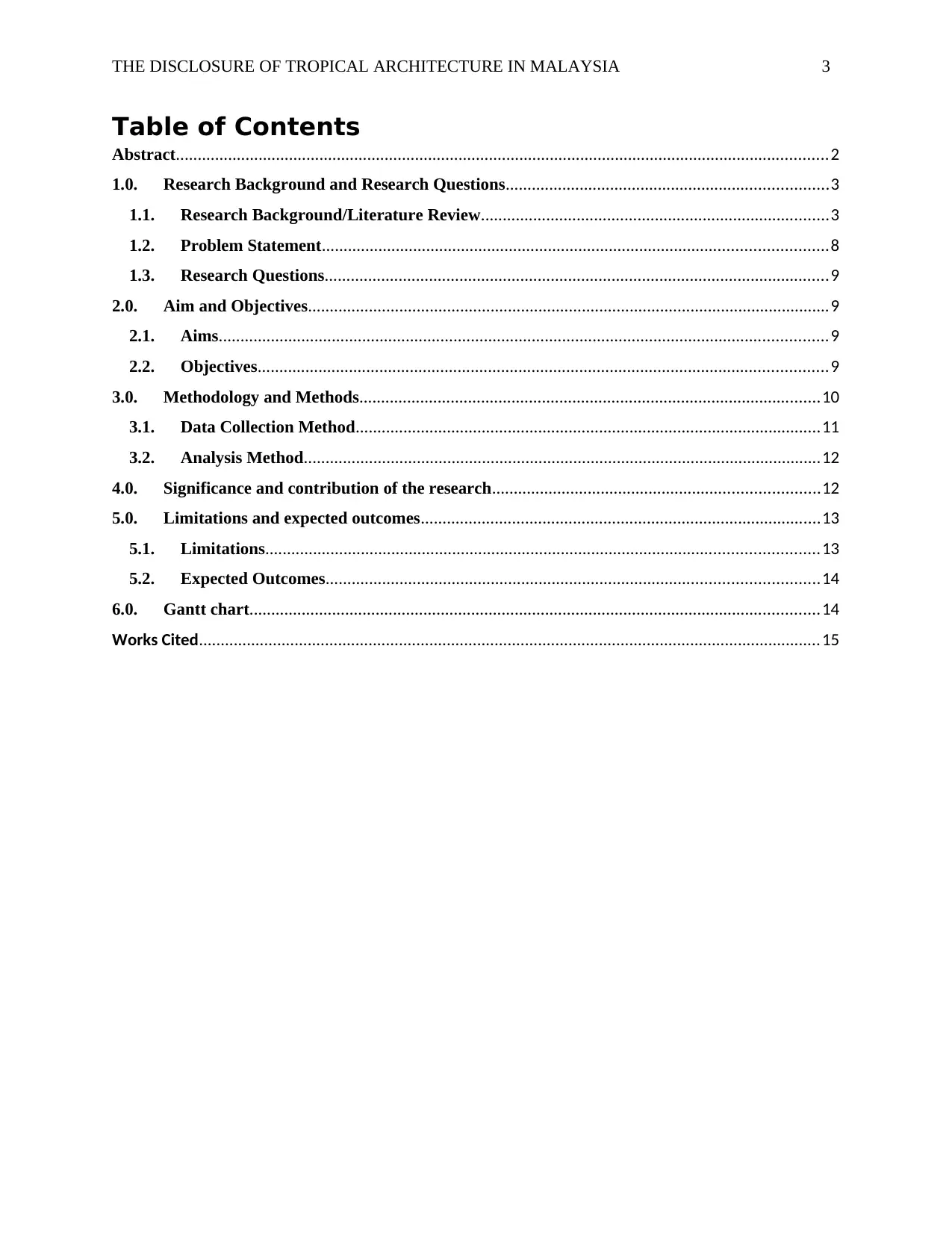
Table of Contents
Abstract......................................................................................................................................................2
1.0. Research Background and Research Questions..........................................................................3
1.1. Research Background/Literature Review................................................................................3
1.2. Problem Statement....................................................................................................................8
1.3. Research Questions....................................................................................................................9
2.0. Aim and Objectives........................................................................................................................9
2.1. Aims............................................................................................................................................9
2.2. Objectives...................................................................................................................................9
3.0. Methodology and Methods..........................................................................................................10
3.1. Data Collection Method...........................................................................................................11
3.2. Analysis Method.......................................................................................................................12
4.0. Significance and contribution of the research...........................................................................12
5.0. Limitations and expected outcomes............................................................................................13
5.1. Limitations...............................................................................................................................13
5.2. Expected Outcomes.................................................................................................................14
6.0. Gantt chart...................................................................................................................................14
Works Cited...............................................................................................................................................15
Table of Contents
Abstract......................................................................................................................................................2
1.0. Research Background and Research Questions..........................................................................3
1.1. Research Background/Literature Review................................................................................3
1.2. Problem Statement....................................................................................................................8
1.3. Research Questions....................................................................................................................9
2.0. Aim and Objectives........................................................................................................................9
2.1. Aims............................................................................................................................................9
2.2. Objectives...................................................................................................................................9
3.0. Methodology and Methods..........................................................................................................10
3.1. Data Collection Method...........................................................................................................11
3.2. Analysis Method.......................................................................................................................12
4.0. Significance and contribution of the research...........................................................................12
5.0. Limitations and expected outcomes............................................................................................13
5.1. Limitations...............................................................................................................................13
5.2. Expected Outcomes.................................................................................................................14
6.0. Gantt chart...................................................................................................................................14
Works Cited...............................................................................................................................................15
⊘ This is a preview!⊘
Do you want full access?
Subscribe today to unlock all pages.

Trusted by 1+ million students worldwide
THE DISCLOSURE OF TROPICAL ARCHITECTURE IN MALAYSIA 4
1.0. Research Background and Research Questions
1.1. Research Background/Literature Review
Design of buildings in tropical zones is largely influenced by changing lifestyle and climate
needs. These elements determine the most appropriate design strategies that should be applied so
as to develop functional, safe, efficient, cost effective, long lasting and sustainable buildings. The
practice or art of designing and constructing buildings or structures that are more functional,
safe, resource efficient and sustainable in tropical climates is known as tropical architecture. It is
mainly concerned with achieving the desired thermal comfort and overall indoor environmental
quality (IEQ) in buildings using passive design elements such as cavity walls, sunshades, wall
and roof insulation, overhangs, light shelves and shading. These elements started being used
during postcolonial era. However, use of ancient architectural elements in Malaysia has reduced
due to several reasons including: inability to meet the current lifestyle and climate needs, lack of
appeal to the current population (lack of modernism), lack of specialized materials needed for the
elements, and lack of knowledge.
Malaysia is located in the tropical region at 3° N from the equator and receives even
rainfall all year round (high relative humidity). Solar radiation level in the region is high with
temperatures ranging from 22° C and 33° C (Al Yacouby, et al., 2011). The average daily
sunlight duration is 8.7 hours and average annual solar radiation level is between 4.21 kWh and
5.56 kWh. This means that indoor temperature in most houses in Malaysia is likely to surpass the
comfortable or desired temperature level. The majority of modern houses are also designed such
that their design features and building materials allows transmission of exceed outdoor
temperature into the houses and does not allow flow of excess heat from the house. As a result,
mechanical air conditioning systems are highly relied upon in creating the desired thermal
1.0. Research Background and Research Questions
1.1. Research Background/Literature Review
Design of buildings in tropical zones is largely influenced by changing lifestyle and climate
needs. These elements determine the most appropriate design strategies that should be applied so
as to develop functional, safe, efficient, cost effective, long lasting and sustainable buildings. The
practice or art of designing and constructing buildings or structures that are more functional,
safe, resource efficient and sustainable in tropical climates is known as tropical architecture. It is
mainly concerned with achieving the desired thermal comfort and overall indoor environmental
quality (IEQ) in buildings using passive design elements such as cavity walls, sunshades, wall
and roof insulation, overhangs, light shelves and shading. These elements started being used
during postcolonial era. However, use of ancient architectural elements in Malaysia has reduced
due to several reasons including: inability to meet the current lifestyle and climate needs, lack of
appeal to the current population (lack of modernism), lack of specialized materials needed for the
elements, and lack of knowledge.
Malaysia is located in the tropical region at 3° N from the equator and receives even
rainfall all year round (high relative humidity). Solar radiation level in the region is high with
temperatures ranging from 22° C and 33° C (Al Yacouby, et al., 2011). The average daily
sunlight duration is 8.7 hours and average annual solar radiation level is between 4.21 kWh and
5.56 kWh. This means that indoor temperature in most houses in Malaysia is likely to surpass the
comfortable or desired temperature level. The majority of modern houses are also designed such
that their design features and building materials allows transmission of exceed outdoor
temperature into the houses and does not allow flow of excess heat from the house. As a result,
mechanical air conditioning systems are highly relied upon in creating the desired thermal
Paraphrase This Document
Need a fresh take? Get an instant paraphrase of this document with our AI Paraphraser
THE DISCLOSURE OF TROPICAL ARCHITECTURE IN MALAYSIA 5
comfort. However, these systems are expensive to install, operate and maintain, and have
negative impacts on the environment. One of the proposed approaches of creating comfortable
thermal comfort in Malaysian houses sustainably is use of tropical architecture. This concept can
create the desired IEQ with minimal energy consumption, costs and environmental impacts.
According to Bay & Ong (2006), tropical zones have numerous architectural problems
mainly those associated with the natural environment and tropical climatic conditions.
Architectural concepts in these regions are affected by a variety of issues such as tradition and
modernization, inappropriately planned rapid urban development, massive rural-urban migration,
and social and cultural strain brought about by globalization. These sentiments were shared by
Yeang (Northern Architecture, 2018) (1987), who stated that local factors like culture and
climate have a great impact on the design of buildings in urban areas in the tropics. All these
researchers agreed that tropical architecture has the potential of improving sustainability of
modern tropical architecture.
Tropical architecture has proven to be very effective in meeting IEQ requirements of
buildings in Malaysia. Even today, there are still numerous traditional buildings in Malaysia that
depict the country’s traditional architecture (Malay architecture). Some of the buildings include:
Islamic Arts Museum, old-style houses in Negeri Sembilan, Cheng Hoon Teng Temple,
Terengkera mosque, Sri Mahamariamman Temple, A’Famosa fort, the Stadthuys, Sultan Abdul
Samad Building, Carcosa Sri Negara, Majestic Hotel, Ipoh Railway Station, Kellie’s Castle,
Suffolk House, Christ Church in Melaka, Bishop’s House in Sarawak, and St. Michael’s and All
Angels Church in Sabah, among others (Malaysia.Travel, (n.d.)); (Teoh, 2018). These buildings
are influenced by architectural styles of various colonial powers, including Portuguese, Dutch
and British, and they have sophisticated architectural elements that are ideally suited to
comfort. However, these systems are expensive to install, operate and maintain, and have
negative impacts on the environment. One of the proposed approaches of creating comfortable
thermal comfort in Malaysian houses sustainably is use of tropical architecture. This concept can
create the desired IEQ with minimal energy consumption, costs and environmental impacts.
According to Bay & Ong (2006), tropical zones have numerous architectural problems
mainly those associated with the natural environment and tropical climatic conditions.
Architectural concepts in these regions are affected by a variety of issues such as tradition and
modernization, inappropriately planned rapid urban development, massive rural-urban migration,
and social and cultural strain brought about by globalization. These sentiments were shared by
Yeang (Northern Architecture, 2018) (1987), who stated that local factors like culture and
climate have a great impact on the design of buildings in urban areas in the tropics. All these
researchers agreed that tropical architecture has the potential of improving sustainability of
modern tropical architecture.
Tropical architecture has proven to be very effective in meeting IEQ requirements of
buildings in Malaysia. Even today, there are still numerous traditional buildings in Malaysia that
depict the country’s traditional architecture (Malay architecture). Some of the buildings include:
Islamic Arts Museum, old-style houses in Negeri Sembilan, Cheng Hoon Teng Temple,
Terengkera mosque, Sri Mahamariamman Temple, A’Famosa fort, the Stadthuys, Sultan Abdul
Samad Building, Carcosa Sri Negara, Majestic Hotel, Ipoh Railway Station, Kellie’s Castle,
Suffolk House, Christ Church in Melaka, Bishop’s House in Sarawak, and St. Michael’s and All
Angels Church in Sabah, among others (Malaysia.Travel, (n.d.)); (Teoh, 2018). These buildings
are influenced by architectural styles of various colonial powers, including Portuguese, Dutch
and British, and they have sophisticated architectural elements that are ideally suited to
THE DISCLOSURE OF TROPICAL ARCHITECTURE IN MALAYSIA 6
conditions in the tropical zones. The elements include: large windows and high-pitched roofs that
allow cross-ventilation, building on stilts to allow cooling of the building by the cross-ventilating
breeze below the house, colorful decorations, and outdoor gardens, among others. Therefore
traditional architecture can form the basis of improving contemporary architecture.
According to Chee, Chang & Wong (2011), tropical architecture was established in mid-
20th century and it included passive cooling approaches of sun-shading and cross-ventilation and
using specific construction materials with the capability of resisting corrosion and fungal growth.
However, the discourse of tropical architecture started losing its relevance from late 1970s due to
onslaught of different economic, social and cultural factors. Some of these included increased
availability of low-cost energy and enhanced dependence on power-driven air-conditioning
systems (Cox, 2012). The discourse of tropical architecture was revived in 1980s as a
sociocultural aspect that was aimed at responding to the globalization-caused homogenization
and neocolonial western cultural aspect (Chang, 2010). Since then, the discourse of tropical
architecture has continued worldwide and this practice continues to be applied in the design and
construction of buildings in tropical zones. In general terms, tropical architecture is deemed ‘a
natural concept’ and is largely determined by climatic or environmental conditions in the tropics.
Therefore there is need to encourage the discourse of tropical architecture so as to determine how
it can incorporate climatic or environmental, economic and social aspects in the design and
construction of buildings in tropical climate.
A study by Hosseini, Mursib, Nafida, & Shahedi (2012) sought to explore the effect of
traditional architecture on modern architecture. The researchers used Malay traditional house as
the case study. Their argument hypothesis was that failure to incorporate traditional practices
knowledge in contemporary designs have made these designs to be unsustainable. The
conditions in the tropical zones. The elements include: large windows and high-pitched roofs that
allow cross-ventilation, building on stilts to allow cooling of the building by the cross-ventilating
breeze below the house, colorful decorations, and outdoor gardens, among others. Therefore
traditional architecture can form the basis of improving contemporary architecture.
According to Chee, Chang & Wong (2011), tropical architecture was established in mid-
20th century and it included passive cooling approaches of sun-shading and cross-ventilation and
using specific construction materials with the capability of resisting corrosion and fungal growth.
However, the discourse of tropical architecture started losing its relevance from late 1970s due to
onslaught of different economic, social and cultural factors. Some of these included increased
availability of low-cost energy and enhanced dependence on power-driven air-conditioning
systems (Cox, 2012). The discourse of tropical architecture was revived in 1980s as a
sociocultural aspect that was aimed at responding to the globalization-caused homogenization
and neocolonial western cultural aspect (Chang, 2010). Since then, the discourse of tropical
architecture has continued worldwide and this practice continues to be applied in the design and
construction of buildings in tropical zones. In general terms, tropical architecture is deemed ‘a
natural concept’ and is largely determined by climatic or environmental conditions in the tropics.
Therefore there is need to encourage the discourse of tropical architecture so as to determine how
it can incorporate climatic or environmental, economic and social aspects in the design and
construction of buildings in tropical climate.
A study by Hosseini, Mursib, Nafida, & Shahedi (2012) sought to explore the effect of
traditional architecture on modern architecture. The researchers used Malay traditional house as
the case study. Their argument hypothesis was that failure to incorporate traditional practices
knowledge in contemporary designs have made these designs to be unsustainable. The
⊘ This is a preview!⊘
Do you want full access?
Subscribe today to unlock all pages.
Trusted by 1+ million students worldwide
THE DISCLOSURE OF TROPICAL ARCHITECTURE IN MALAYSIA 7
researchers explored the Malay traditional house, seeking to ascertain the design values of
traditional architecture used in designing and building this house. Data was collected from
documented sources and through observation of the Malay traditional house. This house was
designed and built by considering daily needs of occupants, cultural aspects and ordinary
people’s activities. Findings from the study showed that traditional architecture has very rich
design values and attributes that can be used to conserve the originality of modern architecture.
Nevertheless, it is important to explore individual design values of traditional architecture so as
to determine their suitability, applicability and how to improve them before being integrated into
modern architecture. These findings were similar to those from a study by Hosseini, Mursib,
Nafida, & Shamninan (2016), which concluded that design values of traditional architecture are
essential in creating innovative designs of modern Malay houses and contemporary architecture
in general. This means that contemporary architecture and better alternative tropicalities can be
developed from traditional architecture knowledge and practice.
Tahir, et al. (2010) conducted a study to investigate the applicability of raised floor
concept for modern terrace houses in tropical zones. This is the commonest, oldest and most
affordable house design in Malaysia. However, the concept has been associated with several
issues for many years, including bad design, safety issues, thermal problems, and unappealing
repairs. Modern terrace houses have been developed as reinforced concrete boxes and masonry
fitted with air conditioning system. These houses do not have most of the elements of Malay
traditional houses, such as cross ventilation openings, sun shade elements, raised floor, and use
of locally available building materials. In their study, Tahir, et al. (2010), found that features of
Malay traditional house can be incorporated in modern terrace houses to make them safer, more
functional, affordable and appealing. Some of the design features of the Malay house include:
researchers explored the Malay traditional house, seeking to ascertain the design values of
traditional architecture used in designing and building this house. Data was collected from
documented sources and through observation of the Malay traditional house. This house was
designed and built by considering daily needs of occupants, cultural aspects and ordinary
people’s activities. Findings from the study showed that traditional architecture has very rich
design values and attributes that can be used to conserve the originality of modern architecture.
Nevertheless, it is important to explore individual design values of traditional architecture so as
to determine their suitability, applicability and how to improve them before being integrated into
modern architecture. These findings were similar to those from a study by Hosseini, Mursib,
Nafida, & Shamninan (2016), which concluded that design values of traditional architecture are
essential in creating innovative designs of modern Malay houses and contemporary architecture
in general. This means that contemporary architecture and better alternative tropicalities can be
developed from traditional architecture knowledge and practice.
Tahir, et al. (2010) conducted a study to investigate the applicability of raised floor
concept for modern terrace houses in tropical zones. This is the commonest, oldest and most
affordable house design in Malaysia. However, the concept has been associated with several
issues for many years, including bad design, safety issues, thermal problems, and unappealing
repairs. Modern terrace houses have been developed as reinforced concrete boxes and masonry
fitted with air conditioning system. These houses do not have most of the elements of Malay
traditional houses, such as cross ventilation openings, sun shade elements, raised floor, and use
of locally available building materials. In their study, Tahir, et al. (2010), found that features of
Malay traditional house can be incorporated in modern terrace houses to make them safer, more
functional, affordable and appealing. Some of the design features of the Malay house include:
Paraphrase This Document
Need a fresh take? Get an instant paraphrase of this document with our AI Paraphraser
THE DISCLOSURE OF TROPICAL ARCHITECTURE IN MALAYSIA 8
stilted house that has the ability to catch higher velocity wind; open interior spaces with less
partitions to allow adequate ventilation; completely operable windows that allows enough
ventilation; large roof eaves that enable effective sun shading; low thermal capacity roofing to
enable adequate insulation against heat; and ventilated roof space that helps in cooling the
building. The raised floor design is aimed for the following: functionality, ventilation, thermal
comfort, lighting, safety & security, economy and privacy (social and visual). The advantages of
this design are: improves ventilation, optimizes and enhances the quality of natural lighting,
creates ample community space, and saves energy. Most importantly is that the raised floor
design can be adopted in Malaysia because it follows the applicable standard measurements.
Therefore combination of raised floor and other traditional Malay house design elements is one
of the promising alternative tropicalities that can be used in Malaysia.
Kubota & Chyee (2010) carried out a study to investigate the potential of using passive
cooling strategies for modern houses in Malaysia’s tropical climate. They conducted a complete
field experiment to establish the performance of different ventilation techniques. They found that
night ventilation was more effective in improving thermal comfort than daytime ventilation, and
thermal condition was improved by dehumidification and increasing air velocity using a ceiling
fan. A similar study was conducted by Roslan, Ibrahim, Affandi, Nawi, & Baharun (2016) to
explore how passive design of roofing system can be used to improve thermal comfort of modern
houses in tropical regions. The researchers found that the desired indoor comfort can be achieved
by minimizing the amount of heat transmitted into the house and removing the hot air trapped in
the house using passive design techniques. This also helps in reducing energy consumption and
costs of the building. Therefore passive design strategies, which are part of the discourse of
stilted house that has the ability to catch higher velocity wind; open interior spaces with less
partitions to allow adequate ventilation; completely operable windows that allows enough
ventilation; large roof eaves that enable effective sun shading; low thermal capacity roofing to
enable adequate insulation against heat; and ventilated roof space that helps in cooling the
building. The raised floor design is aimed for the following: functionality, ventilation, thermal
comfort, lighting, safety & security, economy and privacy (social and visual). The advantages of
this design are: improves ventilation, optimizes and enhances the quality of natural lighting,
creates ample community space, and saves energy. Most importantly is that the raised floor
design can be adopted in Malaysia because it follows the applicable standard measurements.
Therefore combination of raised floor and other traditional Malay house design elements is one
of the promising alternative tropicalities that can be used in Malaysia.
Kubota & Chyee (2010) carried out a study to investigate the potential of using passive
cooling strategies for modern houses in Malaysia’s tropical climate. They conducted a complete
field experiment to establish the performance of different ventilation techniques. They found that
night ventilation was more effective in improving thermal comfort than daytime ventilation, and
thermal condition was improved by dehumidification and increasing air velocity using a ceiling
fan. A similar study was conducted by Roslan, Ibrahim, Affandi, Nawi, & Baharun (2016) to
explore how passive design of roofing system can be used to improve thermal comfort of modern
houses in tropical regions. The researchers found that the desired indoor comfort can be achieved
by minimizing the amount of heat transmitted into the house and removing the hot air trapped in
the house using passive design techniques. This also helps in reducing energy consumption and
costs of the building. Therefore passive design strategies, which are part of the discourse of
THE DISCLOSURE OF TROPICAL ARCHITECTURE IN MALAYSIA 9
tropical architecture, can be used to improve IEQ and thermal comfort of buildings in the tropical
climate of Malaysia.
From the above literatures, it is evident that some of the passive design options that can
help improve thermal comfort of buildings in Malaysia include: raised floor, reflective cool roof,
ventilated roof (stack effect), optimum roof pitch (wind effect), and choice of suitable materials.
Tropical climate is characterized by high solar radiation or temperature and elevated emissivity
levels. This study will identify alternative tropicalities that have design values and attributes of
traditional architecture, which can be used to address various concerns of contemporary
architecture. Malaysian architecture is largely influenced by three main elements: tropical
climate in the region, changing modern needs and trends, and the ancient identity. Therefore the
alternative tropicalities identified should have the design values of traditional Malay houses and
are able to meet the contemporary lifestyle and climate needs. These alternatives should be
developed based on the following elements: ideology, culture, religion, morality, custom,
physical characteristic, structural quality, environmental quality, spatial characteristic and
craftsman quality.
1.2. Problem Statement
Tropical architecture in Malaysia is aimed at achieving the desired thermal comfort in buildings
located in Malaysia, which is dominated by tropical climate. However, some of the tropicalities
are not efficient, cost effective nor sustainable, considering the current social and environmental
needs. Others are deemed old fashioned hence are nit attractive to the present clients (generation)
in Malaysia. Therefore this research proposes to investigate several alternative tropicalities
existing in Malaysia that combines the postcolonial Asian identity and tropical modernist. The
alternative tropicalities identified should be efficient, cost effective, safe and sustainable. The
tropical architecture, can be used to improve IEQ and thermal comfort of buildings in the tropical
climate of Malaysia.
From the above literatures, it is evident that some of the passive design options that can
help improve thermal comfort of buildings in Malaysia include: raised floor, reflective cool roof,
ventilated roof (stack effect), optimum roof pitch (wind effect), and choice of suitable materials.
Tropical climate is characterized by high solar radiation or temperature and elevated emissivity
levels. This study will identify alternative tropicalities that have design values and attributes of
traditional architecture, which can be used to address various concerns of contemporary
architecture. Malaysian architecture is largely influenced by three main elements: tropical
climate in the region, changing modern needs and trends, and the ancient identity. Therefore the
alternative tropicalities identified should have the design values of traditional Malay houses and
are able to meet the contemporary lifestyle and climate needs. These alternatives should be
developed based on the following elements: ideology, culture, religion, morality, custom,
physical characteristic, structural quality, environmental quality, spatial characteristic and
craftsman quality.
1.2. Problem Statement
Tropical architecture in Malaysia is aimed at achieving the desired thermal comfort in buildings
located in Malaysia, which is dominated by tropical climate. However, some of the tropicalities
are not efficient, cost effective nor sustainable, considering the current social and environmental
needs. Others are deemed old fashioned hence are nit attractive to the present clients (generation)
in Malaysia. Therefore this research proposes to investigate several alternative tropicalities
existing in Malaysia that combines the postcolonial Asian identity and tropical modernist. The
alternative tropicalities identified should be efficient, cost effective, safe and sustainable. The
⊘ This is a preview!⊘
Do you want full access?
Subscribe today to unlock all pages.
Trusted by 1+ million students worldwide
THE DISCLOSURE OF TROPICAL ARCHITECTURE IN MALAYSIA 10
researcher will carry out a comprehensive investigation into alternative tropicalities by collecting
relevant information from analysis of existing literature, observation and experts in tropical
architecture in Malaysia through questionnaires and interviews. Findings from the study will
help in improving adoption of tropicalities in Malaysia and enhancing sustainability in Malaysian
building industry.
1.3. Research Questions
The key research questions to be answered in this research are:
1. What are the alternative tropicalities that exist in Malaysia which combines the tropical
modernist and postcolonial Asian identity?
2. What are the common discourse on tropical architecture in Malaysia?
2.0. Aim and Objectives
2.1. Aims
The aims of this research are to:
i) Explore the common discourse on tropical architecture in Malaysia.
ii) Identify alternative tropicalities that exist in Malaysia which combines the tropical
modernist and postcolonial Asian identity.
2.2. Objectives
The objectives of the research are:
1. To identify Malaysian tropical architecture experts who will be participants in the
research.
researcher will carry out a comprehensive investigation into alternative tropicalities by collecting
relevant information from analysis of existing literature, observation and experts in tropical
architecture in Malaysia through questionnaires and interviews. Findings from the study will
help in improving adoption of tropicalities in Malaysia and enhancing sustainability in Malaysian
building industry.
1.3. Research Questions
The key research questions to be answered in this research are:
1. What are the alternative tropicalities that exist in Malaysia which combines the tropical
modernist and postcolonial Asian identity?
2. What are the common discourse on tropical architecture in Malaysia?
2.0. Aim and Objectives
2.1. Aims
The aims of this research are to:
i) Explore the common discourse on tropical architecture in Malaysia.
ii) Identify alternative tropicalities that exist in Malaysia which combines the tropical
modernist and postcolonial Asian identity.
2.2. Objectives
The objectives of the research are:
1. To identify Malaysian tropical architecture experts who will be participants in the
research.
Paraphrase This Document
Need a fresh take? Get an instant paraphrase of this document with our AI Paraphraser
THE DISCLOSURE OF TROPICAL ARCHITECTURE IN MALAYSIA 11
2. To prepare research questionnaires and interviews, and collect data from the research
questionnaires, interviews and existing literature analysis.
3. To compile data gathered from the research questionnaires, interviews and existing
literature analysis.
4. To explore the common discourse on tropical architecture in Malaysia.
5. To identify alternative tropicalities that exist in Malaysia which combines the tropical
modernist and postcolonial Asian identity.
3.0. Methodology and Methods
The overall research methodology that will be used in this study is qualitative research
methodology. This methodology will help to have an in-depth understanding of the main
research topic – tropical architecture in Malaysia. The data collection methods to be used in the
study are: observation, questionnaires, interviews and systematic analysis of existing literature.
Observation – the researcher will identify 10 buildings in Malaysia with a combination of
modern and tropical architectural styles and/or design features, and visit these buildings
physically so as to make direct observations. The observations will help in collecting information
about tropical architectural styles and design features of the buildings.
Questionnaires – the research will prepare questionnaires and send them to 50
participants, who must be exerts in tropical architecture in Malaysia or have been involved in
building projects where tropical architecture was applied. The questionnaires will be used to
collect information about the discourse of tropical architecture in Malaysia and the alternative
tropicalities that exist in Malaysia and which combines the tropical modernist and postcolonial
Asian identity.
2. To prepare research questionnaires and interviews, and collect data from the research
questionnaires, interviews and existing literature analysis.
3. To compile data gathered from the research questionnaires, interviews and existing
literature analysis.
4. To explore the common discourse on tropical architecture in Malaysia.
5. To identify alternative tropicalities that exist in Malaysia which combines the tropical
modernist and postcolonial Asian identity.
3.0. Methodology and Methods
The overall research methodology that will be used in this study is qualitative research
methodology. This methodology will help to have an in-depth understanding of the main
research topic – tropical architecture in Malaysia. The data collection methods to be used in the
study are: observation, questionnaires, interviews and systematic analysis of existing literature.
Observation – the researcher will identify 10 buildings in Malaysia with a combination of
modern and tropical architectural styles and/or design features, and visit these buildings
physically so as to make direct observations. The observations will help in collecting information
about tropical architectural styles and design features of the buildings.
Questionnaires – the research will prepare questionnaires and send them to 50
participants, who must be exerts in tropical architecture in Malaysia or have been involved in
building projects where tropical architecture was applied. The questionnaires will be used to
collect information about the discourse of tropical architecture in Malaysia and the alternative
tropicalities that exist in Malaysia and which combines the tropical modernist and postcolonial
Asian identity.
THE DISCLOSURE OF TROPICAL ARCHITECTURE IN MALAYSIA 12
Interviews – the researcher will conduct interviews with 25 experts in tropical
architecture in Malaysia or other stakeholders who have been involved in building projects in
Malaysia where tropical architecture was applied. The interviews will be used to gather essential
information about the discourse of tropical architecture in Malaysia and the alternative
tropicalities that exist in Malaysia and which combines the tropical modernist and postcolonial
Asian identity.
Analysis of existing literature – the researcher will collect relevant information from
different secondary sources including books, journal articles, websites and publications. This
analysis will focus on the discourse of tropical architecture in Malaysia and the alternative
tropicalities that exist in Malaysia and which combines the tropical modernist and postcolonial
Asian identity.
The questionnaires and interviews to be used in this study will be formal. The
questionnaires and interviews will also be structured with open-ended and closed-ended
questions. The interviews will be telephone interviews and face-to-face interviews. Some
questionnaires will be mailed while others hand delivered to the respondents.
3.1. Data Collection Method
As aforementioned, the data collection methods will be a combination of observation,
questionnaires, interviews and analysis of existing literature.
3.2. Analysis Method
Data analysis involves collecting and organizing data so as to come to a conclusion. In this case,
data analysis will be aimed at answering the research questions and derive important information
Interviews – the researcher will conduct interviews with 25 experts in tropical
architecture in Malaysia or other stakeholders who have been involved in building projects in
Malaysia where tropical architecture was applied. The interviews will be used to gather essential
information about the discourse of tropical architecture in Malaysia and the alternative
tropicalities that exist in Malaysia and which combines the tropical modernist and postcolonial
Asian identity.
Analysis of existing literature – the researcher will collect relevant information from
different secondary sources including books, journal articles, websites and publications. This
analysis will focus on the discourse of tropical architecture in Malaysia and the alternative
tropicalities that exist in Malaysia and which combines the tropical modernist and postcolonial
Asian identity.
The questionnaires and interviews to be used in this study will be formal. The
questionnaires and interviews will also be structured with open-ended and closed-ended
questions. The interviews will be telephone interviews and face-to-face interviews. Some
questionnaires will be mailed while others hand delivered to the respondents.
3.1. Data Collection Method
As aforementioned, the data collection methods will be a combination of observation,
questionnaires, interviews and analysis of existing literature.
3.2. Analysis Method
Data analysis involves collecting and organizing data so as to come to a conclusion. In this case,
data analysis will be aimed at answering the research questions and derive important information
⊘ This is a preview!⊘
Do you want full access?
Subscribe today to unlock all pages.
Trusted by 1+ million students worldwide

1 out of 17


Your All-in-One AI-Powered Toolkit for Academic Success.
+13062052269
info@desklib.com
Available 24*7 on WhatsApp / Email
![[object Object]](/_next/static/media/star-bottom.7253800d.svg)
Unlock your academic potential
Copyright © 2020–2026 A2Z Services. All Rights Reserved. Developed and managed by ZUCOL.