Researching Teaching and Learning: A Critical Evaluation Report
VerifiedAdded on 2020/03/23
|9
|2452
|64
Report
AI Summary
This report critically evaluates the article by Capern and Hammond (2014), which explores the development of positive relationships between teachers and secondary students, specifically focusing on gifted students and those with emotional or behavioral disorders (EBD). The research, conducted in Western Australian secondary schools, examines how teacher behaviors impact student outcomes. The study reveals that gifted students prioritize teacher behaviors that support academic achievement and facilitate positive interactions, while students with EBD value teachers who demonstrate understanding, patience, and emotional support. The report highlights the importance of these findings in creating conducive learning environments and bridging the gap between educational theory and practice, particularly in the context of mathematics education. It also includes a lesson plan sequence focusing on time management and recognizing duration within the measurement and geometry strand, emphasizing the importance of adapting communication methods to meet individual student needs. The research emphasizes that positive student-teacher relationships are crucial for all students, and particularly for those at high academic risk.
Running head: RESEARCHING TEACHING AND LEARNING 1
Researching Teaching and Learning
Name
Institutional Affiliation
Researching Teaching and Learning
Name
Institutional Affiliation

Paraphrase This Document
Need a fresh take? Get an instant paraphrase of this document with our AI Paraphraser

RESEARCHING TEACHING AND LEARNING 2
Introduction
The article by Capern and Hammond (2014) presents a discussion about creating
relationships that are positive for teachers and students that are secondary gifted and those with
emotional or behavioral disorders. The article outlines ways of giving these two groups of
students what they need. Capern and Hammond (2014), assert that associations between students
and their teachers are often very vital in establishing conducive learning environments.
However, positive relationships between teachers and learners are more vital in gifted
students in secondary schools and among those with emotional or behavioral disorders. The
findings show that secondary gifted students valued teacher behaviors that promote friendly and
cordial interactions between students and teachers that supported their learning and academic
success. On the other hand, secondary students with emotional or behavioral disorders cherished
their teacher who showed them considerable understanding, warmth, and patience. According to
Hussain (2017) these qualities are the precursors of teachers’ support in their learning process.
Similarly, comparisons are made in this article between the behaviors identified by
students with EBD and gifted students. It is indicated that there are teacher behaviors that are
essential for both groups. Nevertheless, each group of students specified a set of teacher
behaviors that addressed their unique needs. By having positive relationships between students
and teachers, the former are more likely to be motivated and encouraged in the process of
learning (Luz, 2015). Additionally, as mentioned in the article, students understand that a
positive relationship with their teachers has a positive impact on their motivation and interest
which enhances the learning process.
Introduction
The article by Capern and Hammond (2014) presents a discussion about creating
relationships that are positive for teachers and students that are secondary gifted and those with
emotional or behavioral disorders. The article outlines ways of giving these two groups of
students what they need. Capern and Hammond (2014), assert that associations between students
and their teachers are often very vital in establishing conducive learning environments.
However, positive relationships between teachers and learners are more vital in gifted
students in secondary schools and among those with emotional or behavioral disorders. The
findings show that secondary gifted students valued teacher behaviors that promote friendly and
cordial interactions between students and teachers that supported their learning and academic
success. On the other hand, secondary students with emotional or behavioral disorders cherished
their teacher who showed them considerable understanding, warmth, and patience. According to
Hussain (2017) these qualities are the precursors of teachers’ support in their learning process.
Similarly, comparisons are made in this article between the behaviors identified by
students with EBD and gifted students. It is indicated that there are teacher behaviors that are
essential for both groups. Nevertheless, each group of students specified a set of teacher
behaviors that addressed their unique needs. By having positive relationships between students
and teachers, the former are more likely to be motivated and encouraged in the process of
learning (Luz, 2015). Additionally, as mentioned in the article, students understand that a
positive relationship with their teachers has a positive impact on their motivation and interest
which enhances the learning process.
RESEARCHING TEACHING AND LEARNING 3
The findings in this article are important because they may be applied to enhance
relationships between different groups of students and increase the effectiveness of the learning
process. The findings could be useful in bridging the gap that exists between practice and
educational theory. The established frameworks in this study for creating positive relationships
with these two types of students could be used to enhance academic and social outcomes for
students. They also help develop learning environments that are positive, and thus are crucial,
and ought to be implemented in my key learning area which is mathematics (Gehlbach et al.,
2015). It is important to give enough time to students to prepare for tests or complete
assignments. This also implies letting students work at their own pace to complete tasks.
In addition, it is considerably important for the teachers to be easily approachable and
always accessible for them to provide necessary assistance for the students to catch up on
assignments and prepare for exams. It is also advisable to interests of students in the subject area
and encourages the students based on their interest. Typically, learners who are identified as at
high risk of dropping out of school are disproportionately in low ability mathematics classes
(Muller, 2014). These students usually have educational expectations that are lower, attain low
grades, and view their teachers to be less caring. Their teachers also perceive them as not making
enough effort at school, and they do not perform well on mathematics tests. This is the reason
why it is important to implement the issue in my key learning area (Muller, 2014).
Critical Evaluation of the Article
Many research findings have indicated that positive interactions between students and
their teachers are pivotal in establishing healthy learning environments. Some of these studies
have also examined how student-teacher relationships are formed. However, this article suggests
that there is inadequate comparative research on how to develop positive relationships differently
The findings in this article are important because they may be applied to enhance
relationships between different groups of students and increase the effectiveness of the learning
process. The findings could be useful in bridging the gap that exists between practice and
educational theory. The established frameworks in this study for creating positive relationships
with these two types of students could be used to enhance academic and social outcomes for
students. They also help develop learning environments that are positive, and thus are crucial,
and ought to be implemented in my key learning area which is mathematics (Gehlbach et al.,
2015). It is important to give enough time to students to prepare for tests or complete
assignments. This also implies letting students work at their own pace to complete tasks.
In addition, it is considerably important for the teachers to be easily approachable and
always accessible for them to provide necessary assistance for the students to catch up on
assignments and prepare for exams. It is also advisable to interests of students in the subject area
and encourages the students based on their interest. Typically, learners who are identified as at
high risk of dropping out of school are disproportionately in low ability mathematics classes
(Muller, 2014). These students usually have educational expectations that are lower, attain low
grades, and view their teachers to be less caring. Their teachers also perceive them as not making
enough effort at school, and they do not perform well on mathematics tests. This is the reason
why it is important to implement the issue in my key learning area (Muller, 2014).
Critical Evaluation of the Article
Many research findings have indicated that positive interactions between students and
their teachers are pivotal in establishing healthy learning environments. Some of these studies
have also examined how student-teacher relationships are formed. However, this article suggests
that there is inadequate comparative research on how to develop positive relationships differently
⊘ This is a preview!⊘
Do you want full access?
Subscribe today to unlock all pages.

Trusted by 1+ million students worldwide
RESEARCHING TEACHING AND LEARNING 4
with a different group of students. The positive relationship between students and their teachers
is important for all students. However, it is more critical for students with Emotional or
Behavioral Disorders (EBD) and gifted students (GS). In order for teachers and all education
stakeholders to fully understand what can be done for teachers to form positive relations with
these two groups of students, this study sought to understand the academic needs of different
students. The study examined the views of 58 gifted students and 40 students with EBD from 6
secondary schools in Western Australia. It also identifies the specific behavior of teachers that
lead to the formation of quality relationships with each set of students (Capern & Hammond,
2014).
Capern and Hammond (2014), are of the opinion that constant interaction between
teachers and students have an impact on the students’ emotional, social, and academic wellbeing.
Quality teacher-student relationships have been found to raise the achievement of students and
their attitudes towards learning and school. Other researchers have also found that strong positive
teacher-student relationships between gifted students may help to create a link between the
potential of the students and their accomplishment. It is worth mentioning that constructive
teacher-student relationships may equally assist in redressing the academic difficulties that EBD
students usually go through. In comparison to their peers, EBD students in many instances have
lower grades, are likely to be diagnosed with learning disability, and fail at school more often.
These students also have dropout rate which is higher than their peers.
As mentioned in the previous paragraphs, positive teacher-student relationships are
important to all students. However, this research has a particular interest in the gifted students
and students with EBD as they have a high academic risk (Knoell, 2013). The study equally
attempted to look into the Woolfolk and Weinstein’s appeal by asking students to name
with a different group of students. The positive relationship between students and their teachers
is important for all students. However, it is more critical for students with Emotional or
Behavioral Disorders (EBD) and gifted students (GS). In order for teachers and all education
stakeholders to fully understand what can be done for teachers to form positive relations with
these two groups of students, this study sought to understand the academic needs of different
students. The study examined the views of 58 gifted students and 40 students with EBD from 6
secondary schools in Western Australia. It also identifies the specific behavior of teachers that
lead to the formation of quality relationships with each set of students (Capern & Hammond,
2014).
Capern and Hammond (2014), are of the opinion that constant interaction between
teachers and students have an impact on the students’ emotional, social, and academic wellbeing.
Quality teacher-student relationships have been found to raise the achievement of students and
their attitudes towards learning and school. Other researchers have also found that strong positive
teacher-student relationships between gifted students may help to create a link between the
potential of the students and their accomplishment. It is worth mentioning that constructive
teacher-student relationships may equally assist in redressing the academic difficulties that EBD
students usually go through. In comparison to their peers, EBD students in many instances have
lower grades, are likely to be diagnosed with learning disability, and fail at school more often.
These students also have dropout rate which is higher than their peers.
As mentioned in the previous paragraphs, positive teacher-student relationships are
important to all students. However, this research has a particular interest in the gifted students
and students with EBD as they have a high academic risk (Knoell, 2013). The study equally
attempted to look into the Woolfolk and Weinstein’s appeal by asking students to name
Paraphrase This Document
Need a fresh take? Get an instant paraphrase of this document with our AI Paraphraser

RESEARCHING TEACHING AND LEARNING 5
behaviors o teachers that contribute strongly to the formation of positive quality relationships.
This study fills a gap in corpus of literature by identifying the behavior of teachers that
contributes to positive teacher-student relationships with GS and students with EBD and by
comparing and contrasting the behaviors that were most effective with each set of students.
Findings of the Research
The research study involved Western Australian secondary school students who were
recognized as having EBD or gifted. The findings of the research indicated that students who are
gifted and those with EBD had varied perspectives as to which teacher behaviors were most
crucial for creating constructive relationships with their instructors. GS placed more emphasis on
teacher behaviors that would enable them to perform better academically (Capern & Hammond,
2014). On the other hand, students with EBD held the view that it is crucial for their teachers to
behave in ways that showed understanding, care, patience, as well as support for their academic
activities.
Even though the perspectives of these sets of students were different, there was
agreement concerning teacher behaviors that formed the basis of positive student-teacher
relationships. Both sets of students were in agreement on primary teacher behaviors that were
efficient for developing positive relationships. However, they differed on secondary essential
behaviors. The secondary essential teacher behaviors indicated that GS had a preference for
teacher behaviors that lead to academic excellence and cordial interaction with their teachers.
On the contrary, students with EBD preferred their teachers to behave in ways that
displayed patience, understanding, and many learning opportunities (Capern & Hammond,
2014). Students with EBD were of the view that it is important for their teachers to behave in an
behaviors o teachers that contribute strongly to the formation of positive quality relationships.
This study fills a gap in corpus of literature by identifying the behavior of teachers that
contributes to positive teacher-student relationships with GS and students with EBD and by
comparing and contrasting the behaviors that were most effective with each set of students.
Findings of the Research
The research study involved Western Australian secondary school students who were
recognized as having EBD or gifted. The findings of the research indicated that students who are
gifted and those with EBD had varied perspectives as to which teacher behaviors were most
crucial for creating constructive relationships with their instructors. GS placed more emphasis on
teacher behaviors that would enable them to perform better academically (Capern & Hammond,
2014). On the other hand, students with EBD held the view that it is crucial for their teachers to
behave in ways that showed understanding, care, patience, as well as support for their academic
activities.
Even though the perspectives of these sets of students were different, there was
agreement concerning teacher behaviors that formed the basis of positive student-teacher
relationships. Both sets of students were in agreement on primary teacher behaviors that were
efficient for developing positive relationships. However, they differed on secondary essential
behaviors. The secondary essential teacher behaviors indicated that GS had a preference for
teacher behaviors that lead to academic excellence and cordial interaction with their teachers.
On the contrary, students with EBD preferred their teachers to behave in ways that
displayed patience, understanding, and many learning opportunities (Capern & Hammond,
2014). Students with EBD were of the view that it is important for their teachers to behave in an
RESEARCHING TEACHING AND LEARNING 6
emotionally supportive manner than the gifted students. This shows that the students had the
desire to have cordial relationship with their teachers and had the feeling that their teachers were
mindful of their circumstances and emotional states. Gifted students emphasized on behaviors
that are supportive academically. They considered academic support as the basis for helpful
relationships because they felt that this would allow their teachers to fulfill their basic role of
facilitators of education. It is important to note that both sets of students underscored the
significance of teachers to treat them with respect, being friendly and warm, and helping them
with their school work.
Method of the Research
The behaviors of teachers that lead to good relationships between teachers and secondary
students with EBD and gifted students were investigated by applying mixed-methods approach.
The research study was carried out in Western Australian secondary schools that provide
academic programs to gifted students as well as those with EBD. The mixed-method approach
involves incorporating both qualitative and quantitative research to analyze, gather, and interpret
data (Verloop, 2017).
Quantitative data in this study was collected using surveys, while qualitative data were
collected using focus groups. Data collection process was carried over 18 months. Students were
asked whether they would be able to take part in the study in discussion to give their views on
relationships with their teachers. Six students who were willing to participate were selected
randomly to take part in a focus group. The process of collecting data for the students with EBD
was organized in a similar manner with a sample of 40 students taking part. 12 students who
were willing to participate were selected randomly to participate in a focus group. The student-
teacher relationship survey was used as the primary instrument for collecting quantitative data.
emotionally supportive manner than the gifted students. This shows that the students had the
desire to have cordial relationship with their teachers and had the feeling that their teachers were
mindful of their circumstances and emotional states. Gifted students emphasized on behaviors
that are supportive academically. They considered academic support as the basis for helpful
relationships because they felt that this would allow their teachers to fulfill their basic role of
facilitators of education. It is important to note that both sets of students underscored the
significance of teachers to treat them with respect, being friendly and warm, and helping them
with their school work.
Method of the Research
The behaviors of teachers that lead to good relationships between teachers and secondary
students with EBD and gifted students were investigated by applying mixed-methods approach.
The research study was carried out in Western Australian secondary schools that provide
academic programs to gifted students as well as those with EBD. The mixed-method approach
involves incorporating both qualitative and quantitative research to analyze, gather, and interpret
data (Verloop, 2017).
Quantitative data in this study was collected using surveys, while qualitative data were
collected using focus groups. Data collection process was carried over 18 months. Students were
asked whether they would be able to take part in the study in discussion to give their views on
relationships with their teachers. Six students who were willing to participate were selected
randomly to take part in a focus group. The process of collecting data for the students with EBD
was organized in a similar manner with a sample of 40 students taking part. 12 students who
were willing to participate were selected randomly to participate in a focus group. The student-
teacher relationship survey was used as the primary instrument for collecting quantitative data.
⊘ This is a preview!⊘
Do you want full access?
Subscribe today to unlock all pages.
Trusted by 1+ million students worldwide
RESEARCHING TEACHING AND LEARNING 7
Test of reliability of the student version was conducted by using the Cronbach’s alpha.
Cronbach’s alpha for both students with EBD and gifted students was 0.96 showing high
reliability (Capern & Hammond, 2014).
Teacher behavior was represented by 70 items on the survey in which each of the item
therein was used to represent the teacher’s behavior. Likert scale format was used to score the
items (6 = very strongly agree to 1 = very strongly disagree). This showed how critical each
behavior was for forming a positive teacher-student relationship. The study also made use of
open-ended questions to determine behaviors of teachers that may not have been in the 70 item
list. On the other hand, the purpose of focus groups was to ascertain the findings of the
conducted surveys (Capern & Hammond, 2014). There were two programs with each focus
group consisting of 6 students from every program except one of the gifted programs. Survey
data was analyzed before carrying out the focus groups to allow the participants to have an
opportunity to offer reflections on the outcomes from the study. The resulting data was
triangulated to ensure dependability. The participating students were also asked to provide their
reflections and make comparisons on how certain teachers are good at developing relationships.
The discussions in the focus groups were recorded and properly transcribed to ensure accuracy of
data gathered. A coding system was used to come up with codes (Liberante, 2015).
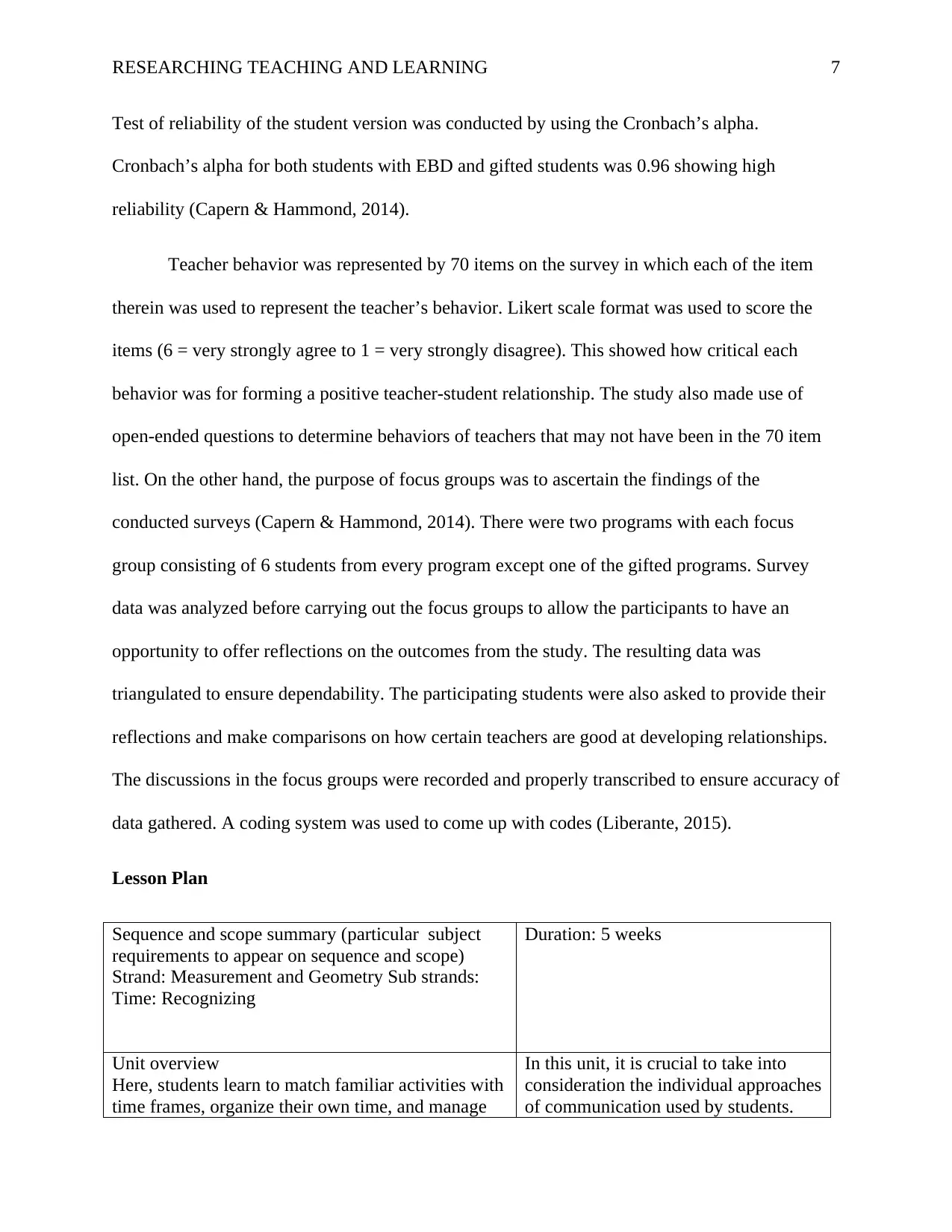
Lesson Plan
Sequence and scope summary (particular subject
requirements to appear on sequence and scope)
Strand: Measurement and Geometry Sub strands:
Time: Recognizing
Duration: 5 weeks
Unit overview
Here, students learn to match familiar activities with
time frames, organize their own time, and manage
In this unit, it is crucial to take into
consideration the individual approaches
of communication used by students.
Test of reliability of the student version was conducted by using the Cronbach’s alpha.
Cronbach’s alpha for both students with EBD and gifted students was 0.96 showing high
reliability (Capern & Hammond, 2014).
Teacher behavior was represented by 70 items on the survey in which each of the item
therein was used to represent the teacher’s behavior. Likert scale format was used to score the
items (6 = very strongly agree to 1 = very strongly disagree). This showed how critical each
behavior was for forming a positive teacher-student relationship. The study also made use of
open-ended questions to determine behaviors of teachers that may not have been in the 70 item
list. On the other hand, the purpose of focus groups was to ascertain the findings of the
conducted surveys (Capern & Hammond, 2014). There were two programs with each focus
group consisting of 6 students from every program except one of the gifted programs. Survey
data was analyzed before carrying out the focus groups to allow the participants to have an
opportunity to offer reflections on the outcomes from the study. The resulting data was
triangulated to ensure dependability. The participating students were also asked to provide their
reflections and make comparisons on how certain teachers are good at developing relationships.
The discussions in the focus groups were recorded and properly transcribed to ensure accuracy of
data gathered. A coding system was used to come up with codes (Liberante, 2015).
Lesson Plan
Sequence and scope summary (particular subject
requirements to appear on sequence and scope)
Strand: Measurement and Geometry Sub strands:
Time: Recognizing
Duration: 5 weeks
Unit overview
Here, students learn to match familiar activities with
time frames, organize their own time, and manage
In this unit, it is crucial to take into
consideration the individual approaches
of communication used by students.
Paraphrase This Document
Need a fresh take? Get an instant paraphrase of this document with our AI Paraphraser
RESEARCHING TEACHING AND LEARNING 8
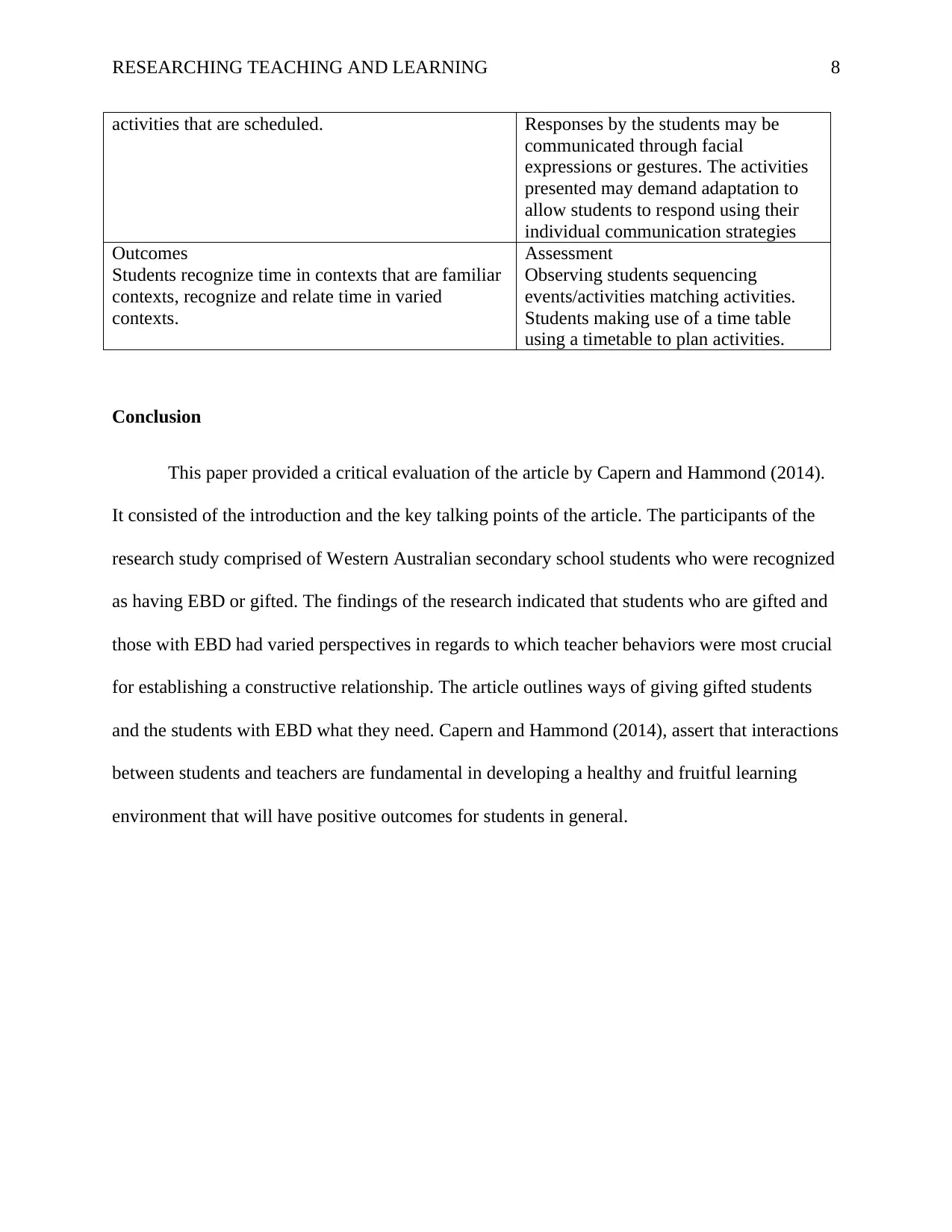
activities that are scheduled. Responses by the students may be
communicated through facial
expressions or gestures. The activities
presented may demand adaptation to
allow students to respond using their
individual communication strategies
Outcomes
Students recognize time in contexts that are familiar
contexts, recognize and relate time in varied
contexts.
Assessment
Observing students sequencing
events/activities matching activities.
Students making use of a time table
using a timetable to plan activities.
Conclusion
This paper provided a critical evaluation of the article by Capern and Hammond (2014).
It consisted of the introduction and the key talking points of the article. The participants of the
research study comprised of Western Australian secondary school students who were recognized
as having EBD or gifted. The findings of the research indicated that students who are gifted and
those with EBD had varied perspectives in regards to which teacher behaviors were most crucial
for establishing a constructive relationship. The article outlines ways of giving gifted students
and the students with EBD what they need. Capern and Hammond (2014), assert that interactions
between students and teachers are fundamental in developing a healthy and fruitful learning
environment that will have positive outcomes for students in general.
activities that are scheduled. Responses by the students may be
communicated through facial
expressions or gestures. The activities
presented may demand adaptation to
allow students to respond using their
individual communication strategies
Outcomes
Students recognize time in contexts that are familiar
contexts, recognize and relate time in varied
contexts.
Assessment
Observing students sequencing
events/activities matching activities.
Students making use of a time table
using a timetable to plan activities.
Conclusion
This paper provided a critical evaluation of the article by Capern and Hammond (2014).
It consisted of the introduction and the key talking points of the article. The participants of the
research study comprised of Western Australian secondary school students who were recognized
as having EBD or gifted. The findings of the research indicated that students who are gifted and
those with EBD had varied perspectives in regards to which teacher behaviors were most crucial
for establishing a constructive relationship. The article outlines ways of giving gifted students
and the students with EBD what they need. Capern and Hammond (2014), assert that interactions
between students and teachers are fundamental in developing a healthy and fruitful learning
environment that will have positive outcomes for students in general.
RESEARCHING TEACHING AND LEARNING 9
References
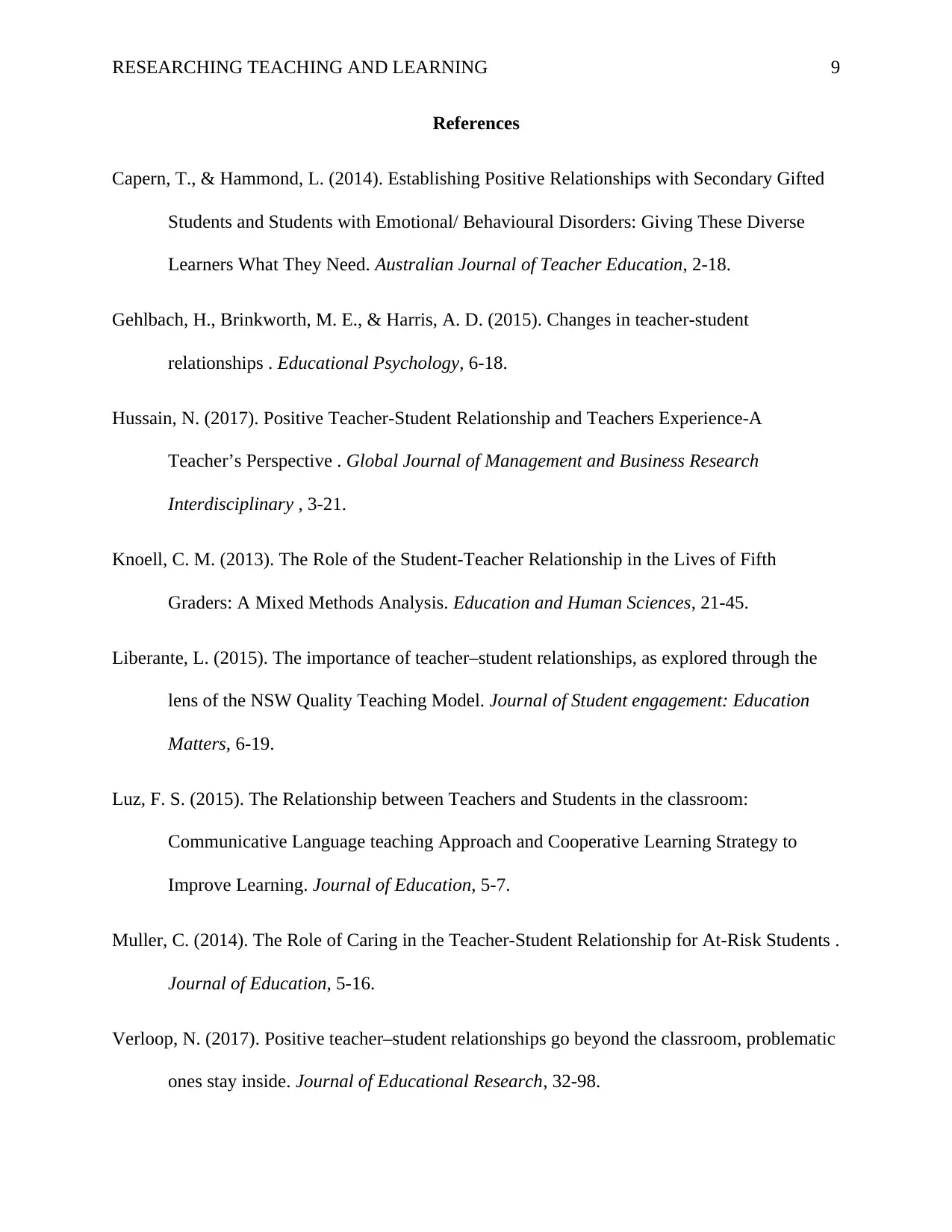
Capern, T., & Hammond, L. (2014). Establishing Positive Relationships with Secondary Gifted
Students and Students with Emotional/ Behavioural Disorders: Giving These Diverse
Learners What They Need. Australian Journal of Teacher Education, 2-18.
Gehlbach, H., Brinkworth, M. E., & Harris, A. D. (2015). Changes in teacher-student
relationships . Educational Psychology, 6-18.
Hussain, N. (2017). Positive Teacher-Student Relationship and Teachers Experience-A
Teacher’s Perspective . Global Journal of Management and Business Research
Interdisciplinary , 3-21.
Knoell, C. M. (2013). The Role of the Student-Teacher Relationship in the Lives of Fifth
Graders: A Mixed Methods Analysis. Education and Human Sciences, 21-45.
Liberante, L. (2015). The importance of teacher–student relationships, as explored through the
lens of the NSW Quality Teaching Model. Journal of Student engagement: Education
Matters, 6-19.
Luz, F. S. (2015). The Relationship between Teachers and Students in the classroom:
Communicative Language teaching Approach and Cooperative Learning Strategy to
Improve Learning. Journal of Education, 5-7.
Muller, C. (2014). The Role of Caring in the Teacher-Student Relationship for At-Risk Students .
Journal of Education, 5-16.
Verloop, N. (2017). Positive teacher–student relationships go beyond the classroom, problematic
ones stay inside. Journal of Educational Research, 32-98.
References
Capern, T., & Hammond, L. (2014). Establishing Positive Relationships with Secondary Gifted
Students and Students with Emotional/ Behavioural Disorders: Giving These Diverse
Learners What They Need. Australian Journal of Teacher Education, 2-18.
Gehlbach, H., Brinkworth, M. E., & Harris, A. D. (2015). Changes in teacher-student
relationships . Educational Psychology, 6-18.
Hussain, N. (2017). Positive Teacher-Student Relationship and Teachers Experience-A
Teacher’s Perspective . Global Journal of Management and Business Research
Interdisciplinary , 3-21.
Knoell, C. M. (2013). The Role of the Student-Teacher Relationship in the Lives of Fifth
Graders: A Mixed Methods Analysis. Education and Human Sciences, 21-45.
Liberante, L. (2015). The importance of teacher–student relationships, as explored through the
lens of the NSW Quality Teaching Model. Journal of Student engagement: Education
Matters, 6-19.
Luz, F. S. (2015). The Relationship between Teachers and Students in the classroom:
Communicative Language teaching Approach and Cooperative Learning Strategy to
Improve Learning. Journal of Education, 5-7.
Muller, C. (2014). The Role of Caring in the Teacher-Student Relationship for At-Risk Students .
Journal of Education, 5-16.
Verloop, N. (2017). Positive teacher–student relationships go beyond the classroom, problematic
ones stay inside. Journal of Educational Research, 32-98.
⊘ This is a preview!⊘
Do you want full access?
Subscribe today to unlock all pages.
Trusted by 1+ million students worldwide

1 out of 9


Related Documents


Your All-in-One AI-Powered Toolkit for Academic Success.
+13062052269
info@desklib.com
Available 24*7 on WhatsApp / Email
![[object Object]](/_next/static/media/star-bottom.7253800d.svg)
Unlock your academic potential
Copyright © 2020–2026 A2Z Services. All Rights Reserved. Developed and managed by ZUCOL.