Responsibility to Protect (R2P) Doctrine: Case Study Analysis

Verified

Added on  2021/04/17

|6
|1578
|42
Case Study
AI Summary
This case study analyzes the Responsibility to Protect (R2P) doctrine, focusing on its application in situations involving atrocity crimes and humanitarian crises, specifically referencing the Syrian conflict. The analysis examines the limitations and failures of R2P, highlighting the complexities of international intervention and the challenges faced by the Security Council. The author discusses the three pillars of R2P, particularly the authorization of force as a last resort, and critiques its effectiveness in cases where governments fail to protect their citizens. The case study emphasizes the need for revisiting and strengthening R2P to address the limitations, such as the inability to protect vulnerable groups and the restrictions on intervention. The analysis underscores the importance of proactive measures, the role of international civil rights bodies, and the need to prioritize human rights over state sovereignty to prevent and resolve humanitarian crises effectively. The author suggests the need for alternative solutions and a more robust international response to protect civilians from violence and atrocities.

Document Page
Case Study Analysis 1
Name:
Course:
Professor:
Date:
tabler-icon-diamond-filled.svg

Paraphrase This Document

Need a fresh take? Get an instant paraphrase of this document with our AI Paraphraser
Document Page
Case Study Analysis 2
Case Study Analysis
a)
In this article, the authors use the approaches which have a sequence of activities which
must be followed in enhancing the Responsibility to Protect doctrine. The authors start by
highlighting the areas which the R2P has been able to fail and the reasons for the failure. As the
authors note, the R2P is complicated and keeps evolving with emergence of new challenges. The
focus on the third pillar of R2P is the main focus of this article. The authors “…discuss the
emergence of R2P, providing an overview of R2P’s third pillar, which authorizes the use of
force” (Williams, Ulbrick & Worboys, 2012). The use of force is analyzed as the last resort for
the international community but still has key restrictions for it to be used. First, the pillar
provides that the nation should have failed to protect its citizens for the Security Council to
intervene. This means that the governments are already carrying out the violations of human
rights. This is argued as a way to help protect the nation’s sovereignty (Thakur, 2017). This is
one of the most ineffective ways to deal with the situation considering the human right
violations.
With this process, Syrians have continued to die in the hands with the government with
the international community and Security Council watching yet they can do nothing. As the
Security Council comes in, it has to start engaging on non-violent means to help solve the
situations. The Security Council is allowed to use minimal force in dealing with the situation
(Williams, Ulbrick & Worboys, 2012). Further, the R2P has an option where the Security
Council is able to fail to solve the crisis. If the Security Council really values the rights of
human, why then fail to solve the atrocity crimes to protect the citizens? With the option of
Document Page
Case Study Analysis 3
failure, it is like requesting the same failed government to take charge and protect its people
again. Nevertheless, the use of force by other parties is also limited which does not seem to make
sense. This is because the Security Council has failed to make impact and this means that the
violence is more than estimated. This is the main problem which has led to difficulties in solving
Syria case (In Hilpold, 2015). Most importantly, the article and R2P provides that a credible
opposition group must be able to provide an intervention, which represents the victims of
atrocity crimes. By the time, it is not possible to have such groups because they will be the first
target by the oppressing forces. This means that the R2P must be revisited more and more to help
solve atrocity crimes in advance and protect lives.
b)
The R2P is a crucial process which can be used to protect against humanitarian calamities
and atrocity crimes. Nevertheless, the R2P is a process which cannot be used to resolve
situations where the government and rebel groups are adamant. The atrocity crimes will continue
to exist as the different groups and government try to hold their stands and proving they are on
the right track. Therefore new means to deal with problems such as in Syria need new measures
to resolve them (Thakur, 2017). The R2P is too weak for the Syria case and tough measures are
needed to be able to resolve the humanitarian rights violations. In this case, Syria is still holding
on its sovereignty and ability to protect the citizens in the name of attacking terrorists. Although
they are within their rights to do, the human rights violations and atrocity crimes are increasing
each day (Nederland, 2010). This is happening with the Security Council and R2P are in place
yet they have a process to follow to solve the situation. The situation in Syria is clear and R2P
must take its final step and if it failed, new developments must be done to resolve such
situations.
Document Page
Case Study Analysis 4
For the interest of the Syrian citizens, the country needs a new force which will move and
take actions on the oppressing forces. Peaceful means of resolving the situations in Syria have
been ignored and failed fully (Thakur, 2016). Deals are being signed and broken in few days.
Therefore with the options in R2P being exhausted, it is time for the Security Council to hand
over to a powerful state to control Syria and resolve the situation. This nevertheless is likely to
face opposition from the state. The Security Council must authorize the use of force. This time,
the directed force should focus on those committing the atrocity crimes. Using limited force will
unlikely be able to resolve the problem and this means that tough measures must be brought in.
with the history of failed negotiations and signed deals, limited force will be likely to fail
(Williams, Ulbrick & Worboys, 2012). So far, the R2P has taken long and the atrocities against
the populations are still happening. Therefore the R2P should have an option to ensure that peace
is restored by all means possible when the different parties seem rigid on solving the problems.
This should be done bearing in mind that atrocity crimes have reached the highest level and they
cannot be allowed to continue.
c)
Responsibility to protect should be given an upper hand to look at situations in countries
for the best interest of the citizens in those countries. Sovereignty is nothing compared to the
lives which are lost when some states are left to protect the citizens when it is clear that they are
heading to failure on that course (Nederland, 2010). Details on nations and states resources to
protect their citizens are always known and therefore the international communities are aware on
states which cannot defend their citizens when faced with some level of situations. The R2P
should be made a law which will have interference on nation’s affair when atrocity crimes seem
tabler-icon-diamond-filled.svg

Paraphrase This Document

Need a fresh take? Get an instant paraphrase of this document with our AI Paraphraser
Document Page
Case Study Analysis 5
to be taking shape. The R2P should focus more on the human rights for the citizens and thus help
to resolve the different situations before much harm is done (Zyberi, 2016). In many cases, R2P
comes late and mostly when the damage has already been done and lives have been lost. This
should not be the case if the law is designed to protect lives.
The international civil rights bodies can be able to analyze the integrity of the states and
be able to know whether the nations can carry out the atrocity crimes. This is clear information
which can be used to ensure that the R2P takes its course early and protect the citizens (Thakur,
2016). Waiting for the atrocity crimes to define that the state has failed to protect the citizens is
failing to protect the same citizens when one is aware of what will happen. This first step of R2P
is done and placed in the name of states sovereignty and it should be done. The international
community’s rules and norms to protect population against the crimes should be the priority.
This should ensure that the R2P is made a law and given the necessary power to intervene when
necessary (Williams, Ulbrick & Worboys, 2012). This R2P should be able to take place at
different stages in different states according to their power to protect the population against
atrocity crimes. This will ensure that the lives protection is given the upper hand than giving the
atrocity criminal space and time to continue with the human rights violation on citizens.
Document Page
Case Study Analysis 6
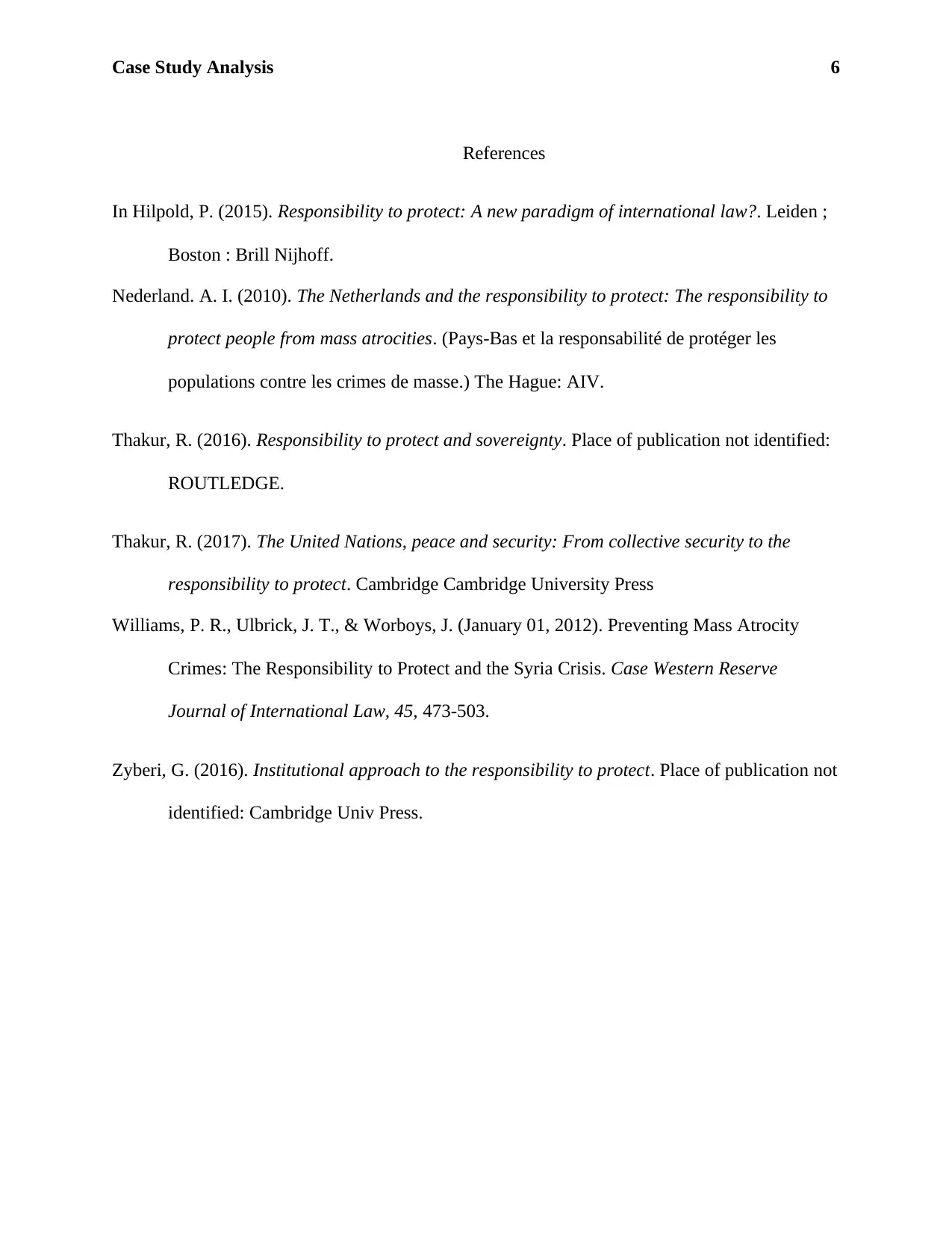
References
In Hilpold, P. (2015). Responsibility to protect: A new paradigm of international law?. Leiden ;
Boston : Brill Nijhoff.
Nederland. A. I. (2010). The Netherlands and the responsibility to protect: The responsibility to
protect people from mass atrocities. (Pays-Bas et la responsabilité de protéger les
populations contre les crimes de masse.) The Hague: AIV.
Thakur, R. (2016). Responsibility to protect and sovereignty. Place of publication not identified:
ROUTLEDGE.
Thakur, R. (2017). The United Nations, peace and security: From collective security to the
responsibility to protect. Cambridge Cambridge University Press
Williams, P. R., Ulbrick, J. T., & Worboys, J. (January 01, 2012). Preventing Mass Atrocity
Crimes: The Responsibility to Protect and the Syria Crisis. Case Western Reserve
Journal of International Law, 45, 473-503.
Zyberi, G. (2016). Institutional approach to the responsibility to protect. Place of publication not
identified: Cambridge Univ Press.
chevron_up_icon
1 out of 6
circle_padding
hide_on_mobile
zoom_out_icon
[object Object]