University Marketing Project: Restaurant Investment vs. Development
VerifiedAdded on 2020/05/01
|15
|3470
|115
Project
AI Summary
This project report, prepared for marketing students Mark and Paul, evaluates two investment opportunities: a restaurant and a new business development. The report analyzes financial figures, including sales, labor, and cash budgets, to determine the more profitable investment. It begins with an introduction and a discussion of the nature and scope of investments. The report then delves into the specifics of the restaurant investment, outlining expenses such as machinery, furniture, and operating costs. Sales, labor, and cash budgets are presented and analyzed to forecast financial performance. The report compares this investment with the new business development opportunity, although details of the second option aren't provided in the provided text. Various financial tools are employed to assess each project's potential profitability and risk. The conclusion aims to identify the superior investment opportunity and explain the rationale behind the decision. The report also includes references.
Running Head: Accounting for business
1
Project Report: Accounting for business
1
Project Report: Accounting for business

Paraphrase This Document
Need a fresh take? Get an instant paraphrase of this document with our AI Paraphraser
Running Head: Accounting for business
2
Executive summary
Marketing student of the university, Mark and Paul wants to start their own start up
and want investment from the investors so that the business could be start by them smoothly.
This report has been prepared for them to analyze that which project is better in order to
make more profits and invest into the project. Mark and Paul have come up with two ideas
one is investment into the business of restaurant and other one is to invest into the new
business development. Through this report, it has been tried to evaluate that which
opportunity is investment is better and why it is better. Before it, the nature of the investment
has also been concerned. For this report, various financial tools have been used.
2
Executive summary
Marketing student of the university, Mark and Paul wants to start their own start up
and want investment from the investors so that the business could be start by them smoothly.
This report has been prepared for them to analyze that which project is better in order to
make more profits and invest into the project. Mark and Paul have come up with two ideas
one is investment into the business of restaurant and other one is to invest into the new
business development. Through this report, it has been tried to evaluate that which
opportunity is investment is better and why it is better. Before it, the nature of the investment
has also been concerned. For this report, various financial tools have been used.
Running Head: Accounting for business
3
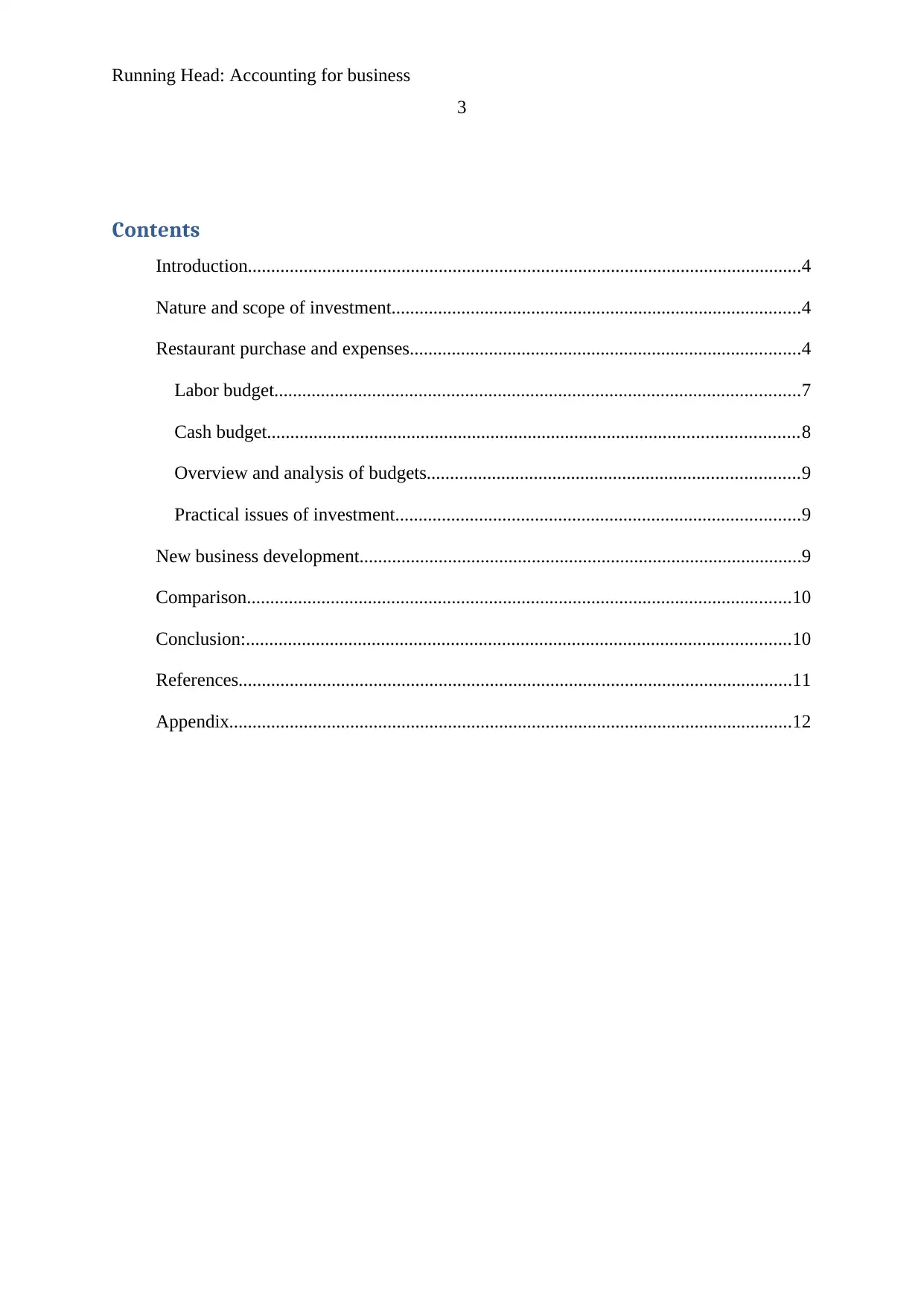
Contents
Introduction.......................................................................................................................4
Nature and scope of investment........................................................................................4
Restaurant purchase and expenses....................................................................................4
Labor budget.................................................................................................................7
Cash budget..................................................................................................................8
Overview and analysis of budgets................................................................................9
Practical issues of investment.......................................................................................9
New business development...............................................................................................9
Comparison.....................................................................................................................10
Conclusion:.....................................................................................................................10
References.......................................................................................................................11
Appendix.........................................................................................................................12
3
Contents
Introduction.......................................................................................................................4
Nature and scope of investment........................................................................................4
Restaurant purchase and expenses....................................................................................4
Labor budget.................................................................................................................7
Cash budget..................................................................................................................8
Overview and analysis of budgets................................................................................9
Practical issues of investment.......................................................................................9
New business development...............................................................................................9
Comparison.....................................................................................................................10
Conclusion:.....................................................................................................................10
References.......................................................................................................................11
Appendix.........................................................................................................................12
⊘ This is a preview!⊘
Do you want full access?
Subscribe today to unlock all pages.

Trusted by 1+ million students worldwide
Running Head: Accounting for business
4
Introduction:
Mark and Paul, two marketing students want to start their own start-up. They both
present two investment opportunity in front of the investors in which they could invest. As
they both are the student of marketing and wondering that which investment opportunity
would offer them more profitability and which opportunity would be better to attract more
investors to invest into the company. Mark and Paul have explained both the opportunities
and all the financial figures related to both the investment project.
Now in this report, the financial figures of the proposals have been organized to
evaluate and conclude a better result. Mark and Paul have come up with two ideas one is
investment into the business of restaurant and other one is to invest into the new business
development. Through this report, it has been tried to evaluate that which opportunity is
investment is better and why it is better. Before it, the nature of the investment has also been
concerned. For this report, various financial tools have been used.
Nature and scope of investment:
Investments are recognized as a key financial term. This is a process in which an
individual, company or society put some efforts and money to get back more money in
return. In financial terms, individuals or the groups invest their savings into the financial
market to increase the total worth of the invested amount. Investment is of numerous types.
An investor could invest into the financial securities according to the requirement such as for
short term investment, corporate securities and treasury bonds are good option whereas for
long term investment, share and debentures are good option. Investment nature is quite
complex (Gitman and Zutter, 2012). It is quite flexible, it is not required that the investment
would always offer the high return to the company. Investment is a process which provides
the various opportunities to the investors on the basis of risk and return factor.
Restaurant purchase and expenses:
Mark and Paul have come up with two ideas one is investment into the business of
restaurant and other one is to invest into the new business development. In first investment
proposal, both of them have explained that if the Mark and Paul would invest into this
opportunity than the following expenses and income would be got by the company (Lafond
and Roychowdhury, 2008). Both the students are not aware about the financial figures and
4
Introduction:
Mark and Paul, two marketing students want to start their own start-up. They both
present two investment opportunity in front of the investors in which they could invest. As
they both are the student of marketing and wondering that which investment opportunity
would offer them more profitability and which opportunity would be better to attract more
investors to invest into the company. Mark and Paul have explained both the opportunities
and all the financial figures related to both the investment project.
Now in this report, the financial figures of the proposals have been organized to
evaluate and conclude a better result. Mark and Paul have come up with two ideas one is
investment into the business of restaurant and other one is to invest into the new business
development. Through this report, it has been tried to evaluate that which opportunity is
investment is better and why it is better. Before it, the nature of the investment has also been
concerned. For this report, various financial tools have been used.
Nature and scope of investment:
Investments are recognized as a key financial term. This is a process in which an
individual, company or society put some efforts and money to get back more money in
return. In financial terms, individuals or the groups invest their savings into the financial
market to increase the total worth of the invested amount. Investment is of numerous types.
An investor could invest into the financial securities according to the requirement such as for
short term investment, corporate securities and treasury bonds are good option whereas for
long term investment, share and debentures are good option. Investment nature is quite
complex (Gitman and Zutter, 2012). It is quite flexible, it is not required that the investment
would always offer the high return to the company. Investment is a process which provides
the various opportunities to the investors on the basis of risk and return factor.
Restaurant purchase and expenses:
Mark and Paul have come up with two ideas one is investment into the business of
restaurant and other one is to invest into the new business development. In first investment
proposal, both of them have explained that if the Mark and Paul would invest into this
opportunity than the following expenses and income would be got by the company (Lafond
and Roychowdhury, 2008). Both the students are not aware about the financial figures and
Paraphrase This Document
Need a fresh take? Get an instant paraphrase of this document with our AI Paraphraser
Running Head: Accounting for business
5
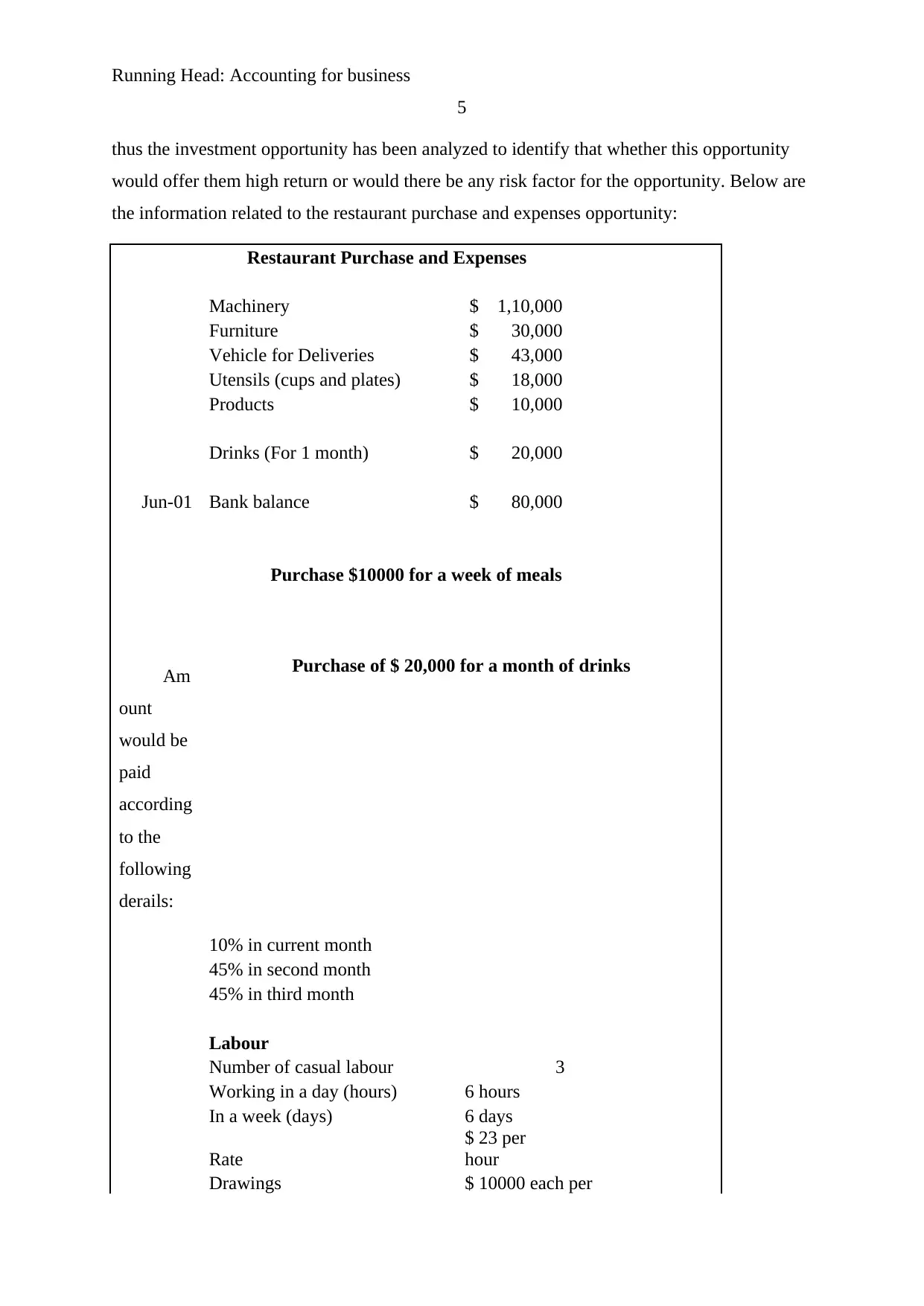
thus the investment opportunity has been analyzed to identify that whether this opportunity
would offer them high return or would there be any risk factor for the opportunity. Below are
the information related to the restaurant purchase and expenses opportunity:
Restaurant Purchase and Expenses
Machinery $ 1,10,000
Furniture $ 30,000
Vehicle for Deliveries $ 43,000
Utensils (cups and plates) $ 18,000
Products $ 10,000
Drinks (For 1 month) $ 20,000
Jun-01 Bank balance $ 80,000
Purchase $10000 for a week of meals
Purchase of $ 20,000 for a month of drinks
Am
ount
would be
paid
according
to the
following
derails:
10% in current month
45% in second month
45% in third month
Labour
Number of casual labour 3
Working in a day (hours) 6 hours
In a week (days) 6 days
Rate
$ 23 per
hour
Drawings $ 10000 each per
5
thus the investment opportunity has been analyzed to identify that whether this opportunity
would offer them high return or would there be any risk factor for the opportunity. Below are
the information related to the restaurant purchase and expenses opportunity:
Restaurant Purchase and Expenses
Machinery $ 1,10,000
Furniture $ 30,000
Vehicle for Deliveries $ 43,000
Utensils (cups and plates) $ 18,000
Products $ 10,000
Drinks (For 1 month) $ 20,000
Jun-01 Bank balance $ 80,000
Purchase $10000 for a week of meals
Purchase of $ 20,000 for a month of drinks
Am
ount
would be
paid
according
to the
following
derails:
10% in current month
45% in second month
45% in third month
Labour
Number of casual labour 3
Working in a day (hours) 6 hours
In a week (days) 6 days
Rate
$ 23 per
hour
Drawings $ 10000 each per
Running Head: Accounting for business
6
month
Overhead $ 5,000
Sales
20000 meals in first month
18000 meals in second month
18000 meals in third month
22000 in forth month
Average selling price $ 45
Drink sales would be triples the amount of
meals per month.
Drink Price $ 6
(Nobes and Parker, 2008)
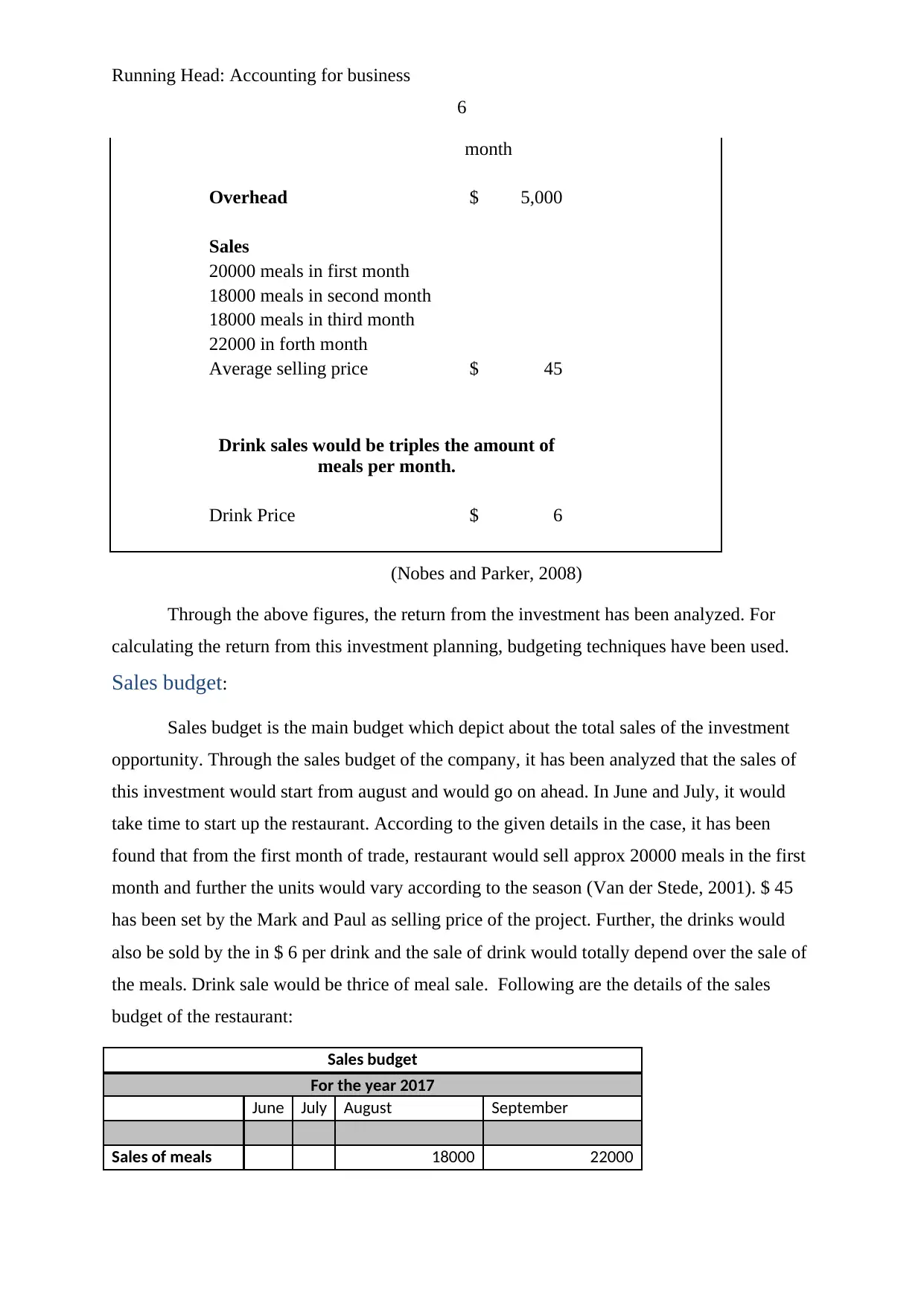
Through the above figures, the return from the investment has been analyzed. For
calculating the return from this investment planning, budgeting techniques have been used.
Sales budget:
Sales budget is the main budget which depict about the total sales of the investment
opportunity. Through the sales budget of the company, it has been analyzed that the sales of
this investment would start from august and would go on ahead. In June and July, it would
take time to start up the restaurant. According to the given details in the case, it has been
found that from the first month of trade, restaurant would sell approx 20000 meals in the first
month and further the units would vary according to the season (Van der Stede, 2001). $ 45
has been set by the Mark and Paul as selling price of the project. Further, the drinks would
also be sold by the in $ 6 per drink and the sale of drink would totally depend over the sale of
the meals. Drink sale would be thrice of meal sale. Following are the details of the sales
budget of the restaurant:
Sales budget
For the year 2017
June July August September
Sales of meals 18000 22000
6
month
Overhead $ 5,000
Sales
20000 meals in first month
18000 meals in second month
18000 meals in third month
22000 in forth month
Average selling price $ 45
Drink sales would be triples the amount of
meals per month.
Drink Price $ 6
(Nobes and Parker, 2008)
Through the above figures, the return from the investment has been analyzed. For
calculating the return from this investment planning, budgeting techniques have been used.
Sales budget:
Sales budget is the main budget which depict about the total sales of the investment
opportunity. Through the sales budget of the company, it has been analyzed that the sales of
this investment would start from august and would go on ahead. In June and July, it would
take time to start up the restaurant. According to the given details in the case, it has been
found that from the first month of trade, restaurant would sell approx 20000 meals in the first
month and further the units would vary according to the season (Van der Stede, 2001). $ 45
has been set by the Mark and Paul as selling price of the project. Further, the drinks would
also be sold by the in $ 6 per drink and the sale of drink would totally depend over the sale of
the meals. Drink sale would be thrice of meal sale. Following are the details of the sales
budget of the restaurant:
Sales budget
For the year 2017
June July August September
Sales of meals 18000 22000
⊘ This is a preview!⊘
Do you want full access?
Subscribe today to unlock all pages.
Trusted by 1+ million students worldwide
Running Head: Accounting for business
7
Sales per unit $ 45 $ 45
Sales price $ 8,10,000 $ 9,90,000
Sales of drink 54000 66000
Sales per unit $ 6 $ 6
Sales price $ 3,24,000 $ 3,96,000
Total Sales $ 11,34,000 $ 13,86,000
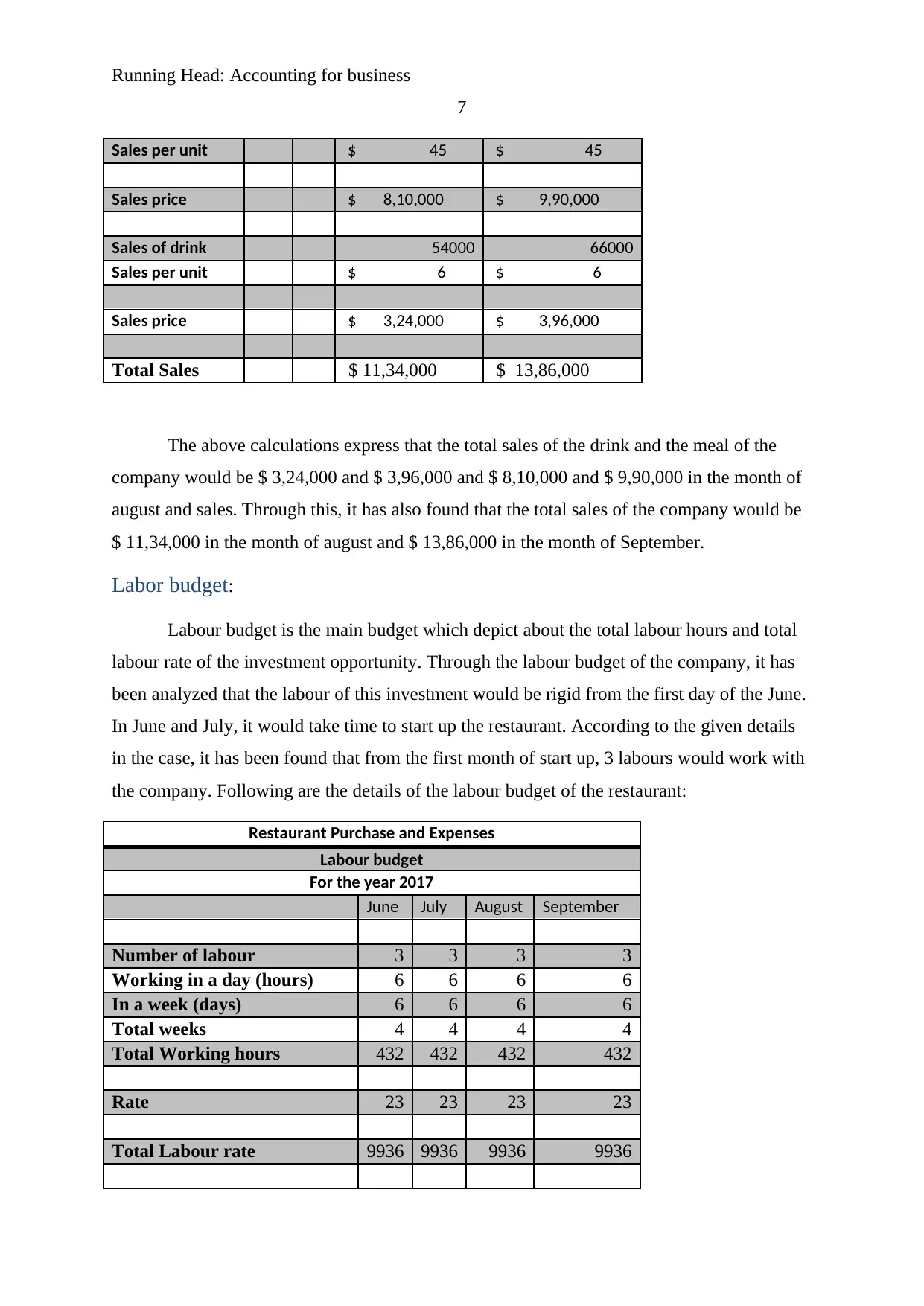
The above calculations express that the total sales of the drink and the meal of the
company would be $ 3,24,000 and $ 3,96,000 and $ 8,10,000 and $ 9,90,000 in the month of
august and sales. Through this, it has also found that the total sales of the company would be
$ 11,34,000 in the month of august and $ 13,86,000 in the month of September.
Labor budget:
Labour budget is the main budget which depict about the total labour hours and total
labour rate of the investment opportunity. Through the labour budget of the company, it has
been analyzed that the labour of this investment would be rigid from the first day of the June.
In June and July, it would take time to start up the restaurant. According to the given details
in the case, it has been found that from the first month of start up, 3 labours would work with
the company. Following are the details of the labour budget of the restaurant:
Restaurant Purchase and Expenses
Labour budget
For the year 2017
June July August September
Number of labour 3 3 3 3
Working in a day (hours) 6 6 6 6
In a week (days) 6 6 6 6
Total weeks 4 4 4 4
Total Working hours 432 432 432 432
Rate 23 23 23 23
Total Labour rate 9936 9936 9936 9936
7
Sales per unit $ 45 $ 45
Sales price $ 8,10,000 $ 9,90,000
Sales of drink 54000 66000
Sales per unit $ 6 $ 6
Sales price $ 3,24,000 $ 3,96,000
Total Sales $ 11,34,000 $ 13,86,000
The above calculations express that the total sales of the drink and the meal of the
company would be $ 3,24,000 and $ 3,96,000 and $ 8,10,000 and $ 9,90,000 in the month of
august and sales. Through this, it has also found that the total sales of the company would be
$ 11,34,000 in the month of august and $ 13,86,000 in the month of September.
Labor budget:
Labour budget is the main budget which depict about the total labour hours and total
labour rate of the investment opportunity. Through the labour budget of the company, it has
been analyzed that the labour of this investment would be rigid from the first day of the June.
In June and July, it would take time to start up the restaurant. According to the given details
in the case, it has been found that from the first month of start up, 3 labours would work with
the company. Following are the details of the labour budget of the restaurant:
Restaurant Purchase and Expenses
Labour budget
For the year 2017
June July August September
Number of labour 3 3 3 3
Working in a day (hours) 6 6 6 6
In a week (days) 6 6 6 6
Total weeks 4 4 4 4
Total Working hours 432 432 432 432
Rate 23 23 23 23
Total Labour rate 9936 9936 9936 9936
Paraphrase This Document
Need a fresh take? Get an instant paraphrase of this document with our AI Paraphraser
Running Head: Accounting for business
8
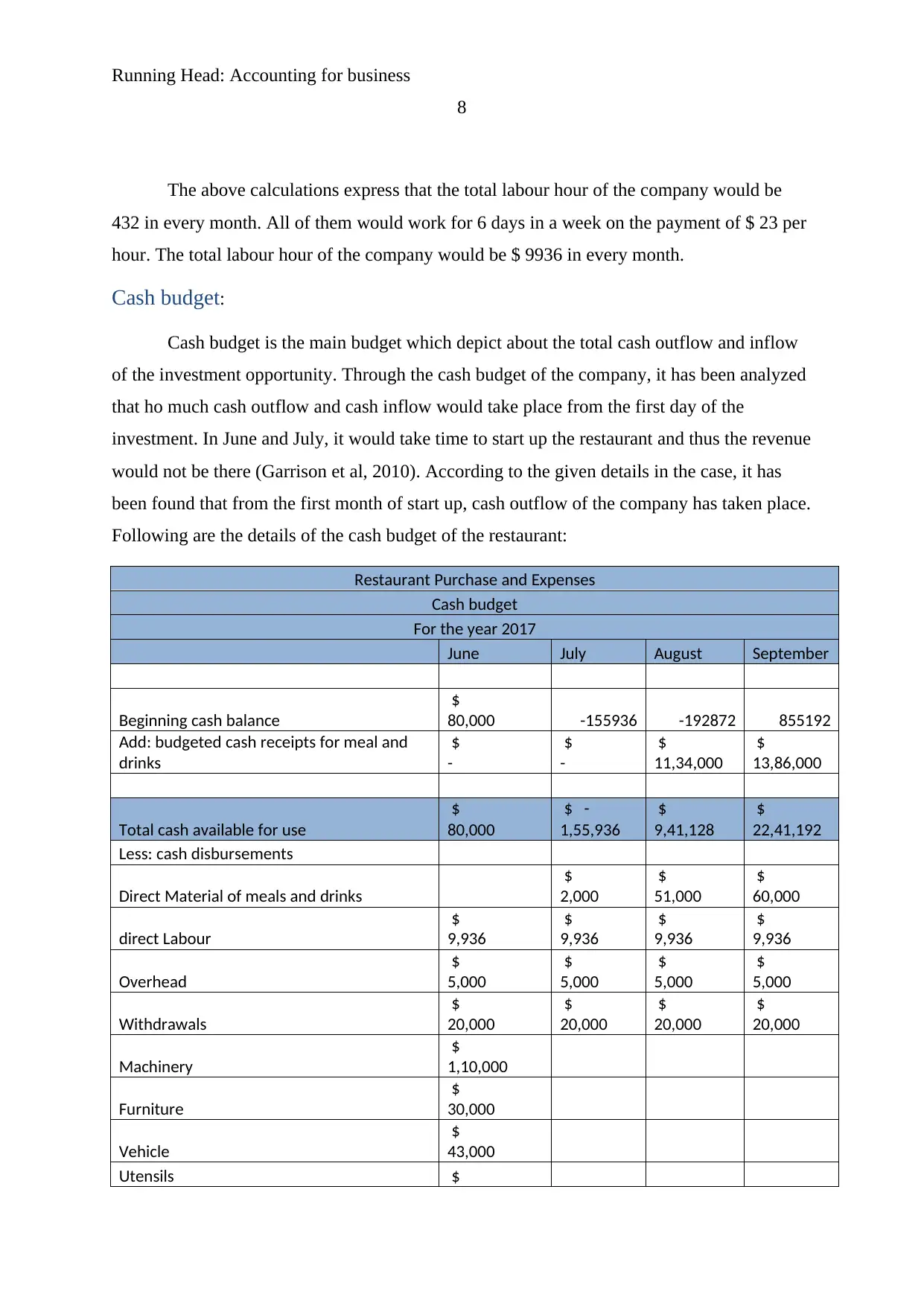
The above calculations express that the total labour hour of the company would be
432 in every month. All of them would work for 6 days in a week on the payment of $ 23 per
hour. The total labour hour of the company would be $ 9936 in every month.
Cash budget:
Cash budget is the main budget which depict about the total cash outflow and inflow
of the investment opportunity. Through the cash budget of the company, it has been analyzed
that ho much cash outflow and cash inflow would take place from the first day of the
investment. In June and July, it would take time to start up the restaurant and thus the revenue
would not be there (Garrison et al, 2010). According to the given details in the case, it has
been found that from the first month of start up, cash outflow of the company has taken place.
Following are the details of the cash budget of the restaurant:
Restaurant Purchase and Expenses
Cash budget
For the year 2017
June July August September
Beginning cash balance
$
80,000 -155936 -192872 855192
Add: budgeted cash receipts for meal and
drinks
$
-
$
-
$
11,34,000
$
13,86,000
Total cash available for use
$
80,000
$ -
1,55,936
$
9,41,128
$
22,41,192
Less: cash disbursements
Direct Material of meals and drinks
$
2,000
$
51,000
$
60,000
direct Labour
$
9,936
$
9,936
$
9,936
$
9,936
Overhead
$
5,000
$
5,000
$
5,000
$
5,000
Withdrawals
$
20,000
$
20,000
$
20,000
$
20,000
Machinery
$
1,10,000
Furniture
$
30,000
Vehicle
$
43,000
Utensils $
8
The above calculations express that the total labour hour of the company would be
432 in every month. All of them would work for 6 days in a week on the payment of $ 23 per
hour. The total labour hour of the company would be $ 9936 in every month.
Cash budget:
Cash budget is the main budget which depict about the total cash outflow and inflow
of the investment opportunity. Through the cash budget of the company, it has been analyzed
that ho much cash outflow and cash inflow would take place from the first day of the
investment. In June and July, it would take time to start up the restaurant and thus the revenue
would not be there (Garrison et al, 2010). According to the given details in the case, it has
been found that from the first month of start up, cash outflow of the company has taken place.
Following are the details of the cash budget of the restaurant:
Restaurant Purchase and Expenses
Cash budget
For the year 2017
June July August September
Beginning cash balance
$
80,000 -155936 -192872 855192
Add: budgeted cash receipts for meal and
drinks
$
-
$
-
$
11,34,000
$
13,86,000
Total cash available for use
$
80,000
$ -
1,55,936
$
9,41,128
$
22,41,192
Less: cash disbursements
Direct Material of meals and drinks
$
2,000
$
51,000
$
60,000
direct Labour
$
9,936
$
9,936
$
9,936
$
9,936
Overhead
$
5,000
$
5,000
$
5,000
$
5,000
Withdrawals
$
20,000
$
20,000
$
20,000
$
20,000
Machinery
$
1,10,000
Furniture
$
30,000
Vehicle
$
43,000
Utensils $
Running Head: Accounting for business
9
18,000
Total disbursements
$
2,35,936
$
36,936
$
85,936
$
94,936
Cash surplus
$ -
1,55,936
$ -
1,92,872
$
8,55,192
$
21,46,256
budgeted ending cash balance
$ -
1,55,936
$ -
1,92,872
$
8,55,192
$
21,46,256
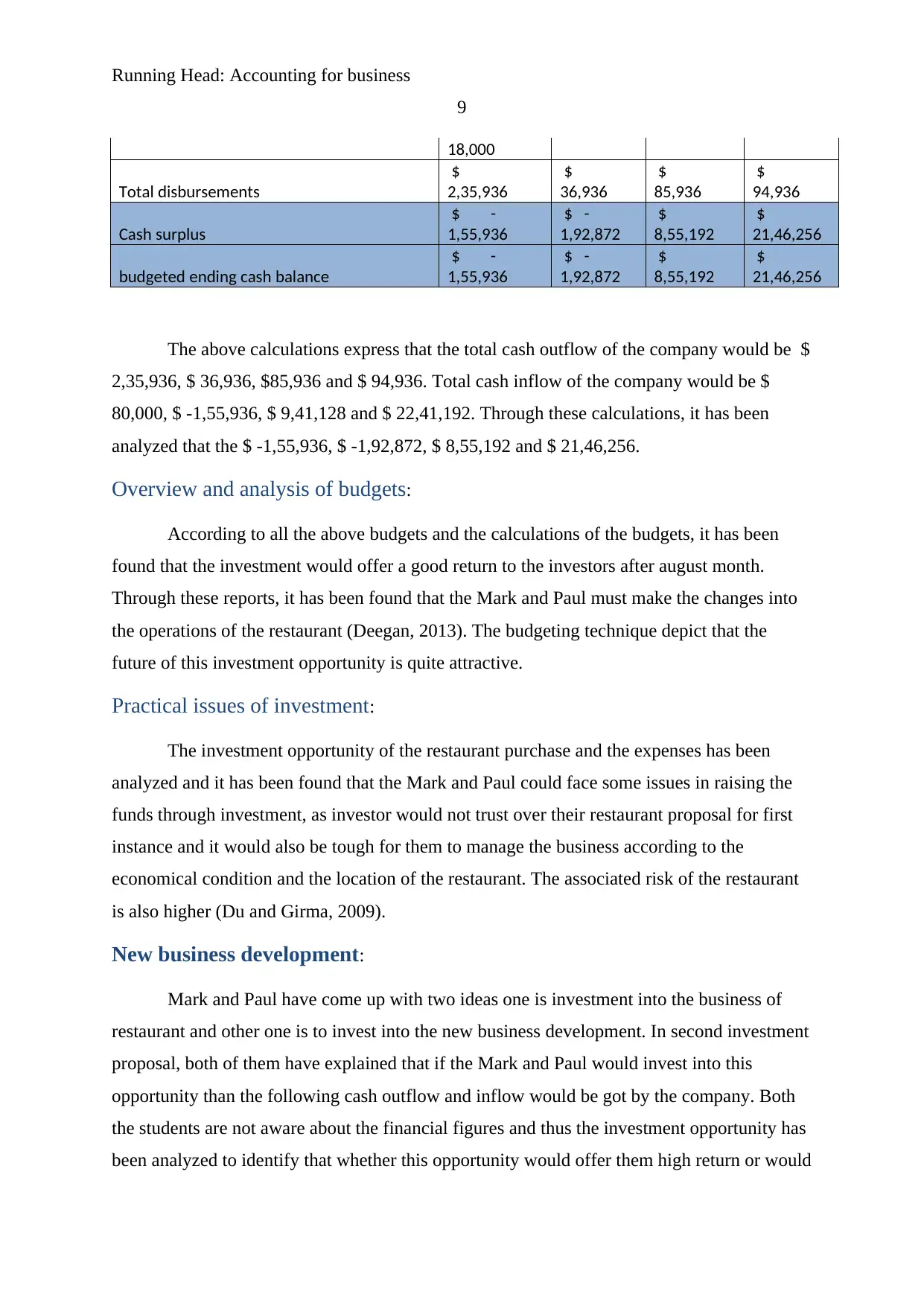
The above calculations express that the total cash outflow of the company would be $
2,35,936, $ 36,936, $85,936 and $ 94,936. Total cash inflow of the company would be $
80,000, $ -1,55,936, $ 9,41,128 and $ 22,41,192. Through these calculations, it has been
analyzed that the $ -1,55,936, $ -1,92,872, $ 8,55,192 and $ 21,46,256.
Overview and analysis of budgets:
According to all the above budgets and the calculations of the budgets, it has been
found that the investment would offer a good return to the investors after august month.
Through these reports, it has been found that the Mark and Paul must make the changes into
the operations of the restaurant (Deegan, 2013). The budgeting technique depict that the
future of this investment opportunity is quite attractive.
Practical issues of investment:
The investment opportunity of the restaurant purchase and the expenses has been
analyzed and it has been found that the Mark and Paul could face some issues in raising the
funds through investment, as investor would not trust over their restaurant proposal for first
instance and it would also be tough for them to manage the business according to the
economical condition and the location of the restaurant. The associated risk of the restaurant
is also higher (Du and Girma, 2009).
New business development:
Mark and Paul have come up with two ideas one is investment into the business of
restaurant and other one is to invest into the new business development. In second investment
proposal, both of them have explained that if the Mark and Paul would invest into this
opportunity than the following cash outflow and inflow would be got by the company. Both
the students are not aware about the financial figures and thus the investment opportunity has
been analyzed to identify that whether this opportunity would offer them high return or would
9
18,000
Total disbursements
$
2,35,936
$
36,936
$
85,936
$
94,936
Cash surplus
$ -
1,55,936
$ -
1,92,872
$
8,55,192
$
21,46,256
budgeted ending cash balance
$ -
1,55,936
$ -
1,92,872
$
8,55,192
$
21,46,256
The above calculations express that the total cash outflow of the company would be $
2,35,936, $ 36,936, $85,936 and $ 94,936. Total cash inflow of the company would be $
80,000, $ -1,55,936, $ 9,41,128 and $ 22,41,192. Through these calculations, it has been
analyzed that the $ -1,55,936, $ -1,92,872, $ 8,55,192 and $ 21,46,256.
Overview and analysis of budgets:
According to all the above budgets and the calculations of the budgets, it has been
found that the investment would offer a good return to the investors after august month.
Through these reports, it has been found that the Mark and Paul must make the changes into
the operations of the restaurant (Deegan, 2013). The budgeting technique depict that the
future of this investment opportunity is quite attractive.
Practical issues of investment:
The investment opportunity of the restaurant purchase and the expenses has been
analyzed and it has been found that the Mark and Paul could face some issues in raising the
funds through investment, as investor would not trust over their restaurant proposal for first
instance and it would also be tough for them to manage the business according to the
economical condition and the location of the restaurant. The associated risk of the restaurant
is also higher (Du and Girma, 2009).
New business development:
Mark and Paul have come up with two ideas one is investment into the business of
restaurant and other one is to invest into the new business development. In second investment
proposal, both of them have explained that if the Mark and Paul would invest into this
opportunity than the following cash outflow and inflow would be got by the company. Both
the students are not aware about the financial figures and thus the investment opportunity has
been analyzed to identify that whether this opportunity would offer them high return or would
⊘ This is a preview!⊘
Do you want full access?
Subscribe today to unlock all pages.
Trusted by 1+ million students worldwide
Running Head: Accounting for business
10
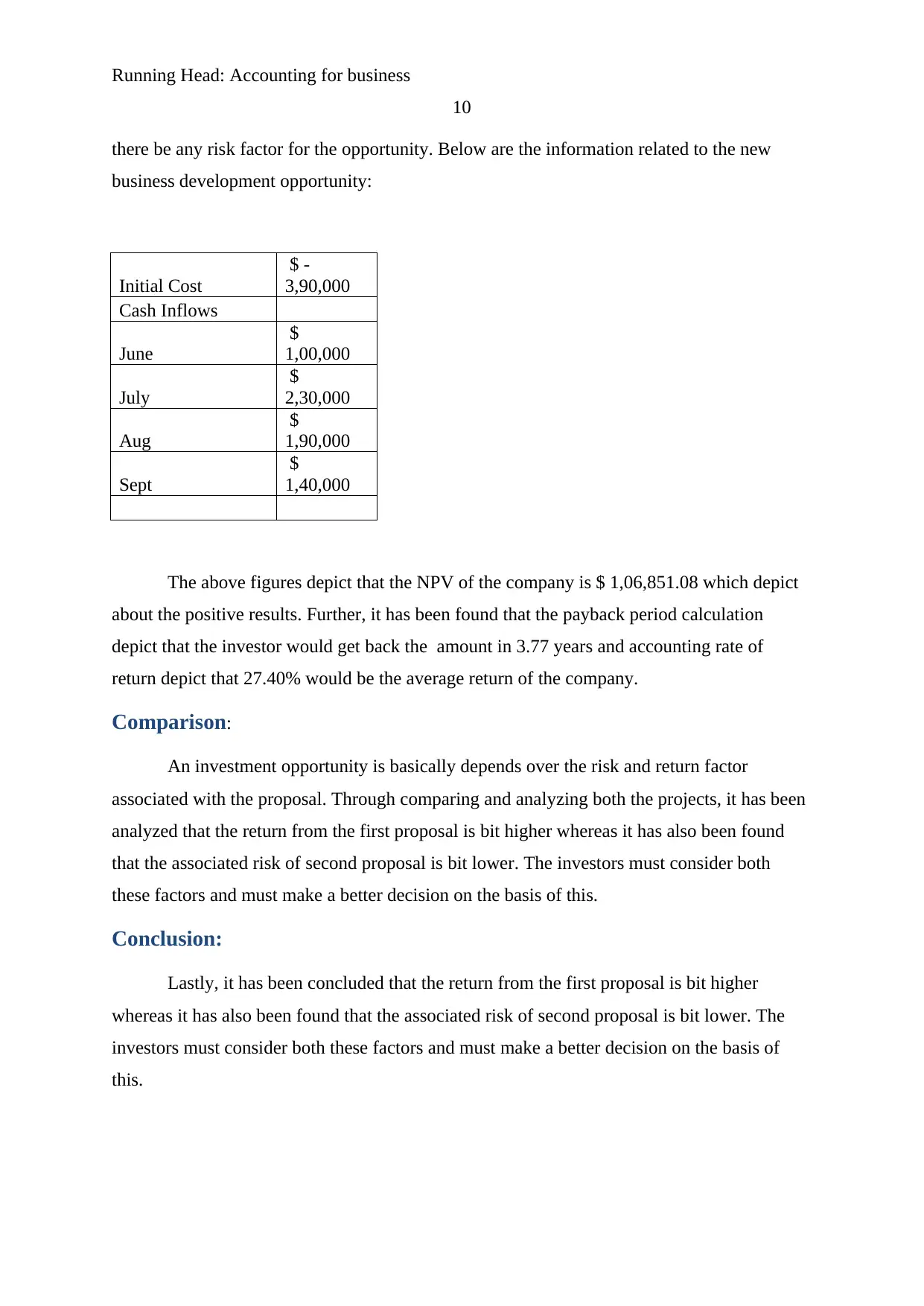
there be any risk factor for the opportunity. Below are the information related to the new
business development opportunity:
Initial Cost
$ -
3,90,000
Cash Inflows
June
$
1,00,000
July
$
2,30,000
Aug
$
1,90,000
Sept
$
1,40,000
The above figures depict that the NPV of the company is $ 1,06,851.08 which depict
about the positive results. Further, it has been found that the payback period calculation
depict that the investor would get back the amount in 3.77 years and accounting rate of
return depict that 27.40% would be the average return of the company.
Comparison:
An investment opportunity is basically depends over the risk and return factor
associated with the proposal. Through comparing and analyzing both the projects, it has been
analyzed that the return from the first proposal is bit higher whereas it has also been found
that the associated risk of second proposal is bit lower. The investors must consider both
these factors and must make a better decision on the basis of this.
Conclusion:
Lastly, it has been concluded that the return from the first proposal is bit higher
whereas it has also been found that the associated risk of second proposal is bit lower. The
investors must consider both these factors and must make a better decision on the basis of
this.
10
there be any risk factor for the opportunity. Below are the information related to the new
business development opportunity:
Initial Cost
$ -
3,90,000
Cash Inflows
June
$
1,00,000
July
$
2,30,000
Aug
$
1,90,000
Sept
$
1,40,000
The above figures depict that the NPV of the company is $ 1,06,851.08 which depict
about the positive results. Further, it has been found that the payback period calculation
depict that the investor would get back the amount in 3.77 years and accounting rate of
return depict that 27.40% would be the average return of the company.
Comparison:
An investment opportunity is basically depends over the risk and return factor
associated with the proposal. Through comparing and analyzing both the projects, it has been
analyzed that the return from the first proposal is bit higher whereas it has also been found
that the associated risk of second proposal is bit lower. The investors must consider both
these factors and must make a better decision on the basis of this.
Conclusion:
Lastly, it has been concluded that the return from the first proposal is bit higher
whereas it has also been found that the associated risk of second proposal is bit lower. The
investors must consider both these factors and must make a better decision on the basis of
this.
Paraphrase This Document
Need a fresh take? Get an instant paraphrase of this document with our AI Paraphraser
Running Head: Accounting for business
11
References:
Deegan, C., 2013. Financial accounting theory. McGraw-Hill Education Australia.
Du, J. and Girma, S., 2009. Source of finance, growth and firm size: evidence from
China (No. 2009.03). Research paper/UNU-WIDER.
Garrison, R.H., Noreen, E.W., Brewer, P.C. and McGowan, A., 2010. Managerial
accounting. Issues in Accounting Education, (25(4), pp.79(2-793.
Gitman, L.J. and Zutter, C.J., 2012. Principles of managerial finance. Prentice Hall.
Kaplan, R.S. and Atkinson, A.A., 2015. Advanced management accounting. PHI Learning.
Lafond, R. and Roychowdhury, S. 2008. Managerial ownership and accounting
conservatism. Journal of accounting research, 46(1), pp.101-135.
Nobes, C. and Parker, R.H. 2008. Comparative international accounting. Pearson Education.
Van der Stede, W.A. 2001. Measuring ‘tight budgetary control’. Management Accounting
Research, 1(2(1), pp.119-137.
11
References:
Deegan, C., 2013. Financial accounting theory. McGraw-Hill Education Australia.
Du, J. and Girma, S., 2009. Source of finance, growth and firm size: evidence from
China (No. 2009.03). Research paper/UNU-WIDER.
Garrison, R.H., Noreen, E.W., Brewer, P.C. and McGowan, A., 2010. Managerial
accounting. Issues in Accounting Education, (25(4), pp.79(2-793.
Gitman, L.J. and Zutter, C.J., 2012. Principles of managerial finance. Prentice Hall.
Kaplan, R.S. and Atkinson, A.A., 2015. Advanced management accounting. PHI Learning.
Lafond, R. and Roychowdhury, S. 2008. Managerial ownership and accounting
conservatism. Journal of accounting research, 46(1), pp.101-135.
Nobes, C. and Parker, R.H. 2008. Comparative international accounting. Pearson Education.
Van der Stede, W.A. 2001. Measuring ‘tight budgetary control’. Management Accounting
Research, 1(2(1), pp.119-137.
Running Head: Accounting for business
12
Appendix:
Restaurant Purchase and Expenses
Cash budget
For the year 2017
June July August September
Begining cash balance $
80,000
-155936 -192872 855192
Add: budgeted cash recepits for meal and
drinks
$
-
$
-
$
11,34,000
$
13,86,000
Total cash available for use $
80,000
$ -
1,55,936
$
9,41,128
$
22,41,192
Less: cash disbursements
Direct Material of meals ad drinks $
2,000
$
51,000
$
60,000
direct Labour $
9,936
$
9,936
$
9,936
$
9,936
Overhead $
5,000
$
5,000
$
5,000
$
5,000
Withdrawals $
20,000
$
20,000
$
20,000
$
20,000
Machinery $
1,10,000
Furniture $
30,000
Vehicle $
43,000
Utensils $
18,000
Total disbursements $
2,35,936
$
36,936
$
85,936
$
94,936
Cash surplus $ -
1,55,936
$ -
1,92,872
$
8,55,192
$
21,46,256
budgetd ending cash balance $ -
1,55,936
$ -
1,92,872
$
8,55,192
$
21,46,256
working Note:
cash Scedule
For the year 2017
12
Appendix:
Restaurant Purchase and Expenses
Cash budget
For the year 2017
June July August September
Begining cash balance $
80,000
-155936 -192872 855192
Add: budgeted cash recepits for meal and
drinks
$
-
$
-
$
11,34,000
$
13,86,000
Total cash available for use $
80,000
$ -
1,55,936
$
9,41,128
$
22,41,192
Less: cash disbursements
Direct Material of meals ad drinks $
2,000
$
51,000
$
60,000
direct Labour $
9,936
$
9,936
$
9,936
$
9,936
Overhead $
5,000
$
5,000
$
5,000
$
5,000
Withdrawals $
20,000
$
20,000
$
20,000
$
20,000
Machinery $
1,10,000
Furniture $
30,000
Vehicle $
43,000
Utensils $
18,000
Total disbursements $
2,35,936
$
36,936
$
85,936
$
94,936
Cash surplus $ -
1,55,936
$ -
1,92,872
$
8,55,192
$
21,46,256
budgetd ending cash balance $ -
1,55,936
$ -
1,92,872
$
8,55,192
$
21,46,256
working Note:
cash Scedule
For the year 2017
⊘ This is a preview!⊘
Do you want full access?
Subscribe today to unlock all pages.
Trusted by 1+ million students worldwide

1 out of 15


Related Documents


Your All-in-One AI-Powered Toolkit for Academic Success.
+13062052269
info@desklib.com
Available 24*7 on WhatsApp / Email
![[object Object]](/_next/static/media/star-bottom.7253800d.svg)
Unlock your academic potential
Copyright © 2020–2026 A2Z Services. All Rights Reserved. Developed and managed by ZUCOL.