Regulatory Requirements Report: Restaurant Business Start-Up
VerifiedAdded on 2022/11/19
|21
|4476
|491
Report
AI Summary
This report comprehensively examines the regulatory requirements necessary for establishing a start-up restaurant business. It covers a wide array of legal and ethical considerations crucial for operational compliance. The report begins by addressing anti-discrimination policies in employment, including enforcement, consequences of non-compliance, and necessary insurance policies. It then delves into licensing, consumer protection under the Australian Consumer Law (ACL), and contract law, highlighting key objectives and prohibited practices. Furthermore, the report explores employer superannuation and contributions, the Fair Work Act 2009, taxation, public liability, duty of care, work health and safety, worker's compensation, and copyright regulations. Each section outlines objectives, prohibited practices, enforcement mechanisms, penalties, required documentation, and suggested insurance coverage, providing a thorough guide for entrepreneurs to navigate the complex legal landscape of the restaurant industry and ensure their business operates ethically and legally.
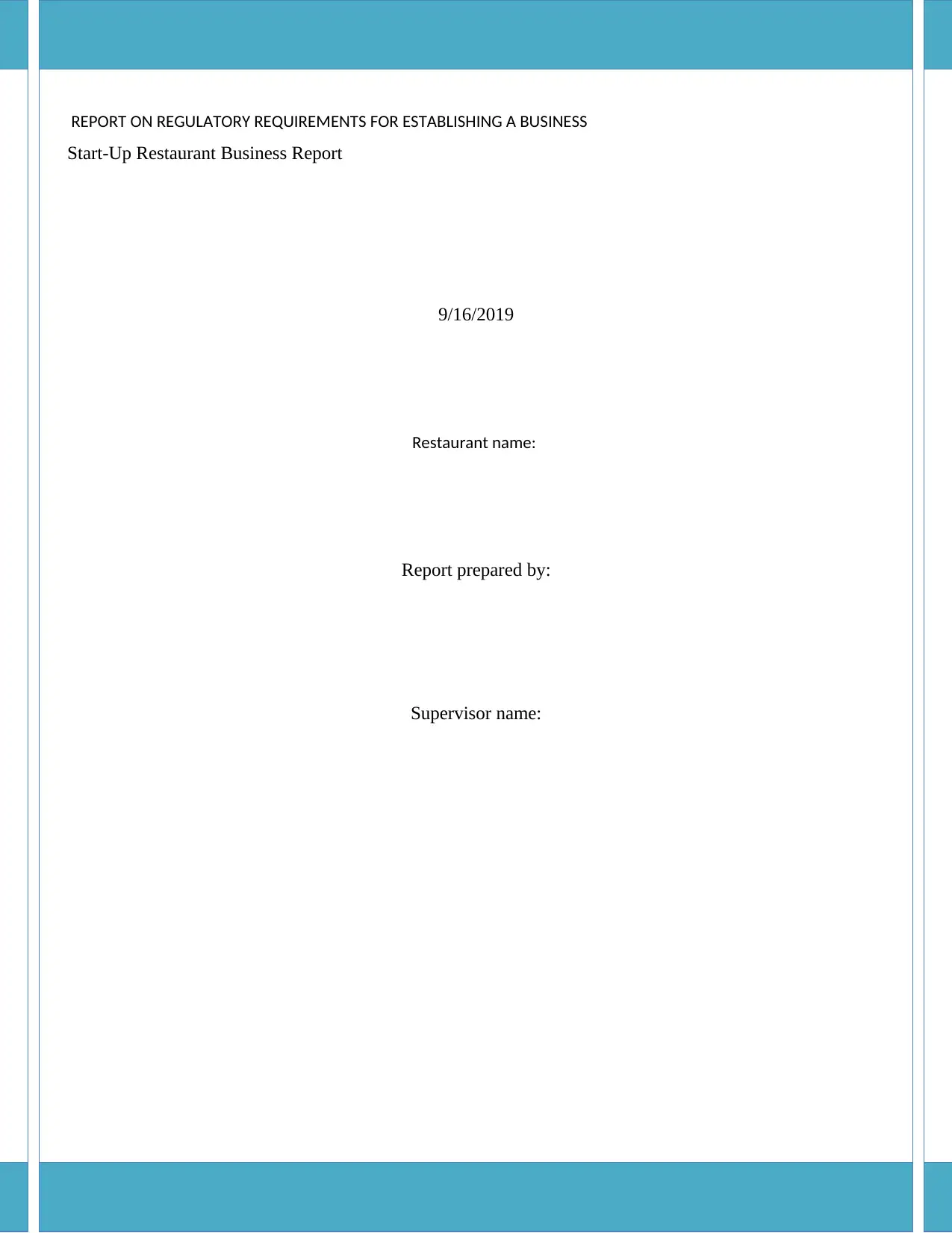
REPORT ON REGULATORY REQUIREMENTS FOR ESTABLISHING A BUSINESS
Start-Up Restaurant Business Report
9/16/2019
Restaurant name:
Report prepared by:
Supervisor name:
Start-Up Restaurant Business Report
9/16/2019
Restaurant name:
Report prepared by:
Supervisor name:

Paraphrase This Document
Need a fresh take? Get an instant paraphrase of this document with our AI Paraphraser
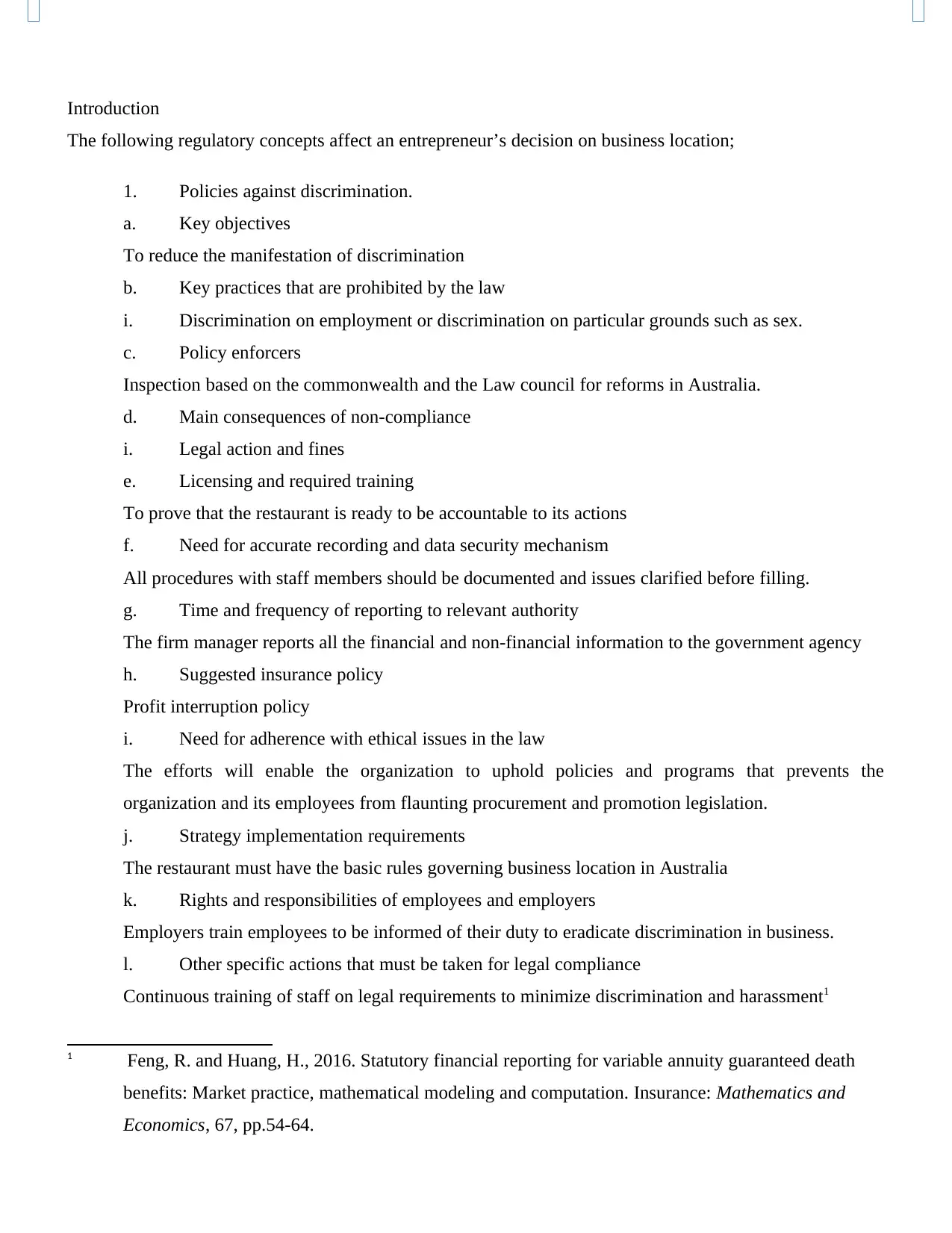
Introduction
The following regulatory concepts affect an entrepreneur’s decision on business location;
1. Policies against discrimination.
a. Key objectives
To reduce the manifestation of discrimination
b. Key practices that are prohibited by the law
i. Discrimination on employment or discrimination on particular grounds such as sex.
c. Policy enforcers
Inspection based on the commonwealth and the Law council for reforms in Australia.
d. Main consequences of non-compliance
i. Legal action and fines
e. Licensing and required training
To prove that the restaurant is ready to be accountable to its actions
f. Need for accurate recording and data security mechanism
All procedures with staff members should be documented and issues clarified before filling.
g. Time and frequency of reporting to relevant authority
The firm manager reports all the financial and non-financial information to the government agency
h. Suggested insurance policy
Profit interruption policy
i. Need for adherence with ethical issues in the law
The efforts will enable the organization to uphold policies and programs that prevents the
organization and its employees from flaunting procurement and promotion legislation.
j. Strategy implementation requirements
The restaurant must have the basic rules governing business location in Australia
k. Rights and responsibilities of employees and employers
Employers train employees to be informed of their duty to eradicate discrimination in business.
l. Other specific actions that must be taken for legal compliance
Continuous training of staff on legal requirements to minimize discrimination and harassment1
1 Feng, R. and Huang, H., 2016. Statutory financial reporting for variable annuity guaranteed death
benefits: Market practice, mathematical modeling and computation. Insurance: Mathematics and
Economics, 67, pp.54-64.
The following regulatory concepts affect an entrepreneur’s decision on business location;
1. Policies against discrimination.
a. Key objectives
To reduce the manifestation of discrimination
b. Key practices that are prohibited by the law
i. Discrimination on employment or discrimination on particular grounds such as sex.
c. Policy enforcers
Inspection based on the commonwealth and the Law council for reforms in Australia.
d. Main consequences of non-compliance
i. Legal action and fines
e. Licensing and required training
To prove that the restaurant is ready to be accountable to its actions
f. Need for accurate recording and data security mechanism
All procedures with staff members should be documented and issues clarified before filling.
g. Time and frequency of reporting to relevant authority
The firm manager reports all the financial and non-financial information to the government agency
h. Suggested insurance policy
Profit interruption policy
i. Need for adherence with ethical issues in the law
The efforts will enable the organization to uphold policies and programs that prevents the
organization and its employees from flaunting procurement and promotion legislation.
j. Strategy implementation requirements
The restaurant must have the basic rules governing business location in Australia
k. Rights and responsibilities of employees and employers
Employers train employees to be informed of their duty to eradicate discrimination in business.
l. Other specific actions that must be taken for legal compliance
Continuous training of staff on legal requirements to minimize discrimination and harassment1
1 Feng, R. and Huang, H., 2016. Statutory financial reporting for variable annuity guaranteed death
benefits: Market practice, mathematical modeling and computation. Insurance: Mathematics and
Economics, 67, pp.54-64.
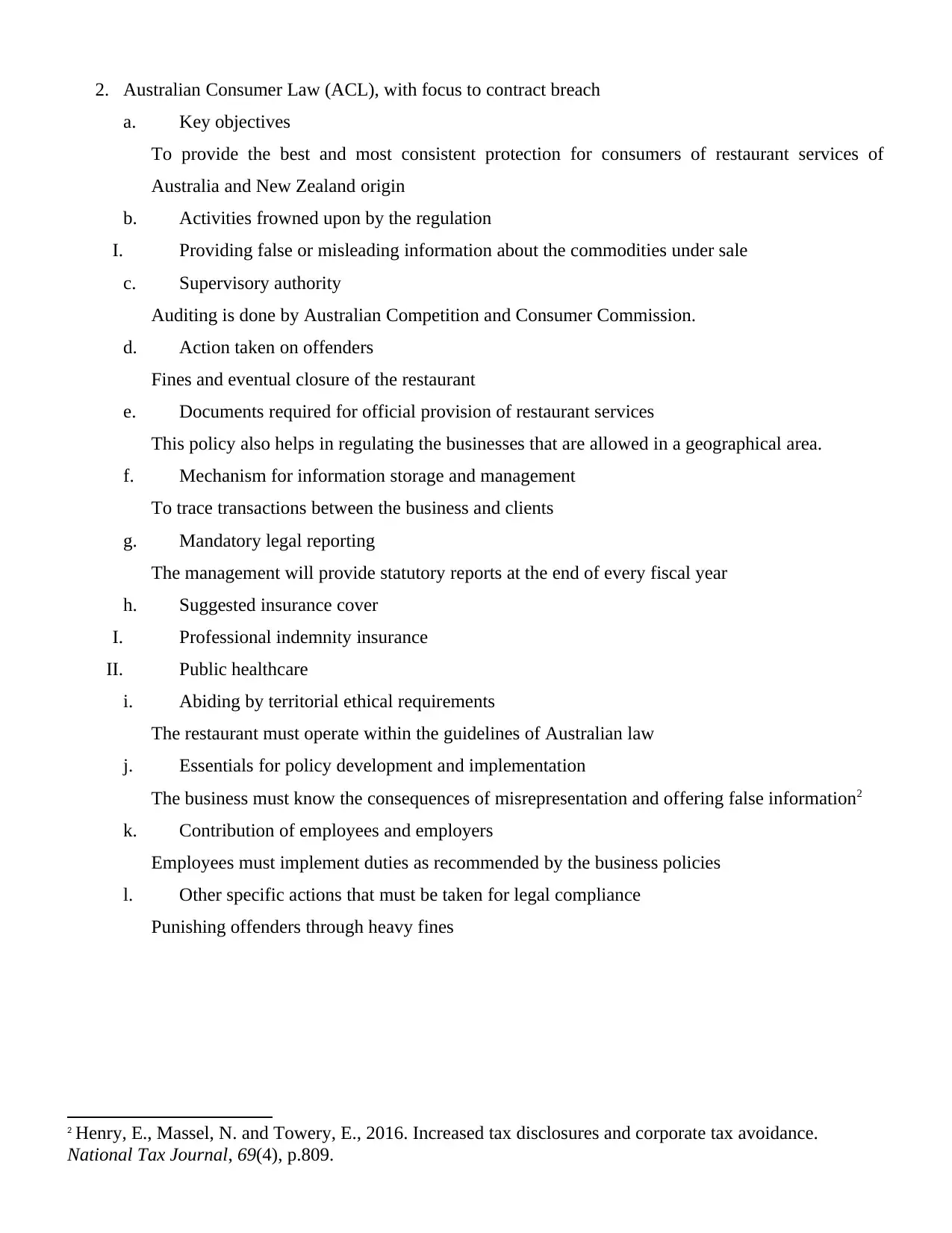
2. Australian Consumer Law (ACL), with focus to contract breach
a. Key objectives
To provide the best and most consistent protection for consumers of restaurant services of
Australia and New Zealand origin
b. Activities frowned upon by the regulation
I. Providing false or misleading information about the commodities under sale
c. Supervisory authority
Auditing is done by Australian Competition and Consumer Commission.
d. Action taken on offenders
Fines and eventual closure of the restaurant
e. Documents required for official provision of restaurant services
This policy also helps in regulating the businesses that are allowed in a geographical area.
f. Mechanism for information storage and management
To trace transactions between the business and clients
g. Mandatory legal reporting
The management will provide statutory reports at the end of every fiscal year
h. Suggested insurance cover
I. Professional indemnity insurance
II. Public healthcare
i. Abiding by territorial ethical requirements
The restaurant must operate within the guidelines of Australian law
j. Essentials for policy development and implementation
The business must know the consequences of misrepresentation and offering false information2
k. Contribution of employees and employers
Employees must implement duties as recommended by the business policies
l. Other specific actions that must be taken for legal compliance
Punishing offenders through heavy fines
2 Henry, E., Massel, N. and Towery, E., 2016. Increased tax disclosures and corporate tax avoidance.
National Tax Journal, 69(4), p.809.
a. Key objectives
To provide the best and most consistent protection for consumers of restaurant services of
Australia and New Zealand origin
b. Activities frowned upon by the regulation
I. Providing false or misleading information about the commodities under sale
c. Supervisory authority
Auditing is done by Australian Competition and Consumer Commission.
d. Action taken on offenders
Fines and eventual closure of the restaurant
e. Documents required for official provision of restaurant services
This policy also helps in regulating the businesses that are allowed in a geographical area.
f. Mechanism for information storage and management
To trace transactions between the business and clients
g. Mandatory legal reporting
The management will provide statutory reports at the end of every fiscal year
h. Suggested insurance cover
I. Professional indemnity insurance
II. Public healthcare
i. Abiding by territorial ethical requirements
The restaurant must operate within the guidelines of Australian law
j. Essentials for policy development and implementation
The business must know the consequences of misrepresentation and offering false information2
k. Contribution of employees and employers
Employees must implement duties as recommended by the business policies
l. Other specific actions that must be taken for legal compliance
Punishing offenders through heavy fines
2 Henry, E., Massel, N. and Towery, E., 2016. Increased tax disclosures and corporate tax avoidance.
National Tax Journal, 69(4), p.809.
⊘ This is a preview!⊘
Do you want full access?
Subscribe today to unlock all pages.

Trusted by 1+ million students worldwide
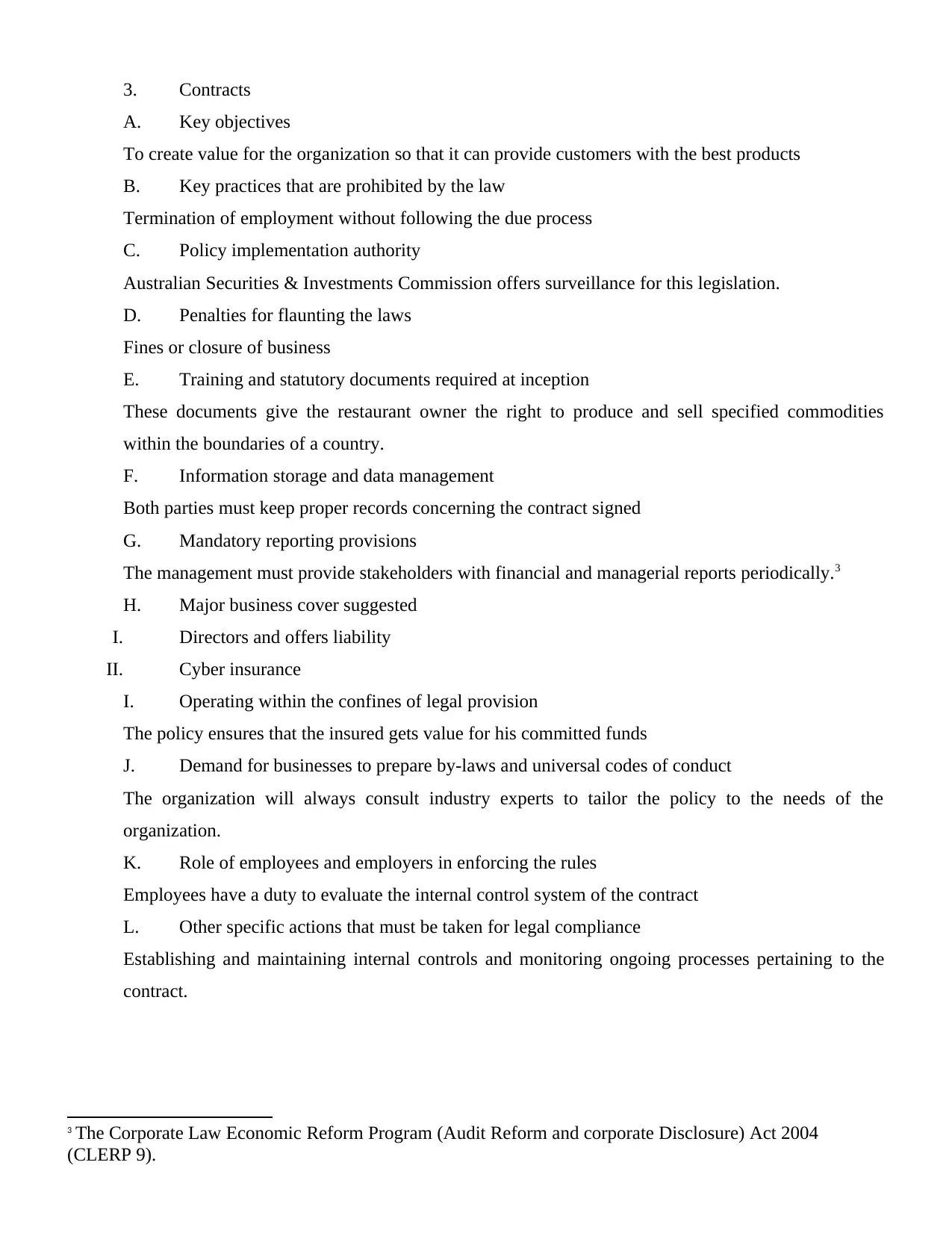
3. Contracts
A. Key objectives
To create value for the organization so that it can provide customers with the best products
B. Key practices that are prohibited by the law
Termination of employment without following the due process
C. Policy implementation authority
Australian Securities & Investments Commission offers surveillance for this legislation.
D. Penalties for flaunting the laws
Fines or closure of business
E. Training and statutory documents required at inception
These documents give the restaurant owner the right to produce and sell specified commodities
within the boundaries of a country.
F. Information storage and data management
Both parties must keep proper records concerning the contract signed
G. Mandatory reporting provisions
The management must provide stakeholders with financial and managerial reports periodically.3
H. Major business cover suggested
I. Directors and offers liability
II. Cyber insurance
I. Operating within the confines of legal provision
The policy ensures that the insured gets value for his committed funds
J. Demand for businesses to prepare by-laws and universal codes of conduct
The organization will always consult industry experts to tailor the policy to the needs of the
organization.
K. Role of employees and employers in enforcing the rules
Employees have a duty to evaluate the internal control system of the contract
L. Other specific actions that must be taken for legal compliance
Establishing and maintaining internal controls and monitoring ongoing processes pertaining to the
contract.
3 The Corporate Law Economic Reform Program (Audit Reform and corporate Disclosure) Act 2004
(CLERP 9).
A. Key objectives
To create value for the organization so that it can provide customers with the best products
B. Key practices that are prohibited by the law
Termination of employment without following the due process
C. Policy implementation authority
Australian Securities & Investments Commission offers surveillance for this legislation.
D. Penalties for flaunting the laws
Fines or closure of business
E. Training and statutory documents required at inception
These documents give the restaurant owner the right to produce and sell specified commodities
within the boundaries of a country.
F. Information storage and data management
Both parties must keep proper records concerning the contract signed
G. Mandatory reporting provisions
The management must provide stakeholders with financial and managerial reports periodically.3
H. Major business cover suggested
I. Directors and offers liability
II. Cyber insurance
I. Operating within the confines of legal provision
The policy ensures that the insured gets value for his committed funds
J. Demand for businesses to prepare by-laws and universal codes of conduct
The organization will always consult industry experts to tailor the policy to the needs of the
organization.
K. Role of employees and employers in enforcing the rules
Employees have a duty to evaluate the internal control system of the contract
L. Other specific actions that must be taken for legal compliance
Establishing and maintaining internal controls and monitoring ongoing processes pertaining to the
contract.
3 The Corporate Law Economic Reform Program (Audit Reform and corporate Disclosure) Act 2004
(CLERP 9).
Paraphrase This Document
Need a fresh take? Get an instant paraphrase of this document with our AI Paraphraser
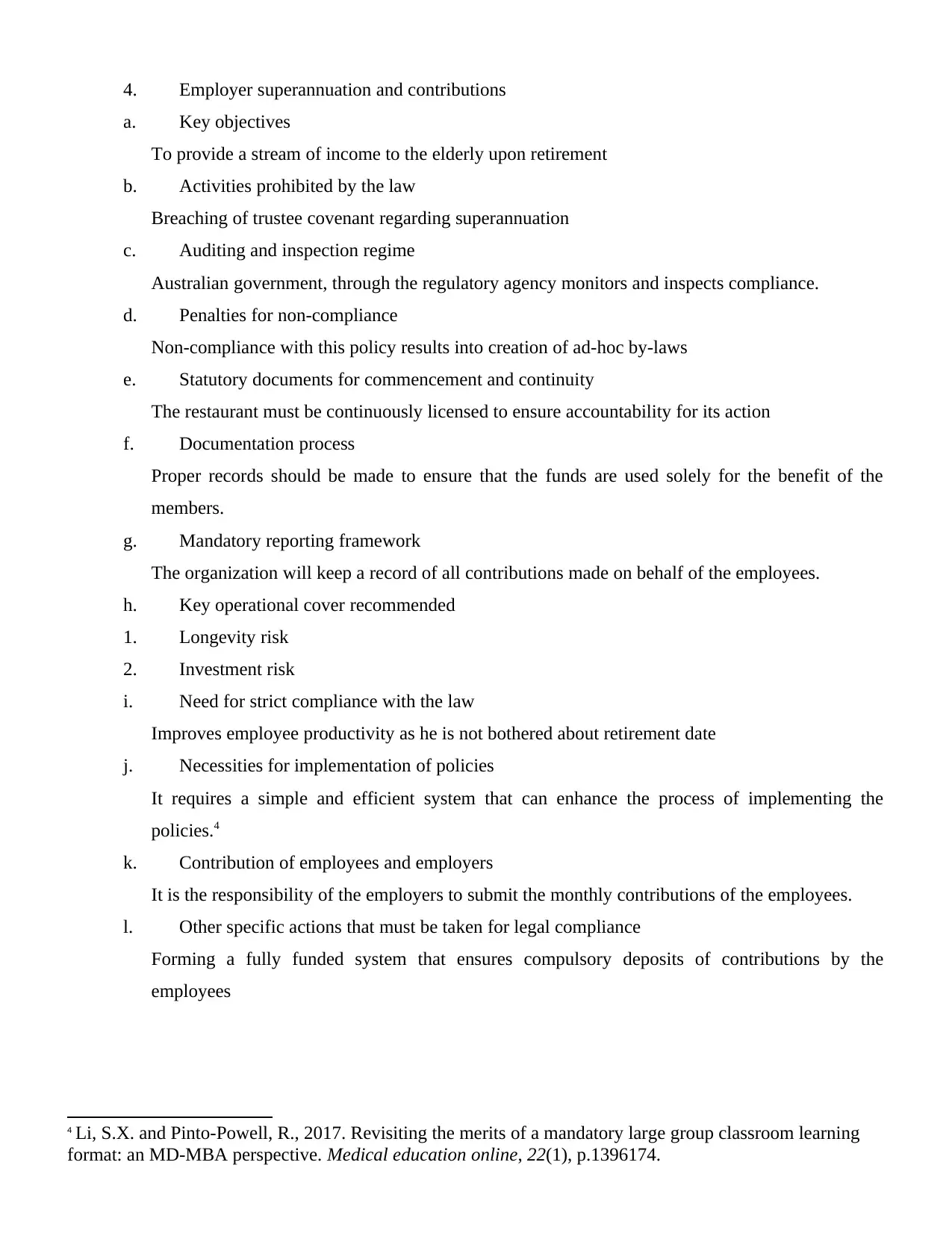
4. Employer superannuation and contributions
a. Key objectives
To provide a stream of income to the elderly upon retirement
b. Activities prohibited by the law
Breaching of trustee covenant regarding superannuation
c. Auditing and inspection regime
Australian government, through the regulatory agency monitors and inspects compliance.
d. Penalties for non-compliance
Non-compliance with this policy results into creation of ad-hoc by-laws
e. Statutory documents for commencement and continuity
The restaurant must be continuously licensed to ensure accountability for its action
f. Documentation process
Proper records should be made to ensure that the funds are used solely for the benefit of the
members.
g. Mandatory reporting framework
The organization will keep a record of all contributions made on behalf of the employees.
h. Key operational cover recommended
1. Longevity risk
2. Investment risk
i. Need for strict compliance with the law
Improves employee productivity as he is not bothered about retirement date
j. Necessities for implementation of policies
It requires a simple and efficient system that can enhance the process of implementing the
policies.4
k. Contribution of employees and employers
It is the responsibility of the employers to submit the monthly contributions of the employees.
l. Other specific actions that must be taken for legal compliance
Forming a fully funded system that ensures compulsory deposits of contributions by the
employees
4 Li, S.X. and Pinto-Powell, R., 2017. Revisiting the merits of a mandatory large group classroom learning
format: an MD-MBA perspective. Medical education online, 22(1), p.1396174.
a. Key objectives
To provide a stream of income to the elderly upon retirement
b. Activities prohibited by the law
Breaching of trustee covenant regarding superannuation
c. Auditing and inspection regime
Australian government, through the regulatory agency monitors and inspects compliance.
d. Penalties for non-compliance
Non-compliance with this policy results into creation of ad-hoc by-laws
e. Statutory documents for commencement and continuity
The restaurant must be continuously licensed to ensure accountability for its action
f. Documentation process
Proper records should be made to ensure that the funds are used solely for the benefit of the
members.
g. Mandatory reporting framework
The organization will keep a record of all contributions made on behalf of the employees.
h. Key operational cover recommended
1. Longevity risk
2. Investment risk
i. Need for strict compliance with the law
Improves employee productivity as he is not bothered about retirement date
j. Necessities for implementation of policies
It requires a simple and efficient system that can enhance the process of implementing the
policies.4
k. Contribution of employees and employers
It is the responsibility of the employers to submit the monthly contributions of the employees.
l. Other specific actions that must be taken for legal compliance
Forming a fully funded system that ensures compulsory deposits of contributions by the
employees
4 Li, S.X. and Pinto-Powell, R., 2017. Revisiting the merits of a mandatory large group classroom learning
format: an MD-MBA perspective. Medical education online, 22(1), p.1396174.
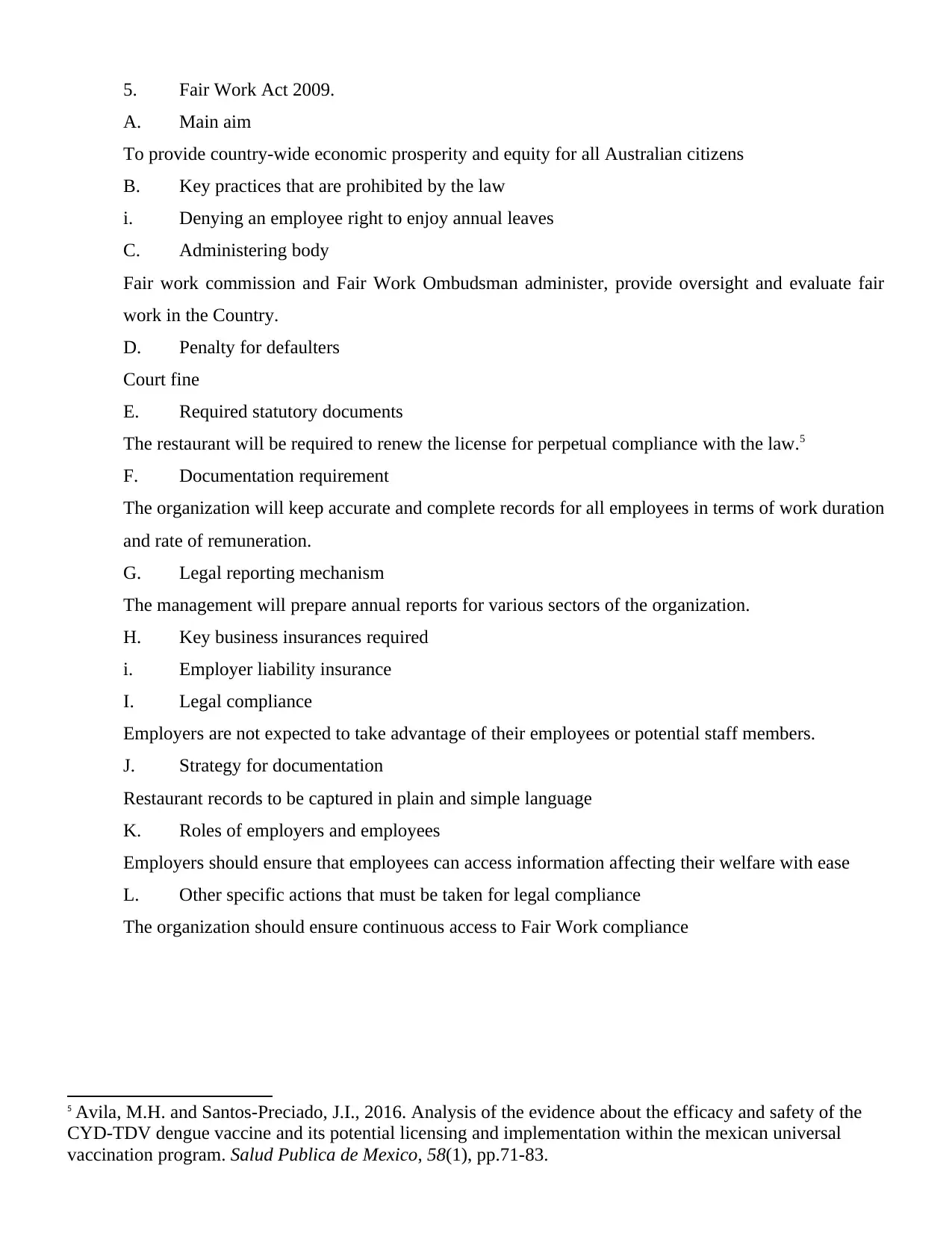
5. Fair Work Act 2009.
A. Main aim
To provide country-wide economic prosperity and equity for all Australian citizens
B. Key practices that are prohibited by the law
i. Denying an employee right to enjoy annual leaves
C. Administering body
Fair work commission and Fair Work Ombudsman administer, provide oversight and evaluate fair
work in the Country.
D. Penalty for defaulters
Court fine
E. Required statutory documents
The restaurant will be required to renew the license for perpetual compliance with the law.5
F. Documentation requirement
The organization will keep accurate and complete records for all employees in terms of work duration
and rate of remuneration.
G. Legal reporting mechanism
The management will prepare annual reports for various sectors of the organization.
H. Key business insurances required
i. Employer liability insurance
I. Legal compliance
Employers are not expected to take advantage of their employees or potential staff members.
J. Strategy for documentation
Restaurant records to be captured in plain and simple language
K. Roles of employers and employees
Employers should ensure that employees can access information affecting their welfare with ease
L. Other specific actions that must be taken for legal compliance
The organization should ensure continuous access to Fair Work compliance
5 Avila, M.H. and Santos-Preciado, J.I., 2016. Analysis of the evidence about the efficacy and safety of the
CYD-TDV dengue vaccine and its potential licensing and implementation within the mexican universal
vaccination program. Salud Publica de Mexico, 58(1), pp.71-83.
A. Main aim
To provide country-wide economic prosperity and equity for all Australian citizens
B. Key practices that are prohibited by the law
i. Denying an employee right to enjoy annual leaves
C. Administering body
Fair work commission and Fair Work Ombudsman administer, provide oversight and evaluate fair
work in the Country.
D. Penalty for defaulters
Court fine
E. Required statutory documents
The restaurant will be required to renew the license for perpetual compliance with the law.5
F. Documentation requirement
The organization will keep accurate and complete records for all employees in terms of work duration
and rate of remuneration.
G. Legal reporting mechanism
The management will prepare annual reports for various sectors of the organization.
H. Key business insurances required
i. Employer liability insurance
I. Legal compliance
Employers are not expected to take advantage of their employees or potential staff members.
J. Strategy for documentation
Restaurant records to be captured in plain and simple language
K. Roles of employers and employees
Employers should ensure that employees can access information affecting their welfare with ease
L. Other specific actions that must be taken for legal compliance
The organization should ensure continuous access to Fair Work compliance
5 Avila, M.H. and Santos-Preciado, J.I., 2016. Analysis of the evidence about the efficacy and safety of the
CYD-TDV dengue vaccine and its potential licensing and implementation within the mexican universal
vaccination program. Salud Publica de Mexico, 58(1), pp.71-83.
⊘ This is a preview!⊘
Do you want full access?
Subscribe today to unlock all pages.
Trusted by 1+ million students worldwide
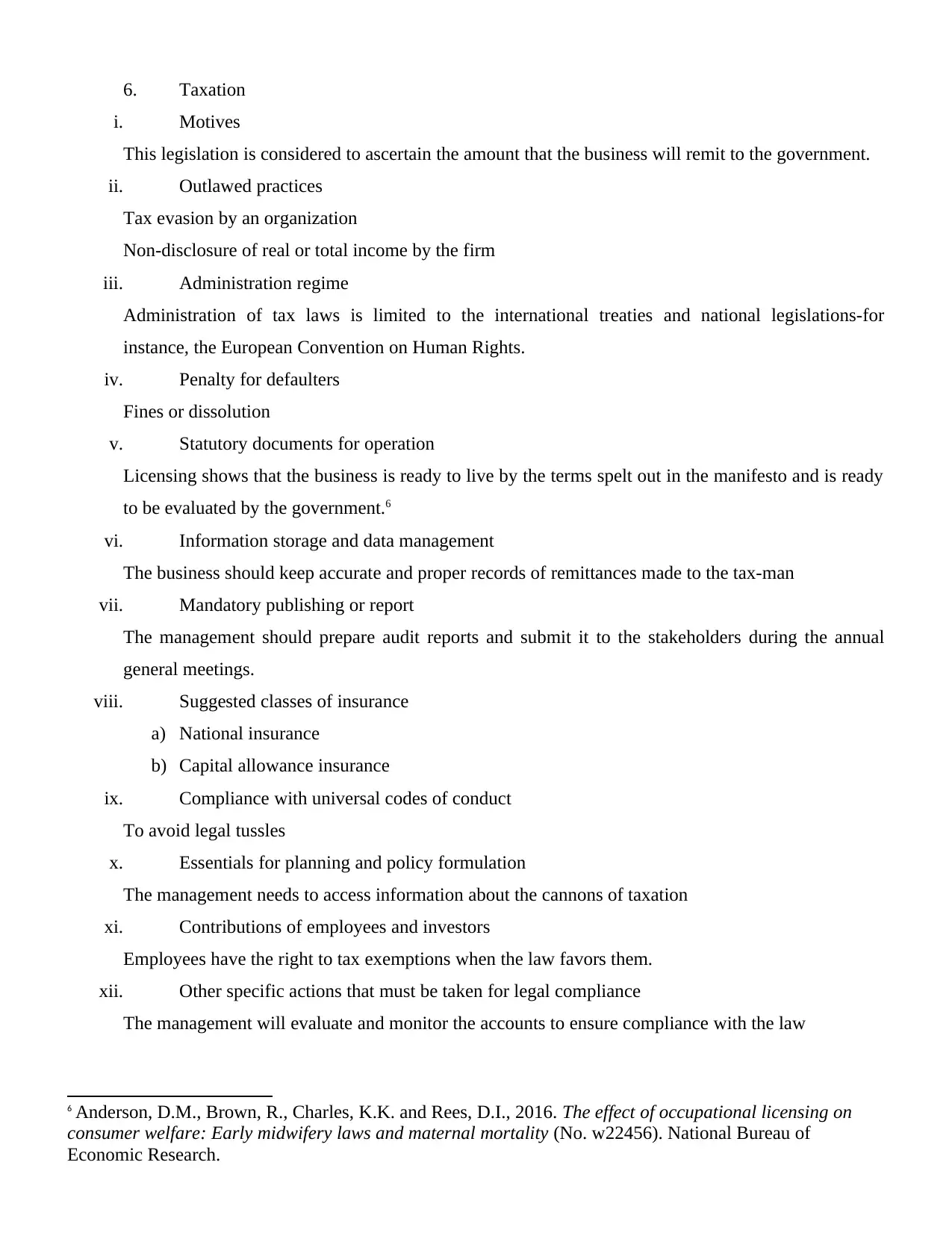
6. Taxation
i. Motives
This legislation is considered to ascertain the amount that the business will remit to the government.
ii. Outlawed practices
Tax evasion by an organization
Non-disclosure of real or total income by the firm
iii. Administration regime
Administration of tax laws is limited to the international treaties and national legislations-for
instance, the European Convention on Human Rights.
iv. Penalty for defaulters
Fines or dissolution
v. Statutory documents for operation
Licensing shows that the business is ready to live by the terms spelt out in the manifesto and is ready
to be evaluated by the government.6
vi. Information storage and data management
The business should keep accurate and proper records of remittances made to the tax-man
vii. Mandatory publishing or report
The management should prepare audit reports and submit it to the stakeholders during the annual
general meetings.
viii. Suggested classes of insurance
a) National insurance
b) Capital allowance insurance
ix. Compliance with universal codes of conduct
To avoid legal tussles
x. Essentials for planning and policy formulation
The management needs to access information about the cannons of taxation
xi. Contributions of employees and investors
Employees have the right to tax exemptions when the law favors them.
xii. Other specific actions that must be taken for legal compliance
The management will evaluate and monitor the accounts to ensure compliance with the law
6 Anderson, D.M., Brown, R., Charles, K.K. and Rees, D.I., 2016. The effect of occupational licensing on
consumer welfare: Early midwifery laws and maternal mortality (No. w22456). National Bureau of
Economic Research.
i. Motives
This legislation is considered to ascertain the amount that the business will remit to the government.
ii. Outlawed practices
Tax evasion by an organization
Non-disclosure of real or total income by the firm
iii. Administration regime
Administration of tax laws is limited to the international treaties and national legislations-for
instance, the European Convention on Human Rights.
iv. Penalty for defaulters
Fines or dissolution
v. Statutory documents for operation
Licensing shows that the business is ready to live by the terms spelt out in the manifesto and is ready
to be evaluated by the government.6
vi. Information storage and data management
The business should keep accurate and proper records of remittances made to the tax-man
vii. Mandatory publishing or report
The management should prepare audit reports and submit it to the stakeholders during the annual
general meetings.
viii. Suggested classes of insurance
a) National insurance
b) Capital allowance insurance
ix. Compliance with universal codes of conduct
To avoid legal tussles
x. Essentials for planning and policy formulation
The management needs to access information about the cannons of taxation
xi. Contributions of employees and investors
Employees have the right to tax exemptions when the law favors them.
xii. Other specific actions that must be taken for legal compliance
The management will evaluate and monitor the accounts to ensure compliance with the law
6 Anderson, D.M., Brown, R., Charles, K.K. and Rees, D.I., 2016. The effect of occupational licensing on
consumer welfare: Early midwifery laws and maternal mortality (No. w22456). National Bureau of
Economic Research.
Paraphrase This Document
Need a fresh take? Get an instant paraphrase of this document with our AI Paraphraser
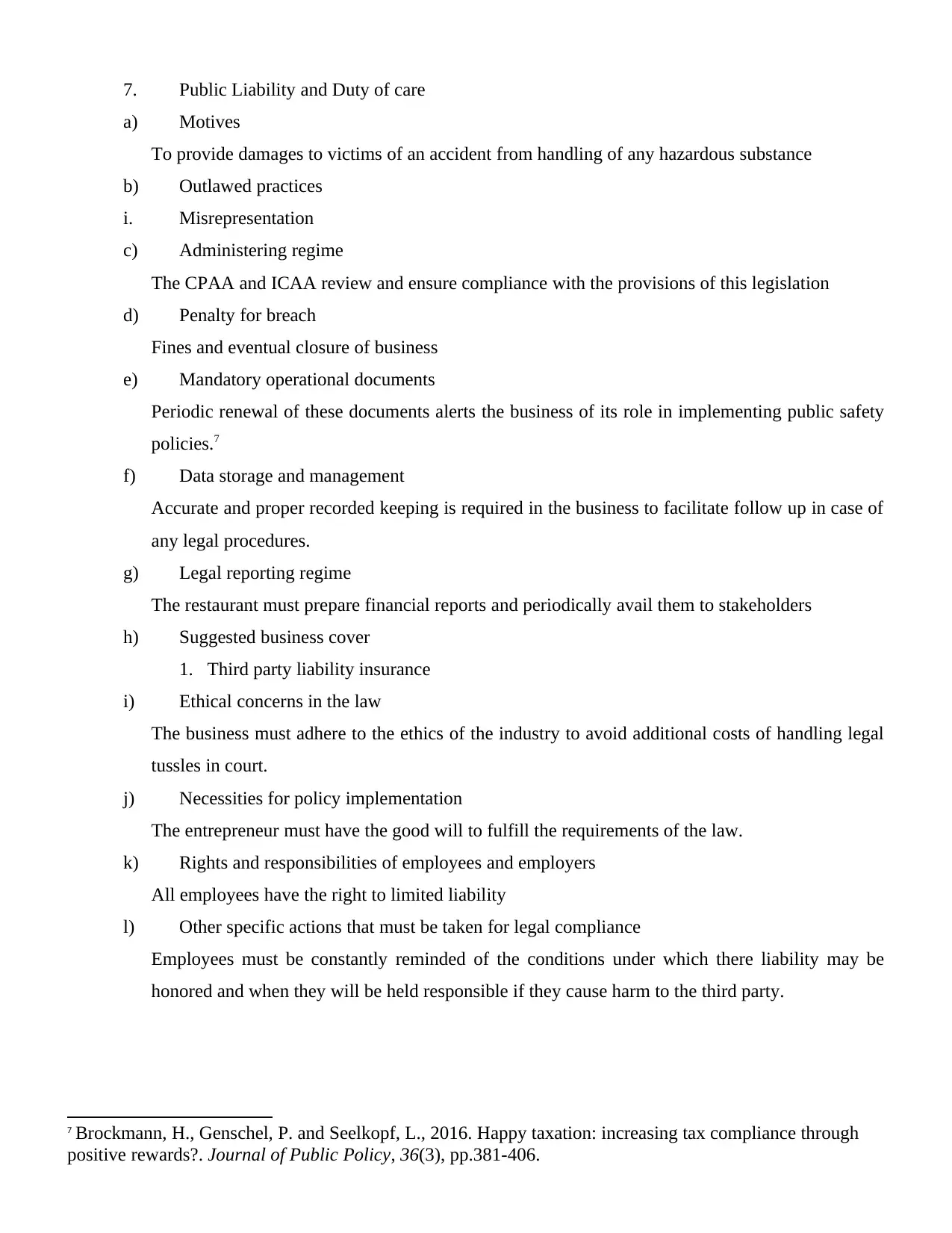
7. Public Liability and Duty of care
a) Motives
To provide damages to victims of an accident from handling of any hazardous substance
b) Outlawed practices
i. Misrepresentation
c) Administering regime
The CPAA and ICAA review and ensure compliance with the provisions of this legislation
d) Penalty for breach
Fines and eventual closure of business
e) Mandatory operational documents
Periodic renewal of these documents alerts the business of its role in implementing public safety
policies.7
f) Data storage and management
Accurate and proper recorded keeping is required in the business to facilitate follow up in case of
any legal procedures.
g) Legal reporting regime
The restaurant must prepare financial reports and periodically avail them to stakeholders
h) Suggested business cover
1. Third party liability insurance
i) Ethical concerns in the law
The business must adhere to the ethics of the industry to avoid additional costs of handling legal
tussles in court.
j) Necessities for policy implementation
The entrepreneur must have the good will to fulfill the requirements of the law.
k) Rights and responsibilities of employees and employers
All employees have the right to limited liability
l) Other specific actions that must be taken for legal compliance
Employees must be constantly reminded of the conditions under which there liability may be
honored and when they will be held responsible if they cause harm to the third party.
7 Brockmann, H., Genschel, P. and Seelkopf, L., 2016. Happy taxation: increasing tax compliance through
positive rewards?. Journal of Public Policy, 36(3), pp.381-406.
a) Motives
To provide damages to victims of an accident from handling of any hazardous substance
b) Outlawed practices
i. Misrepresentation
c) Administering regime
The CPAA and ICAA review and ensure compliance with the provisions of this legislation
d) Penalty for breach
Fines and eventual closure of business
e) Mandatory operational documents
Periodic renewal of these documents alerts the business of its role in implementing public safety
policies.7
f) Data storage and management
Accurate and proper recorded keeping is required in the business to facilitate follow up in case of
any legal procedures.
g) Legal reporting regime
The restaurant must prepare financial reports and periodically avail them to stakeholders
h) Suggested business cover
1. Third party liability insurance
i) Ethical concerns in the law
The business must adhere to the ethics of the industry to avoid additional costs of handling legal
tussles in court.
j) Necessities for policy implementation
The entrepreneur must have the good will to fulfill the requirements of the law.
k) Rights and responsibilities of employees and employers
All employees have the right to limited liability
l) Other specific actions that must be taken for legal compliance
Employees must be constantly reminded of the conditions under which there liability may be
honored and when they will be held responsible if they cause harm to the third party.
7 Brockmann, H., Genschel, P. and Seelkopf, L., 2016. Happy taxation: increasing tax compliance through
positive rewards?. Journal of Public Policy, 36(3), pp.381-406.
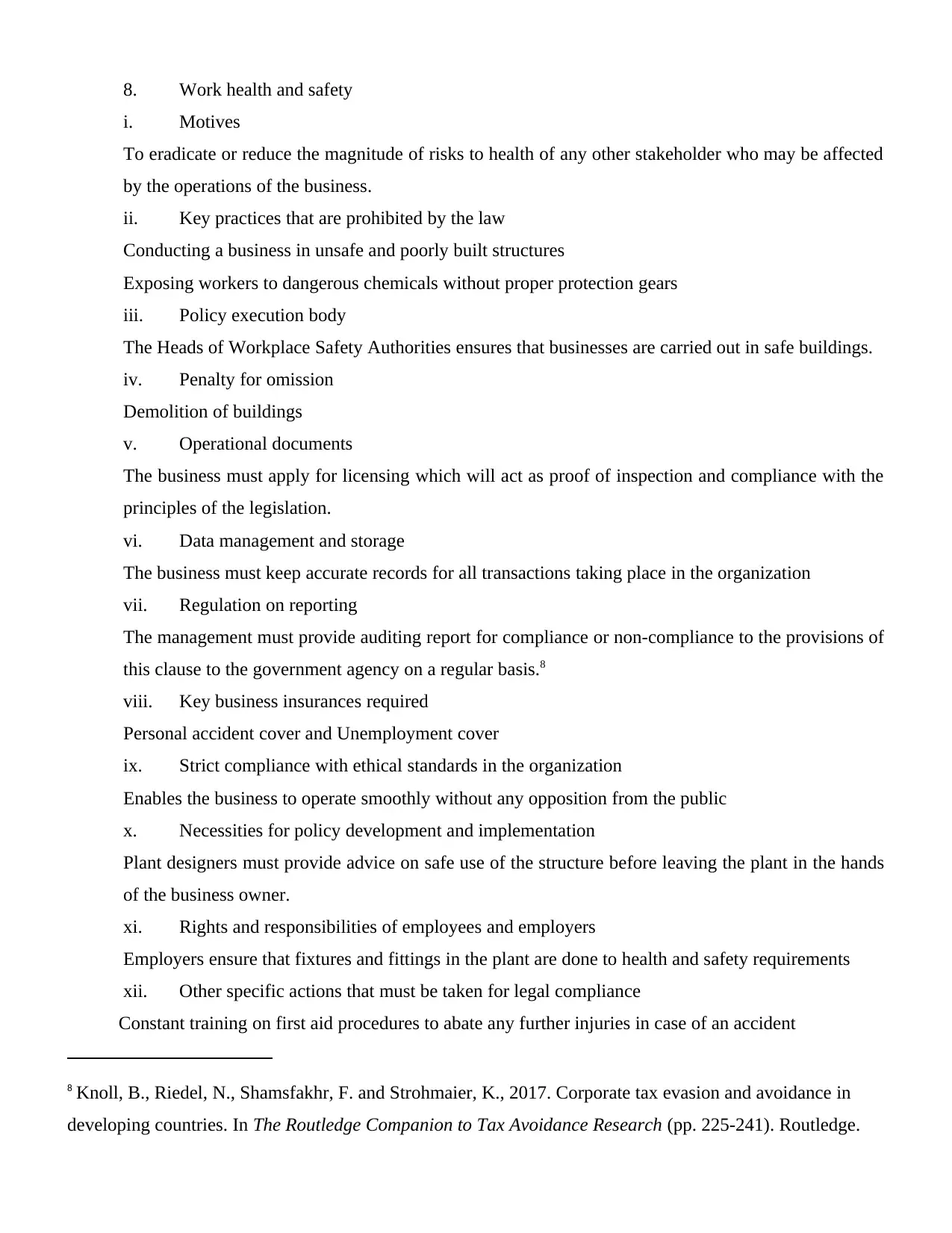
8. Work health and safety
i. Motives
To eradicate or reduce the magnitude of risks to health of any other stakeholder who may be affected
by the operations of the business.
ii. Key practices that are prohibited by the law
Conducting a business in unsafe and poorly built structures
Exposing workers to dangerous chemicals without proper protection gears
iii. Policy execution body
The Heads of Workplace Safety Authorities ensures that businesses are carried out in safe buildings.
iv. Penalty for omission
Demolition of buildings
v. Operational documents
The business must apply for licensing which will act as proof of inspection and compliance with the
principles of the legislation.
vi. Data management and storage
The business must keep accurate records for all transactions taking place in the organization
vii. Regulation on reporting
The management must provide auditing report for compliance or non-compliance to the provisions of
this clause to the government agency on a regular basis.8
viii. Key business insurances required
Personal accident cover and Unemployment cover
ix. Strict compliance with ethical standards in the organization
Enables the business to operate smoothly without any opposition from the public
x. Necessities for policy development and implementation
Plant designers must provide advice on safe use of the structure before leaving the plant in the hands
of the business owner.
xi. Rights and responsibilities of employees and employers
Employers ensure that fixtures and fittings in the plant are done to health and safety requirements
xii. Other specific actions that must be taken for legal compliance
Constant training on first aid procedures to abate any further injuries in case of an accident
8 Knoll, B., Riedel, N., Shamsfakhr, F. and Strohmaier, K., 2017. Corporate tax evasion and avoidance in
developing countries. In The Routledge Companion to Tax Avoidance Research (pp. 225-241). Routledge.
i. Motives
To eradicate or reduce the magnitude of risks to health of any other stakeholder who may be affected
by the operations of the business.
ii. Key practices that are prohibited by the law
Conducting a business in unsafe and poorly built structures
Exposing workers to dangerous chemicals without proper protection gears
iii. Policy execution body
The Heads of Workplace Safety Authorities ensures that businesses are carried out in safe buildings.
iv. Penalty for omission
Demolition of buildings
v. Operational documents
The business must apply for licensing which will act as proof of inspection and compliance with the
principles of the legislation.
vi. Data management and storage
The business must keep accurate records for all transactions taking place in the organization
vii. Regulation on reporting
The management must provide auditing report for compliance or non-compliance to the provisions of
this clause to the government agency on a regular basis.8
viii. Key business insurances required
Personal accident cover and Unemployment cover
ix. Strict compliance with ethical standards in the organization
Enables the business to operate smoothly without any opposition from the public
x. Necessities for policy development and implementation
Plant designers must provide advice on safe use of the structure before leaving the plant in the hands
of the business owner.
xi. Rights and responsibilities of employees and employers
Employers ensure that fixtures and fittings in the plant are done to health and safety requirements
xii. Other specific actions that must be taken for legal compliance
Constant training on first aid procedures to abate any further injuries in case of an accident
8 Knoll, B., Riedel, N., Shamsfakhr, F. and Strohmaier, K., 2017. Corporate tax evasion and avoidance in
developing countries. In The Routledge Companion to Tax Avoidance Research (pp. 225-241). Routledge.
⊘ This is a preview!⊘
Do you want full access?
Subscribe today to unlock all pages.
Trusted by 1+ million students worldwide
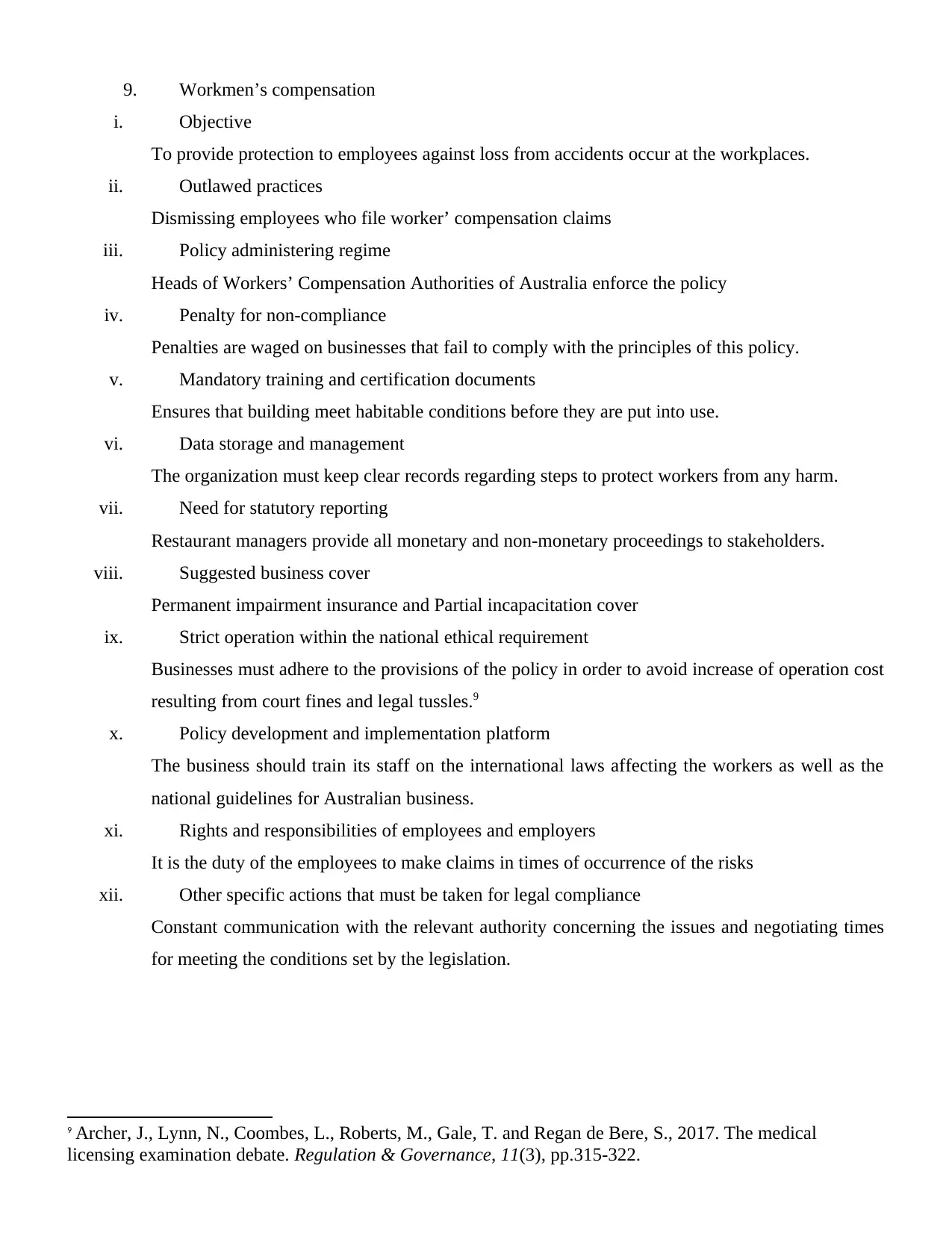
9. Workmen’s compensation
i. Objective
To provide protection to employees against loss from accidents occur at the workplaces.
ii. Outlawed practices
Dismissing employees who file worker’ compensation claims
iii. Policy administering regime
Heads of Workers’ Compensation Authorities of Australia enforce the policy
iv. Penalty for non-compliance
Penalties are waged on businesses that fail to comply with the principles of this policy.
v. Mandatory training and certification documents
Ensures that building meet habitable conditions before they are put into use.
vi. Data storage and management
The organization must keep clear records regarding steps to protect workers from any harm.
vii. Need for statutory reporting
Restaurant managers provide all monetary and non-monetary proceedings to stakeholders.
viii. Suggested business cover
Permanent impairment insurance and Partial incapacitation cover
ix. Strict operation within the national ethical requirement
Businesses must adhere to the provisions of the policy in order to avoid increase of operation cost
resulting from court fines and legal tussles.9
x. Policy development and implementation platform
The business should train its staff on the international laws affecting the workers as well as the
national guidelines for Australian business.
xi. Rights and responsibilities of employees and employers
It is the duty of the employees to make claims in times of occurrence of the risks
xii. Other specific actions that must be taken for legal compliance
Constant communication with the relevant authority concerning the issues and negotiating times
for meeting the conditions set by the legislation.
9 Archer, J., Lynn, N., Coombes, L., Roberts, M., Gale, T. and Regan de Bere, S., 2017. The medical
licensing examination debate. Regulation & Governance, 11(3), pp.315-322.
i. Objective
To provide protection to employees against loss from accidents occur at the workplaces.
ii. Outlawed practices
Dismissing employees who file worker’ compensation claims
iii. Policy administering regime
Heads of Workers’ Compensation Authorities of Australia enforce the policy
iv. Penalty for non-compliance
Penalties are waged on businesses that fail to comply with the principles of this policy.
v. Mandatory training and certification documents
Ensures that building meet habitable conditions before they are put into use.
vi. Data storage and management
The organization must keep clear records regarding steps to protect workers from any harm.
vii. Need for statutory reporting
Restaurant managers provide all monetary and non-monetary proceedings to stakeholders.
viii. Suggested business cover
Permanent impairment insurance and Partial incapacitation cover
ix. Strict operation within the national ethical requirement
Businesses must adhere to the provisions of the policy in order to avoid increase of operation cost
resulting from court fines and legal tussles.9
x. Policy development and implementation platform
The business should train its staff on the international laws affecting the workers as well as the
national guidelines for Australian business.
xi. Rights and responsibilities of employees and employers
It is the duty of the employees to make claims in times of occurrence of the risks
xii. Other specific actions that must be taken for legal compliance
Constant communication with the relevant authority concerning the issues and negotiating times
for meeting the conditions set by the legislation.
9 Archer, J., Lynn, N., Coombes, L., Roberts, M., Gale, T. and Regan de Bere, S., 2017. The medical
licensing examination debate. Regulation & Governance, 11(3), pp.315-322.
Paraphrase This Document
Need a fresh take? Get an instant paraphrase of this document with our AI Paraphraser
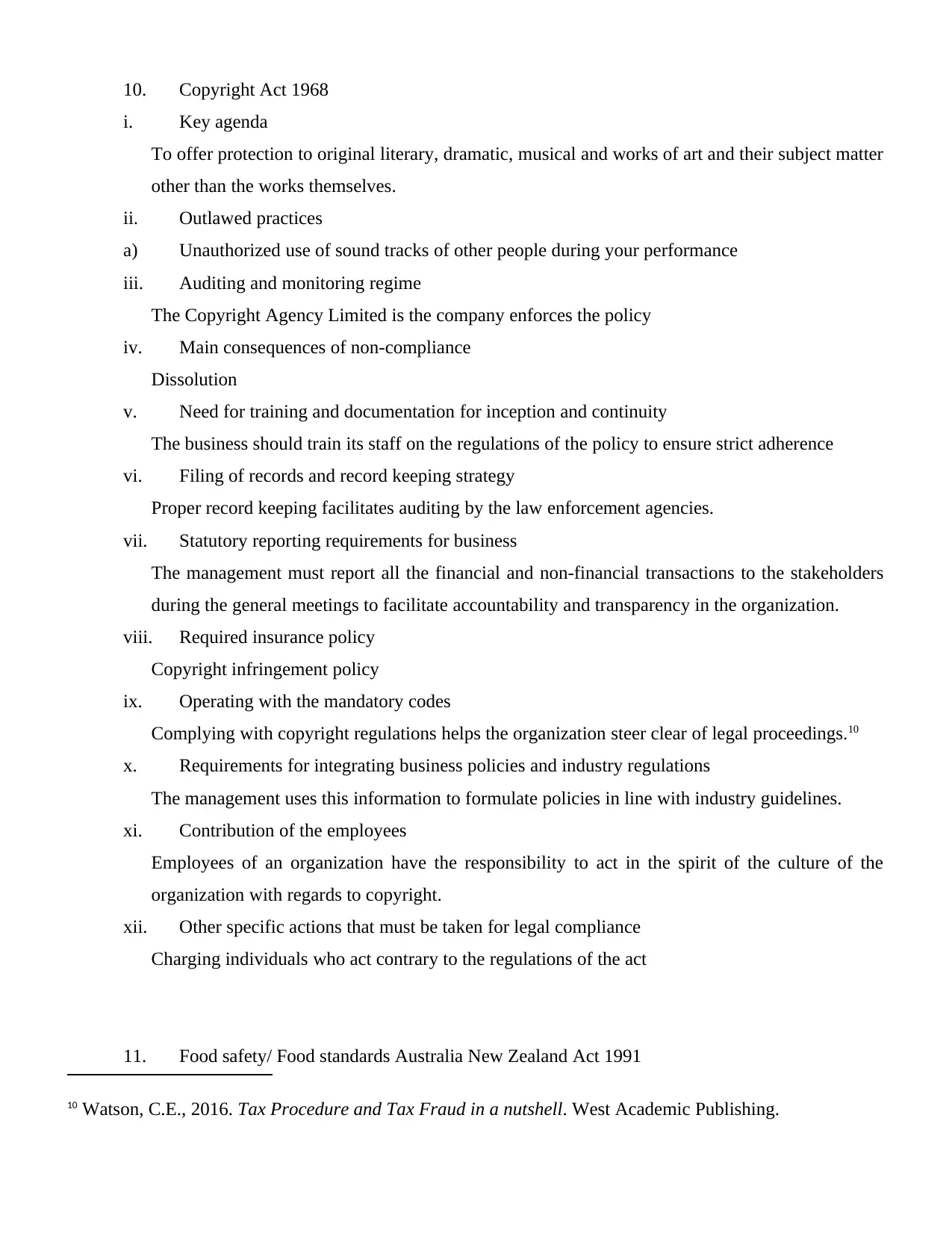
10. Copyright Act 1968
i. Key agenda
To offer protection to original literary, dramatic, musical and works of art and their subject matter
other than the works themselves.
ii. Outlawed practices
a) Unauthorized use of sound tracks of other people during your performance
iii. Auditing and monitoring regime
The Copyright Agency Limited is the company enforces the policy
iv. Main consequences of non-compliance
Dissolution
v. Need for training and documentation for inception and continuity
The business should train its staff on the regulations of the policy to ensure strict adherence
vi. Filing of records and record keeping strategy
Proper record keeping facilitates auditing by the law enforcement agencies.
vii. Statutory reporting requirements for business
The management must report all the financial and non-financial transactions to the stakeholders
during the general meetings to facilitate accountability and transparency in the organization.
viii. Required insurance policy
Copyright infringement policy
ix. Operating with the mandatory codes
Complying with copyright regulations helps the organization steer clear of legal proceedings.10
x. Requirements for integrating business policies and industry regulations
The management uses this information to formulate policies in line with industry guidelines.
xi. Contribution of the employees
Employees of an organization have the responsibility to act in the spirit of the culture of the
organization with regards to copyright.
xii. Other specific actions that must be taken for legal compliance
Charging individuals who act contrary to the regulations of the act
11. Food safety/ Food standards Australia New Zealand Act 1991
10 Watson, C.E., 2016. Tax Procedure and Tax Fraud in a nutshell. West Academic Publishing.
i. Key agenda
To offer protection to original literary, dramatic, musical and works of art and their subject matter
other than the works themselves.
ii. Outlawed practices
a) Unauthorized use of sound tracks of other people during your performance
iii. Auditing and monitoring regime
The Copyright Agency Limited is the company enforces the policy
iv. Main consequences of non-compliance
Dissolution
v. Need for training and documentation for inception and continuity
The business should train its staff on the regulations of the policy to ensure strict adherence
vi. Filing of records and record keeping strategy
Proper record keeping facilitates auditing by the law enforcement agencies.
vii. Statutory reporting requirements for business
The management must report all the financial and non-financial transactions to the stakeholders
during the general meetings to facilitate accountability and transparency in the organization.
viii. Required insurance policy
Copyright infringement policy
ix. Operating with the mandatory codes
Complying with copyright regulations helps the organization steer clear of legal proceedings.10
x. Requirements for integrating business policies and industry regulations
The management uses this information to formulate policies in line with industry guidelines.
xi. Contribution of the employees
Employees of an organization have the responsibility to act in the spirit of the culture of the
organization with regards to copyright.
xii. Other specific actions that must be taken for legal compliance
Charging individuals who act contrary to the regulations of the act
11. Food safety/ Food standards Australia New Zealand Act 1991
10 Watson, C.E., 2016. Tax Procedure and Tax Fraud in a nutshell. West Academic Publishing.
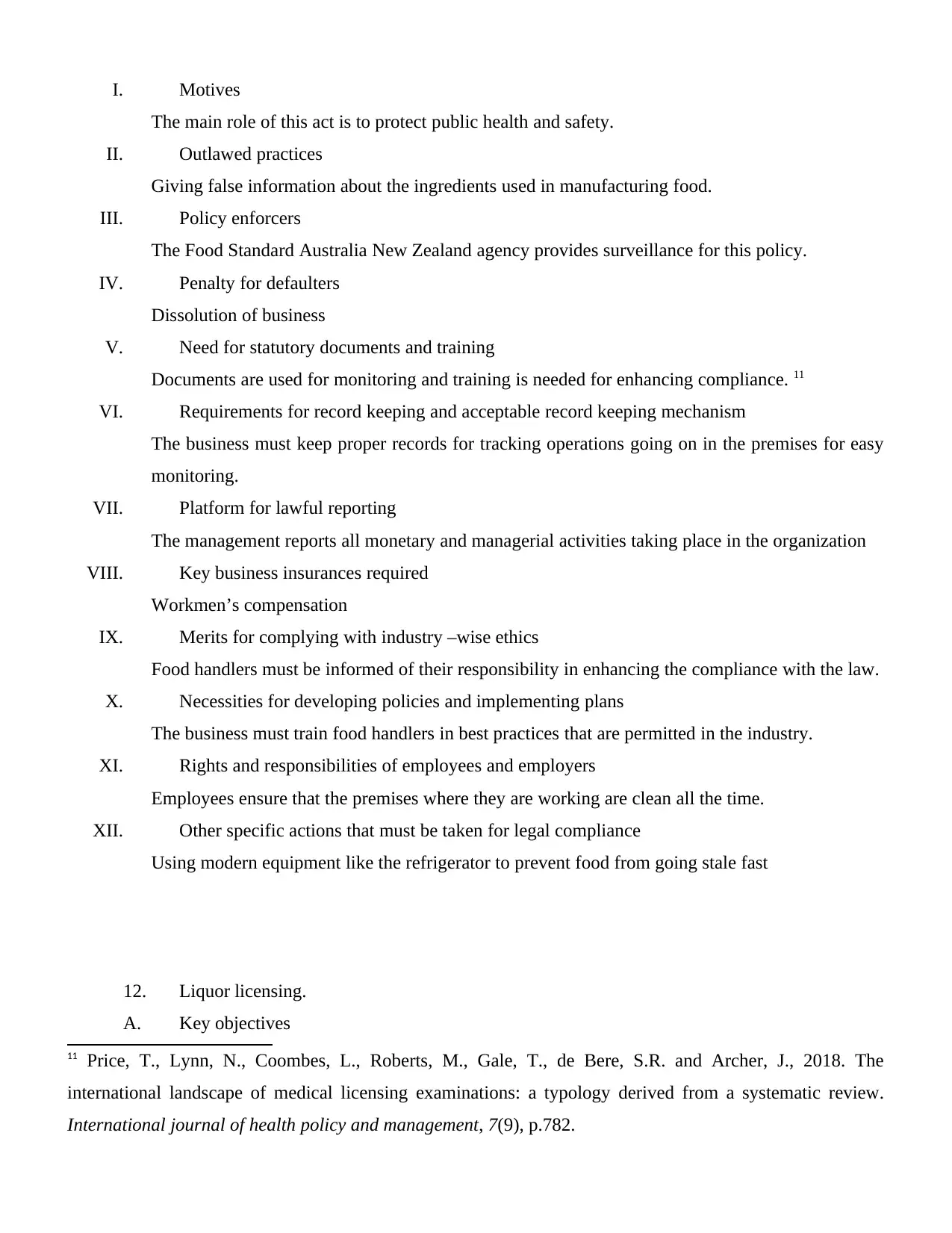
I. Motives
The main role of this act is to protect public health and safety.
II. Outlawed practices
Giving false information about the ingredients used in manufacturing food.
III. Policy enforcers
The Food Standard Australia New Zealand agency provides surveillance for this policy.
IV. Penalty for defaulters
Dissolution of business
V. Need for statutory documents and training
Documents are used for monitoring and training is needed for enhancing compliance. 11
VI. Requirements for record keeping and acceptable record keeping mechanism
The business must keep proper records for tracking operations going on in the premises for easy
monitoring.
VII. Platform for lawful reporting
The management reports all monetary and managerial activities taking place in the organization
VIII. Key business insurances required
Workmen’s compensation
IX. Merits for complying with industry –wise ethics
Food handlers must be informed of their responsibility in enhancing the compliance with the law.
X. Necessities for developing policies and implementing plans
The business must train food handlers in best practices that are permitted in the industry.
XI. Rights and responsibilities of employees and employers
Employees ensure that the premises where they are working are clean all the time.
XII. Other specific actions that must be taken for legal compliance
Using modern equipment like the refrigerator to prevent food from going stale fast
12. Liquor licensing.
A. Key objectives
11 Price, T., Lynn, N., Coombes, L., Roberts, M., Gale, T., de Bere, S.R. and Archer, J., 2018. The
international landscape of medical licensing examinations: a typology derived from a systematic review.
International journal of health policy and management, 7(9), p.782.
The main role of this act is to protect public health and safety.
II. Outlawed practices
Giving false information about the ingredients used in manufacturing food.
III. Policy enforcers
The Food Standard Australia New Zealand agency provides surveillance for this policy.
IV. Penalty for defaulters
Dissolution of business
V. Need for statutory documents and training
Documents are used for monitoring and training is needed for enhancing compliance. 11
VI. Requirements for record keeping and acceptable record keeping mechanism
The business must keep proper records for tracking operations going on in the premises for easy
monitoring.
VII. Platform for lawful reporting
The management reports all monetary and managerial activities taking place in the organization
VIII. Key business insurances required
Workmen’s compensation
IX. Merits for complying with industry –wise ethics
Food handlers must be informed of their responsibility in enhancing the compliance with the law.
X. Necessities for developing policies and implementing plans
The business must train food handlers in best practices that are permitted in the industry.
XI. Rights and responsibilities of employees and employers
Employees ensure that the premises where they are working are clean all the time.
XII. Other specific actions that must be taken for legal compliance
Using modern equipment like the refrigerator to prevent food from going stale fast
12. Liquor licensing.
A. Key objectives
11 Price, T., Lynn, N., Coombes, L., Roberts, M., Gale, T., de Bere, S.R. and Archer, J., 2018. The
international landscape of medical licensing examinations: a typology derived from a systematic review.
International journal of health policy and management, 7(9), p.782.
⊘ This is a preview!⊘
Do you want full access?
Subscribe today to unlock all pages.
Trusted by 1+ million students worldwide

1 out of 21


Related Documents


Your All-in-One AI-Powered Toolkit for Academic Success.
+13062052269
info@desklib.com
Available 24*7 on WhatsApp / Email
![[object Object]](/_next/static/media/star-bottom.7253800d.svg)
Unlock your academic potential
Copyright © 2020–2026 A2Z Services. All Rights Reserved. Developed and managed by ZUCOL.