HRM Report: Restructuring of the Organization Analysis
VerifiedAdded on 2020/01/28
|13
|4123
|125
Report
AI Summary
This report delves into the core aspects of Human Resource Management (HRM) within the context of organizational restructuring. It begins by outlining the purpose and functions of HRM, emphasizing its role in maximizing employee output and achieving organizational objectives. The report then explores various recruitment methods, comparing their strengths and weaknesses, followed by an analysis of the benefits of different HRM practices for both employers and employees, such as conflict resolution, employee relations, and training. Furthermore, the report evaluates the effectiveness of HRM practices in enhancing productivity and profitability. The report also highlights the importance of HRM in providing talent and skills through recruitment and selection processes, examining various techniques and their effectiveness. The report also discusses workforce planning, its influence on HRM, and its benefits for both employers and employees. The report concludes by discussing the strengths and weaknesses of different recruitment and selection approaches, and evaluating HRM practices within an administrative context.
Restructuring of the
organization
organization

Paraphrase This Document
Need a fresh take? Get an instant paraphrase of this document with our AI Paraphraser
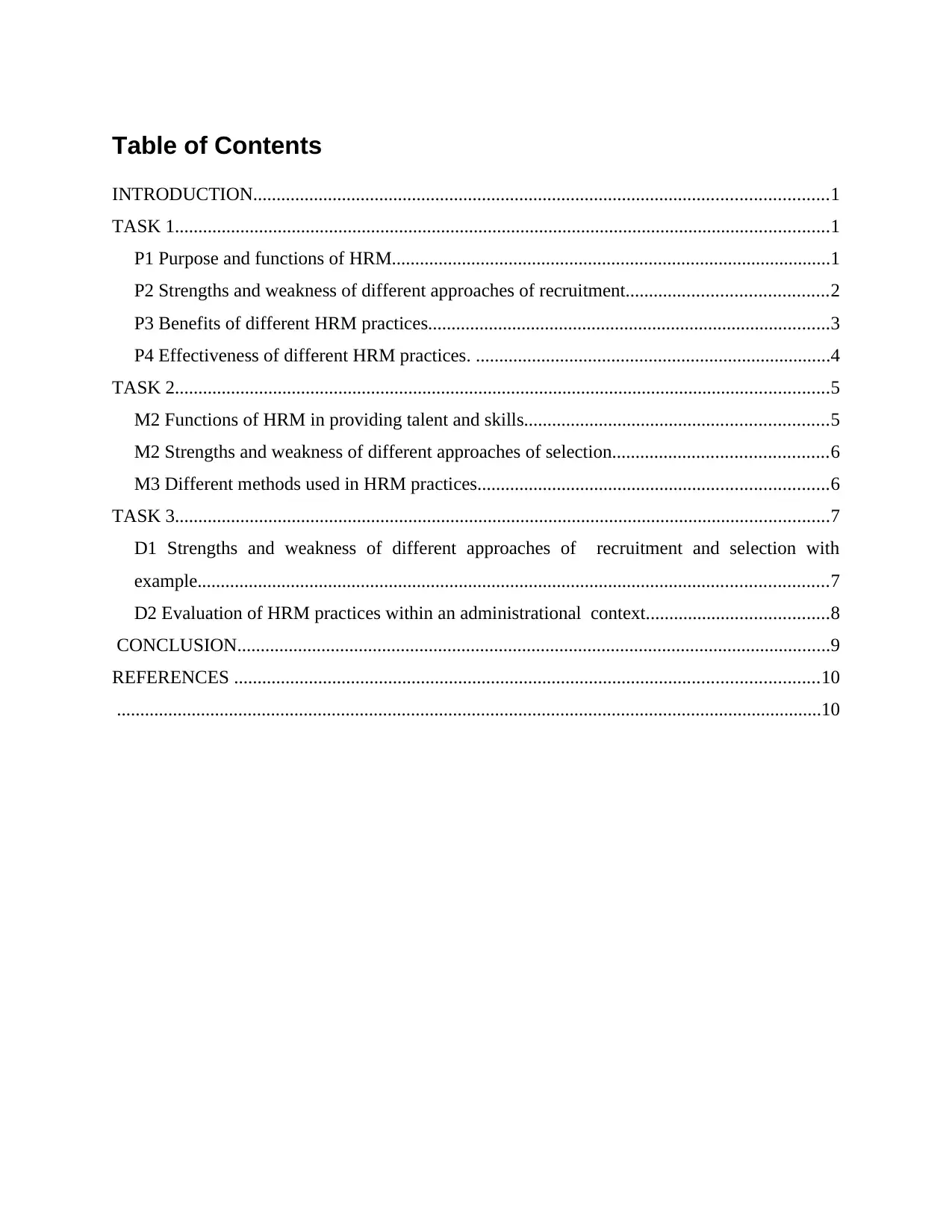
Table of Contents
INTRODUCTION...........................................................................................................................1
TASK 1............................................................................................................................................1
P1 Purpose and functions of HRM..............................................................................................1
P2 Strengths and weakness of different approaches of recruitment...........................................2
P3 Benefits of different HRM practices......................................................................................3
P4 Effectiveness of different HRM practices. ............................................................................4
TASK 2............................................................................................................................................5
M2 Functions of HRM in providing talent and skills.................................................................5
M2 Strengths and weakness of different approaches of selection..............................................6
M3 Different methods used in HRM practices...........................................................................6
TASK 3............................................................................................................................................7
D1 Strengths and weakness of different approaches of recruitment and selection with
example.......................................................................................................................................7
D2 Evaluation of HRM practices within an administrational context.......................................8
CONCLUSION...............................................................................................................................9
REFERENCES .............................................................................................................................10
.......................................................................................................................................................10
INTRODUCTION...........................................................................................................................1
TASK 1............................................................................................................................................1
P1 Purpose and functions of HRM..............................................................................................1
P2 Strengths and weakness of different approaches of recruitment...........................................2
P3 Benefits of different HRM practices......................................................................................3
P4 Effectiveness of different HRM practices. ............................................................................4
TASK 2............................................................................................................................................5
M2 Functions of HRM in providing talent and skills.................................................................5
M2 Strengths and weakness of different approaches of selection..............................................6
M3 Different methods used in HRM practices...........................................................................6
TASK 3............................................................................................................................................7
D1 Strengths and weakness of different approaches of recruitment and selection with
example.......................................................................................................................................7
D2 Evaluation of HRM practices within an administrational context.......................................8
CONCLUSION...............................................................................................................................9
REFERENCES .............................................................................................................................10
.......................................................................................................................................................10
INTRODUCTION
Present report is based on the human resource management. Employees are the essential
assets of any enterprise and contribute a lot in the overall success of the enterprise so it is very
important and responsibility of every manager to manage them in a manner that they can
contribute a lot in achieving the objectives of the enterprise(Cummings and Worley, 2014).
Different methods of recruitment and selection are given under the report with their strengthens
and weakness. Main purpose and functions of the HRM are also described. HRM contribute a lot
in increasing the overall productivity and profit of the enterprise and at the same time it helps the
manager in recruit the right person for the right job.
Employers and employee both get benefited through this. Other than this the main
purpose of the HRM is to effectively manage all the activities of human resource in order to
easily get or achieve the objectives of the enterprise.
TASK 1
P1 Purpose and functions of HRM
Human resource management is a process of managing the human resources of the
enterprise. The main purpose of this process is to maximise the output of employee and enhance
his or her performance in order to better achieve the objectives of the enterprise.
Main purpose of this function is to manage all the activities of employees working in the
enterprise. All the legal issues are solved through this other than it is the responsibility of the
manager to to manage consistency in all the operations of the business.
There are number of functions performed by HRM. Major function of HRM include the
following: Recruitment and selection: It is the one and most important function of HRM. It is the
responsibility of HRM department to recruit skilled and talented employees for the
enterprise to perform different kinds of roles(Garner, 2012). Maintaining good working conditions: It is the main function of HRM is to provide and
maintain good working conditions in the enterprise so that every employee like the
workplace and its environment. Training and development: It is the responsibility of human resource manager to conduct
training and development programmes to enhance the skills of the employees and make
them ready to face the future competitive environment(Erkama, 2010).
1
Present report is based on the human resource management. Employees are the essential
assets of any enterprise and contribute a lot in the overall success of the enterprise so it is very
important and responsibility of every manager to manage them in a manner that they can
contribute a lot in achieving the objectives of the enterprise(Cummings and Worley, 2014).
Different methods of recruitment and selection are given under the report with their strengthens
and weakness. Main purpose and functions of the HRM are also described. HRM contribute a lot
in increasing the overall productivity and profit of the enterprise and at the same time it helps the
manager in recruit the right person for the right job.
Employers and employee both get benefited through this. Other than this the main
purpose of the HRM is to effectively manage all the activities of human resource in order to
easily get or achieve the objectives of the enterprise.
TASK 1
P1 Purpose and functions of HRM
Human resource management is a process of managing the human resources of the
enterprise. The main purpose of this process is to maximise the output of employee and enhance
his or her performance in order to better achieve the objectives of the enterprise.
Main purpose of this function is to manage all the activities of employees working in the
enterprise. All the legal issues are solved through this other than it is the responsibility of the
manager to to manage consistency in all the operations of the business.
There are number of functions performed by HRM. Major function of HRM include the
following: Recruitment and selection: It is the one and most important function of HRM. It is the
responsibility of HRM department to recruit skilled and talented employees for the
enterprise to perform different kinds of roles(Garner, 2012). Maintaining good working conditions: It is the main function of HRM is to provide and
maintain good working conditions in the enterprise so that every employee like the
workplace and its environment. Training and development: It is the responsibility of human resource manager to conduct
training and development programmes to enhance the skills of the employees and make
them ready to face the future competitive environment(Erkama, 2010).
1
⊘ This is a preview!⊘
Do you want full access?
Subscribe today to unlock all pages.

Trusted by 1+ million students worldwide
Managing employee relations: Employees are the assets of the enterprise so it is the
responsibility of the manager to maintain good relations among them.
Orientation: It is very important to provide proper guidance to the new employee in
order to help him to learn about the new things in the enterprise.
All these are the main functions of HRM in any enterprise.
Workforce planning: This is one of the important function of human resource
management. Workforce planning is a systematic process of analysing what an enterprise want
in terms of experience, size, knowledge and skills of employees in order to achieve the set
targets. This inform the enterprise about the current skills they have and also help in analysing
the various factors ion the business activity. One of the main benefit of doing workforce planning
is that it provide opportunity to the employers to decide in advance about the skills and
capabilities required in a candidate for doing work in the firm. This planning support the
employer during the process of recruitment and save the time. The main benefit for employees is
that this planning conduct training and development programmes for them which help in
enhancing their skills and capabilities. All this motivate them to work harder and provide them
various opportunities for growth.
Process of workforce planning affect the process of human resource management and its
function because this guide the HR during the formulation of various policies and strategies.
Operational workforce planning helps in better the relationship of employee and employer. This
can be understood by the following points:
This increase the productivity of employees and ensure the proper utilisation of
resources.
This ensure the optimum distribution of talent in every department.
This helps in identifying the skills required at workplace and help in set criteria for the
process of recruitment.
Decrease the obsolete time of workers.
Identify the ways for achieving better satisfaction of employees.
Strategic workforce planning helps in dealing with the broad issues held at workplace.
It helps in identifying the future needs of manpower.
Identify and evaluate the future options.
Ensure the proper implementation of workforce strategy.
2
responsibility of the manager to maintain good relations among them.
Orientation: It is very important to provide proper guidance to the new employee in
order to help him to learn about the new things in the enterprise.
All these are the main functions of HRM in any enterprise.
Workforce planning: This is one of the important function of human resource
management. Workforce planning is a systematic process of analysing what an enterprise want
in terms of experience, size, knowledge and skills of employees in order to achieve the set
targets. This inform the enterprise about the current skills they have and also help in analysing
the various factors ion the business activity. One of the main benefit of doing workforce planning
is that it provide opportunity to the employers to decide in advance about the skills and
capabilities required in a candidate for doing work in the firm. This planning support the
employer during the process of recruitment and save the time. The main benefit for employees is
that this planning conduct training and development programmes for them which help in
enhancing their skills and capabilities. All this motivate them to work harder and provide them
various opportunities for growth.
Process of workforce planning affect the process of human resource management and its
function because this guide the HR during the formulation of various policies and strategies.
Operational workforce planning helps in better the relationship of employee and employer. This
can be understood by the following points:
This increase the productivity of employees and ensure the proper utilisation of
resources.
This ensure the optimum distribution of talent in every department.
This helps in identifying the skills required at workplace and help in set criteria for the
process of recruitment.
Decrease the obsolete time of workers.
Identify the ways for achieving better satisfaction of employees.
Strategic workforce planning helps in dealing with the broad issues held at workplace.
It helps in identifying the future needs of manpower.
Identify and evaluate the future options.
Ensure the proper implementation of workforce strategy.
2
Paraphrase This Document
Need a fresh take? Get an instant paraphrase of this document with our AI Paraphraser
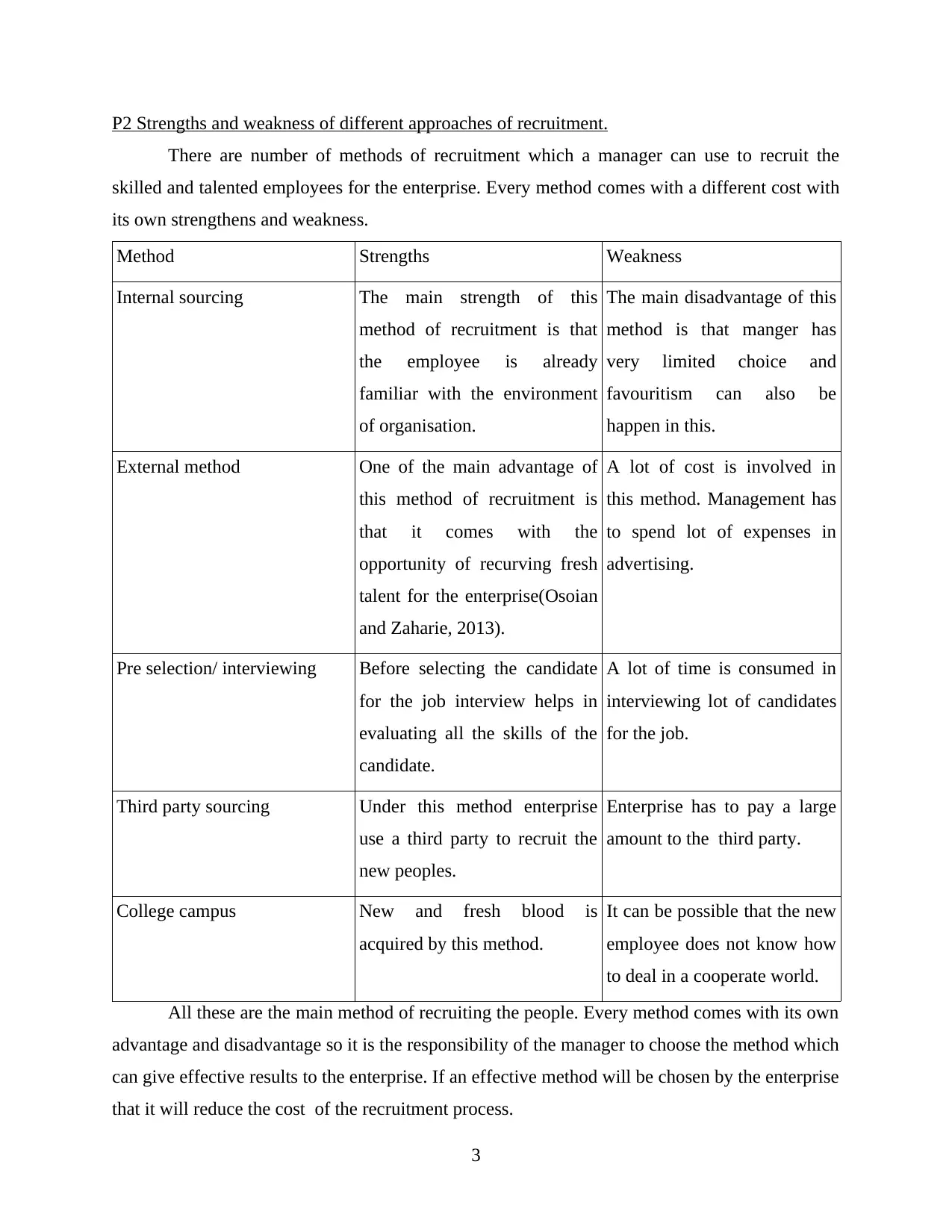
P2 Strengths and weakness of different approaches of recruitment.
There are number of methods of recruitment which a manager can use to recruit the
skilled and talented employees for the enterprise. Every method comes with a different cost with
its own strengthens and weakness.
Method Strengths Weakness
Internal sourcing The main strength of this
method of recruitment is that
the employee is already
familiar with the environment
of organisation.
The main disadvantage of this
method is that manger has
very limited choice and
favouritism can also be
happen in this.
External method One of the main advantage of
this method of recruitment is
that it comes with the
opportunity of recurving fresh
talent for the enterprise(Osoian
and Zaharie, 2013).
A lot of cost is involved in
this method. Management has
to spend lot of expenses in
advertising.
Pre selection/ interviewing Before selecting the candidate
for the job interview helps in
evaluating all the skills of the
candidate.
A lot of time is consumed in
interviewing lot of candidates
for the job.
Third party sourcing Under this method enterprise
use a third party to recruit the
new peoples.
Enterprise has to pay a large
amount to the third party.
College campus New and fresh blood is
acquired by this method.
It can be possible that the new
employee does not know how
to deal in a cooperate world.
All these are the main method of recruiting the people. Every method comes with its own
advantage and disadvantage so it is the responsibility of the manager to choose the method which
can give effective results to the enterprise. If an effective method will be chosen by the enterprise
that it will reduce the cost of the recruitment process.
3
There are number of methods of recruitment which a manager can use to recruit the
skilled and talented employees for the enterprise. Every method comes with a different cost with
its own strengthens and weakness.
Method Strengths Weakness
Internal sourcing The main strength of this
method of recruitment is that
the employee is already
familiar with the environment
of organisation.
The main disadvantage of this
method is that manger has
very limited choice and
favouritism can also be
happen in this.
External method One of the main advantage of
this method of recruitment is
that it comes with the
opportunity of recurving fresh
talent for the enterprise(Osoian
and Zaharie, 2013).
A lot of cost is involved in
this method. Management has
to spend lot of expenses in
advertising.
Pre selection/ interviewing Before selecting the candidate
for the job interview helps in
evaluating all the skills of the
candidate.
A lot of time is consumed in
interviewing lot of candidates
for the job.
Third party sourcing Under this method enterprise
use a third party to recruit the
new peoples.
Enterprise has to pay a large
amount to the third party.
College campus New and fresh blood is
acquired by this method.
It can be possible that the new
employee does not know how
to deal in a cooperate world.
All these are the main method of recruiting the people. Every method comes with its own
advantage and disadvantage so it is the responsibility of the manager to choose the method which
can give effective results to the enterprise. If an effective method will be chosen by the enterprise
that it will reduce the cost of the recruitment process.
3
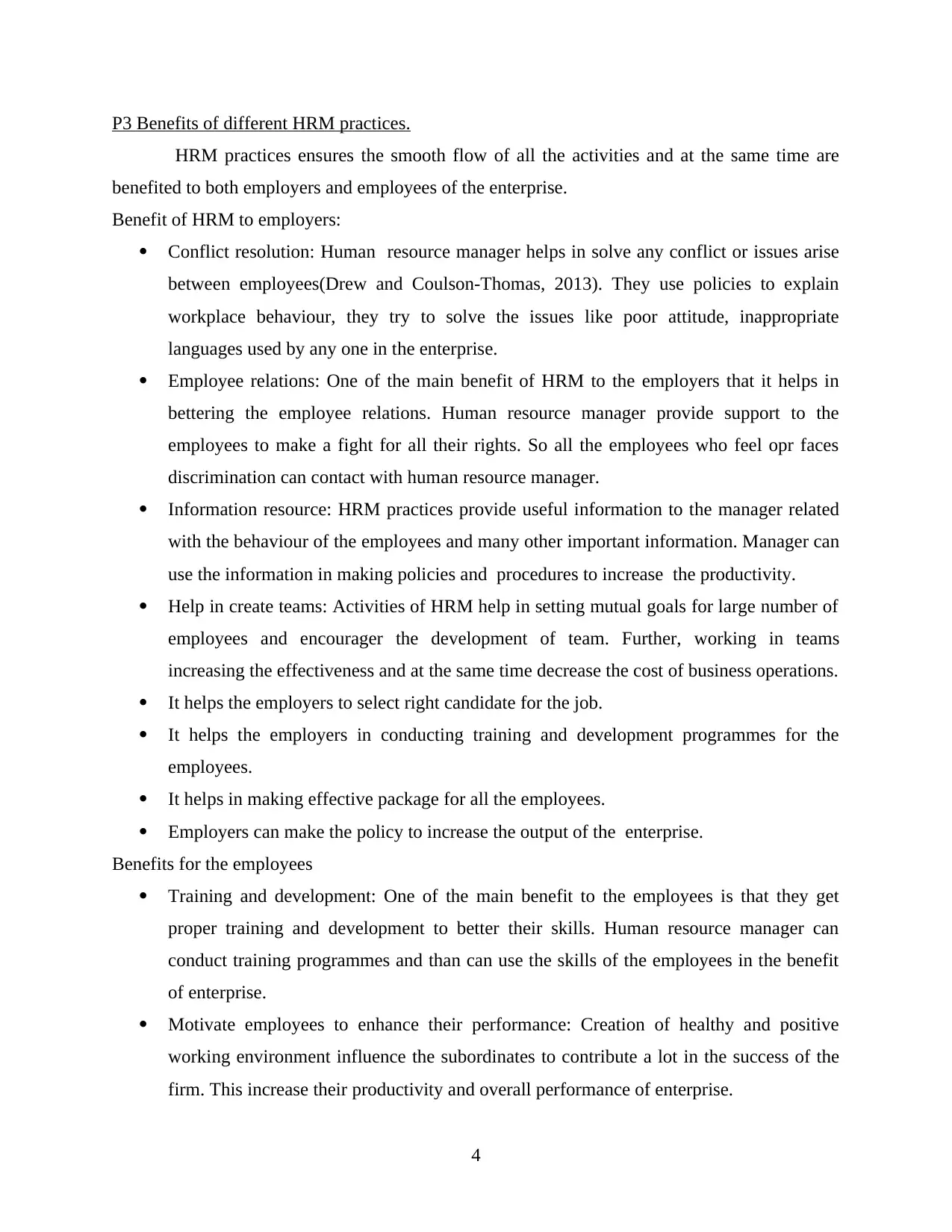
P3 Benefits of different HRM practices.
HRM practices ensures the smooth flow of all the activities and at the same time are
benefited to both employers and employees of the enterprise.
Benefit of HRM to employers:
Conflict resolution: Human resource manager helps in solve any conflict or issues arise
between employees(Drew and Coulson‐Thomas, 2013). They use policies to explain
workplace behaviour, they try to solve the issues like poor attitude, inappropriate
languages used by any one in the enterprise.
Employee relations: One of the main benefit of HRM to the employers that it helps in
bettering the employee relations. Human resource manager provide support to the
employees to make a fight for all their rights. So all the employees who feel opr faces
discrimination can contact with human resource manager.
Information resource: HRM practices provide useful information to the manager related
with the behaviour of the employees and many other important information. Manager can
use the information in making policies and procedures to increase the productivity.
Help in create teams: Activities of HRM help in setting mutual goals for large number of
employees and encourager the development of team. Further, working in teams
increasing the effectiveness and at the same time decrease the cost of business operations.
It helps the employers to select right candidate for the job.
It helps the employers in conducting training and development programmes for the
employees.
It helps in making effective package for all the employees.
Employers can make the policy to increase the output of the enterprise.
Benefits for the employees
Training and development: One of the main benefit to the employees is that they get
proper training and development to better their skills. Human resource manager can
conduct training programmes and than can use the skills of the employees in the benefit
of enterprise.
Motivate employees to enhance their performance: Creation of healthy and positive
working environment influence the subordinates to contribute a lot in the success of the
firm. This increase their productivity and overall performance of enterprise.
4
HRM practices ensures the smooth flow of all the activities and at the same time are
benefited to both employers and employees of the enterprise.
Benefit of HRM to employers:
Conflict resolution: Human resource manager helps in solve any conflict or issues arise
between employees(Drew and Coulson‐Thomas, 2013). They use policies to explain
workplace behaviour, they try to solve the issues like poor attitude, inappropriate
languages used by any one in the enterprise.
Employee relations: One of the main benefit of HRM to the employers that it helps in
bettering the employee relations. Human resource manager provide support to the
employees to make a fight for all their rights. So all the employees who feel opr faces
discrimination can contact with human resource manager.
Information resource: HRM practices provide useful information to the manager related
with the behaviour of the employees and many other important information. Manager can
use the information in making policies and procedures to increase the productivity.
Help in create teams: Activities of HRM help in setting mutual goals for large number of
employees and encourager the development of team. Further, working in teams
increasing the effectiveness and at the same time decrease the cost of business operations.
It helps the employers to select right candidate for the job.
It helps the employers in conducting training and development programmes for the
employees.
It helps in making effective package for all the employees.
Employers can make the policy to increase the output of the enterprise.
Benefits for the employees
Training and development: One of the main benefit to the employees is that they get
proper training and development to better their skills. Human resource manager can
conduct training programmes and than can use the skills of the employees in the benefit
of enterprise.
Motivate employees to enhance their performance: Creation of healthy and positive
working environment influence the subordinates to contribute a lot in the success of the
firm. This increase their productivity and overall performance of enterprise.
4
⊘ This is a preview!⊘
Do you want full access?
Subscribe today to unlock all pages.
Trusted by 1+ million students worldwide
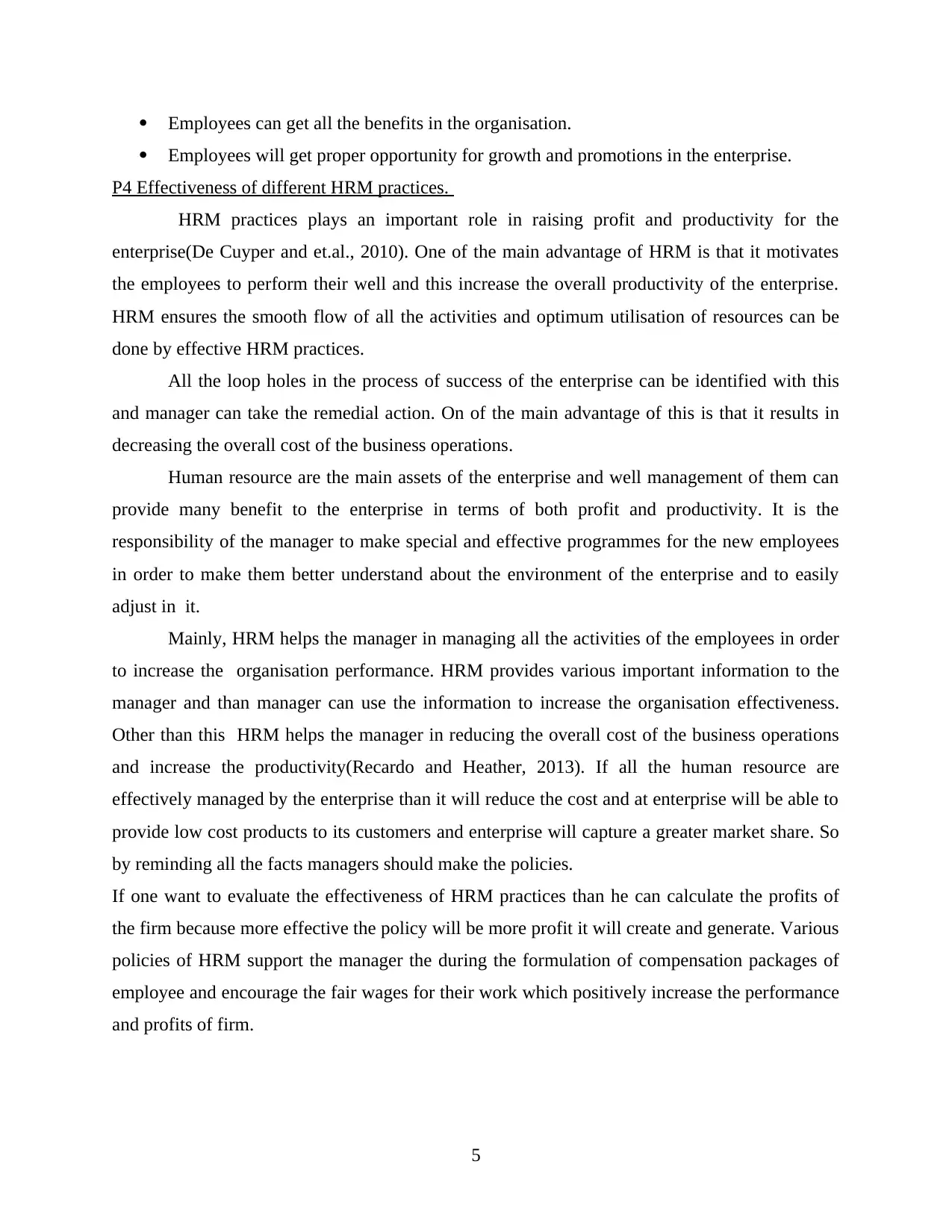
Employees can get all the benefits in the organisation.
Employees will get proper opportunity for growth and promotions in the enterprise.
P4 Effectiveness of different HRM practices.
HRM practices plays an important role in raising profit and productivity for the
enterprise(De Cuyper and et.al., 2010). One of the main advantage of HRM is that it motivates
the employees to perform their well and this increase the overall productivity of the enterprise.
HRM ensures the smooth flow of all the activities and optimum utilisation of resources can be
done by effective HRM practices.
All the loop holes in the process of success of the enterprise can be identified with this
and manager can take the remedial action. On of the main advantage of this is that it results in
decreasing the overall cost of the business operations.
Human resource are the main assets of the enterprise and well management of them can
provide many benefit to the enterprise in terms of both profit and productivity. It is the
responsibility of the manager to make special and effective programmes for the new employees
in order to make them better understand about the environment of the enterprise and to easily
adjust in it.
Mainly, HRM helps the manager in managing all the activities of the employees in order
to increase the organisation performance. HRM provides various important information to the
manager and than manager can use the information to increase the organisation effectiveness.
Other than this HRM helps the manager in reducing the overall cost of the business operations
and increase the productivity(Recardo and Heather, 2013). If all the human resource are
effectively managed by the enterprise than it will reduce the cost and at enterprise will be able to
provide low cost products to its customers and enterprise will capture a greater market share. So
by reminding all the facts managers should make the policies.
If one want to evaluate the effectiveness of HRM practices than he can calculate the profits of
the firm because more effective the policy will be more profit it will create and generate. Various
policies of HRM support the manager the during the formulation of compensation packages of
employee and encourage the fair wages for their work which positively increase the performance
and profits of firm.
5
Employees will get proper opportunity for growth and promotions in the enterprise.
P4 Effectiveness of different HRM practices.
HRM practices plays an important role in raising profit and productivity for the
enterprise(De Cuyper and et.al., 2010). One of the main advantage of HRM is that it motivates
the employees to perform their well and this increase the overall productivity of the enterprise.
HRM ensures the smooth flow of all the activities and optimum utilisation of resources can be
done by effective HRM practices.
All the loop holes in the process of success of the enterprise can be identified with this
and manager can take the remedial action. On of the main advantage of this is that it results in
decreasing the overall cost of the business operations.
Human resource are the main assets of the enterprise and well management of them can
provide many benefit to the enterprise in terms of both profit and productivity. It is the
responsibility of the manager to make special and effective programmes for the new employees
in order to make them better understand about the environment of the enterprise and to easily
adjust in it.
Mainly, HRM helps the manager in managing all the activities of the employees in order
to increase the organisation performance. HRM provides various important information to the
manager and than manager can use the information to increase the organisation effectiveness.
Other than this HRM helps the manager in reducing the overall cost of the business operations
and increase the productivity(Recardo and Heather, 2013). If all the human resource are
effectively managed by the enterprise than it will reduce the cost and at enterprise will be able to
provide low cost products to its customers and enterprise will capture a greater market share. So
by reminding all the facts managers should make the policies.
If one want to evaluate the effectiveness of HRM practices than he can calculate the profits of
the firm because more effective the policy will be more profit it will create and generate. Various
policies of HRM support the manager the during the formulation of compensation packages of
employee and encourage the fair wages for their work which positively increase the performance
and profits of firm.
5
Paraphrase This Document
Need a fresh take? Get an instant paraphrase of this document with our AI Paraphraser
TASK 2
M2 Functions of HRM in providing talent and skills.
HRM plays an important and effective role in providing talent and skills to the enterprise
to increase the productivity. Recruitment and selection is one and the important function of
HRM. There are number of tools and techniques available to the manager of the enterprise to
recruit the skilled employees for the enterprise.
By using various tools and techniques managers of the enterprise can recruit right people
for the right job. HRM uses different techniques in order to evaluate the effectiveness of the
different candidates and helps in choosing the best(Woodward, Perkins and Brown, 2010). A
large number of candidates come to get the job so it becomes difficult for the manager to choose
the right one and in this HRM plays and important role and help the managers in choosing the
best.
HRM plays a big and effective role in
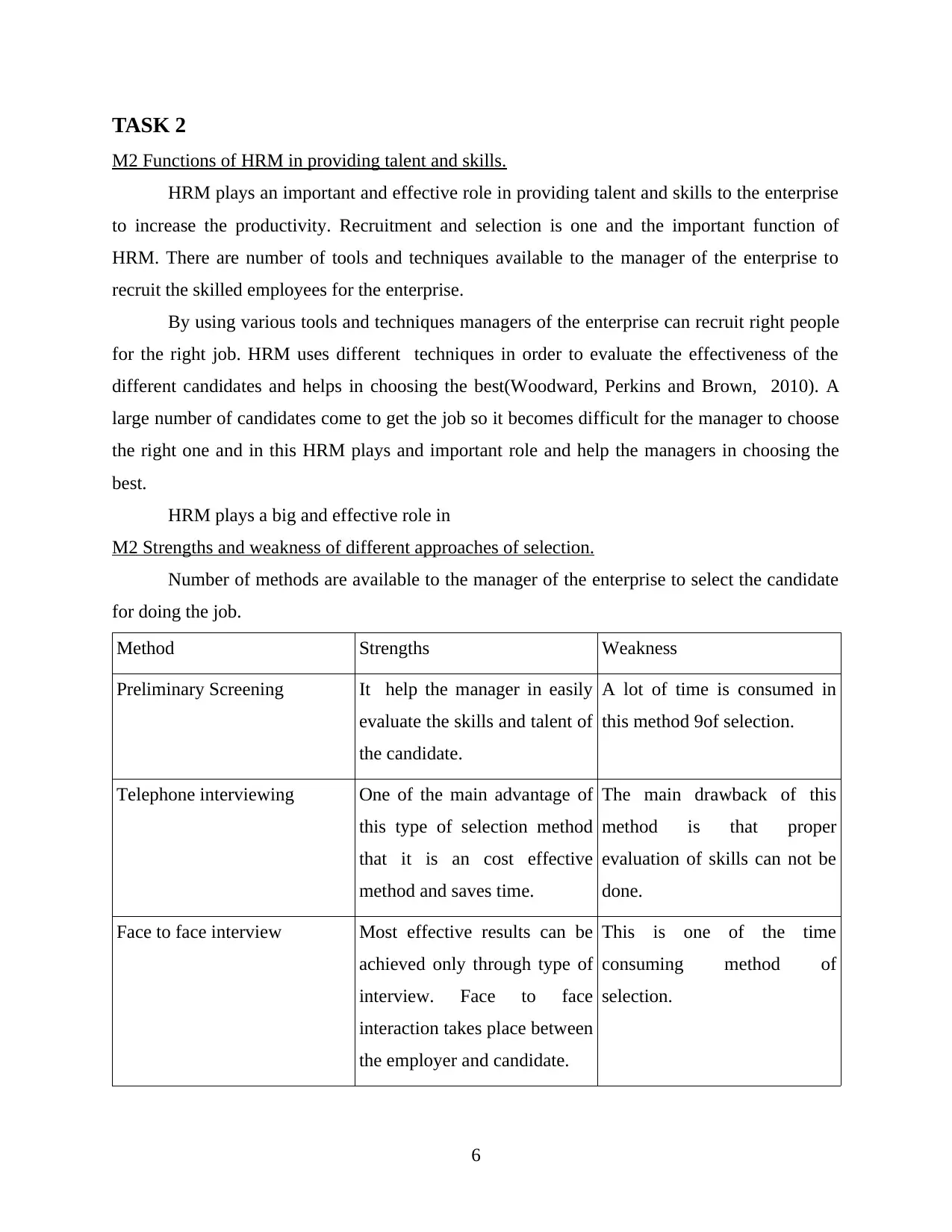
M2 Strengths and weakness of different approaches of selection.
Number of methods are available to the manager of the enterprise to select the candidate
for doing the job.
Method Strengths Weakness
Preliminary Screening It help the manager in easily
evaluate the skills and talent of
the candidate.
A lot of time is consumed in
this method 9of selection.
Telephone interviewing One of the main advantage of
this type of selection method
that it is an cost effective
method and saves time.
The main drawback of this
method is that proper
evaluation of skills can not be
done.
Face to face interview Most effective results can be
achieved only through type of
interview. Face to face
interaction takes place between
the employer and candidate.
This is one of the time
consuming method of
selection.
6
M2 Functions of HRM in providing talent and skills.
HRM plays an important and effective role in providing talent and skills to the enterprise
to increase the productivity. Recruitment and selection is one and the important function of
HRM. There are number of tools and techniques available to the manager of the enterprise to
recruit the skilled employees for the enterprise.
By using various tools and techniques managers of the enterprise can recruit right people
for the right job. HRM uses different techniques in order to evaluate the effectiveness of the
different candidates and helps in choosing the best(Woodward, Perkins and Brown, 2010). A
large number of candidates come to get the job so it becomes difficult for the manager to choose
the right one and in this HRM plays and important role and help the managers in choosing the
best.
HRM plays a big and effective role in
M2 Strengths and weakness of different approaches of selection.
Number of methods are available to the manager of the enterprise to select the candidate
for doing the job.
Method Strengths Weakness
Preliminary Screening It help the manager in easily
evaluate the skills and talent of
the candidate.
A lot of time is consumed in
this method 9of selection.
Telephone interviewing One of the main advantage of
this type of selection method
that it is an cost effective
method and saves time.
The main drawback of this
method is that proper
evaluation of skills can not be
done.
Face to face interview Most effective results can be
achieved only through type of
interview. Face to face
interaction takes place between
the employer and candidate.
This is one of the time
consuming method of
selection.
6
All these are the main methods of selecting an employee for the enterprise other than this
there are number of methods which can be used a manager to select skilled employees for the
enterprise(Snape and Redman, 2010). Test of abilities and skills is one of the method of selection
various activities are performed by the candidates in order to evaluate their skills. Instead of this
personality test of the employees are done in order to check their personal skills including
communication and many many other skills. More skilled the employee will more he or she will
be beneficial for the enterprise. All these are the test done by the employer in order to study the
skills of a candidate.
M3 Different methods used in HRM practices.
Methods used in the HRM includes the following:
360 degree feedback: This is one of the effective method used by the human resource
manager to evaluate the performance of the employees. Under this feedback is collected
about the performance of employee through its peers, customers(Patel and Cardon,
2010).
Job analysis: Under this method manager study how critical a job is and what kind of
skills are required to perform that job.
Job description: This method is used top described all the duties and responsibilities of a
particular job.
Behavioural event interview: This is a situation when an employee is done something
very good or worst and in this situation manager take the interview of the employee.
Job specification: Under this manager of the enterprise specification of jobs.
Managers of the Next plc use all these methods to evaluate the performance of its employees and
do all the necessary steps to improve the performance. All these HRM practices help the
manager in knowing about the current and potential skills of ll the employees and in order to
enhance the potential skills of the employees the manager can made or conduct a training
programme to make the employees able to perform more well.
Other than these these are number of methods used by the enterprises to control the
activities of the employees(Fong and et.al.,2011). One of the main advantage of HRM practices
that it gives opportunity to the employees to enhance their skills and by this employees can get a
chance of promotion in the company. HRM practices helps in managing all the complex
operations in the enterprise.
7
there are number of methods which can be used a manager to select skilled employees for the
enterprise(Snape and Redman, 2010). Test of abilities and skills is one of the method of selection
various activities are performed by the candidates in order to evaluate their skills. Instead of this
personality test of the employees are done in order to check their personal skills including
communication and many many other skills. More skilled the employee will more he or she will
be beneficial for the enterprise. All these are the test done by the employer in order to study the
skills of a candidate.
M3 Different methods used in HRM practices.
Methods used in the HRM includes the following:
360 degree feedback: This is one of the effective method used by the human resource
manager to evaluate the performance of the employees. Under this feedback is collected
about the performance of employee through its peers, customers(Patel and Cardon,
2010).
Job analysis: Under this method manager study how critical a job is and what kind of
skills are required to perform that job.
Job description: This method is used top described all the duties and responsibilities of a
particular job.
Behavioural event interview: This is a situation when an employee is done something
very good or worst and in this situation manager take the interview of the employee.
Job specification: Under this manager of the enterprise specification of jobs.
Managers of the Next plc use all these methods to evaluate the performance of its employees and
do all the necessary steps to improve the performance. All these HRM practices help the
manager in knowing about the current and potential skills of ll the employees and in order to
enhance the potential skills of the employees the manager can made or conduct a training
programme to make the employees able to perform more well.
Other than these these are number of methods used by the enterprises to control the
activities of the employees(Fong and et.al.,2011). One of the main advantage of HRM practices
that it gives opportunity to the employees to enhance their skills and by this employees can get a
chance of promotion in the company. HRM practices helps in managing all the complex
operations in the enterprise.
7
⊘ This is a preview!⊘
Do you want full access?
Subscribe today to unlock all pages.
Trusted by 1+ million students worldwide
TASK 3
D1 Strengths and weakness of different approaches of recruitment and selection with example.
Recruitment is a process of recruiting or hiring skilled candidates for the enterprise.
Number of approaches can be used by the manager of the enterprise to recruit the candidates.
Every method or approach has its own advantage and disadvantage. It can be possible that one
method can give effective results in one situation while other will be effective in the other
situation.
For example: When a senior post is empty in an enterprise than it will be helpful for the
enterprise to use an external source of recruitment rather than an external source. Because the top
manager of the enterprise has a lot of responsibility and in this situation a new hiring will take
time to understand the environment of the business and cost will also occur to give training to
him so in this situation internal method of recruitment will be helpful because candidate will
know all about the businesses and will easily manage the responsibility.
Different situations arises in an enterprise it is not necessary that all the time only one
recruitment method will give effective results to the enterprise(Vanhala and Ahteela, 2011). If
the vacancy is needed to fill in an emergency than internal recruitment will proof helpful in this
situation. And if there is a need that expertise is want to perform complex activities and if the
internal employees does not have the ability than in this external method scan be used by the
manager in order to recruit a skilled employee. A lost of cost is occurred when an enterprise use
external method of recruitment. Cost occurred in the advertisement and a lot of time is consumed
in the interview.
D2 Evaluation of HRM practices within an administrational context.
In today's world HRM practices are performed in almost every enterprise because it
ensure the smooth functioning of human resources or ensures optimum utilisation of resources.
Next plc also implement the HRM practices to mange all the activities of employees and at the
same time in order to reduce the cost of business operations.
Managers of the Next plc use this to enhance the performance of their employees and at
the same time resolve all the issues if arise. The managers of Next plc can better manage all the
activities of the employees by making effective policies and process. All the policies should be
made so that employees can give their best. Human resource manager has the responsibility to
8
D1 Strengths and weakness of different approaches of recruitment and selection with example.
Recruitment is a process of recruiting or hiring skilled candidates for the enterprise.
Number of approaches can be used by the manager of the enterprise to recruit the candidates.
Every method or approach has its own advantage and disadvantage. It can be possible that one
method can give effective results in one situation while other will be effective in the other
situation.
For example: When a senior post is empty in an enterprise than it will be helpful for the
enterprise to use an external source of recruitment rather than an external source. Because the top
manager of the enterprise has a lot of responsibility and in this situation a new hiring will take
time to understand the environment of the business and cost will also occur to give training to
him so in this situation internal method of recruitment will be helpful because candidate will
know all about the businesses and will easily manage the responsibility.
Different situations arises in an enterprise it is not necessary that all the time only one
recruitment method will give effective results to the enterprise(Vanhala and Ahteela, 2011). If
the vacancy is needed to fill in an emergency than internal recruitment will proof helpful in this
situation. And if there is a need that expertise is want to perform complex activities and if the
internal employees does not have the ability than in this external method scan be used by the
manager in order to recruit a skilled employee. A lost of cost is occurred when an enterprise use
external method of recruitment. Cost occurred in the advertisement and a lot of time is consumed
in the interview.
D2 Evaluation of HRM practices within an administrational context.
In today's world HRM practices are performed in almost every enterprise because it
ensure the smooth functioning of human resources or ensures optimum utilisation of resources.
Next plc also implement the HRM practices to mange all the activities of employees and at the
same time in order to reduce the cost of business operations.
Managers of the Next plc use this to enhance the performance of their employees and at
the same time resolve all the issues if arise. The managers of Next plc can better manage all the
activities of the employees by making effective policies and process. All the policies should be
made so that employees can give their best. Human resource manager has the responsibility to
8
Paraphrase This Document
Need a fresh take? Get an instant paraphrase of this document with our AI Paraphraser
manage all the activities done by the employees and if there is any employee who has lack of
skills than it is the responsibility of the manager to conduct training and development
programmes for that employee so he or she can contribute lot in the success of the
enterprise(Jimenez-Jimenez and Sanz-Valle, 2012).
Manager of the next plc should try to make the effective HRM policies for the employees
so they can perform and give their best. Otherwise the conflicts will arise and employees will
leave the enter[rise and this will harm the image of the enterprise and goodwill in the mind of the
customers.
Manager of every enterprise should give emphasis on bettering the working conditions so
that employees like the work environment and can contribute a lot(Taylor, 2014). All the issues
faced by the employees while working should be better solved by the managers. By making
effective HRM policies the manager can contribute a lot towards the success of the enterprise.
Policies of HRM plays an important role in achieving the goals of the enterprise.
CONCLUSION
From the above information it can be concluded that employees plays an important role
in the success of the enterprise so kit is the responsibility of the manager to manage all the
activities of them or any issue faced by them so they can perform their best. HRM practices helps
the manager in choosing the best and skilled candidate or choose the right people for the right
job. If right people will be choose by the enterprise than it will contribute a lot in the success of
the enterprise.
The main focus of HRM practices is to increase or enhance the overall performance of
the employees. Proper training and development programme should be timely conduct by the
manager in order to increase the skills of the employees(Henry and Temtime 2010). Skilled and
talented candidate can be chosen by the enterprise by choosiness right method of selection. It is
the responsibility of the manager to chose that method of recruitment which will provide
effective results to the enterprise.
9
skills than it is the responsibility of the manager to conduct training and development
programmes for that employee so he or she can contribute lot in the success of the
enterprise(Jimenez-Jimenez and Sanz-Valle, 2012).
Manager of the next plc should try to make the effective HRM policies for the employees
so they can perform and give their best. Otherwise the conflicts will arise and employees will
leave the enter[rise and this will harm the image of the enterprise and goodwill in the mind of the
customers.
Manager of every enterprise should give emphasis on bettering the working conditions so
that employees like the work environment and can contribute a lot(Taylor, 2014). All the issues
faced by the employees while working should be better solved by the managers. By making
effective HRM policies the manager can contribute a lot towards the success of the enterprise.
Policies of HRM plays an important role in achieving the goals of the enterprise.
CONCLUSION
From the above information it can be concluded that employees plays an important role
in the success of the enterprise so kit is the responsibility of the manager to manage all the
activities of them or any issue faced by them so they can perform their best. HRM practices helps
the manager in choosing the best and skilled candidate or choose the right people for the right
job. If right people will be choose by the enterprise than it will contribute a lot in the success of
the enterprise.
The main focus of HRM practices is to increase or enhance the overall performance of
the employees. Proper training and development programme should be timely conduct by the
manager in order to increase the skills of the employees(Henry and Temtime 2010). Skilled and
talented candidate can be chosen by the enterprise by choosiness right method of selection. It is
the responsibility of the manager to chose that method of recruitment which will provide
effective results to the enterprise.
9

10
⊘ This is a preview!⊘
Do you want full access?
Subscribe today to unlock all pages.
Trusted by 1+ million students worldwide

1 out of 13


Related Documents


Your All-in-One AI-Powered Toolkit for Academic Success.
+13062052269
info@desklib.com
Available 24*7 on WhatsApp / Email
![[object Object]](/_next/static/media/star-bottom.7253800d.svg)
Unlock your academic potential
Copyright © 2020–2026 A2Z Services. All Rights Reserved. Developed and managed by ZUCOL.