Retail Theory and Practice: An Analysis of H&M's Strategy
VerifiedAdded on 2022/12/26
|13
|3446
|60
Report
AI Summary
This report provides a comprehensive analysis of H&M's retail strategy, examining both the external and internal environments influencing the company's performance. The analysis begins with an introduction to the concept of retailing, outlining key principles such as consumer orientation, multi-channel systems, value-driven goods, and goal orientation, with a focus on the fashion retail industry. The main body of the report delves into the macro and micro environments affecting H&M, utilizing PESTEL analysis to assess political, economic, social, technological, environmental, and legal factors. It also employs Porter's Five Forces to evaluate the competitive landscape within the industry. Furthermore, the report applies the retail life cycle theory to suggest strategic recommendations for H&M, particularly focusing on innovation, growth, and maturity stages. The report concludes with a discussion of recommendations and a conclusion summarizing the key findings and strategic implications for H&M within the dynamic fashion retail market.
RETAIL
THEORY AND
PRACTICE
THEORY AND
PRACTICE

Paraphrase This Document
Need a fresh take? Get an instant paraphrase of this document with our AI Paraphraser
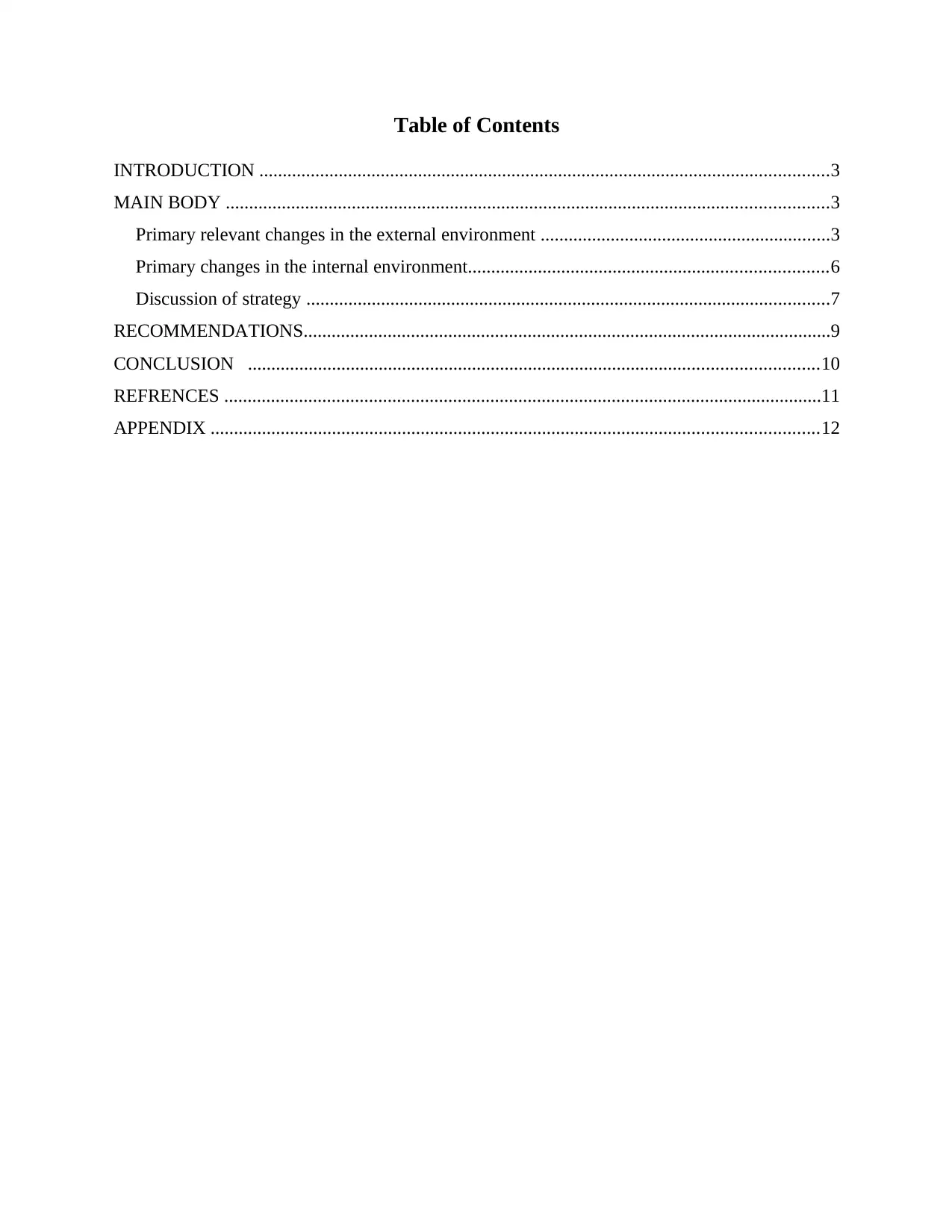
Table of Contents
INTRODUCTION ..........................................................................................................................3
MAIN BODY .................................................................................................................................3
Primary relevant changes in the external environment ..............................................................3
Primary changes in the internal environment.............................................................................6
Discussion of strategy ................................................................................................................7
RECOMMENDATIONS.................................................................................................................9
CONCLUSION ..........................................................................................................................10
REFRENCES ................................................................................................................................11
APPENDIX ..................................................................................................................................12
INTRODUCTION ..........................................................................................................................3
MAIN BODY .................................................................................................................................3
Primary relevant changes in the external environment ..............................................................3
Primary changes in the internal environment.............................................................................6
Discussion of strategy ................................................................................................................7
RECOMMENDATIONS.................................................................................................................9
CONCLUSION ..........................................................................................................................10
REFRENCES ................................................................................................................................11
APPENDIX ..................................................................................................................................12
INTRODUCTION
Retailing is defined as the direct buying and selling of goods and a retail sale is occurs
when a business sells a product or service to a consumer for their own use. The main element of
a retail sale is that the end user of the product is the buyer. Retailing concept includes four major
principle which are followed by every retailer in order to gain success in their business
endeavours. Consumer orientation is the first retailing concept which includes identification of
consume expectations and needs associated with a product in order to maximise consumer
satisfaction. Retail organisations in the current digital age make co-ordinated efforts which h
helps them gain desired results. Multi-channel systems are formed which integrate business
plans and activities to enhance efficiency. The third concept of retailing is to produce value
driven goods and various startles such as upscaling and discount sales are adopted by retailers to
increase value given to the consumer while maintaining high profitability. Goal orientation is
another retailing concept which focuses on using strategies to attain business objectives of the
company. Fashion retail industry is a consumer goods market which provides clothing,
accessories and footwear. Main features of retail industry include short life-cycles, high
competition and fickle consumers.
Background of the company: H&M is a Swedish international firm which operates in
the fashion retail industry. The company was founded in the year 2019 and has since grown to
become one of the leading members of the global fashion retail industry. The firm owns and
controls 5000 physical stores in 74 international markets. The firm offers online shopping in 33
countries and the firm has employed 126,376 workers on a global scale in order to conduct daily
business activities effectively. The firm owns various subsidiary brands which include Monki,
ARKET Cheap Monday among other brands. The company offers a wide range of clothing and
accessories to men women and children which has helped the firm become the second largest
fashion retailer in the world. This report includes primary eternal and internal changes in British
fashion retail industry along with a strategy based on retail life-cycle theory.
MAIN BODY
Primary relevant changes in the external environment
Macro environment: The macro environment consists of primary uncontrollable forces
which influence decision making of an organisation and impact performance of the firm.
Retailing is defined as the direct buying and selling of goods and a retail sale is occurs
when a business sells a product or service to a consumer for their own use. The main element of
a retail sale is that the end user of the product is the buyer. Retailing concept includes four major
principle which are followed by every retailer in order to gain success in their business
endeavours. Consumer orientation is the first retailing concept which includes identification of
consume expectations and needs associated with a product in order to maximise consumer
satisfaction. Retail organisations in the current digital age make co-ordinated efforts which h
helps them gain desired results. Multi-channel systems are formed which integrate business
plans and activities to enhance efficiency. The third concept of retailing is to produce value
driven goods and various startles such as upscaling and discount sales are adopted by retailers to
increase value given to the consumer while maintaining high profitability. Goal orientation is
another retailing concept which focuses on using strategies to attain business objectives of the
company. Fashion retail industry is a consumer goods market which provides clothing,
accessories and footwear. Main features of retail industry include short life-cycles, high
competition and fickle consumers.
Background of the company: H&M is a Swedish international firm which operates in
the fashion retail industry. The company was founded in the year 2019 and has since grown to
become one of the leading members of the global fashion retail industry. The firm owns and
controls 5000 physical stores in 74 international markets. The firm offers online shopping in 33
countries and the firm has employed 126,376 workers on a global scale in order to conduct daily
business activities effectively. The firm owns various subsidiary brands which include Monki,
ARKET Cheap Monday among other brands. The company offers a wide range of clothing and
accessories to men women and children which has helped the firm become the second largest
fashion retailer in the world. This report includes primary eternal and internal changes in British
fashion retail industry along with a strategy based on retail life-cycle theory.
MAIN BODY
Primary relevant changes in the external environment
Macro environment: The macro environment consists of primary uncontrollable forces
which influence decision making of an organisation and impact performance of the firm.
⊘ This is a preview!⊘
Do you want full access?
Subscribe today to unlock all pages.

Trusted by 1+ million students worldwide
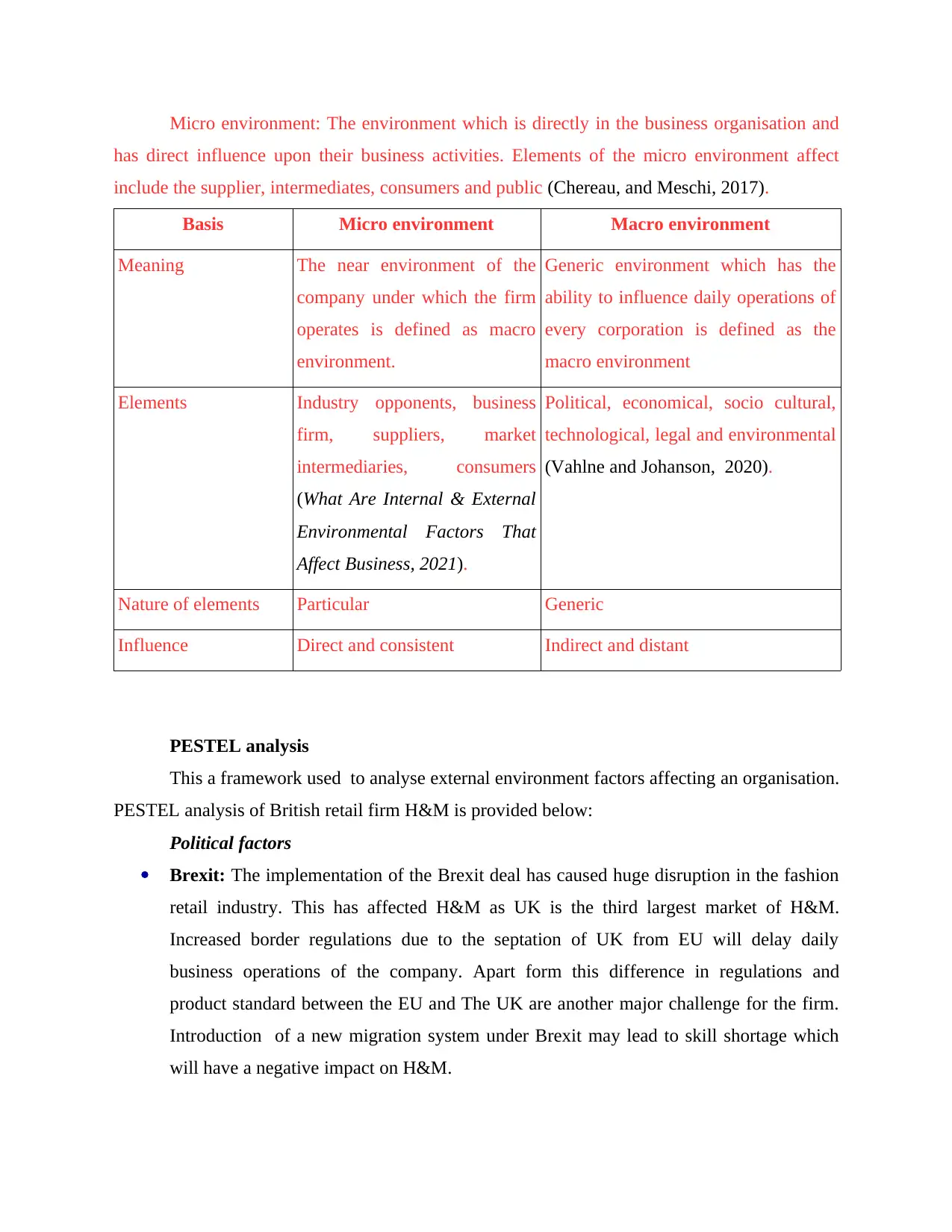
Micro environment: The environment which is directly in the business organisation and
has direct influence upon their business activities. Elements of the micro environment affect
include the supplier, intermediates, consumers and public (Chereau, and Meschi, 2017).
Basis Micro environment Macro environment
Meaning The near environment of the
company under which the firm
operates is defined as macro
environment.
Generic environment which has the
ability to influence daily operations of
every corporation is defined as the
macro environment
Elements Industry opponents, business
firm, suppliers, market
intermediaries, consumers
(What Are Internal & External
Environmental Factors That
Affect Business, 2021).
Political, economical, socio cultural,
technological, legal and environmental
(Vahlne and Johanson, 2020).
Nature of elements Particular Generic
Influence Direct and consistent Indirect and distant
PESTEL analysis
This a framework used to analyse external environment factors affecting an organisation.
PESTEL analysis of British retail firm H&M is provided below:
Political factors
Brexit: The implementation of the Brexit deal has caused huge disruption in the fashion
retail industry. This has affected H&M as UK is the third largest market of H&M.
Increased border regulations due to the septation of UK from EU will delay daily
business operations of the company. Apart form this difference in regulations and
product standard between the EU and The UK are another major challenge for the firm.
Introduction of a new migration system under Brexit may lead to skill shortage which
will have a negative impact on H&M.
has direct influence upon their business activities. Elements of the micro environment affect
include the supplier, intermediates, consumers and public (Chereau, and Meschi, 2017).
Basis Micro environment Macro environment
Meaning The near environment of the
company under which the firm
operates is defined as macro
environment.
Generic environment which has the
ability to influence daily operations of
every corporation is defined as the
macro environment
Elements Industry opponents, business
firm, suppliers, market
intermediaries, consumers
(What Are Internal & External
Environmental Factors That
Affect Business, 2021).
Political, economical, socio cultural,
technological, legal and environmental
(Vahlne and Johanson, 2020).
Nature of elements Particular Generic
Influence Direct and consistent Indirect and distant
PESTEL analysis
This a framework used to analyse external environment factors affecting an organisation.
PESTEL analysis of British retail firm H&M is provided below:
Political factors
Brexit: The implementation of the Brexit deal has caused huge disruption in the fashion
retail industry. This has affected H&M as UK is the third largest market of H&M.
Increased border regulations due to the septation of UK from EU will delay daily
business operations of the company. Apart form this difference in regulations and
product standard between the EU and The UK are another major challenge for the firm.
Introduction of a new migration system under Brexit may lead to skill shortage which
will have a negative impact on H&M.
Paraphrase This Document
Need a fresh take? Get an instant paraphrase of this document with our AI Paraphraser
Taxation policies: The 2021 budget of UK includes increase in corporate tax from 19%
to 25% in the year 2023 (Budget 2021: Rishi Sunak warns tax rises to follow spending
spree, 2021). as the UK is one of the key international market for H&M, taxation rise
will have drastic effect on the profitability of the firm.
Economical factor
Low consumer spending: The COVID-19 pandemic and effects of the 2009 recession
are major contributors in the current decrease in consumer spending. Consumers are
focusing on saving money and avoid purchasing on a regular basis due to the downturn
of the British economy. H&M sales reduced by 5% in September 2020 compared to the
same month previous year (Coronavirus: H&M to close 250 shops as Covid drives sales
online, 2020). Decrease in sales lead to closure of 250 physical stores of H&M.
Exchange rates: H&M is a global retail brands and effect on exchange rates of their key
markets affects the overall profitability of the company. The quarterly performance of the
firm in the year 2019 increased by 9% due to changes in exchange rate. The firm is
affected by exchange rates changes due to the difference between local currencies of
various foreign sales.
Social factor
Rise of individualism: Individualism in terms of fashion is defined as the unique
qualities of a fashion product which differentiates it from other trends and allows the
buyer to reject conformity. There is current rise in retail fashion industry which focuses
on building unique and innovation design. This social trend affects H&M as consumers
are demanding unique and individualistic designs. The firm has the opportunity to offer
such designs through their online stories and drive sales.
Demographical changes: The main demographical changes which affect the fashion
industry is increasing influence of young consumers which includes millennials and gen
Z on current fashion trends. Social media allows young consumers to shape the latest
fashion trends (Andresen, 2019). This affects H&M as the firm needs to forecast and
understand latests fashion trends in order to offer products which drive sales.
Technological factor
Online sales: Rise in online sales is a major technological factor which affects overall
sales of the respective organisation. High online sales contribute significantly to the
to 25% in the year 2023 (Budget 2021: Rishi Sunak warns tax rises to follow spending
spree, 2021). as the UK is one of the key international market for H&M, taxation rise
will have drastic effect on the profitability of the firm.
Economical factor
Low consumer spending: The COVID-19 pandemic and effects of the 2009 recession
are major contributors in the current decrease in consumer spending. Consumers are
focusing on saving money and avoid purchasing on a regular basis due to the downturn
of the British economy. H&M sales reduced by 5% in September 2020 compared to the
same month previous year (Coronavirus: H&M to close 250 shops as Covid drives sales
online, 2020). Decrease in sales lead to closure of 250 physical stores of H&M.
Exchange rates: H&M is a global retail brands and effect on exchange rates of their key
markets affects the overall profitability of the company. The quarterly performance of the
firm in the year 2019 increased by 9% due to changes in exchange rate. The firm is
affected by exchange rates changes due to the difference between local currencies of
various foreign sales.
Social factor
Rise of individualism: Individualism in terms of fashion is defined as the unique
qualities of a fashion product which differentiates it from other trends and allows the
buyer to reject conformity. There is current rise in retail fashion industry which focuses
on building unique and innovation design. This social trend affects H&M as consumers
are demanding unique and individualistic designs. The firm has the opportunity to offer
such designs through their online stories and drive sales.
Demographical changes: The main demographical changes which affect the fashion
industry is increasing influence of young consumers which includes millennials and gen
Z on current fashion trends. Social media allows young consumers to shape the latest
fashion trends (Andresen, 2019). This affects H&M as the firm needs to forecast and
understand latests fashion trends in order to offer products which drive sales.
Technological factor
Online sales: Rise in online sales is a major technological factor which affects overall
sales of the respective organisation. High online sales contribute significantly to the
overall profitability of the H&M and high competition form online retailers is a major
thereat to the company.
Advanced technology: H&M utilises advanced technology for operations and supply
chain management by outsourcing logistic to a third party in UK. Hermes is the third
party logistics provider of the firm which gives the firm advanced technology to track
their logistic operations in real time and increase response rate of the company. This
technology has helped the firm gain competitive advantage in UK.
Environmental factor
Sustainable fashion: Rising demand of sustainable fashion on a global scale have
impacted H&M. The respective firm has adopted various sustainable practices such as
utilisation of recycled sources to manufacture their products. This has increased the brand
image of the firm.
Environmental impact of fashion: The retail fashion industry is a main contributor in
global warming and climate change (Booth and et. al., 2020). Consumers are moving
towards purchasing used products instead of fast fashion due to environmental concerns.
H&M needs to provide high quality products which can be used for a longer time period
instead of fast fashion in order to reduce negative effects of this external factor.
Legal factor National minimum wage: Increase in national minimum wage which is the minimum
wage given by business firms to their employees affects the respective company. This
increases overall labour costs of the firm which reduces profitability of H&M.
Legislation policies: H&M operates on a global scale and has to comply with the
legislation policies of different countries. In UK the firm has to follow health and safety
act along with other acts in employment legislation in order to avoid legal action against
the company (Buckle and Thompson, 2020).
Primary changes in the internal environment
Porter's five forces analysis
This is a framework used to analyse competition within an industry. Competitive forces
of an industry influence the probability of the company. Porter's five forces analysis of H&M
provided below:
thereat to the company.
Advanced technology: H&M utilises advanced technology for operations and supply
chain management by outsourcing logistic to a third party in UK. Hermes is the third
party logistics provider of the firm which gives the firm advanced technology to track
their logistic operations in real time and increase response rate of the company. This
technology has helped the firm gain competitive advantage in UK.
Environmental factor
Sustainable fashion: Rising demand of sustainable fashion on a global scale have
impacted H&M. The respective firm has adopted various sustainable practices such as
utilisation of recycled sources to manufacture their products. This has increased the brand
image of the firm.
Environmental impact of fashion: The retail fashion industry is a main contributor in
global warming and climate change (Booth and et. al., 2020). Consumers are moving
towards purchasing used products instead of fast fashion due to environmental concerns.
H&M needs to provide high quality products which can be used for a longer time period
instead of fast fashion in order to reduce negative effects of this external factor.
Legal factor National minimum wage: Increase in national minimum wage which is the minimum
wage given by business firms to their employees affects the respective company. This
increases overall labour costs of the firm which reduces profitability of H&M.
Legislation policies: H&M operates on a global scale and has to comply with the
legislation policies of different countries. In UK the firm has to follow health and safety
act along with other acts in employment legislation in order to avoid legal action against
the company (Buckle and Thompson, 2020).
Primary changes in the internal environment
Porter's five forces analysis
This is a framework used to analyse competition within an industry. Competitive forces
of an industry influence the probability of the company. Porter's five forces analysis of H&M
provided below:
⊘ This is a preview!⊘
Do you want full access?
Subscribe today to unlock all pages.
Trusted by 1+ million students worldwide
Rivalry within the industry: There is high competition within the global fashion retail
industry. H&M faces tough competition from online and offline fashion retail brands.
The major opponents of H&M are Zara, Gap and M&S which sell their products through
online and physical stores. Apart from this, online fashion retail firms such as boohoo
and Amazon apparel compete with H&M for large section of the market share. Threat of new entrants: The threat of new entrants in the fashion retail sector is low.
Fashion retail organisations have to sell high volumes of their products in order to attain
profitability which as entry barrier for small organisations as they are not able to provide
fashion products at large volumes. This along with strong brand personality of H&M are
the main factors which have reduced threat of entry. Threat of substitute products: H&M faces high threat of substitute products from active
organisations along with wide availability of counterfeit products. The main reason
behind this is presence of wide number of alternatives from online and offline
organisations. In addition to this new competitors such as Facebook marketplace also
prove alternative products. Bargaining power of suppliers: This competitive force in context of H&M is low. The
main reason behind low bargaining power of suppliers is the large amount of suppliers
which offer quality products at low costs. This makes the suppliers dependent on the
consumers which reduces their influence on business firms. Raw material of the supplier
does not differ in quality which further lowers their influence (Garvey and et. al., 2017).
Bargaining power of buyers: Consumers have high bargaining power in relation to
fashion retail organisation H&M. This is due to high price sensitivity and low loyalty of
the consumers. Consumers switch to competitive brands easily after slight increase in
prices which results in high influence over the company.
Discussion of strategy
Retail life cycle theory
This theory states that retail firms experience a life-cycle which has identifiable stages.
Retail organisations can gain continuous progress by understanding each stage and implement
policies which deal with factors which are faced by the firm in each stage.
Innovation stage
industry. H&M faces tough competition from online and offline fashion retail brands.
The major opponents of H&M are Zara, Gap and M&S which sell their products through
online and physical stores. Apart from this, online fashion retail firms such as boohoo
and Amazon apparel compete with H&M for large section of the market share. Threat of new entrants: The threat of new entrants in the fashion retail sector is low.
Fashion retail organisations have to sell high volumes of their products in order to attain
profitability which as entry barrier for small organisations as they are not able to provide
fashion products at large volumes. This along with strong brand personality of H&M are
the main factors which have reduced threat of entry. Threat of substitute products: H&M faces high threat of substitute products from active
organisations along with wide availability of counterfeit products. The main reason
behind this is presence of wide number of alternatives from online and offline
organisations. In addition to this new competitors such as Facebook marketplace also
prove alternative products. Bargaining power of suppliers: This competitive force in context of H&M is low. The
main reason behind low bargaining power of suppliers is the large amount of suppliers
which offer quality products at low costs. This makes the suppliers dependent on the
consumers which reduces their influence on business firms. Raw material of the supplier
does not differ in quality which further lowers their influence (Garvey and et. al., 2017).
Bargaining power of buyers: Consumers have high bargaining power in relation to
fashion retail organisation H&M. This is due to high price sensitivity and low loyalty of
the consumers. Consumers switch to competitive brands easily after slight increase in
prices which results in high influence over the company.
Discussion of strategy
Retail life cycle theory
This theory states that retail firms experience a life-cycle which has identifiable stages.
Retail organisations can gain continuous progress by understanding each stage and implement
policies which deal with factors which are faced by the firm in each stage.
Innovation stage
Paraphrase This Document
Need a fresh take? Get an instant paraphrase of this document with our AI Paraphraser
This stage focuses on reformation of business methods in order to deal with emerging
changes in the retail industry. The main factors which affect H&M are the rising demand of
sustainable fashion and environmental conscious firm and the technological factor of increasing
usage of online portals to conduct business activities. Emergence of these factors has affected the
fashion retail industry and H&M needs to reformat their business methods in order to deal with
such changes. The respective organisation need to create strong online presence, create user
friendly online portals for international consumers in order to drive online sales. This will help
the company deal with internal threat of high rivalry (Germain and Knight, 2021). Apart from
this the company needs to develop sustainable fashion lines and promote sustainable practices in
every business aspect in order to met rising demand of environment conscious fashion.
Growth stage
This stage starts when consumers accept changing business model and business
organisations start reformatting their business methods in order to deal with stiff competition.
Growing sales from the reformatted business method are profitable for the company (Hayes,
2018). This stage in context of Swedish retail firm H&M includes adoption of various practices
such as improved online service standard and enhanced online transaction services in order to
continuous growth of sales. Apart from this. H&M needs to expand their product portfolio of
sustainable products in order to meet riding consumer demand and deal with threat of high
competition.
Maturity stage
This stage include business organisations which have adopted new business format have
gained peak market share and the main aim of business firms at this stage is to maintain their
market share. The reformats in business methods will not provide H&M continuous growth after
this stage as the mean features of this new format are not sufficient in attracting large amount of
consumers (Heller and et. al., 2019). H&M needs to decrease the costs of their sustainable
products and offer online discounts to their costumers in order to maintain high market share in
the maturity stage. H&M needs to focus on expanding their new business formats into
undiscovered markets which includes selling sustainable products in new regions. In addition to
this the company needs to seek continuous improvement for so that consumers are remain
attracted to the products of the firm and decline of profit margin is stooped for a a longer time
changes in the retail industry. The main factors which affect H&M are the rising demand of
sustainable fashion and environmental conscious firm and the technological factor of increasing
usage of online portals to conduct business activities. Emergence of these factors has affected the
fashion retail industry and H&M needs to reformat their business methods in order to deal with
such changes. The respective organisation need to create strong online presence, create user
friendly online portals for international consumers in order to drive online sales. This will help
the company deal with internal threat of high rivalry (Germain and Knight, 2021). Apart from
this the company needs to develop sustainable fashion lines and promote sustainable practices in
every business aspect in order to met rising demand of environment conscious fashion.
Growth stage
This stage starts when consumers accept changing business model and business
organisations start reformatting their business methods in order to deal with stiff competition.
Growing sales from the reformatted business method are profitable for the company (Hayes,
2018). This stage in context of Swedish retail firm H&M includes adoption of various practices
such as improved online service standard and enhanced online transaction services in order to
continuous growth of sales. Apart from this. H&M needs to expand their product portfolio of
sustainable products in order to meet riding consumer demand and deal with threat of high
competition.
Maturity stage
This stage include business organisations which have adopted new business format have
gained peak market share and the main aim of business firms at this stage is to maintain their
market share. The reformats in business methods will not provide H&M continuous growth after
this stage as the mean features of this new format are not sufficient in attracting large amount of
consumers (Heller and et. al., 2019). H&M needs to decrease the costs of their sustainable
products and offer online discounts to their costumers in order to maintain high market share in
the maturity stage. H&M needs to focus on expanding their new business formats into
undiscovered markets which includes selling sustainable products in new regions. In addition to
this the company needs to seek continuous improvement for so that consumers are remain
attracted to the products of the firm and decline of profit margin is stooped for a a longer time
period. This will help the company deal with high competition which is an internal factor
affecting profitability of the firm.
Decline stage
This stage begins when the new formats adopted by retail organisations become
convention of the retail industry. This stage involves high decline in profits and some
organisations suffer loss as new formats emerge, consumer preferences change and the
conventional format which were adopted as the new formats in the innovation stage are not able
to provide high profitability (Helm, Kim and Van Riper, 2020). Market shrinkage is another
feature of the decline stage which results in loss of the company. H&M needs to develop new
strategies and identify emerging formats as this stage marks the end of this retail life-cycle and
the beginning of other retail life-cycle. The new format adopted by H&M of focusing on online
sales is conventional format now which has increased the competition. These factors have made
this stage unfavourable for the company. After the completion of this stage retail industry will
enter new life-cycle in which H&M has to adopt new business format on the basis of external
and internal environmental changes affecting the company.
RECOMMENDATIONS
H&M needs to expand their product portfolio with sustainable products in order to meet
rising demand of environmental conscious products.
H&M needs to utilise digital marketing practices in order to drive online sales and deal
with high industrial rivalry.
The respective organisation needs to formulate unique products which provide unique
products in order to provide individualistic fashion products.
affecting profitability of the firm.
Decline stage
This stage begins when the new formats adopted by retail organisations become
convention of the retail industry. This stage involves high decline in profits and some
organisations suffer loss as new formats emerge, consumer preferences change and the
conventional format which were adopted as the new formats in the innovation stage are not able
to provide high profitability (Helm, Kim and Van Riper, 2020). Market shrinkage is another
feature of the decline stage which results in loss of the company. H&M needs to develop new
strategies and identify emerging formats as this stage marks the end of this retail life-cycle and
the beginning of other retail life-cycle. The new format adopted by H&M of focusing on online
sales is conventional format now which has increased the competition. These factors have made
this stage unfavourable for the company. After the completion of this stage retail industry will
enter new life-cycle in which H&M has to adopt new business format on the basis of external
and internal environmental changes affecting the company.
RECOMMENDATIONS
H&M needs to expand their product portfolio with sustainable products in order to meet
rising demand of environmental conscious products.
H&M needs to utilise digital marketing practices in order to drive online sales and deal
with high industrial rivalry.
The respective organisation needs to formulate unique products which provide unique
products in order to provide individualistic fashion products.
⊘ This is a preview!⊘
Do you want full access?
Subscribe today to unlock all pages.
Trusted by 1+ million students worldwide
The respective company needs to provide offers which encourage consumers to recycle
and reuse products as it will reduce environmental harm. This will enhance environment
friendly brand image of the firm and help the company attract environmental conscious
consumers. H&M will gain competitive advantage through this decision as competing
retail organisation have failed in becoming sustainable fast fashion brand. The firm will
be able to deal with external environmental factor of rise in sustainability as well as
internal environmental factor of high competitive rivalry.
The company needs to offer creative and individualistic products with an initial low price
in order to attract large amount of consumers and gain competitive advantage. This will
help the company increase their market share despite threat from competing
organisations.
H&M needs to sell their products at competitive pricing in order to deal with high
competition, price sensitive consumers and low consumer spending rate.
H&M needs to produce products which cater to young age consumer as they have high
influence on trends in fashion industry. In addition to this the company neds to advertise
their brands on platforms which are used by Millennials and gen-z consumers in order to
create a brand image associated with young age fashion.
and reuse products as it will reduce environmental harm. This will enhance environment
friendly brand image of the firm and help the company attract environmental conscious
consumers. H&M will gain competitive advantage through this decision as competing
retail organisation have failed in becoming sustainable fast fashion brand. The firm will
be able to deal with external environmental factor of rise in sustainability as well as
internal environmental factor of high competitive rivalry.
The company needs to offer creative and individualistic products with an initial low price
in order to attract large amount of consumers and gain competitive advantage. This will
help the company increase their market share despite threat from competing
organisations.
H&M needs to sell their products at competitive pricing in order to deal with high
competition, price sensitive consumers and low consumer spending rate.
H&M needs to produce products which cater to young age consumer as they have high
influence on trends in fashion industry. In addition to this the company neds to advertise
their brands on platforms which are used by Millennials and gen-z consumers in order to
create a brand image associated with young age fashion.
Paraphrase This Document
Need a fresh take? Get an instant paraphrase of this document with our AI Paraphraser
CONCLUSION
From the above report it is concluded that the fashion retail industry is influenced by
various internal as well as external factors. Fashion retail organisations need to understand
various factors which influence their profitability in order to secure a beneficial position in the
highly competitive industry. Retail organisations follow retailing concepts which helps them
build and sell profitable products for continuous growth and progress of the organisations. Retail
life cycle theory needs to be utilised by fashion retail organisations in order to effectively deal
with effects of various internal and external factors affecting the company in order to gain
continuous progress and attain leading status in the global retail industry.
From the above report it is concluded that the fashion retail industry is influenced by
various internal as well as external factors. Fashion retail organisations need to understand
various factors which influence their profitability in order to secure a beneficial position in the
highly competitive industry. Retail organisations follow retailing concepts which helps them
build and sell profitable products for continuous growth and progress of the organisations. Retail
life cycle theory needs to be utilised by fashion retail organisations in order to effectively deal
with effects of various internal and external factors affecting the company in order to gain
continuous progress and attain leading status in the global retail industry.
REFRENCES
Books and journals
Andresen, M.A., 2019. Environmental criminology: Evolution, theory, and practice. Routledge.
Booth and et. al., 2020. Modern actuarial theory and practice. CRC Press.
Buckle, M. and Thompson, J., 2020. The UK financial system: Theory and Practice. Manchester
University Press.
Chereau, P. and Meschi, P.X., 2017. Strategic Consulting: Tools and methods for successful
strategy missions. Springer
Garvey, R. and et. al., 2017. Coaching and mentoring: Theory and practice. Sage.
Germain, C.B. and Knight, C., 2021. The life model of social work practice: Advances in theory
and practice. Columbia University Press.
Hayes, J., 2018. The theory and practice of change management. Palgrave.
Heller and et. al., 2019. Let me imagine that for you: Transforming the retail frontline through
augmenting customer mental imagery ability. Journal of Retailing, 95(2), pp.94-114.
Helm, S., Kim, S.H. and Van Riper, S., 2020. Navigating the ‘retail apocalypse’: a framework of
consumer evaluations of the new retail landscape. Journal of Retailing and Consumer
Services, 54.
Lee, K.C., 2018. Grocery shopping, food waste, and the retail landscape of cities: The case of
Seoul. Journal of Cleaner Production, 172, pp.325-334.
Parent, M.M. and Ruetsch, A., 2020. Managing major sports events: Theory and practice.
Routledge.
Vahlne, J.E. and Johanson, J., 2020. The Uppsala model: Networks and micro-foundations.
Journal of International Business Studies, 51(1), pp.4-10.
Online
Budget 2021: Rishi Sunak warns tax rises to follow spending spree, 2021. [Online] Avaialble
through <https://www.bbc.com/news/business-56266683>
Coronavirus: H&M to close 250 shops as Covid drives sales online, 2020. [Online] Available
through <https://www.bbc.com/news/business-54369802>
What Are Internal & External Environmental Factors That Affect Business, 2021. [Online]
Available through<https://www.mageplaza.com/blog/what-are-internal-external-
environmental-factors-that-affect-business.html>
Books and journals
Andresen, M.A., 2019. Environmental criminology: Evolution, theory, and practice. Routledge.
Booth and et. al., 2020. Modern actuarial theory and practice. CRC Press.
Buckle, M. and Thompson, J., 2020. The UK financial system: Theory and Practice. Manchester
University Press.
Chereau, P. and Meschi, P.X., 2017. Strategic Consulting: Tools and methods for successful
strategy missions. Springer
Garvey, R. and et. al., 2017. Coaching and mentoring: Theory and practice. Sage.
Germain, C.B. and Knight, C., 2021. The life model of social work practice: Advances in theory
and practice. Columbia University Press.
Hayes, J., 2018. The theory and practice of change management. Palgrave.
Heller and et. al., 2019. Let me imagine that for you: Transforming the retail frontline through
augmenting customer mental imagery ability. Journal of Retailing, 95(2), pp.94-114.
Helm, S., Kim, S.H. and Van Riper, S., 2020. Navigating the ‘retail apocalypse’: a framework of
consumer evaluations of the new retail landscape. Journal of Retailing and Consumer
Services, 54.
Lee, K.C., 2018. Grocery shopping, food waste, and the retail landscape of cities: The case of
Seoul. Journal of Cleaner Production, 172, pp.325-334.
Parent, M.M. and Ruetsch, A., 2020. Managing major sports events: Theory and practice.
Routledge.
Vahlne, J.E. and Johanson, J., 2020. The Uppsala model: Networks and micro-foundations.
Journal of International Business Studies, 51(1), pp.4-10.
Online
Budget 2021: Rishi Sunak warns tax rises to follow spending spree, 2021. [Online] Avaialble
through <https://www.bbc.com/news/business-56266683>
Coronavirus: H&M to close 250 shops as Covid drives sales online, 2020. [Online] Available
through <https://www.bbc.com/news/business-54369802>
What Are Internal & External Environmental Factors That Affect Business, 2021. [Online]
Available through<https://www.mageplaza.com/blog/what-are-internal-external-
environmental-factors-that-affect-business.html>
⊘ This is a preview!⊘
Do you want full access?
Subscribe today to unlock all pages.
Trusted by 1+ million students worldwide

1 out of 13


Related Documents


Your All-in-One AI-Powered Toolkit for Academic Success.
+13062052269
info@desklib.com
Available 24*7 on WhatsApp / Email
![[object Object]](/_next/static/media/star-bottom.7253800d.svg)
Unlock your academic potential
Copyright © 2020–2026 A2Z Services. All Rights Reserved. Developed and managed by ZUCOL.