Retail Management Report: Business Location, Community Impact Analysis

Verified

Added on  2019/09/25

|3
|728
|346
Report
AI Summary
This report delves into the core aspects of retail management, focusing on the critical decisions retailers make when establishing their businesses, particularly the strategic importance of location. It examines how retailers assess suitable locations, considering factors like target customers and their lifestyles, emphasizing that retailers primarily focus on providing goods and services, with location decisions often prioritizing accessibility and market fit. The report further investigates the significant impact, both positive and negative, that successful and unsuccessful retailers have on the communities they serve. It presents examples, such as the competitive advantages of Wal-Mart and the challenges faced by Sonic, to illustrate these effects, including the potential for increased traffic, changes in employment rates, and the importance of corporate social responsibility. The conclusion underscores the necessity of corporate social responsibility for retailers in achieving a sustainable competitive edge and fostering customer loyalty, referencing the strategies employed by Staples to build a strong customer base. The report emphasizes the importance of understanding customer needs when entering a new market and creating a foundation of customer loyalty.
Document Page
Running Head: Retail Management
retail management
Introduction to Retail Management
tabler-icon-diamond-filled.svg

Paraphrase This Document

Need a fresh take? Get an instant paraphrase of this document with our AI Paraphraser
Document Page
Retail Management 1
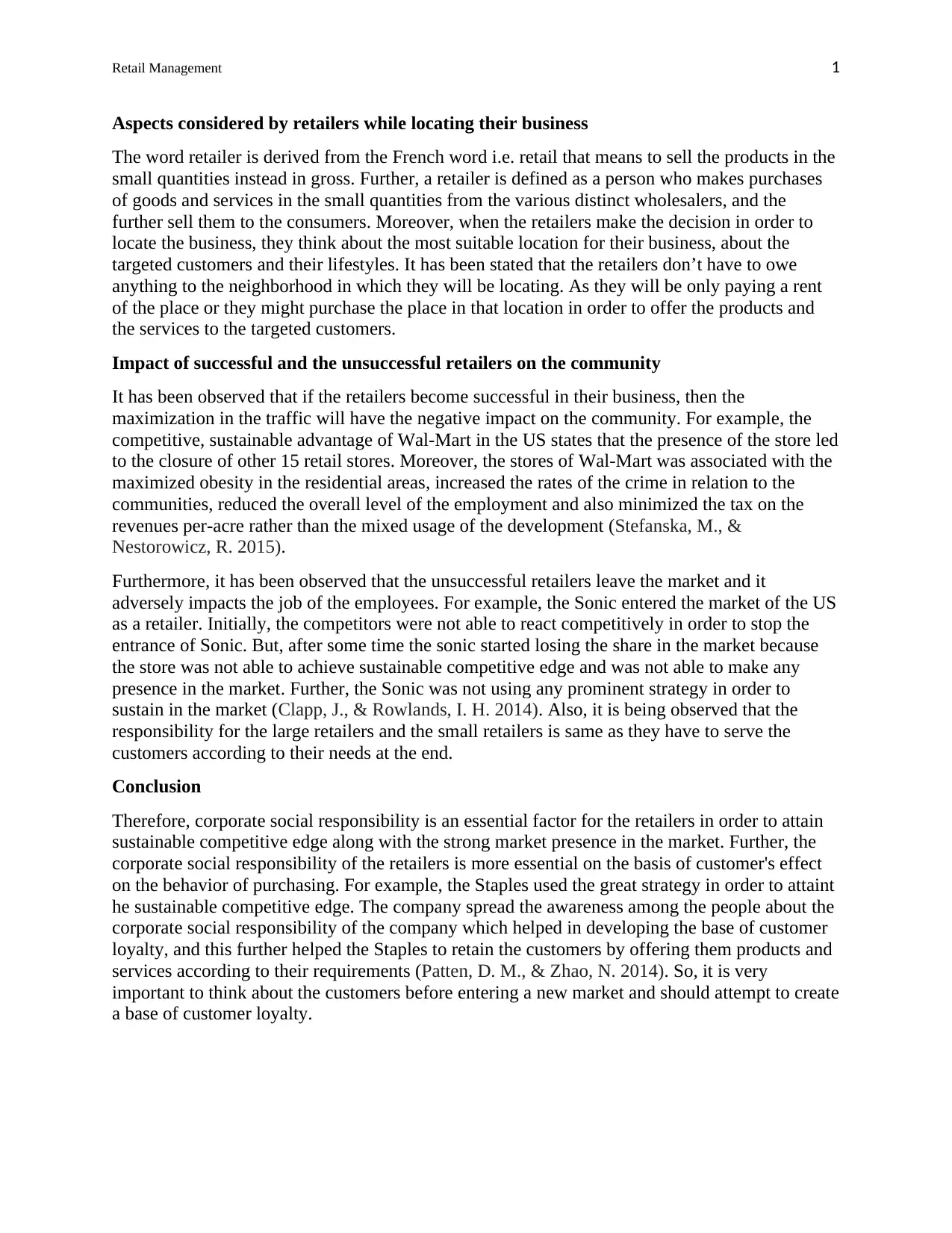
Aspects considered by retailers while locating their business
The word retailer is derived from the French word i.e. retail that means to sell the products in the
small quantities instead in gross. Further, a retailer is defined as a person who makes purchases
of goods and services in the small quantities from the various distinct wholesalers, and the
further sell them to the consumers. Moreover, when the retailers make the decision in order to
locate the business, they think about the most suitable location for their business, about the
targeted customers and their lifestyles. It has been stated that the retailers don’t have to owe
anything to the neighborhood in which they will be locating. As they will be only paying a rent
of the place or they might purchase the place in that location in order to offer the products and
the services to the targeted customers.
Impact of successful and the unsuccessful retailers on the community
It has been observed that if the retailers become successful in their business, then the
maximization in the traffic will have the negative impact on the community. For example, the
competitive, sustainable advantage of Wal-Mart in the US states that the presence of the store led
to the closure of other 15 retail stores. Moreover, the stores of Wal-Mart was associated with the
maximized obesity in the residential areas, increased the rates of the crime in relation to the
communities, reduced the overall level of the employment and also minimized the tax on the
revenues per-acre rather than the mixed usage of the development (Stefanska, M., &
Nestorowicz, R. 2015).
Furthermore, it has been observed that the unsuccessful retailers leave the market and it
adversely impacts the job of the employees. For example, the Sonic entered the market of the US
as a retailer. Initially, the competitors were not able to react competitively in order to stop the
entrance of Sonic. But, after some time the sonic started losing the share in the market because
the store was not able to achieve sustainable competitive edge and was not able to make any
presence in the market. Further, the Sonic was not using any prominent strategy in order to
sustain in the market (Clapp, J., & Rowlands, I. H. 2014). Also, it is being observed that the
responsibility for the large retailers and the small retailers is same as they have to serve the
customers according to their needs at the end.
Conclusion
Therefore, corporate social responsibility is an essential factor for the retailers in order to attain
sustainable competitive edge along with the strong market presence in the market. Further, the
corporate social responsibility of the retailers is more essential on the basis of customer's effect
on the behavior of purchasing. For example, the Staples used the great strategy in order to attaint
he sustainable competitive edge. The company spread the awareness among the people about the
corporate social responsibility of the company which helped in developing the base of customer
loyalty, and this further helped the Staples to retain the customers by offering them products and
services according to their requirements (Patten, D. M., & Zhao, N. 2014). So, it is very
important to think about the customers before entering a new market and should attempt to create
a base of customer loyalty.
Document Page
Retail Management 2
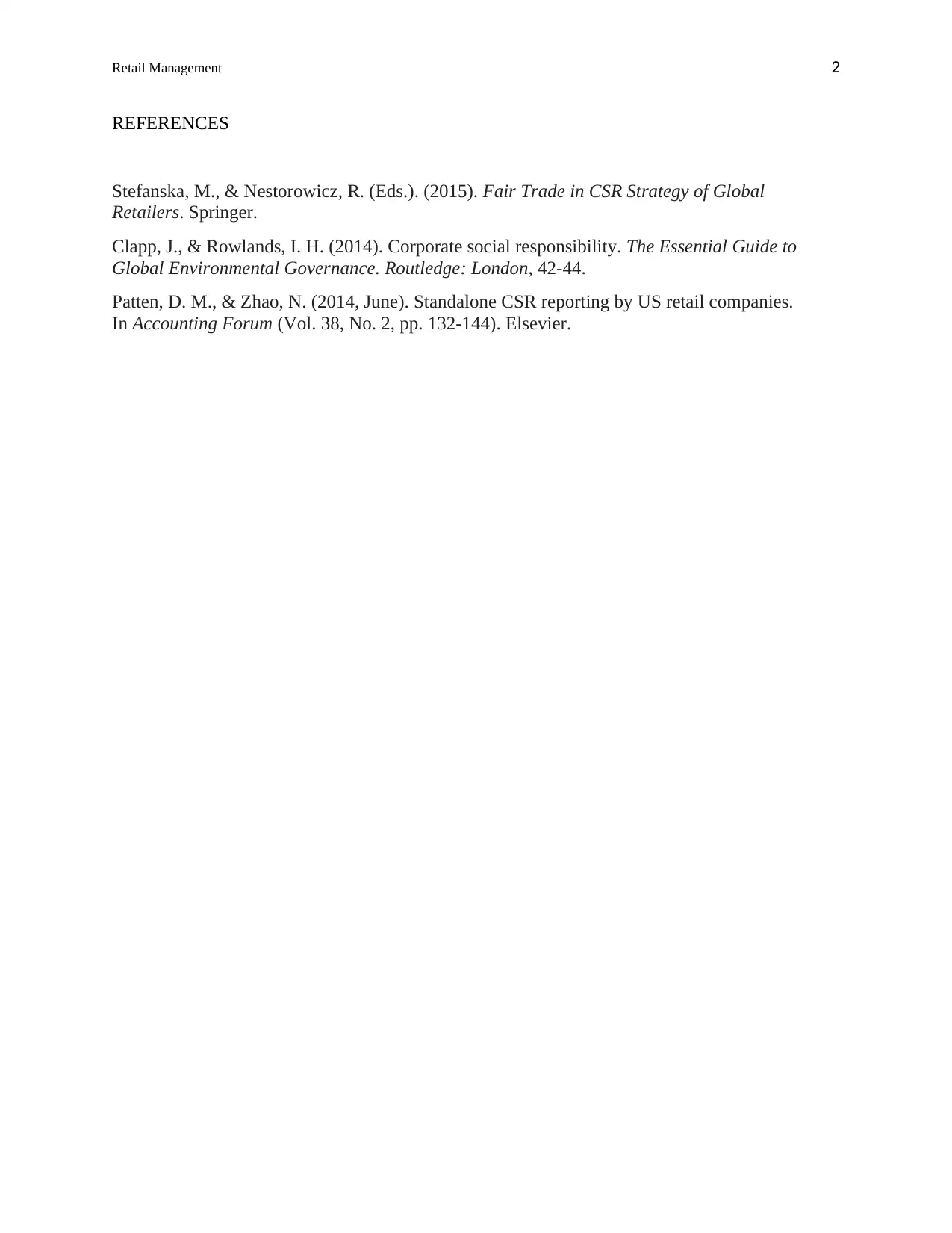
REFERENCES
Stefanska, M., & Nestorowicz, R. (Eds.). (2015). Fair Trade in CSR Strategy of Global
Retailers. Springer.
Clapp, J., & Rowlands, I. H. (2014). Corporate social responsibility. The Essential Guide to
Global Environmental Governance. Routledge: London, 42-44.
Patten, D. M., & Zhao, N. (2014, June). Standalone CSR reporting by US retail companies.
In Accounting Forum (Vol. 38, No. 2, pp. 132-144). Elsevier.
chevron_up_icon
1 out of 3
circle_padding
hide_on_mobile
zoom_out_icon
[object Object]