Implementing the Life Cycle Model in Retail Business Strategy
VerifiedAdded on 2020/05/28
|19
|3370
|34
AI Summary
This assignment explores the significance of team management within the context of business simulations. By examining various studies, such as those by Bücker & Korzilius (2015) and Juchem et al. (2014), it highlights how simulation games can enhance managerial effectiveness and leadership skills. The role of strategic management in fostering successful teams is emphasized through practical examples from retail sales strategies and advertisement planning. Additionally, the assignment discusses how simulations serve as educational tools for developing competencies necessary for business success, reflecting on insights from works by Fitó-Bertran et al. (2015) and Kenworthy & Wong (2014).

Running head: BUILDING BUSINESS PRACTICE
Building Business Practice
Name of the student
University name
Author’s note
Building Business Practice
Name of the student
University name
Author’s note

Paraphrase This Document
Need a fresh take? Get an instant paraphrase of this document with our AI Paraphraser
1BUILDING BUSINESS PRACTICE
Executive summary
The current report focuses upon the aspect of building effective business practice methods. One
of the most important aspects of business management is teamwork and effective team play. In
large as well as small scale organizations people are working as part of teams. There is a
constant exchange of information and knowledge which helps in the achievement of the business
goals and targets. The business management simulation game refers to engaging in an activity
which is mainly implemented to generate more curiosity in the learners and develop certain
amount of responsibility in them towards managing and handling of a project. It helps in the
development of management skills along with necessary risk management strategies for the
success of a business project. The red ocean situations of the market require that excellent
managerial skills be applied as there is a constant threat from the competitors. Additionally, the
taste of the target customer base is constantly changing.
Executive summary
The current report focuses upon the aspect of building effective business practice methods. One
of the most important aspects of business management is teamwork and effective team play. In
large as well as small scale organizations people are working as part of teams. There is a
constant exchange of information and knowledge which helps in the achievement of the business
goals and targets. The business management simulation game refers to engaging in an activity
which is mainly implemented to generate more curiosity in the learners and develop certain
amount of responsibility in them towards managing and handling of a project. It helps in the
development of management skills along with necessary risk management strategies for the
success of a business project. The red ocean situations of the market require that excellent
managerial skills be applied as there is a constant threat from the competitors. Additionally, the
taste of the target customer base is constantly changing.
2BUILDING BUSINESS PRACTICE
Table of Contents
Component 1................................................................................................................................3
Introduction......................................................................................................................................3
Personal reflective statement...........................................................................................................3
Component 2................................................................................................................................7
360 Degree assessment evaluation..................................................................................................7
Key issues of undertaking a team project......................................................................................11
Presentation (refer to appendix 1).................................................................................................12
Development as team player and team working skills...............................................................13
Conclusion.....................................................................................................................................15
References......................................................................................................................................16
Appendix 1.....................................................................................................................................18
Table of Contents
Component 1................................................................................................................................3
Introduction......................................................................................................................................3
Personal reflective statement...........................................................................................................3
Component 2................................................................................................................................7
360 Degree assessment evaluation..................................................................................................7
Key issues of undertaking a team project......................................................................................11
Presentation (refer to appendix 1).................................................................................................12
Development as team player and team working skills...............................................................13
Conclusion.....................................................................................................................................15
References......................................................................................................................................16
Appendix 1.....................................................................................................................................18
⊘ This is a preview!⊘
Do you want full access?
Subscribe today to unlock all pages.

Trusted by 1+ million students worldwide
3BUILDING BUSINESS PRACTICE
Component 1
Introduction
In the current business report a particular scenario has been focussed upon as part of a
business management simulation game. The business simulation is used for providing training to
the management students regarding the business ethics and protocols which are to be
implemented in a particular scenario. The business management simulation game is used for
business acumen training and development1. Some of the objectives covered under the training
program are - decision making, strategic thinking, problem solving, financial and market
analysis, leadership and teamwork. The word simulation can be further referred to as the
processing and analysis of a problem situation to find out the correct alternative.
Personal reflective statement
The skills required for management of the business activities can be divided into a
number of steps and procedures such as evaluation of the information sources, collection and
presentation of the data, balancing of the emotional intelligence while working with others. One
of the most important aspects of conducting a business project is conducting market analysis
about the different risk factors which might affect the success of the business plan2. Therefore,
working as a part of a team in a business management simulation game I need to focus upon the
1 Loon, M., Evans, J. and Kerridge, C., (2015). Reprint: Learning with a strategic management simulation game: A
case study. The International Journal of Management Education, 13(3), pp.371-380.
2 Kenworthy, J. and Wong, A., (2014). Developing managerial effectiveness: assessing and comparing the impact of
development programmes using a management simulation or a management game. Developments in Business
Simulation and Experiential Learning, 32.
Component 1
Introduction
In the current business report a particular scenario has been focussed upon as part of a
business management simulation game. The business simulation is used for providing training to
the management students regarding the business ethics and protocols which are to be
implemented in a particular scenario. The business management simulation game is used for
business acumen training and development1. Some of the objectives covered under the training
program are - decision making, strategic thinking, problem solving, financial and market
analysis, leadership and teamwork. The word simulation can be further referred to as the
processing and analysis of a problem situation to find out the correct alternative.
Personal reflective statement
The skills required for management of the business activities can be divided into a
number of steps and procedures such as evaluation of the information sources, collection and
presentation of the data, balancing of the emotional intelligence while working with others. One
of the most important aspects of conducting a business project is conducting market analysis
about the different risk factors which might affect the success of the business plan2. Therefore,
working as a part of a team in a business management simulation game I need to focus upon the
1 Loon, M., Evans, J. and Kerridge, C., (2015). Reprint: Learning with a strategic management simulation game: A
case study. The International Journal of Management Education, 13(3), pp.371-380.
2 Kenworthy, J. and Wong, A., (2014). Developing managerial effectiveness: assessing and comparing the impact of
development programmes using a management simulation or a management game. Developments in Business
Simulation and Experiential Learning, 32.
Paraphrase This Document
Need a fresh take? Get an instant paraphrase of this document with our AI Paraphraser
4BUILDING BUSINESS PRACTICE
various internal and external factors which might affect the success of the project. For example,
participants may be chosen who play the role of the founder of a new start up company in the
retail sector. Therefore, an efficient business planning requires setting up of the prices of the
products, deciding upon the workforce which needs to be hired, fixing of salary and
compensation packages. I also need to focus upon improving the relationships with different
stakeholders by laying out a transparent profit sharing policies. For the evaluation of the
information sources a wide variety of marketing tools could be used such as the porter’s
competitive forces, PESTLE analysis etc. Additionally, I could also conduct a PESTLE which
would help me in identifying the effect of different political, economic, social, technological,
legal and environmental factors which influences the success rate of a start up. As reported price
shifting in the global market influences the rate of purchase of the end products3. The inflation
has a significant effect on the prices of the raw materials which goes into making the final goods.
Therefore, a significant rise in the prices of raw materials will also increase the price of the final
goods.
For conducting the business management simulation game specific group students have
been further divided into teams. Some of the students have been asked to play the role of
stakeholders. The stakeholders play a crucial role within the context of a business organization. It
is necessary to discuss the marketing plans with the stakeholders. The stakeholder group consists
of the management, investors, distribution partners as well as the customers. During undertaking
the business game project I have realized the importance of the data collection and presentation
process. In order to collect the data we have used a basic survey process where a certain fraction
3 Peteraf, M., Gamble, J. and Thompson Jr, A., (2014). Essentials of strategic management: The quest for
competitive advantage. New York: McGraw-Hill Education, pp122-236.
various internal and external factors which might affect the success of the project. For example,
participants may be chosen who play the role of the founder of a new start up company in the
retail sector. Therefore, an efficient business planning requires setting up of the prices of the
products, deciding upon the workforce which needs to be hired, fixing of salary and
compensation packages. I also need to focus upon improving the relationships with different
stakeholders by laying out a transparent profit sharing policies. For the evaluation of the
information sources a wide variety of marketing tools could be used such as the porter’s
competitive forces, PESTLE analysis etc. Additionally, I could also conduct a PESTLE which
would help me in identifying the effect of different political, economic, social, technological,
legal and environmental factors which influences the success rate of a start up. As reported price
shifting in the global market influences the rate of purchase of the end products3. The inflation
has a significant effect on the prices of the raw materials which goes into making the final goods.
Therefore, a significant rise in the prices of raw materials will also increase the price of the final
goods.
For conducting the business management simulation game specific group students have
been further divided into teams. Some of the students have been asked to play the role of
stakeholders. The stakeholders play a crucial role within the context of a business organization. It
is necessary to discuss the marketing plans with the stakeholders. The stakeholder group consists
of the management, investors, distribution partners as well as the customers. During undertaking
the business game project I have realized the importance of the data collection and presentation
process. In order to collect the data we have used a basic survey process where a certain fraction
3 Peteraf, M., Gamble, J. and Thompson Jr, A., (2014). Essentials of strategic management: The quest for
competitive advantage. New York: McGraw-Hill Education, pp122-236.
5BUILDING BUSINESS PRACTICE
of the students were to participate within the survey process as the target customer group. Their
responses were collected through the survey and the statistically significant data were used in
formulation of important results and alternatives. Here, questions were drafted by my team and I
pertaining to the benefits and losses of different changes brought about within retail market. The
benefits of availability of packet ready foods versus the health hazards caused by them and the
preferences of the customers were used for drafting a research question such as – “Do you think
the availability of packet foods saves time out of your daily schedule?”.... “Do you think
consuming packet ready foods is good for your health?”. The link to the question was provided
in Google forms to the participants. The responses were analyzed for arriving at significant
statistical results. The results were further discussed with the accessor where each of the students
was invited to express their views regarding the results.
Another important aspect in the development of necessary skills and business acumen is
working effectively within a team. I need to focus upon the aspect of development of team skills
such as effective communication for transmitting as well as understanding the grievances faced
by my respective team members. I need to focus upon building my emotional intelligence for
communicating effectively with my peers within the group. The emotional intelligence refers to
the aspect of understanding one’s own feelings along with those working along with him to find
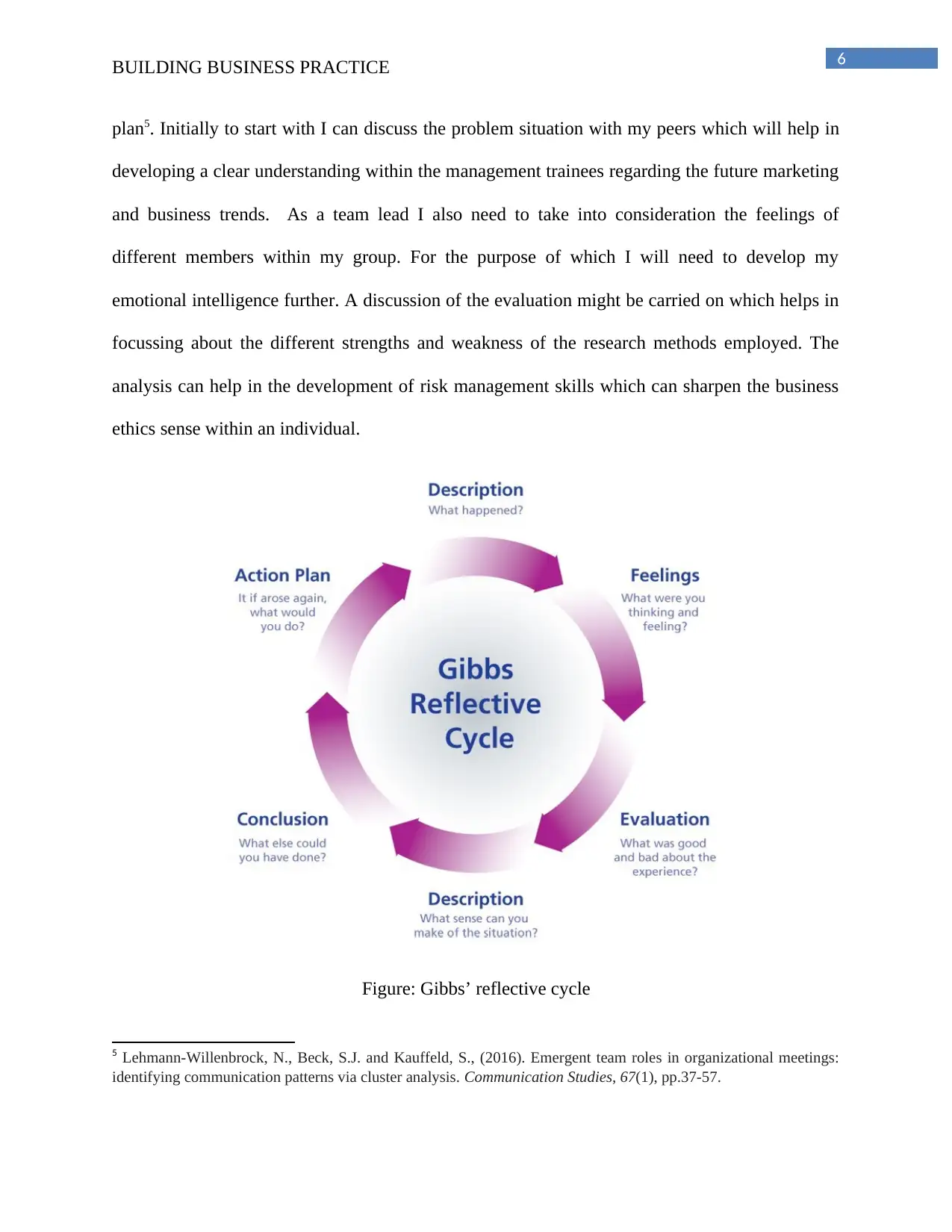
out an agreed way of problem solving4. For reflecting upon my management skills and
approaches in can use the Gibb’s reflective cycle. The Gibb’s reflective cycle consists of a
number of components such as –description, feelings, evaluation, analysis, conclusion and action
4 Bücker, J.J. and Korzilius, H., (2015). Developing cultural intelligence: assessing the effect of the Ecotonos
cultural simulation game for international business students. The International Journal of Human Resource
Management, 26(15), pp.1995-(2014).
of the students were to participate within the survey process as the target customer group. Their
responses were collected through the survey and the statistically significant data were used in
formulation of important results and alternatives. Here, questions were drafted by my team and I
pertaining to the benefits and losses of different changes brought about within retail market. The
benefits of availability of packet ready foods versus the health hazards caused by them and the
preferences of the customers were used for drafting a research question such as – “Do you think
the availability of packet foods saves time out of your daily schedule?”.... “Do you think
consuming packet ready foods is good for your health?”. The link to the question was provided
in Google forms to the participants. The responses were analyzed for arriving at significant
statistical results. The results were further discussed with the accessor where each of the students
was invited to express their views regarding the results.
Another important aspect in the development of necessary skills and business acumen is
working effectively within a team. I need to focus upon the aspect of development of team skills
such as effective communication for transmitting as well as understanding the grievances faced
by my respective team members. I need to focus upon building my emotional intelligence for
communicating effectively with my peers within the group. The emotional intelligence refers to
the aspect of understanding one’s own feelings along with those working along with him to find
out an agreed way of problem solving4. For reflecting upon my management skills and
approaches in can use the Gibb’s reflective cycle. The Gibb’s reflective cycle consists of a
number of components such as –description, feelings, evaluation, analysis, conclusion and action
4 Bücker, J.J. and Korzilius, H., (2015). Developing cultural intelligence: assessing the effect of the Ecotonos
cultural simulation game for international business students. The International Journal of Human Resource
Management, 26(15), pp.1995-(2014).
⊘ This is a preview!⊘
Do you want full access?
Subscribe today to unlock all pages.
Trusted by 1+ million students worldwide
6BUILDING BUSINESS PRACTICE
plan5. Initially to start with I can discuss the problem situation with my peers which will help in
developing a clear understanding within the management trainees regarding the future marketing
and business trends. As a team lead I also need to take into consideration the feelings of
different members within my group. For the purpose of which I will need to develop my
emotional intelligence further. A discussion of the evaluation might be carried on which helps in
focussing about the different strengths and weakness of the research methods employed. The
analysis can help in the development of risk management skills which can sharpen the business
ethics sense within an individual.
Figure: Gibbs’ reflective cycle
5 Lehmann-Willenbrock, N., Beck, S.J. and Kauffeld, S., (2016). Emergent team roles in organizational meetings:
identifying communication patterns via cluster analysis. Communication Studies, 67(1), pp.37-57.
plan5. Initially to start with I can discuss the problem situation with my peers which will help in
developing a clear understanding within the management trainees regarding the future marketing
and business trends. As a team lead I also need to take into consideration the feelings of
different members within my group. For the purpose of which I will need to develop my
emotional intelligence further. A discussion of the evaluation might be carried on which helps in
focussing about the different strengths and weakness of the research methods employed. The
analysis can help in the development of risk management skills which can sharpen the business
ethics sense within an individual.
Figure: Gibbs’ reflective cycle
5 Lehmann-Willenbrock, N., Beck, S.J. and Kauffeld, S., (2016). Emergent team roles in organizational meetings:
identifying communication patterns via cluster analysis. Communication Studies, 67(1), pp.37-57.
Paraphrase This Document
Need a fresh take? Get an instant paraphrase of this document with our AI Paraphraser
7BUILDING BUSINESS PRACTICE
Component 2
360 Degree assessment evaluation
Self
Assessment
Cooperation Creativity Effort Reliability Total
Name
Team Leader
4 3 4 3 12
Justification of final mark for self assessment
As I was starting out new as a team leader of a business management simulation game I lacked certain
amount of knowledge and skills required for effective team guidance and planning f future alternatives.
Therefore, I lacked on the creativity parameter.
Team Members’ Name Cooperation Creativity Effort reliability Total
1. 2 3 4 5 14
Component 2
360 Degree assessment evaluation
Self
Assessment
Cooperation Creativity Effort Reliability Total
Name
Team Leader
4 3 4 3 12
Justification of final mark for self assessment
As I was starting out new as a team leader of a business management simulation game I lacked certain
amount of knowledge and skills required for effective team guidance and planning f future alternatives.
Therefore, I lacked on the creativity parameter.
Team Members’ Name Cooperation Creativity Effort reliability Total
1. 2 3 4 5 14
8BUILDING BUSINESS PRACTICE
Justification of final mark for 1.
There was sufficient lack of cooperation from the end of the particular team member.
It was not clear that whether the team member was facing any difficulty in understanding the objectives
of the assignment or
Simply lacking interest in the process build up as there was lack of attention within the specific team
member.
2. 2 1 3 2 8
Justification of final mark for 2.
The team member performed poor in all the parameters.
Therefore an analysis was conducted which reflected that the team member had difficulty in following
up the different steps of the study
Study.
The reason being language incompetency which made it difficult for the management student to follow
the different approaches taught within the game.
3. 3 2 3 5 12
Justification of final mark for 3.
The team member relatively low on creativity
The same could be attributed to the lack of sufficient knowledge and skills within a beginner
Justification of final mark for 1.
There was sufficient lack of cooperation from the end of the particular team member.
It was not clear that whether the team member was facing any difficulty in understanding the objectives
of the assignment or
Simply lacking interest in the process build up as there was lack of attention within the specific team
member.
2. 2 1 3 2 8
Justification of final mark for 2.
The team member performed poor in all the parameters.
Therefore an analysis was conducted which reflected that the team member had difficulty in following
up the different steps of the study
Study.
The reason being language incompetency which made it difficult for the management student to follow
the different approaches taught within the game.
3. 3 2 3 5 12
Justification of final mark for 3.
The team member relatively low on creativity
The same could be attributed to the lack of sufficient knowledge and skills within a beginner
⊘ This is a preview!⊘
Do you want full access?
Subscribe today to unlock all pages.
Trusted by 1+ million students worldwide
9BUILDING BUSINESS PRACTICE
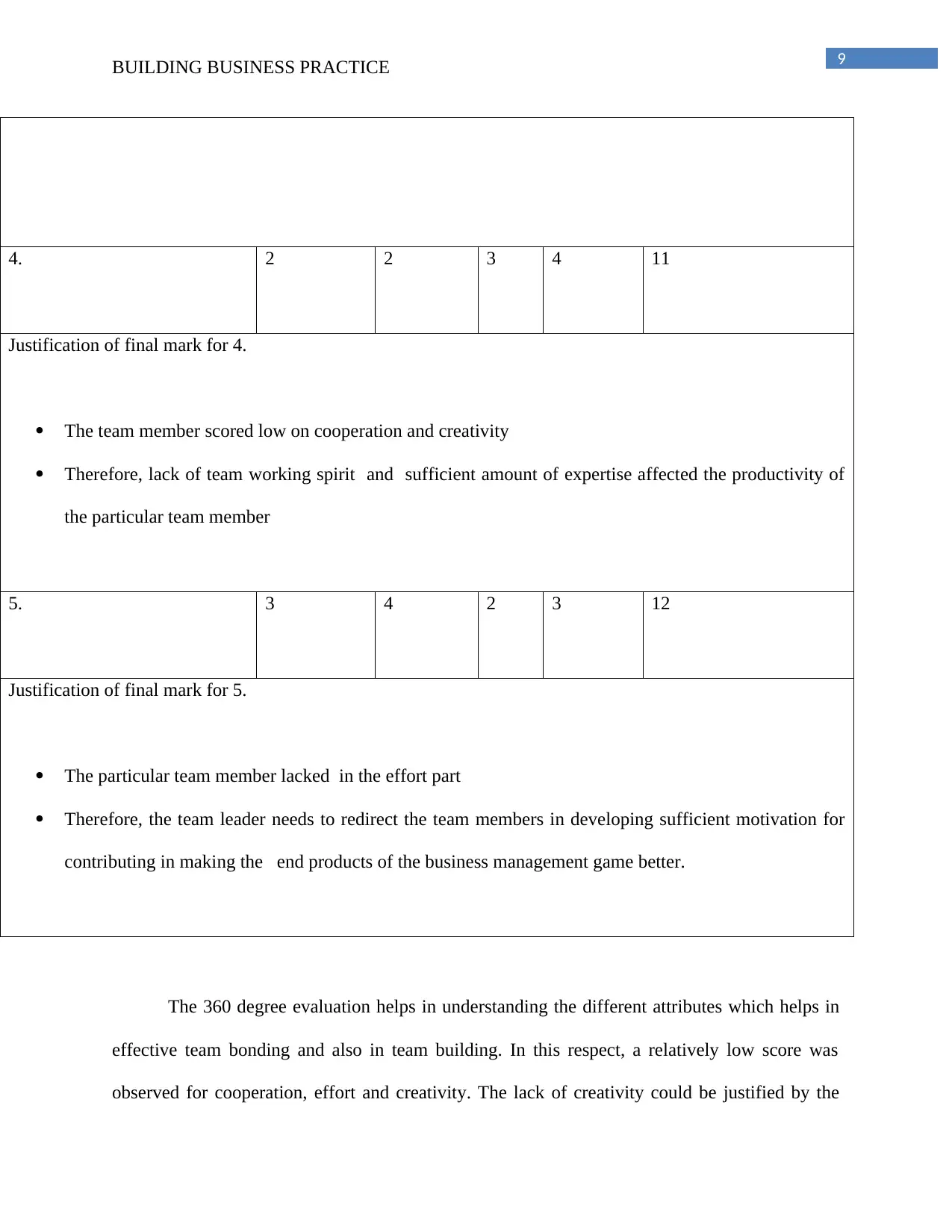
4. 2 2 3 4 11
Justification of final mark for 4.
The team member scored low on cooperation and creativity
Therefore, lack of team working spirit and sufficient amount of expertise affected the productivity of
the particular team member
5. 3 4 2 3 12
Justification of final mark for 5.
The particular team member lacked in the effort part
Therefore, the team leader needs to redirect the team members in developing sufficient motivation for
contributing in making the end products of the business management game better.
The 360 degree evaluation helps in understanding the different attributes which helps in
effective team bonding and also in team building. In this respect, a relatively low score was
observed for cooperation, effort and creativity. The lack of creativity could be justified by the
4. 2 2 3 4 11
Justification of final mark for 4.
The team member scored low on cooperation and creativity
Therefore, lack of team working spirit and sufficient amount of expertise affected the productivity of
the particular team member
5. 3 4 2 3 12
Justification of final mark for 5.
The particular team member lacked in the effort part
Therefore, the team leader needs to redirect the team members in developing sufficient motivation for
contributing in making the end products of the business management game better.
The 360 degree evaluation helps in understanding the different attributes which helps in
effective team bonding and also in team building. In this respect, a relatively low score was
observed for cooperation, effort and creativity. The lack of creativity could be justified by the
Paraphrase This Document
Need a fresh take? Get an instant paraphrase of this document with our AI Paraphraser
10BUILDING BUSINESS PRACTICE
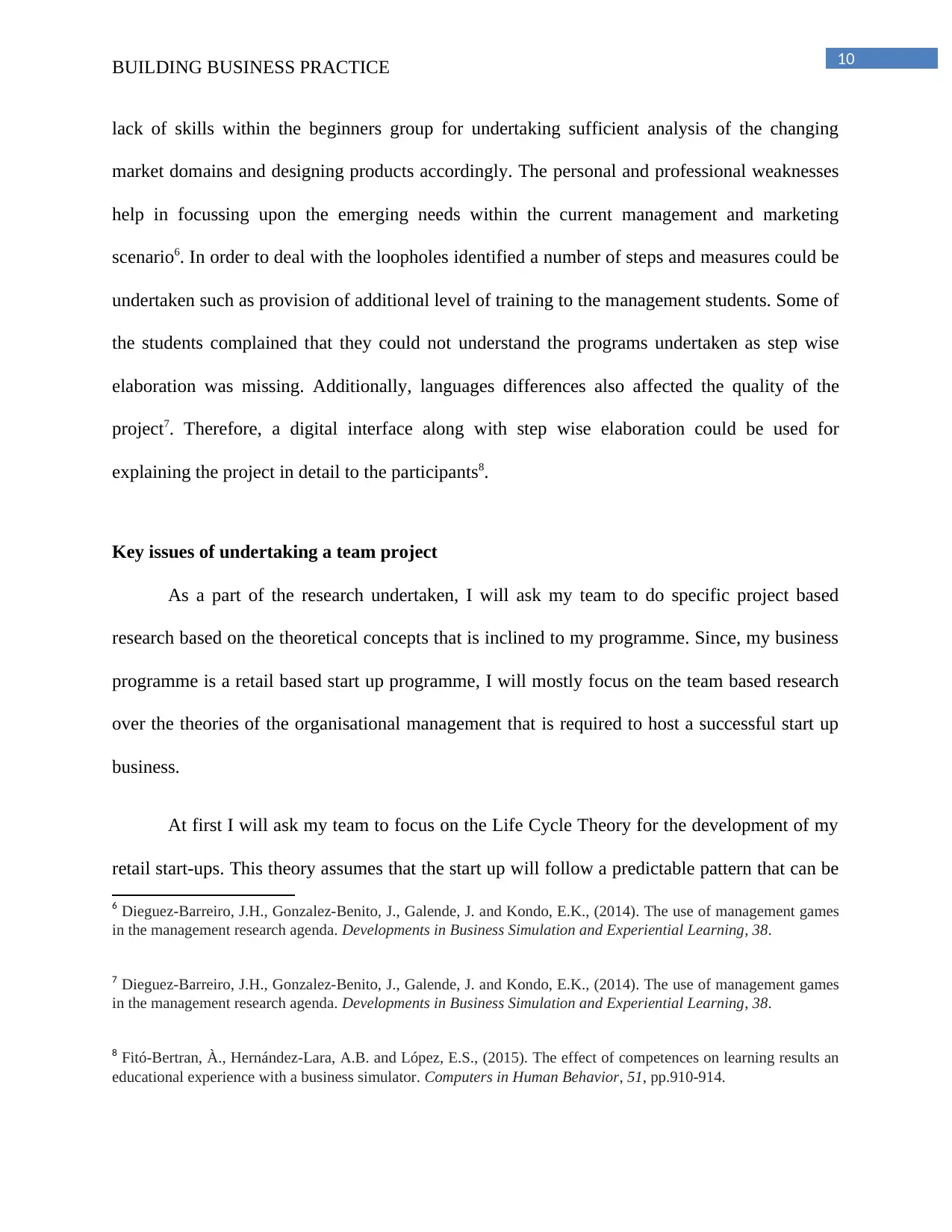
lack of skills within the beginners group for undertaking sufficient analysis of the changing
market domains and designing products accordingly. The personal and professional weaknesses
help in focussing upon the emerging needs within the current management and marketing
scenario6. In order to deal with the loopholes identified a number of steps and measures could be
undertaken such as provision of additional level of training to the management students. Some of
the students complained that they could not understand the programs undertaken as step wise
elaboration was missing. Additionally, languages differences also affected the quality of the
project7. Therefore, a digital interface along with step wise elaboration could be used for
explaining the project in detail to the participants8.
Key issues of undertaking a team project
As a part of the research undertaken, I will ask my team to do specific project based
research based on the theoretical concepts that is inclined to my programme. Since, my business
programme is a retail based start up programme, I will mostly focus on the team based research
over the theories of the organisational management that is required to host a successful start up
business.
At first I will ask my team to focus on the Life Cycle Theory for the development of my
retail start-ups. This theory assumes that the start up will follow a predictable pattern that can be
6 Dieguez-Barreiro, J.H., Gonzalez-Benito, J., Galende, J. and Kondo, E.K., (2014). The use of management games
in the management research agenda. Developments in Business Simulation and Experiential Learning, 38.
7 Dieguez-Barreiro, J.H., Gonzalez-Benito, J., Galende, J. and Kondo, E.K., (2014). The use of management games
in the management research agenda. Developments in Business Simulation and Experiential Learning, 38.
8 Fitó-Bertran, À., Hernández-Lara, A.B. and López, E.S., (2015). The effect of competences on learning results an
educational experience with a business simulator. Computers in Human Behavior, 51, pp.910-914.
lack of skills within the beginners group for undertaking sufficient analysis of the changing
market domains and designing products accordingly. The personal and professional weaknesses
help in focussing upon the emerging needs within the current management and marketing
scenario6. In order to deal with the loopholes identified a number of steps and measures could be
undertaken such as provision of additional level of training to the management students. Some of
the students complained that they could not understand the programs undertaken as step wise
elaboration was missing. Additionally, languages differences also affected the quality of the
project7. Therefore, a digital interface along with step wise elaboration could be used for
explaining the project in detail to the participants8.
Key issues of undertaking a team project
As a part of the research undertaken, I will ask my team to do specific project based
research based on the theoretical concepts that is inclined to my programme. Since, my business
programme is a retail based start up programme, I will mostly focus on the team based research
over the theories of the organisational management that is required to host a successful start up
business.
At first I will ask my team to focus on the Life Cycle Theory for the development of my
retail start-ups. This theory assumes that the start up will follow a predictable pattern that can be
6 Dieguez-Barreiro, J.H., Gonzalez-Benito, J., Galende, J. and Kondo, E.K., (2014). The use of management games
in the management research agenda. Developments in Business Simulation and Experiential Learning, 38.
7 Dieguez-Barreiro, J.H., Gonzalez-Benito, J., Galende, J. and Kondo, E.K., (2014). The use of management games
in the management research agenda. Developments in Business Simulation and Experiential Learning, 38.
8 Fitó-Bertran, À., Hernández-Lara, A.B. and López, E.S., (2015). The effect of competences on learning results an
educational experience with a business simulator. Computers in Human Behavior, 51, pp.910-914.
11BUILDING BUSINESS PRACTICE
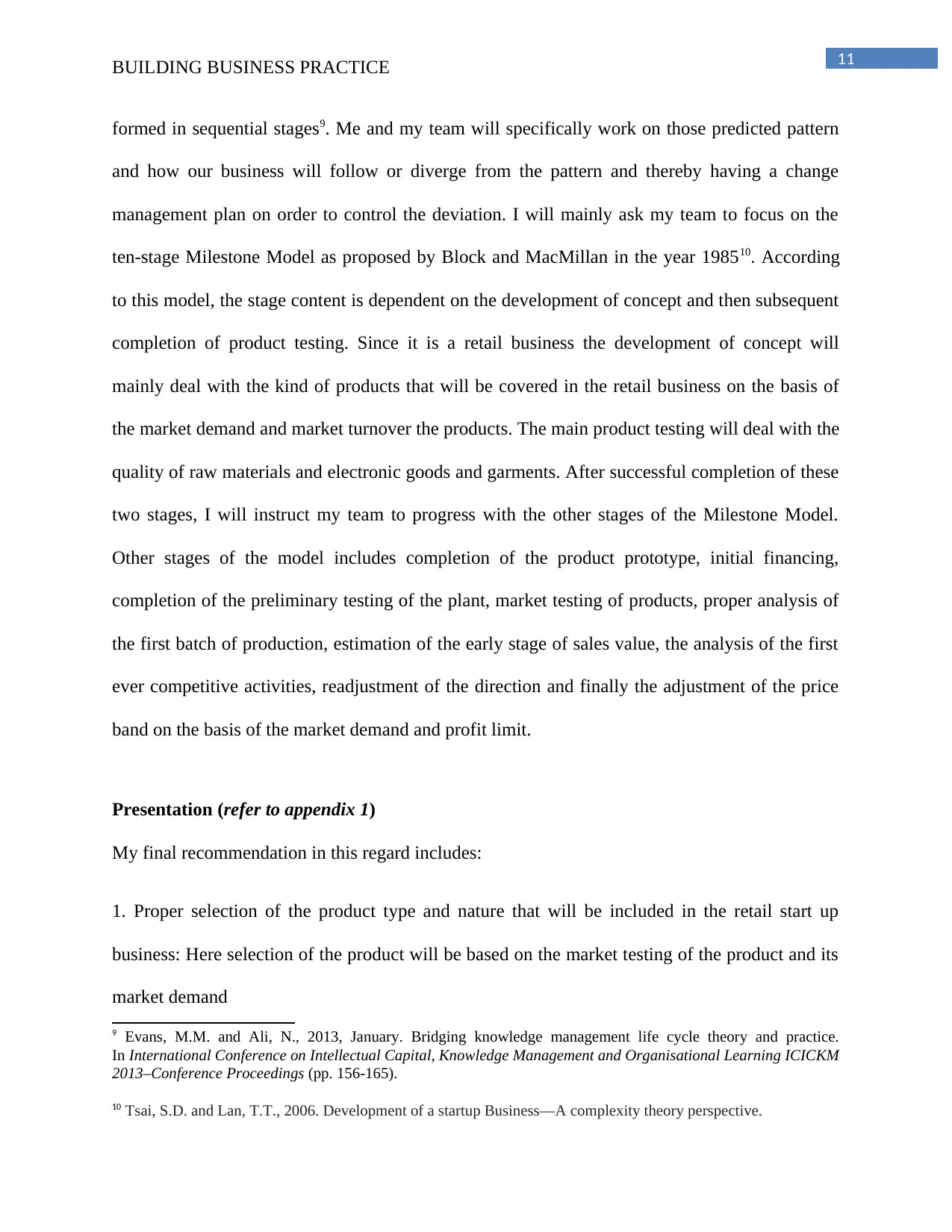
formed in sequential stages9. Me and my team will specifically work on those predicted pattern
and how our business will follow or diverge from the pattern and thereby having a change
management plan on order to control the deviation. I will mainly ask my team to focus on the
ten-stage Milestone Model as proposed by Block and MacMillan in the year 198510. According
to this model, the stage content is dependent on the development of concept and then subsequent
completion of product testing. Since it is a retail business the development of concept will
mainly deal with the kind of products that will be covered in the retail business on the basis of
the market demand and market turnover the products. The main product testing will deal with the
quality of raw materials and electronic goods and garments. After successful completion of these
two stages, I will instruct my team to progress with the other stages of the Milestone Model.
Other stages of the model includes completion of the product prototype, initial financing,
completion of the preliminary testing of the plant, market testing of products, proper analysis of
the first batch of production, estimation of the early stage of sales value, the analysis of the first
ever competitive activities, readjustment of the direction and finally the adjustment of the price
band on the basis of the market demand and profit limit.
Presentation (refer to appendix 1)
My final recommendation in this regard includes:
1. Proper selection of the product type and nature that will be included in the retail start up
business: Here selection of the product will be based on the market testing of the product and its
market demand
9 Evans, M.M. and Ali, N., 2013, January. Bridging knowledge management life cycle theory and practice.
In International Conference on Intellectual Capital, Knowledge Management and Organisational Learning ICICKM
2013–Conference Proceedings (pp. 156-165).
10 Tsai, S.D. and Lan, T.T., 2006. Development of a startup Business—A complexity theory perspective.
formed in sequential stages9. Me and my team will specifically work on those predicted pattern
and how our business will follow or diverge from the pattern and thereby having a change
management plan on order to control the deviation. I will mainly ask my team to focus on the
ten-stage Milestone Model as proposed by Block and MacMillan in the year 198510. According
to this model, the stage content is dependent on the development of concept and then subsequent
completion of product testing. Since it is a retail business the development of concept will
mainly deal with the kind of products that will be covered in the retail business on the basis of
the market demand and market turnover the products. The main product testing will deal with the
quality of raw materials and electronic goods and garments. After successful completion of these
two stages, I will instruct my team to progress with the other stages of the Milestone Model.
Other stages of the model includes completion of the product prototype, initial financing,
completion of the preliminary testing of the plant, market testing of products, proper analysis of
the first batch of production, estimation of the early stage of sales value, the analysis of the first
ever competitive activities, readjustment of the direction and finally the adjustment of the price
band on the basis of the market demand and profit limit.
Presentation (refer to appendix 1)
My final recommendation in this regard includes:
1. Proper selection of the product type and nature that will be included in the retail start up
business: Here selection of the product will be based on the market testing of the product and its
market demand
9 Evans, M.M. and Ali, N., 2013, January. Bridging knowledge management life cycle theory and practice.
In International Conference on Intellectual Capital, Knowledge Management and Organisational Learning ICICKM
2013–Conference Proceedings (pp. 156-165).
10 Tsai, S.D. and Lan, T.T., 2006. Development of a startup Business—A complexity theory perspective.
⊘ This is a preview!⊘
Do you want full access?
Subscribe today to unlock all pages.
Trusted by 1+ million students worldwide

1 out of 19


Related Documents


Your All-in-One AI-Powered Toolkit for Academic Success.
+13062052269
info@desklib.com
Available 24*7 on WhatsApp / Email
![[object Object]](/_next/static/media/star-bottom.7253800d.svg)
Unlock your academic potential
Copyright © 2020–2026 A2Z Services. All Rights Reserved. Developed and managed by ZUCOL.