Retail Industry: Economic Features, Competition, and Decision-Making
VerifiedAdded on 2023/06/18
|12
|3169
|100
Report
AI Summary
This report provides a comprehensive microeconomic analysis of the retail industry, focusing on its key economic features, pricing and cost characteristics, competitive environment, and strategic decision-making processes. It highlights the retail industry's role in connecting manufacturers to consumers, its impact on employment, and its contribution to economic growth. The report explores various pricing models, including cost-plus pricing, manufacturer suggested retail price, competitive pricing, prestige pricing, psychological pricing, and multiple pricing. It discusses the competitive landscape, emphasizing the importance of customer service, innovation, and differentiation. Strategic decision-making is examined through the lens of segmentation, targeting, and positioning, along with market penetration and diversification strategies. The report also incorporates graphs illustrating the rise of online shopping and trends in retail employment. Finally, it offers recommendations for companies like Marks and Spencer, focusing on personalized marketing, online customer service, and research-driven market entry strategies.
MICROECONOMIC
PROJECT
PROJECT

Paraphrase This Document
Need a fresh take? Get an instant paraphrase of this document with our AI Paraphraser
TABLE OF CONTENTS
INTRODUCTION...........................................................................................................................3
Important economic features of the industry...............................................................................3
Pricing and costs characteristics..................................................................................................4
Competitive environment............................................................................................................6
Strategic decision-making...........................................................................................................6
Graphs..........................................................................................................................................8
Recommendations on strategies..................................................................................................9
CONCLUSION..............................................................................................................................11
REFERENCES..............................................................................................................................12
2
INTRODUCTION...........................................................................................................................3
Important economic features of the industry...............................................................................3
Pricing and costs characteristics..................................................................................................4
Competitive environment............................................................................................................6
Strategic decision-making...........................................................................................................6
Graphs..........................................................................................................................................8
Recommendations on strategies..................................................................................................9
CONCLUSION..............................................................................................................................11
REFERENCES..............................................................................................................................12
2
INTRODUCTION
The study is on economic characteristics and features of an industry. Retail industry has been
taken in the report. The economic features of the industry have been explained. Pricing, cost
characteristics have been talked about in the report. Competition and strategic decision-making
of the industry has been talked about. Data and charts have been provided for supporting the
points made. Recommendations have been given on strategies of organisation chosen as Marks
and Spencer which is a prominent retail company of UK.
Important economic features of the industry
Retail industry can be said as activities which are utilised for selling a product or service to
customers for their use. It is necessary for individual demands of customer to be matched with
supply by manufacturers.
Economic features of the industry
Retailers provide goods in finished form to the customers, they bring goods from wholesalers
and thus act as a link in goods distribution which is a significant part of the economy. The goods
being manufactured in factory reaches to customers through a logistics chain and retailers are the
last in the chain who come indirect contact with customers. The pricing in retail is done in a
manner that factory puts a profit on cost per unit on a product to gain revenue and supplies to the
wholesaler and the wholesaler supplies it to the retailer by putting a profit on the same. Retailer
now has to put a profit on the batch supplied and ultimately it gets to the customer at a price
called transaction price which is also the final price on which customer makes a purchase. Unlike
wholesalers, retailers do not purchase in bulk and thus cost of products increases for them
(Gonda and et.al., 2020). They have to buy and supply products in market as per demand and
thus regular quantities of the products are purchased and displayed for sale.
Retailers can be said to be the link in chain of gauging customer requirements and demand
anticipation accordingly. The market trends current information is gathered by retailers and
conveyed to the manufacturers telling them about anticipated demand for various categories of
products. Thus, this helps in making the right product by the organisation and sales which
generate revenues improving the economy.
The retail industry have players operating on a large scale and offer employment opportunities
on a large scale to people and thus are an important contributor in employment statistics of a
3
The study is on economic characteristics and features of an industry. Retail industry has been
taken in the report. The economic features of the industry have been explained. Pricing, cost
characteristics have been talked about in the report. Competition and strategic decision-making
of the industry has been talked about. Data and charts have been provided for supporting the
points made. Recommendations have been given on strategies of organisation chosen as Marks
and Spencer which is a prominent retail company of UK.
Important economic features of the industry
Retail industry can be said as activities which are utilised for selling a product or service to
customers for their use. It is necessary for individual demands of customer to be matched with
supply by manufacturers.
Economic features of the industry
Retailers provide goods in finished form to the customers, they bring goods from wholesalers
and thus act as a link in goods distribution which is a significant part of the economy. The goods
being manufactured in factory reaches to customers through a logistics chain and retailers are the
last in the chain who come indirect contact with customers. The pricing in retail is done in a
manner that factory puts a profit on cost per unit on a product to gain revenue and supplies to the
wholesaler and the wholesaler supplies it to the retailer by putting a profit on the same. Retailer
now has to put a profit on the batch supplied and ultimately it gets to the customer at a price
called transaction price which is also the final price on which customer makes a purchase. Unlike
wholesalers, retailers do not purchase in bulk and thus cost of products increases for them
(Gonda and et.al., 2020). They have to buy and supply products in market as per demand and
thus regular quantities of the products are purchased and displayed for sale.
Retailers can be said to be the link in chain of gauging customer requirements and demand
anticipation accordingly. The market trends current information is gathered by retailers and
conveyed to the manufacturers telling them about anticipated demand for various categories of
products. Thus, this helps in making the right product by the organisation and sales which
generate revenues improving the economy.
The retail industry have players operating on a large scale and offer employment opportunities
on a large scale to people and thus are an important contributor in employment statistics of a
3
⊘ This is a preview!⊘
Do you want full access?
Subscribe today to unlock all pages.

Trusted by 1+ million students worldwide
nation. The retail sector has also expanded to many countries other than the host country. The
retail sector encompasses many areas of specialising having different skills and the departments
where one can find job is Finance, Accounts, operations, logistics etc.
Retail sector has also given birth to entrepreneurship and there have become many entrepreneurs
in retail who have become wealthy businessmen. Thus, retail sector has been one which has
economically benefited the nation in growth and employment benefitting people (Gonda and
et.al., 2020).
Pricing and costs characteristics
The different types of pricing models exist in retail where sale exists from many forms of retail.
The organisation in retail, as said before, adds a profit to its cost price of the product from the
wholesaler. Cost pricing becomes easier to comprehend when retailer adds own profits to the
product price till then in chain.
Cost addition pricing
This strategy is easier to calculate for price of merchandise and the increase in merchandise retail
price is proportionate to increase in cost price of the product. The customer do not have a role to
play in this mechanism.
Manufacturer suggested retail price
The retailer makes the transaction price on suggestion of manufacturer of the product.
Condition 1
Retailer makes sale of the product at the price which is at same price as put by manufacturer.
Condition 2
Retailer makes the selling of merchandise at a lesser price which was given by manufacturer.
This period sees the discounts being offered on the merchandise (Kaur and et.al., 2021).
Condition 3
Retailers mark a price which is unreasonably higher and then do a reduction in price on request
of customer and thus through bargain, it is made lower where customer has to negotiate for the
product price.
Competitive pricing
4
retail sector encompasses many areas of specialising having different skills and the departments
where one can find job is Finance, Accounts, operations, logistics etc.
Retail sector has also given birth to entrepreneurship and there have become many entrepreneurs
in retail who have become wealthy businessmen. Thus, retail sector has been one which has
economically benefited the nation in growth and employment benefitting people (Gonda and
et.al., 2020).
Pricing and costs characteristics
The different types of pricing models exist in retail where sale exists from many forms of retail.
The organisation in retail, as said before, adds a profit to its cost price of the product from the
wholesaler. Cost pricing becomes easier to comprehend when retailer adds own profits to the
product price till then in chain.
Cost addition pricing
This strategy is easier to calculate for price of merchandise and the increase in merchandise retail
price is proportionate to increase in cost price of the product. The customer do not have a role to
play in this mechanism.
Manufacturer suggested retail price
The retailer makes the transaction price on suggestion of manufacturer of the product.
Condition 1
Retailer makes sale of the product at the price which is at same price as put by manufacturer.
Condition 2
Retailer makes the selling of merchandise at a lesser price which was given by manufacturer.
This period sees the discounts being offered on the merchandise (Kaur and et.al., 2021).
Condition 3
Retailers mark a price which is unreasonably higher and then do a reduction in price on request
of customer and thus through bargain, it is made lower where customer has to negotiate for the
product price.
Competitive pricing
4
Paraphrase This Document
Need a fresh take? Get an instant paraphrase of this document with our AI Paraphraser
The competition in retail has prompted retailers for giving customer service which is excellent
and gives preference by customer to the competitors.
Price of merchandise is more or less in similarity to competitor but retailers in between keep on
adding benefits for customers.
Retailer ensures better service to be given to customers to create an edge over competitors.
Pricing kept below competitors
This policy states that:
Price of merchandise is kept lower than one being offered by competitors to customers.
Prestige pricing
According to pricing mechanism, price of merchandise is put a slight above than competitors.
The retailer can charge price which is higher than competitors under these circumstances:
a) Brands exclusive at store
b) Brand image of store.
c) Prime location of store
d) Customer service which is excellent
e) Merchandise which is not available at any store
f) Trends latest being followed
Psychological pricing
The price of product which is willingly purchased by customer is known as psychological
pricing. These prices are perceived by customers to be right. Retailer sets pricing which is felt
can meet buyers’ expectations and can buy the merchandise in easy way (Kaur and et.al., 2021).
Multiple pricing
According to multiple pricing, retailer sells multiple products for one price. Retailers make a
combination of products to be sold for a fixed price.
5
and gives preference by customer to the competitors.
Price of merchandise is more or less in similarity to competitor but retailers in between keep on
adding benefits for customers.
Retailer ensures better service to be given to customers to create an edge over competitors.
Pricing kept below competitors
This policy states that:
Price of merchandise is kept lower than one being offered by competitors to customers.
Prestige pricing
According to pricing mechanism, price of merchandise is put a slight above than competitors.
The retailer can charge price which is higher than competitors under these circumstances:
a) Brands exclusive at store
b) Brand image of store.
c) Prime location of store
d) Customer service which is excellent
e) Merchandise which is not available at any store
f) Trends latest being followed
Psychological pricing
The price of product which is willingly purchased by customer is known as psychological
pricing. These prices are perceived by customers to be right. Retailer sets pricing which is felt
can meet buyers’ expectations and can buy the merchandise in easy way (Kaur and et.al., 2021).
Multiple pricing
According to multiple pricing, retailer sells multiple products for one price. Retailers make a
combination of products to be sold for a fixed price.
5
Competitive environment
Talking of competition in today’s scenario, it can be said that retailers are facing tough
competition. Large number of retailers have increased competition which offer same products at
same prices (Crowley and Stainback, 2019). The only factor which can differentiate is providing
of better value and giving offerings to customers. Retailers can provide better customer service
and after sales service to differentiate in competition. It has been seen that retailers give offerings
and discounts on products in seasonal and festive occasions. For staying in competition,
innovation and differentiation through positioning is necessary and retailers try to innovate their
stores or shops, which can provide an ambience to the public. The business opportunities
expansion in global terms and taking business prospects which are bigger have been identified by
retailers and diversification has been done in business formats through entering in product
segments which are of varied types and can earn profits for the organisation (Crowley and
Stainback, 2019).
Strategic decision-making
The retail decision-making has been in a strategic way in order to compete. Segmentation,
Positioning and Targeting is used by retail segment to make the right marketing strategy.
Segmentation means using behavioural, psychological, geographical and demographic factors to
segment customers on their habits and preferences. The behavioural characteristics are analysed
of what are the preferences of customers in their buying habits. The psychological characteristics
are analysed of what are the liking of customers and the psychological influence of factors which
motivate to buy them such as something which is traditional is famous between customers or of
age products which customers give preference to. Geographical factors like place of convenience
for customers to buy products with malls near residential areas and the designing of products
according to the geographical locations also affect customer purchase. Demographic factors
which affect the market are age group of customers, their income and their social circle which
have an effect on the buying habits. For instance, youth segment being affected by the beauty
and personal care products, income of people residing in particular areas and the social status
according to which they make purchase (Kautish and Sharma, 2018).
6
Talking of competition in today’s scenario, it can be said that retailers are facing tough
competition. Large number of retailers have increased competition which offer same products at
same prices (Crowley and Stainback, 2019). The only factor which can differentiate is providing
of better value and giving offerings to customers. Retailers can provide better customer service
and after sales service to differentiate in competition. It has been seen that retailers give offerings
and discounts on products in seasonal and festive occasions. For staying in competition,
innovation and differentiation through positioning is necessary and retailers try to innovate their
stores or shops, which can provide an ambience to the public. The business opportunities
expansion in global terms and taking business prospects which are bigger have been identified by
retailers and diversification has been done in business formats through entering in product
segments which are of varied types and can earn profits for the organisation (Crowley and
Stainback, 2019).
Strategic decision-making
The retail decision-making has been in a strategic way in order to compete. Segmentation,
Positioning and Targeting is used by retail segment to make the right marketing strategy.
Segmentation means using behavioural, psychological, geographical and demographic factors to
segment customers on their habits and preferences. The behavioural characteristics are analysed
of what are the preferences of customers in their buying habits. The psychological characteristics
are analysed of what are the liking of customers and the psychological influence of factors which
motivate to buy them such as something which is traditional is famous between customers or of
age products which customers give preference to. Geographical factors like place of convenience
for customers to buy products with malls near residential areas and the designing of products
according to the geographical locations also affect customer purchase. Demographic factors
which affect the market are age group of customers, their income and their social circle which
have an effect on the buying habits. For instance, youth segment being affected by the beauty
and personal care products, income of people residing in particular areas and the social status
according to which they make purchase (Kautish and Sharma, 2018).
6
⊘ This is a preview!⊘
Do you want full access?
Subscribe today to unlock all pages.
Trusted by 1+ million students worldwide
Targeting means a customer segment which can be interested for buying a product. According to
product specifications, the product is made for customers who shall buy it. The youth for
instance, is targeted for new fashion garments and accessories, middle class is targeted by lower
pricing of groceries and other essentials, students are targeted by books of famous authors at
discounts given. This helps company to concentrate on the products to be made which can bring
in revenue for the company.
Positioning refers to differentiating a company’s products with infusing characteristics and
features in product which are distinguishable and can create an image in the minds of customers.
If a drink of general purpose is mixed with certain flavour and added with healthy vitamins and
minerals, it can create an image of a health-conscious drink and set itself in minds of people who
like healthy drinks. This can act as substitute for the carbonated drinks. Similarly, garments of
eco-friendly fabric can act as differentiator from other garment products and customers will be
motivated for buying them as it will hold more value for them linking with nature. Nowadays,
companies are taking up environmental issues on social media which gives them a sustainable
image. Also, in their operations they are including energy saving methods liked by customers
(Kautish and Sharma, 2018).
Other methods used in retail sector are of market penetration, diversification where firstly retail
industry uses methods to enter the market, by pricing lower than the competitors and giving extra
services like post-sales service. The strategy is to enter the markets and create an awareness of
the product and as it grows famous, the retail company increases the price slowly. It also goes for
promotion strategies to market the product on a larger scale for reaching audience and creating
awareness in them. Market diversification is company changing its product category to various
other product categories while retaining the old product. It can thus cater to a larger customer
segment and thus earn revenues. Product development strategy has focus on introduction of
products which are new to the market existing. This strategy involves the product range
expansion. The strategy used in product development makes use of research and develops
products which are new to the market and make partnerships with other firms for launching a
combo product offer (Atulkar and Kesari, 2018).
The market development is another strategy in which organisation enters in new market with
brands which are existing. New markets can be new geographical regions or even a foreign
market.
7
product specifications, the product is made for customers who shall buy it. The youth for
instance, is targeted for new fashion garments and accessories, middle class is targeted by lower
pricing of groceries and other essentials, students are targeted by books of famous authors at
discounts given. This helps company to concentrate on the products to be made which can bring
in revenue for the company.
Positioning refers to differentiating a company’s products with infusing characteristics and
features in product which are distinguishable and can create an image in the minds of customers.
If a drink of general purpose is mixed with certain flavour and added with healthy vitamins and
minerals, it can create an image of a health-conscious drink and set itself in minds of people who
like healthy drinks. This can act as substitute for the carbonated drinks. Similarly, garments of
eco-friendly fabric can act as differentiator from other garment products and customers will be
motivated for buying them as it will hold more value for them linking with nature. Nowadays,
companies are taking up environmental issues on social media which gives them a sustainable
image. Also, in their operations they are including energy saving methods liked by customers
(Kautish and Sharma, 2018).
Other methods used in retail sector are of market penetration, diversification where firstly retail
industry uses methods to enter the market, by pricing lower than the competitors and giving extra
services like post-sales service. The strategy is to enter the markets and create an awareness of
the product and as it grows famous, the retail company increases the price slowly. It also goes for
promotion strategies to market the product on a larger scale for reaching audience and creating
awareness in them. Market diversification is company changing its product category to various
other product categories while retaining the old product. It can thus cater to a larger customer
segment and thus earn revenues. Product development strategy has focus on introduction of
products which are new to the market existing. This strategy involves the product range
expansion. The strategy used in product development makes use of research and develops
products which are new to the market and make partnerships with other firms for launching a
combo product offer (Atulkar and Kesari, 2018).
The market development is another strategy in which organisation enters in new market with
brands which are existing. New markets can be new geographical regions or even a foreign
market.
7
Paraphrase This Document
Need a fresh take? Get an instant paraphrase of this document with our AI Paraphraser
Graphs
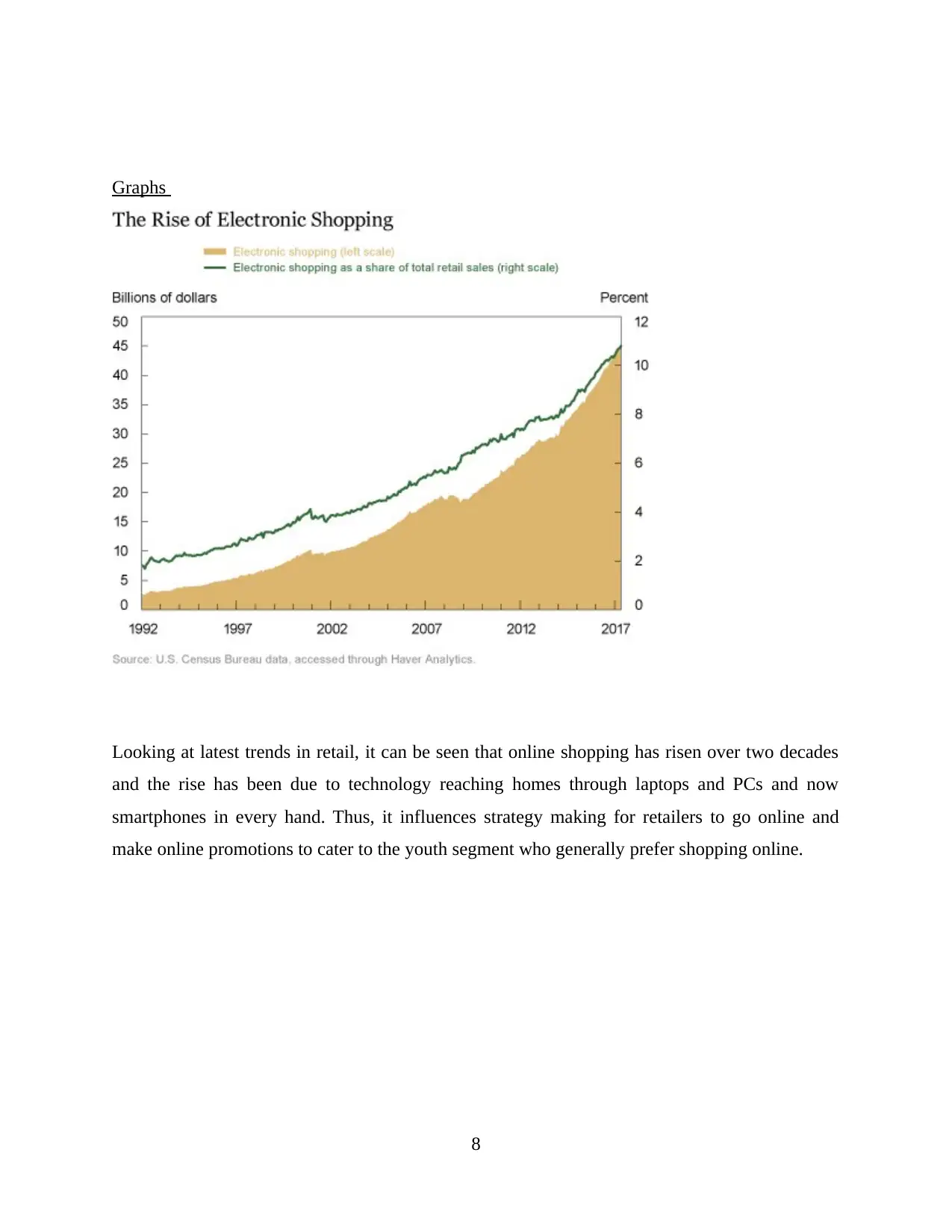
Looking at latest trends in retail, it can be seen that online shopping has risen over two decades
and the rise has been due to technology reaching homes through laptops and PCs and now
smartphones in every hand. Thus, it influences strategy making for retailers to go online and
make online promotions to cater to the youth segment who generally prefer shopping online.
8
Looking at latest trends in retail, it can be seen that online shopping has risen over two decades
and the rise has been due to technology reaching homes through laptops and PCs and now
smartphones in every hand. Thus, it influences strategy making for retailers to go online and
make online promotions to cater to the youth segment who generally prefer shopping online.
8
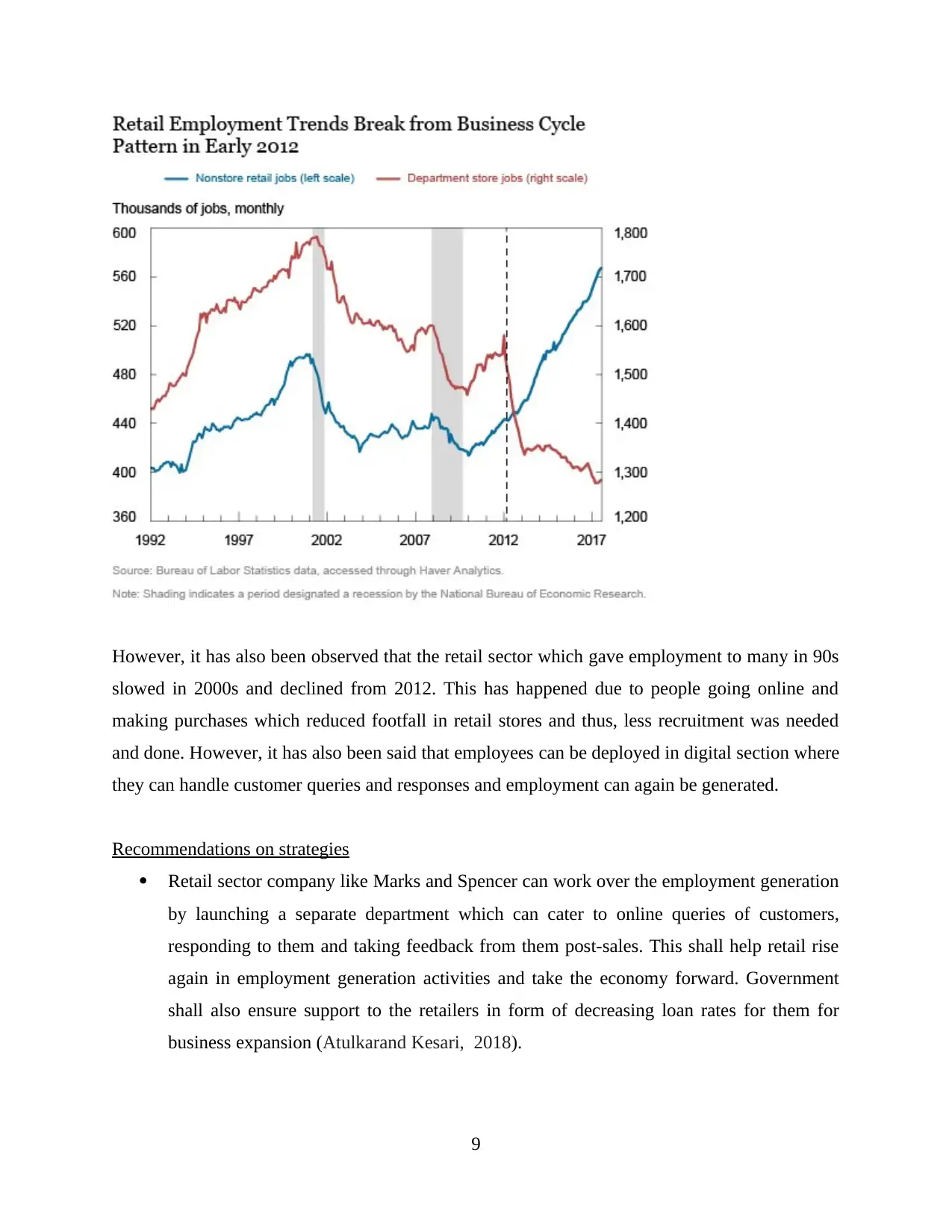
However, it has also been observed that the retail sector which gave employment to many in 90s
slowed in 2000s and declined from 2012. This has happened due to people going online and
making purchases which reduced footfall in retail stores and thus, less recruitment was needed
and done. However, it has also been said that employees can be deployed in digital section where
they can handle customer queries and responses and employment can again be generated.
Recommendations on strategies
Retail sector company like Marks and Spencer can work over the employment generation
by launching a separate department which can cater to online queries of customers,
responding to them and taking feedback from them post-sales. This shall help retail rise
again in employment generation activities and take the economy forward. Government
shall also ensure support to the retailers in form of decreasing loan rates for them for
business expansion (Atulkarand Kesari, 2018).
9
slowed in 2000s and declined from 2012. This has happened due to people going online and
making purchases which reduced footfall in retail stores and thus, less recruitment was needed
and done. However, it has also been said that employees can be deployed in digital section where
they can handle customer queries and responses and employment can again be generated.
Recommendations on strategies
Retail sector company like Marks and Spencer can work over the employment generation
by launching a separate department which can cater to online queries of customers,
responding to them and taking feedback from them post-sales. This shall help retail rise
again in employment generation activities and take the economy forward. Government
shall also ensure support to the retailers in form of decreasing loan rates for them for
business expansion (Atulkarand Kesari, 2018).
9
⊘ This is a preview!⊘
Do you want full access?
Subscribe today to unlock all pages.
Trusted by 1+ million students worldwide
Marks and Spencer should focus more on personalised marketing using digital techniques
and project to customer the product range according to his needs and use e-mail and SMS
marketing to tell about the latest offers and discounts as well as the new product launch.
Marks and Spencer has to focus on research when it enters new markets and monitoring
of management should be done frequently to check the progress to avoid loss in setting
up firm in new regions. Cultural study and shopping habits of customers should be
known beforehand and accordingly product launch should take place.
Marks and Spencer can follow the competitive pricing policy. This would support the
business entities to attract the buying behaviour of customers with support of pricing
policy. This is essential for the business entities to offer its products at a most affordable
price possible (Chizema and et.al., 2021). Retail sector is full of competitiveness as the
product segment offer under the sector is basic product require to live so this become
more essential for the businesses to offer a price that can attract to all types of potential
customer available in the market.
Business entities like Marks and Spencer in the retail sector can implement the social
media or digital marketing policies. This is to recommend that business ventures can
utilise this policy so that best level of growth opportunities could be created by the
business ventures. These strategies would involve platforms like Facebook, Instagram
and many more that can favour the business houses to mitigate all its various business
objectives. Attracting customer is a huge task that needed to ensure by companies and
this also become a major task that also dealt through the use of this policy or strategy.
The companies and business ventures operate under the retail sector such as Marks and
Spencer should give proper emphasis over taking the use of product development
policies. This is important for the business house to delegate the product development
policy so that companies can approach the best level of product development campaign.
The role of the product development practices that can allow the business ventures to
approach the overall growth and development practice of the business ventures. This is
all about approaching the best level of business development and growth practices of the
organisation (Goga, Paelo and Nyamwena, 2019). The product development is very
10
and project to customer the product range according to his needs and use e-mail and SMS
marketing to tell about the latest offers and discounts as well as the new product launch.
Marks and Spencer has to focus on research when it enters new markets and monitoring
of management should be done frequently to check the progress to avoid loss in setting
up firm in new regions. Cultural study and shopping habits of customers should be
known beforehand and accordingly product launch should take place.
Marks and Spencer can follow the competitive pricing policy. This would support the
business entities to attract the buying behaviour of customers with support of pricing
policy. This is essential for the business entities to offer its products at a most affordable
price possible (Chizema and et.al., 2021). Retail sector is full of competitiveness as the
product segment offer under the sector is basic product require to live so this become
more essential for the businesses to offer a price that can attract to all types of potential
customer available in the market.
Business entities like Marks and Spencer in the retail sector can implement the social
media or digital marketing policies. This is to recommend that business ventures can
utilise this policy so that best level of growth opportunities could be created by the
business ventures. These strategies would involve platforms like Facebook, Instagram
and many more that can favour the business houses to mitigate all its various business
objectives. Attracting customer is a huge task that needed to ensure by companies and
this also become a major task that also dealt through the use of this policy or strategy.
The companies and business ventures operate under the retail sector such as Marks and
Spencer should give proper emphasis over taking the use of product development
policies. This is important for the business house to delegate the product development
policy so that companies can approach the best level of product development campaign.
The role of the product development practices that can allow the business ventures to
approach the overall growth and development practice of the business ventures. This is
all about approaching the best level of business development and growth practices of the
organisation (Goga, Paelo and Nyamwena, 2019). The product development is very
10
Paraphrase This Document
Need a fresh take? Get an instant paraphrase of this document with our AI Paraphraser
significant is in respect to the organisation and ventures and entities that can support the
overall growth and development possibilities of the ventures.
The customer satisfaction is a very significant aspect that can allocate the best level of
brand value. The role of the brand value that can deliver the overall business growth and
development possibilities of the ventures. The role of the business operations that can
support and favour the business unit to deal with the overall business ventures and
operations. This makes it significant for the business unit to approach the overall business
objective and growth oriented opportunities for the venture.
This is so significant for the business unit to give emphasis over progressive style or
approach of leadership. This becomes essential for the company and business houses to
deliver and delegate the business practices of ventures. This become essential for the
organisation and retail sector is to delegate the best level and form of overall growth and
development to ensue the best form of overall growth and development for the business
unit. This practice would also involve practicing innovation to ensure the best level of
growth and development of the venture.
CONCLUSION
It can be said that retail sector has a positive impact on economy. The pricing and cost
characteristics were discussed. Competition prevalent and strategies used were highlighted.
Graphs were added in the report regarding retail trend and effects. Recommendations were given
for improvisation in organisation chosen.
11
overall growth and development possibilities of the ventures.
The customer satisfaction is a very significant aspect that can allocate the best level of
brand value. The role of the brand value that can deliver the overall business growth and
development possibilities of the ventures. The role of the business operations that can
support and favour the business unit to deal with the overall business ventures and
operations. This makes it significant for the business unit to approach the overall business
objective and growth oriented opportunities for the venture.
This is so significant for the business unit to give emphasis over progressive style or
approach of leadership. This becomes essential for the company and business houses to
deliver and delegate the business practices of ventures. This become essential for the
organisation and retail sector is to delegate the best level and form of overall growth and
development to ensue the best form of overall growth and development for the business
unit. This practice would also involve practicing innovation to ensure the best level of
growth and development of the venture.
CONCLUSION
It can be said that retail sector has a positive impact on economy. The pricing and cost
characteristics were discussed. Competition prevalent and strategies used were highlighted.
Graphs were added in the report regarding retail trend and effects. Recommendations were given
for improvisation in organisation chosen.
11
REFERENCES
Books and Journals
Atulkar, S. and Kesari, B., 2018. A review on art of creating values in retail for improving
business performance. Journal of Business Administration Research, 7(1), pp.22-26.
Chizema, D. and et.al., 2021. Identifying the determinants of outward foreign direct investment
decisions of South African retail enterprises investing into Africa. Acta Commercii-
Independent Research Journal in the Management Sciences. 21(1). p.895.
Crowley, M. and Stainback, K., 2019. Retail sector concentration, local economic structure, and
community well-being. Annual Review of Sociology, 45, pp.321-343.
Goga, S., Paelo, A. and Nyamwena, J., 2019. Online Retailing in South Africa: An Overview.
Gonda, G., Gorgenyi-Hegyes, E., Nathan, R.J. and Fekete-Farkas, M., 2020. Competitive Factors
of Fashion Retail Sector with Special Focus on SMEs. Economies, 8(4), p.95.
Kaur, J., Santhoshkumar, N., Nomani, M.Z.M., Sharma, D.K., Maroor, J.P. and Dhiman, V.,
2021. Impact of Internets of Things (IOT) in retail sector. Materials Today: Proceedings.
Kautish, P. and Sharma, R., 2018. Consumer values, fashion consciousness and behavioural
intentions in the online fashion retail sector. International Journal of Retail &
Distribution Management.
Prasad, J., 2020. A Qualitative Investigation on the Impact of Human Resource Information
Systems (HRIS) on the Organisation Performance in the Retail Sector of
Canada (Doctoral dissertation, Dublin, National College of Ireland).
Saxena, D., Komalavalli, C. and Laroiya, C., 2018. Harnessing Big Data for Growth in Retail
Industry. International Journal of Management, IT and Engineering, 8(6), pp.130-144.
Śmigielska, G. and Oczkowska, R., 2017. Retailers’ competitiveness on global
markets. International Entrepreneurship Review, 3(1), pp.175-196.
12
Books and Journals
Atulkar, S. and Kesari, B., 2018. A review on art of creating values in retail for improving
business performance. Journal of Business Administration Research, 7(1), pp.22-26.
Chizema, D. and et.al., 2021. Identifying the determinants of outward foreign direct investment
decisions of South African retail enterprises investing into Africa. Acta Commercii-
Independent Research Journal in the Management Sciences. 21(1). p.895.
Crowley, M. and Stainback, K., 2019. Retail sector concentration, local economic structure, and
community well-being. Annual Review of Sociology, 45, pp.321-343.
Goga, S., Paelo, A. and Nyamwena, J., 2019. Online Retailing in South Africa: An Overview.
Gonda, G., Gorgenyi-Hegyes, E., Nathan, R.J. and Fekete-Farkas, M., 2020. Competitive Factors
of Fashion Retail Sector with Special Focus on SMEs. Economies, 8(4), p.95.
Kaur, J., Santhoshkumar, N., Nomani, M.Z.M., Sharma, D.K., Maroor, J.P. and Dhiman, V.,
2021. Impact of Internets of Things (IOT) in retail sector. Materials Today: Proceedings.
Kautish, P. and Sharma, R., 2018. Consumer values, fashion consciousness and behavioural
intentions in the online fashion retail sector. International Journal of Retail &
Distribution Management.
Prasad, J., 2020. A Qualitative Investigation on the Impact of Human Resource Information
Systems (HRIS) on the Organisation Performance in the Retail Sector of
Canada (Doctoral dissertation, Dublin, National College of Ireland).
Saxena, D., Komalavalli, C. and Laroiya, C., 2018. Harnessing Big Data for Growth in Retail
Industry. International Journal of Management, IT and Engineering, 8(6), pp.130-144.
Śmigielska, G. and Oczkowska, R., 2017. Retailers’ competitiveness on global
markets. International Entrepreneurship Review, 3(1), pp.175-196.
12
⊘ This is a preview!⊘
Do you want full access?
Subscribe today to unlock all pages.
Trusted by 1+ million students worldwide

1 out of 12


Related Documents


Your All-in-One AI-Powered Toolkit for Academic Success.
+13062052269
info@desklib.com
Available 24*7 on WhatsApp / Email
![[object Object]](/_next/static/media/star-bottom.7253800d.svg)
Unlock your academic potential
Copyright © 2020–2026 A2Z Services. All Rights Reserved. Developed and managed by ZUCOL.