Economics: Retail Cost Structure and Competition in Singapore

Verified

Added on  2023/04/22

|7
|1820
|164
Report
AI Summary
This report examines the retail industry in Singapore, focusing on the cost structures of large versus small retailers and their impact on market competition. It identifies fixed and variable costs, economies of scale, and the role of technology in creating competitive advantages for larger retailers like Giant. The analysis extends to the market structure, assessing its proximity to perfect competition and the challenges faced by smaller retailers. The report concludes by exploring the long-run prospects for small retailers, considering opportunities in online marketplaces and semi-urban areas, as well as the importance of adapting to changing consumer preferences. It also highlights the potential for specialization to ensure their survival in the face of competition from larger players.
Document Page
1
ECONOMICS ASSIGNMENT
tabler-icon-diamond-filled.svg

Paraphrase This Document

Need a fresh take? Get an instant paraphrase of this document with our AI Paraphraser
Document Page
2
Contents
(a)...............................................................................................................................................3
(b)...............................................................................................................................................4
(c)...............................................................................................................................................5
Reference....................................................................................................................................7
Document Page
3
(a)
Description of the differences in the cost structure
There are mainly two different cost component of the cost of producing. These are the fixed
cost and the variable cost. While the fixed cost does not depend on the number of units being
produced, the variable cost increases with the increases in the output. Now, the cost structure
of small retailers and large retailers differs significantly. Small retailers face less demand for
their product and hence produce lower output. Corresponding inputs to the production
process is also less. On the other hand, larger retailers have a huge demand from the side of
the customers. It allows them to produce at a large quantity at one go which in turn allows
them the flexibility to use technology which reduces the average cost of production
(Krisnakumar, Sulaiman, Chin, Masod, Zakuan & Choon, 2018). In addition to that economy
of scale also come into play that reduces the average cost of production as the number of
units produced increased. Thus, the profit margin of the bigger retailer remains high
compared to the smaller retailers.
Reasons for the differences in the cost structure
There are mainly two main reasons behind the differences in the cost structure of bigger and
smaller retailers of the Singaporean market. These are the scale of production and the use of
technology. The scale of production refers to the process where a huge number of units are
produced by the manufacturer. As the number of output rises the manufactures save on the
bulk purchases of inputs and hence cost structure differs. On the other hand, flexibility to use
the technology in the production also allows the larger retailer to have a lower average cost of
production. For example, Giant hypermarket in Singapore produces a huge number of clothes
at one go. This allows them to buy fabrics at discounted bulk rates. Apart from that, a huge
number of clothes production also allows them to use technology in place of human effort as
well. Koh, Hong & Tan (2018) noted that technology not only reduces the direct production
cost but it also takes a lot less time to produce a huge number of units. Therefore, the retailer
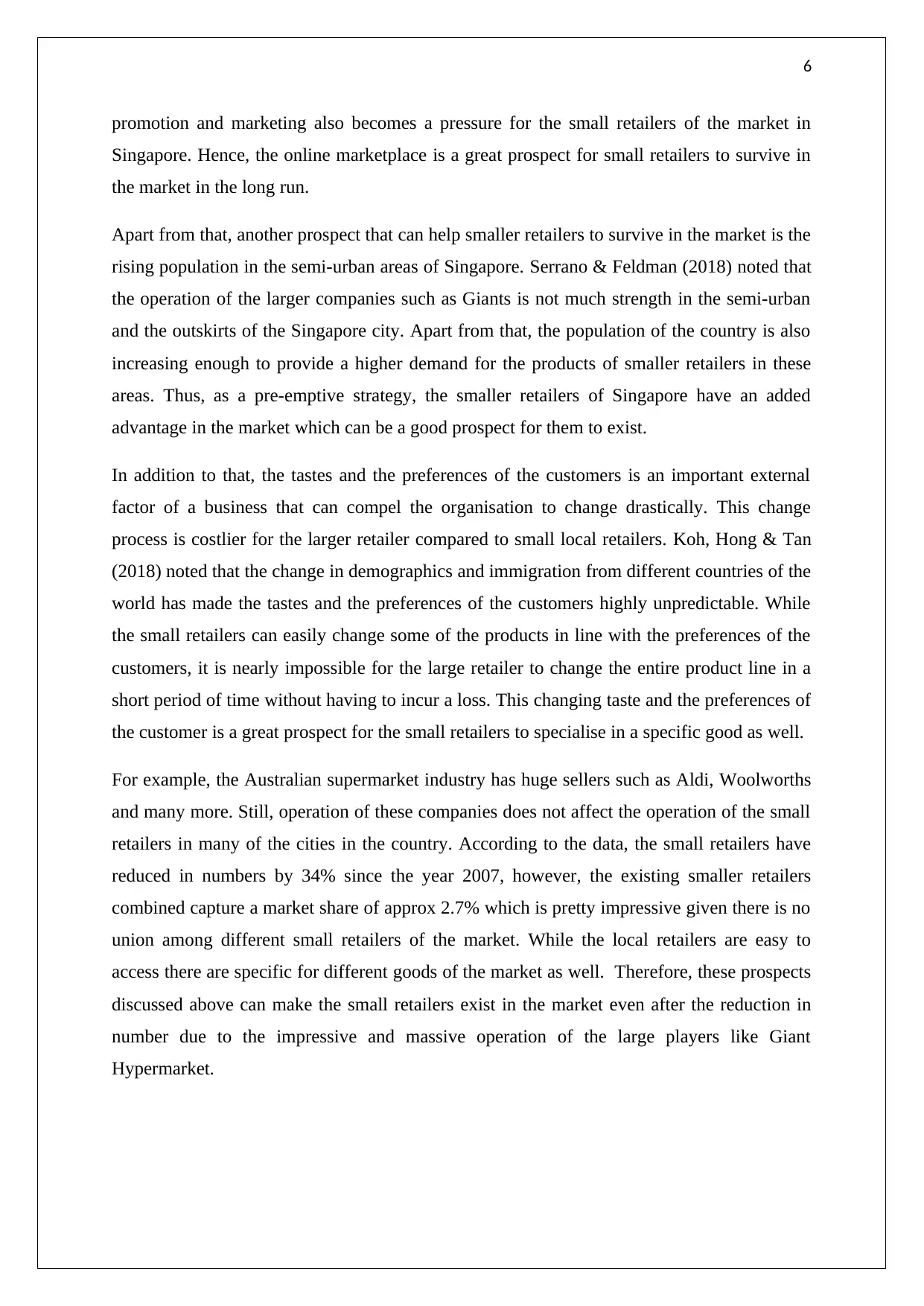
produces more at a given time. The figure below shows the economies of scale and the
reduction of the average cost with the increase in the output.
Document Page
4
Figure 1: The economies of scale
(Source: Pouw, 2017)
Impact of different cost structure in the competitiveness
This difference of cost structure among the bigger and smaller retailers of Singapore is
crucial for the competitiveness of the organisation as well. Market competitiveness depends a
lot on the price that the retailers charge for each of the units they sell. For a given quality of
product, a customer will always buy the cheaper alternative from the market. The absence of
economies of scale does not allow the small retailers to reduce the average cost of units much
compared to the larger counterpart. Thus, the price remains high and customer demands a
lesser quantity of goods from the small retailers. On the other hand, the low average cost per
unit of production allows large retailers to have reduced the price level down attracting a lot
of customers from the market. Most of the products that are sold in the hypermarkets such as
Giants are inelastic and hence revenue increases with the reduction in price.
(b)
Market structure of the hypermarket industry of Singapore
Market structure refers to the characteristics of the market in terms of the number of patrons
and the control of the patrons over the prices of the market. The market structure of
tabler-icon-diamond-filled.svg

Paraphrase This Document

Need a fresh take? Get an instant paraphrase of this document with our AI Paraphraser
Document Page
5
hypermarket is close to perfect competition. However, the real-life characteristics of the
Singaporean hypermarket industry are exactly like a perfect competition as the control over
the price is not uniformly distributed among different sellers of the market. Similar to a
perfect competition the nature of the goods and the services provided in the industry is
homogenous. Apart from that, the number of sellers and the buyers in the market is huge.
However, cost structure as discussed above is not similar for all the players of the market.
The industry of hypermarket in Singapore consists of a small number of large sellers and a
huge number of small sellers. The large sellers of the market such as Giant Hypermarket have
the flexibilities to use economies of scale which further reflects in the price they offer for
each of the units. Thus, they can reduce the prices for the goods and the services more than
their smaller counterparts. In recent times, the customers of the market have shifted their
demand from the local small retailers to the larger retailers as this cheaper for the consumers.
Additionally, the entry and the exit from the hypermarket industry of Singapore are also
similar to the perfect competition. This justifies the reason for the reduction in small retailers
in the market in recent years. Lower average cost and the reduce prices allows large retailers
to enjoy better market share compared to the small retailers. In the recent time, the number of
small players has reduced in such a way that it can be said that, market structure is
transitioning from a competitive market to an oligopolistic market with few large sellers.
(c)
Long-run prospects for the small retailers to exist in the market
As per the recent trends and the behaviours of the existing players and the nature of the
market, the small players would disappear from the market. However, it is important to note
that, the industry is also facing high competition from the side of the online market platforms
as well. These online market platforms can be a great prospect for small retailers to exist in
the market in the long run. Serrano & Feldman (2018) stated that an online market platform
has a model that includes small retailers as a store. One of the biggest advantages of being a
part of the online marketplace for small retailers is that it will also work as an advertisement
for their goods and service as well. In Singaporean industry, large companies like Giant
spend a lot in the promotion and the marketing of the goods they sell in the market. Thus,
customers are aware of the brands and the names. Contrary to that, small local retailers fail to
develop a reputation in the market. Thus, not only the cost structure, the pressure of
Document Page
6
promotion and marketing also becomes a pressure for the small retailers of the market in
Singapore. Hence, the online marketplace is a great prospect for small retailers to survive in
the market in the long run.
Apart from that, another prospect that can help smaller retailers to survive in the market is the
rising population in the semi-urban areas of Singapore. Serrano & Feldman (2018) noted that
the operation of the larger companies such as Giants is not much strength in the semi-urban
and the outskirts of the Singapore city. Apart from that, the population of the country is also
increasing enough to provide a higher demand for the products of smaller retailers in these
areas. Thus, as a pre-emptive strategy, the smaller retailers of Singapore have an added
advantage in the market which can be a good prospect for them to exist.
In addition to that, the tastes and the preferences of the customers is an important external
factor of a business that can compel the organisation to change drastically. This change
process is costlier for the larger retailer compared to small local retailers. Koh, Hong & Tan
(2018) noted that the change in demographics and immigration from different countries of the
world has made the tastes and the preferences of the customers highly unpredictable. While
the small retailers can easily change some of the products in line with the preferences of the
customers, it is nearly impossible for the large retailer to change the entire product line in a
short period of time without having to incur a loss. This changing taste and the preferences of
the customer is a great prospect for the small retailers to specialise in a specific good as well.
For example, the Australian supermarket industry has huge sellers such as Aldi, Woolworths
and many more. Still, operation of these companies does not affect the operation of the small
retailers in many of the cities in the country. According to the data, the small retailers have
reduced in numbers by 34% since the year 2007, however, the existing smaller retailers
combined capture a market share of approx 2.7% which is pretty impressive given there is no
union among different small retailers of the market. While the local retailers are easy to
access there are specific for different goods of the market as well. Therefore, these prospects
discussed above can make the small retailers exist in the market even after the reduction in
number due to the impressive and massive operation of the large players like Giant
Hypermarket.
Document Page
7
Reference
Koh, E., Hong, H., & Tan, J. P. L. (2018). Formatively assessing teamwork in technology-
enabled twenty-first-century classrooms: exploratory findings of a teamwork
awareness programme in Singapore. Asia Pacific Journal of Education, 38(1), 129-
144.
Krisnakumar, V. A., Sulaiman, Z., Chin, T. A., Masod, A., Zakuan, N., & Choon, T. L.
(2018, November). Consumer proneness towards in-store promotion in foreign-based
hypermarket vs local-based hypermarket. In AIP Conference Proceedings (Vol. 2044,
No. 1, p. 020011). AIP Publishing.
Pouw, N. (2017). An Introduction to Gender and Wellbeing in Microeconomics. Routledge.
Serrano, R., & Feldman, A. M. (2018). A short course in intermediate microeconomics with
calculus. Cambridge University Press.
chevron_up_icon
1 out of 7
circle_padding
hide_on_mobile
zoom_out_icon
[object Object]