University Project: Life Insurance and Retirement Valuation Analysis
VerifiedAdded on  2022/08/13
|21
|2921
|55
Project
AI Summary
This assignment delves into the intricacies of life insurance and retirement valuation, focusing on the application of the Projected Unit Credit (PUC) and Entry Age Normal (EAN) methods. It involves creating assumptions for both methods within a defined-benefit pension scheme, considering factors like employee age, salary, and contribution rates. The project requires building Excel models to determine initial contribution rates and assess the scheme's funding position over a 15-year period under various scenarios, including changes in contribution calculation methods, scheme closures, and large-scale redundancies. Furthermore, the assignment explores the impact of different scenarios on the scheme's progression. The student also identifies potential factors influencing the scheme's progress and contribution requirements, such as demographic shifts, economic conditions, and policy adjustments, culminating in a business memo to the Board of Trustees outlining funding speeds and strategies for managing conflicts among stakeholders.

1
Name:
Course
Professor’s name
University name
City, State
Date of submission
Name:
Course
Professor’s name
University name
City, State
Date of submission
Paraphrase This Document
Need a fresh take? Get an instant paraphrase of this document with our AI Paraphraser

2
1) Determine an initial contribution rate for each Grade using the PUC Method
and the EAN method
a) Create a set of assumptions for both the EAN and PUC method and
assumptions for meant for each of the methods
1. The actuarial methods and assumptions to this two agree on a defined –benefit,
price and salary. The plans of the dependent dominate the occupational provision
retirement and therefore the actual involvement in actuarial costing.
2. The methods and actuarial provisions vary from country to country and sometimes
may depend of the method used for financing and implementation of the
arrangement benefit and the pension scheme size.
3. In most places the use of the two methods has increased due to the size and the
magnitude of the defined contribution plans (Arnold, et al, 2019).
4. In defined contribution such as this, the arrangements reflects more on the
involvement of actuarial valuations on the normal life insurance savings and in
many cases the methods used may be implemented using insurance contracts.
5. The two methods have mostly been used due to the defined contribution plans
6. Taxation treatment in the retirement scheme has played a major role in accounting
for the benefits in the two methods.
Assumptions meant for the PUC Method
This actuary method assumption is an estimate of uncertain model in variable input normally
used in for the purposes of calculating benefits and premiums. It is an evaluation risk method
of probabilities and has broad applications which include computer programming, economics,
insurance industry and even the fiancé industry. The actuarial method assumption may
1) Determine an initial contribution rate for each Grade using the PUC Method
and the EAN method
a) Create a set of assumptions for both the EAN and PUC method and
assumptions for meant for each of the methods
1. The actuarial methods and assumptions to this two agree on a defined –benefit,
price and salary. The plans of the dependent dominate the occupational provision
retirement and therefore the actual involvement in actuarial costing.
2. The methods and actuarial provisions vary from country to country and sometimes
may depend of the method used for financing and implementation of the
arrangement benefit and the pension scheme size.
3. In most places the use of the two methods has increased due to the size and the
magnitude of the defined contribution plans (Arnold, et al, 2019).
4. In defined contribution such as this, the arrangements reflects more on the
involvement of actuarial valuations on the normal life insurance savings and in
many cases the methods used may be implemented using insurance contracts.
5. The two methods have mostly been used due to the defined contribution plans
6. Taxation treatment in the retirement scheme has played a major role in accounting
for the benefits in the two methods.
Assumptions meant for the PUC Method
This actuary method assumption is an estimate of uncertain model in variable input normally
used in for the purposes of calculating benefits and premiums. It is an evaluation risk method
of probabilities and has broad applications which include computer programming, economics,
insurance industry and even the fiancé industry. The actuarial method assumption may

3
include predicting the person’s age, health conditions, gender and even their possible
lifespan. Large statistical data that is creatable to the uncertain variables and that may lead to
a predictive variable (Ayuso, Bravo, and Holzmann, 2016).
This method is an estimate and a forecast on an uncertain variable used for the sole purpose
of calculating insurance premiums and benefits.
It may involve statistical data or mathematical models designed to evaluate the risk of a
particular risk event of pension and retirement benefits.
There are broad applications of actuarial assumptions including in the field of insurance,
computer programming and finance.
Assumptions of the EAN method
1. It is designed to calculate the projection, forecast and expectancy of a person seeking
the benefit of pension’s schemes.
2. Focuses on the projected premiums in the RNA and potential payouts for insurance
benefits and pension plans.
3. It include analysis of retirement contribution rates, mortality rates, and survivorship
and disability rates (Beetsma et al, 2019).
4. This method is an estimate and a forecast on an uncertain variable used for the sole
purpose of calculating insurance premiums and benefits.
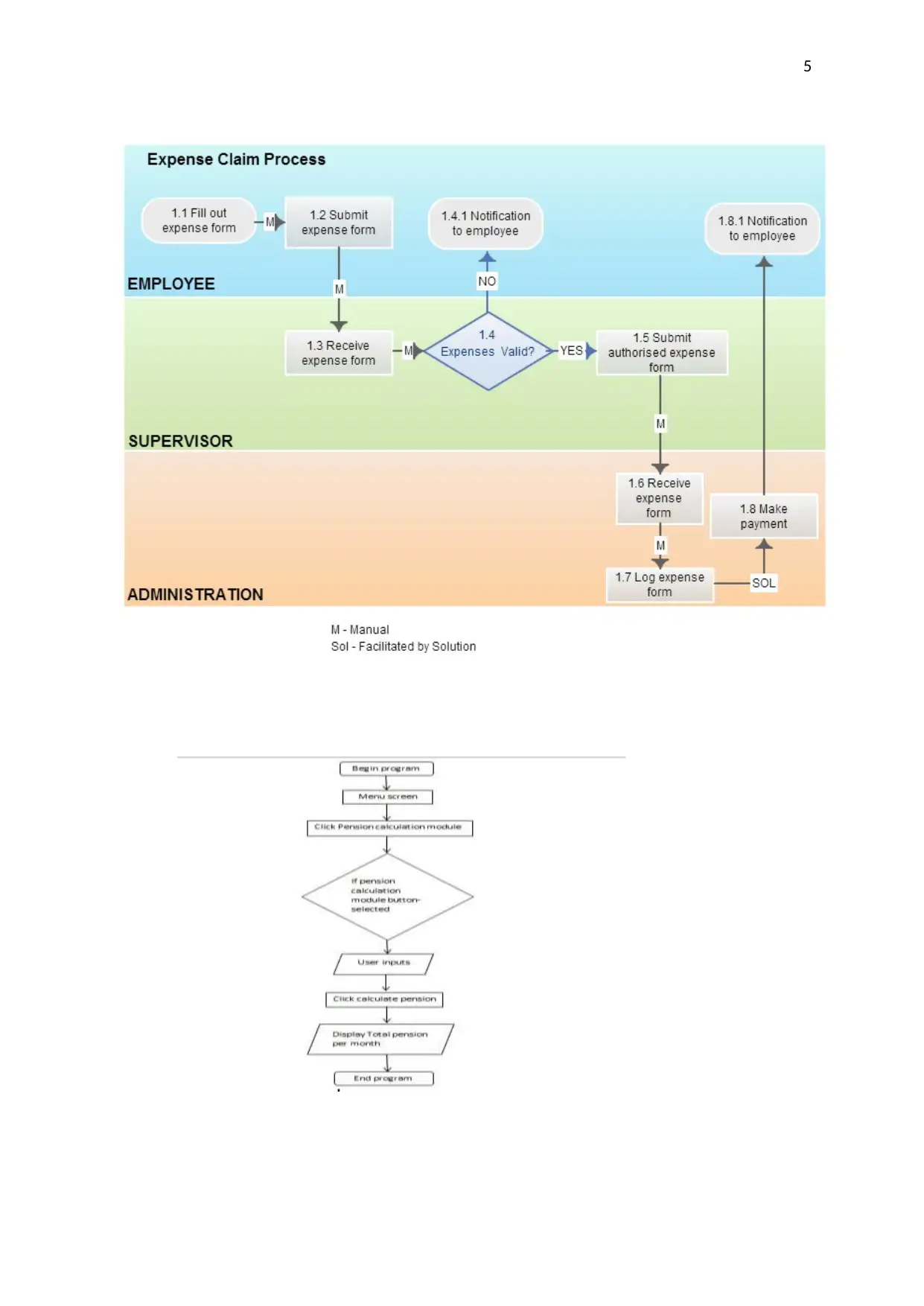
b) Develop a flowchart that shows the calculation logic for the determination of
the initial contribution rate using the PUC method.
include predicting the person’s age, health conditions, gender and even their possible
lifespan. Large statistical data that is creatable to the uncertain variables and that may lead to
a predictive variable (Ayuso, Bravo, and Holzmann, 2016).
This method is an estimate and a forecast on an uncertain variable used for the sole purpose
of calculating insurance premiums and benefits.
It may involve statistical data or mathematical models designed to evaluate the risk of a
particular risk event of pension and retirement benefits.
There are broad applications of actuarial assumptions including in the field of insurance,
computer programming and finance.
Assumptions of the EAN method
1. It is designed to calculate the projection, forecast and expectancy of a person seeking
the benefit of pension’s schemes.
2. Focuses on the projected premiums in the RNA and potential payouts for insurance
benefits and pension plans.
3. It include analysis of retirement contribution rates, mortality rates, and survivorship
and disability rates (Beetsma et al, 2019).
4. This method is an estimate and a forecast on an uncertain variable used for the sole
purpose of calculating insurance premiums and benefits.
b) Develop a flowchart that shows the calculation logic for the determination of
the initial contribution rate using the PUC method.
⊘ This is a preview!⊘
Do you want full access?
Subscribe today to unlock all pages.

Trusted by 1+ million students worldwide

4
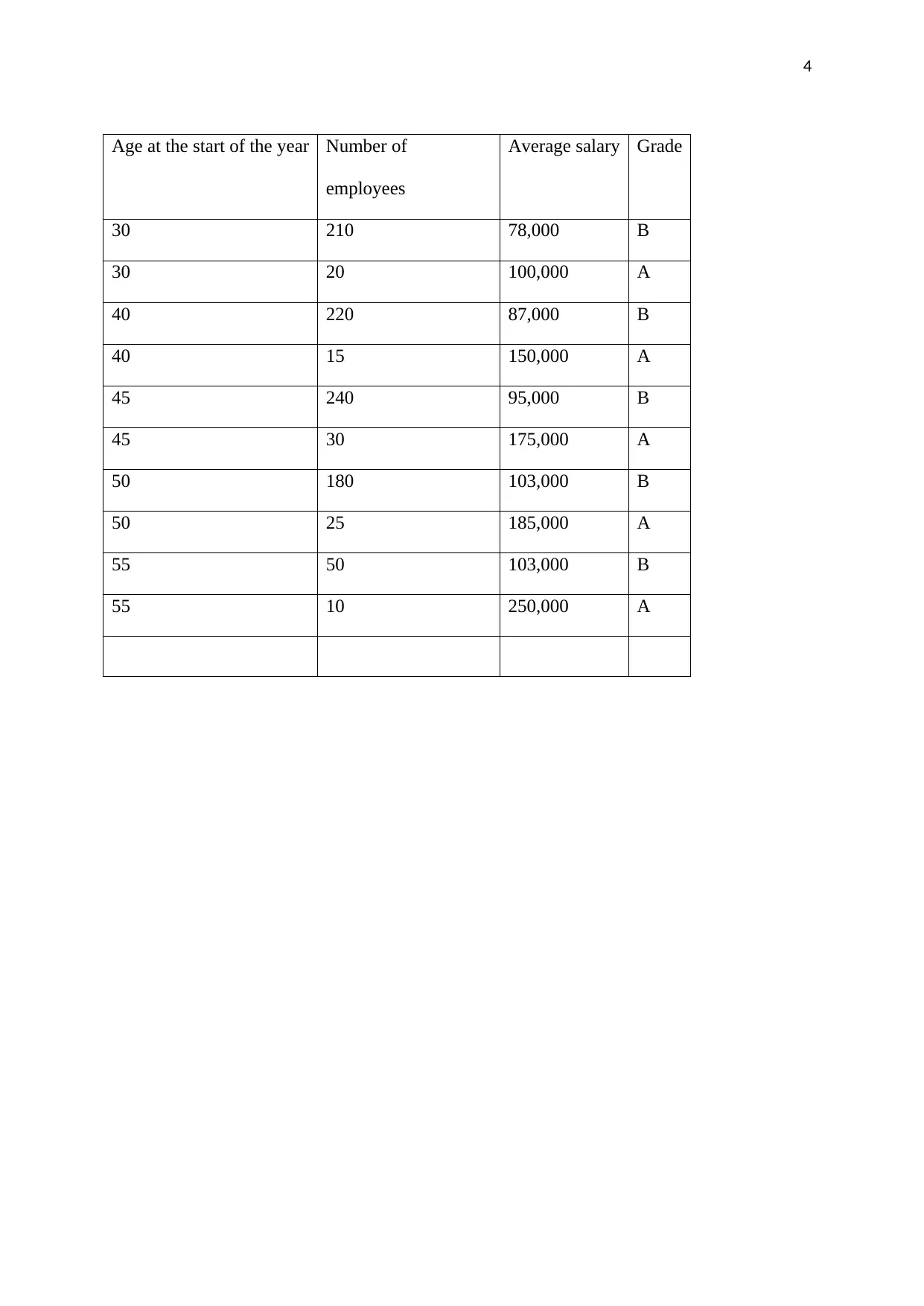
Age at the start of the year Number of
employees
Average salary Grade
30 210 78,000 B
30 20 100,000 A
40 220 87,000 B
40 15 150,000 A
45 240 95,000 B
45 30 175,000 A
50 180 103,000 B
50 25 185,000 A
55 50 103,000 B
55 10 250,000 A
Age at the start of the year Number of
employees
Average salary Grade
30 210 78,000 B
30 20 100,000 A
40 220 87,000 B
40 15 150,000 A
45 240 95,000 B
45 30 175,000 A
50 180 103,000 B
50 25 185,000 A
55 50 103,000 B
55 10 250,000 A
Paraphrase This Document
Need a fresh take? Get an instant paraphrase of this document with our AI Paraphraser

5

6
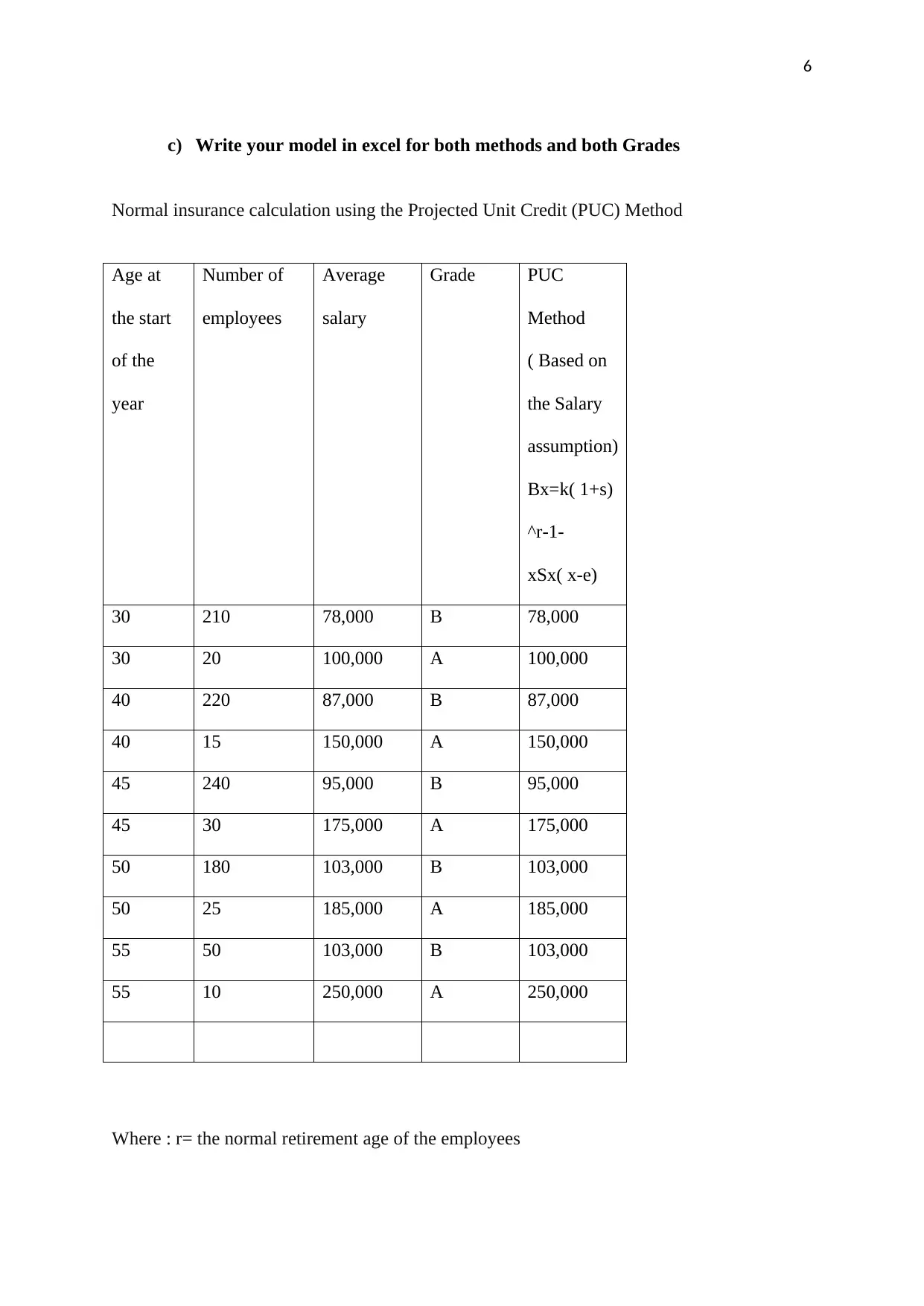
c) Write your model in excel for both methods and both Grades
Normal insurance calculation using the Projected Unit Credit (PUC) Method
Age at
the start
of the
year
Number of
employees
Average
salary
Grade PUC
Method
( Based on
the Salary
assumption)
Bx=k( 1+s)
^r-1-
xSx( x-e)
30 210 78,000 B 78,000
30 20 100,000 A 100,000
40 220 87,000 B 87,000
40 15 150,000 A 150,000
45 240 95,000 B 95,000
45 30 175,000 A 175,000
50 180 103,000 B 103,000
50 25 185,000 A 185,000
55 50 103,000 B 103,000
55 10 250,000 A 250,000
Where : r= the normal retirement age of the employees
c) Write your model in excel for both methods and both Grades
Normal insurance calculation using the Projected Unit Credit (PUC) Method
Age at
the start
of the
year
Number of
employees
Average
salary
Grade PUC
Method
( Based on
the Salary
assumption)
Bx=k( 1+s)
^r-1-
xSx( x-e)
30 210 78,000 B 78,000
30 20 100,000 A 100,000
40 220 87,000 B 87,000
40 15 150,000 A 150,000
45 240 95,000 B 95,000
45 30 175,000 A 175,000
50 180 103,000 B 103,000
50 25 185,000 A 185,000
55 50 103,000 B 103,000
55 10 250,000 A 250,000
Where : r= the normal retirement age of the employees
⊘ This is a preview!⊘
Do you want full access?
Subscribe today to unlock all pages.

Trusted by 1+ million students worldwide

7
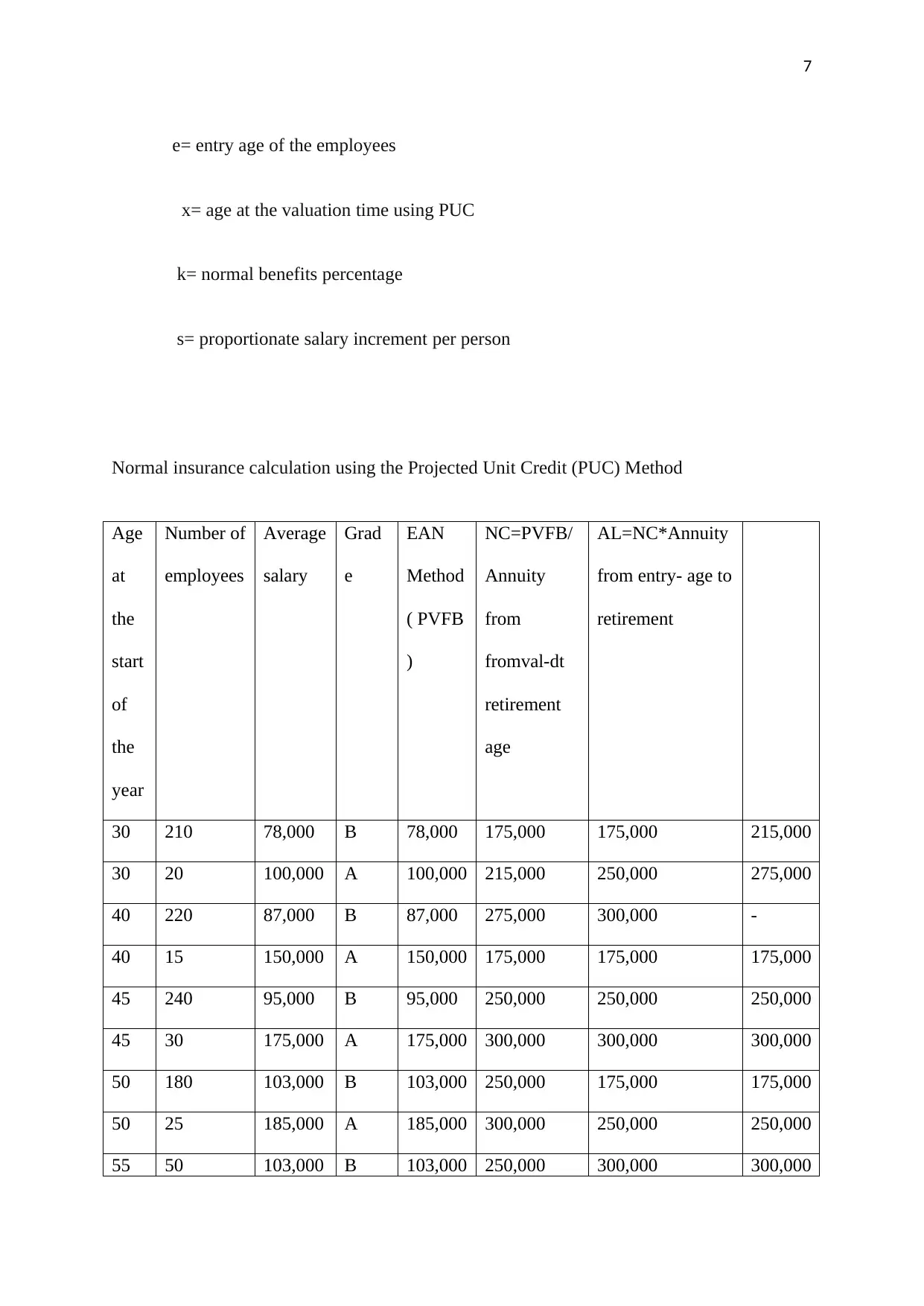
e= entry age of the employees
x= age at the valuation time using PUC
k= normal benefits percentage
s= proportionate salary increment per person
Normal insurance calculation using the Projected Unit Credit (PUC) Method
Age
at
the
start
of
the
year
Number of
employees
Average
salary
Grad
e
EAN
Method
( PVFB
)
NC=PVFB/
Annuity
from
fromval-dt
retirement
age
AL=NC*Annuity
from entry- age to
retirement
30 210 78,000 B 78,000 175,000 175,000 215,000
30 20 100,000 A 100,000 215,000 250,000 275,000
40 220 87,000 B 87,000 275,000 300,000 -
40 15 150,000 A 150,000 175,000 175,000 175,000
45 240 95,000 B 95,000 250,000 250,000 250,000
45 30 175,000 A 175,000 300,000 300,000 300,000
50 180 103,000 B 103,000 250,000 175,000 175,000
50 25 185,000 A 185,000 300,000 250,000 250,000
55 50 103,000 B 103,000 250,000 300,000 300,000
e= entry age of the employees
x= age at the valuation time using PUC
k= normal benefits percentage
s= proportionate salary increment per person
Normal insurance calculation using the Projected Unit Credit (PUC) Method
Age
at
the
start
of
the
year
Number of
employees
Average
salary
Grad
e
EAN
Method
( PVFB
)
NC=PVFB/
Annuity
from
fromval-dt
retirement
age
AL=NC*Annuity
from entry- age to
retirement
30 210 78,000 B 78,000 175,000 175,000 215,000
30 20 100,000 A 100,000 215,000 250,000 275,000
40 220 87,000 B 87,000 275,000 300,000 -
40 15 150,000 A 150,000 175,000 175,000 175,000
45 240 95,000 B 95,000 250,000 250,000 250,000
45 30 175,000 A 175,000 300,000 300,000 300,000
50 180 103,000 B 103,000 250,000 175,000 175,000
50 25 185,000 A 185,000 300,000 250,000 250,000
55 50 103,000 B 103,000 250,000 300,000 300,000
Paraphrase This Document
Need a fresh take? Get an instant paraphrase of this document with our AI Paraphraser

8
55 10 250,000 A 250,000 220,000 450,000 -
Where: r= the normal retirement age of the employees
e= entry age of the employees
x= age at the valuation time using PUC
k= normal benefits percentage
s= proportionate salary increment per person
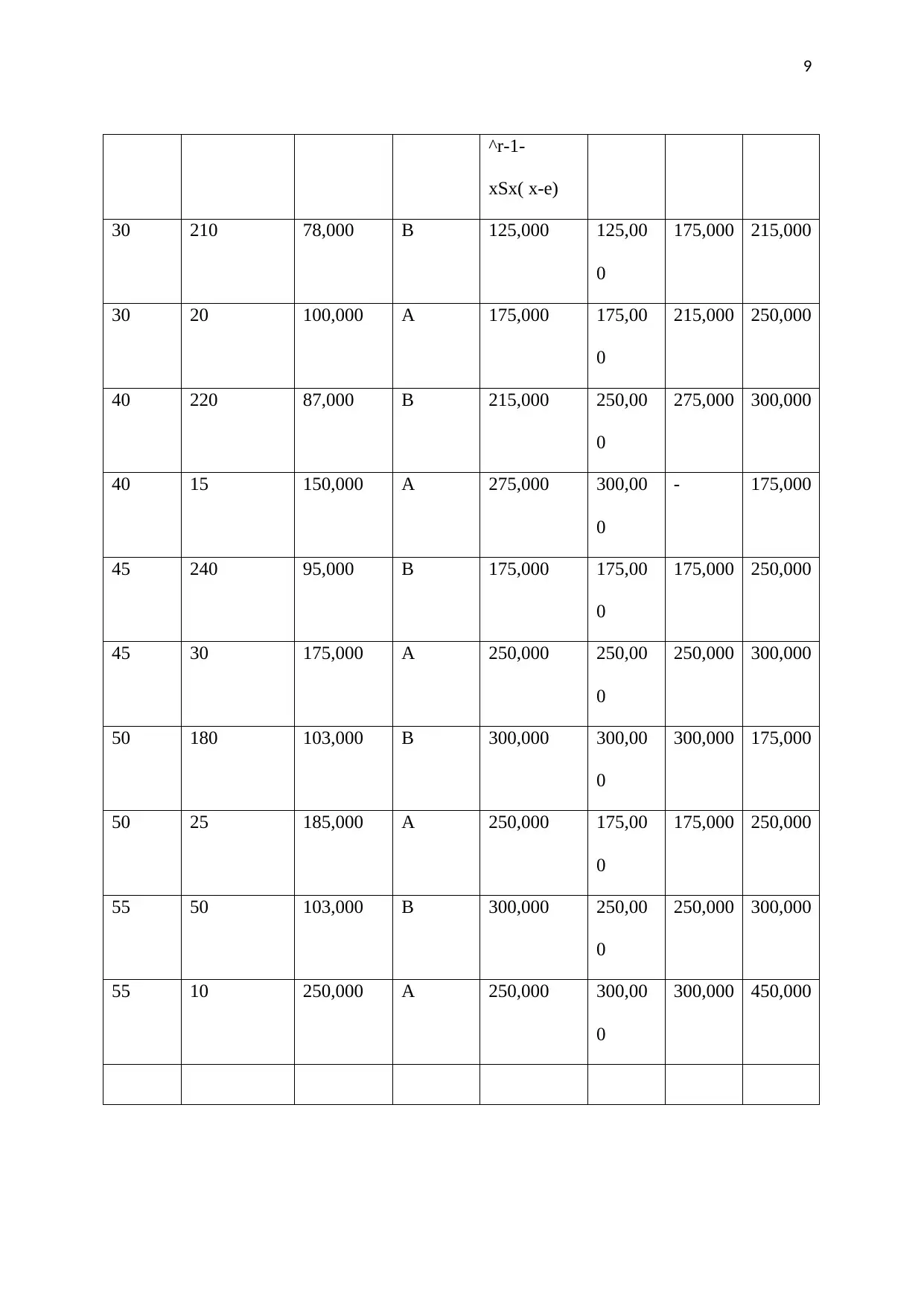
2. Determine the scheme’s funding position (for accrued past service benefits) in 15 years’
time, using your original assumptions and under each of the following scenarios
a. Contributions are calculated each year using PUC method determined at commencement
and updated every three years
Age at
the start
of the
year
Number of
employees
Average
salary
Grade PUC
Method
( Based on
the Salary
assumption)
Bx=k( 1+s)
Year 1 Year 2 Year 3
55 10 250,000 A 250,000 220,000 450,000 -
Where: r= the normal retirement age of the employees
e= entry age of the employees
x= age at the valuation time using PUC
k= normal benefits percentage
s= proportionate salary increment per person
2. Determine the scheme’s funding position (for accrued past service benefits) in 15 years’
time, using your original assumptions and under each of the following scenarios
a. Contributions are calculated each year using PUC method determined at commencement
and updated every three years
Age at
the start
of the
year
Number of
employees
Average
salary
Grade PUC
Method
( Based on
the Salary
assumption)
Bx=k( 1+s)
Year 1 Year 2 Year 3

9
^r-1-
xSx( x-e)
30 210 78,000 B 125,000 125,00
0
175,000 215,000
30 20 100,000 A 175,000 175,00
0
215,000 250,000
40 220 87,000 B 215,000 250,00
0
275,000 300,000
40 15 150,000 A 275,000 300,00
0
- 175,000
45 240 95,000 B 175,000 175,00
0
175,000 250,000
45 30 175,000 A 250,000 250,00
0
250,000 300,000
50 180 103,000 B 300,000 300,00
0
300,000 175,000
50 25 185,000 A 250,000 175,00
0
175,000 250,000
55 50 103,000 B 300,000 250,00
0
250,000 300,000
55 10 250,000 A 250,000 300,00
0
300,000 450,000
^r-1-
xSx( x-e)
30 210 78,000 B 125,000 125,00
0
175,000 215,000
30 20 100,000 A 175,000 175,00
0
215,000 250,000
40 220 87,000 B 215,000 250,00
0
275,000 300,000
40 15 150,000 A 275,000 300,00
0
- 175,000
45 240 95,000 B 175,000 175,00
0
175,000 250,000
45 30 175,000 A 250,000 250,00
0
250,000 300,000
50 180 103,000 B 300,000 300,00
0
300,000 175,000
50 25 185,000 A 250,000 175,00
0
175,000 250,000
55 50 103,000 B 300,000 250,00
0
250,000 300,000
55 10 250,000 A 250,000 300,00
0
300,000 450,000
⊘ This is a preview!⊘
Do you want full access?
Subscribe today to unlock all pages.

Trusted by 1+ million students worldwide

10
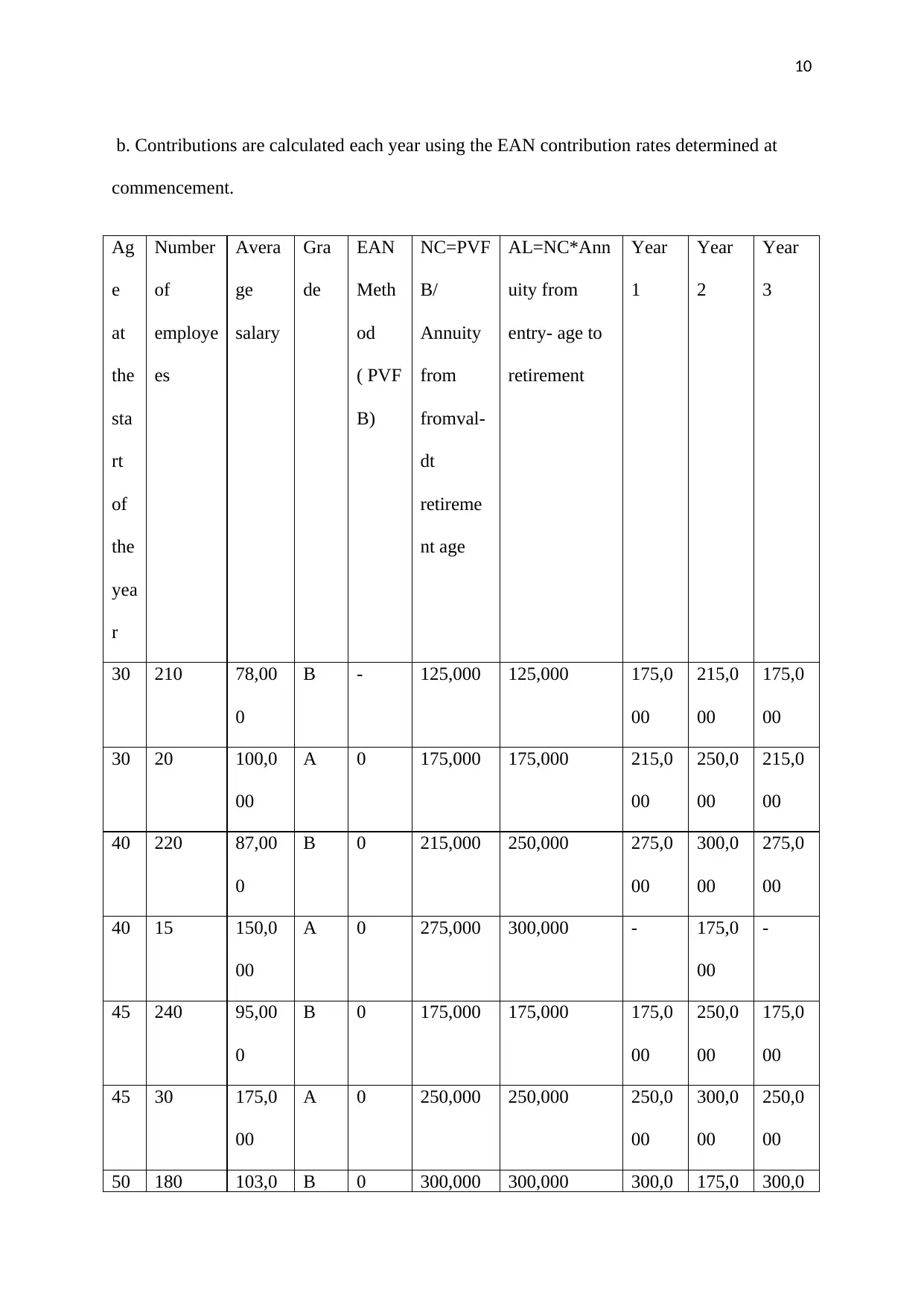
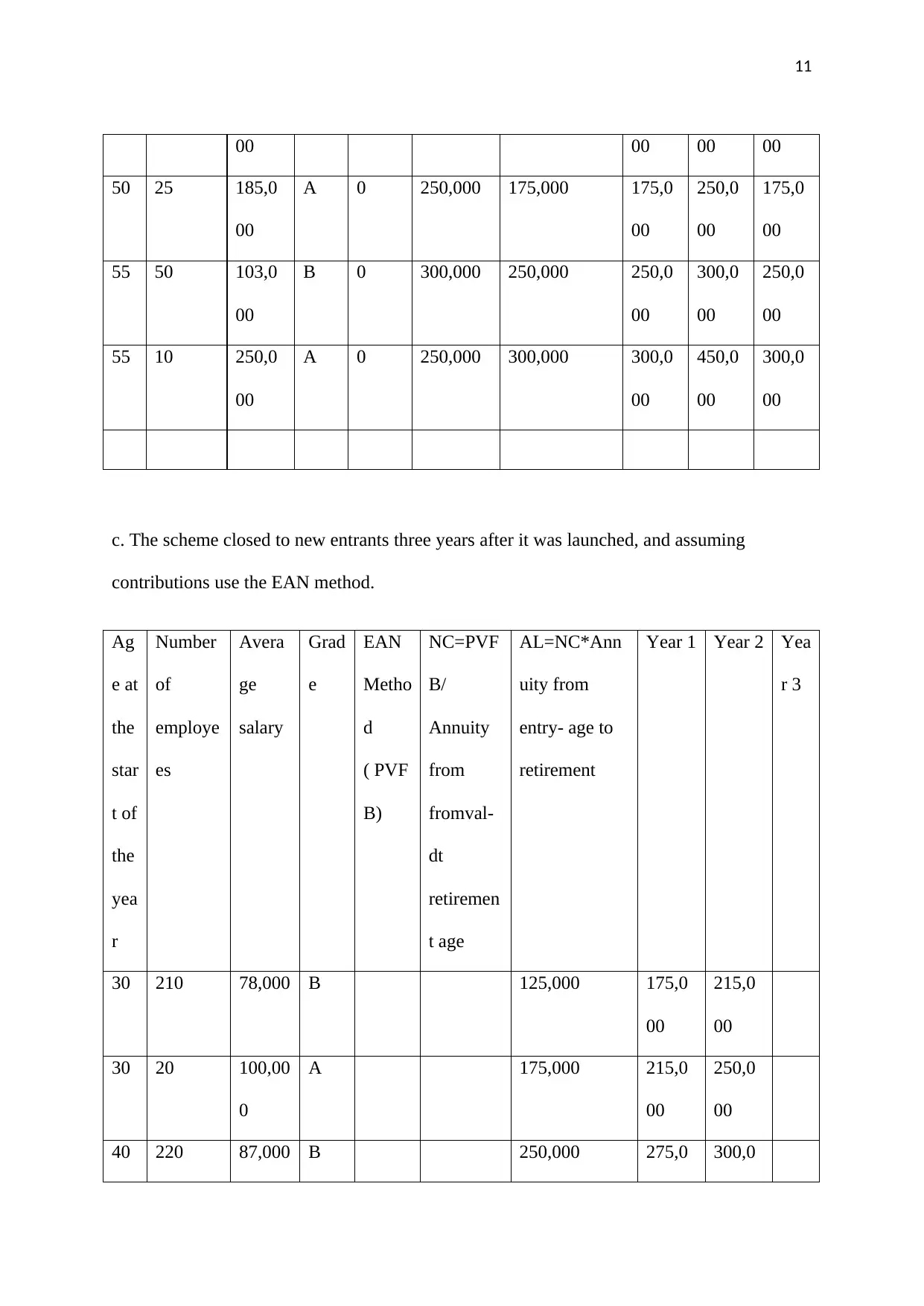
b. Contributions are calculated each year using the EAN contribution rates determined at
commencement.
Ag
e
at
the
sta
rt
of
the
yea
r
Number
of
employe
es
Avera
ge
salary
Gra
de
EAN
Meth
od
( PVF
B)
NC=PVF
B/
Annuity
from
fromval-
dt
retireme
nt age
AL=NC*Ann
uity from
entry- age to
retirement
Year
1
Year
2
Year
3
30 210 78,00
0
B - 125,000 125,000 175,0
00
215,0
00
175,0
00
30 20 100,0
00
A 0 175,000 175,000 215,0
00
250,0
00
215,0
00
40 220 87,00
0
B 0 215,000 250,000 275,0
00
300,0
00
275,0
00
40 15 150,0
00
A 0 275,000 300,000 - 175,0
00
-
45 240 95,00
0
B 0 175,000 175,000 175,0
00
250,0
00
175,0
00
45 30 175,0
00
A 0 250,000 250,000 250,0
00
300,0
00
250,0
00
50 180 103,0 B 0 300,000 300,000 300,0 175,0 300,0
b. Contributions are calculated each year using the EAN contribution rates determined at
commencement.
Ag
e
at
the
sta
rt
of
the
yea
r
Number
of
employe
es
Avera
ge
salary
Gra
de
EAN
Meth
od
( PVF
B)
NC=PVF
B/
Annuity
from
fromval-
dt
retireme
nt age
AL=NC*Ann
uity from
entry- age to
retirement
Year
1
Year
2
Year
3
30 210 78,00
0
B - 125,000 125,000 175,0
00
215,0
00
175,0
00
30 20 100,0
00
A 0 175,000 175,000 215,0
00
250,0
00
215,0
00
40 220 87,00
0
B 0 215,000 250,000 275,0
00
300,0
00
275,0
00
40 15 150,0
00
A 0 275,000 300,000 - 175,0
00
-
45 240 95,00
0
B 0 175,000 175,000 175,0
00
250,0
00
175,0
00
45 30 175,0
00
A 0 250,000 250,000 250,0
00
300,0
00
250,0
00
50 180 103,0 B 0 300,000 300,000 300,0 175,0 300,0
Paraphrase This Document
Need a fresh take? Get an instant paraphrase of this document with our AI Paraphraser

11
00 00 00 00
50 25 185,0
00
A 0 250,000 175,000 175,0
00
250,0
00
175,0
00
55 50 103,0
00
B 0 300,000 250,000 250,0
00
300,0
00
250,0
00
55 10 250,0
00
A 0 250,000 300,000 300,0
00
450,0
00
300,0
00
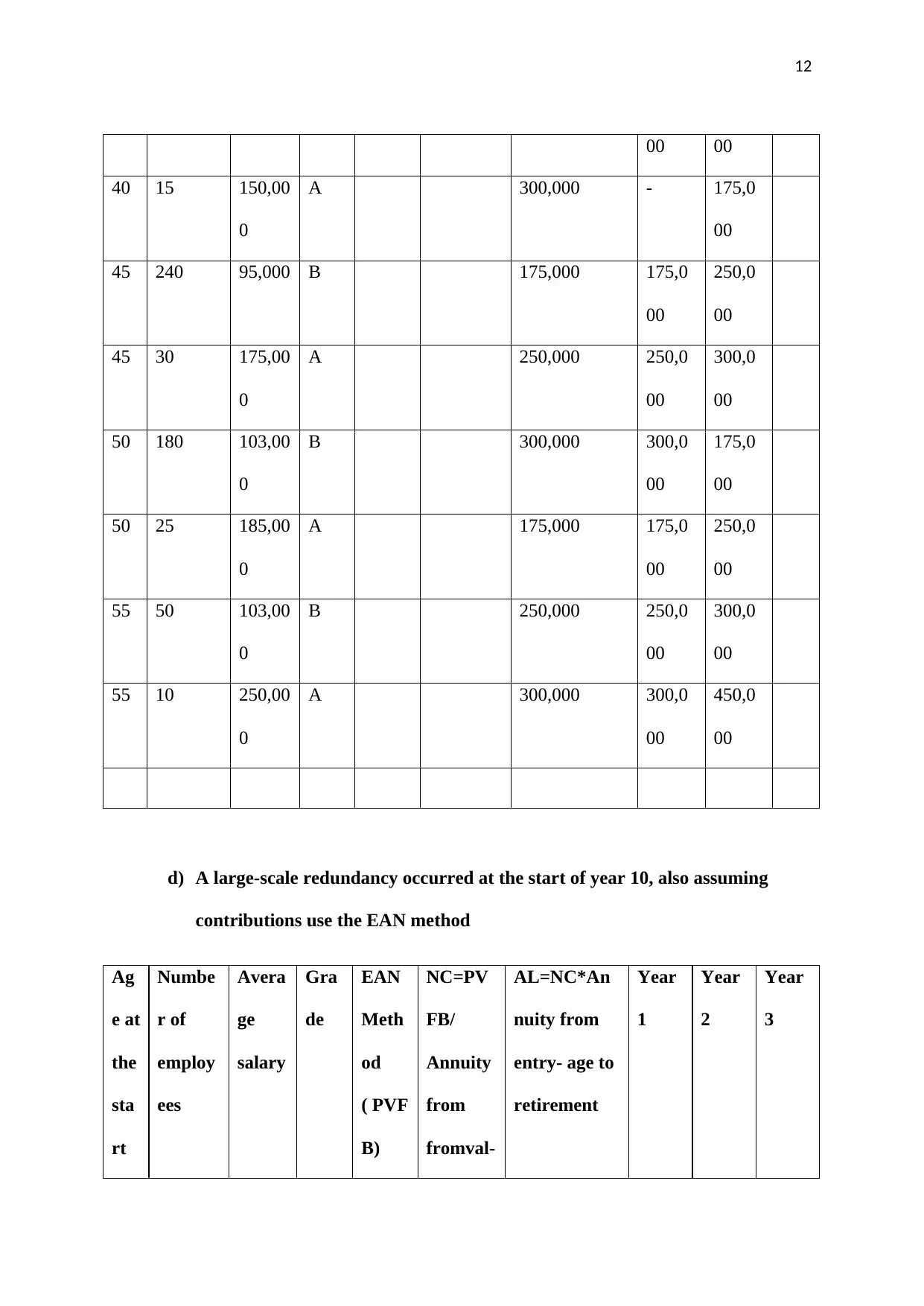
c. The scheme closed to new entrants three years after it was launched, and assuming
contributions use the EAN method.
Ag
e at
the
star
t of
the
yea
r
Number
of
employe
es
Avera
ge
salary
Grad
e
EAN
Metho
d
( PVF
B)
NC=PVF
B/
Annuity
from
fromval-
dt
retiremen
t age
AL=NC*Ann
uity from
entry- age to
retirement
Year 1 Year 2 Yea
r 3
30 210 78,000 B 125,000 175,0
00
215,0
00
30 20 100,00
0
A 175,000 215,0
00
250,0
00
40 220 87,000 B 250,000 275,0 300,0
00 00 00 00
50 25 185,0
00
A 0 250,000 175,000 175,0
00
250,0
00
175,0
00
55 50 103,0
00
B 0 300,000 250,000 250,0
00
300,0
00
250,0
00
55 10 250,0
00
A 0 250,000 300,000 300,0
00
450,0
00
300,0
00
c. The scheme closed to new entrants three years after it was launched, and assuming
contributions use the EAN method.
Ag
e at
the
star
t of
the
yea
r
Number
of
employe
es
Avera
ge
salary
Grad
e
EAN
Metho
d
( PVF
B)
NC=PVF
B/
Annuity
from
fromval-
dt
retiremen
t age
AL=NC*Ann
uity from
entry- age to
retirement
Year 1 Year 2 Yea
r 3
30 210 78,000 B 125,000 175,0
00
215,0
00
30 20 100,00
0
A 175,000 215,0
00
250,0
00
40 220 87,000 B 250,000 275,0 300,0

12
00 00
40 15 150,00
0
A 300,000 - 175,0
00
45 240 95,000 B 175,000 175,0
00
250,0
00
45 30 175,00
0
A 250,000 250,0
00
300,0
00
50 180 103,00
0
B 300,000 300,0
00
175,0
00
50 25 185,00
0
A 175,000 175,0
00
250,0
00
55 50 103,00
0
B 250,000 250,0
00
300,0
00
55 10 250,00
0
A 300,000 300,0
00
450,0
00
d) A large-scale redundancy occurred at the start of year 10, also assuming
contributions use the EAN method
Ag
e at
the
sta
rt
Numbe
r of
employ
ees
Avera
ge
salary
Gra
de
EAN
Meth
od
( PVF
B)
NC=PV
FB/
Annuity
from
fromval-
AL=NC*An
nuity from
entry- age to
retirement
Year
1
Year
2
Year
3
00 00
40 15 150,00
0
A 300,000 - 175,0
00
45 240 95,000 B 175,000 175,0
00
250,0
00
45 30 175,00
0
A 250,000 250,0
00
300,0
00
50 180 103,00
0
B 300,000 300,0
00
175,0
00
50 25 185,00
0
A 175,000 175,0
00
250,0
00
55 50 103,00
0
B 250,000 250,0
00
300,0
00
55 10 250,00
0
A 300,000 300,0
00
450,0
00
d) A large-scale redundancy occurred at the start of year 10, also assuming
contributions use the EAN method
Ag
e at
the
sta
rt
Numbe
r of
employ
ees
Avera
ge
salary
Gra
de
EAN
Meth
od
( PVF
B)
NC=PV
FB/
Annuity
from
fromval-
AL=NC*An
nuity from
entry- age to
retirement
Year
1
Year
2
Year
3
⊘ This is a preview!⊘
Do you want full access?
Subscribe today to unlock all pages.

Trusted by 1+ million students worldwide
1 out of 21
Related Documents
Your All-in-One AI-Powered Toolkit for Academic Success.
 +13062052269
info@desklib.com
Available 24*7 on WhatsApp / Email
Unlock your academic potential
Copyright © 2020–2025 A2Z Services. All Rights Reserved. Developed and managed by ZUCOL.