Analysis of Rewards Management on Employee Performance Dissertation
VerifiedAdded on 2019/12/28
|43
|10407
|163
Thesis and Dissertation
AI Summary
This dissertation examines the impact of rewards management on employee performance and retention, focusing on the senior management within the hospitality industry. The study explores the concept of reward management, different types of rewards (intrinsic, extrinsic, financial, non-financial, performance-based, and membership-based), and their effects on employee motivation, productivity, and retention. The research includes a literature review, detailed research methodology, and analysis of the findings. The study aims to understand the meaning of rewards management and recognition, investigate their use for performance and retention, and identify their impact on increasing performance and retention within the senior section of an organization. The dissertation provides insights into how rewards and recognition strategies can be effectively implemented to enhance employee satisfaction, improve performance, and reduce employee turnover, offering valuable information for both academics and practitioners in the field of HRM. The study is based on a case study of a hotel brand, analyzing its reward management practices and their impact on the workforce.

DISSERTATION
HRM
HRM

Paraphrase This Document
Need a fresh take? Get an instant paraphrase of this document with our AI Paraphraser
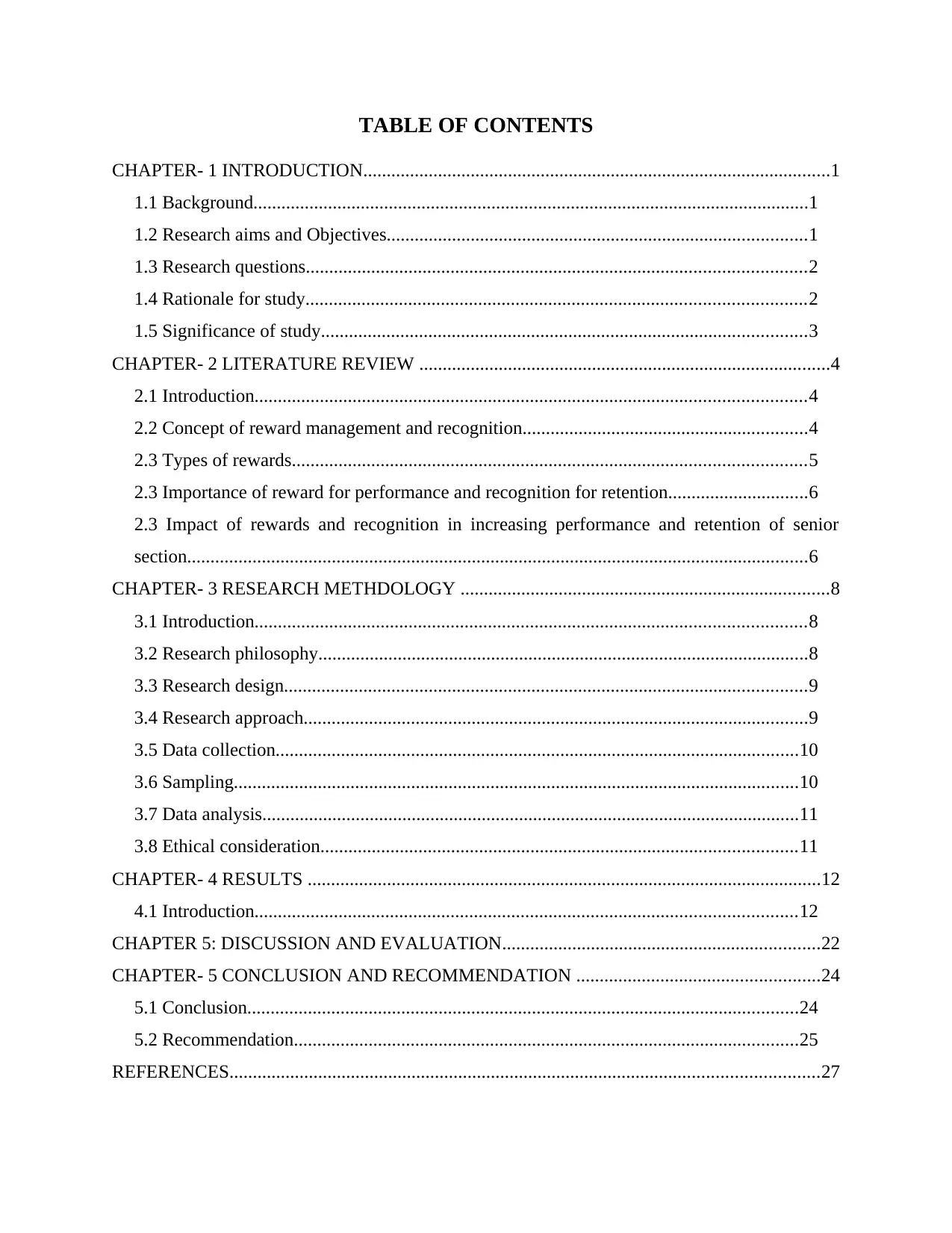
TABLE OF CONTENTS
CHAPTER- 1 INTRODUCTION....................................................................................................1
1.1 Background.......................................................................................................................1
1.2 Research aims and Objectives..........................................................................................1
1.3 Research questions...........................................................................................................2
1.4 Rationale for study...........................................................................................................2
1.5 Significance of study........................................................................................................3
CHAPTER- 2 LITERATURE REVIEW ........................................................................................4
2.1 Introduction......................................................................................................................4
2.2 Concept of reward management and recognition.............................................................4
2.3 Types of rewards..............................................................................................................5
2.3 Importance of reward for performance and recognition for retention..............................6
2.3 Impact of rewards and recognition in increasing performance and retention of senior
section.....................................................................................................................................6
CHAPTER- 3 RESEARCH METHDOLOGY ...............................................................................8
3.1 Introduction......................................................................................................................8
3.2 Research philosophy.........................................................................................................8
3.3 Research design................................................................................................................9
3.4 Research approach............................................................................................................9
3.5 Data collection................................................................................................................10
3.6 Sampling.........................................................................................................................10
3.7 Data analysis...................................................................................................................11
3.8 Ethical consideration......................................................................................................11
CHAPTER- 4 RESULTS ..............................................................................................................12
4.1 Introduction....................................................................................................................12
CHAPTER 5: DISCUSSION AND EVALUATION....................................................................22
CHAPTER- 5 CONCLUSION AND RECOMMENDATION ....................................................24
5.1 Conclusion......................................................................................................................24
5.2 Recommendation............................................................................................................25
REFERENCES..............................................................................................................................27
CHAPTER- 1 INTRODUCTION....................................................................................................1
1.1 Background.......................................................................................................................1
1.2 Research aims and Objectives..........................................................................................1
1.3 Research questions...........................................................................................................2
1.4 Rationale for study...........................................................................................................2
1.5 Significance of study........................................................................................................3
CHAPTER- 2 LITERATURE REVIEW ........................................................................................4
2.1 Introduction......................................................................................................................4
2.2 Concept of reward management and recognition.............................................................4
2.3 Types of rewards..............................................................................................................5
2.3 Importance of reward for performance and recognition for retention..............................6
2.3 Impact of rewards and recognition in increasing performance and retention of senior
section.....................................................................................................................................6
CHAPTER- 3 RESEARCH METHDOLOGY ...............................................................................8
3.1 Introduction......................................................................................................................8
3.2 Research philosophy.........................................................................................................8
3.3 Research design................................................................................................................9
3.4 Research approach............................................................................................................9
3.5 Data collection................................................................................................................10
3.6 Sampling.........................................................................................................................10
3.7 Data analysis...................................................................................................................11
3.8 Ethical consideration......................................................................................................11
CHAPTER- 4 RESULTS ..............................................................................................................12
4.1 Introduction....................................................................................................................12
CHAPTER 5: DISCUSSION AND EVALUATION....................................................................22
CHAPTER- 5 CONCLUSION AND RECOMMENDATION ....................................................24
5.1 Conclusion......................................................................................................................24
5.2 Recommendation............................................................................................................25
REFERENCES..............................................................................................................................27
CHAPTER- 1 INTRODUCTION
1.1 Background
In the present era the organizations demonstrates higher degree of commitment with
respect to reinforcement of the practices related with rewards that are being aligned with other
HR practices as well as goals of the firm in order to attract, retain as well as motivate the
personnel (Obeidat and Abdallah, 2014). Suitable reward practice act as an aid in attracting
towards result driven professionals who can thrive as well as succeed within the environment
that is performance based. Therefore such is considered as crucial motivator and provides greater
contribution towards increasing the productivity of the personnel in case it is being executed in
an effective manner (Cobb, 2016).
An effective management of the reward system has greater advantageous influence over
the personnel in various manner. This includes facilitating longer term emphasis with continuous
enhancement, reduction in the service operating costs, encourages team work, reduce
dissatisfaction among employees and increase interest among the personnel within the financial
performance of the firm (Cobb, 2016). Higher performance business keeps management of their
reward practices in a manner that it is enabling them to make prediction of what kind of
innovation can work in the best manner as well as ensures what is being done for the sake of
delivering outcomes that are expected (Fay and et.al, 2015).
Company information
Study will be based on firm which are operating in the hospitality industry. Hotel is well
known leading budget hotel brand which offer luxurious services at budget price. It is operating
its business at large scale in the hospitality industry. It is an international type of hotel which
provides Wi-Fi services, luxurious rooms, meeting rooms to its valuable customers. It is
operating its business across the world. It is considered as most luxurious brand in the hospitality
industry and there are more than 250 employees are working. Mainly it has its head quarter in
central of London. Hotel provides all kind of facilities to its consumers as per their needs and
requirements. Hotel target market is women and men between age of 20-45. It targets its
consumers on the bases of their income level, its facilities are quit costly thus people those who
are having good income source they can enjoy services of the company. Across the world cited
firm has more than 30 branches where skilled people are working ad they are contributing well in
the success of entity. UK is the famous place from the tourism point of view, hotel is able to
1
1.1 Background
In the present era the organizations demonstrates higher degree of commitment with
respect to reinforcement of the practices related with rewards that are being aligned with other
HR practices as well as goals of the firm in order to attract, retain as well as motivate the
personnel (Obeidat and Abdallah, 2014). Suitable reward practice act as an aid in attracting
towards result driven professionals who can thrive as well as succeed within the environment
that is performance based. Therefore such is considered as crucial motivator and provides greater
contribution towards increasing the productivity of the personnel in case it is being executed in
an effective manner (Cobb, 2016).
An effective management of the reward system has greater advantageous influence over
the personnel in various manner. This includes facilitating longer term emphasis with continuous
enhancement, reduction in the service operating costs, encourages team work, reduce
dissatisfaction among employees and increase interest among the personnel within the financial
performance of the firm (Cobb, 2016). Higher performance business keeps management of their
reward practices in a manner that it is enabling them to make prediction of what kind of
innovation can work in the best manner as well as ensures what is being done for the sake of
delivering outcomes that are expected (Fay and et.al, 2015).
Company information
Study will be based on firm which are operating in the hospitality industry. Hotel is well
known leading budget hotel brand which offer luxurious services at budget price. It is operating
its business at large scale in the hospitality industry. It is an international type of hotel which
provides Wi-Fi services, luxurious rooms, meeting rooms to its valuable customers. It is
operating its business across the world. It is considered as most luxurious brand in the hospitality
industry and there are more than 250 employees are working. Mainly it has its head quarter in
central of London. Hotel provides all kind of facilities to its consumers as per their needs and
requirements. Hotel target market is women and men between age of 20-45. It targets its
consumers on the bases of their income level, its facilities are quit costly thus people those who
are having good income source they can enjoy services of the company. Across the world cited
firm has more than 30 branches where skilled people are working ad they are contributing well in
the success of entity. UK is the famous place from the tourism point of view, hotel is able to
1
⊘ This is a preview!⊘
Do you want full access?
Subscribe today to unlock all pages.

Trusted by 1+ million students worldwide
attract tourist by providing them quality services. It is situated near airports, railway stations and
offer products and services at affordable prices as compared to other global hotels (Types of
Employee Recognition and Rewards, 2017).
Study will discuss the use of rewards management as performance and recognition for the
retention of employee within the senior section (5 Tips for Effective Employee Recognition,
2017). Literature of other authors will be reviewed in this study so that in depth information can
be collected. Research methodologies will be described and discussion or evaluation will be done
of the subject matter.
1.2 Research aims and Objectives
Aim: To Analysis of the use of rewards management to improve performance as recognition for
employees within the senior management.
Research Objectives:
To understand the concept of rewards management and recognition.
To investigate the use of rewards management as performance and recognition for the
retention of employee within the senior section of organization.
To identify the impact of rewards and recognition in increasing performance and
retention of senior section in the organization.
1.3 Research questions
What is the meaning of rewards management and recognition.
Explain the use of rewards management to improve performance as recognition for the
retention of employee within the senior section of organization.
What is the impact of rewards and recognition in increasing performance of senior
section in the organization.
1.4 Rationale for study
In the present era there is increase in issues related with minimizing retention of the
personnel. Along with this lack of proper reward is affecting the performance of the employees
to a greater extent. As the competition among the business has enhanced thus there is greater
need towards the business to develop the strategies that can assist in retention of the skilled
personnel for longer span of time (Goetsch and Davis, 2014). Rewards and recognition are
2
offer products and services at affordable prices as compared to other global hotels (Types of
Employee Recognition and Rewards, 2017).
Study will discuss the use of rewards management as performance and recognition for the
retention of employee within the senior section (5 Tips for Effective Employee Recognition,
2017). Literature of other authors will be reviewed in this study so that in depth information can
be collected. Research methodologies will be described and discussion or evaluation will be done
of the subject matter.
1.2 Research aims and Objectives
Aim: To Analysis of the use of rewards management to improve performance as recognition for
employees within the senior management.
Research Objectives:
To understand the concept of rewards management and recognition.
To investigate the use of rewards management as performance and recognition for the
retention of employee within the senior section of organization.
To identify the impact of rewards and recognition in increasing performance and
retention of senior section in the organization.
1.3 Research questions
What is the meaning of rewards management and recognition.
Explain the use of rewards management to improve performance as recognition for the
retention of employee within the senior section of organization.
What is the impact of rewards and recognition in increasing performance of senior
section in the organization.
1.4 Rationale for study
In the present era there is increase in issues related with minimizing retention of the
personnel. Along with this lack of proper reward is affecting the performance of the employees
to a greater extent. As the competition among the business has enhanced thus there is greater
need towards the business to develop the strategies that can assist in retention of the skilled
personnel for longer span of time (Goetsch and Davis, 2014). Rewards and recognition are
2
Paraphrase This Document
Need a fresh take? Get an instant paraphrase of this document with our AI Paraphraser
regarded as important factors that helps in attainment of the success by the firm in an effective
manner. The issue can be resolved when the business would employee suitable reward system so
that it is able to provide satisfaction to the employees to a significant level. Apart from this it is
competitive era competitors are offering attracting packages to the skilled employees. That is
why they are moving towards other brands, if they are not getting satisfactory salary packages in
the existing workplace (Cobb, 2016). Companies have to understand requirement of people and
pay attention to hold skilled persons in the organization for longer duration. Through this study
scholar will be able to find ways of encouraging management employees so that their
performance can be improved and they can contribute well in accomplishing goal of the firm.
The present investigation would shed light on the concept of reward system as well as
recognition towards enhancing the performance as well as increasing retention of the personnel
(Navimipour and Zareie, 2015).
1.5 Significance of study
Every research is carried out with a particular aim. The aim of the present thesis is
towards analysing the use of rewards management to improve performance as recognition for
employees within the senior management. The present study would assist the academician. This
is when carrying out PH.D. The investigation will provide greater deal towards offering
knowledge regarding the impact of rewards system on the performance of personnel. The current
research is very important by this way organizations will get to know difference between rewards
and recognition (Obeidat and Abdallah, 2014). That will support them in identifying the situation
that how rewards system can enhance efficiency of performance of managers and how
recognition can enhance their retention rate. By this way they will be able to measure the
performance of the company and authorities will be able to make strategies so that sustainability
of workers can get improved and they work better in the workplace. Through this study
management level people will get to know about new strategies and techniques that can help in
improving retention rate of its workers (Storey, 2014).
3
manner. The issue can be resolved when the business would employee suitable reward system so
that it is able to provide satisfaction to the employees to a significant level. Apart from this it is
competitive era competitors are offering attracting packages to the skilled employees. That is
why they are moving towards other brands, if they are not getting satisfactory salary packages in
the existing workplace (Cobb, 2016). Companies have to understand requirement of people and
pay attention to hold skilled persons in the organization for longer duration. Through this study
scholar will be able to find ways of encouraging management employees so that their
performance can be improved and they can contribute well in accomplishing goal of the firm.
The present investigation would shed light on the concept of reward system as well as
recognition towards enhancing the performance as well as increasing retention of the personnel
(Navimipour and Zareie, 2015).
1.5 Significance of study
Every research is carried out with a particular aim. The aim of the present thesis is
towards analysing the use of rewards management to improve performance as recognition for
employees within the senior management. The present study would assist the academician. This
is when carrying out PH.D. The investigation will provide greater deal towards offering
knowledge regarding the impact of rewards system on the performance of personnel. The current
research is very important by this way organizations will get to know difference between rewards
and recognition (Obeidat and Abdallah, 2014). That will support them in identifying the situation
that how rewards system can enhance efficiency of performance of managers and how
recognition can enhance their retention rate. By this way they will be able to measure the
performance of the company and authorities will be able to make strategies so that sustainability
of workers can get improved and they work better in the workplace. Through this study
management level people will get to know about new strategies and techniques that can help in
improving retention rate of its workers (Storey, 2014).
3
CHAPTER- 2 LITERATURE REVIEW
2.1 Introduction
This is considered as the most effective section as it act as an aid for the researcher in
determining the gaps that prevails in the past. There is existence of several investigator who have
reflected varied data with respect to phenomenon under the study. In the particular section
various theories have been developed as per the understanding which the author possess (Yang,
Huang and Hsu, 2014). In this section critical analysis will be done on the basis of the past
information on same subject. In the present dissertation the section of literature review will
facilitates in enhancing appropriate knowledge with respect to impact of reward system on the
performance of the employees (Cobb, 2016).
2.2 Concept of reward management and recognition
Reward management deals with the development as well as execution of the strategies as
well as policies which aims at rewarding the people in fair, equitable as well as consistent
manner as per their value to the business. In accordance with the views of Shields and et.al,
(2015) it has been examined that reward management is comprised of analysis as well as control
of the personnel compensation, remuneration as well as other advantages for the employees.
Along with this reward management possess the aim to make creation as well as effectively
operate the structure of reward for the business (Cobb, 2016). The structure associated with the
reward is comprised of the policies as well as practices relating with the pay, total reward,
minimum wage as well as team reward. Entity is required to make changes in its HR policies that
will support in improving condition of the company. It would help in managing the operations
effectively (Bustamam, Teng and Abdullah, 2014). Changes in existing policy is quit easy
because manager can identify loop fall in the practices and can modify specific policies .
Development of new policy is more costly as compare to modifications. Cited firm can
coordinate with all staff members via email, social networking sites, internet, telephonic and can
make them aware with reward system. It would be manageable by corporation and it would be
able to implement suggestion in cost effective ways (Cobb, 2016).
In contrast to this recognition is considered as the action or the procedure associated with
recognizing or being recognized in particular. This has been assessed that recognition is suitable
for the personnel in terms that it is effective in making them feel motivated for the actions that
are being performed by them. As per the views of Bustamam, Teng and Abdullah, (2014) it has
4
2.1 Introduction
This is considered as the most effective section as it act as an aid for the researcher in
determining the gaps that prevails in the past. There is existence of several investigator who have
reflected varied data with respect to phenomenon under the study. In the particular section
various theories have been developed as per the understanding which the author possess (Yang,
Huang and Hsu, 2014). In this section critical analysis will be done on the basis of the past
information on same subject. In the present dissertation the section of literature review will
facilitates in enhancing appropriate knowledge with respect to impact of reward system on the
performance of the employees (Cobb, 2016).
2.2 Concept of reward management and recognition
Reward management deals with the development as well as execution of the strategies as
well as policies which aims at rewarding the people in fair, equitable as well as consistent
manner as per their value to the business. In accordance with the views of Shields and et.al,
(2015) it has been examined that reward management is comprised of analysis as well as control
of the personnel compensation, remuneration as well as other advantages for the employees.
Along with this reward management possess the aim to make creation as well as effectively
operate the structure of reward for the business (Cobb, 2016). The structure associated with the
reward is comprised of the policies as well as practices relating with the pay, total reward,
minimum wage as well as team reward. Entity is required to make changes in its HR policies that
will support in improving condition of the company. It would help in managing the operations
effectively (Bustamam, Teng and Abdullah, 2014). Changes in existing policy is quit easy
because manager can identify loop fall in the practices and can modify specific policies .
Development of new policy is more costly as compare to modifications. Cited firm can
coordinate with all staff members via email, social networking sites, internet, telephonic and can
make them aware with reward system. It would be manageable by corporation and it would be
able to implement suggestion in cost effective ways (Cobb, 2016).
In contrast to this recognition is considered as the action or the procedure associated with
recognizing or being recognized in particular. This has been assessed that recognition is suitable
for the personnel in terms that it is effective in making them feel motivated for the actions that
are being performed by them. As per the views of Bustamam, Teng and Abdullah, (2014) it has
4
⊘ This is a preview!⊘
Do you want full access?
Subscribe today to unlock all pages.
Trusted by 1+ million students worldwide
been examined that both of the aspects are considered as important for the success of the
business.
2.3 Types of rewards
Reward is considered as the pay that is being offered by the personnel to the employees.
This is comprised of packages of pay, benefits, services etc (Njanja and et.al, 20130. Rewards
are being categorized into several forms. This has been enumerated in the manner stated as
under:
Intrinsic rewards and extrinsic reward
Intrinsic rewards are considered as satisfaction which the individual gains from the job
itself. This implies that they are regarded as the factors associated with self actualization and
esteem needs of the personnel (Laguador, De Castro and Portugal, 2014). On the other hand
extrinsic rewards are considered as the advantages that are attained externally. Such are
considered as the rewards which are offered in money terms as well as fringe benefits. These are
results attached with the policies of the management of the firm (Cobb, 2016).
Financial rewards and non financial rewards
In accordance with the views of Presslee, Vance and Webb, (2013) it has been examined
that financial rewards are considered as those payment which can directly or indirectly improves
the well being of the personnel. Financial rewards assist in making the employees sound in
financial terms and assist them in fulfilling their desire. Direct payment is comprised of salary,
wages, commission, bonus, allowances etc. In contrast to this non financial rewards is referred to
as the benefit of the employees that does not improves well being in financial terms (Gopal and
Chowdhury, 2014). However they possess effectiveness in providing job satisfaction to the
employees. It is comprised of preferred lunch hours, parking spaces, desired work assignments
etc (Obeidat and Abdallah, 2014).
Performance based rewards and membership based rewards
Agwu, (2013) asserts that performance based rewards are such benefits that can be
offered based upon the ability of the employee to perform the job. The reward is dependent on
the individual's performance at actual work place. Such kind of rewards are exemplified through
usage of commission, incentive systems, group bonuses etc. However membership based
rewards are one that are being paid based on being member of the firm. This implies basis of
allocation of the reward is personnel's business membership (Cobb, 2016).
5
business.
2.3 Types of rewards
Reward is considered as the pay that is being offered by the personnel to the employees.
This is comprised of packages of pay, benefits, services etc (Njanja and et.al, 20130. Rewards
are being categorized into several forms. This has been enumerated in the manner stated as
under:
Intrinsic rewards and extrinsic reward
Intrinsic rewards are considered as satisfaction which the individual gains from the job
itself. This implies that they are regarded as the factors associated with self actualization and
esteem needs of the personnel (Laguador, De Castro and Portugal, 2014). On the other hand
extrinsic rewards are considered as the advantages that are attained externally. Such are
considered as the rewards which are offered in money terms as well as fringe benefits. These are
results attached with the policies of the management of the firm (Cobb, 2016).
Financial rewards and non financial rewards
In accordance with the views of Presslee, Vance and Webb, (2013) it has been examined
that financial rewards are considered as those payment which can directly or indirectly improves
the well being of the personnel. Financial rewards assist in making the employees sound in
financial terms and assist them in fulfilling their desire. Direct payment is comprised of salary,
wages, commission, bonus, allowances etc. In contrast to this non financial rewards is referred to
as the benefit of the employees that does not improves well being in financial terms (Gopal and
Chowdhury, 2014). However they possess effectiveness in providing job satisfaction to the
employees. It is comprised of preferred lunch hours, parking spaces, desired work assignments
etc (Obeidat and Abdallah, 2014).
Performance based rewards and membership based rewards
Agwu, (2013) asserts that performance based rewards are such benefits that can be
offered based upon the ability of the employee to perform the job. The reward is dependent on
the individual's performance at actual work place. Such kind of rewards are exemplified through
usage of commission, incentive systems, group bonuses etc. However membership based
rewards are one that are being paid based on being member of the firm. This implies basis of
allocation of the reward is personnel's business membership (Cobb, 2016).
5
Paraphrase This Document
Need a fresh take? Get an instant paraphrase of this document with our AI Paraphraser
2.3 Importance of reward for performance and recognition for retention
Rewarding the sound performance is considered as essential in managing, motivating as
well as controlling the performance. The reward and recognition strategies can in positive terms
affects the attitude of the personnel (Snelgar, Renard and Venter, 2013). There is presence of
several employees who are being motivated by two targets. This is comprised of earning pay
check as well as performing the work which makes them feel proud. There is presence of greater
importance of reward which is in terms of enhancing the satisfaction among the personnel that
results in increasing the performance to a greater extent. This has been examined that by the
means employee recognition greater number of benefits are being attained by the employees.
This is in terms of increase in the productivity, satisfaction from the job, retention, loyalty, team
culture etc. In accordance with the views of Henderson and et.al, (2014) it has been examined
that staff that is engaged is more productive, works in effective manner as well as proactive for
the sake performing job in an effective manner. In case the efforts are being praised as well as
rewarded then it makes sense that staff member would work harder in order to attain the
recognition from the personnel. As per the views of Brunges and Foley-Brinza, (2014) this has
been determined that recognition of the efforts of the personnel reflects that job which are being
performed is valuable to the organization. It demonstrates that hard work of the employee is
being rewarded and thus it is considered significant. Such makes the personnel feel that they are
making some difference. Higher turnover of the staff results in lowering down the morale which
can make other people look some where else. The time which is needed to determine new staff
impact on the use as well as fiscal cost is higher this retention of the staff is considered priority.
The provision attached with the rewards offers the personnel with the reason that is tangible for
purpose of staying. Entity is required to give reward as per the need of senior management
employees. If it provides rewards as per the requirement then it will help in making them loyal
and increasing their satisfaction level. By this way they will retain in the organisation for longer
duration and will serve better to the entity (Cobb, 2016) .
2.3 Impact of rewards and recognition in increasing performance and retention of senior section
In accordance with the views of Agwu, (2013) it has been examined that employees are
the backbone of the organizations their skills and hard work support in accomplishing the goal of
the companies. It is necessary to make them satisfy for that rewards management is the great tool
through which firms can motivate the persons and can enhance their morale (Cobb, 2016). It
6
Rewarding the sound performance is considered as essential in managing, motivating as
well as controlling the performance. The reward and recognition strategies can in positive terms
affects the attitude of the personnel (Snelgar, Renard and Venter, 2013). There is presence of
several employees who are being motivated by two targets. This is comprised of earning pay
check as well as performing the work which makes them feel proud. There is presence of greater
importance of reward which is in terms of enhancing the satisfaction among the personnel that
results in increasing the performance to a greater extent. This has been examined that by the
means employee recognition greater number of benefits are being attained by the employees.
This is in terms of increase in the productivity, satisfaction from the job, retention, loyalty, team
culture etc. In accordance with the views of Henderson and et.al, (2014) it has been examined
that staff that is engaged is more productive, works in effective manner as well as proactive for
the sake performing job in an effective manner. In case the efforts are being praised as well as
rewarded then it makes sense that staff member would work harder in order to attain the
recognition from the personnel. As per the views of Brunges and Foley-Brinza, (2014) this has
been determined that recognition of the efforts of the personnel reflects that job which are being
performed is valuable to the organization. It demonstrates that hard work of the employee is
being rewarded and thus it is considered significant. Such makes the personnel feel that they are
making some difference. Higher turnover of the staff results in lowering down the morale which
can make other people look some where else. The time which is needed to determine new staff
impact on the use as well as fiscal cost is higher this retention of the staff is considered priority.
The provision attached with the rewards offers the personnel with the reason that is tangible for
purpose of staying. Entity is required to give reward as per the need of senior management
employees. If it provides rewards as per the requirement then it will help in making them loyal
and increasing their satisfaction level. By this way they will retain in the organisation for longer
duration and will serve better to the entity (Cobb, 2016) .
2.3 Impact of rewards and recognition in increasing performance and retention of senior section
In accordance with the views of Agwu, (2013) it has been examined that employees are
the backbone of the organizations their skills and hard work support in accomplishing the goal of
the companies. It is necessary to make them satisfy for that rewards management is the great tool
through which firms can motivate the persons and can enhance their morale (Cobb, 2016). It
6
supports the entity in improving their confidence and they perform between in the workplace.
Rewards management is the great tool that improve efficiency level of the employees. As per the
view of Snelgar, Renard and Venter, (2013) companies offer senior management attractive
salaries, incentives, cash bonuses, team rewards in order to motivate them so that people can
perform their work better and put the best efforts for attaining the goal of the firms. As part of
productivity enhancement strategy firm must during appraisal process must communicate weak
points to employees and must communicate them ways that they can adopt to improve their
performance. Entity needs to appraise the best performer in front of all staff members. It will
help in boosting the person and that will encourage other members as well. That would support
in retaining the skilled people in the organization for longer duration.
Gopal and Chowdhury, (2014) argued that recognition affect the retention rate of the
senior section in the corporation. If firms appraise the manager in front of all team members and
senior management then it will encourage them and they will feel confident. By this way they
will sustain in the company for longer duration. Employees and managers are the assets of the
company, they put their hard efforts in order to achieve the common goal of the organization
(Types of Employee Recognition and Rewards, 2017). Skills of senior section in the workplace
play significant role in the organization and they formulate the policy and strategies so that
company can achieve its goal. It is essential that firms offer rewards and recognition to their staff
members so that they feel satisfied and retain in the workplace for longer period. Rewards and
recognition make them feel satisfied and they put their best efforts that reflects in their
performances. That makes them loyal towards the brand and they retain in the company and will
serve best to the consumers (Cobb, 2016).
7
Rewards management is the great tool that improve efficiency level of the employees. As per the
view of Snelgar, Renard and Venter, (2013) companies offer senior management attractive
salaries, incentives, cash bonuses, team rewards in order to motivate them so that people can
perform their work better and put the best efforts for attaining the goal of the firms. As part of
productivity enhancement strategy firm must during appraisal process must communicate weak
points to employees and must communicate them ways that they can adopt to improve their
performance. Entity needs to appraise the best performer in front of all staff members. It will
help in boosting the person and that will encourage other members as well. That would support
in retaining the skilled people in the organization for longer duration.
Gopal and Chowdhury, (2014) argued that recognition affect the retention rate of the
senior section in the corporation. If firms appraise the manager in front of all team members and
senior management then it will encourage them and they will feel confident. By this way they
will sustain in the company for longer duration. Employees and managers are the assets of the
company, they put their hard efforts in order to achieve the common goal of the organization
(Types of Employee Recognition and Rewards, 2017). Skills of senior section in the workplace
play significant role in the organization and they formulate the policy and strategies so that
company can achieve its goal. It is essential that firms offer rewards and recognition to their staff
members so that they feel satisfied and retain in the workplace for longer period. Rewards and
recognition make them feel satisfied and they put their best efforts that reflects in their
performances. That makes them loyal towards the brand and they retain in the company and will
serve best to the consumers (Cobb, 2016).
7
⊘ This is a preview!⊘
Do you want full access?
Subscribe today to unlock all pages.
Trusted by 1+ million students worldwide
CHAPTER- 3 RESEARCH METHDOLOGY
3.1 Introduction
Research methodology is considered as one of the essential chapter. It supports scholar in
conducting the study in systematic manner. It provides direction to the researcher that needs to
be followed (Snelgar, Renard and Venter, 2013). Investigator will describe various tools and
techniques which have been applied in this study.
3.2 Research philosophy
This is considered as the blueprint of the research on the basis of which the research
follows appropriate path. The method is regarded as suitable as based on this the development of
the background for the investigation is being done. In this regard interpretivism as well as
positivism are the two philosophies (Hermann, 2015). Positivism is the term in which factual
knowledge gained by using observation techniques. This philosophy is much more depended
upon the quantifiable observation. In this philosophy there is no human interest, it totally
depends upon view point of researcher which is gained by observing the real environment. On
other hand interpretivismis another research philosophy in which scholar involves human being
in the investigation in order get relevant information about subject matter. This method assumes
that access to reality can be gained only through social constructions such as sharing of meaning
etc (Goetsch, D. L. and Davis, S. B., 2014). It focuses on specific issue and gather information
accordingly. In the present investigation the most appropriate one is Positivism philosophy
(Brunges and Foley-Brinza, 2014). This is due to the reason that it assist in examining the
multiple reality. The research tool have been used in order to examine the appropriate knowledge
with respect to influence of reward system and recognition on the performance as well as
retention of the personnel. This research philosophy is quantitative in nature. On the other hand
positivism research philosophy is based on the hypothesis development. The investigation does
not make incorporation of any type of hypothesis due to which selection of positivism
philosophy has been done. This makes sure assessment of the human behaviour by the means of
tool such as questionnaire (Agwu, 2013).
3.3 Research design
It is the great tool that systematizes the research in effective manner. It is the outline of an
investigation that directs the scholar so that overall goal of the study can be achieved. Selection
of research design is very important because it helps in obtaining relevant information about
8
3.1 Introduction
Research methodology is considered as one of the essential chapter. It supports scholar in
conducting the study in systematic manner. It provides direction to the researcher that needs to
be followed (Snelgar, Renard and Venter, 2013). Investigator will describe various tools and
techniques which have been applied in this study.
3.2 Research philosophy
This is considered as the blueprint of the research on the basis of which the research
follows appropriate path. The method is regarded as suitable as based on this the development of
the background for the investigation is being done. In this regard interpretivism as well as
positivism are the two philosophies (Hermann, 2015). Positivism is the term in which factual
knowledge gained by using observation techniques. This philosophy is much more depended
upon the quantifiable observation. In this philosophy there is no human interest, it totally
depends upon view point of researcher which is gained by observing the real environment. On
other hand interpretivismis another research philosophy in which scholar involves human being
in the investigation in order get relevant information about subject matter. This method assumes
that access to reality can be gained only through social constructions such as sharing of meaning
etc (Goetsch, D. L. and Davis, S. B., 2014). It focuses on specific issue and gather information
accordingly. In the present investigation the most appropriate one is Positivism philosophy
(Brunges and Foley-Brinza, 2014). This is due to the reason that it assist in examining the
multiple reality. The research tool have been used in order to examine the appropriate knowledge
with respect to influence of reward system and recognition on the performance as well as
retention of the personnel. This research philosophy is quantitative in nature. On the other hand
positivism research philosophy is based on the hypothesis development. The investigation does
not make incorporation of any type of hypothesis due to which selection of positivism
philosophy has been done. This makes sure assessment of the human behaviour by the means of
tool such as questionnaire (Agwu, 2013).
3.3 Research design
It is the great tool that systematizes the research in effective manner. It is the outline of an
investigation that directs the scholar so that overall goal of the study can be achieved. Selection
of research design is very important because it helps in obtaining relevant information about
8
Paraphrase This Document
Need a fresh take? Get an instant paraphrase of this document with our AI Paraphraser
subject matter. If scholar selects wrong research design then it may affect overall study and its
finding as well. There are mainly three types of designs used in dissertation; descriptive,
exploratory and experimental etc (Cobb, 2016).
Research design can be defined as strategy that researcher choose to integrate various
components in its study (Hermann, 2015). In the present study investigator has taken support of
descriptive research design. It was the non-quantified topic thus use of descriptive research
design was appropriate. The main reason of selective this design in the present study is that
scholar wanted to conduct this investigation in qualitative manner. Thus, use of this tools was
appropriate and has supported to describe each aspect related to human resource management
effectively. With the help of this method individual has gathered information about belief,
attitude of senior manager. Hotel which is operating its business across the world, it is having
more than 250 employees in its workplace. All workers contribute well in the economic
development of the nation. With the help of this tool scholar has identified variables that has
assisted in getting optimistic results. It is considered as one of the effective tool through which
data can be described easily by using models and theories (Cobb, 2016). Descriptive research
design is the tool that helps in conducting the study in descriptive manner. Individual has taken
support of theories and model in order to complete this investigation. This theoretical analysis
technique has helped the researcher in carrying the investigation in theoretical bases. With the
help of this method, individual has become able to highlight the issues' and find out the results in
effective manner. This tool has supported in constructing the questionnaire through which
individual got to know about effectiveness of reward management in the entity.
3.4 Research approach
Approach is considered as appropriate tool on the basis of which the researcher can
generalize the tools and make determination of the suitable information in accordance with the
offered phenomenon under study. There is existence of two kinds of approach for the
investigation. This is comprised of inductive as well as deductive. Both are different in nature,
deductive approach starts with hypotheses and it emphasis on causality. In this type of method
research starts with general level and moves to specific direction. It is used in such investigations
in which scientific investigation is associated. On other hand inductive approach is far differed
from the deductive approach (Cobb, 2016). This is the tool in which research begins with
collection of data on the bases of subject matter. Once data is gathered then scholar take time to
9
finding as well. There are mainly three types of designs used in dissertation; descriptive,
exploratory and experimental etc (Cobb, 2016).
Research design can be defined as strategy that researcher choose to integrate various
components in its study (Hermann, 2015). In the present study investigator has taken support of
descriptive research design. It was the non-quantified topic thus use of descriptive research
design was appropriate. The main reason of selective this design in the present study is that
scholar wanted to conduct this investigation in qualitative manner. Thus, use of this tools was
appropriate and has supported to describe each aspect related to human resource management
effectively. With the help of this method individual has gathered information about belief,
attitude of senior manager. Hotel which is operating its business across the world, it is having
more than 250 employees in its workplace. All workers contribute well in the economic
development of the nation. With the help of this tool scholar has identified variables that has
assisted in getting optimistic results. It is considered as one of the effective tool through which
data can be described easily by using models and theories (Cobb, 2016). Descriptive research
design is the tool that helps in conducting the study in descriptive manner. Individual has taken
support of theories and model in order to complete this investigation. This theoretical analysis
technique has helped the researcher in carrying the investigation in theoretical bases. With the
help of this method, individual has become able to highlight the issues' and find out the results in
effective manner. This tool has supported in constructing the questionnaire through which
individual got to know about effectiveness of reward management in the entity.
3.4 Research approach
Approach is considered as appropriate tool on the basis of which the researcher can
generalize the tools and make determination of the suitable information in accordance with the
offered phenomenon under study. There is existence of two kinds of approach for the
investigation. This is comprised of inductive as well as deductive. Both are different in nature,
deductive approach starts with hypotheses and it emphasis on causality. In this type of method
research starts with general level and moves to specific direction. It is used in such investigations
in which scientific investigation is associated. On other hand inductive approach is far differed
from the deductive approach (Cobb, 2016). This is the tool in which research begins with
collection of data on the bases of subject matter. Once data is gathered then scholar take time to
9
step back in order to review the information so that optimistic results can be gained at the end of
dissertation. Inductive approach is associated with qualitative research type and researcher uses
research questions in order to narrow the scope of study. Inductive approach is one that act as an
aid in accumulating suitable information as per the stated objectives within the research as well
as questions (Njanja and et.al, 2013). On the other hand deductive approach depends on
developing hypothesis. On the basis of such strategy the investigator would develop the research
strategy in order to test the information which is being accumulated. For the present thesis
Deductive research approach is considered the most suitable one. This is due to the reason that in
present thesis the data is gathered by means of questionnaire that is offered to the managers of
the business. Along with this it is regarded as appropriate means on the basis of which
appropriate inferences can be devised. Through the assistance of such theorise attached with
subject are gained in positive way (Yang, Huang and Hsu, 2014).
3.5 Data collection
Data collection is the tool that supports in gathering in-depth information about the topic
and developing understanding about the subject matter. Further it develops the results which are
on the basis of such. With respect to this primary as well as secondary sources are referred to as
the two major sources that can be used for collecting the information. Under primary source the
method such as survey, observation as well as interview are being used (Cobb, 2016). Here the
data is being gathered for the initial time. On the other hand secondary information is collected
by online article, books and journals. They are the external sources through which the data is
determined. In the present thesis the data has been collected from both primary as well as
secondary sources. In addition to this, Researcher takes support of primary and secondary
sources for data collection because through primary data collection technique person will be able
to know point of views of managers of entity on the rewards and recognition. This act as an aid
in identifying the root cause of problems thus suitable conclusion can be drawn from thesis
(Goetsch and Davis, 2014).
3.6 Sampling
Sampling can be defined as way of selecting units from the large population. It is the
process of selection of number of individuals in the study those who can give accurate
information about the subject matter. It is divided into two parts; probability and non probability
sampling. Both techniques are differed from each other and helps in identifying results in
10
dissertation. Inductive approach is associated with qualitative research type and researcher uses
research questions in order to narrow the scope of study. Inductive approach is one that act as an
aid in accumulating suitable information as per the stated objectives within the research as well
as questions (Njanja and et.al, 2013). On the other hand deductive approach depends on
developing hypothesis. On the basis of such strategy the investigator would develop the research
strategy in order to test the information which is being accumulated. For the present thesis
Deductive research approach is considered the most suitable one. This is due to the reason that in
present thesis the data is gathered by means of questionnaire that is offered to the managers of
the business. Along with this it is regarded as appropriate means on the basis of which
appropriate inferences can be devised. Through the assistance of such theorise attached with
subject are gained in positive way (Yang, Huang and Hsu, 2014).
3.5 Data collection
Data collection is the tool that supports in gathering in-depth information about the topic
and developing understanding about the subject matter. Further it develops the results which are
on the basis of such. With respect to this primary as well as secondary sources are referred to as
the two major sources that can be used for collecting the information. Under primary source the
method such as survey, observation as well as interview are being used (Cobb, 2016). Here the
data is being gathered for the initial time. On the other hand secondary information is collected
by online article, books and journals. They are the external sources through which the data is
determined. In the present thesis the data has been collected from both primary as well as
secondary sources. In addition to this, Researcher takes support of primary and secondary
sources for data collection because through primary data collection technique person will be able
to know point of views of managers of entity on the rewards and recognition. This act as an aid
in identifying the root cause of problems thus suitable conclusion can be drawn from thesis
(Goetsch and Davis, 2014).
3.6 Sampling
Sampling can be defined as way of selecting units from the large population. It is the
process of selection of number of individuals in the study those who can give accurate
information about the subject matter. It is divided into two parts; probability and non probability
sampling. Both techniques are differed from each other and helps in identifying results in
10
⊘ This is a preview!⊘
Do you want full access?
Subscribe today to unlock all pages.
Trusted by 1+ million students worldwide

1 out of 43


Related Documents


Your All-in-One AI-Powered Toolkit for Academic Success.
+13062052269
info@desklib.com
Available 24*7 on WhatsApp / Email
![[object Object]](/_next/static/media/star-bottom.7253800d.svg)
Unlock your academic potential
Copyright © 2020–2026 A2Z Services. All Rights Reserved. Developed and managed by ZUCOL.