Total Rewards Program Success: Metrics, Employee Relations, and Labor
VerifiedAdded on 2019/10/18
|6
|1244
|431
Report
AI Summary
This report analyzes the success of total rewards programs within an organization, focusing on key metrics such as merit pay and employee benefits to gauge effectiveness. It explores the role of HR in balancing advocacy for both employees and the organization, examining the interplay between employee relations and labor relations. The report contrasts these two HR functions, highlighting their contributions to organizational functioning. Furthermore, it explains how labor and employee relations policies impact the organization's total rewards programs, emphasizing the significance of non-monetary rewards in employee motivation and talent retention. References to relevant literature support the analysis, providing a comprehensive overview of the subject.
1. Assume an organization wants to gauge the success of its total rewards
program. Discuss at least two possible metrics or outcomes it might use. Be
sure to explain why you chose the metrics you discuss and how they are
indicative of a successful total rewards program.
In order to gauge the success of the Total Reward points in my organization, I would
adopt a Merit pay metric (Armstrong, 2015). This is related to the performance and
contribution of individual employees that will enable employers to compensate the
employees based on their job and performance. If implemented well, this can be a
motivational factor for the future performance as well as help in retain talent if the result
if achieved. The right compensation is vital and a greatest factor to retain talent, failing
which the organization can lose its key people. Periodic assessment will ensure that the
employees are committed to their work as well as work under pressure.
The second metric which would help determine the success of the TRP is how the benefit
program is working towards retaining the employees and whether or not they feel
motivated enough in the company. Benefits and perks such as pensions, annual holidays
and flexible benefit programs in the organization help in ensuring job security, thereby
ensuring talent retention in the organization. In those organizations where the employees
are aging, or are married, have children, there is greater responsibility. Including an
effective benefit program will ensure satisfied and committed work force in an
organization.
program. Discuss at least two possible metrics or outcomes it might use. Be
sure to explain why you chose the metrics you discuss and how they are
indicative of a successful total rewards program.
In order to gauge the success of the Total Reward points in my organization, I would
adopt a Merit pay metric (Armstrong, 2015). This is related to the performance and
contribution of individual employees that will enable employers to compensate the
employees based on their job and performance. If implemented well, this can be a
motivational factor for the future performance as well as help in retain talent if the result
if achieved. The right compensation is vital and a greatest factor to retain talent, failing
which the organization can lose its key people. Periodic assessment will ensure that the
employees are committed to their work as well as work under pressure.
The second metric which would help determine the success of the TRP is how the benefit
program is working towards retaining the employees and whether or not they feel
motivated enough in the company. Benefits and perks such as pensions, annual holidays
and flexible benefit programs in the organization help in ensuring job security, thereby
ensuring talent retention in the organization. In those organizations where the employees
are aging, or are married, have children, there is greater responsibility. Including an
effective benefit program will ensure satisfied and committed work force in an
organization.
Paraphrase This Document
Need a fresh take? Get an instant paraphrase of this document with our AI Paraphraser

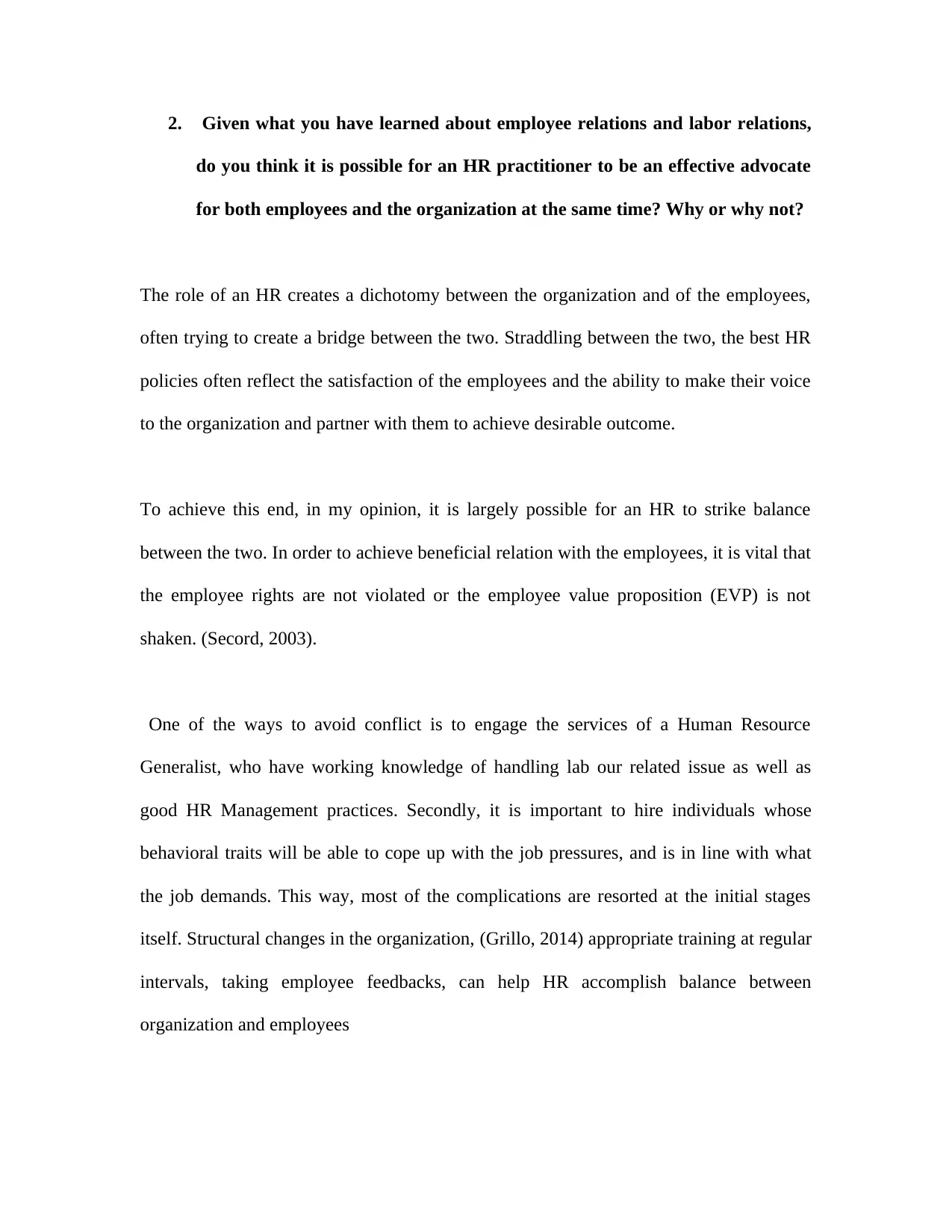
2. Given what you have learned about employee relations and labor relations,
do you think it is possible for an HR practitioner to be an effective advocate
for both employees and the organization at the same time? Why or why not?
The role of an HR creates a dichotomy between the organization and of the employees,
often trying to create a bridge between the two. Straddling between the two, the best HR
policies often reflect the satisfaction of the employees and the ability to make their voice
to the organization and partner with them to achieve desirable outcome.
To achieve this end, in my opinion, it is largely possible for an HR to strike balance
between the two. In order to achieve beneficial relation with the employees, it is vital that
the employee rights are not violated or the employee value proposition (EVP) is not
shaken. (Secord, 2003).
One of the ways to avoid conflict is to engage the services of a Human Resource
Generalist, who have working knowledge of handling lab our related issue as well as
good HR Management practices. Secondly, it is important to hire individuals whose
behavioral traits will be able to cope up with the job pressures, and is in line with what
the job demands. This way, most of the complications are resorted at the initial stages
itself. Structural changes in the organization, (Grillo, 2014) appropriate training at regular
intervals, taking employee feedbacks, can help HR accomplish balance between
organization and employees
do you think it is possible for an HR practitioner to be an effective advocate
for both employees and the organization at the same time? Why or why not?
The role of an HR creates a dichotomy between the organization and of the employees,
often trying to create a bridge between the two. Straddling between the two, the best HR
policies often reflect the satisfaction of the employees and the ability to make their voice
to the organization and partner with them to achieve desirable outcome.
To achieve this end, in my opinion, it is largely possible for an HR to strike balance
between the two. In order to achieve beneficial relation with the employees, it is vital that
the employee rights are not violated or the employee value proposition (EVP) is not
shaken. (Secord, 2003).
One of the ways to avoid conflict is to engage the services of a Human Resource
Generalist, who have working knowledge of handling lab our related issue as well as
good HR Management practices. Secondly, it is important to hire individuals whose
behavioral traits will be able to cope up with the job pressures, and is in line with what
the job demands. This way, most of the complications are resorted at the initial stages
itself. Structural changes in the organization, (Grillo, 2014) appropriate training at regular
intervals, taking employee feedbacks, can help HR accomplish balance between
organization and employees

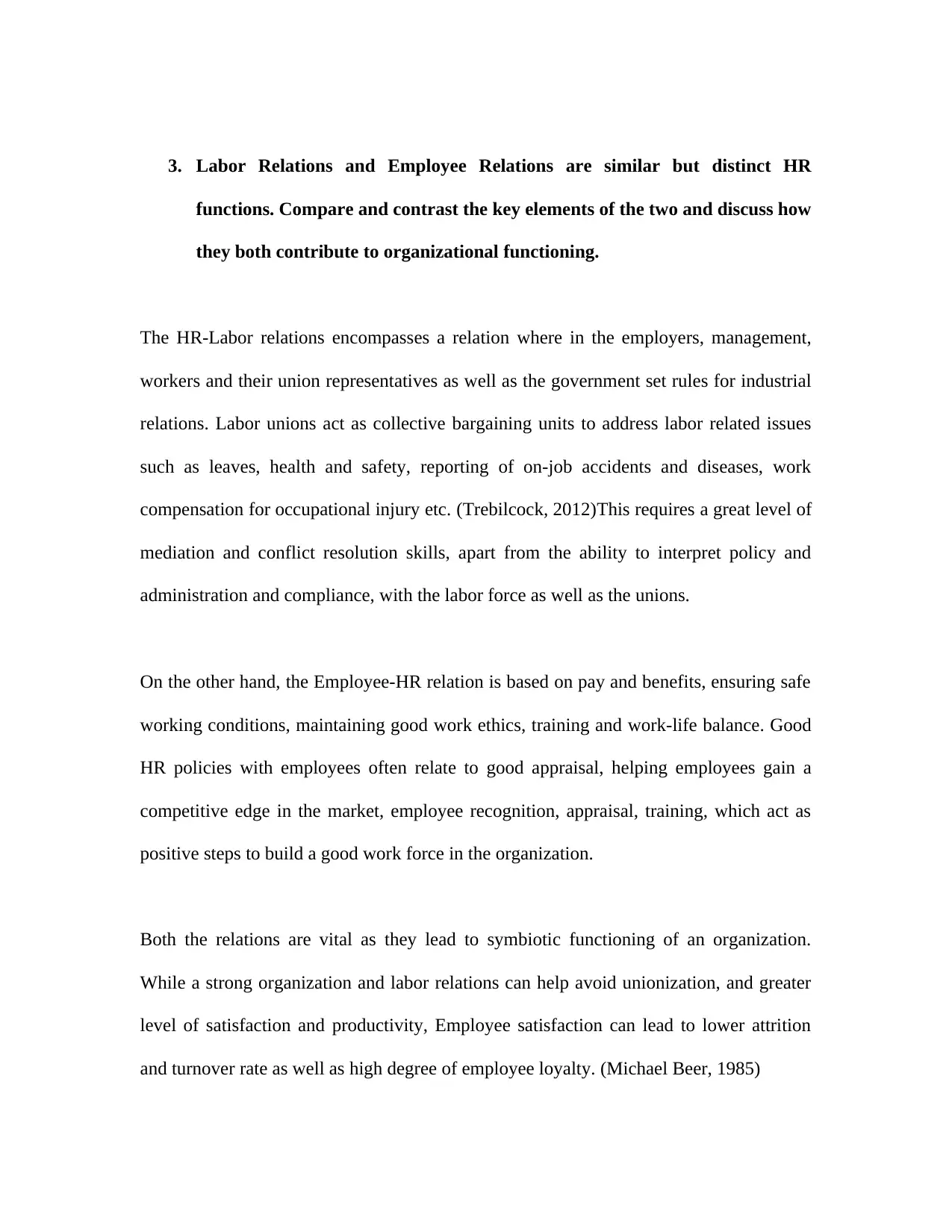
3. Labor Relations and Employee Relations are similar but distinct HR
functions. Compare and contrast the key elements of the two and discuss how
they both contribute to organizational functioning.
The HR-Labor relations encompasses a relation where in the employers, management,
workers and their union representatives as well as the government set rules for industrial
relations. Labor unions act as collective bargaining units to address labor related issues
such as leaves, health and safety, reporting of on-job accidents and diseases, work
compensation for occupational injury etc. (Trebilcock, 2012)This requires a great level of
mediation and conflict resolution skills, apart from the ability to interpret policy and
administration and compliance, with the labor force as well as the unions.
On the other hand, the Employee-HR relation is based on pay and benefits, ensuring safe
working conditions, maintaining good work ethics, training and work-life balance. Good
HR policies with employees often relate to good appraisal, helping employees gain a
competitive edge in the market, employee recognition, appraisal, training, which act as
positive steps to build a good work force in the organization.
Both the relations are vital as they lead to symbiotic functioning of an organization.
While a strong organization and labor relations can help avoid unionization, and greater
level of satisfaction and productivity, Employee satisfaction can lead to lower attrition
and turnover rate as well as high degree of employee loyalty. (Michael Beer, 1985)
functions. Compare and contrast the key elements of the two and discuss how
they both contribute to organizational functioning.
The HR-Labor relations encompasses a relation where in the employers, management,
workers and their union representatives as well as the government set rules for industrial
relations. Labor unions act as collective bargaining units to address labor related issues
such as leaves, health and safety, reporting of on-job accidents and diseases, work
compensation for occupational injury etc. (Trebilcock, 2012)This requires a great level of
mediation and conflict resolution skills, apart from the ability to interpret policy and
administration and compliance, with the labor force as well as the unions.
On the other hand, the Employee-HR relation is based on pay and benefits, ensuring safe
working conditions, maintaining good work ethics, training and work-life balance. Good
HR policies with employees often relate to good appraisal, helping employees gain a
competitive edge in the market, employee recognition, appraisal, training, which act as
positive steps to build a good work force in the organization.
Both the relations are vital as they lead to symbiotic functioning of an organization.
While a strong organization and labor relations can help avoid unionization, and greater
level of satisfaction and productivity, Employee satisfaction can lead to lower attrition
and turnover rate as well as high degree of employee loyalty. (Michael Beer, 1985)
⊘ This is a preview!⊘
Do you want full access?
Subscribe today to unlock all pages.

Trusted by 1+ million students worldwide

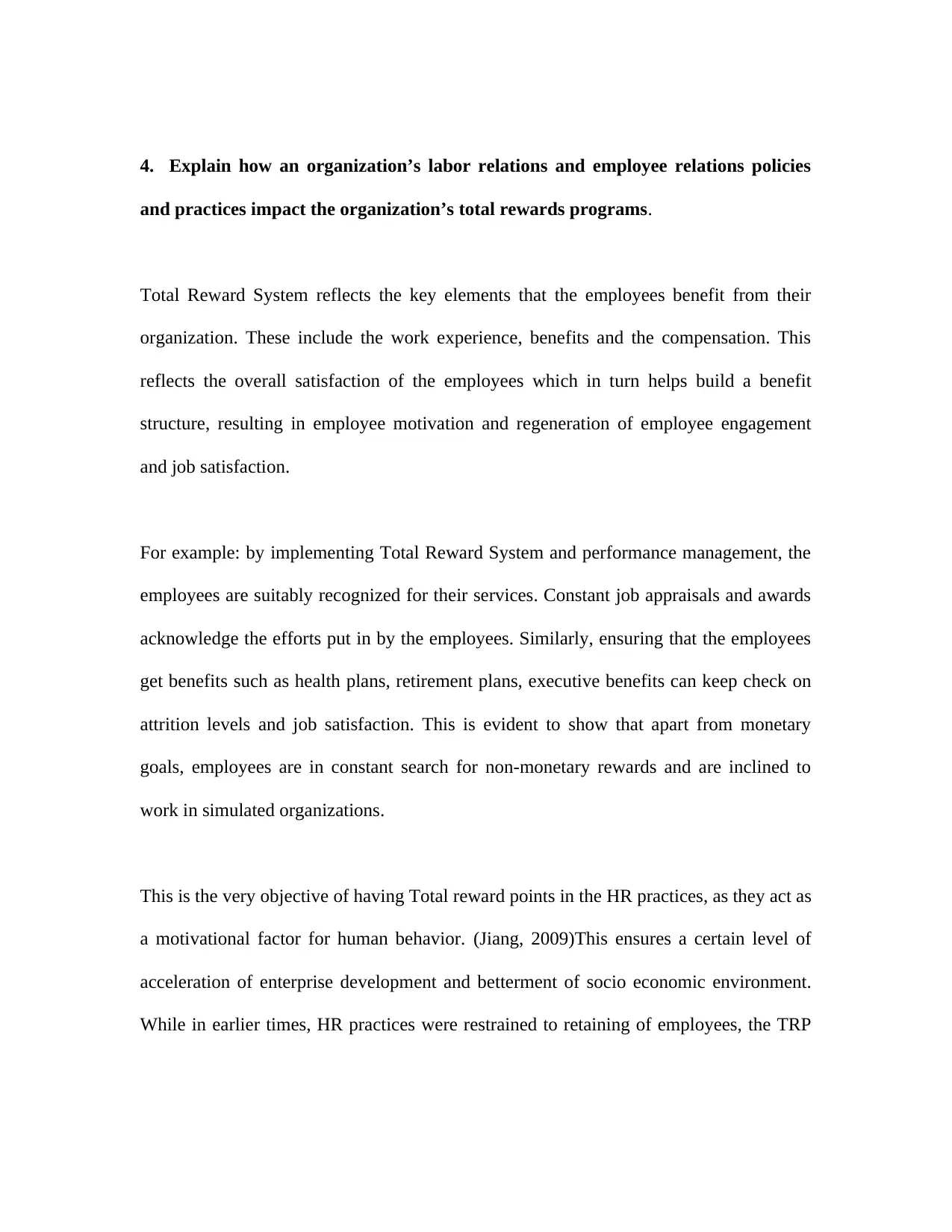
4. Explain how an organization’s labor relations and employee relations policies
and practices impact the organization’s total rewards programs.
Total Reward System reflects the key elements that the employees benefit from their
organization. These include the work experience, benefits and the compensation. This
reflects the overall satisfaction of the employees which in turn helps build a benefit
structure, resulting in employee motivation and regeneration of employee engagement
and job satisfaction.
For example: by implementing Total Reward System and performance management, the
employees are suitably recognized for their services. Constant job appraisals and awards
acknowledge the efforts put in by the employees. Similarly, ensuring that the employees
get benefits such as health plans, retirement plans, executive benefits can keep check on
attrition levels and job satisfaction. This is evident to show that apart from monetary
goals, employees are in constant search for non-monetary rewards and are inclined to
work in simulated organizations.
This is the very objective of having Total reward points in the HR practices, as they act as
a motivational factor for human behavior. (Jiang, 2009)This ensures a certain level of
acceleration of enterprise development and betterment of socio economic environment.
While in earlier times, HR practices were restrained to retaining of employees, the TRP
and practices impact the organization’s total rewards programs.
Total Reward System reflects the key elements that the employees benefit from their
organization. These include the work experience, benefits and the compensation. This
reflects the overall satisfaction of the employees which in turn helps build a benefit
structure, resulting in employee motivation and regeneration of employee engagement
and job satisfaction.
For example: by implementing Total Reward System and performance management, the
employees are suitably recognized for their services. Constant job appraisals and awards
acknowledge the efforts put in by the employees. Similarly, ensuring that the employees
get benefits such as health plans, retirement plans, executive benefits can keep check on
attrition levels and job satisfaction. This is evident to show that apart from monetary
goals, employees are in constant search for non-monetary rewards and are inclined to
work in simulated organizations.
This is the very objective of having Total reward points in the HR practices, as they act as
a motivational factor for human behavior. (Jiang, 2009)This ensures a certain level of
acceleration of enterprise development and betterment of socio economic environment.
While in earlier times, HR practices were restrained to retaining of employees, the TRP
Paraphrase This Document
Need a fresh take? Get an instant paraphrase of this document with our AI Paraphraser

system reflects the way in which an enterprise can attract, retain as well as motivate
talent.
talent.

References
Armstrong, M. (2015). Improving Performance. In M. Armstrong, Armstrong's
Handbook of Reward Management Practice: (pp. 40-43). London: Kogan Page.
Grillo, M. C. (2014). Straddling the Line or Embracing the Dichotomy: HR’s Role as an
Employee Advocate as Necessary to Remaining (or Becoming) a Business Partne.
Cornell HR Review .
Jiang, Z. (2009). Total Reward Strategy: A Human Resources Management Strategy.
International journal of Business Management , 177-181.
Michael Beer, B. S. (1985). Readings in Human Resource Management. New York:
Simon and Schuster.
Secord, H. (2003). Implementing Best Practices in Human Resources Management.
Toronto: CCH Canada Limited.
Trebilcock, A. (2012). Labour Resources and Human Resources Management. Retrieved
October 25, 2016, from International Labor Organization:
http://www.ilocis.org/documents/chpt21e.htm
Armstrong, M. (2015). Improving Performance. In M. Armstrong, Armstrong's
Handbook of Reward Management Practice: (pp. 40-43). London: Kogan Page.
Grillo, M. C. (2014). Straddling the Line or Embracing the Dichotomy: HR’s Role as an
Employee Advocate as Necessary to Remaining (or Becoming) a Business Partne.
Cornell HR Review .
Jiang, Z. (2009). Total Reward Strategy: A Human Resources Management Strategy.
International journal of Business Management , 177-181.
Michael Beer, B. S. (1985). Readings in Human Resource Management. New York:
Simon and Schuster.
Secord, H. (2003). Implementing Best Practices in Human Resources Management.
Toronto: CCH Canada Limited.
Trebilcock, A. (2012). Labour Resources and Human Resources Management. Retrieved
October 25, 2016, from International Labor Organization:
http://www.ilocis.org/documents/chpt21e.htm
⊘ This is a preview!⊘
Do you want full access?
Subscribe today to unlock all pages.

Trusted by 1+ million students worldwide
1 out of 6
Related Documents
Your All-in-One AI-Powered Toolkit for Academic Success.
+13062052269
info@desklib.com
Available 24*7 on WhatsApp / Email
Unlock your academic potential
Copyright © 2020–2026 A2Z Services. All Rights Reserved. Developed and managed by ZUCOL.