Analyzing Environmental Pollution: Rising Air Pollution in India
VerifiedAdded on 2023/06/03
|9
|2877
|245
Essay
AI Summary
This essay critically examines the escalating issue of air pollution in India, a developing nation grappling with rapid industrialization and population growth. It identifies key contributors such as deforestation, crop burning, coal combustion in power plants and industries, and vehicular emissions, particularly in urban centers like Delhi. The essay highlights the detrimental effects of air pollution, including increased respiratory and cardiac ailments, neonatal disorders, and climate change impacts like coastal flooding and glacial retreat. It emphasizes the lack of awareness and insufficient governmental action to curb pollution. The essay proposes several solutions, including promoting sustainable energy sources, implementing stricter regulations on industries and deforestation, encouraging eco-friendly vehicles, and investing in public transportation infrastructure. The author reflects on feedback received, particularly regarding the use of informal language and improper referencing, and outlines steps taken to address these weaknesses in the revised paper. The essay concludes that concerted efforts from the government, industries, and individuals are crucial to mitigate air pollution and ensure a sustainable future for India. Desklib offers similar solved assignments and past papers for students.
RUNNING HEAD: REVISED PAPER & WRITTEN RESPONSE TO FEEDBACK
REVISED PAPER & WRITTEN RESPONSE TO FEEDBACK
1
REVISED PAPER & WRITTEN RESPONSE TO FEEDBACK
1

Paraphrase This Document
Need a fresh take? Get an instant paraphrase of this document with our AI Paraphraser
RUNNING HEAD: REVISED PAPER & WRITTEN RESPONSE TO FEEDBACK
Part 1- Paper Resubmission
Rising Air Pollution in India
Introduction
Air pollution is a major environmental threat that faces most countries of the world
(Greenstone & Hanna, 2014). Especially in a developing country such as India, the impact from
air pollution is tremendous. Environmental pollution in general is on the rise and imposes major
threat for the Indian economy. The government has taken insignificant steps towards
improvisation of the environment of the country. There is tremendous rise in air pollution in the
country, with deteriorating quality of air inhaled. Globally environmental pollution imposes
major threat, and is gradually transforming the climate. With rising sea levels, depleting
atmospheric ozone layer, depletion of various species, environment pollution possesses to be a
major global threat (Lakshmi et. al., 2013). Air pollution has been attributed to the leading cause
for climatic change. In India the global challenge of environmental pollution is more prominent
and increasing with no measures to curb the same. The scope of the current argument analyses
environmental pollution against development in India.
Analysis
Environmental pollution comprises of air, water and soil pollution, in India all three are
on continuous rise. The direct impact from such pollution is on the health and on the increasing
burden of medical costs. With air pollution being one of the leading threats across the country,
the current argument focuses on some of the leading causes and impacts, with ways to overcome
the same (Shrivastava, Neeta & Geeta, 2013). Air pollution in India is primarily due to
deforestation, burning of crops, burning of coal for power production and factory production,
automobile industry and so on. The most significantly affected areas in India are the cities, such
as Delhi where air pollution causes lack of vision. Cities within India experience as high as
PM10 levels of air pollution with low visibility and having greater incidence of diseases. In
cities, causes of air pollution can primarily be attributed to automobiles combustion. Incomplete
combustible gasses from diesel engines causes significant amounts of air pollution. Increasing
2
Part 1- Paper Resubmission
Rising Air Pollution in India
Introduction
Air pollution is a major environmental threat that faces most countries of the world
(Greenstone & Hanna, 2014). Especially in a developing country such as India, the impact from
air pollution is tremendous. Environmental pollution in general is on the rise and imposes major
threat for the Indian economy. The government has taken insignificant steps towards
improvisation of the environment of the country. There is tremendous rise in air pollution in the
country, with deteriorating quality of air inhaled. Globally environmental pollution imposes
major threat, and is gradually transforming the climate. With rising sea levels, depleting
atmospheric ozone layer, depletion of various species, environment pollution possesses to be a
major global threat (Lakshmi et. al., 2013). Air pollution has been attributed to the leading cause
for climatic change. In India the global challenge of environmental pollution is more prominent
and increasing with no measures to curb the same. The scope of the current argument analyses
environmental pollution against development in India.
Analysis
Environmental pollution comprises of air, water and soil pollution, in India all three are
on continuous rise. The direct impact from such pollution is on the health and on the increasing
burden of medical costs. With air pollution being one of the leading threats across the country,
the current argument focuses on some of the leading causes and impacts, with ways to overcome
the same (Shrivastava, Neeta & Geeta, 2013). Air pollution in India is primarily due to
deforestation, burning of crops, burning of coal for power production and factory production,
automobile industry and so on. The most significantly affected areas in India are the cities, such
as Delhi where air pollution causes lack of vision. Cities within India experience as high as
PM10 levels of air pollution with low visibility and having greater incidence of diseases. In
cities, causes of air pollution can primarily be attributed to automobiles combustion. Incomplete
combustible gasses from diesel engines causes significant amounts of air pollution. Increasing
2
RUNNING HEAD: REVISED PAPER & WRITTEN RESPONSE TO FEEDBACK
sales of vehicles in India and automobiles is the cause for increasing air pollution. Most
importantly lack of public infrastructure and connectivity in transportation makes most
commuters avail their own transport facilities. Infrastructure spending in transport and road
connectivity is still lacking in India, where there is greater reliance on self-mode of transport
(Guttikunda & Calori, 2013). Metro railway links present provides connection to a limited area,
which further deters commuters from availing of public transport facilities. Most cities are
surrounded by suburbs or villages where farming is practiced. India being one of the largest
exporters of crops and other raw food materials, rotation of crops is practiced. In order for crop
rotation, after a crop has been plucked, reaming part is burnt in the field, for saving time and
costs of cleaning. This burning of crop leftovers produces immense amount of pollution which
gets added to the atmosphere.
Power plants in India are mostly thermal power plants due to presence of a number of
rivers in the country. Such thermal power plants make extensive use of burning of coal for the
production of electricity (Fullerton, Bruce & Gordon, 2008). Manufacturing industries in the
country also makes use of coal as a source of thermal energy for their production processes.
Extensive coal combustion has created a brown cloud over India, which is visible from space.
Coal is also used as a cooking source in villages and suburbs, where electricity and LPG is not
available. Deforestation in India by burning down forests is another leading cause for air
pollution. Large chunks of land are cleared in India for the purpose of supporting its ever
growing population. Such land spaces are converted into living spaces. There is extensive usage
of CFCs in the country for air conditioners, refrigerators, other appliances and so on (Smith,
2013). Usage of such CFCs release free radicles into the atmosphere that causes air pollution.
Heavy air in winter unable to ascend and dissipate causes more implications on the atmospheric
pollution, creating a thick haze. Industries, households, famers and other sources of pollution are
deterrent towards undertaking any action that might reduce the incidence of harmful gasses and
particulate matters from entering the atmosphere. The most integral cause for concern in air
pollution in India is that it is rising and there is little awareness to curb the same. There is no
prohibitions imposed form the government or any other authorities which might deter usage of
sources that causes air pollution.
3
sales of vehicles in India and automobiles is the cause for increasing air pollution. Most
importantly lack of public infrastructure and connectivity in transportation makes most
commuters avail their own transport facilities. Infrastructure spending in transport and road
connectivity is still lacking in India, where there is greater reliance on self-mode of transport
(Guttikunda & Calori, 2013). Metro railway links present provides connection to a limited area,
which further deters commuters from availing of public transport facilities. Most cities are
surrounded by suburbs or villages where farming is practiced. India being one of the largest
exporters of crops and other raw food materials, rotation of crops is practiced. In order for crop
rotation, after a crop has been plucked, reaming part is burnt in the field, for saving time and
costs of cleaning. This burning of crop leftovers produces immense amount of pollution which
gets added to the atmosphere.
Power plants in India are mostly thermal power plants due to presence of a number of
rivers in the country. Such thermal power plants make extensive use of burning of coal for the
production of electricity (Fullerton, Bruce & Gordon, 2008). Manufacturing industries in the
country also makes use of coal as a source of thermal energy for their production processes.
Extensive coal combustion has created a brown cloud over India, which is visible from space.
Coal is also used as a cooking source in villages and suburbs, where electricity and LPG is not
available. Deforestation in India by burning down forests is another leading cause for air
pollution. Large chunks of land are cleared in India for the purpose of supporting its ever
growing population. Such land spaces are converted into living spaces. There is extensive usage
of CFCs in the country for air conditioners, refrigerators, other appliances and so on (Smith,
2013). Usage of such CFCs release free radicles into the atmosphere that causes air pollution.
Heavy air in winter unable to ascend and dissipate causes more implications on the atmospheric
pollution, creating a thick haze. Industries, households, famers and other sources of pollution are
deterrent towards undertaking any action that might reduce the incidence of harmful gasses and
particulate matters from entering the atmosphere. The most integral cause for concern in air
pollution in India is that it is rising and there is little awareness to curb the same. There is no
prohibitions imposed form the government or any other authorities which might deter usage of
sources that causes air pollution.
3
⊘ This is a preview!⊘
Do you want full access?
Subscribe today to unlock all pages.

Trusted by 1+ million students worldwide
RUNNING HEAD: REVISED PAPER & WRITTEN RESPONSE TO FEEDBACK
Though worldwide tremendous amount of research is conducted and sustainable
measures for generating energy are included, India lacks such implementations (Mills et.al.,
2009). The government of India needs to implement measures, which can promote using of
sustainable sources of energy. The most important factor within the country is lack of awareness.
Though the people within the country are experiencing several implications on health due to such
air pollution, there is little awareness. There is significant rise of cardiac ailments, lung disorders,
neonatal disorders, stillbirth cases that are being reported in areas within the country, where there
is pollution. Cases of neonatal diseases from air pollution is causing rise in healthcare costs for
the government at an alarming rate. Incidence of coastal flooding and decrease of glaciers in the
Himalayas are some other implications that are a direct consequence of the climate change from
rising air pollution (Balakrishnan et. al., 2011). Air temperature of the country has risen by 2
degrees from the rising air pollution. Moreover, the entire country is experiencing a climatic
change with frequent cases of hurricanes and other storms that are creating devastating effects. If
the government fails to apply measures now, then it might be too late to bring about any changes.
There needs to be serious steps taken and strategies adopted for the purpose of curbing air
pollution effectively. Such strategies have to include providing with alternate sources of energy
and also imposing fine if necessary for those who are responsible for polluting the environment.
The government can ask industries to install filters on the combustible gases that get exhausted
from its factories. Increasing usage of biofuels and other modes of energy sources will help the
country overcome its long term concern for rising air pollution (Kumar et. al., 2008). For
immediate effects, the government can gradually ban personal diesel automobiles for curbing
pollution in cities. However, this concern for air pollution has to be dealt with more seriousness.
Conclusion
The current scenario of environmental pollution that India is facing can be overcome only
through regulatory changes. The causes of pollution has been diagnosed, hence there needs to be
a way devised which allows reduction in such polluting source (Cooper & Alley, 2010). A major
investment into infrastructure development of transportation has to be undertaken so that less
number of automobiles plies on road. An alternative to burning fossil fuel has to be diagnosed
and designed. An alternate form of energy such as solar or wind energy can help the country
4
Though worldwide tremendous amount of research is conducted and sustainable
measures for generating energy are included, India lacks such implementations (Mills et.al.,
2009). The government of India needs to implement measures, which can promote using of
sustainable sources of energy. The most important factor within the country is lack of awareness.
Though the people within the country are experiencing several implications on health due to such
air pollution, there is little awareness. There is significant rise of cardiac ailments, lung disorders,
neonatal disorders, stillbirth cases that are being reported in areas within the country, where there
is pollution. Cases of neonatal diseases from air pollution is causing rise in healthcare costs for
the government at an alarming rate. Incidence of coastal flooding and decrease of glaciers in the
Himalayas are some other implications that are a direct consequence of the climate change from
rising air pollution (Balakrishnan et. al., 2011). Air temperature of the country has risen by 2
degrees from the rising air pollution. Moreover, the entire country is experiencing a climatic
change with frequent cases of hurricanes and other storms that are creating devastating effects. If
the government fails to apply measures now, then it might be too late to bring about any changes.
There needs to be serious steps taken and strategies adopted for the purpose of curbing air
pollution effectively. Such strategies have to include providing with alternate sources of energy
and also imposing fine if necessary for those who are responsible for polluting the environment.
The government can ask industries to install filters on the combustible gases that get exhausted
from its factories. Increasing usage of biofuels and other modes of energy sources will help the
country overcome its long term concern for rising air pollution (Kumar et. al., 2008). For
immediate effects, the government can gradually ban personal diesel automobiles for curbing
pollution in cities. However, this concern for air pollution has to be dealt with more seriousness.
Conclusion
The current scenario of environmental pollution that India is facing can be overcome only
through regulatory changes. The causes of pollution has been diagnosed, hence there needs to be
a way devised which allows reduction in such polluting source (Cooper & Alley, 2010). A major
investment into infrastructure development of transportation has to be undertaken so that less
number of automobiles plies on road. An alternative to burning fossil fuel has to be diagnosed
and designed. An alternate form of energy such as solar or wind energy can help the country
4
Paraphrase This Document
Need a fresh take? Get an instant paraphrase of this document with our AI Paraphraser
RUNNING HEAD: REVISED PAPER & WRITTEN RESPONSE TO FEEDBACK
meet its demand for power and reduce carbon footprints on the environment. In order to bring
about significant reduction in air pollution, the government needs to step up measures. A curb
has to be imposed industries, which makes use of coal. Research in alternate source of energy
has to be undertaken and implemented to reduce incidence of air pollution. More importantly
there has to be imposed stringent restrictions prohibiting deforestation and burning of crops
especially during winters when the air weight is generally higher. The Government also needs to
discourage automobile pollution by promoting more ecofriendly vehicles that does not make use
of fossil fuel. There needs to be significant increase in usage of public transport such that overall
pollution from automobiles can be less. Research and developmental activities is taking place
which can significantly reduce air pollution. Indian government needs to implement sustainable
forms of energy generation within the country and recycling needs to initiate so as to be able to
reduce overall impacts of air pollution. Usage of energy from solar or wind power has been seen
to be more sustainable in nature compared to fossil fuels, thus needs to be integrated. In absence
of governmental efforts in curbing of pollution, individuals in the country will not be motivated
to adopt measures. The Government’s ignorance in curbing of air pollution will further have
implications and increasing the incidence of health impacts on the country. Therefore, it becomes
integral to deal with this global challenge at the country level and introduce measures.
5
meet its demand for power and reduce carbon footprints on the environment. In order to bring
about significant reduction in air pollution, the government needs to step up measures. A curb
has to be imposed industries, which makes use of coal. Research in alternate source of energy
has to be undertaken and implemented to reduce incidence of air pollution. More importantly
there has to be imposed stringent restrictions prohibiting deforestation and burning of crops
especially during winters when the air weight is generally higher. The Government also needs to
discourage automobile pollution by promoting more ecofriendly vehicles that does not make use
of fossil fuel. There needs to be significant increase in usage of public transport such that overall
pollution from automobiles can be less. Research and developmental activities is taking place
which can significantly reduce air pollution. Indian government needs to implement sustainable
forms of energy generation within the country and recycling needs to initiate so as to be able to
reduce overall impacts of air pollution. Usage of energy from solar or wind power has been seen
to be more sustainable in nature compared to fossil fuels, thus needs to be integrated. In absence
of governmental efforts in curbing of pollution, individuals in the country will not be motivated
to adopt measures. The Government’s ignorance in curbing of air pollution will further have
implications and increasing the incidence of health impacts on the country. Therefore, it becomes
integral to deal with this global challenge at the country level and introduce measures.
5
RUNNING HEAD: REVISED PAPER & WRITTEN RESPONSE TO FEEDBACK
Part 2 –Response to Feedback
Critical Feedback
Self-reflection is a useful and critical tool which helps in self-analysis. The global issue
that had been analysed in the previous essay is of environmental pollution. Globally
environmental pollution is on continuous rise, especially air pollution. It has significant impacts
on the environment and also on the health of individuals in the society. The essay that I had
written in a critical manner included several relevant information and context. My professor
praised me for analysing the topic in great detail. I had searched immense number of resources
such as internet journals, websites, books for gathering information related to the topic. I had
been capable to assimilate such diversified information for my topic as well in order to produce a
comprehensive report within the given word count and given deadline. The report that I finally
produced and submitted contained information related to my own country India and the global
challenge that it faces. I had worked hard and spent almost over 15 days for the production of the
final report. As I was not very accustomed with report writing capabilities and skills, I took
longer than it is required to complete the report. I felt that while writing the essay, some of my
strengths which were reflected included analytical capabilities, ability to comprehend and
capability to write fluent English. Though the written portion received significant amounts of
praise from my professor and I received passing grade, there are certain challenges in my
writing.
A most integral challenge that I had diagnosed in my writing skills was use of informal
language. Though I knew consciously that I had to write the report in formal language and
present it well, I was unable to do so. Due to lack of practice, I was unable to write the report by
using of formal language and terms; this was a major hindrance for me. Another integral factor
that was presented before me for the report writing was my inability to format references in a
correct manner. I had not fully made use of references for all the facts and figures that I had used
for the purpose of my report. Moreover, the in-text citations were also not appropriate. It implies
that I need to learn regarding referencing from the Blackboard link and apply it well in practical
contexts. I did not possess full skills to formulate references and format in-text citations. Another
area which I missed, which otherwise could have allowed me to score distinction is the area of
grammatical checks. Though MsWord has an in-built tool and feature allowing users to check for
6
Part 2 –Response to Feedback
Critical Feedback
Self-reflection is a useful and critical tool which helps in self-analysis. The global issue
that had been analysed in the previous essay is of environmental pollution. Globally
environmental pollution is on continuous rise, especially air pollution. It has significant impacts
on the environment and also on the health of individuals in the society. The essay that I had
written in a critical manner included several relevant information and context. My professor
praised me for analysing the topic in great detail. I had searched immense number of resources
such as internet journals, websites, books for gathering information related to the topic. I had
been capable to assimilate such diversified information for my topic as well in order to produce a
comprehensive report within the given word count and given deadline. The report that I finally
produced and submitted contained information related to my own country India and the global
challenge that it faces. I had worked hard and spent almost over 15 days for the production of the
final report. As I was not very accustomed with report writing capabilities and skills, I took
longer than it is required to complete the report. I felt that while writing the essay, some of my
strengths which were reflected included analytical capabilities, ability to comprehend and
capability to write fluent English. Though the written portion received significant amounts of
praise from my professor and I received passing grade, there are certain challenges in my
writing.
A most integral challenge that I had diagnosed in my writing skills was use of informal
language. Though I knew consciously that I had to write the report in formal language and
present it well, I was unable to do so. Due to lack of practice, I was unable to write the report by
using of formal language and terms; this was a major hindrance for me. Another integral factor
that was presented before me for the report writing was my inability to format references in a
correct manner. I had not fully made use of references for all the facts and figures that I had used
for the purpose of my report. Moreover, the in-text citations were also not appropriate. It implies
that I need to learn regarding referencing from the Blackboard link and apply it well in practical
contexts. I did not possess full skills to formulate references and format in-text citations. Another
area which I missed, which otherwise could have allowed me to score distinction is the area of
grammatical checks. Though MsWord has an in-built tool and feature allowing users to check for
6
⊘ This is a preview!⊘
Do you want full access?
Subscribe today to unlock all pages.
Trusted by 1+ million students worldwide
RUNNING HEAD: REVISED PAPER & WRITTEN RESPONSE TO FEEDBACK
spelling and grammatical checks for the work they have done, I missed out on it completely.
Though I did proofread my work, yet I did not undertake spelling and grammar check for my
work. In order to score Distinction, I need to conduct this check and proofread prior to my
submission. In my work, I have made use of several abbreviations and contradictions. This will
reduce my capability to write an assignment well. I will need to write my assignments carefully
from next time to avoid all possible contradictions and proofread my work twice prior to
submission. I will also show a draft work to my professor before submission, so that some
corrections can be made and I can score high marks.
7
spelling and grammatical checks for the work they have done, I missed out on it completely.
Though I did proofread my work, yet I did not undertake spelling and grammar check for my
work. In order to score Distinction, I need to conduct this check and proofread prior to my
submission. In my work, I have made use of several abbreviations and contradictions. This will
reduce my capability to write an assignment well. I will need to write my assignments carefully
from next time to avoid all possible contradictions and proofread my work twice prior to
submission. I will also show a draft work to my professor before submission, so that some
corrections can be made and I can score high marks.
7
Paraphrase This Document
Need a fresh take? Get an instant paraphrase of this document with our AI Paraphraser
RUNNING HEAD: REVISED PAPER & WRITTEN RESPONSE TO FEEDBACK
References
Balakrishnan, K., Ramaswamy, P., Sambandam, S., Thangavel, G., Ghosh, S., Johnson, P., …. &
Thanasekaraan, V., (2011). Air pollution from household solid fuel combustion in India:
an overview of exposure and health related information to inform health research
priorities. Global health action, 4(1), 5638. Accessed from
https://www.tandfonline.com/doi/abs/10.3402/gha.v4i0.5638
Cooper, C. D., & Alley, F. C. (2010). Air pollution control: A design approach. Waveland Press.
Accessed from https://books.google.co.in/books?
hl=en&lr=&id=pdpdDwAAQBAJ&oi=fnd&pg=PR3&dq=air+pollution+india&ots=JF2
HM2oF6g&sig=NoIg6A3e3O1JP9B3GgqIdxE3-fw#v=onepage&q=air%20pollution
%20india&f=false
Fullerton, D. G., Bruce, N., & Gordon, S. B. (2008). Indoor air pollution from biomass fuel
smoke is a major health concern in the developing world. Transactions of the Royal
Society of Tropical Medicine and Hygiene, 102(9), 843-851. Accessed from
https://academic.oup.com/trstmh/article-abstract/102/9/843/1887437
Greenstone, M., & Hanna, R. (2014). Environmental regulations, air and water pollution, and
infant mortality in India. American Economic Review, 104(10), 3038-72. Accessed from
https://www.aeaweb.org/articles?id=10.1257/aer.104.10.3038
Guttikunda, S. K., & Calori, G. (2013). A GIS based emissions inventory at 1 km× 1 km spatial
resolution for air pollution analysis in Delhi, India. Atmospheric Environment, 67, 101-
111. Accessed from
https://www.sciencedirect.com/science/article/pii/S1352231012010229
Kumar, R., Nagar, J. K., Raj, N., Kumar, P., Kushwah, A. S., Meena, M., & Gaur, S. N. (2008).
Impact of domestic air pollution from cooking fuel on respiratory allergies in children in
India. Asian Pacific Journal of Allergy and Immunology, 26(4), 213. Accessed from
https://www.researchgate.net/profile/Shailendra_Gaur2/publication/
24230453_Impact_of_Domestic_Air_Pollution_from_Cooking_Fuel_on_Respiratory_Al
lergies_in_Children_in_India/links/0046351499291365a8000000.pdf
8
References
Balakrishnan, K., Ramaswamy, P., Sambandam, S., Thangavel, G., Ghosh, S., Johnson, P., …. &
Thanasekaraan, V., (2011). Air pollution from household solid fuel combustion in India:
an overview of exposure and health related information to inform health research
priorities. Global health action, 4(1), 5638. Accessed from
https://www.tandfonline.com/doi/abs/10.3402/gha.v4i0.5638
Cooper, C. D., & Alley, F. C. (2010). Air pollution control: A design approach. Waveland Press.
Accessed from https://books.google.co.in/books?
hl=en&lr=&id=pdpdDwAAQBAJ&oi=fnd&pg=PR3&dq=air+pollution+india&ots=JF2
HM2oF6g&sig=NoIg6A3e3O1JP9B3GgqIdxE3-fw#v=onepage&q=air%20pollution
%20india&f=false
Fullerton, D. G., Bruce, N., & Gordon, S. B. (2008). Indoor air pollution from biomass fuel
smoke is a major health concern in the developing world. Transactions of the Royal
Society of Tropical Medicine and Hygiene, 102(9), 843-851. Accessed from
https://academic.oup.com/trstmh/article-abstract/102/9/843/1887437
Greenstone, M., & Hanna, R. (2014). Environmental regulations, air and water pollution, and
infant mortality in India. American Economic Review, 104(10), 3038-72. Accessed from
https://www.aeaweb.org/articles?id=10.1257/aer.104.10.3038
Guttikunda, S. K., & Calori, G. (2013). A GIS based emissions inventory at 1 km× 1 km spatial
resolution for air pollution analysis in Delhi, India. Atmospheric Environment, 67, 101-
111. Accessed from
https://www.sciencedirect.com/science/article/pii/S1352231012010229
Kumar, R., Nagar, J. K., Raj, N., Kumar, P., Kushwah, A. S., Meena, M., & Gaur, S. N. (2008).
Impact of domestic air pollution from cooking fuel on respiratory allergies in children in
India. Asian Pacific Journal of Allergy and Immunology, 26(4), 213. Accessed from
https://www.researchgate.net/profile/Shailendra_Gaur2/publication/
24230453_Impact_of_Domestic_Air_Pollution_from_Cooking_Fuel_on_Respiratory_Al
lergies_in_Children_in_India/links/0046351499291365a8000000.pdf
8
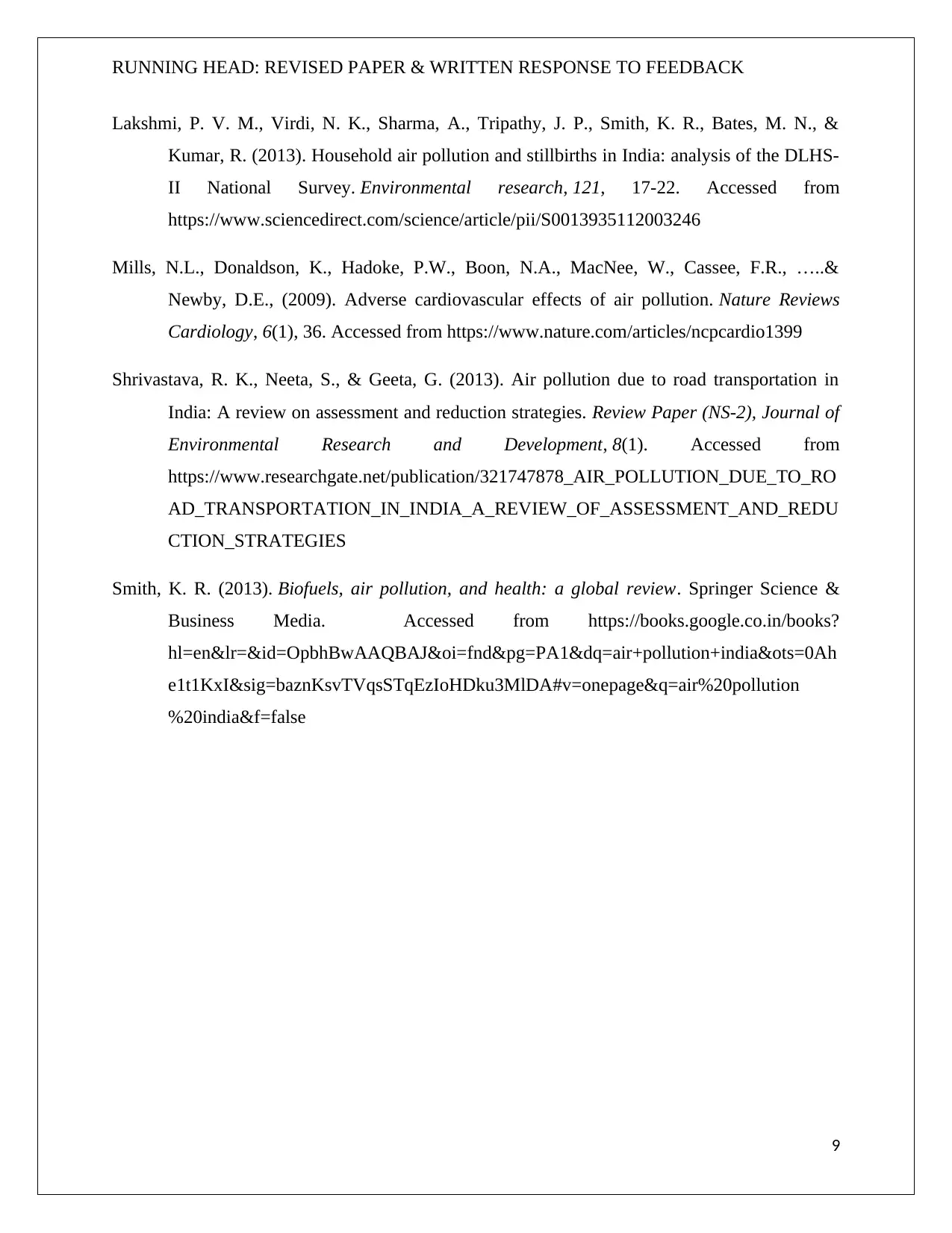
RUNNING HEAD: REVISED PAPER & WRITTEN RESPONSE TO FEEDBACK
Lakshmi, P. V. M., Virdi, N. K., Sharma, A., Tripathy, J. P., Smith, K. R., Bates, M. N., &
Kumar, R. (2013). Household air pollution and stillbirths in India: analysis of the DLHS-
II National Survey. Environmental research, 121, 17-22. Accessed from
https://www.sciencedirect.com/science/article/pii/S0013935112003246
Mills, N.L., Donaldson, K., Hadoke, P.W., Boon, N.A., MacNee, W., Cassee, F.R., …..&
Newby, D.E., (2009). Adverse cardiovascular effects of air pollution. Nature Reviews
Cardiology, 6(1), 36. Accessed from https://www.nature.com/articles/ncpcardio1399
Shrivastava, R. K., Neeta, S., & Geeta, G. (2013). Air pollution due to road transportation in
India: A review on assessment and reduction strategies. Review Paper (NS-2), Journal of
Environmental Research and Development, 8(1). Accessed from
https://www.researchgate.net/publication/321747878_AIR_POLLUTION_DUE_TO_RO
AD_TRANSPORTATION_IN_INDIA_A_REVIEW_OF_ASSESSMENT_AND_REDU
CTION_STRATEGIES
Smith, K. R. (2013). Biofuels, air pollution, and health: a global review. Springer Science &
Business Media. Accessed from https://books.google.co.in/books?
hl=en&lr=&id=OpbhBwAAQBAJ&oi=fnd&pg=PA1&dq=air+pollution+india&ots=0Ah
e1t1KxI&sig=baznKsvTVqsSTqEzIoHDku3MlDA#v=onepage&q=air%20pollution
%20india&f=false
9
Lakshmi, P. V. M., Virdi, N. K., Sharma, A., Tripathy, J. P., Smith, K. R., Bates, M. N., &
Kumar, R. (2013). Household air pollution and stillbirths in India: analysis of the DLHS-
II National Survey. Environmental research, 121, 17-22. Accessed from
https://www.sciencedirect.com/science/article/pii/S0013935112003246
Mills, N.L., Donaldson, K., Hadoke, P.W., Boon, N.A., MacNee, W., Cassee, F.R., …..&
Newby, D.E., (2009). Adverse cardiovascular effects of air pollution. Nature Reviews
Cardiology, 6(1), 36. Accessed from https://www.nature.com/articles/ncpcardio1399
Shrivastava, R. K., Neeta, S., & Geeta, G. (2013). Air pollution due to road transportation in
India: A review on assessment and reduction strategies. Review Paper (NS-2), Journal of
Environmental Research and Development, 8(1). Accessed from
https://www.researchgate.net/publication/321747878_AIR_POLLUTION_DUE_TO_RO
AD_TRANSPORTATION_IN_INDIA_A_REVIEW_OF_ASSESSMENT_AND_REDU
CTION_STRATEGIES
Smith, K. R. (2013). Biofuels, air pollution, and health: a global review. Springer Science &
Business Media. Accessed from https://books.google.co.in/books?
hl=en&lr=&id=OpbhBwAAQBAJ&oi=fnd&pg=PA1&dq=air+pollution+india&ots=0Ah
e1t1KxI&sig=baznKsvTVqsSTqEzIoHDku3MlDA#v=onepage&q=air%20pollution
%20india&f=false
9
⊘ This is a preview!⊘
Do you want full access?
Subscribe today to unlock all pages.
Trusted by 1+ million students worldwide

1 out of 9


Your All-in-One AI-Powered Toolkit for Academic Success.
+13062052269
info@desklib.com
Available 24*7 on WhatsApp / Email
![[object Object]](/_next/static/media/star-bottom.7253800d.svg)
Unlock your academic potential
Copyright © 2020–2026 A2Z Services. All Rights Reserved. Developed and managed by ZUCOL.