University Risk Perception and Analysis Report: Analysis of Threats
VerifiedAdded on 2021/04/19
|16
|4591
|28
Report
AI Summary
This report delves into the multifaceted realm of risk perception and analysis, examining both energy and non-energy threats across various scenarios. It begins by exploring diverse examples, including mine explosions, aircraft accidents, and environmental disasters, to illustrate the nature of these threats. The report then applies the time sequence model to analyze consequences, severity, and potential mechanisms of events, using the Great Barrier Reef incident as a case study. Furthermore, it addresses ship grounding, detailing causation factors and the implications of such events. The analysis extends to quantifying and estimating risks, providing a comprehensive overview of risk management principles. The report underscores the importance of understanding and mitigating risks in various contexts, from environmental protection to public safety. Finally, the report discusses the significance of human error and the need for proactive measures to prevent future incidents. This comprehensive analysis provides valuable insights into risk assessment and management strategies.

Running head: RISK PERCEPTION AND ANALYSIS
Risk analysis
Name of the Student:
Name of the University:
Author Note:
Risk analysis
Name of the Student:
Name of the University:
Author Note:

Paraphrase This Document
Need a fresh take? Get an instant paraphrase of this document with our AI Paraphraser
1RISK PERCEPTION AND ANALYSIS
Table of Contents
Introduction......................................................................................................................................2
Part A: Energy and non-energy threats............................................................................................2
Part B: Applying the time sequence model.....................................................................................5
Part C: Time Zone 1........................................................................................................................7
Part D: Quantifying estimates of risk..............................................................................................8
Conclusion.....................................................................................................................................11
Reference.......................................................................................................................................12
Table of Contents
Introduction......................................................................................................................................2
Part A: Energy and non-energy threats............................................................................................2
Part B: Applying the time sequence model.....................................................................................5
Part C: Time Zone 1........................................................................................................................7
Part D: Quantifying estimates of risk..............................................................................................8
Conclusion.....................................................................................................................................11
Reference.......................................................................................................................................12
2RISK PERCEPTION AND ANALYSIS
Introduction
Perception of risk is a personal understanding of decision making. It refers to the
judgements of the people with respect to the likeliness of the occurrence of the deadly disease,
illness and injury. Perception of risk is necessary because it helps in recognising the risk related
to communication and also risk associated with health (Brown 2014). There are two main
dimensions of risk perception: emotional dimension and cognitive dimension. The cognitive
dimension can be described as how people understand the risk and know about them, while the
emotional dimension can be related to how people feel about the risk. Risk analysis, on the other
hand, is a systematic study of risk and the uncertainties that a person encounters during the
framing of a public policy, engineering, business and profession. Risk analysis helps in
identification of the probable risk which is faced by an organization, institution, and an
individual (Vasvári 2015). This study is based on the energy and the non-energy threats, the
application of the time sequence model, time zone of a grounding ship, quantification and
estimation of the risks.
Part A: Energy and non-energy threats
1. Explosions occurring in a coal mine are not uncommon and there are two types of mine
explosions: coal dust explosion and methane explosions. The methane explosion can be related
to the catching of fire by the methane gas which is present in the hydrocarbon pockets. The
explosion occurs when the methane gas comes in contact with oxygen and there is a presence of
a source of heat (Li et al. 2012). Coal dust can also be attributed to the to the reason of mine
explosion, however, there are conditions which result into explosion. Such factors are the
presence of oxygen, a combustible dust, high concentration of the presence of the dust in the air,
Introduction
Perception of risk is a personal understanding of decision making. It refers to the
judgements of the people with respect to the likeliness of the occurrence of the deadly disease,
illness and injury. Perception of risk is necessary because it helps in recognising the risk related
to communication and also risk associated with health (Brown 2014). There are two main
dimensions of risk perception: emotional dimension and cognitive dimension. The cognitive
dimension can be described as how people understand the risk and know about them, while the
emotional dimension can be related to how people feel about the risk. Risk analysis, on the other
hand, is a systematic study of risk and the uncertainties that a person encounters during the
framing of a public policy, engineering, business and profession. Risk analysis helps in
identification of the probable risk which is faced by an organization, institution, and an
individual (Vasvári 2015). This study is based on the energy and the non-energy threats, the
application of the time sequence model, time zone of a grounding ship, quantification and
estimation of the risks.
Part A: Energy and non-energy threats
1. Explosions occurring in a coal mine are not uncommon and there are two types of mine
explosions: coal dust explosion and methane explosions. The methane explosion can be related
to the catching of fire by the methane gas which is present in the hydrocarbon pockets. The
explosion occurs when the methane gas comes in contact with oxygen and there is a presence of
a source of heat (Li et al. 2012). Coal dust can also be attributed to the to the reason of mine
explosion, however, there are conditions which result into explosion. Such factors are the
presence of oxygen, a combustible dust, high concentration of the presence of the dust in the air,
⊘ This is a preview!⊘
Do you want full access?
Subscribe today to unlock all pages.

Trusted by 1+ million students worldwide
3RISK PERCEPTION AND ANALYSIS
the source of ignition, a confined area or an enclosure (Bartknecht 2012). Thus, in this scenario,
the energy source is considered as a threat.
2. The light aircraft during the final approach to landing at the Geelong airway came in contact
with the power lines. The power line is actually an energy threat here, however, in the accident,
the light aircraft is involved and is also designated to be an energy threat because within the
engine there is a constant moving of engine parts, the mixing of the fuel along with the oxygen
acted as an active energy threat. The explosion in the internal engine resulted in the total
destruction of the aircraft and it was an active threat to the two commuters that were travelling
by aircraft (Lee, Choi and Seo 2016). The broken power lines were still having the current
flowing and it can hazardous for the moving nearby. Thus, the broken power line can be
considered as an active energy threat.
3. When a person falls into a cold water body, the body tends to lose heat at a faster rate. The
body fails to regain the lost heat due to the constant exposure to cold water. Such condition
results from a medical emergency called the hypothermia and this occurs when the temperature
of the body falls below the 35 degree Celsius. When the temperature of a body falls rapidly, the
organs, nervous system, and heart stop functioning normally. If a person experiencing such
condition is left untreated, then there is a higher chance that the respiratory and the heart
functioning will stop and the person will eventually die (Dragancea et al. 2013). Thus, it can be
inferred that the falling into cold water and the eventual death of the person is a non-energy
threat.
4. A suspension bridge actually suspends from two chains or ropes from two tall towers. The
majority of the weight is the compression weight due to the vehicles travelling on the deck. The
weight on the deck is transferred via the cables to the two towers. The cables that support the
the source of ignition, a confined area or an enclosure (Bartknecht 2012). Thus, in this scenario,
the energy source is considered as a threat.
2. The light aircraft during the final approach to landing at the Geelong airway came in contact
with the power lines. The power line is actually an energy threat here, however, in the accident,
the light aircraft is involved and is also designated to be an energy threat because within the
engine there is a constant moving of engine parts, the mixing of the fuel along with the oxygen
acted as an active energy threat. The explosion in the internal engine resulted in the total
destruction of the aircraft and it was an active threat to the two commuters that were travelling
by aircraft (Lee, Choi and Seo 2016). The broken power lines were still having the current
flowing and it can hazardous for the moving nearby. Thus, the broken power line can be
considered as an active energy threat.
3. When a person falls into a cold water body, the body tends to lose heat at a faster rate. The
body fails to regain the lost heat due to the constant exposure to cold water. Such condition
results from a medical emergency called the hypothermia and this occurs when the temperature
of the body falls below the 35 degree Celsius. When the temperature of a body falls rapidly, the
organs, nervous system, and heart stop functioning normally. If a person experiencing such
condition is left untreated, then there is a higher chance that the respiratory and the heart
functioning will stop and the person will eventually die (Dragancea et al. 2013). Thus, it can be
inferred that the falling into cold water and the eventual death of the person is a non-energy
threat.
4. A suspension bridge actually suspends from two chains or ropes from two tall towers. The
majority of the weight is the compression weight due to the vehicles travelling on the deck. The
weight on the deck is transferred via the cables to the two towers. The cables that support the
Paraphrase This Document
Need a fresh take? Get an instant paraphrase of this document with our AI Paraphraser
4RISK PERCEPTION AND ANALYSIS
deck of the bridge receive the tensional forces of the bridge. The excess of the tensional force has
resulted in the breaking of the bridge's support cables. Whereas due to the breakage of the cables,
vehicles fell from the bridge and the 11 people died due to drowning. Drowning is a secondary
non-energy threat while the breakage of the cable can be attributed to the build-up of the
tensional force within the cables (An, Spencer and Ou 2015).
5. Potential energy can be described as the energy possessed by an object due to its position with
respect to the other objects. In this case, the part of the cliff may have undergone stress within
itself. Thus, when the part of cliff broke off from the whole structure, the potential energy within
the rock transformed into kinetic energy. This combination of the potential and the kinetic
energy resulted in the death of the couple (Elvin and Erturk, 2013). Thus, in this case, there is the
sure presence of an energy source.
6. There can be much reason due to which a building can collapse. A building can collapse due
to ground shaking, earthquake, the build-up of the tensional forces within the different parts of
the building. Whereas, there are other reasons for building collapses like the usage of improper
building materials, deficiency in the design of the building and human error. The presence of the
several factors minimizes chances of depicting a single source as an energy or a non-energy
source (Windapo and Rotimi, 2012). Thus, the scenario of building collapse can be attributed to
both the energy and non-energy source.
7. pesticide food poisoning has two types of effects: long-term and short-term effects.
Considering the case, at least 2483 people complained about the illness after eating the frozen
fish which was contaminated by pesticide. The people that suffered the illness due to the
consumption of the pesticide-contaminated food was because foreign agents entered the body
deck of the bridge receive the tensional forces of the bridge. The excess of the tensional force has
resulted in the breaking of the bridge's support cables. Whereas due to the breakage of the cables,
vehicles fell from the bridge and the 11 people died due to drowning. Drowning is a secondary
non-energy threat while the breakage of the cable can be attributed to the build-up of the
tensional force within the cables (An, Spencer and Ou 2015).
5. Potential energy can be described as the energy possessed by an object due to its position with
respect to the other objects. In this case, the part of the cliff may have undergone stress within
itself. Thus, when the part of cliff broke off from the whole structure, the potential energy within
the rock transformed into kinetic energy. This combination of the potential and the kinetic
energy resulted in the death of the couple (Elvin and Erturk, 2013). Thus, in this case, there is the
sure presence of an energy source.
6. There can be much reason due to which a building can collapse. A building can collapse due
to ground shaking, earthquake, the build-up of the tensional forces within the different parts of
the building. Whereas, there are other reasons for building collapses like the usage of improper
building materials, deficiency in the design of the building and human error. The presence of the
several factors minimizes chances of depicting a single source as an energy or a non-energy
source (Windapo and Rotimi, 2012). Thus, the scenario of building collapse can be attributed to
both the energy and non-energy source.
7. pesticide food poisoning has two types of effects: long-term and short-term effects.
Considering the case, at least 2483 people complained about the illness after eating the frozen
fish which was contaminated by pesticide. The people that suffered the illness due to the
consumption of the pesticide-contaminated food was because foreign agents entered the body
5RISK PERCEPTION AND ANALYSIS
and the body started to react positively (Bajwa and Sandhu 2014). Thus, it can be inferred that in
this case, there is an existence of non-energy source.
8. Arsonists are the one that commits the crime by deliberately set fire to the wildland areas and
abandoned homes. The fire set by these arsonists to the grass and the trees resulted in an open
coal mine catching fire as well. The major risk here is posed not the fire but the arsonists
themselves (Gannon et al. 2012). Thus, arsonists here are considered as a non-energy source.
9. The safety barrier is supposed to be working in order to keep the animals safely within the
cage. This safety barrier is also meant to keep the humans safely that work outside the cage,
however the failure of the safety barrier resulted in to a mishap. The defective bolt was actually
the resulted in to the mishap, thus the bolt can be considered as a non-energy source.
10. Findings suggest that the liquefaction of the mining waste was caused due to the mixing of
the two different types of tailings like the slimes and the sands. This occurred during the
construction procedure and a minor earthquake initiated the process. Earthquake can be
considered as an energy source for this mishap, however the major damage was caused by the
mining waste that washed across the region and killed around 11 people (Jefferies and Been
2015). The movement of water with such a great force can be positively considered as a threat
from an energy source.
Part B: Applying the time sequence model
a. the various types of consequences that could have arisen from the case are as follows:
Shipping poses a direct danger to the reef when the ships try to cross the reef.
From the superficial analysis it does not reveal much, however from inside the
reef, the condition is much worse and present a hostile condition.
and the body started to react positively (Bajwa and Sandhu 2014). Thus, it can be inferred that in
this case, there is an existence of non-energy source.
8. Arsonists are the one that commits the crime by deliberately set fire to the wildland areas and
abandoned homes. The fire set by these arsonists to the grass and the trees resulted in an open
coal mine catching fire as well. The major risk here is posed not the fire but the arsonists
themselves (Gannon et al. 2012). Thus, arsonists here are considered as a non-energy source.
9. The safety barrier is supposed to be working in order to keep the animals safely within the
cage. This safety barrier is also meant to keep the humans safely that work outside the cage,
however the failure of the safety barrier resulted in to a mishap. The defective bolt was actually
the resulted in to the mishap, thus the bolt can be considered as a non-energy source.
10. Findings suggest that the liquefaction of the mining waste was caused due to the mixing of
the two different types of tailings like the slimes and the sands. This occurred during the
construction procedure and a minor earthquake initiated the process. Earthquake can be
considered as an energy source for this mishap, however the major damage was caused by the
mining waste that washed across the region and killed around 11 people (Jefferies and Been
2015). The movement of water with such a great force can be positively considered as a threat
from an energy source.
Part B: Applying the time sequence model
a. the various types of consequences that could have arisen from the case are as follows:
Shipping poses a direct danger to the reef when the ships try to cross the reef.
From the superficial analysis it does not reveal much, however from inside the
reef, the condition is much worse and present a hostile condition.
⊘ This is a preview!⊘
Do you want full access?
Subscribe today to unlock all pages.
Trusted by 1+ million students worldwide
6RISK PERCEPTION AND ANALYSIS
The major problem that can result from the crossing of the ships across the reef is
that it results in the death of the corals. Ships are likely to face accidents inside
the reef due to the hostile conditions. While if the crossing ship is containing oil
then it might cause oil spill and might damage the whole environment. This
affects not just the corals but also the entire ecosystem and also harms the fauna
and flora of the area (ABC News, 2018).
b. The severity of each of the consequence can be related to the damage of the reef by the ship
has resulted in it to a scar which was 1.9 miles long and was 820 feet long. When the ship
entered the reef, due to the shredding of the hull about 3 tons of oil leaked. It was later found that
the marine life in the reef was flattened and the shoal structure was damaged by the vessel's
weight. The damage was not severe because there was no presence of the toxic chemicals from
the spillage, however, the recovery might take around 10 to 20 years (Gelineau 2018).
c. The event that occurred in the Great Barrier Reef is a destruction of ecology and the
environment and the prime reason is the human error. The act was done deliberately and resulted
in the loss of the ecology and environment and thus can be designated as a non-energy threat.
The oil spillage that occurred on the reef was not significant and thus the energy source threat
can be nullified.
d. the possible mechanism of the event might have included the diverting the cargo ship into a
different direction. This would have bypassed the direct passage through the Great Barrier Reef
and at the same time would have prevented the occurrence of this event.
e. The preconditions of the mechanism can be described as the measures that could have been
taken in order to avert the mishap and the accident. The exact usage of the GPS coordinates,
The major problem that can result from the crossing of the ships across the reef is
that it results in the death of the corals. Ships are likely to face accidents inside
the reef due to the hostile conditions. While if the crossing ship is containing oil
then it might cause oil spill and might damage the whole environment. This
affects not just the corals but also the entire ecosystem and also harms the fauna
and flora of the area (ABC News, 2018).
b. The severity of each of the consequence can be related to the damage of the reef by the ship
has resulted in it to a scar which was 1.9 miles long and was 820 feet long. When the ship
entered the reef, due to the shredding of the hull about 3 tons of oil leaked. It was later found that
the marine life in the reef was flattened and the shoal structure was damaged by the vessel's
weight. The damage was not severe because there was no presence of the toxic chemicals from
the spillage, however, the recovery might take around 10 to 20 years (Gelineau 2018).
c. The event that occurred in the Great Barrier Reef is a destruction of ecology and the
environment and the prime reason is the human error. The act was done deliberately and resulted
in the loss of the ecology and environment and thus can be designated as a non-energy threat.
The oil spillage that occurred on the reef was not significant and thus the energy source threat
can be nullified.
d. the possible mechanism of the event might have included the diverting the cargo ship into a
different direction. This would have bypassed the direct passage through the Great Barrier Reef
and at the same time would have prevented the occurrence of this event.
e. The preconditions of the mechanism can be described as the measures that could have been
taken in order to avert the mishap and the accident. The exact usage of the GPS coordinates,
Paraphrase This Document
Need a fresh take? Get an instant paraphrase of this document with our AI Paraphraser
7RISK PERCEPTION AND ANALYSIS
along with care route planning. The southern extremity of the Great Barrier Reef provides the
alternative route for the ships to bypass the reef and the proper integration of the monitoring
arrangements can effectively advert any future occurrence this kind of mishaps (ABC News,
2018).
Part C: Time Zone 1
(i) Ship grounding can be described as an impact of a specific type of ship on the waterway side
or a seabed. The process can be done intentionally or deliberately in order to land the cargo and
the crew, repair or maintenance. Whereas, the case is totally different if there is an accident, and
in cases where accidents occur the ship run aground. There are hazardous effects of grounding of
ships, this might result in damage to the hull structure. Severe damages might lead to human
casualties, loss of the ship, cargo spills, hull breaches. From the global data point, about one-
third of the accidents occur with the commercial ships. This type of accidents come in the second
place after the collision of a ship with another ship. There are several reasons for the grounding
of ships and they are: organizational and human factors, speed, type of the vessel, age of the
vessel, waterway geometry, depth of the waterway, wind, waves, visibility, tide, darkness,
current (Mazaheri, Montewka and Kujala 2014).
The timezone 1 offered several different types of events or the causation factors depending upon
which the ship grounding specifically depends. Human error is the prime reason and alone is the
major contributor to the grounding accidents over the world. Improper and insufficient
information of the navigational waterways and the port is the main cause of the grounding
accident. Improper retaliatory measures were undertaken in an untimely manner and the
negligence of the manoeuvrability is the main cause of the major grounding accidents. It depends
on the manoeuvring potentiality and this is a deciding factor of how a ship will be stranded after
along with care route planning. The southern extremity of the Great Barrier Reef provides the
alternative route for the ships to bypass the reef and the proper integration of the monitoring
arrangements can effectively advert any future occurrence this kind of mishaps (ABC News,
2018).
Part C: Time Zone 1
(i) Ship grounding can be described as an impact of a specific type of ship on the waterway side
or a seabed. The process can be done intentionally or deliberately in order to land the cargo and
the crew, repair or maintenance. Whereas, the case is totally different if there is an accident, and
in cases where accidents occur the ship run aground. There are hazardous effects of grounding of
ships, this might result in damage to the hull structure. Severe damages might lead to human
casualties, loss of the ship, cargo spills, hull breaches. From the global data point, about one-
third of the accidents occur with the commercial ships. This type of accidents come in the second
place after the collision of a ship with another ship. There are several reasons for the grounding
of ships and they are: organizational and human factors, speed, type of the vessel, age of the
vessel, waterway geometry, depth of the waterway, wind, waves, visibility, tide, darkness,
current (Mazaheri, Montewka and Kujala 2014).
The timezone 1 offered several different types of events or the causation factors depending upon
which the ship grounding specifically depends. Human error is the prime reason and alone is the
major contributor to the grounding accidents over the world. Improper and insufficient
information of the navigational waterways and the port is the main cause of the grounding
accident. Improper retaliatory measures were undertaken in an untimely manner and the
negligence of the manoeuvrability is the main cause of the major grounding accidents. It depends
on the manoeuvring potentiality and this is a deciding factor of how a ship will be stranded after
8RISK PERCEPTION AND ANALYSIS
the procedures of grounding are undertaken. Captain's error is the most important contributory
factor with respect to the ship grounding. The grounding of ship generally occurs due to any
person steering or the captain steering the vessel does a mistake in steering, navigation or any
other ship operation.
Human error is considered over the other approaches because human error alone is the major
contributing factor. Other than the GPS, the manoeuvrability and the steering is done by the
humans and thus the human error is bound to occur here (Safety Institute of Australia 2018).
(ii) Before the ship grounding took place the several events that contributed to the event begin
with the first mate (who is also called as the second in charge of captain) is in charge of the
vessel at that moment. The second in charge ordered the docking and loading outside the
Gladstone, Queensland. The period mentioned docking by the second in charge was 28 hours and
then the de-docking procedures will be proceeded with. The second in charge then went off for 2
hours and in order to rest. It is important to note that his rest was due in 38 hours. After the de-
docking took place, the second in charge plotted a course along with the captain and went on to
set a course that will commonly set through a shortcut to the sea lane. The coordinate change has
been done by the first mate, however, it was not entered into the computer. This fact was
communicated to the second mate, however, he forgot to put the new coordinates into the
computer. This has resulted in the ship move in accordance with the old coordinates. This has
resulted in the ship move into the protected areas of the reef. Like it was mentioned in the
previous question, human error played a major role in affecting the ecology and the environment
of the reef. This has resulted in to ship grounding and the damage of the reef ecology. The
timezone 1 of the time sequence model explicitly mentions about the preconditions that have led
to the accident (Safety Institute of Australia 2018).
the procedures of grounding are undertaken. Captain's error is the most important contributory
factor with respect to the ship grounding. The grounding of ship generally occurs due to any
person steering or the captain steering the vessel does a mistake in steering, navigation or any
other ship operation.
Human error is considered over the other approaches because human error alone is the major
contributing factor. Other than the GPS, the manoeuvrability and the steering is done by the
humans and thus the human error is bound to occur here (Safety Institute of Australia 2018).
(ii) Before the ship grounding took place the several events that contributed to the event begin
with the first mate (who is also called as the second in charge of captain) is in charge of the
vessel at that moment. The second in charge ordered the docking and loading outside the
Gladstone, Queensland. The period mentioned docking by the second in charge was 28 hours and
then the de-docking procedures will be proceeded with. The second in charge then went off for 2
hours and in order to rest. It is important to note that his rest was due in 38 hours. After the de-
docking took place, the second in charge plotted a course along with the captain and went on to
set a course that will commonly set through a shortcut to the sea lane. The coordinate change has
been done by the first mate, however, it was not entered into the computer. This fact was
communicated to the second mate, however, he forgot to put the new coordinates into the
computer. This has resulted in the ship move in accordance with the old coordinates. This has
resulted in the ship move into the protected areas of the reef. Like it was mentioned in the
previous question, human error played a major role in affecting the ecology and the environment
of the reef. This has resulted in to ship grounding and the damage of the reef ecology. The
timezone 1 of the time sequence model explicitly mentions about the preconditions that have led
to the accident (Safety Institute of Australia 2018).
⊘ This is a preview!⊘
Do you want full access?
Subscribe today to unlock all pages.
Trusted by 1+ million students worldwide
9RISK PERCEPTION AND ANALYSIS
Part D: Quantifying estimates of risk
Radioactivity can be described as the release of the particles from the nucleus of an atom
and this results in to a nuclear stability. It is no denying that there are many nuclear isotopes
which are unstable and at the same time also emit some form of radiation. The common types of
radiation are the gamma, beta and alpha, and the order mentioned is in descending order. There
is a potential risk from the radioactivity as it affects the living cells of the tissues when a
considerable amount of the ionizing radiation is exposed. Overexposure may lead to cancer and
also exposure to small amounts of radiation also result into harmful effects of the body (United
States Nuclear Regulatory Commission 2018).
(i) the units of exposure for the radioactive risk is measured in different units. The units that
measure the decay of the radioactive elements can be Becquerel (Bq) and curie (Ci). While the
exposure is measured as the radiation which is travelling through air. There are certain monitors
that can measure the exposure. The units of the radioactive exposure is coulomb/kilogram (C/kg)
and roentgen (R) (United States Nuclear Regulatory Commission 2018).
(ii) the dose equivalent is termed as the quantity of the radiation which is absorbed by the body
and the medical effects after getting exposed to the radiation. Especially for the gamma and beta
radiation the dose equivalent is similar to the absorbed dose. In comparison, the dose equivalent
is actually larger than the absorbed dose with respect to the neutron and alpha radiation. The
reason is that the alpha and the neutron radiation is more damaging for the human body. The unit
for the dose equivalent are Sievert (Sv), roentgen equivalent man (rem) and biological dose
equivalent which is measured as 1 by thousandth of rem. 1R or exposure is equal to 1 rad and
this, in turn, is again equal to 1 rem or 1 thousand mrem (BBC News 2018).
Part D: Quantifying estimates of risk
Radioactivity can be described as the release of the particles from the nucleus of an atom
and this results in to a nuclear stability. It is no denying that there are many nuclear isotopes
which are unstable and at the same time also emit some form of radiation. The common types of
radiation are the gamma, beta and alpha, and the order mentioned is in descending order. There
is a potential risk from the radioactivity as it affects the living cells of the tissues when a
considerable amount of the ionizing radiation is exposed. Overexposure may lead to cancer and
also exposure to small amounts of radiation also result into harmful effects of the body (United
States Nuclear Regulatory Commission 2018).
(i) the units of exposure for the radioactive risk is measured in different units. The units that
measure the decay of the radioactive elements can be Becquerel (Bq) and curie (Ci). While the
exposure is measured as the radiation which is travelling through air. There are certain monitors
that can measure the exposure. The units of the radioactive exposure is coulomb/kilogram (C/kg)
and roentgen (R) (United States Nuclear Regulatory Commission 2018).
(ii) the dose equivalent is termed as the quantity of the radiation which is absorbed by the body
and the medical effects after getting exposed to the radiation. Especially for the gamma and beta
radiation the dose equivalent is similar to the absorbed dose. In comparison, the dose equivalent
is actually larger than the absorbed dose with respect to the neutron and alpha radiation. The
reason is that the alpha and the neutron radiation is more damaging for the human body. The unit
for the dose equivalent are Sievert (Sv), roentgen equivalent man (rem) and biological dose
equivalent which is measured as 1 by thousandth of rem. 1R or exposure is equal to 1 rad and
this, in turn, is again equal to 1 rem or 1 thousand mrem (BBC News 2018).
Paraphrase This Document
Need a fresh take? Get an instant paraphrase of this document with our AI Paraphraser
10RISK PERCEPTION AND ANALYSIS
The probability of radiation can be calculated through the risk probability (P) over a
number of people (N) that are exclusively involved in an activity, the whole body annual
maximum dose (E) and the radiation risk probability coefficient (C). Thus, the risk probability
can be calculated by P= N x E x C.
Effective doses less than the 200mSv, C= 0.5 x 10⁻⁴ or C= 1.0 x10 -4. The dose in most of
the cases in less than 200 mSv for a single year, c value is taken as 0.5 x 10 -4. Thus, the radiation
risk probability can be calculated using the formula P= N x E (Waller 2013)
The value of the P is actually the whole body dose and is not the same as the skin dose or
an extremity dose. P values must be calculated before the control measures are placed.
(iii) When body reacts with the ionizing radiations, the energy gets transferred to the body
tissues. The dose absorbed by the body is the energy absorbed per unit weight of the tissue or the
organ. This is expressed in the units of gray (Gy). One joule of energy absorbed dose by 1
kilogram of the organ is equivalent to the one gray dose. 100 rads is equivalent one gray.
Committed dose is a term which is used when a material gets in to body through ingestion or
inhalation. The dose of the radiation enters the body and gets accumulated. The total amount of
the dose that gets accumulated into the body for over 50 years is called committed dose. The
quantity of the committed dose can be said to be equivalent with the amount of the radioactive
material ingested over an amount of time and the time for which it stays within the body.
According to the International Commission on Radiological Protection (ICRP) there are two
types of committed dose: committed equivalent dose and committed effective dose (Canadian
Centre for Occupational Health & Safety 2018).
The probability of radiation can be calculated through the risk probability (P) over a
number of people (N) that are exclusively involved in an activity, the whole body annual
maximum dose (E) and the radiation risk probability coefficient (C). Thus, the risk probability
can be calculated by P= N x E x C.
Effective doses less than the 200mSv, C= 0.5 x 10⁻⁴ or C= 1.0 x10 -4. The dose in most of
the cases in less than 200 mSv for a single year, c value is taken as 0.5 x 10 -4. Thus, the radiation
risk probability can be calculated using the formula P= N x E (Waller 2013)
The value of the P is actually the whole body dose and is not the same as the skin dose or
an extremity dose. P values must be calculated before the control measures are placed.
(iii) When body reacts with the ionizing radiations, the energy gets transferred to the body
tissues. The dose absorbed by the body is the energy absorbed per unit weight of the tissue or the
organ. This is expressed in the units of gray (Gy). One joule of energy absorbed dose by 1
kilogram of the organ is equivalent to the one gray dose. 100 rads is equivalent one gray.
Committed dose is a term which is used when a material gets in to body through ingestion or
inhalation. The dose of the radiation enters the body and gets accumulated. The total amount of
the dose that gets accumulated into the body for over 50 years is called committed dose. The
quantity of the committed dose can be said to be equivalent with the amount of the radioactive
material ingested over an amount of time and the time for which it stays within the body.
According to the International Commission on Radiological Protection (ICRP) there are two
types of committed dose: committed equivalent dose and committed effective dose (Canadian
Centre for Occupational Health & Safety 2018).
11RISK PERCEPTION AND ANALYSIS
(iv) the exposure to the high levels of radiation ranging above the 1 gray can lead to different
types of sickness in relation to radiation and wide range of symptoms. Vomiting and nausea are
the first issues that occur after an hour of exposure and this followed by fever, headache, and
diarrhoea. The higher levels of radiation can lead to symptoms that are immediately felt and
experienced and this causes the fatal damage to the internal organs of the human body. There is a
quantification that radiation absorption over and above 4 grays can potentially kill healthy adults.
The major consequence is the significant damage that the ionizing radiation does to the body.
The radiations potentially damage the DNA cell which is beyond repair and the long-term
exposure can lead to cancer (US EPA 2018).
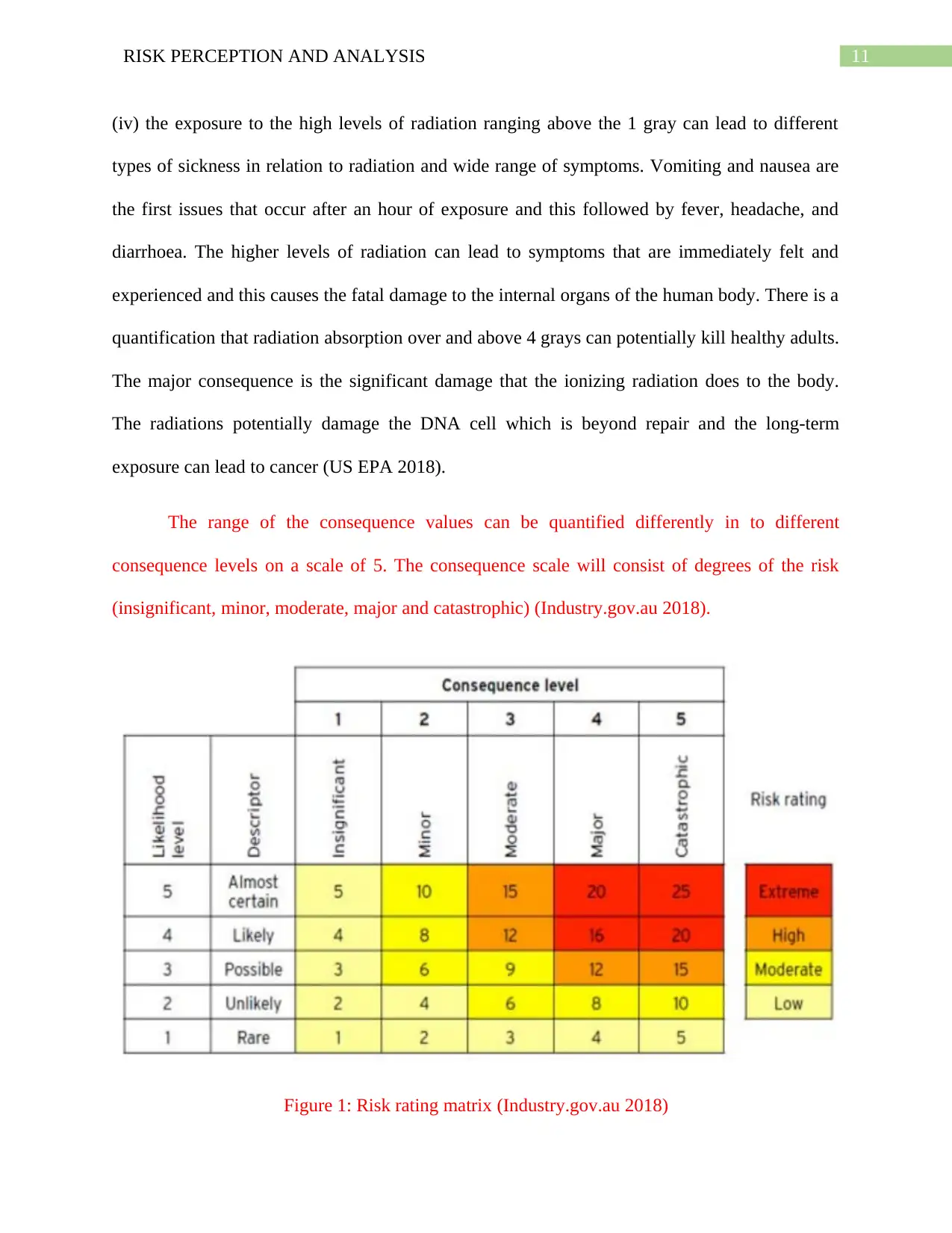
The range of the consequence values can be quantified differently in to different
consequence levels on a scale of 5. The consequence scale will consist of degrees of the risk
(insignificant, minor, moderate, major and catastrophic) (Industry.gov.au 2018).
Figure 1: Risk rating matrix (Industry.gov.au 2018)
(iv) the exposure to the high levels of radiation ranging above the 1 gray can lead to different
types of sickness in relation to radiation and wide range of symptoms. Vomiting and nausea are
the first issues that occur after an hour of exposure and this followed by fever, headache, and
diarrhoea. The higher levels of radiation can lead to symptoms that are immediately felt and
experienced and this causes the fatal damage to the internal organs of the human body. There is a
quantification that radiation absorption over and above 4 grays can potentially kill healthy adults.
The major consequence is the significant damage that the ionizing radiation does to the body.
The radiations potentially damage the DNA cell which is beyond repair and the long-term
exposure can lead to cancer (US EPA 2018).
The range of the consequence values can be quantified differently in to different
consequence levels on a scale of 5. The consequence scale will consist of degrees of the risk
(insignificant, minor, moderate, major and catastrophic) (Industry.gov.au 2018).
Figure 1: Risk rating matrix (Industry.gov.au 2018)
⊘ This is a preview!⊘
Do you want full access?
Subscribe today to unlock all pages.
Trusted by 1+ million students worldwide

1 out of 16


Your All-in-One AI-Powered Toolkit for Academic Success.
+13062052269
info@desklib.com
Available 24*7 on WhatsApp / Email
![[object Object]](/_next/static/media/star-bottom.7253800d.svg)
Unlock your academic potential
Copyright © 2020–2026 A2Z Services. All Rights Reserved. Developed and managed by ZUCOL.