Risk Assessments for IT Projects: A Courier Company in Australia
VerifiedAdded on 2020/05/16
|17
|3539
|449
Report
AI Summary
This report provides a detailed IT risk assessment for a courier company operating in Australia. It begins with an executive summary and table of contents, followed by an introduction outlining the scope of the assessment. The discussion section analyzes project success factors, including the impact of economic, social, and technical complexities using the PESTEL framework, and the complexities in micro and macro environments. The project background describes the company's operations, specifically the Advanced Information Based Allocation (AIBA) system for fleet and dispatch management. The report identifies and assesses various risks, including political, economic, social, technical, environmental, and legal risks. It then outlines critical success factors, such as market research, project planning, technical proficiency, change management, stakeholder engagement, risk management, and communication. The report concludes by summarizing the factors affecting project management and offering insights into mitigating risks and ensuring project success. References are included to support the analysis.
Running head: RISK ASSESSMENTS FOR IT PROJECTS
Risk assessments for IT projects
Name of the student
Name of the University
Author note
Risk assessments for IT projects
Name of the student
Name of the University
Author note

Paraphrase This Document
Need a fresh take? Get an instant paraphrase of this document with our AI Paraphraser
1RISK ASSESSMENTS FOR IT PROJECTS
Executive summary
This report discusses about the IT risk assessment of a company. The chosen company is a
courier company and the chosen country is Australia. This report includes a description of the
project. This report also includes the various risks to the system. Lastly, this report includes the
critical success factors that are to be included for an effective project management. This report
concludes by showing the various factors which affects the management of the project.
Executive summary
This report discusses about the IT risk assessment of a company. The chosen company is a
courier company and the chosen country is Australia. This report includes a description of the
project. This report also includes the various risks to the system. Lastly, this report includes the
critical success factors that are to be included for an effective project management. This report
concludes by showing the various factors which affects the management of the project.
2RISK ASSESSMENTS FOR IT PROJECTS
Table of Contents
Introduction......................................................................................................................................3
Discussion........................................................................................................................................3
Project background......................................................................................................................5
Risks............................................................................................................................................6
Critical success factor..................................................................................................................8
Conclusion.....................................................................................................................................12
References......................................................................................................................................14
Table of Contents
Introduction......................................................................................................................................3
Discussion........................................................................................................................................3
Project background......................................................................................................................5
Risks............................................................................................................................................6
Critical success factor..................................................................................................................8
Conclusion.....................................................................................................................................12
References......................................................................................................................................14
⊘ This is a preview!⊘
Do you want full access?
Subscribe today to unlock all pages.

Trusted by 1+ million students worldwide
3RISK ASSESSMENTS FOR IT PROJECTS
Introduction
The assessment that is carried out in this report discusses about the critical success factors
that are considered for various IT related projects. The sources responsible for the complexity of
these projects will be analyzed successfully in this report. Moreover, this report will also include
a risk assessment of the projects which will be used to get an efficient analysis of the
requirements. This report mainly discusses about the adoption of advanced systems which can be
used for delivery and receiving sections of the company. In addition, this report also discusses
about the risk assessment of these projects along with the stakeholder management processes.
Discussion
Success factors of a project are termed as those parameters which are effective in
contributing to the success of a project. The most important parameter which is considered for
any project is the factors which can contribute to the project both in a positive and in a negative
way. This helps in increasing the chances of success for a project (Ergu et al., 2014). However,
the main sources of complexity of this project are the various factors like the economic, social
and technical factors which contribute to the influence of the objectives.
Introduction
The assessment that is carried out in this report discusses about the critical success factors
that are considered for various IT related projects. The sources responsible for the complexity of
these projects will be analyzed successfully in this report. Moreover, this report will also include
a risk assessment of the projects which will be used to get an efficient analysis of the
requirements. This report mainly discusses about the adoption of advanced systems which can be
used for delivery and receiving sections of the company. In addition, this report also discusses
about the risk assessment of these projects along with the stakeholder management processes.
Discussion
Success factors of a project are termed as those parameters which are effective in
contributing to the success of a project. The most important parameter which is considered for
any project is the factors which can contribute to the project both in a positive and in a negative
way. This helps in increasing the chances of success for a project (Ergu et al., 2014). However,
the main sources of complexity of this project are the various factors like the economic, social
and technical factors which contribute to the influence of the objectives.
Paraphrase This Document
Need a fresh take? Get an instant paraphrase of this document with our AI Paraphraser
4RISK ASSESSMENTS FOR IT PROJECTS
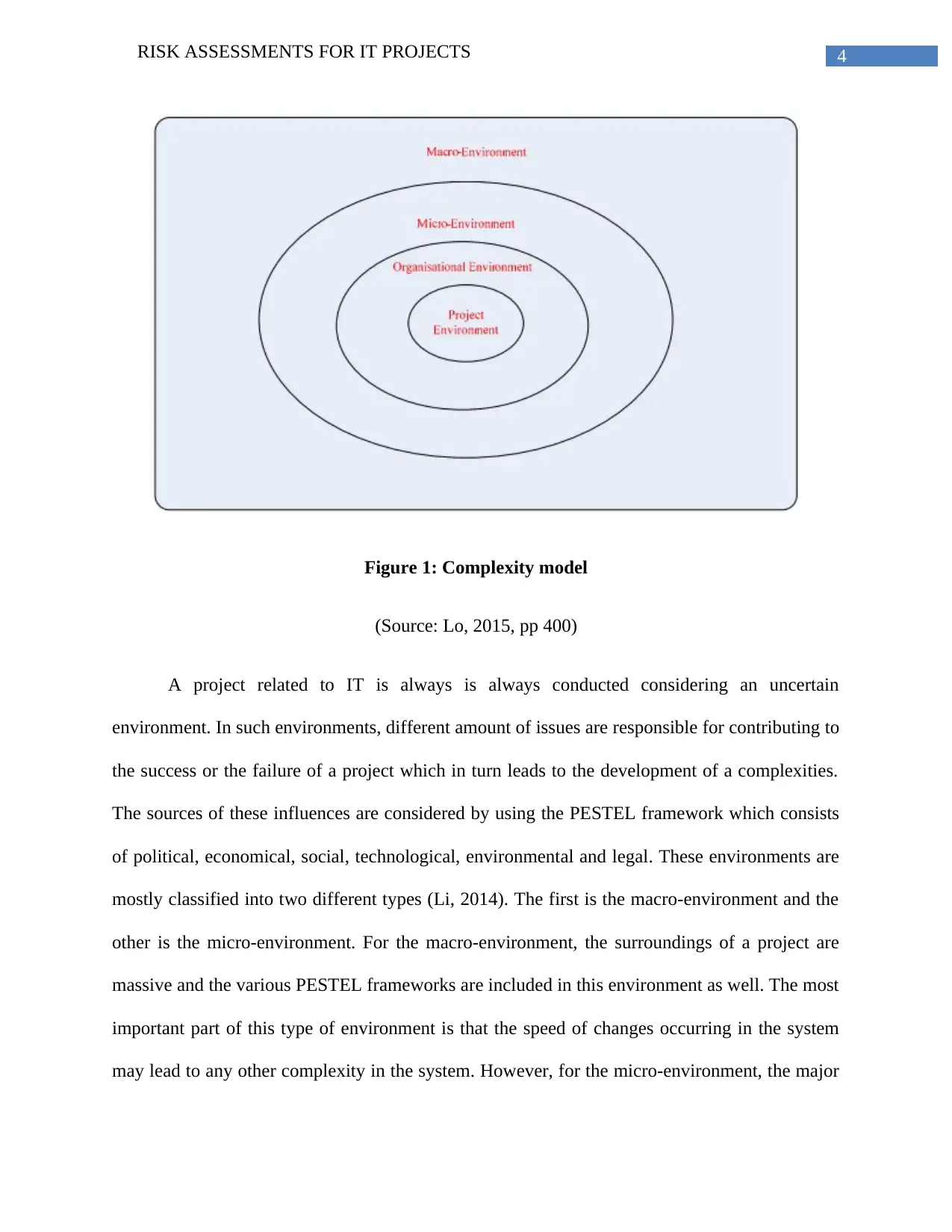
Figure 1: Complexity model
(Source: Lo, 2015, pp 400)
A project related to IT is always is always conducted considering an uncertain
environment. In such environments, different amount of issues are responsible for contributing to
the success or the failure of a project which in turn leads to the development of a complexities.
The sources of these influences are considered by using the PESTEL framework which consists
of political, economical, social, technological, environmental and legal. These environments are
mostly classified into two different types (Li, 2014). The first is the macro-environment and the
other is the micro-environment. For the macro-environment, the surroundings of a project are
massive and the various PESTEL frameworks are included in this environment as well. The most
important part of this type of environment is that the speed of changes occurring in the system
may lead to any other complexity in the system. However, for the micro-environment, the major
Figure 1: Complexity model
(Source: Lo, 2015, pp 400)
A project related to IT is always is always conducted considering an uncertain
environment. In such environments, different amount of issues are responsible for contributing to
the success or the failure of a project which in turn leads to the development of a complexities.
The sources of these influences are considered by using the PESTEL framework which consists
of political, economical, social, technological, environmental and legal. These environments are
mostly classified into two different types (Li, 2014). The first is the macro-environment and the
other is the micro-environment. For the macro-environment, the surroundings of a project are
massive and the various PESTEL frameworks are included in this environment as well. The most
important part of this type of environment is that the speed of changes occurring in the system
may lead to any other complexity in the system. However, for the micro-environment, the major
5RISK ASSESSMENTS FOR IT PROJECTS
parameters are the clients. For determining the requirements of the clients, a complexity may
arise in taking into account all the major requirements. Due to the presence of technical or
logical issues, there can be any presence of arising complexities in the system. The development,
constriction, understanding and communication of such requirements is considered as a
challenge for all the members of the project team, especially when setting up a reasonable project
scope by considering the input from the users and deciding the level of involvement in setting up
the scope and system requirements.
Project background
Courier services are a major part of any business. This involves the sending or receiving
shipments. This is termed as a major sub-part of any company. For this report, the assessment
will be based on a courier company. The courier company operates for 24 hours a day and 7 days
a week. The parcel from any source is taken to any destination within the country that it is
involved in business (Grunwald, 2015). However, these parcels can be sent to any destination
worldwide when they are requested by premium clients.
This is normally done by utilizing an IT based projects. This is the Advanced Information
Based Allocation (AIBA) which is supposed to be a fleet management and dispatch management
system. This is mainly used to allocate an order id to the parcel and then allocate it to the proper
vehicle so that it can be transferred easily to its destination. The vehicles that are taken for
dispatch can range from motorbikes, vans or even bicycles. This also involves sending message
notification so that the status of the travel system can be determined. Moreover, the Advanced
Information Based Allocation system can also be used to detect the nearest location of the pickup
vehicle so that any changes in the level of congestion can be effectively monitored. This will be
notified to the vehicle in charge so that the dispatch can be effectively made without the
parameters are the clients. For determining the requirements of the clients, a complexity may
arise in taking into account all the major requirements. Due to the presence of technical or
logical issues, there can be any presence of arising complexities in the system. The development,
constriction, understanding and communication of such requirements is considered as a
challenge for all the members of the project team, especially when setting up a reasonable project
scope by considering the input from the users and deciding the level of involvement in setting up
the scope and system requirements.
Project background
Courier services are a major part of any business. This involves the sending or receiving
shipments. This is termed as a major sub-part of any company. For this report, the assessment
will be based on a courier company. The courier company operates for 24 hours a day and 7 days
a week. The parcel from any source is taken to any destination within the country that it is
involved in business (Grunwald, 2015). However, these parcels can be sent to any destination
worldwide when they are requested by premium clients.
This is normally done by utilizing an IT based projects. This is the Advanced Information
Based Allocation (AIBA) which is supposed to be a fleet management and dispatch management
system. This is mainly used to allocate an order id to the parcel and then allocate it to the proper
vehicle so that it can be transferred easily to its destination. The vehicles that are taken for
dispatch can range from motorbikes, vans or even bicycles. This also involves sending message
notification so that the status of the travel system can be determined. Moreover, the Advanced
Information Based Allocation system can also be used to detect the nearest location of the pickup
vehicle so that any changes in the level of congestion can be effectively monitored. This will be
notified to the vehicle in charge so that the dispatch can be effectively made without the
⊘ This is a preview!⊘
Do you want full access?
Subscribe today to unlock all pages.
Trusted by 1+ million students worldwide
6RISK ASSESSMENTS FOR IT PROJECTS
possibility of any delays. Aside from the congestion level, the weather conditions are also
notified to the vehicle in charge of the dispatch.
Furthermore, the company has made various upgrades for their customers as well. This is
mainly done for addressing the concerns of the customer. As customers are always on the
lookout for their parcels, it is necessary to address these requirements for keeping the brand
image of the company (Avgerou & Walsham, 2017). Due to this reason, the parcels can be
tracked in real-time on the map by using the GPS technology. In addition, the shortest route of
the parcel is also shown to the customers so that billings are made according to the route
covered. After receiving the parcel, an email confirmation is sent to the receiver. This is the main
business model which provides an idea of dedication to the customers about the company
involved.
Risks
There are various kinds of issues which are reflected in both types of environments. For
the macro-environment, the PESTEL framework is used to denote the assessment techniques.
These mainly involve the political, economic, social, technological, environmental and legal
factors.
Political risks
The project which involves major IT related infrastructures can be heavily affected if the
government enforces law on this. However, it has been seen that the courier industry is not
subjected to any government related factors (Teo, 2015). As some of the government actions like
sending credentials or notices also involve utilizing the dispatch systems, the courier system is
not always monitored.
possibility of any delays. Aside from the congestion level, the weather conditions are also
notified to the vehicle in charge of the dispatch.
Furthermore, the company has made various upgrades for their customers as well. This is
mainly done for addressing the concerns of the customer. As customers are always on the
lookout for their parcels, it is necessary to address these requirements for keeping the brand
image of the company (Avgerou & Walsham, 2017). Due to this reason, the parcels can be
tracked in real-time on the map by using the GPS technology. In addition, the shortest route of
the parcel is also shown to the customers so that billings are made according to the route
covered. After receiving the parcel, an email confirmation is sent to the receiver. This is the main
business model which provides an idea of dedication to the customers about the company
involved.
Risks
There are various kinds of issues which are reflected in both types of environments. For
the macro-environment, the PESTEL framework is used to denote the assessment techniques.
These mainly involve the political, economic, social, technological, environmental and legal
factors.
Political risks
The project which involves major IT related infrastructures can be heavily affected if the
government enforces law on this. However, it has been seen that the courier industry is not
subjected to any government related factors (Teo, 2015). As some of the government actions like
sending credentials or notices also involve utilizing the dispatch systems, the courier system is
not always monitored.
Paraphrase This Document
Need a fresh take? Get an instant paraphrase of this document with our AI Paraphraser
7RISK ASSESSMENTS FOR IT PROJECTS
Economic risks
There are various economic factors which are to be considered while making a risk
assessment of the company concerned. The geographical factor may lead to risks in the
economic factors of the company. For the company to get daily orders, the location needs to be
assessed first. This involves determining the market of the company so that there can be orders
made available on the company. The website of the company must also be effectively advertised
in front of traffic such that their attention can be successfully captured for availing the services.
Technical risks
There are various technical risks that are evident through the normal processing of the
company. The company website may experience heavy server load. Due to this, it can lead to
downtime of the website. The server will have to deal with excessive load from the traffic.
Another technical risk that may have an impact is the presence of vulnerabilities to the
system. As a result, the advanced tracking system which is the most important part of the
company can experience faults. This will result in losing valuable time in business. These risks
are considered to be technical in nature and any threats or risks in this system can lead to
problems in the normal business flow (Valacich & Schneider, 2015). For addressing such
problems, the company need to identify the risks associated and must make effective investments
on their chosen technologies.
Environmental issues
The environmental issues are other aspects which are to be considered by the company
concerned. As the company operates by using different vehicles, they might be subjected to
Economic risks
There are various economic factors which are to be considered while making a risk
assessment of the company concerned. The geographical factor may lead to risks in the
economic factors of the company. For the company to get daily orders, the location needs to be
assessed first. This involves determining the market of the company so that there can be orders
made available on the company. The website of the company must also be effectively advertised
in front of traffic such that their attention can be successfully captured for availing the services.
Technical risks
There are various technical risks that are evident through the normal processing of the
company. The company website may experience heavy server load. Due to this, it can lead to
downtime of the website. The server will have to deal with excessive load from the traffic.
Another technical risk that may have an impact is the presence of vulnerabilities to the
system. As a result, the advanced tracking system which is the most important part of the
company can experience faults. This will result in losing valuable time in business. These risks
are considered to be technical in nature and any threats or risks in this system can lead to
problems in the normal business flow (Valacich & Schneider, 2015). For addressing such
problems, the company need to identify the risks associated and must make effective investments
on their chosen technologies.
Environmental issues
The environmental issues are other aspects which are to be considered by the company
concerned. As the company operates by using different vehicles, they might be subjected to
8RISK ASSESSMENTS FOR IT PROJECTS
various issues. For example, for parking related fines, larger vehicles may experience major
deductions in applying for delivery of the parcels. Similarly, lack of internet connection may
make a driver forget to update the requirements. The IT project will be considered for selecting
the most appropriate delivery parcel in place of the most environmentally secure.
Legal risks
The company may face legal issues from various factors. As customer satisfaction is a
very important concept which is always considered by any company, it also has its negative
impacts as well. Any unsatisfied customer may press charges against the company (Köhler et al.,
2015). In addition, due to any unfavorable conditions, if the parcel is subjected to any damages
or impacts, the customer may press charges against the company concerned.
In addition, the output of the project may be subjected to any kinds of government
legislation which generally involves specific guidelines. For addressing these conditions, the
company may apply for patent protection so that an effective product creation is finalized. In
case the government signs the patent, it might be able to reduce the complexity related to the
project such that threats due to new entrants in the macro-environment are mitigated.
Critical success factor
The success factor of the project defines all the parameters that are necessary for a
successful project completion. There are three different phases in the project which involves
project completion (Laudon & Laudon, 2015). They are pre-implementation, implementation and
post-implementation. In the pre-implementation process, the requirements of the project is
analyzed and planned. In the implementation process, it involves adopting the processes for
various issues. For example, for parking related fines, larger vehicles may experience major
deductions in applying for delivery of the parcels. Similarly, lack of internet connection may
make a driver forget to update the requirements. The IT project will be considered for selecting
the most appropriate delivery parcel in place of the most environmentally secure.
Legal risks
The company may face legal issues from various factors. As customer satisfaction is a
very important concept which is always considered by any company, it also has its negative
impacts as well. Any unsatisfied customer may press charges against the company (Köhler et al.,
2015). In addition, due to any unfavorable conditions, if the parcel is subjected to any damages
or impacts, the customer may press charges against the company concerned.
In addition, the output of the project may be subjected to any kinds of government
legislation which generally involves specific guidelines. For addressing these conditions, the
company may apply for patent protection so that an effective product creation is finalized. In
case the government signs the patent, it might be able to reduce the complexity related to the
project such that threats due to new entrants in the macro-environment are mitigated.
Critical success factor
The success factor of the project defines all the parameters that are necessary for a
successful project completion. There are three different phases in the project which involves
project completion (Laudon & Laudon, 2015). They are pre-implementation, implementation and
post-implementation. In the pre-implementation process, the requirements of the project is
analyzed and planned. In the implementation process, it involves adopting the processes for
⊘ This is a preview!⊘
Do you want full access?
Subscribe today to unlock all pages.
Trusted by 1+ million students worldwide
9RISK ASSESSMENTS FOR IT PROJECTS
successful project completion. The post-implementation phase involves all the activities that are
undertaken after getting the outcome of the project.
Figure 2: Critical success factors
(Source: Teo, 2015, pp 25)
The critical success factors involve various parameters which are mentioned in the
diagram above. They are market research, project plan, technical issues, change management,
stakeholder management, risk management and communication management.
Market research
For successfully achieving the outcomes of the project, the responsible personnel must
make a full market analysis such that the scope of the project can be determined. In addition, the
demands of the product can also be effectively measured. This helps in making an analysis of the
product demand such that it can effectively tailored to meet the business needs of thr population
concerned.
successful project completion. The post-implementation phase involves all the activities that are
undertaken after getting the outcome of the project.
Figure 2: Critical success factors
(Source: Teo, 2015, pp 25)
The critical success factors involve various parameters which are mentioned in the
diagram above. They are market research, project plan, technical issues, change management,
stakeholder management, risk management and communication management.
Market research
For successfully achieving the outcomes of the project, the responsible personnel must
make a full market analysis such that the scope of the project can be determined. In addition, the
demands of the product can also be effectively measured. This helps in making an analysis of the
product demand such that it can effectively tailored to meet the business needs of thr population
concerned.
Paraphrase This Document
Need a fresh take? Get an instant paraphrase of this document with our AI Paraphraser
10RISK ASSESSMENTS FOR IT PROJECTS
Project plan
The manager of the project must have a sufficient format of doing the project. This will
be utilized in following the steps of a project. This involves making an analysis of the
requirements of the project which generally involves timeline, scope, budget and resources.
There are various phases of a project management plan. The first phase is the planning phase
which involves planning of the project. In this phase all the requirements all accounted and
analyzed. The next phase is the initiation phase where the project is started and the processes
involving a project are followed. In this process, the requirements are gathered (Richardson et
al., 2015). The third phase is the execution phase where all the necessary steps for completing
the project are followed. In the fourth phase, then monitoring of the system is adopted. This is
involved with the monitoring of the systems such that errors can be minimized. The last phase is
the closure phase which involves closing of the project. In this phase, the outcome of the project
is usually discovered.
Technical issues
The personnel responsible for the project must be technically strong such that designing,
developing, implementing and evaluating of the system will be adopted. When there are various
issues persistent in the project life cycle, the team responsible must be able to achieve the
outcome in their own way by considering the budget and the availability of the resources. The
major technical issues that are mainly involved are the problems in the structure of the
department (Boud, Cohen & Sampson, 2014). In addition, the issues pertaining to the technical
level must not be addressed by the technical development but by the major departments as well.
This is mainly denoted by shared organization structures.
Project plan
The manager of the project must have a sufficient format of doing the project. This will
be utilized in following the steps of a project. This involves making an analysis of the
requirements of the project which generally involves timeline, scope, budget and resources.
There are various phases of a project management plan. The first phase is the planning phase
which involves planning of the project. In this phase all the requirements all accounted and
analyzed. The next phase is the initiation phase where the project is started and the processes
involving a project are followed. In this process, the requirements are gathered (Richardson et
al., 2015). The third phase is the execution phase where all the necessary steps for completing
the project are followed. In the fourth phase, then monitoring of the system is adopted. This is
involved with the monitoring of the systems such that errors can be minimized. The last phase is
the closure phase which involves closing of the project. In this phase, the outcome of the project
is usually discovered.
Technical issues
The personnel responsible for the project must be technically strong such that designing,
developing, implementing and evaluating of the system will be adopted. When there are various
issues persistent in the project life cycle, the team responsible must be able to achieve the
outcome in their own way by considering the budget and the availability of the resources. The
major technical issues that are mainly involved are the problems in the structure of the
department (Boud, Cohen & Sampson, 2014). In addition, the issues pertaining to the technical
level must not be addressed by the technical development but by the major departments as well.
This is mainly denoted by shared organization structures.
11RISK ASSESSMENTS FOR IT PROJECTS
The system that has been made will be responsible for meeting the demands of the
company and the stakeholders. For example, in case of a website, any changes in the user
experience will be responsible for impacting the systems. As such, the end-user experience must
be improved by making changes in the system.
Change management
Change management is an effective factor considered in critical success factors. Change
is driven by technology, knowledge and business environment. In case of any IT project, change
management is basically applied to maintain the possibility of control in the system and reduce
and chances of risks in the system which will add to the benefit of the program (Lo, 2015). For
ensuring the success of a project, small amount of changes are involved which mainly consist of
small radical changes to substantial amounts of changes. This will be responsible for company
operations and initial scope.
Stakeholder management
The stakeholder management is responsible for taking into account the various amount of
stakeholders to the system. The stakeholders are those people who are responsible for the
activities accounted to the system or the project (Galegher, Kraut & Egido, 2014). For the courier
company, the major stakeholders involved in this process are the customers, the employees,
government and the technical experts. As all these stakeholders are different, the contributions
and the capabilities of them can be considered in a different manner.
Risk management
The system that has been made will be responsible for meeting the demands of the
company and the stakeholders. For example, in case of a website, any changes in the user
experience will be responsible for impacting the systems. As such, the end-user experience must
be improved by making changes in the system.
Change management
Change management is an effective factor considered in critical success factors. Change
is driven by technology, knowledge and business environment. In case of any IT project, change
management is basically applied to maintain the possibility of control in the system and reduce
and chances of risks in the system which will add to the benefit of the program (Lo, 2015). For
ensuring the success of a project, small amount of changes are involved which mainly consist of
small radical changes to substantial amounts of changes. This will be responsible for company
operations and initial scope.
Stakeholder management
The stakeholder management is responsible for taking into account the various amount of
stakeholders to the system. The stakeholders are those people who are responsible for the
activities accounted to the system or the project (Galegher, Kraut & Egido, 2014). For the courier
company, the major stakeholders involved in this process are the customers, the employees,
government and the technical experts. As all these stakeholders are different, the contributions
and the capabilities of them can be considered in a different manner.
Risk management
⊘ This is a preview!⊘
Do you want full access?
Subscribe today to unlock all pages.
Trusted by 1+ million students worldwide

1 out of 17


Related Documents


Your All-in-One AI-Powered Toolkit for Academic Success.
+13062052269
info@desklib.com
Available 24*7 on WhatsApp / Email
![[object Object]](/_next/static/media/star-bottom.7253800d.svg)
Unlock your academic potential
Copyright © 2020–2026 A2Z Services. All Rights Reserved. Developed and managed by ZUCOL.