Equitable Funding Risk Management and Assessment Report
VerifiedAdded on 2021/02/22
|10
|2983
|472
Report
AI Summary
This report provides a comprehensive analysis of risk management within the context of Equitable Funding Ltd. It begins by defining risk management and outlining various types of risk, including strategic, compliance, technology, and financial risks, and their potential impacts. The report then examines high-risk activities across primary, secondary, and tertiary sectors, emphasizing safety concerns and potential hazards. It explores the meaning of business risk, the role of risk management functions, and how different business functions contribute to managing risk. The report also details various approaches to risk assessment and management, such as avoidance, reduction, sharing, and retention, alongside specific methods like the risk matrix and indicator-based approaches. Furthermore, the report assesses activities to identify the probability of risk using techniques like documentation review, brainstorming, interviewing, and SWOT analysis. It analyzes the potential impact of identified risks, such as economic crises and volatility, and proposes a risk management plan. The plan includes activities to identify risks and strategies to mitigate their impact. Overall, the report offers insights into effective risk management strategies tailored to the financial services industry.
ATHE Risk Management

Paraphrase This Document
Need a fresh take? Get an instant paraphrase of this document with our AI Paraphraser
Table of Contents
INTRODUCTION ..........................................................................................................................3
TASK 1............................................................................................................................................3
LO 1.................................................................................................................................................3
1.1 The impact of various types of risk on Equitable Funding Ltd., are ...............................3
1.2 Activities which are high risk in different sectors ...........................................................3
TASK 2............................................................................................................................................4
2.1 Meaning of Business risk ................................................................................................4
2.2 Role of risk management function in organisation...........................................................4
2.3 Role of business function in management of risk ...........................................................5
D1 Different approaches with risk assessment and management .........................................5
TASK 3............................................................................................................................................6
Covered in PPT ......................................................................................................................6
TASK 4............................................................................................................................................6
4.1 Assessment of activities in order to identify the probability of risk.................................6
4.2 Potential impact of identified risk ...................................................................................7
4.3 Risk management plan.....................................................................................................7
M1. Strategies used in order to made risk management plan ................................................8
D1 Strategic benefit to the organisation of having effective risk management plan ............8
CONCLUSION ...............................................................................................................................9
REFERENCES..............................................................................................................................10
INTRODUCTION ..........................................................................................................................3
TASK 1............................................................................................................................................3
LO 1.................................................................................................................................................3
1.1 The impact of various types of risk on Equitable Funding Ltd., are ...............................3
1.2 Activities which are high risk in different sectors ...........................................................3
TASK 2............................................................................................................................................4
2.1 Meaning of Business risk ................................................................................................4
2.2 Role of risk management function in organisation...........................................................4
2.3 Role of business function in management of risk ...........................................................5
D1 Different approaches with risk assessment and management .........................................5
TASK 3............................................................................................................................................6
Covered in PPT ......................................................................................................................6
TASK 4............................................................................................................................................6
4.1 Assessment of activities in order to identify the probability of risk.................................6
4.2 Potential impact of identified risk ...................................................................................7
4.3 Risk management plan.....................................................................................................7
M1. Strategies used in order to made risk management plan ................................................8
D1 Strategic benefit to the organisation of having effective risk management plan ............8
CONCLUSION ...............................................................................................................................9
REFERENCES..............................................................................................................................10
INTRODUCTION
Risk management can be define as a process of forecasting and evaluating financial risk
by identification of procedure which can be used in order to minimize risk. In order to
understand the risk management in detail report will cover different types of risk which company
may face(Almeida, Hankins and Williams, 2017). It will also cover risk assessment and
management techniques. The approaches of crisis management has also been discussed in the
report. The report will also highlight the risk management plan which company can use in order
to mitigate the impact of risk.
TASK 1
LO 1
1.1 The impact of various types of risk on Equitable Funding Ltd., are
Strategic risk: Strategic risk can be defined as a risk which occur due to lack in management,
poor execution and lack of availability of resources.
Equitable funding than face the impact of such type of risk on the business. Due to wrong
decision by the top management or changes in business environment can affect the working of
the company. Such type of risk can create huge loss to company, missed deadlines and can also
result in poor cash flow.
Compliance risk: If the business fails to adhere rules of a particular company or particular
sector than it may result in paying fines, reputational damage and prosecution.
Technology risk: As the technology is changing rapidly therefore this can be a major risk to the
business.
This risk can cause Equitable funding loss of time on systems, corruption of data or in
some cases it may also result in data breach(Teixeira, Sou, Sandberg and Johansson, 2015).
Financial risk: There are various internal as well as external factors which can result in financial
risk such as exchange rates, interest rates and fluctuation in financial market.
These factors may affect the Equitable funding which causes company to face loss of
income, negative cash flow or in some cases it may result in end of business.
Scenario of different sectors
1.2 Activities which are high risk in different sectors
Risk management can be define as a process of forecasting and evaluating financial risk
by identification of procedure which can be used in order to minimize risk. In order to
understand the risk management in detail report will cover different types of risk which company
may face(Almeida, Hankins and Williams, 2017). It will also cover risk assessment and
management techniques. The approaches of crisis management has also been discussed in the
report. The report will also highlight the risk management plan which company can use in order
to mitigate the impact of risk.
TASK 1
LO 1
1.1 The impact of various types of risk on Equitable Funding Ltd., are
Strategic risk: Strategic risk can be defined as a risk which occur due to lack in management,
poor execution and lack of availability of resources.
Equitable funding than face the impact of such type of risk on the business. Due to wrong
decision by the top management or changes in business environment can affect the working of
the company. Such type of risk can create huge loss to company, missed deadlines and can also
result in poor cash flow.
Compliance risk: If the business fails to adhere rules of a particular company or particular
sector than it may result in paying fines, reputational damage and prosecution.
Technology risk: As the technology is changing rapidly therefore this can be a major risk to the
business.
This risk can cause Equitable funding loss of time on systems, corruption of data or in
some cases it may also result in data breach(Teixeira, Sou, Sandberg and Johansson, 2015).
Financial risk: There are various internal as well as external factors which can result in financial
risk such as exchange rates, interest rates and fluctuation in financial market.
These factors may affect the Equitable funding which causes company to face loss of
income, negative cash flow or in some cases it may result in end of business.
Scenario of different sectors
1.2 Activities which are high risk in different sectors
⊘ This is a preview!⊘
Do you want full access?
Subscribe today to unlock all pages.

Trusted by 1+ million students worldwide
Primary sector: The activities of primary sector are mining, forestry, farming, grazing,
gathering and fishing.
Forestry, hunting, fishing, are the activities which are in high risk in primary sector.
Employees in this sector often faces the safety issues. The reason behind this is that despite of
despite of disastrous situations mining exposes workers to mercury, radon or dust which creates
a negative impact on health of an individual.
Secondary sector: Metal working, smelting, textile production, auto mobile production,
chemical and engineering industries etc., generally the activities related to manufacturing are
activities performed by companies in this sector.
Food product and manufacturing, civil and heavy engineering services, are activities in
high risk. The risk is quite diverse in such industries. Employees in this sector has to work with
heavy duty machinery and has to handle hazardous materials.
Tertiary sector: Retail, wholesale, transportation, distribution, entertainment services are
activities of tertiary sector.
The activities which is in high risk in this sector is retail, transportation and distribution.
The tertiary activities is less risky in comparison to others. The retail and transportation is facing
a huge competition.
TASK 2
2.1 Meaning of Business risk
Uncertainness which are beyond control or it can be defined as a risk which leads to
incurring or less profits or losses as expected. Such factors are not controllable by the business.
As the Equitable Funding Ltd., face the problem of risk management as stated by the third party
regulator. Managing risk within the organisation is important as it failure may lead company to
suffer a huge loss in a market.
There are various kinds of business risk which companies might face such as strategic
risk the failure of applied strategy , financial risk due to taking of loan and reputational risk
which may occur due to any inappropriate activity. Like for example Tesco Bank is exposed to a
number of risks, the most significant of which are credit risk, operational risk, liquidity and
funding risk, market risk, and legal and regulatory compliance risk. 1 The Bank continues to
actively manage the risks to which it is exposed
gathering and fishing.
Forestry, hunting, fishing, are the activities which are in high risk in primary sector.
Employees in this sector often faces the safety issues. The reason behind this is that despite of
despite of disastrous situations mining exposes workers to mercury, radon or dust which creates
a negative impact on health of an individual.
Secondary sector: Metal working, smelting, textile production, auto mobile production,
chemical and engineering industries etc., generally the activities related to manufacturing are
activities performed by companies in this sector.
Food product and manufacturing, civil and heavy engineering services, are activities in
high risk. The risk is quite diverse in such industries. Employees in this sector has to work with
heavy duty machinery and has to handle hazardous materials.
Tertiary sector: Retail, wholesale, transportation, distribution, entertainment services are
activities of tertiary sector.
The activities which is in high risk in this sector is retail, transportation and distribution.
The tertiary activities is less risky in comparison to others. The retail and transportation is facing
a huge competition.
TASK 2
2.1 Meaning of Business risk
Uncertainness which are beyond control or it can be defined as a risk which leads to
incurring or less profits or losses as expected. Such factors are not controllable by the business.
As the Equitable Funding Ltd., face the problem of risk management as stated by the third party
regulator. Managing risk within the organisation is important as it failure may lead company to
suffer a huge loss in a market.
There are various kinds of business risk which companies might face such as strategic
risk the failure of applied strategy , financial risk due to taking of loan and reputational risk
which may occur due to any inappropriate activity. Like for example Tesco Bank is exposed to a
number of risks, the most significant of which are credit risk, operational risk, liquidity and
funding risk, market risk, and legal and regulatory compliance risk. 1 The Bank continues to
actively manage the risks to which it is exposed
Paraphrase This Document
Need a fresh take? Get an instant paraphrase of this document with our AI Paraphraser
2.2 Role of risk management function in organisation
Risk management is needed in an organisation in order to be prepared for facing any type
of challenges. If there are proper risk management practices within the organisation than it will
help in examining the realistic as well as cost effective opportunities in order to balance the
commercial issues. Risk management within the Equity funding monitors, identify and treat
property, income and personal exposure to loss. The main role of risk management in an
Equitable funding Ltd., is to ensure preservation of human as well as physical assets. It will help
company to survive in market and face every type of risk. Like for example a case study of one
of the UK's largest retailers, Tesco plc, is used to show how ERM can be introduced as part of an
existing strategic control system. The case demonstrates that, despite some differences in lines of
communications, the strategic controls and risk controls can be used to achieve a common
objective.
2.3 Role of business function in management of risk
The various business functions such as distribution and logistics, administrative and management
functions, research and development, information and communication technology help business
in order to manage risk.
It became important that all the department of the organisation should prepare themselves
at their own level to manage risk which will help company overall to manage risk properly. For
example, the common risk which finance department can face are bankruptcy, equity market
downturn, project overspend etc. similarly IT department may face improper use of data, system
failures, improper use of data etc. these all risk at departmental level can be a threat to whole
organisation.
The Equitable funding Ltd., can also develop and administer some risk control techniques which
will help company to reduce frequency of loss. Various financing techniques can also be
developed in order to ensure that adequate resources are available within the organisation. The
system wide risk management policies can also be created in order to solve complex business
problems.
Therefore, all business functions of Equitable funding plays an important role in order to
manage risk. The various departments within the organisation manage risk at their own level
which helps business to manage risk efficiently. Like for example Brand guidelines have been
updated to provide Group-wide consistency over the use of the Tesco brand. Group commercial
Risk management is needed in an organisation in order to be prepared for facing any type
of challenges. If there are proper risk management practices within the organisation than it will
help in examining the realistic as well as cost effective opportunities in order to balance the
commercial issues. Risk management within the Equity funding monitors, identify and treat
property, income and personal exposure to loss. The main role of risk management in an
Equitable funding Ltd., is to ensure preservation of human as well as physical assets. It will help
company to survive in market and face every type of risk. Like for example a case study of one
of the UK's largest retailers, Tesco plc, is used to show how ERM can be introduced as part of an
existing strategic control system. The case demonstrates that, despite some differences in lines of
communications, the strategic controls and risk controls can be used to achieve a common
objective.
2.3 Role of business function in management of risk
The various business functions such as distribution and logistics, administrative and management
functions, research and development, information and communication technology help business
in order to manage risk.
It became important that all the department of the organisation should prepare themselves
at their own level to manage risk which will help company overall to manage risk properly. For
example, the common risk which finance department can face are bankruptcy, equity market
downturn, project overspend etc. similarly IT department may face improper use of data, system
failures, improper use of data etc. these all risk at departmental level can be a threat to whole
organisation.
The Equitable funding Ltd., can also develop and administer some risk control techniques which
will help company to reduce frequency of loss. Various financing techniques can also be
developed in order to ensure that adequate resources are available within the organisation. The
system wide risk management policies can also be created in order to solve complex business
problems.
Therefore, all business functions of Equitable funding plays an important role in order to
manage risk. The various departments within the organisation manage risk at their own level
which helps business to manage risk efficiently. Like for example Brand guidelines have been
updated to provide Group-wide consistency over the use of the Tesco brand. Group commercial
and corporate affairs policies and procedures have been updated. Communications, media
relations and corporate responsibility plans are in place and include internal and external
stakeholder engagement. Like for example Brand guidelines have been updated to provide
Group-wide consistency over the use of the Tesco brand. Group commercial and corporate
affairs policies and procedures have been updated. Communications, media relations and
corporate responsibility plans are in place and include internal and external stakeholder
engagement.
D1 Different approaches with risk assessment and management
The approaches for risk management are :
Avoidance: this approach involves not performing activity which carry risk. For example, not
flying in air-plane due to risk of air-plane crash or hijack(Uhl and Gollenia, 2016.).
A company can avoid to take part in such activities which result in loss to company.
Reduction: Reducing severity of loss is referred to as risk reduction.
In order to reduce risk modern software can be helpful. Outsourcing is also a good
example, of risk reduction in business.
Sharing: Sharing approach simply means sharing of risk along with other parties.
For example, public sector company whose shares can be sold to public and in this way
company can share risk among different investors is a good example of sharing approach.
Retention: Taking up responsibility of particular risk is known as risk retention. The companies
retain risk when they think that cost of doing business is less in comparison to cost of fully or
partially insuring it.
Risk assessment approach
Risk matrix approach : A risk matrix approach is a useful approach which is used during risk
assessment. This is thee simple method which is used in order to increase the visibility of risk
and assisting decision making by the management.
Equitable funding Ltd. Can use this approach as it will help in rating the severity of risk.
This approach will help company to reach with all type of risk. It will help company to evaluate
the level of risk company can face at different levels(Approaches to risk assessment, 2019).
Indicator based approach :
The many cases arise where risk mapping can not be a appropriate way for measuring
risk. This approach will help to analyse various components of vulnerability such as
relations and corporate responsibility plans are in place and include internal and external
stakeholder engagement. Like for example Brand guidelines have been updated to provide
Group-wide consistency over the use of the Tesco brand. Group commercial and corporate
affairs policies and procedures have been updated. Communications, media relations and
corporate responsibility plans are in place and include internal and external stakeholder
engagement.
D1 Different approaches with risk assessment and management
The approaches for risk management are :
Avoidance: this approach involves not performing activity which carry risk. For example, not
flying in air-plane due to risk of air-plane crash or hijack(Uhl and Gollenia, 2016.).
A company can avoid to take part in such activities which result in loss to company.
Reduction: Reducing severity of loss is referred to as risk reduction.
In order to reduce risk modern software can be helpful. Outsourcing is also a good
example, of risk reduction in business.
Sharing: Sharing approach simply means sharing of risk along with other parties.
For example, public sector company whose shares can be sold to public and in this way
company can share risk among different investors is a good example of sharing approach.
Retention: Taking up responsibility of particular risk is known as risk retention. The companies
retain risk when they think that cost of doing business is less in comparison to cost of fully or
partially insuring it.
Risk assessment approach
Risk matrix approach : A risk matrix approach is a useful approach which is used during risk
assessment. This is thee simple method which is used in order to increase the visibility of risk
and assisting decision making by the management.
Equitable funding Ltd. Can use this approach as it will help in rating the severity of risk.
This approach will help company to reach with all type of risk. It will help company to evaluate
the level of risk company can face at different levels(Approaches to risk assessment, 2019).
Indicator based approach :
The many cases arise where risk mapping can not be a appropriate way for measuring
risk. This approach will help to analyse various components of vulnerability such as
⊘ This is a preview!⊘
Do you want full access?
Subscribe today to unlock all pages.
Trusted by 1+ million students worldwide
environmental vulnerability, social vulnerability and capacity. This approach help to measure
risk and vulnerability by using selected comparative indicators in quantitative way.
The company can use this approach in order to assess risk.
TASK 3
Covered in PPT
TASK 4
4.1 Assessment of activities in order to identify the probability of risk
Documentation review : The Equitable funding Ltd., can use this technique in order to identify
the risk. The company can review all the document such as articles, organisational process
assets, lessons learned, past experiences etc.
Brainstorming : The company can conduct meeting in which the risk which the company might
face in future should be assessed. It will help company to get views of different people in the
organisation from different departments.
Interviewing : The company can also conduct interview of project participants, experts,
stakeholders in order to identify the risk associated.
Swot analysis : the company should try to perform swot analysis of the project which company
is going to perform it will help in identifying risk associated with the project which company is
going to perform or is currently working on.
4.2 Potential impact of identified risk
As the company is in financial service industry therefore the threat which company can
face is economic crisis in UK, secondly the company may also get affected by the volatility in
exchange rate. The sudden economic crisis may cause company to cut back the employees from
the organisation. In order to cut cost the company may charge hire interest rate for loans which
might cause company to loose it customers.
A poor risk management can also result in poor user adoption means if the employees of
Equitable funding Ltd., does not make correct use of process used or tools then it may affect the
company. If the risk not analysed then it may cause late running of projects which may lead to
increase in time and cost. The economic crisis may affect the working of company.
4.3 Risk management plan
Activities for risk management Procedure
risk and vulnerability by using selected comparative indicators in quantitative way.
The company can use this approach in order to assess risk.
TASK 3
Covered in PPT
TASK 4
4.1 Assessment of activities in order to identify the probability of risk
Documentation review : The Equitable funding Ltd., can use this technique in order to identify
the risk. The company can review all the document such as articles, organisational process
assets, lessons learned, past experiences etc.
Brainstorming : The company can conduct meeting in which the risk which the company might
face in future should be assessed. It will help company to get views of different people in the
organisation from different departments.
Interviewing : The company can also conduct interview of project participants, experts,
stakeholders in order to identify the risk associated.
Swot analysis : the company should try to perform swot analysis of the project which company
is going to perform it will help in identifying risk associated with the project which company is
going to perform or is currently working on.
4.2 Potential impact of identified risk
As the company is in financial service industry therefore the threat which company can
face is economic crisis in UK, secondly the company may also get affected by the volatility in
exchange rate. The sudden economic crisis may cause company to cut back the employees from
the organisation. In order to cut cost the company may charge hire interest rate for loans which
might cause company to loose it customers.
A poor risk management can also result in poor user adoption means if the employees of
Equitable funding Ltd., does not make correct use of process used or tools then it may affect the
company. If the risk not analysed then it may cause late running of projects which may lead to
increase in time and cost. The economic crisis may affect the working of company.
4.3 Risk management plan
Activities for risk management Procedure
Paraphrase This Document
Need a fresh take? Get an instant paraphrase of this document with our AI Paraphraser
Make a list First the company should list all the
risk which company thinks the
company may face in future. The risk
which the financial service industry
may face is economic crisis.
The second most major threat which
company facing is bank lending criteria
alters and it does not allow refinancing.
The company should try to first
evaluate the risk factors such as
financial risk, technological risk etc.,
which the company may face.
Prioritize risk Second step is the company should try
to prioritize the risk. For prioritizing the
risk which company should first
address to. The company require to set
the criteria for the ranking the severity
of addressing the risk.
Developing an action plan After prioritizing the risk company
need to create an action plan which will
help company to mitigate the negative
impact of risk on company.
Human resource deployment The company should ensure that people
under the organisation should
continuously work with the company in
order to mange risk. The company
should ensure that all the people who
will get affected should be secured.
Communication A meeting should be conducted in
order to plan the next step including
risk which company thinks the
company may face in future. The risk
which the financial service industry
may face is economic crisis.
The second most major threat which
company facing is bank lending criteria
alters and it does not allow refinancing.
The company should try to first
evaluate the risk factors such as
financial risk, technological risk etc.,
which the company may face.
Prioritize risk Second step is the company should try
to prioritize the risk. For prioritizing the
risk which company should first
address to. The company require to set
the criteria for the ranking the severity
of addressing the risk.
Developing an action plan After prioritizing the risk company
need to create an action plan which will
help company to mitigate the negative
impact of risk on company.
Human resource deployment The company should ensure that people
under the organisation should
continuously work with the company in
order to mange risk. The company
should ensure that all the people who
will get affected should be secured.
Communication A meeting should be conducted in
order to plan the next step including
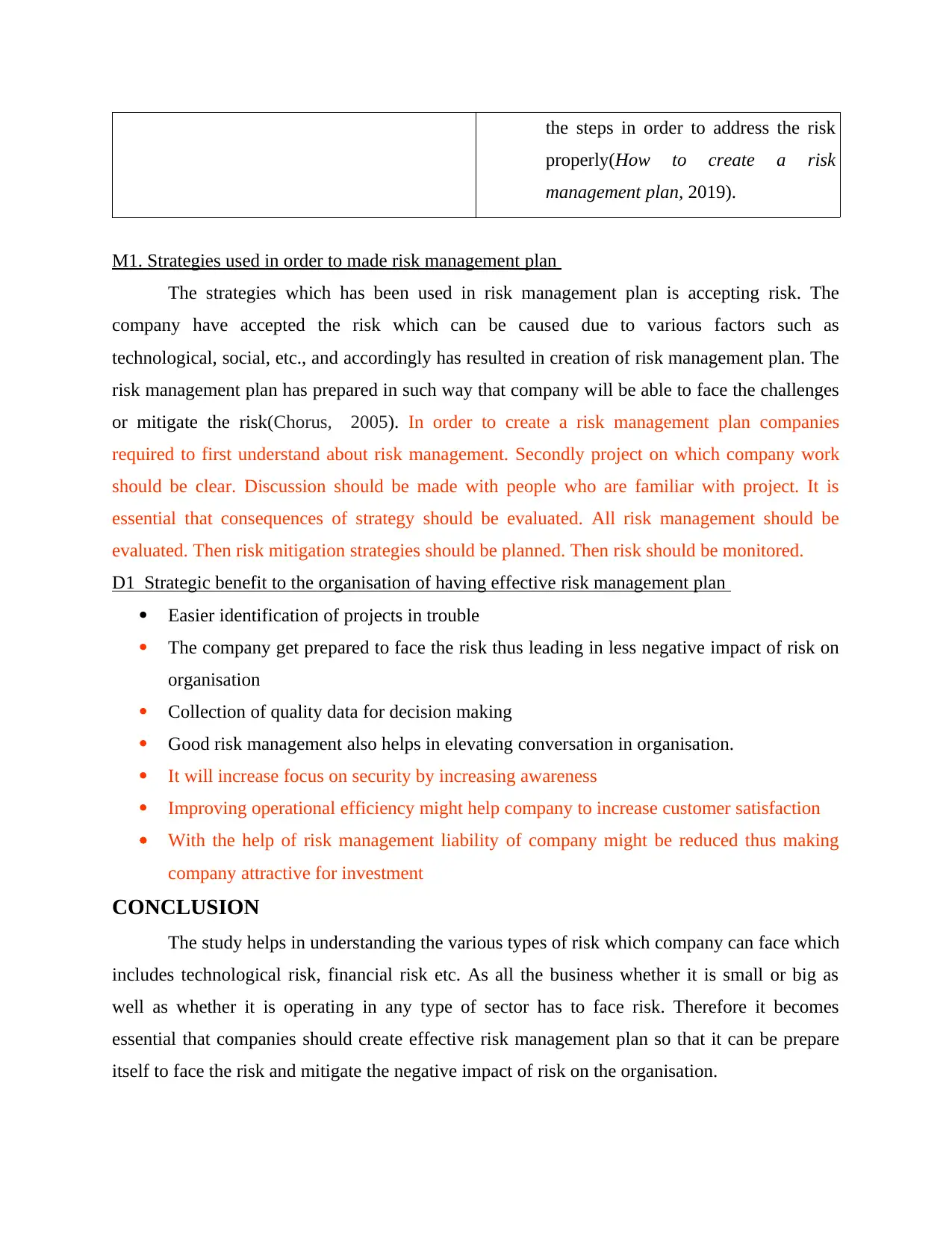
the steps in order to address the risk
properly(How to create a risk
management plan, 2019).
M1. Strategies used in order to made risk management plan
The strategies which has been used in risk management plan is accepting risk. The
company have accepted the risk which can be caused due to various factors such as
technological, social, etc., and accordingly has resulted in creation of risk management plan. The
risk management plan has prepared in such way that company will be able to face the challenges
or mitigate the risk(Chorus, 2005). In order to create a risk management plan companies
required to first understand about risk management. Secondly project on which company work
should be clear. Discussion should be made with people who are familiar with project. It is
essential that consequences of strategy should be evaluated. All risk management should be
evaluated. Then risk mitigation strategies should be planned. Then risk should be monitored.
D1 Strategic benefit to the organisation of having effective risk management plan
Easier identification of projects in trouble
The company get prepared to face the risk thus leading in less negative impact of risk on
organisation
Collection of quality data for decision making
Good risk management also helps in elevating conversation in organisation.
It will increase focus on security by increasing awareness
Improving operational efficiency might help company to increase customer satisfaction
With the help of risk management liability of company might be reduced thus making
company attractive for investment
CONCLUSION
The study helps in understanding the various types of risk which company can face which
includes technological risk, financial risk etc. As all the business whether it is small or big as
well as whether it is operating in any type of sector has to face risk. Therefore it becomes
essential that companies should create effective risk management plan so that it can be prepare
itself to face the risk and mitigate the negative impact of risk on the organisation.
properly(How to create a risk
management plan, 2019).
M1. Strategies used in order to made risk management plan
The strategies which has been used in risk management plan is accepting risk. The
company have accepted the risk which can be caused due to various factors such as
technological, social, etc., and accordingly has resulted in creation of risk management plan. The
risk management plan has prepared in such way that company will be able to face the challenges
or mitigate the risk(Chorus, 2005). In order to create a risk management plan companies
required to first understand about risk management. Secondly project on which company work
should be clear. Discussion should be made with people who are familiar with project. It is
essential that consequences of strategy should be evaluated. All risk management should be
evaluated. Then risk mitigation strategies should be planned. Then risk should be monitored.
D1 Strategic benefit to the organisation of having effective risk management plan
Easier identification of projects in trouble
The company get prepared to face the risk thus leading in less negative impact of risk on
organisation
Collection of quality data for decision making
Good risk management also helps in elevating conversation in organisation.
It will increase focus on security by increasing awareness
Improving operational efficiency might help company to increase customer satisfaction
With the help of risk management liability of company might be reduced thus making
company attractive for investment
CONCLUSION
The study helps in understanding the various types of risk which company can face which
includes technological risk, financial risk etc. As all the business whether it is small or big as
well as whether it is operating in any type of sector has to face risk. Therefore it becomes
essential that companies should create effective risk management plan so that it can be prepare
itself to face the risk and mitigate the negative impact of risk on the organisation.
⊘ This is a preview!⊘
Do you want full access?
Subscribe today to unlock all pages.
Trusted by 1+ million students worldwide
REFERENCES
Books and Journals
Almeida, H., Hankins, K.W. and Williams, R., 2017. Risk management with supply
contracts. The Review of Financial Studies, 30(12). pp.4179-4215.
Bjørnsen, K., Jensen, A. and Aven, T., 2018. Using qualitative types of risk assessments in
conjunction with FRAM to strengthen the resilience of systems. Journal of Risk
Research, pp.1-14.
Chorus, I. ed., 2005. Current approaches to cyanotoxin risk assessment, risk management and
regulations in different countries. Fed. Environmental Agency.
Robinson, G., Mares, S. and Arney, F., 2017. Continuity, engagement and integration: Early
intervention in remote Australian aboriginal communities. Australian Social
Work, 70(1). pp.116-124.
Teixeira, A., Sou, K.C., Sandberg, H. and Johansson, K.H., 2015. Secure control systems: A
quantitative risk management approach. IEEE Control Systems Magazine, 35(1). pp.24-
45.
Uhl, A. and Gollenia, L.A. eds., 2016. A handbook of business transformation management
methodology. Routledge.
Online
Approaches to risk assessment. 2019. [Online] Available through
http://www.firstpracticemanagement.co.uk/blog/posts/the-5-step-approach-to-risk-
assessment/
How to create a risk management plan. 2019.[Online] Available through
https://www.managementstudyguide.com/risk-management-plan.htm
Books and Journals
Almeida, H., Hankins, K.W. and Williams, R., 2017. Risk management with supply
contracts. The Review of Financial Studies, 30(12). pp.4179-4215.
Bjørnsen, K., Jensen, A. and Aven, T., 2018. Using qualitative types of risk assessments in
conjunction with FRAM to strengthen the resilience of systems. Journal of Risk
Research, pp.1-14.
Chorus, I. ed., 2005. Current approaches to cyanotoxin risk assessment, risk management and
regulations in different countries. Fed. Environmental Agency.
Robinson, G., Mares, S. and Arney, F., 2017. Continuity, engagement and integration: Early
intervention in remote Australian aboriginal communities. Australian Social
Work, 70(1). pp.116-124.
Teixeira, A., Sou, K.C., Sandberg, H. and Johansson, K.H., 2015. Secure control systems: A
quantitative risk management approach. IEEE Control Systems Magazine, 35(1). pp.24-
45.
Uhl, A. and Gollenia, L.A. eds., 2016. A handbook of business transformation management
methodology. Routledge.
Online
Approaches to risk assessment. 2019. [Online] Available through
http://www.firstpracticemanagement.co.uk/blog/posts/the-5-step-approach-to-risk-
assessment/
How to create a risk management plan. 2019.[Online] Available through
https://www.managementstudyguide.com/risk-management-plan.htm

1 out of 10


Related Documents


Your All-in-One AI-Powered Toolkit for Academic Success.
+13062052269
info@desklib.com
Available 24*7 on WhatsApp / Email
![[object Object]](/_next/static/media/star-bottom.7253800d.svg)
Unlock your academic potential
Copyright © 2020–2026 A2Z Services. All Rights Reserved. Developed and managed by ZUCOL.