Risk Assessment Report: Analyzing Business Risks and Mitigation
VerifiedAdded on 2023/06/05
|11
|2930
|413
Report
AI Summary
This report presents a comprehensive risk assessment of a business, focusing on three key areas: pressure points arising from growth, organizational culture, and information management. The analysis delves into the risks associated with rapid market expansion, including employee inexperience, and the potential for compromised product and service quality. The report also examines the impact of entrepreneurial risk-taking, executive resistance to negative information, and internal competition on organizational performance. Furthermore, it assesses the risks tied to information management, such as transaction complexity and gaps in diagnostic performance. The report utilizes a risk exposure calculator to quantify potential losses and proposes mitigation strategies, including employee training, market research, improved communication, and enhanced information systems, to minimize risks and improve overall business outcomes. The report is an essential guide for businesses to understand and address potential threats to their operations.
Risk Assessment

Paraphrase This Document
Need a fresh take? Get an instant paraphrase of this document with our AI Paraphraser
Table of Contents
Introduction................................................................................................................................3
Pressure point due to growth..................................................................................................3
Pressure point due to culture..................................................................................................5
Pressure Points due to Information Management..................................................................7
Conclusion..................................................................................................................................9
References................................................................................................................................10
Introduction................................................................................................................................3
Pressure point due to growth..................................................................................................3
Pressure point due to culture..................................................................................................5
Pressure Points due to Information Management..................................................................7
Conclusion..................................................................................................................................9
References................................................................................................................................10
Introduction
Top management in present’s firms are facing the frightening task of navigating their
organization safely though an increasingly challenging market environments and business
conditions. Due to these dynamic scenarios, the risks associated with the firm are increasing
and modern day businesses are becoming more problematic. These problems are not easily
identifiable, more anxiety provoking, and less easily managed. According to Nishat Faisal et
al., (2007) the risks evident in the present competitive environment are ubiquitous and spread
through the entire functionalities of an organization. Therefore, in present scenario the main
objective of the business is to identify the main risks associated with the organization and try
to reduce as well as minimize the exposure.
Therefore the present report is emphasising on the risk assessment reports which comprises
of three important sections – pressure point due to growth, pressure point due to culture and
pressure point due to information management. Moreover, the report would also focus on the
mitigation strategies, i.e. how risks can be reduced.
Risk assessment reports
In order to analyze the risks and its weight, risks exposure calculator is used. Risks exposure
calculator is not a precise tool such as cash flow analysis and an electronic spreadsheet, its
outcomes is directional. It helps the management of an organization to find out
organization’s risks level is in the danger, safety and caution. Once the management can
understand an organization’s risks level, they can make effective steps to solve them or can
align it with business strategies (Shedden et al., 2010).
Pressure point due to growth
Fast increasing market businesses are often exciting and they are operating in an intensely
competitive market environment. A growing organization attracts the employees’ interest as
well as emphasising on the aspect of business profitability. In pursuing organizational
strategies, greater importance is given on ensuring sales improvements and revenues growth.
Moreover, the person who is doing well within the organization is offered with better rewards
and incentives as compared to the other individuals. A person performing excellently within
an organization is offered with better career growth opportunities and this can lead to a lot of
pressure and stress on the other employees and this would eventually have a negative impact
Top management in present’s firms are facing the frightening task of navigating their
organization safely though an increasingly challenging market environments and business
conditions. Due to these dynamic scenarios, the risks associated with the firm are increasing
and modern day businesses are becoming more problematic. These problems are not easily
identifiable, more anxiety provoking, and less easily managed. According to Nishat Faisal et
al., (2007) the risks evident in the present competitive environment are ubiquitous and spread
through the entire functionalities of an organization. Therefore, in present scenario the main
objective of the business is to identify the main risks associated with the organization and try
to reduce as well as minimize the exposure.
Therefore the present report is emphasising on the risk assessment reports which comprises
of three important sections – pressure point due to growth, pressure point due to culture and
pressure point due to information management. Moreover, the report would also focus on the
mitigation strategies, i.e. how risks can be reduced.
Risk assessment reports
In order to analyze the risks and its weight, risks exposure calculator is used. Risks exposure
calculator is not a precise tool such as cash flow analysis and an electronic spreadsheet, its
outcomes is directional. It helps the management of an organization to find out
organization’s risks level is in the danger, safety and caution. Once the management can
understand an organization’s risks level, they can make effective steps to solve them or can
align it with business strategies (Shedden et al., 2010).
Pressure point due to growth
Fast increasing market businesses are often exciting and they are operating in an intensely
competitive market environment. A growing organization attracts the employees’ interest as
well as emphasising on the aspect of business profitability. In pursuing organizational
strategies, greater importance is given on ensuring sales improvements and revenues growth.
Moreover, the person who is doing well within the organization is offered with better rewards
and incentives as compared to the other individuals. A person performing excellently within
an organization is offered with better career growth opportunities and this can lead to a lot of
pressure and stress on the other employees and this would eventually have a negative impact
⊘ This is a preview!⊘
Do you want full access?
Subscribe today to unlock all pages.

Trusted by 1+ million students worldwide
on their performance at the workplace (Merna and Al-Thani, 2011). Expansion in operations
is another growth related pressure point in business. In order to succeed in a competitive
market, business establishments must increase their existing production line by ensuring the
utilization of innovation techniques and setting up of new production facilities. Without
proper planning, infrastructure support, and lack of distribution channels in the market
today’s organizations are likely to face a lot of challenges and complexities in the rapid
expansion. This would eventually lead to an overload, resulting in compromises in their
product and service quality. Inexperience among the employees and the staff’s members
could sometime create the growth related pressure point at the workplace. Organization needs
a huge amount of manpower for satisfying their business needs and requirements and at times
the manager could make the mistake of not checking their social background, experience and
education qualifications which could invariably have a negative impact on the organization in
a negative manner (Tjoa et al., 2008). As an outcome, employees have lack of an
adequate knowledge and skills which makes them unable to understand their work roles and
responsibilities.
Risks description Probability of
occurrence
Loss size(days) Risks exposure in
days
pressure for
performance
35% 10
3.5
rate of expansion 25% 14 3.75
inexperience of key
employees
45% 25
11.25
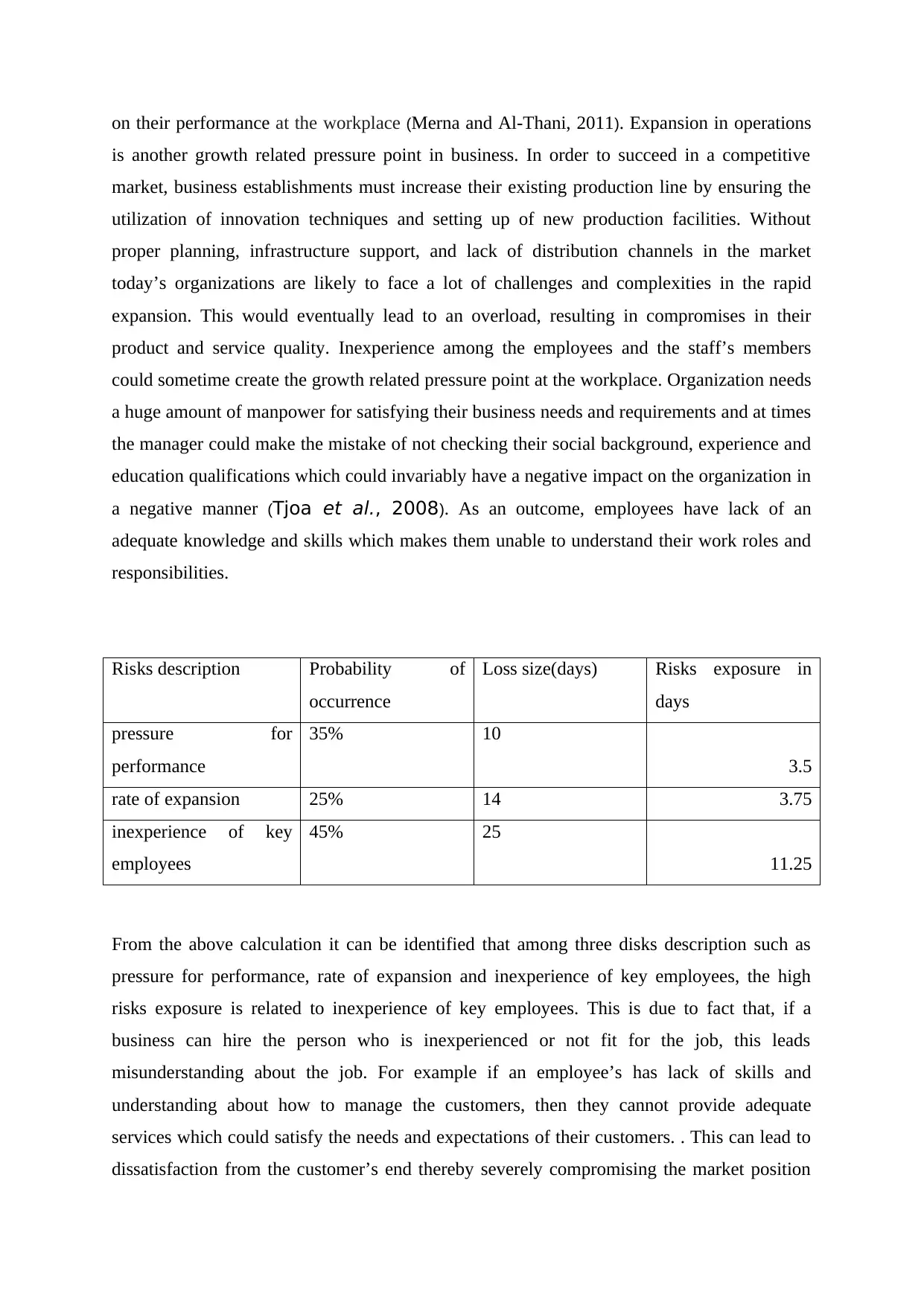
From the above calculation it can be identified that among three disks description such as
pressure for performance, rate of expansion and inexperience of key employees, the high
risks exposure is related to inexperience of key employees. This is due to fact that, if a
business can hire the person who is inexperienced or not fit for the job, this leads
misunderstanding about the job. For example if an employee’s has lack of skills and
understanding about how to manage the customers, then they cannot provide adequate
services which could satisfy the needs and expectations of their customers. . This can lead to
dissatisfaction from the customer’s end thereby severely compromising the market position
is another growth related pressure point in business. In order to succeed in a competitive
market, business establishments must increase their existing production line by ensuring the
utilization of innovation techniques and setting up of new production facilities. Without
proper planning, infrastructure support, and lack of distribution channels in the market
today’s organizations are likely to face a lot of challenges and complexities in the rapid
expansion. This would eventually lead to an overload, resulting in compromises in their
product and service quality. Inexperience among the employees and the staff’s members
could sometime create the growth related pressure point at the workplace. Organization needs
a huge amount of manpower for satisfying their business needs and requirements and at times
the manager could make the mistake of not checking their social background, experience and
education qualifications which could invariably have a negative impact on the organization in
a negative manner (Tjoa et al., 2008). As an outcome, employees have lack of an
adequate knowledge and skills which makes them unable to understand their work roles and
responsibilities.
Risks description Probability of
occurrence
Loss size(days) Risks exposure in
days
pressure for
performance
35% 10
3.5
rate of expansion 25% 14 3.75
inexperience of key
employees
45% 25
11.25
From the above calculation it can be identified that among three disks description such as
pressure for performance, rate of expansion and inexperience of key employees, the high
risks exposure is related to inexperience of key employees. This is due to fact that, if a
business can hire the person who is inexperienced or not fit for the job, this leads
misunderstanding about the job. For example if an employee’s has lack of skills and
understanding about how to manage the customers, then they cannot provide adequate
services which could satisfy the needs and expectations of their customers. . This can lead to
dissatisfaction from the customer’s end thereby severely compromising the market position
Paraphrase This Document
Need a fresh take? Get an instant paraphrase of this document with our AI Paraphraser
as well as sales performance of the organization (O'Donnell and Schultz Jr, 2005).
Experience in the workplace brings in some other issues mainly in terms of high innovation
and unstructured business. It takes too much time and effort on the part of an organization to
make their employees realise and understand the organization values. Therefore to mitigate
these risks, the management of an organization needs to implements effective strategies, such
as before their final induction into the workforce, the organization needs to put them through
comprehensive training and development classes (Simons, 1999). In addition to this,
management needs to build effective strategies regarding what percentage of new employees
could be filled up for these posts so that the organization performance and output would not
be hampered. Next, risks exposure is rate of expansion, thus to solve this problems the
management needs to analyze their available resources and conducts the market research
before implementing any strategies regarding expansion (Koller, 2005).
Pressure point due to culture
In present competitive environment no business can survive for long haul without
entrepreneurial risks considering the fact that it is the main determinant of organizational
creativity and innovation. But the success can make confident risks takers too much
complacent about their abilities and this would make them overconfident which is not good in
the long haul. Sometime it can be seen that successful business enterprises invest lots of
money in undertaking risky deals and alliances with business establishments that may not
have much ability to fulfil the changing needs and preferences of the customers (Manuj and
Mentzer, 2008). Again, it could be seen that rewarding the entrepreneurial initiative might not
be the right things to do as sometimes it could increase the risks exposure to an organization.
In order to compute the risks assessment and exposure, the management of an organization
might need to find out the percentage of business based on new services and products that
have been produced by their creative and risk taking workers (Dunovic et al., 2013). The
higher the numbers of such workers, the larger would be the risk exposure to the
organisation. Another reason of the higher score of the percentage is the internal working
environment within the organisation.
Executive resistance to bad news is considered another pressure point due to culture.
Executive resistance to bad news has negatively impact on organization performance and
eventually hampers the organization growth by making business establishments lose out on
the market competition with their business rivals (Merna and Al-Thani, 2011). Therefore, it is
Experience in the workplace brings in some other issues mainly in terms of high innovation
and unstructured business. It takes too much time and effort on the part of an organization to
make their employees realise and understand the organization values. Therefore to mitigate
these risks, the management of an organization needs to implements effective strategies, such
as before their final induction into the workforce, the organization needs to put them through
comprehensive training and development classes (Simons, 1999). In addition to this,
management needs to build effective strategies regarding what percentage of new employees
could be filled up for these posts so that the organization performance and output would not
be hampered. Next, risks exposure is rate of expansion, thus to solve this problems the
management needs to analyze their available resources and conducts the market research
before implementing any strategies regarding expansion (Koller, 2005).
Pressure point due to culture
In present competitive environment no business can survive for long haul without
entrepreneurial risks considering the fact that it is the main determinant of organizational
creativity and innovation. But the success can make confident risks takers too much
complacent about their abilities and this would make them overconfident which is not good in
the long haul. Sometime it can be seen that successful business enterprises invest lots of
money in undertaking risky deals and alliances with business establishments that may not
have much ability to fulfil the changing needs and preferences of the customers (Manuj and
Mentzer, 2008). Again, it could be seen that rewarding the entrepreneurial initiative might not
be the right things to do as sometimes it could increase the risks exposure to an organization.
In order to compute the risks assessment and exposure, the management of an organization
might need to find out the percentage of business based on new services and products that
have been produced by their creative and risk taking workers (Dunovic et al., 2013). The
higher the numbers of such workers, the larger would be the risk exposure to the
organisation. Another reason of the higher score of the percentage is the internal working
environment within the organisation.
Executive resistance to bad news is considered another pressure point due to culture.
Executive resistance to bad news has negatively impact on organization performance and
eventually hampers the organization growth by making business establishments lose out on
the market competition with their business rivals (Merna and Al-Thani, 2011). Therefore, it is
imperative for the management of an organization to focus on the improvement of this issue
as this would eventually help them to sustain the business competition in the market for the
long haul by accomplishing better organisational performance. In order to compute the risks
exposure, management of an organization needs to focus on the how much bad new they hear
on a daily basis and how it could be minimised. By finding out the answers to these
problems, business establishments would be able to solve their business risks in a better
manner (O'Donnell and Schultz Jr, 2005).
Internal competition is also considered one of the main risks associated with the organization.
Senior executives of an organization mainly established a healthy competition at the
workplace in order to stimulate an exceptional effort from all their employees (Dumbrava, &
Iacob, 2013). Moreover, it could be observed that internal competition at workplace could
create many other issues such as workplace politic and lack of trust and understanding among
the employees. This would result in potential credit losses, loss of business assets as well as
the market reputation of the organization.
Risks description
Probabilit
y of
occurrenc
e
Loss
size(day
s)
Risks
exposur
e in
days
rewards for entrepreneurial
risk taking 22% 8 1.76
executive resistance to bad
news 20% 12 2.4
level of internal competition 55% 15 8.25
From the calculation and findings of risks exposure, it can be observed that among them level
of internal competition is more rather than the other two factors. Therefore to solve these
issues in successful manner, management of an organization needs to implement effective
communication procedures within their business domain. Additionally for mitigating these
risks in a better manner, the management needs to accomplish or conduct regular meetings
with their staff members. This would help them to indentify the main issues related to
customer satisfaction and market demand in a successful manner. Apart from that
management needs to incorporate better motivation strategies which would help them to
as this would eventually help them to sustain the business competition in the market for the
long haul by accomplishing better organisational performance. In order to compute the risks
exposure, management of an organization needs to focus on the how much bad new they hear
on a daily basis and how it could be minimised. By finding out the answers to these
problems, business establishments would be able to solve their business risks in a better
manner (O'Donnell and Schultz Jr, 2005).
Internal competition is also considered one of the main risks associated with the organization.
Senior executives of an organization mainly established a healthy competition at the
workplace in order to stimulate an exceptional effort from all their employees (Dumbrava, &
Iacob, 2013). Moreover, it could be observed that internal competition at workplace could
create many other issues such as workplace politic and lack of trust and understanding among
the employees. This would result in potential credit losses, loss of business assets as well as
the market reputation of the organization.
Risks description
Probabilit
y of
occurrenc
e
Loss
size(day
s)
Risks
exposur
e in
days
rewards for entrepreneurial
risk taking 22% 8 1.76
executive resistance to bad
news 20% 12 2.4
level of internal competition 55% 15 8.25
From the calculation and findings of risks exposure, it can be observed that among them level
of internal competition is more rather than the other two factors. Therefore to solve these
issues in successful manner, management of an organization needs to implement effective
communication procedures within their business domain. Additionally for mitigating these
risks in a better manner, the management needs to accomplish or conduct regular meetings
with their staff members. This would help them to indentify the main issues related to
customer satisfaction and market demand in a successful manner. Apart from that
management needs to incorporate better motivation strategies which would help them to
⊘ This is a preview!⊘
Do you want full access?
Subscribe today to unlock all pages.
Trusted by 1+ million students worldwide
increase the organizational performance and mitigate these issues in a successful manner
(Nigro and Abbate, 2011).
Pressure Points due to Information Management
Information is a critical component of any modern day business organization without which
they would not be able to sustain their business competition in the market. Information plays
a vital role in the daily organizational functionalities and it helps management of the business
establishments to undertake better and informed decisions for ensuring the future
organizational growth and productivity in the market (Nigro and Abbate, 2011).
An effective flow of information within a company is critical to its market performance and
in the absence of an effective information management systems the organizations are
invariably exposed to greater market risks. Product and service innovation is a vital
instrument of success in a competitive marketplace. By fostering greater innovation and
creativity within their existing product and service offerings and bundling their new products
with their existing ones, organizations are invariably increasing complexity of business
transactions (Shedden et al., 2010). Such complexities could arise from the cross-border
agreements in international operations and the creative financing of
customer`s purchases wherein there is a need for formulating highly
complex contractual agreements. Furthermore, if only a handful of
experts are able to understand and realise the resulting obligations and
cash flow contingencies that would be encountered by an organization
from such transaction complexity, it would really pose a threat to the
normal smooth functioning of the organization in the near future (Calow,
2009).
Increasing the volumes of transactions is another crucial factor that would
put greater burden or pressure on their existing organizational information
systems. Excessive transactions would invariably create an overloading of
the information systems and this would lead to a greater leniency in the
process of scrutinising the business transactions in order to ensure that
they strictly adhere to preapproved organizational policies. Overloaded
computer information support systems would not be able to perform in an
optimum manner and as a result they would not be able to capture and
present the accurate information or data that is crucial to ensure
(Nigro and Abbate, 2011).
Pressure Points due to Information Management
Information is a critical component of any modern day business organization without which
they would not be able to sustain their business competition in the market. Information plays
a vital role in the daily organizational functionalities and it helps management of the business
establishments to undertake better and informed decisions for ensuring the future
organizational growth and productivity in the market (Nigro and Abbate, 2011).
An effective flow of information within a company is critical to its market performance and
in the absence of an effective information management systems the organizations are
invariably exposed to greater market risks. Product and service innovation is a vital
instrument of success in a competitive marketplace. By fostering greater innovation and
creativity within their existing product and service offerings and bundling their new products
with their existing ones, organizations are invariably increasing complexity of business
transactions (Shedden et al., 2010). Such complexities could arise from the cross-border
agreements in international operations and the creative financing of
customer`s purchases wherein there is a need for formulating highly
complex contractual agreements. Furthermore, if only a handful of
experts are able to understand and realise the resulting obligations and
cash flow contingencies that would be encountered by an organization
from such transaction complexity, it would really pose a threat to the
normal smooth functioning of the organization in the near future (Calow,
2009).
Increasing the volumes of transactions is another crucial factor that would
put greater burden or pressure on their existing organizational information
systems. Excessive transactions would invariably create an overloading of
the information systems and this would lead to a greater leniency in the
process of scrutinising the business transactions in order to ensure that
they strictly adhere to preapproved organizational policies. Overloaded
computer information support systems would not be able to perform in an
optimum manner and as a result they would not be able to capture and
present the accurate information or data that is crucial to ensure
Paraphrase This Document
Need a fresh take? Get an instant paraphrase of this document with our AI Paraphraser
organizational growth and productivity. This would also increase the
organizational risk in the long haul (Simons, 1999).
The gaps in the diagnostic performance are another critical factor that
contributes towards greater organizational risks. The existing amount of
pressure put on the internal reporting systems of an organization would
invariably decide how effectively they are able to monitor and analyse the
organizational performance and productivity in the market. The internal
reporting systems which measures organizational performance variables
such as return on capital employed, product and service quality must be
monitored in a regular manner so as to ensure that there are no gaps or
bottlenecks that could eventually threaten the organizational performance
(O'Donnell and Schultz Jr, 2005). This would help them to ensure effective
risk identification and risk management systems within their
organizational domain which would eventually help an organization to
tackle and manage their business risks in a better manner.
Risks description
Probabilit
y of
occurrenc
e
Loss
size(days
)
Risks
exposur
e in
days
transaction complexity and
velocity 15% 5 0.75
gaps in diagnostic performance 32% 15 4.8
degree of decentralised decision
making 65% 25 16.25
The degree of decentralised decision making process which is inherent
within an organization is another crucial factor that would contribute
towards greater business risks for an organization. The greater the
amount of decentralisation, the more would be the confusion in the
decision making process as there are more managers and branches
involved in a decentralised working environment (Koller, 2005). This is
why the organizational decision making process gets further complicated
due to the lack of consensus and understanding among the different
mangers who are working in different offices in a country. There would be
more time consumed in the process of organizational decision making and
organizational risk in the long haul (Simons, 1999).
The gaps in the diagnostic performance are another critical factor that
contributes towards greater organizational risks. The existing amount of
pressure put on the internal reporting systems of an organization would
invariably decide how effectively they are able to monitor and analyse the
organizational performance and productivity in the market. The internal
reporting systems which measures organizational performance variables
such as return on capital employed, product and service quality must be
monitored in a regular manner so as to ensure that there are no gaps or
bottlenecks that could eventually threaten the organizational performance
(O'Donnell and Schultz Jr, 2005). This would help them to ensure effective
risk identification and risk management systems within their
organizational domain which would eventually help an organization to
tackle and manage their business risks in a better manner.
Risks description
Probabilit
y of
occurrenc
e
Loss
size(days
)
Risks
exposur
e in
days
transaction complexity and
velocity 15% 5 0.75
gaps in diagnostic performance 32% 15 4.8
degree of decentralised decision
making 65% 25 16.25
The degree of decentralised decision making process which is inherent
within an organization is another crucial factor that would contribute
towards greater business risks for an organization. The greater the
amount of decentralisation, the more would be the confusion in the
decision making process as there are more managers and branches
involved in a decentralised working environment (Koller, 2005). This is
why the organizational decision making process gets further complicated
due to the lack of consensus and understanding among the different
mangers who are working in different offices in a country. There would be
more time consumed in the process of organizational decision making and
this would invariably compromise the organizational performance and
decision making (Calow, 2009). Thus, the organization would be facing a
greater risk in their business operations in the near future.
From the table above, it is clear to us that the degree of decentralised decision
making is the most critical component that has a much higher chances of occurrence as
compared to the others. This is closely followed in second place by the gaps in diagnostic
performance which has the second highest probability of occurrence and finally transaction
complexity and velocity has the lowest possibility of occurrence within an organization.
Conclusion
From the above findings and analysis it can be said that risks considered the important
element for any business and has a negative impact on organization performance. In order to
solve risks in a better manner management of an organization needs to implement better risks
assessment procedures and also computer the risks exposure. This would help them to
determine the most effective risks elements that impact the performance of an organization.
decision making (Calow, 2009). Thus, the organization would be facing a
greater risk in their business operations in the near future.
From the table above, it is clear to us that the degree of decentralised decision
making is the most critical component that has a much higher chances of occurrence as
compared to the others. This is closely followed in second place by the gaps in diagnostic
performance which has the second highest probability of occurrence and finally transaction
complexity and velocity has the lowest possibility of occurrence within an organization.
Conclusion
From the above findings and analysis it can be said that risks considered the important
element for any business and has a negative impact on organization performance. In order to
solve risks in a better manner management of an organization needs to implement better risks
assessment procedures and also computer the risks exposure. This would help them to
determine the most effective risks elements that impact the performance of an organization.
⊘ This is a preview!⊘
Do you want full access?
Subscribe today to unlock all pages.
Trusted by 1+ million students worldwide
References
Calow, P. P. (Ed.)., 2009. Handbook of environmental risk assessment and
management. John Wiley & Sons.
Dunović, I. B., Radujković, M., & Vukomanović, M., 2013. Risk register development and
implementation for construction projects. Gra evinar, 65(1), 23-35.
El-Sayegh, S.M., 2008. Risk assessment and allocation in the UAE
construction industry. International journal of project management, 26(4),
pp.431-438.
Koller, G. R., 2005. Risk assessment and decision making in business and
industry: A practical guide. Chapman and Hall/CRC.
Manuj, I., and Mentzer, J. T., 2008. Global supply chain risk management
strategies. International Journal of Physical Distribution & Logistics Management, 38(3),
192-223.
Merna, T., and Al-Thani, F. F., 2011. Corporate risk management. John Wiley & Sons.
Nigro, G. L., and Abbate, L., 2011. Risk assessment and profit sharing in
business networks. International Journal of Production Economics, 131(1),
234-241.
Nishat Faisal, M., Banwet, D. K., and Shankar, R., 2007. Information risks management in
supply chains: an assessment and mitigation framework. Journal of Enterprise Information
Management, 20(6), 677-699.
O'Donnell, E., and Schultz Jr, J. J., 2005. The halo effect in business risk
audits: Can strategic risk assessment bias auditor judgment about
accounting details?. The Accounting Review, 80(3), 921-939.
Shedden, P., Smith, W., and Ahmad, A., 2010. Information security risk assessment: towards
a business practice perspective. Elsevier
Calow, P. P. (Ed.)., 2009. Handbook of environmental risk assessment and
management. John Wiley & Sons.
Dunović, I. B., Radujković, M., & Vukomanović, M., 2013. Risk register development and
implementation for construction projects. Gra evinar, 65(1), 23-35.
El-Sayegh, S.M., 2008. Risk assessment and allocation in the UAE
construction industry. International journal of project management, 26(4),
pp.431-438.
Koller, G. R., 2005. Risk assessment and decision making in business and
industry: A practical guide. Chapman and Hall/CRC.
Manuj, I., and Mentzer, J. T., 2008. Global supply chain risk management
strategies. International Journal of Physical Distribution & Logistics Management, 38(3),
192-223.
Merna, T., and Al-Thani, F. F., 2011. Corporate risk management. John Wiley & Sons.
Nigro, G. L., and Abbate, L., 2011. Risk assessment and profit sharing in
business networks. International Journal of Production Economics, 131(1),
234-241.
Nishat Faisal, M., Banwet, D. K., and Shankar, R., 2007. Information risks management in
supply chains: an assessment and mitigation framework. Journal of Enterprise Information
Management, 20(6), 677-699.
O'Donnell, E., and Schultz Jr, J. J., 2005. The halo effect in business risk
audits: Can strategic risk assessment bias auditor judgment about
accounting details?. The Accounting Review, 80(3), 921-939.
Shedden, P., Smith, W., and Ahmad, A., 2010. Information security risk assessment: towards
a business practice perspective. Elsevier
Paraphrase This Document
Need a fresh take? Get an instant paraphrase of this document with our AI Paraphraser
Simons, R., 1999. How Risky Is Your Company?. [online] Harvard Business
Review. Available at: https://hbr.org/1999/05/how-risky-is-your-company
[Accessed 1 Oct. 2018].
Tjoa, S., Jakoubi, S. and Quirchmayr, G., 2008, March. Enhancing business
impact analysis and risk assessment applying a risk-aware business
process modeling and simulation methodology. In Availability, Reliability
and Security, 2008. ARES 08. Third International Conference on (pp. 179-
186). IEEE.
Review. Available at: https://hbr.org/1999/05/how-risky-is-your-company
[Accessed 1 Oct. 2018].
Tjoa, S., Jakoubi, S. and Quirchmayr, G., 2008, March. Enhancing business
impact analysis and risk assessment applying a risk-aware business
process modeling and simulation methodology. In Availability, Reliability
and Security, 2008. ARES 08. Third International Conference on (pp. 179-
186). IEEE.

1 out of 11


Related Documents


Your All-in-One AI-Powered Toolkit for Academic Success.
+13062052269
info@desklib.com
Available 24*7 on WhatsApp / Email
![[object Object]](/_next/static/media/star-bottom.7253800d.svg)
Unlock your academic potential
Copyright © 2020–2026 A2Z Services. All Rights Reserved. Developed and managed by ZUCOL.