University MNG10247: Risk Factor in Entrepreneurship Study Guide

Verified

Added on  2022/11/14

|5
|1078
|328
Report
AI Summary
This study guide, created for a 'Managing People and Organizations' course at the university, delves into the crucial topic of risk factors in entrepreneurship. It begins by emphasizing the inherent risks associated with starting a business, particularly in innovative ventures like the "impossible burger." The guide outlines learning outcomes focused on understanding risk factors, different risk types (financial, social, psychic), and mitigation strategies. It explains the importance of risk management for entrepreneurial success, highlighting that understanding and addressing risks is key to preventing losses and achieving objectives. The guide further details various risk types, including financial (cash flow), social and family (career changes), and psychic risks (potential for financial catastrophe), emphasizing their impact on entrepreneurs. It concludes with a learning activity suggestion, emphasizing pairing and sharing to reinforce the learning outcomes. The guide is well-structured, referencing relevant academic sources to support its analysis of entrepreneurial risks and risk management.
Document Page
MANAGING PEOPLE AND ORGANIZATIONS 1
MANAGING PEOPLE AND ORGANIZATIONS
Student’s Name
Course Name
Professor’s Name
University Name
City, State
Date
tabler-icon-diamond-filled.svg

Paraphrase This Document

Need a fresh take? Get an instant paraphrase of this document with our AI Paraphraser
Document Page
MANAGING PEOPLE AND ORGANIZATIONS 2
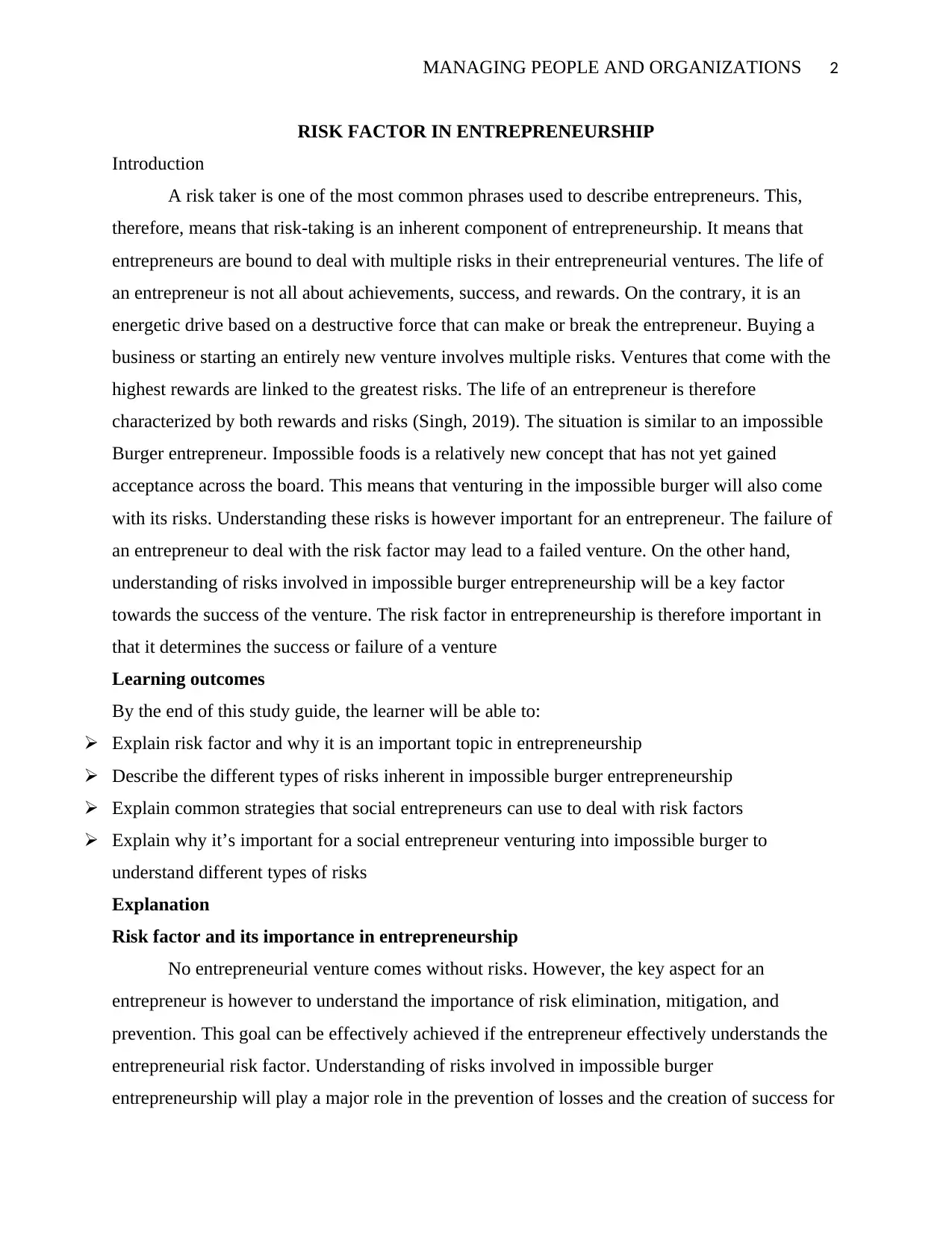
RISK FACTOR IN ENTREPRENEURSHIP
Introduction
A risk taker is one of the most common phrases used to describe entrepreneurs. This,
therefore, means that risk-taking is an inherent component of entrepreneurship. It means that
entrepreneurs are bound to deal with multiple risks in their entrepreneurial ventures. The life of
an entrepreneur is not all about achievements, success, and rewards. On the contrary, it is an
energetic drive based on a destructive force that can make or break the entrepreneur. Buying a
business or starting an entirely new venture involves multiple risks. Ventures that come with the
highest rewards are linked to the greatest risks. The life of an entrepreneur is therefore
characterized by both rewards and risks (Singh, 2019). The situation is similar to an impossible
Burger entrepreneur. Impossible foods is a relatively new concept that has not yet gained
acceptance across the board. This means that venturing in the impossible burger will also come
with its risks. Understanding these risks is however important for an entrepreneur. The failure of
an entrepreneur to deal with the risk factor may lead to a failed venture. On the other hand,
understanding of risks involved in impossible burger entrepreneurship will be a key factor
towards the success of the venture. The risk factor in entrepreneurship is therefore important in
that it determines the success or failure of a venture
Learning outcomes
By the end of this study guide, the learner will be able to:
Explain risk factor and why it is an important topic in entrepreneurship
Describe the different types of risks inherent in impossible burger entrepreneurship
Explain common strategies that social entrepreneurs can use to deal with risk factors
Explain why it’s important for a social entrepreneur venturing into impossible burger to
understand different types of risks
Explanation
Risk factor and its importance in entrepreneurship
No entrepreneurial venture comes without risks. However, the key aspect for an
entrepreneur is however to understand the importance of risk elimination, mitigation, and
prevention. This goal can be effectively achieved if the entrepreneur effectively understands the
entrepreneurial risk factor. Understanding of risks involved in impossible burger
entrepreneurship will play a major role in the prevention of losses and the creation of success for
Document Page
MANAGING PEOPLE AND ORGANIZATIONS 3
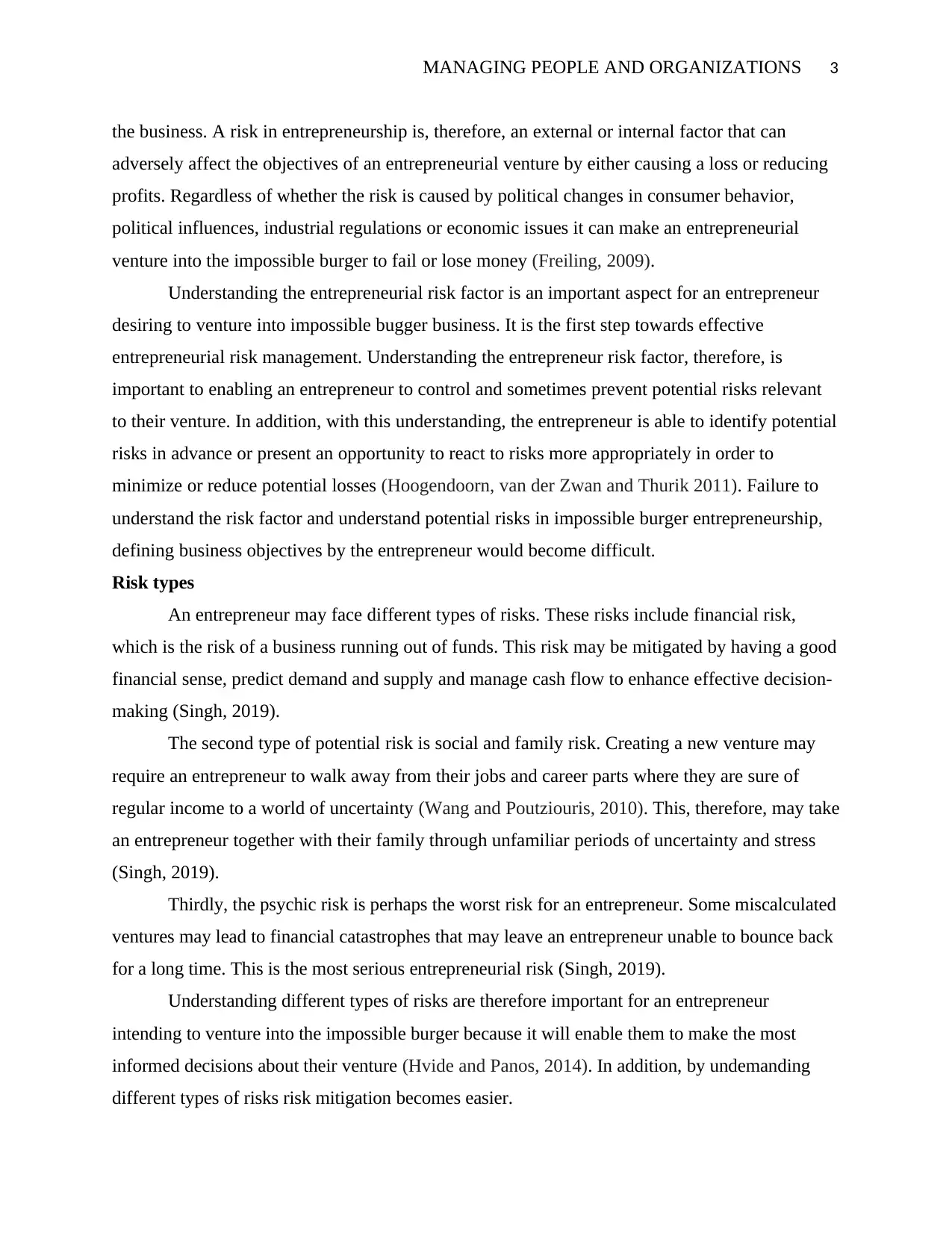
the business. A risk in entrepreneurship is, therefore, an external or internal factor that can
adversely affect the objectives of an entrepreneurial venture by either causing a loss or reducing
profits. Regardless of whether the risk is caused by political changes in consumer behavior,
political influences, industrial regulations or economic issues it can make an entrepreneurial
venture into the impossible burger to fail or lose money (Freiling, 2009).
Understanding the entrepreneurial risk factor is an important aspect for an entrepreneur
desiring to venture into impossible bugger business. It is the first step towards effective
entrepreneurial risk management. Understanding the entrepreneur risk factor, therefore, is
important to enabling an entrepreneur to control and sometimes prevent potential risks relevant
to their venture. In addition, with this understanding, the entrepreneur is able to identify potential
risks in advance or present an opportunity to react to risks more appropriately in order to
minimize or reduce potential losses (Hoogendoorn, van der Zwan and Thurik 2011). Failure to
understand the risk factor and understand potential risks in impossible burger entrepreneurship,
defining business objectives by the entrepreneur would become difficult.
Risk types
An entrepreneur may face different types of risks. These risks include financial risk,
which is the risk of a business running out of funds. This risk may be mitigated by having a good
financial sense, predict demand and supply and manage cash flow to enhance effective decision-
making (Singh, 2019).
The second type of potential risk is social and family risk. Creating a new venture may
require an entrepreneur to walk away from their jobs and career parts where they are sure of
regular income to a world of uncertainty (Wang and Poutziouris, 2010). This, therefore, may take
an entrepreneur together with their family through unfamiliar periods of uncertainty and stress
(Singh, 2019).
Thirdly, the psychic risk is perhaps the worst risk for an entrepreneur. Some miscalculated
ventures may lead to financial catastrophes that may leave an entrepreneur unable to bounce back
for a long time. This is the most serious entrepreneurial risk (Singh, 2019).
Understanding different types of risks are therefore important for an entrepreneur
intending to venture into the impossible burger because it will enable them to make the most
informed decisions about their venture (Hvide and Panos, 2014). In addition, by undemanding
different types of risks risk mitigation becomes easier.
Document Page
MANAGING PEOPLE AND ORGANIZATIONS 4
Learning activity
Pairing and sharing
Pairing and sharing on one of the entrepreneurial risk issues identified with my colleagues
would be an effective learning activity in helping me reinforce the learning outcomes identified.
tabler-icon-diamond-filled.svg

Paraphrase This Document

Need a fresh take? Get an instant paraphrase of this document with our AI Paraphraser
Document Page
MANAGING PEOPLE AND ORGANIZATIONS 5
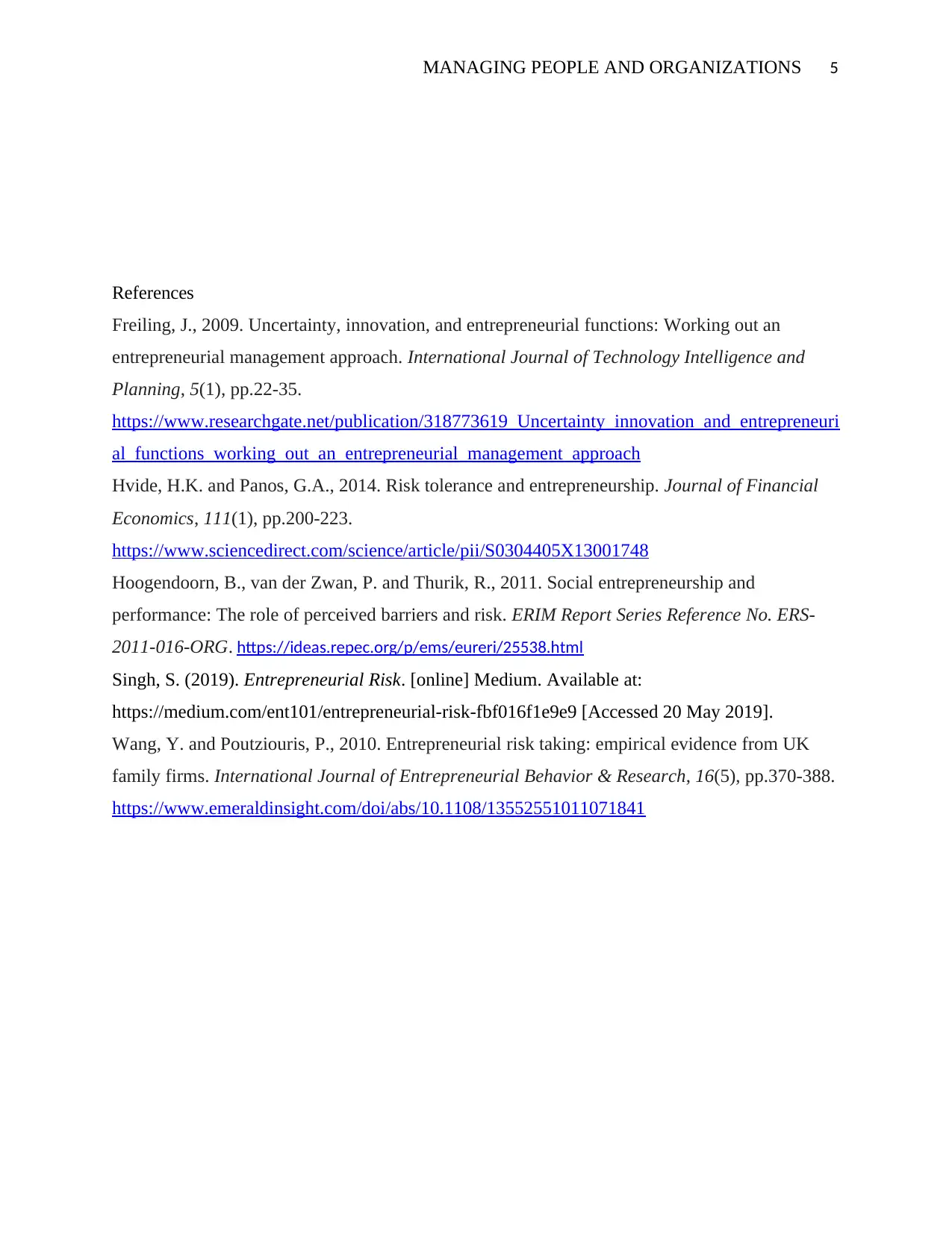
References
Freiling, J., 2009. Uncertainty, innovation, and entrepreneurial functions: Working out an
entrepreneurial management approach. International Journal of Technology Intelligence and
Planning, 5(1), pp.22-35.
https://www.researchgate.net/publication/318773619_Uncertainty_innovation_and_entrepreneuri
al_functions_working_out_an_entrepreneurial_management_approach
Hvide, H.K. and Panos, G.A., 2014. Risk tolerance and entrepreneurship. Journal of Financial
Economics, 111(1), pp.200-223.
https://www.sciencedirect.com/science/article/pii/S0304405X13001748
Hoogendoorn, B., van der Zwan, P. and Thurik, R., 2011. Social entrepreneurship and
performance: The role of perceived barriers and risk. ERIM Report Series Reference No. ERS-
2011-016-ORG. https://ideas.repec.org/p/ems/eureri/25538.html
Singh, S. (2019). Entrepreneurial Risk. [online] Medium. Available at:
https://medium.com/ent101/entrepreneurial-risk-fbf016f1e9e9 [Accessed 20 May 2019].
Wang, Y. and Poutziouris, P., 2010. Entrepreneurial risk taking: empirical evidence from UK
family firms. International Journal of Entrepreneurial Behavior & Research, 16(5), pp.370-388.
https://www.emeraldinsight.com/doi/abs/10.1108/13552551011071841
chevron_up_icon
1 out of 5
circle_padding
hide_on_mobile
zoom_out_icon
[object Object]