COMP3770/6770: Risk Management in Bushfire Control Report

Verified

Added on  2022/08/21

|6
|1192
|16
Report
AI Summary
This report focuses on the management of risk control in bushfire scenarios, specifically referencing the bushfires in Canberra. It begins by outlining potential risks associated with such incidents, including the impact on flora and fauna, increased air pollution leading to health issues, and economic consequences. The report then details various strategies for controlling these risks, such as fuel management, ignition control, responsiveness, planning, and community engagement. It also highlights the role of the government in implementing educational campaigns and policies. The discussion emphasizes the importance of proactive measures in fire management policies to mitigate the impact of bushfires on both human life and the environment.
Document Page
Running head: MANAGEMENT OF RISK CONTROL IN BUSHFIRE
MANAGEMENT OF RISK CONTROL IN BUSHFIRE
Name of the student:
Name of the university:
Author Note:
tabler-icon-diamond-filled.svg

Paraphrase This Document

Need a fresh take? Get an instant paraphrase of this document with our AI Paraphraser
Document Page
1MANAGEMENT OF RISK CONTROL IN BUSHFIRE
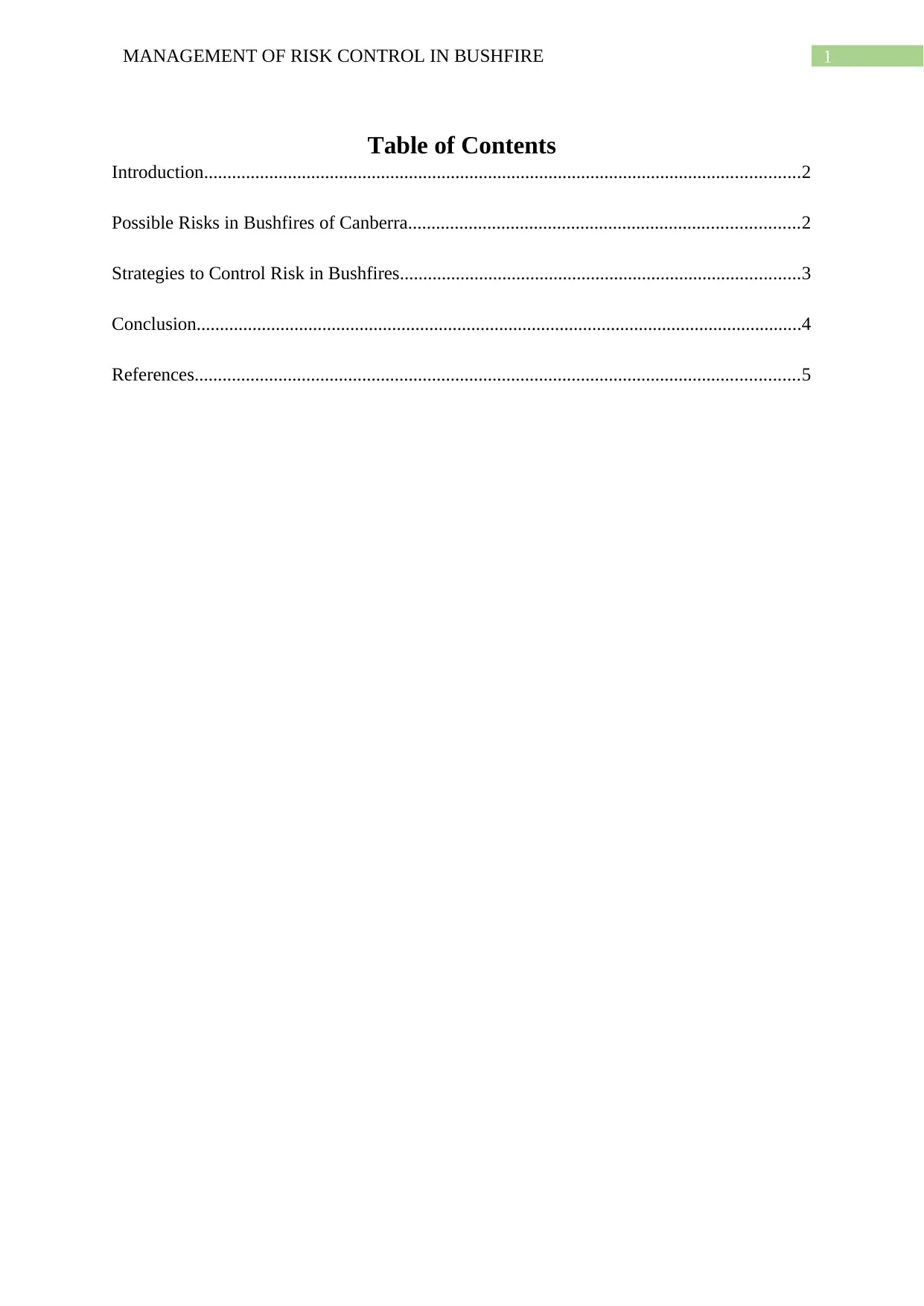
Table of Contents
Introduction................................................................................................................................2
Possible Risks in Bushfires of Canberra....................................................................................2
Strategies to Control Risk in Bushfires......................................................................................3
Conclusion..................................................................................................................................4
References..................................................................................................................................5
Document Page
2MANAGEMENT OF RISK CONTROL IN BUSHFIRE
Introduction
Managing risks are essential for any society to predict the adverse situations that
might happen later in advance, analysing them thoroughly and adapting strategies to mitigate
them as soon as possible [1]. Acclimating strategies for risks require evaluation of the risks
and the degree of its effect on society. One such unsafe incident that occurred recently is the
bushfires in Canberra, the capital of Australia. The paper will discuss the potential risks
regarding the incident and mitigation procedures to overcome it.
Possible Risks in Bushfires of Canberra
Bushfires in Australia are a common phenomenon to occur and the most current
incident of bushfire that happened are in the states of New South Wales and Victoria. The fire
was raging in South Canberra in the month of summer that lead to the closing of the nearby
Parliament as well as the airport for safety measures [2]. The probable hazardous incidents
that may have occurred due to these bushfires are:
The major impact occurs on the flora and fauna in the wildlife of Australia. The wild
animals and birds are likely to die in the upcoming days due to damage of their habitat
and food resources. Billions of animals and birds get affected due to the disruption in
their ecosystems for the bushfires in the region. Thus, bushfires cause high impactful
damage on the survival of the wildlife of Australia.
The climate of Australia becomes hugely polluted due to the fires and smokes
generated from these bushfires. The increase in the raging bushfires led to the
emission of 400 mega tonnes of carbon dioxide into the climate leading to an increase
for greenhouse gases in Australia [3]. More to that, these gases are contributing to the
phenomenon of global warming thus creating a hazardous climatic loop in future.
Document Page
3MANAGEMENT OF RISK CONTROL IN BUSHFIRE
Increase in air pollution due to these bushfires are causing a major damage to the
health of the population at large. The air quality index measured in Canberra is worse
than the other cities of the world [5]. The smoke and gases from the fires in the forest
affects the respiratory system of the people living in that region making them suffer
from diseases like asthma, bronchitis, defective lungs and many more.
Another major risk that occurs due to the bushfires is on the economy of Australia.
The bushfires lead to closing down of organizations such as the parliament or the
airport that result in the halt of economic growth of the country. Bushfires mainly
affects the farming and the tourism industry of Australia.
Strategies to Control Risk in Bushfires
The government of Australia has segregated management strategies to control the
bushfires of Australia according to the assets and adapted them in the Bushfire Risk
Management Plan for the documentation procedure. The concerned people or stakeholders
who will play a key role in diminishing the fire and its effects are the fire authorities,
landowners, land managers, local councils, the community and the operations manager. The
various management strategies to control the bushfires are:
Fuel Managing- This treatment comprises of three methods in controlling the bushfire fuel
by reducing, removing and controlling the fuels to less combustible type [4]. This is done by
grazing of animals or slashing down the fuels or by physically removing them from the site in
advance.
Ignition Controlling- This refers to the method by which the buildings, landscapes or items
that are prone to ignition are removed from the place to control the ignition readily. People
are made aware through education programmes about the steps that can be taken for different
fire attacks and take actions by using fire extinguishers, blankets and many more.
tabler-icon-diamond-filled.svg

Paraphrase This Document

Need a fresh take? Get an instant paraphrase of this document with our AI Paraphraser
Document Page
4MANAGEMENT OF RISK CONTROL IN BUSHFIRE
Responsiveness- The fire-fighting operations are assisted in this strategy by improving the
water supply arrangement and involving fire fighters who can access these water-supplying
machines efficiently. The fire fighters need to be educated enough to handle immediate
situations and take actions that will reduce the fire at large within the minimum possible time.
Planning- This strategy focuses on evolving plans and methodologies that will help the fire
fighters and the local community to deal with bushfires effectively. This includes closing
down of the nearby infrastructure immediately, rescuing animals from the forests and others.
Engagement of Community- The local community can play a major role in extinguishing
bushfires. They can be involved for the supply of water from their nearby homes and can use
less flammable items to take precaution against such incidents.
Role of Government- The local government-wide controls should conduct educational
campaigns and plan policies to manage the bushfire risks [6]. In these circumstances, asset-
specific treatment will not be required.
Conclusion
The bushfires are quite a common occurrence in the states of Australia and the
government should include effective measures in their fire management policies in order to
counterattack these incidents with mitigation strategies. The possible risks that might occur
for the human and the wildlife are discussed and management strategies are conversed in
details to understand how to deal with the bushfires of Australia.
Document Page
5MANAGEMENT OF RISK CONTROL IN BUSHFIRE
References
[1] L. Ockenden, INCREASING THE COMPREHENSIVENESS OF BUSHFIRE RISK
MANAGEMENT IN VICTORIA THROUGH THE PLANNING SYSTEM (Doctoral
dissertation, The University of Melbourne), 2018.
[2] V. Florec, and D.J.Pannell, Economic assessment of bushfire risk management options in
Western Australia: case studies in the Perth Hills and in the south-west of Western Australia,
2016.
[3] R. Attwater, L. Anderson, and C. Derry, Agricultural risk management of a peri-urban
water recycling scheme to meet mixed land-use needs. Agricultural Water Management, 176,
pp.266-269, 2016.
[4] M. Roberts, J. Sharples, and A. Rawlinson, Incorporating ember attack in bushfire risk
assessment: a case study of the Ginninderry region. In MODSIM2017 Proceedings-MSSANZ,
Modelling and Simulation Society of Australia and New Zealand, The 22nd International
Congress on Modelling and Simulation (Hobart, TAS) (pp. 1152-1158) , 2017.
[5] J. Whittaker, K. Haynes, M. Tofa, C. Wilkinson, and M. Taylor, UNDERSTANDING
BUSHFIRE RISK, WARNINGS AND RESPONSES: A STUDY OF THE 2018 REEDY
SWAMP FIRE, 2020.
[6] P. Gonzalez, C. Allan, and D.H. Spennemann, ‘Boiler plating’in fire management plans,
2020.
chevron_up_icon
1 out of 6
circle_padding
hide_on_mobile
zoom_out_icon
[object Object]