Risk Management in Various Project Delivery Methods Analysis
VerifiedAdded on 2023/04/22
|13
|3221
|326
Report
AI Summary
This report provides an overview of risk management within various project delivery methods, including Design-Bid-Build, Design-Build, and Build-Operate-Transfer (BOT). It emphasizes the importance of risk management processes in identifying and analyzing potential risks at each stage of a project. The report discusses how different project delivery systems allocate and share risks, highlighting the increasing popularity of Design-Build methods due to their single managerial approach. It also examines the unique risk factors associated with each delivery method, such as political and economic risks in BOT projects, and stresses the need for effective risk management strategies to minimize project delays and financial losses. The report further explores traditional risk management methods and the importance of data collection and decision-making in the construction industry. It concludes by underscoring the significance of minimizing risks to achieve the best project outcomes.
Running head: RISK MANAGEMENT
Risk Management
Name of the Student
Name of the University
Risk Management
Name of the Student
Name of the University

Paraphrase This Document
Need a fresh take? Get an instant paraphrase of this document with our AI Paraphraser
2
RISK MANAGEMENT
Table of Contents
Introduction................................................................................................................................3
1. Risk Management...................................................................................................................3
2. Risk management in different project delivery methods.......................................................6
Conclusion................................................................................................................................11
References................................................................................................................................12
RISK MANAGEMENT
Table of Contents
Introduction................................................................................................................................3
1. Risk Management...................................................................................................................3
2. Risk management in different project delivery methods.......................................................6
Conclusion................................................................................................................................11
References................................................................................................................................12
3
RISK MANAGEMENT
Introduction
In the market of design build, the responsibility and roles of contractors, designer and
owner often crossed several lines which must be prioritized among all involved parties and
attentions must be given to how liability is shared among all (Kerzner and Kerzner 2017).
According to many experts, there are several significant liability issues involved with the
design build process. Therefore, it is very important to comprehend how the risks of design
build altered from those of design build in order to identify the risk of project equality.
Generally, owners are often elect the design build cause the responsibility is one entity
centric and it also offers fast tracking. The main reason for elect such approach is owners
does not need to involve into the specifications. The drawback is the design builder who were
associated with the contractor has the responsibility for delivering a constructed and facility.
Finally, the contractors are not responsible for any aspects of the project as well as the
performance and design (Fleming and Koppelman 2016). As a result, contractors are growing
their responsibilities significantly, additionally increasing their professional liability
exposures. Moreover, the engineers and architects must comprehend that they are no longer
employed for the owner, but for the builder/designer who has putative the project underneath
a piece sum organisation.
1. Risk Management
Risk Management has been an important part of any project that came into light. Risks
are involved at each and every step of processes in the project. Risk management processes
have been helping in providing various strategies in order to identify and analyze risks
involved in the project (Harrison and Lock 2017). Various construction projects have been
possessing a lot of risks in due time. However, each and every construction project has been
different from each other with different strategies. Therefore, risks have been also different
RISK MANAGEMENT
Introduction
In the market of design build, the responsibility and roles of contractors, designer and
owner often crossed several lines which must be prioritized among all involved parties and
attentions must be given to how liability is shared among all (Kerzner and Kerzner 2017).
According to many experts, there are several significant liability issues involved with the
design build process. Therefore, it is very important to comprehend how the risks of design
build altered from those of design build in order to identify the risk of project equality.
Generally, owners are often elect the design build cause the responsibility is one entity
centric and it also offers fast tracking. The main reason for elect such approach is owners
does not need to involve into the specifications. The drawback is the design builder who were
associated with the contractor has the responsibility for delivering a constructed and facility.
Finally, the contractors are not responsible for any aspects of the project as well as the
performance and design (Fleming and Koppelman 2016). As a result, contractors are growing
their responsibilities significantly, additionally increasing their professional liability
exposures. Moreover, the engineers and architects must comprehend that they are no longer
employed for the owner, but for the builder/designer who has putative the project underneath
a piece sum organisation.
1. Risk Management
Risk Management has been an important part of any project that came into light. Risks
are involved at each and every step of processes in the project. Risk management processes
have been helping in providing various strategies in order to identify and analyze risks
involved in the project (Harrison and Lock 2017). Various construction projects have been
possessing a lot of risks in due time. However, each and every construction project has been
different from each other with different strategies. Therefore, risks have been also different
⊘ This is a preview!⊘
Do you want full access?
Subscribe today to unlock all pages.

Trusted by 1+ million students worldwide
4
RISK MANAGEMENT
for each of the projects. The project lead used to select project delivery system for each of the
project and consult with the project members. A proper consultation with the project
members help in proper distribution of project deliverables to the client (Walker 2015). The
selection of delivery system has been depended on the operations of the organizations
including expertise knowledge, local jurisdiction and laws and overall delivery scheme.
Design-Build method has been increasing iuts popularity as perfect solution for
addressing different types of limitations in the methods. These type of systems have been
providing single managerial methods for both construction and design interface. The design
interface needs to be properly done in the due course as construction has been depended on
the design section of the project (Nicholas and Steyn 2017). The aim of the building project
has been totally depended on the initiation of construction in order to maintain a proper
approach towards the construction of building within deadline. The project delivery system of
the company needs to be aware of the design interface of the construction project as it has
been the most important part of the construction. Simplification of managerial interface has
been helping in designing the change in the planning steps of the company (Fuller et al.
2017). The delay in delivery of projects can be maintained by proper planning methods
applied in the project.
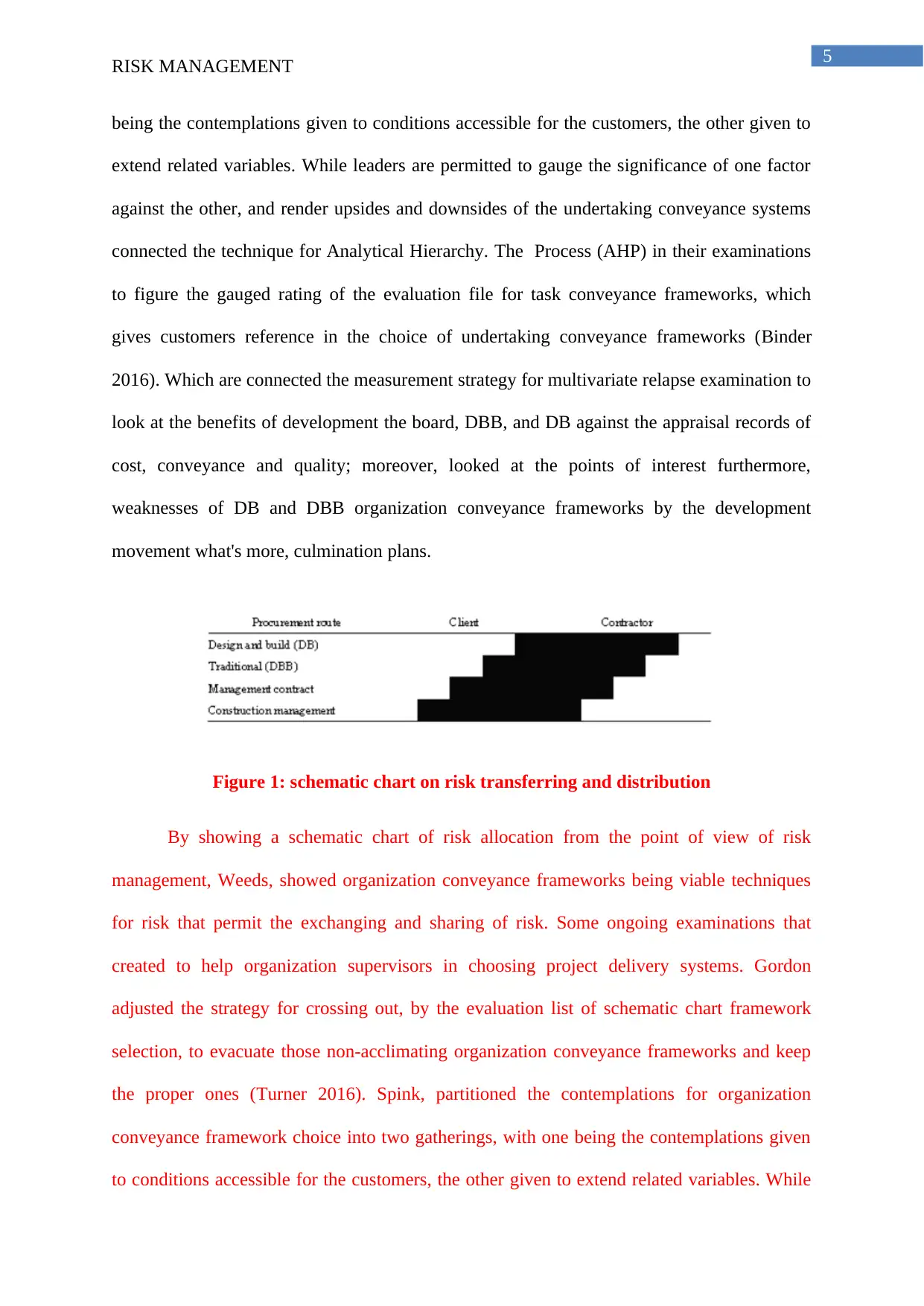
By showing a schematic chart of risk allocation from the point of view of risk
management, Iweeds, showed organization conveyance frameworks being viable techniques
for risk that permit the exchanging and sharing of risk (as appeared in Figure 1). Some
ongoing examinations that created to help organization supervisors in choosing project
delivery systems. Gordon adjusted the strategy for crossing out, by the evaluation list of
schematic chart framework selection, to evacuate those non-acclimating organization
conveyance frameworks and keep the proper ones (Verzuh 2015). Spink, partitioned the
contemplations for organization conveyance framework choice into two gatherings, with one
RISK MANAGEMENT
for each of the projects. The project lead used to select project delivery system for each of the
project and consult with the project members. A proper consultation with the project
members help in proper distribution of project deliverables to the client (Walker 2015). The
selection of delivery system has been depended on the operations of the organizations
including expertise knowledge, local jurisdiction and laws and overall delivery scheme.
Design-Build method has been increasing iuts popularity as perfect solution for
addressing different types of limitations in the methods. These type of systems have been
providing single managerial methods for both construction and design interface. The design
interface needs to be properly done in the due course as construction has been depended on
the design section of the project (Nicholas and Steyn 2017). The aim of the building project
has been totally depended on the initiation of construction in order to maintain a proper
approach towards the construction of building within deadline. The project delivery system of
the company needs to be aware of the design interface of the construction project as it has
been the most important part of the construction. Simplification of managerial interface has
been helping in designing the change in the planning steps of the company (Fuller et al.
2017). The delay in delivery of projects can be maintained by proper planning methods
applied in the project.
By showing a schematic chart of risk allocation from the point of view of risk
management, Iweeds, showed organization conveyance frameworks being viable techniques
for risk that permit the exchanging and sharing of risk (as appeared in Figure 1). Some
ongoing examinations that created to help organization supervisors in choosing project
delivery systems. Gordon adjusted the strategy for crossing out, by the evaluation list of
schematic chart framework selection, to evacuate those non-acclimating organization
conveyance frameworks and keep the proper ones (Verzuh 2015). Spink, partitioned the
contemplations for organization conveyance framework choice into two gatherings, with one
Paraphrase This Document
Need a fresh take? Get an instant paraphrase of this document with our AI Paraphraser
5
RISK MANAGEMENT
being the contemplations given to conditions accessible for the customers, the other given to
extend related variables. While leaders are permitted to gauge the significance of one factor
against the other, and render upsides and downsides of the undertaking conveyance systems
connected the technique for Analytical Hierarchy. The Process (AHP) in their examinations
to figure the gauged rating of the evaluation file for task conveyance frameworks, which
gives customers reference in the choice of undertaking conveyance frameworks (Binder
2016). Which are connected the measurement strategy for multivariate relapse examination to
look at the benefits of development the board, DBB, and DB against the appraisal records of
cost, conveyance and quality; moreover, looked at the points of interest furthermore,
weaknesses of DB and DBB organization conveyance frameworks by the development
movement what's more, culmination plans.
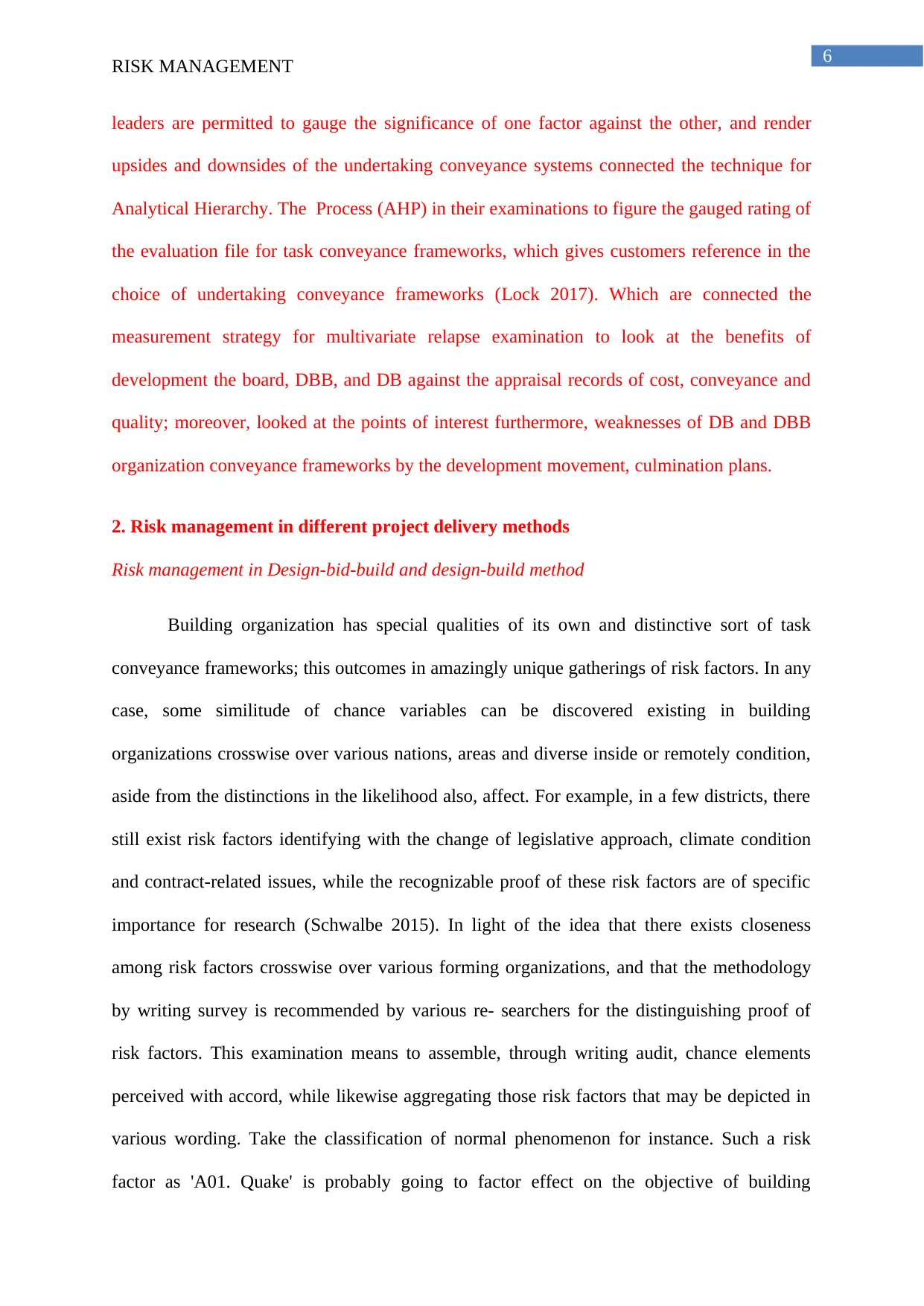
Figure 1: schematic chart on risk transferring and distribution
By showing a schematic chart of risk allocation from the point of view of risk
management, Weeds, showed organization conveyance frameworks being viable techniques
for risk that permit the exchanging and sharing of risk. Some ongoing examinations that
created to help organization supervisors in choosing project delivery systems. Gordon
adjusted the strategy for crossing out, by the evaluation list of schematic chart framework
selection, to evacuate those non-acclimating organization conveyance frameworks and keep
the proper ones (Turner 2016). Spink, partitioned the contemplations for organization
conveyance framework choice into two gatherings, with one being the contemplations given
to conditions accessible for the customers, the other given to extend related variables. While
RISK MANAGEMENT
being the contemplations given to conditions accessible for the customers, the other given to
extend related variables. While leaders are permitted to gauge the significance of one factor
against the other, and render upsides and downsides of the undertaking conveyance systems
connected the technique for Analytical Hierarchy. The Process (AHP) in their examinations
to figure the gauged rating of the evaluation file for task conveyance frameworks, which
gives customers reference in the choice of undertaking conveyance frameworks (Binder
2016). Which are connected the measurement strategy for multivariate relapse examination to
look at the benefits of development the board, DBB, and DB against the appraisal records of
cost, conveyance and quality; moreover, looked at the points of interest furthermore,
weaknesses of DB and DBB organization conveyance frameworks by the development
movement what's more, culmination plans.
Figure 1: schematic chart on risk transferring and distribution
By showing a schematic chart of risk allocation from the point of view of risk
management, Weeds, showed organization conveyance frameworks being viable techniques
for risk that permit the exchanging and sharing of risk. Some ongoing examinations that
created to help organization supervisors in choosing project delivery systems. Gordon
adjusted the strategy for crossing out, by the evaluation list of schematic chart framework
selection, to evacuate those non-acclimating organization conveyance frameworks and keep
the proper ones (Turner 2016). Spink, partitioned the contemplations for organization
conveyance framework choice into two gatherings, with one being the contemplations given
to conditions accessible for the customers, the other given to extend related variables. While
6
RISK MANAGEMENT
leaders are permitted to gauge the significance of one factor against the other, and render
upsides and downsides of the undertaking conveyance systems connected the technique for
Analytical Hierarchy. The Process (AHP) in their examinations to figure the gauged rating of
the evaluation file for task conveyance frameworks, which gives customers reference in the
choice of undertaking conveyance frameworks (Lock 2017). Which are connected the
measurement strategy for multivariate relapse examination to look at the benefits of
development the board, DBB, and DB against the appraisal records of cost, conveyance and
quality; moreover, looked at the points of interest furthermore, weaknesses of DB and DBB
organization conveyance frameworks by the development movement, culmination plans.
2. Risk management in different project delivery methods
Risk management in Design-bid-build and design-build method
Building organization has special qualities of its own and distinctive sort of task
conveyance frameworks; this outcomes in amazingly unique gatherings of risk factors. In any
case, some similitude of chance variables can be discovered existing in building
organizations crosswise over various nations, areas and diverse inside or remotely condition,
aside from the distinctions in the likelihood also, affect. For example, in a few districts, there
still exist risk factors identifying with the change of legislative approach, climate condition
and contract-related issues, while the recognizable proof of these risk factors are of specific
importance for research (Schwalbe 2015). In light of the idea that there exists closeness
among risk factors crosswise over various forming organizations, and that the methodology
by writing survey is recommended by various re- searchers for the distinguishing proof of
risk factors. This examination means to assemble, through writing audit, chance elements
perceived with accord, while likewise aggregating those risk factors that may be depicted in
various wording. Take the classification of normal phenomenon for instance. Such a risk
factor as 'A01. Quake' is probably going to factor effect on the objective of building
RISK MANAGEMENT
leaders are permitted to gauge the significance of one factor against the other, and render
upsides and downsides of the undertaking conveyance systems connected the technique for
Analytical Hierarchy. The Process (AHP) in their examinations to figure the gauged rating of
the evaluation file for task conveyance frameworks, which gives customers reference in the
choice of undertaking conveyance frameworks (Lock 2017). Which are connected the
measurement strategy for multivariate relapse examination to look at the benefits of
development the board, DBB, and DB against the appraisal records of cost, conveyance and
quality; moreover, looked at the points of interest furthermore, weaknesses of DB and DBB
organization conveyance frameworks by the development movement, culmination plans.
2. Risk management in different project delivery methods
Risk management in Design-bid-build and design-build method
Building organization has special qualities of its own and distinctive sort of task
conveyance frameworks; this outcomes in amazingly unique gatherings of risk factors. In any
case, some similitude of chance variables can be discovered existing in building
organizations crosswise over various nations, areas and diverse inside or remotely condition,
aside from the distinctions in the likelihood also, affect. For example, in a few districts, there
still exist risk factors identifying with the change of legislative approach, climate condition
and contract-related issues, while the recognizable proof of these risk factors are of specific
importance for research (Schwalbe 2015). In light of the idea that there exists closeness
among risk factors crosswise over various forming organizations, and that the methodology
by writing survey is recommended by various re- searchers for the distinguishing proof of
risk factors. This examination means to assemble, through writing audit, chance elements
perceived with accord, while likewise aggregating those risk factors that may be depicted in
various wording. Take the classification of normal phenomenon for instance. Such a risk
factor as 'A01. Quake' is probably going to factor effect on the objective of building
⊘ This is a preview!⊘
Do you want full access?
Subscribe today to unlock all pages.
Trusted by 1+ million students worldwide
7
RISK MANAGEMENT
organizations for being 'A0101. Task misfortune brought about by quake', demonstrating this
risk factor being broadly perceived. Organization misfortune acquired by high wind' is
similar cases. The risk factors are classified by previously mentioned investigation strategies
as indicated by the kinds of their sources and fill in as the survey things. While filling in as
the fundamental information for criticalness positioning of these risk factors and measure of
risk with worldly sequencing change over various undertaking stages (Martinelli and
Milosevic 2016). Where these risk factors are classified into 11 classifications and 62 things,
with each risk thing further being separated into a number of risk factors with explicit
depictions for the risk thing, making an aggregate of 106 risk factors, for example, the risk
thing of 'G03. Awkward facilitator', which is further, isolated into three risk variables of
'G0301. Chang request cannot be affirmed in the blink of an eye','G0302. Need of compelling
correspondence', and 'G0303. Lacking data accumulation.
Risk management in design-built-transfer, design-build-operate- transfer and EPCM
The built operate transfer (BOT) projects have been basically large scale projects that
have been providing infrastructure facilities and transaction costs on average between 5 to
10% of total cost of project. Therefore, large projects having lots of processes involved that
include many risks in it. Moreover, the engineers and architects must comprehend that they
are no longer employed for the owner, but for the builder/designer who has putative the
project underneath a piece sum organisation (Svejvig and Andersen 2015).Therefore, risks
management process in long leading tome and resulting assets have been properly analysed
and identifies. Therefore, risk management contains a lot of processes in the BOT methods.
The risk involved in the BOT have been based on two fold. Initially there are risks involved
in the initial process and financial operational risks. Secondly, large scale projects have been
facing political and economic risks. The high level risks involved in the BOT projects have
been complicated in managing them. Various private sector and government bodies are
RISK MANAGEMENT
organizations for being 'A0101. Task misfortune brought about by quake', demonstrating this
risk factor being broadly perceived. Organization misfortune acquired by high wind' is
similar cases. The risk factors are classified by previously mentioned investigation strategies
as indicated by the kinds of their sources and fill in as the survey things. While filling in as
the fundamental information for criticalness positioning of these risk factors and measure of
risk with worldly sequencing change over various undertaking stages (Martinelli and
Milosevic 2016). Where these risk factors are classified into 11 classifications and 62 things,
with each risk thing further being separated into a number of risk factors with explicit
depictions for the risk thing, making an aggregate of 106 risk factors, for example, the risk
thing of 'G03. Awkward facilitator', which is further, isolated into three risk variables of
'G0301. Chang request cannot be affirmed in the blink of an eye','G0302. Need of compelling
correspondence', and 'G0303. Lacking data accumulation.
Risk management in design-built-transfer, design-build-operate- transfer and EPCM
The built operate transfer (BOT) projects have been basically large scale projects that
have been providing infrastructure facilities and transaction costs on average between 5 to
10% of total cost of project. Therefore, large projects having lots of processes involved that
include many risks in it. Moreover, the engineers and architects must comprehend that they
are no longer employed for the owner, but for the builder/designer who has putative the
project underneath a piece sum organisation (Svejvig and Andersen 2015).Therefore, risks
management process in long leading tome and resulting assets have been properly analysed
and identifies. Therefore, risk management contains a lot of processes in the BOT methods.
The risk involved in the BOT have been based on two fold. Initially there are risks involved
in the initial process and financial operational risks. Secondly, large scale projects have been
facing political and economic risks. The high level risks involved in the BOT projects have
been complicated in managing them. Various private sector and government bodies are
Paraphrase This Document
Need a fresh take? Get an instant paraphrase of this document with our AI Paraphraser
8
RISK MANAGEMENT
involved in this kind of projects (Joslin and Müller 2015). Therefore, governmental
regulatory are involved and maintained in the projects. Risks are involved in these projects
with respect to time, quality and budget. As a result, contractors are growing their
responsibilities significantly, additionally increasing their professional liability exposures.
The complication process of BIT projects have been creating additional risks in them.
Therefore, involvement of governmental risks in the BOT projects have been attempting for
involving in the projects.
There are higher number of parties involved in these projects that makes it more
complex. Organization misfortune acquired by high wind' is similar cases. The risk factors
are classified by previously mentioned investigation strategies as indicated by the kinds of
their sources and fill in as the survey things (Sears et al. 2015). Therefore, financial
management has been maintaining a keen approach in the development of project within
time. Risk management in these type of projects have been maintained by traditional methods
in which design is separate from construction and customer has been responsible for these
projects. This has not been done due to long time and duration of projects with high
investments. Finally, the contractors are not responsible for any aspects of the project as well
as the performance and design. Risks management process in BOT method involves data
collection on a huge scale that needs to be cost effective and practical. The addition in the
realistic world have been maintaining a keen approach in the dependency of various risks.
Decision makers have been maintaining various approached in the development of the risk
management process in order to provide a proper results in the construction industry
(Todorović et al. 2015). Risk management processes in the maintenance of the risks involved
in the BOT has been mentioned in above sections. This examination means to assemble,
through writing audit, chance elements perceived with accord, while likewise aggregating
those risk factors that may be depicted in various wording. The best outcome of the project
RISK MANAGEMENT
involved in this kind of projects (Joslin and Müller 2015). Therefore, governmental
regulatory are involved and maintained in the projects. Risks are involved in these projects
with respect to time, quality and budget. As a result, contractors are growing their
responsibilities significantly, additionally increasing their professional liability exposures.
The complication process of BIT projects have been creating additional risks in them.
Therefore, involvement of governmental risks in the BOT projects have been attempting for
involving in the projects.
There are higher number of parties involved in these projects that makes it more
complex. Organization misfortune acquired by high wind' is similar cases. The risk factors
are classified by previously mentioned investigation strategies as indicated by the kinds of
their sources and fill in as the survey things (Sears et al. 2015). Therefore, financial
management has been maintaining a keen approach in the development of project within
time. Risk management in these type of projects have been maintained by traditional methods
in which design is separate from construction and customer has been responsible for these
projects. This has not been done due to long time and duration of projects with high
investments. Finally, the contractors are not responsible for any aspects of the project as well
as the performance and design. Risks management process in BOT method involves data
collection on a huge scale that needs to be cost effective and practical. The addition in the
realistic world have been maintaining a keen approach in the dependency of various risks.
Decision makers have been maintaining various approached in the development of the risk
management process in order to provide a proper results in the construction industry
(Todorović et al. 2015). Risk management processes in the maintenance of the risks involved
in the BOT has been mentioned in above sections. This examination means to assemble,
through writing audit, chance elements perceived with accord, while likewise aggregating
those risk factors that may be depicted in various wording. The best outcome of the project
9
RISK MANAGEMENT
can be identified by minimizing most of the risks involved in the projects. While filling in as
the fundamental information for criticalness positioning of these risk factors and measure of
risk with worldly sequencing change over various undertaking stages
The drawback is the design builder who were associated with the contractor has the
responsibility for delivering a constructed and facility.
Risk allocation in Design-Bid-Build has been traditional delivery method. The owner
does not have to meet directly with subcontractors. Task misfortune brought about by quake',
demonstrating this risk factor being broadly perceived. The exception in the risk management
policies has been maintaining the DB method (Kaiser, El Arbi and Ahlemann 2015).
Decision markets in these method have been responsible for maintaining a keen approach ion
the development of the risks management processes. DB projects have been involved in
transferring risks for the DBT. Therefore, risks included with environmental approval, design
issues and local agency have been identified. The risks in design issues have been traditional
and being responsibility of the agency.
RISK MANAGEMENT
can be identified by minimizing most of the risks involved in the projects. While filling in as
the fundamental information for criticalness positioning of these risk factors and measure of
risk with worldly sequencing change over various undertaking stages
The drawback is the design builder who were associated with the contractor has the
responsibility for delivering a constructed and facility.
Risk allocation in Design-Bid-Build has been traditional delivery method. The owner
does not have to meet directly with subcontractors. Task misfortune brought about by quake',
demonstrating this risk factor being broadly perceived. The exception in the risk management
policies has been maintaining the DB method (Kaiser, El Arbi and Ahlemann 2015).
Decision markets in these method have been responsible for maintaining a keen approach ion
the development of the risks management processes. DB projects have been involved in
transferring risks for the DBT. Therefore, risks included with environmental approval, design
issues and local agency have been identified. The risks in design issues have been traditional
and being responsibility of the agency.
⊘ This is a preview!⊘
Do you want full access?
Subscribe today to unlock all pages.
Trusted by 1+ million students worldwide
10
RISK MANAGEMENT
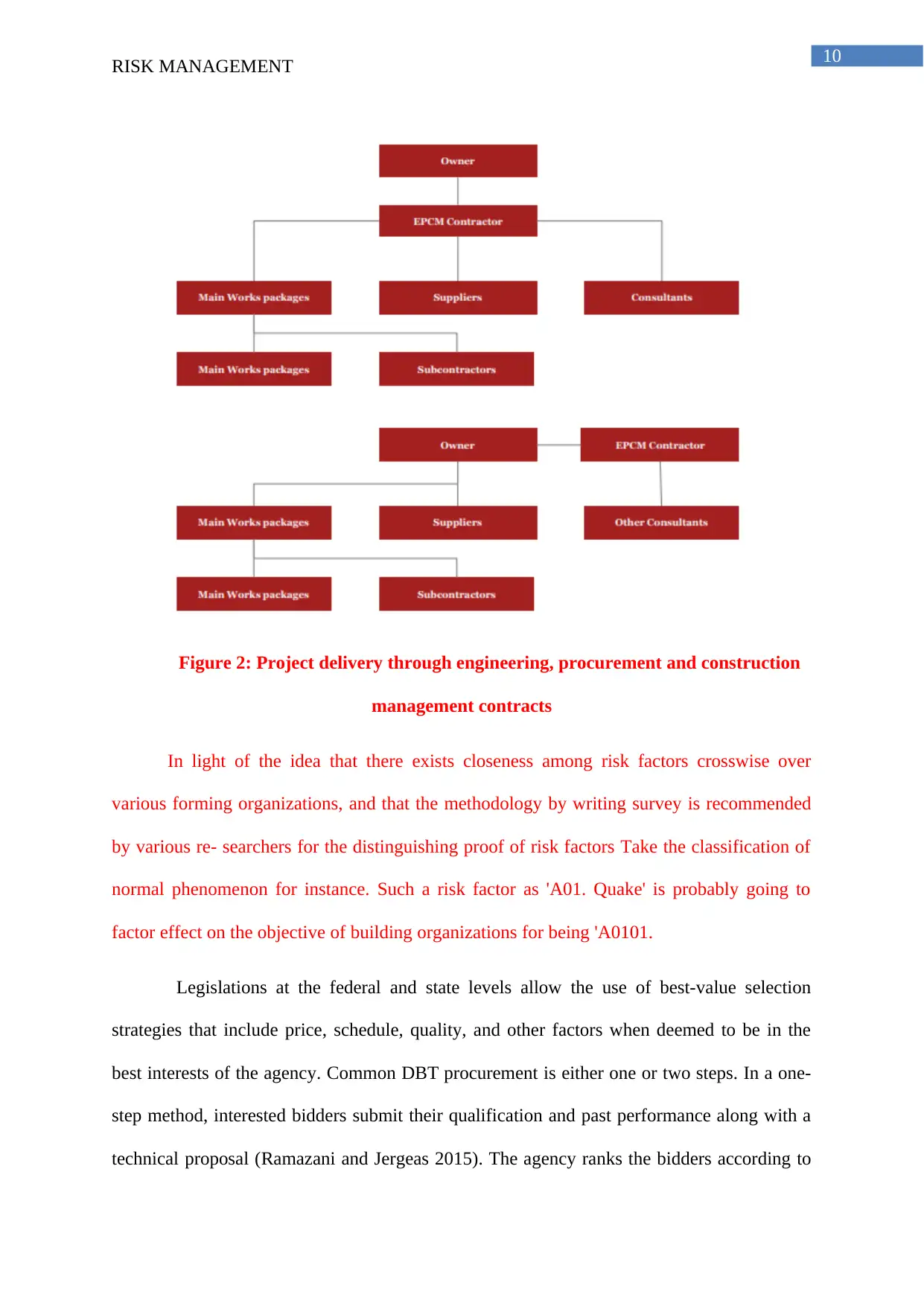
Figure 2: Project delivery through engineering, procurement and construction
management contracts
In light of the idea that there exists closeness among risk factors crosswise over
various forming organizations, and that the methodology by writing survey is recommended
by various re- searchers for the distinguishing proof of risk factors Take the classification of
normal phenomenon for instance. Such a risk factor as 'A01. Quake' is probably going to
factor effect on the objective of building organizations for being 'A0101.
Legislations at the federal and state levels allow the use of best-value selection
strategies that include price, schedule, quality, and other factors when deemed to be in the
best interests of the agency. Common DBT procurement is either one or two steps. In a one-
step method, interested bidders submit their qualification and past performance along with a
technical proposal (Ramazani and Jergeas 2015). The agency ranks the bidders according to
RISK MANAGEMENT
Figure 2: Project delivery through engineering, procurement and construction
management contracts
In light of the idea that there exists closeness among risk factors crosswise over
various forming organizations, and that the methodology by writing survey is recommended
by various re- searchers for the distinguishing proof of risk factors Take the classification of
normal phenomenon for instance. Such a risk factor as 'A01. Quake' is probably going to
factor effect on the objective of building organizations for being 'A0101.
Legislations at the federal and state levels allow the use of best-value selection
strategies that include price, schedule, quality, and other factors when deemed to be in the
best interests of the agency. Common DBT procurement is either one or two steps. In a one-
step method, interested bidders submit their qualification and past performance along with a
technical proposal (Ramazani and Jergeas 2015). The agency ranks the bidders according to
Paraphrase This Document
Need a fresh take? Get an instant paraphrase of this document with our AI Paraphraser
11
RISK MANAGEMENT
the established criteria and awards the project to the highest ranked bidder. In the case of the
two-step method, the interested bidders are initially asked to submit a description of team
qualifications, past performances, resumes of key personnel, organizational charts and other
information relating to the team’s qualifications. The agency then short-lists three bidders
(typically) based on weightings of the selection criteria. In the second step, the short-listed
bidders are asked to submit a technical proposal with price and innovative design ideas.
Conclusion
It can be concluded that risk management strategies in the projects have been an
important part of the projects. Organizations have been looking for minimizing risks in
different project delivery method. The use of different risk management strategies have been
helping in managing different project in the organization. There are higher number of parties
involved in these projects that makes it more complex. Organization misfortune acquired by
high wind' is similar cases. The risk factors are classified by previously mentioned
investigation strategies as indicated by the kinds of their sources and fill in as the survey
things.
RISK MANAGEMENT
the established criteria and awards the project to the highest ranked bidder. In the case of the
two-step method, the interested bidders are initially asked to submit a description of team
qualifications, past performances, resumes of key personnel, organizational charts and other
information relating to the team’s qualifications. The agency then short-lists three bidders
(typically) based on weightings of the selection criteria. In the second step, the short-listed
bidders are asked to submit a technical proposal with price and innovative design ideas.
Conclusion
It can be concluded that risk management strategies in the projects have been an
important part of the projects. Organizations have been looking for minimizing risks in
different project delivery method. The use of different risk management strategies have been
helping in managing different project in the organization. There are higher number of parties
involved in these projects that makes it more complex. Organization misfortune acquired by
high wind' is similar cases. The risk factors are classified by previously mentioned
investigation strategies as indicated by the kinds of their sources and fill in as the survey
things.
12
RISK MANAGEMENT
References
Kerzner, H. and Kerzner, H.R., 2017. Project management: a systems approach to planning,
scheduling, and controlling. John Wiley & Sons.
Harrison, F. and Lock, D., 2017. Advanced project management: a structured approach.
Routledge.
Walker, A., 2015. Project management in construction. John Wiley & Sons.
Nicholas, J.M. and Steyn, H., 2017. Project management for engineering, business and
technology. Routledge.
Fuller, M.A., Valacich, J.S., George, J.F. and Schneider, C., 2017. Information Systems
Project Management: A Process and Team Approach, Edition 1.1. Prospect Press.
Verzuh, E., 2015. The fast forward MBA in project management. John Wiley & Sons.
Binder, J., 2016. Global project management: communication, collaboration and management
across borders. Routledge.
Turner, R., 2016. Gower handbook of project management. Routledge.
Lock, D., 2017. The essentials of project management. Routledge.
Schwalbe, K., 2015. Information technology project management. Cengage Learning.
Martinelli, R.J. and Milosevic, D.Z., 2016. Project management toolbox: tools and techniques
for the practicing project manager. John Wiley & Sons.
Svejvig, P. and Andersen, P., 2015. Rethinking project management: A structured literature
review with a critical look at the brave new world. International Journal of Project
Management, 33(2), pp.278-290.
RISK MANAGEMENT
References
Kerzner, H. and Kerzner, H.R., 2017. Project management: a systems approach to planning,
scheduling, and controlling. John Wiley & Sons.
Harrison, F. and Lock, D., 2017. Advanced project management: a structured approach.
Routledge.
Walker, A., 2015. Project management in construction. John Wiley & Sons.
Nicholas, J.M. and Steyn, H., 2017. Project management for engineering, business and
technology. Routledge.
Fuller, M.A., Valacich, J.S., George, J.F. and Schneider, C., 2017. Information Systems
Project Management: A Process and Team Approach, Edition 1.1. Prospect Press.
Verzuh, E., 2015. The fast forward MBA in project management. John Wiley & Sons.
Binder, J., 2016. Global project management: communication, collaboration and management
across borders. Routledge.
Turner, R., 2016. Gower handbook of project management. Routledge.
Lock, D., 2017. The essentials of project management. Routledge.
Schwalbe, K., 2015. Information technology project management. Cengage Learning.
Martinelli, R.J. and Milosevic, D.Z., 2016. Project management toolbox: tools and techniques
for the practicing project manager. John Wiley & Sons.
Svejvig, P. and Andersen, P., 2015. Rethinking project management: A structured literature
review with a critical look at the brave new world. International Journal of Project
Management, 33(2), pp.278-290.
⊘ This is a preview!⊘
Do you want full access?
Subscribe today to unlock all pages.
Trusted by 1+ million students worldwide

1 out of 13


Related Documents


Your All-in-One AI-Powered Toolkit for Academic Success.
+13062052269
info@desklib.com
Available 24*7 on WhatsApp / Email
![[object Object]](/_next/static/media/star-bottom.7253800d.svg)
Unlock your academic potential
Copyright © 2020–2026 A2Z Services. All Rights Reserved. Developed and managed by ZUCOL.