Risk Management Plan for Etihad Rail Project: Analysis and Mitigation
VerifiedAdded on 2022/08/18
|17
|3157
|19
Report
AI Summary
This report presents a comprehensive risk management plan for the Etihad Rail project, a large-scale infrastructure development in the UAE. It begins with an overview and background of the project, highlighting its multibillion-dollar scope and the inherent risks involved. The core of the report details the risk management plan, including risk identification, analysis, and assessment. The report categorizes risks into financial (funding, cost overruns), engineering/construction (procurement, design), and social/political (organizational changes, licensing, scheduling). Qualitative and quantitative risk analyses are performed, with risks assessed based on severity and likelihood, using a risk matrix to determine risk values (unacceptable, tolerable, acceptable). High-risk areas are identified, such as funding source, design standards and planning schedule, and decision-making processes. The report also includes risk mitigation strategies and tracking mechanisms. The report concludes by emphasizing the importance of proactive risk management for the successful completion of the Etihad Rail project. The report is a comprehensive analysis of the risks involved in the project, along with mitigation strategies.
Running head: RISK MANAGEMENT PLAN
Risk Management Plan on Etihad Rail project
Name of the Student:
Name of the University:
Risk Management Plan on Etihad Rail project
Name of the Student:
Name of the University:

Paraphrase This Document
Need a fresh take? Get an instant paraphrase of this document with our AI Paraphraser
1RISK MANAGEMENT PLAN
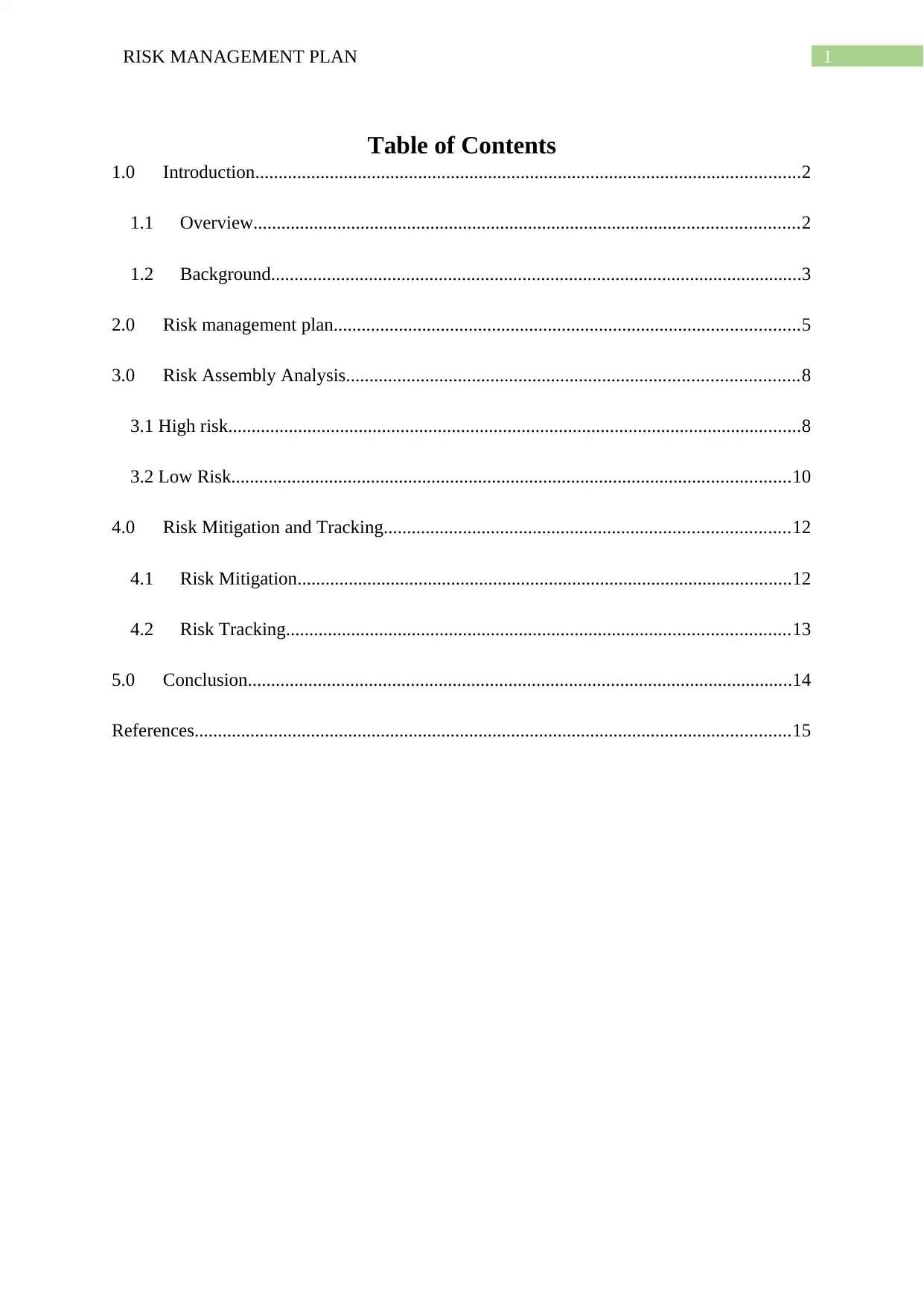
Table of Contents
1.0 Introduction.....................................................................................................................2
1.1 Overview.....................................................................................................................2
1.2 Background..................................................................................................................3
2.0 Risk management plan....................................................................................................5
3.0 Risk Assembly Analysis.................................................................................................8
3.1 High risk...........................................................................................................................8
3.2 Low Risk........................................................................................................................10
4.0 Risk Mitigation and Tracking.......................................................................................12
4.1 Risk Mitigation..........................................................................................................12
4.2 Risk Tracking............................................................................................................13
5.0 Conclusion.....................................................................................................................14
References................................................................................................................................15
Table of Contents
1.0 Introduction.....................................................................................................................2
1.1 Overview.....................................................................................................................2
1.2 Background..................................................................................................................3
2.0 Risk management plan....................................................................................................5
3.0 Risk Assembly Analysis.................................................................................................8
3.1 High risk...........................................................................................................................8
3.2 Low Risk........................................................................................................................10
4.0 Risk Mitigation and Tracking.......................................................................................12
4.1 Risk Mitigation..........................................................................................................12
4.2 Risk Tracking............................................................................................................13
5.0 Conclusion.....................................................................................................................14
References................................................................................................................................15
2RISK MANAGEMENT PLAN
1.0 Introduction
1.1 Overview
The risk management plan is focused on Etihad Rail project which is a rail network
development plan in UAE. The risk planning, risk analysis, risk assessment and risk
monitoring requires infrastructure project with effective project management system to assure
effective project outcomes (Alshehhi et al., 2018). The main objective of this report is to
prepare a risk management plan to assess risks, analyze risks, monitor and control identified
risks using project management concepts.
Etihad Rail is a long term rail network project with multibillion dollar project,
therefore this project is risky to be conducted. The major identified risks of Etihad Rail
Project are as follows:
Financial project risk: The main sources of financial risks are lack of project funding
and cost overruns. The funds collected for the project was not enough to complete the
development work. There was lack of funding sources. While conducting development work
of rail network project, the management team had not estimated the proper expenses required
to calculate total project budget (Ahmad & Ahmad, 2016). Accuracy of cost estimation was
too low lead to cost overruns.
Engineering or construction risk: The two main sources of engineering or
construction risks are construction procurement and lack of project design. There was no
accurate safety standards were taken for development work. The employees working in the
development work were not provide with construction safety precautions due to which there
were health hazards. The construction materials supplied for the work was not up to better
quality, lead to lack of quality control (Todorov et al., 2018). The construction design of the
1.0 Introduction
1.1 Overview
The risk management plan is focused on Etihad Rail project which is a rail network
development plan in UAE. The risk planning, risk analysis, risk assessment and risk
monitoring requires infrastructure project with effective project management system to assure
effective project outcomes (Alshehhi et al., 2018). The main objective of this report is to
prepare a risk management plan to assess risks, analyze risks, monitor and control identified
risks using project management concepts.
Etihad Rail is a long term rail network project with multibillion dollar project,
therefore this project is risky to be conducted. The major identified risks of Etihad Rail
Project are as follows:
Financial project risk: The main sources of financial risks are lack of project funding
and cost overruns. The funds collected for the project was not enough to complete the
development work. There was lack of funding sources. While conducting development work
of rail network project, the management team had not estimated the proper expenses required
to calculate total project budget (Ahmad & Ahmad, 2016). Accuracy of cost estimation was
too low lead to cost overruns.
Engineering or construction risk: The two main sources of engineering or
construction risks are construction procurement and lack of project design. There was no
accurate safety standards were taken for development work. The employees working in the
development work were not provide with construction safety precautions due to which there
were health hazards. The construction materials supplied for the work was not up to better
quality, lead to lack of quality control (Todorov et al., 2018). The construction design of the
⊘ This is a preview!⊘
Do you want full access?
Subscribe today to unlock all pages.

Trusted by 1+ million students worldwide
3RISK MANAGEMENT PLAN
rail network project was complex due to which the project managers were not able to meet
with design standards.
Social or political risk: The main sources of social or political risks are organizational
modification, licensing plus permits as well as planning timetable in addition to decision
making method. The project manager not conducted proper project scheduling of entire
development work and the project manager had not taken proper decisions based on
construction requirements. Licensing and permits of the construction work had not taken on
time due to which there were delays in construction work of rail network (Brink, 2017).
There was sudden change in organizational policies and procedures due to which there was
political risks in the project.
1.2 Background
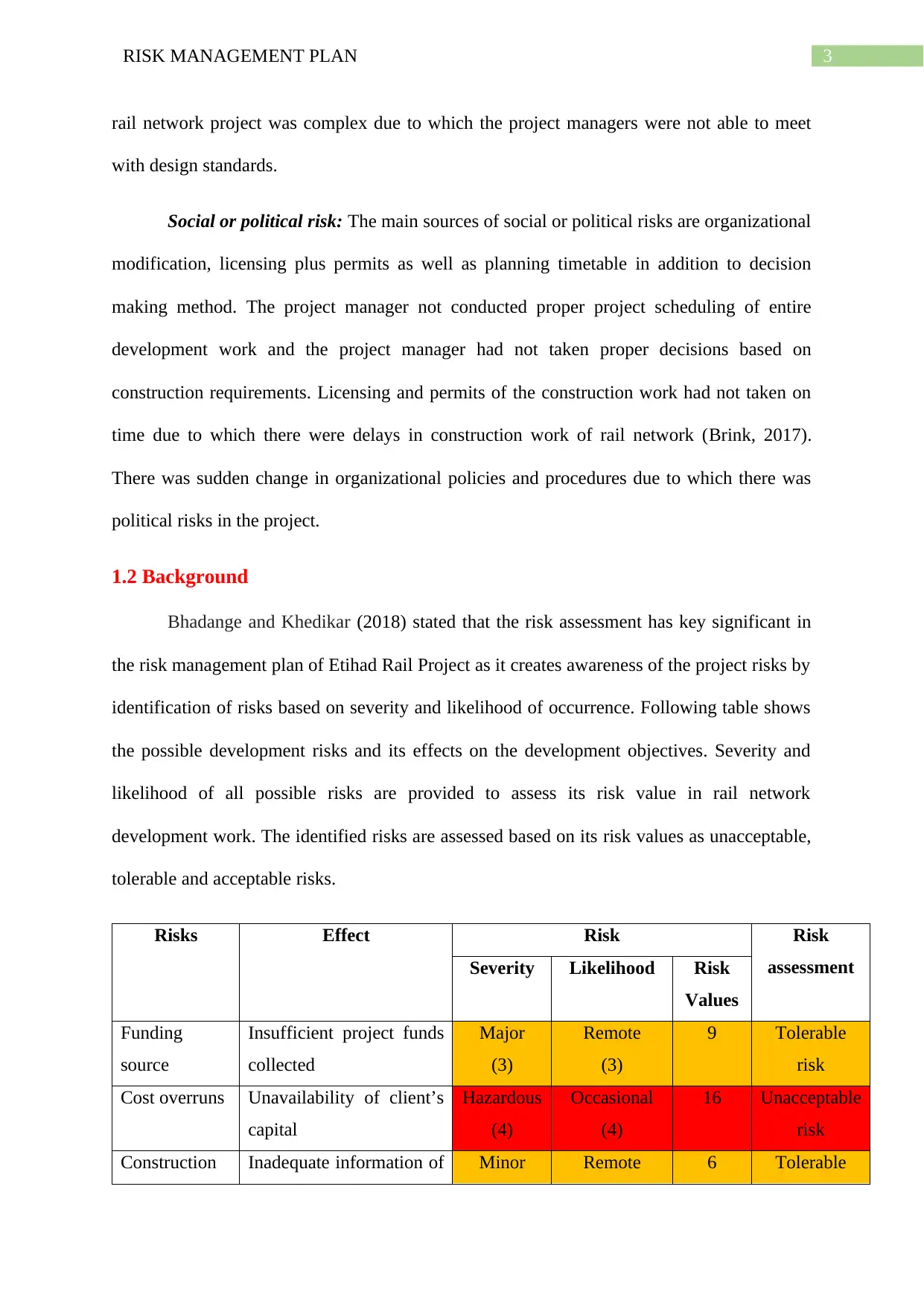
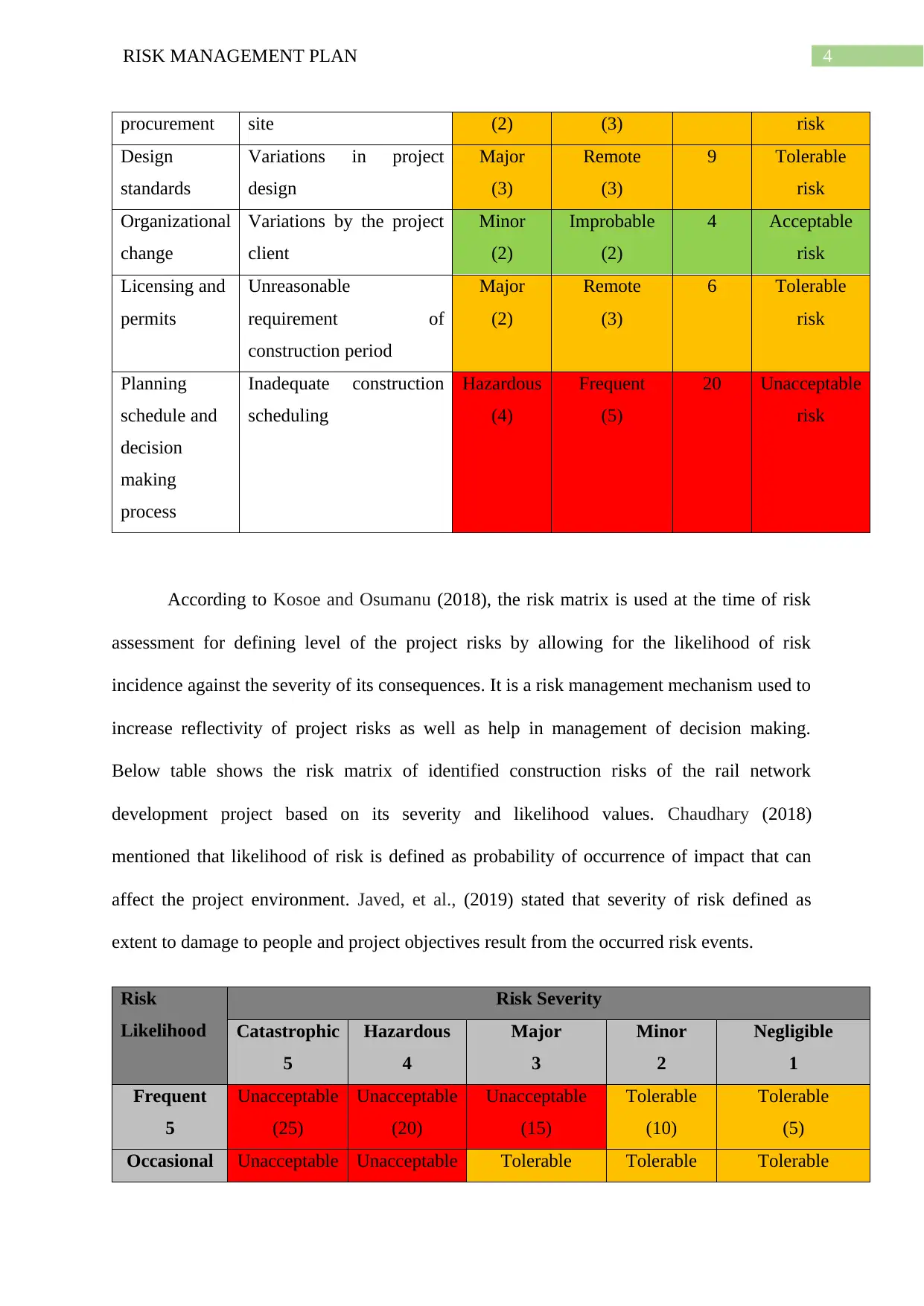
Bhadange and Khedikar (2018) stated that the risk assessment has key significant in
the risk management plan of Etihad Rail Project as it creates awareness of the project risks by
identification of risks based on severity and likelihood of occurrence. Following table shows
the possible development risks and its effects on the development objectives. Severity and
likelihood of all possible risks are provided to assess its risk value in rail network
development work. The identified risks are assessed based on its risk values as unacceptable,
tolerable and acceptable risks.
Risks Effect Risk Risk
assessmentSeverity Likelihood Risk
Values
Funding
source
Insufficient project funds
collected
Major
(3)
Remote
(3)
9 Tolerable
risk
Cost overruns Unavailability of client’s
capital
Hazardous
(4)
Occasional
(4)
16 Unacceptable
risk
Construction Inadequate information of Minor Remote 6 Tolerable
rail network project was complex due to which the project managers were not able to meet
with design standards.
Social or political risk: The main sources of social or political risks are organizational
modification, licensing plus permits as well as planning timetable in addition to decision
making method. The project manager not conducted proper project scheduling of entire
development work and the project manager had not taken proper decisions based on
construction requirements. Licensing and permits of the construction work had not taken on
time due to which there were delays in construction work of rail network (Brink, 2017).
There was sudden change in organizational policies and procedures due to which there was
political risks in the project.
1.2 Background
Bhadange and Khedikar (2018) stated that the risk assessment has key significant in
the risk management plan of Etihad Rail Project as it creates awareness of the project risks by
identification of risks based on severity and likelihood of occurrence. Following table shows
the possible development risks and its effects on the development objectives. Severity and
likelihood of all possible risks are provided to assess its risk value in rail network
development work. The identified risks are assessed based on its risk values as unacceptable,
tolerable and acceptable risks.
Risks Effect Risk Risk
assessmentSeverity Likelihood Risk
Values
Funding
source
Insufficient project funds
collected
Major
(3)
Remote
(3)
9 Tolerable
risk
Cost overruns Unavailability of client’s
capital
Hazardous
(4)
Occasional
(4)
16 Unacceptable
risk
Construction Inadequate information of Minor Remote 6 Tolerable
Paraphrase This Document
Need a fresh take? Get an instant paraphrase of this document with our AI Paraphraser
4RISK MANAGEMENT PLAN
procurement site (2) (3) risk
Design
standards
Variations in project
design
Major
(3)
Remote
(3)
9 Tolerable
risk
Organizational
change
Variations by the project
client
Minor
(2)
Improbable
(2)
4 Acceptable
risk
Licensing and
permits
Unreasonable
requirement of
construction period
Major
(2)
Remote
(3)
6 Tolerable
risk
Planning
schedule and
decision
making
process
Inadequate construction
scheduling
Hazardous
(4)
Frequent
(5)
20 Unacceptable
risk
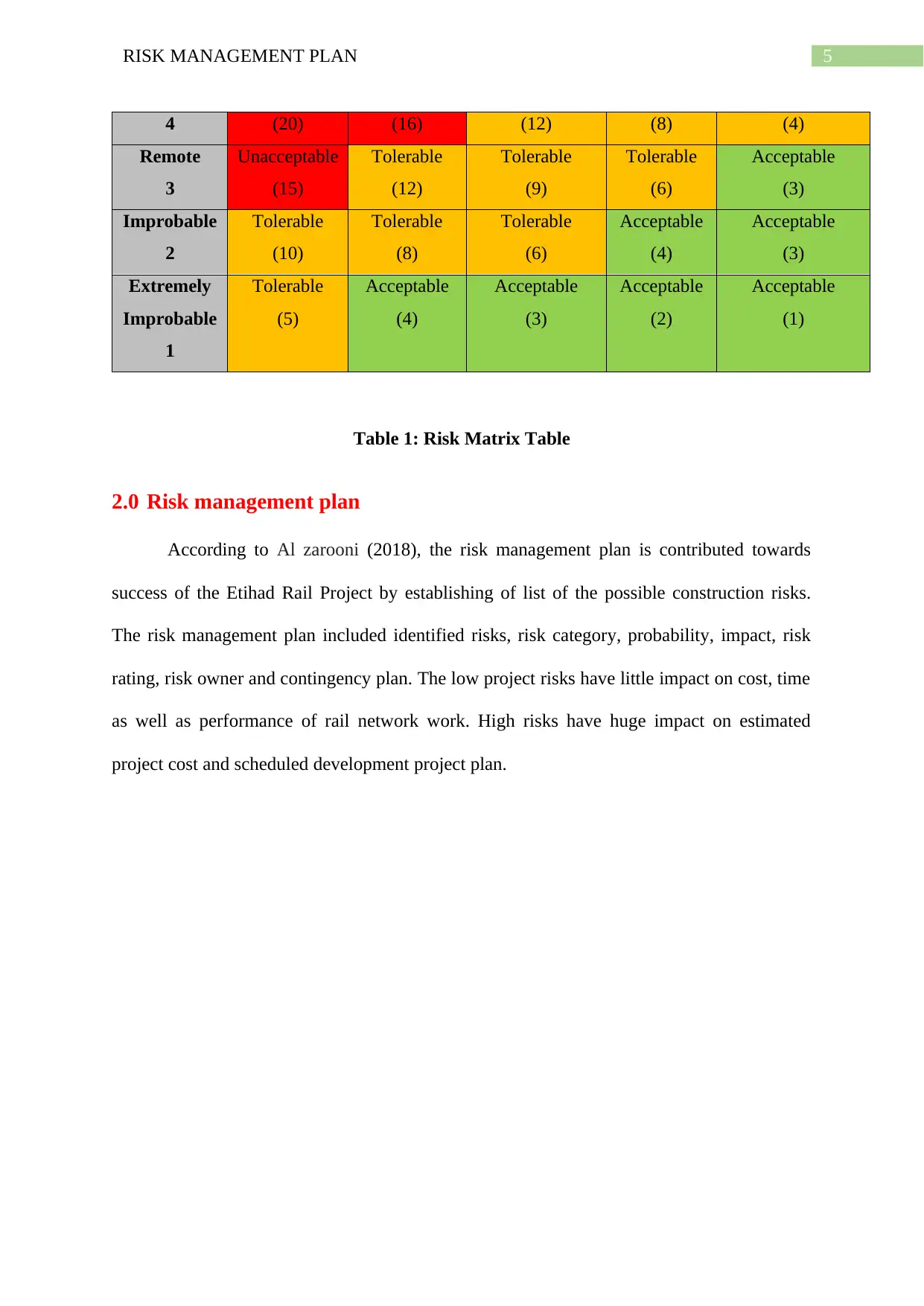
According to Kosoe and Osumanu (2018), the risk matrix is used at the time of risk
assessment for defining level of the project risks by allowing for the likelihood of risk
incidence against the severity of its consequences. It is a risk management mechanism used to
increase reflectivity of project risks as well as help in management of decision making.
Below table shows the risk matrix of identified construction risks of the rail network
development project based on its severity and likelihood values. Chaudhary (2018)
mentioned that likelihood of risk is defined as probability of occurrence of impact that can
affect the project environment. Javed, et al., (2019) stated that severity of risk defined as
extent to damage to people and project objectives result from the occurred risk events.
Risk
Likelihood
Risk Severity
Catastrophic
5
Hazardous
4
Major
3
Minor
2
Negligible
1
Frequent
5
Unacceptable
(25)
Unacceptable
(20)
Unacceptable
(15)
Tolerable
(10)
Tolerable
(5)
Occasional Unacceptable Unacceptable Tolerable Tolerable Tolerable
procurement site (2) (3) risk
Design
standards
Variations in project
design
Major
(3)
Remote
(3)
9 Tolerable
risk
Organizational
change
Variations by the project
client
Minor
(2)
Improbable
(2)
4 Acceptable
risk
Licensing and
permits
Unreasonable
requirement of
construction period
Major
(2)
Remote
(3)
6 Tolerable
risk
Planning
schedule and
decision
making
process
Inadequate construction
scheduling
Hazardous
(4)
Frequent
(5)
20 Unacceptable
risk
According to Kosoe and Osumanu (2018), the risk matrix is used at the time of risk
assessment for defining level of the project risks by allowing for the likelihood of risk
incidence against the severity of its consequences. It is a risk management mechanism used to
increase reflectivity of project risks as well as help in management of decision making.
Below table shows the risk matrix of identified construction risks of the rail network
development project based on its severity and likelihood values. Chaudhary (2018)
mentioned that likelihood of risk is defined as probability of occurrence of impact that can
affect the project environment. Javed, et al., (2019) stated that severity of risk defined as
extent to damage to people and project objectives result from the occurred risk events.
Risk
Likelihood
Risk Severity
Catastrophic
5
Hazardous
4
Major
3
Minor
2
Negligible
1
Frequent
5
Unacceptable
(25)
Unacceptable
(20)
Unacceptable
(15)
Tolerable
(10)
Tolerable
(5)
Occasional Unacceptable Unacceptable Tolerable Tolerable Tolerable
5RISK MANAGEMENT PLAN
4 (20) (16) (12) (8) (4)
Remote
3
Unacceptable
(15)
Tolerable
(12)
Tolerable
(9)
Tolerable
(6)
Acceptable
(3)
Improbable
2
Tolerable
(10)
Tolerable
(8)
Tolerable
(6)
Acceptable
(4)
Acceptable
(3)
Extremely
Improbable
1
Tolerable
(5)
Acceptable
(4)
Acceptable
(3)
Acceptable
(2)
Acceptable
(1)
Table 1: Risk Matrix Table
2.0 Risk management plan
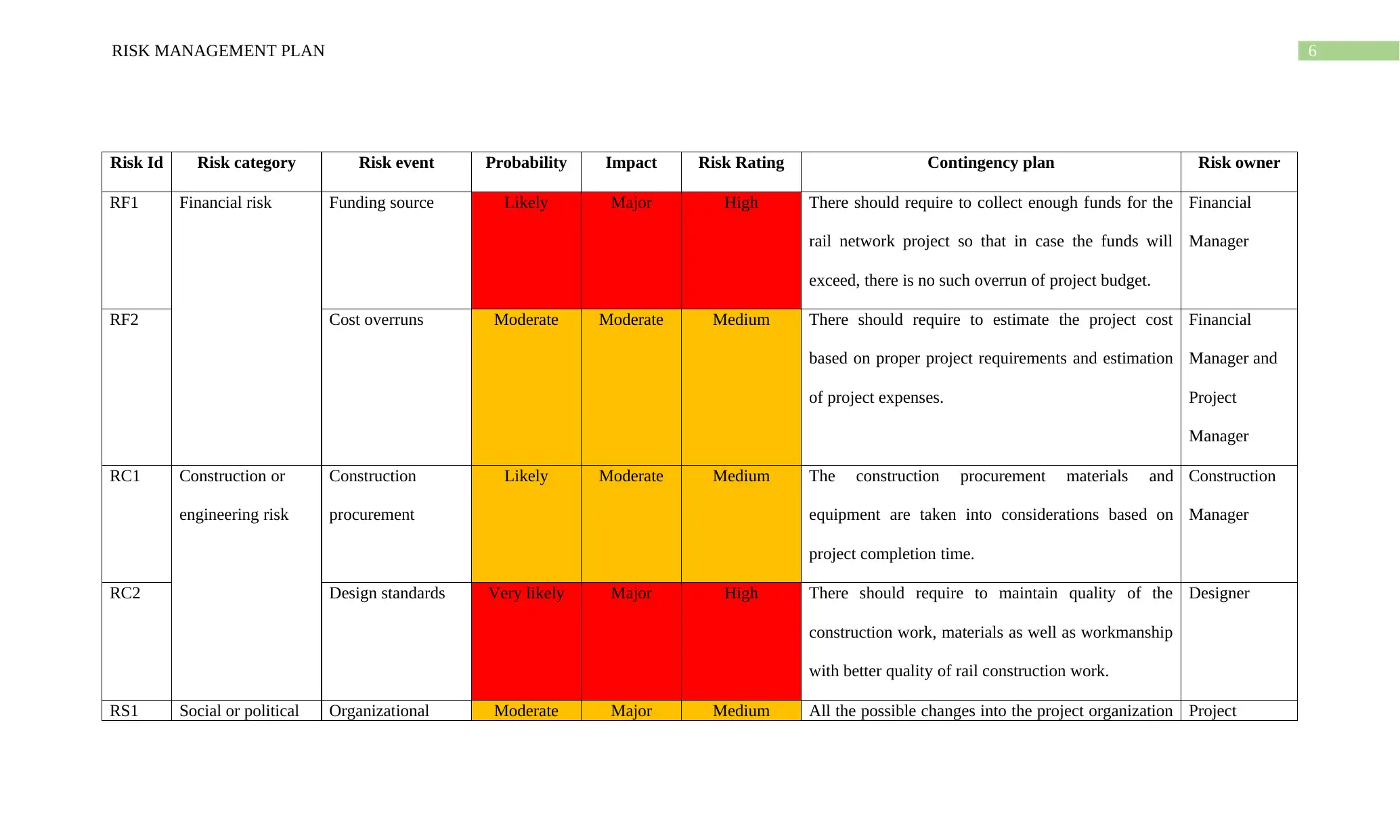
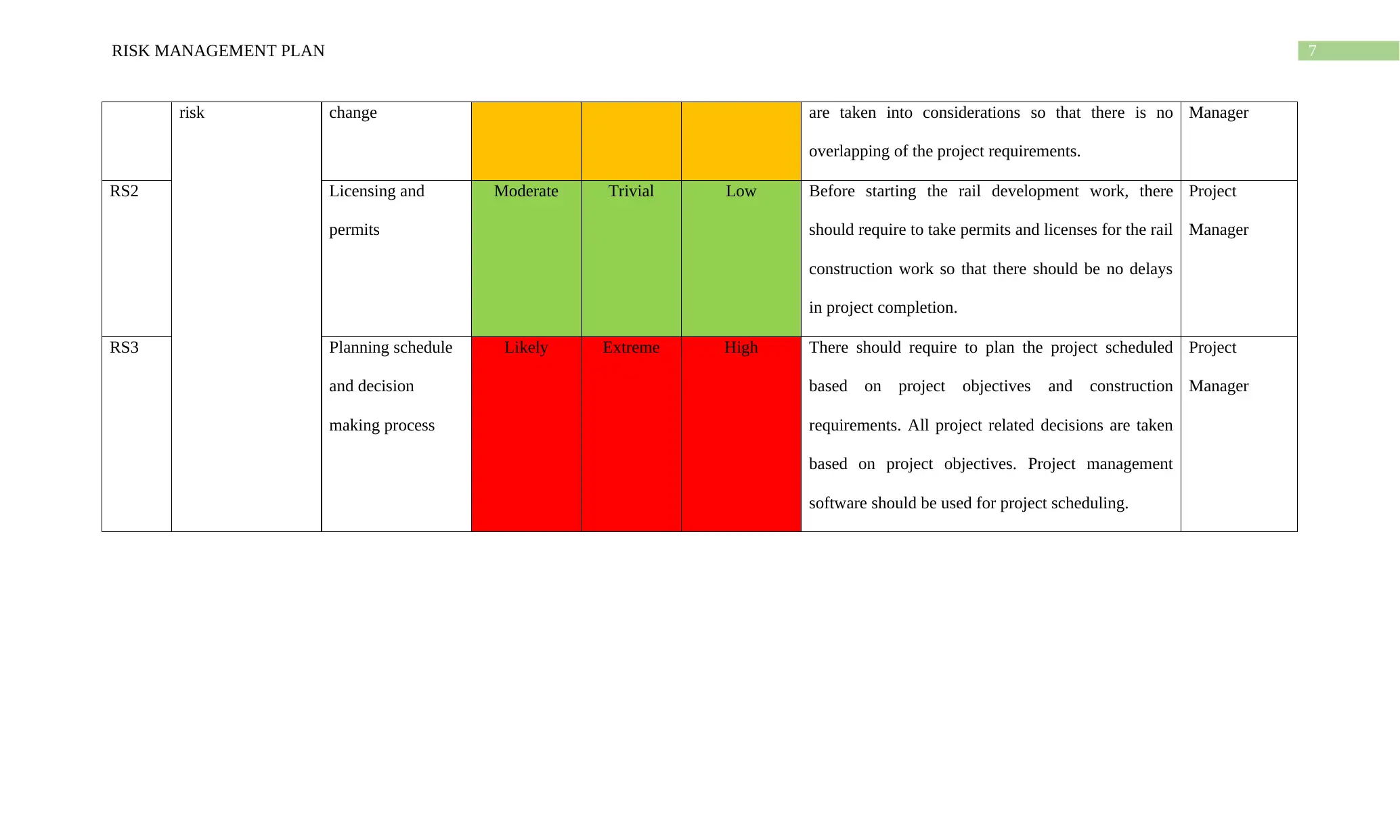
According to Al zarooni (2018), the risk management plan is contributed towards
success of the Etihad Rail Project by establishing of list of the possible construction risks.
The risk management plan included identified risks, risk category, probability, impact, risk
rating, risk owner and contingency plan. The low project risks have little impact on cost, time
as well as performance of rail network work. High risks have huge impact on estimated
project cost and scheduled development project plan.
4 (20) (16) (12) (8) (4)
Remote
3
Unacceptable
(15)
Tolerable
(12)
Tolerable
(9)
Tolerable
(6)
Acceptable
(3)
Improbable
2
Tolerable
(10)
Tolerable
(8)
Tolerable
(6)
Acceptable
(4)
Acceptable
(3)
Extremely
Improbable
1
Tolerable
(5)
Acceptable
(4)
Acceptable
(3)
Acceptable
(2)
Acceptable
(1)
Table 1: Risk Matrix Table
2.0 Risk management plan
According to Al zarooni (2018), the risk management plan is contributed towards
success of the Etihad Rail Project by establishing of list of the possible construction risks.
The risk management plan included identified risks, risk category, probability, impact, risk
rating, risk owner and contingency plan. The low project risks have little impact on cost, time
as well as performance of rail network work. High risks have huge impact on estimated
project cost and scheduled development project plan.
⊘ This is a preview!⊘
Do you want full access?
Subscribe today to unlock all pages.
Trusted by 1+ million students worldwide
6RISK MANAGEMENT PLAN
Risk Id Risk category Risk event Probability Impact Risk Rating Contingency plan Risk owner
RF1 Financial risk Funding source Likely Major High There should require to collect enough funds for the
rail network project so that in case the funds will
exceed, there is no such overrun of project budget.
Financial
Manager
RF2 Cost overruns Moderate Moderate Medium There should require to estimate the project cost
based on proper project requirements and estimation
of project expenses.
Financial
Manager and
Project
Manager
RC1 Construction or
engineering risk
Construction
procurement
Likely Moderate Medium The construction procurement materials and
equipment are taken into considerations based on
project completion time.
Construction
Manager
RC2 Design standards Very likely Major High There should require to maintain quality of the
construction work, materials as well as workmanship
with better quality of rail construction work.
Designer
RS1 Social or political Organizational Moderate Major Medium All the possible changes into the project organization Project
Risk Id Risk category Risk event Probability Impact Risk Rating Contingency plan Risk owner
RF1 Financial risk Funding source Likely Major High There should require to collect enough funds for the
rail network project so that in case the funds will
exceed, there is no such overrun of project budget.
Financial
Manager
RF2 Cost overruns Moderate Moderate Medium There should require to estimate the project cost
based on proper project requirements and estimation
of project expenses.
Financial
Manager and
Project
Manager
RC1 Construction or
engineering risk
Construction
procurement
Likely Moderate Medium The construction procurement materials and
equipment are taken into considerations based on
project completion time.
Construction
Manager
RC2 Design standards Very likely Major High There should require to maintain quality of the
construction work, materials as well as workmanship
with better quality of rail construction work.
Designer
RS1 Social or political Organizational Moderate Major Medium All the possible changes into the project organization Project
Paraphrase This Document
Need a fresh take? Get an instant paraphrase of this document with our AI Paraphraser
7RISK MANAGEMENT PLAN
risk change are taken into considerations so that there is no
overlapping of the project requirements.
Manager
RS2 Licensing and
permits
Moderate Trivial Low Before starting the rail development work, there
should require to take permits and licenses for the rail
construction work so that there should be no delays
in project completion.
Project
Manager
RS3 Planning schedule
and decision
making process
Likely Extreme High There should require to plan the project scheduled
based on project objectives and construction
requirements. All project related decisions are taken
based on project objectives. Project management
software should be used for project scheduling.
Project
Manager
risk change are taken into considerations so that there is no
overlapping of the project requirements.
Manager
RS2 Licensing and
permits
Moderate Trivial Low Before starting the rail development work, there
should require to take permits and licenses for the rail
construction work so that there should be no delays
in project completion.
Project
Manager
RS3 Planning schedule
and decision
making process
Likely Extreme High There should require to plan the project scheduled
based on project objectives and construction
requirements. All project related decisions are taken
based on project objectives. Project management
software should be used for project scheduling.
Project
Manager
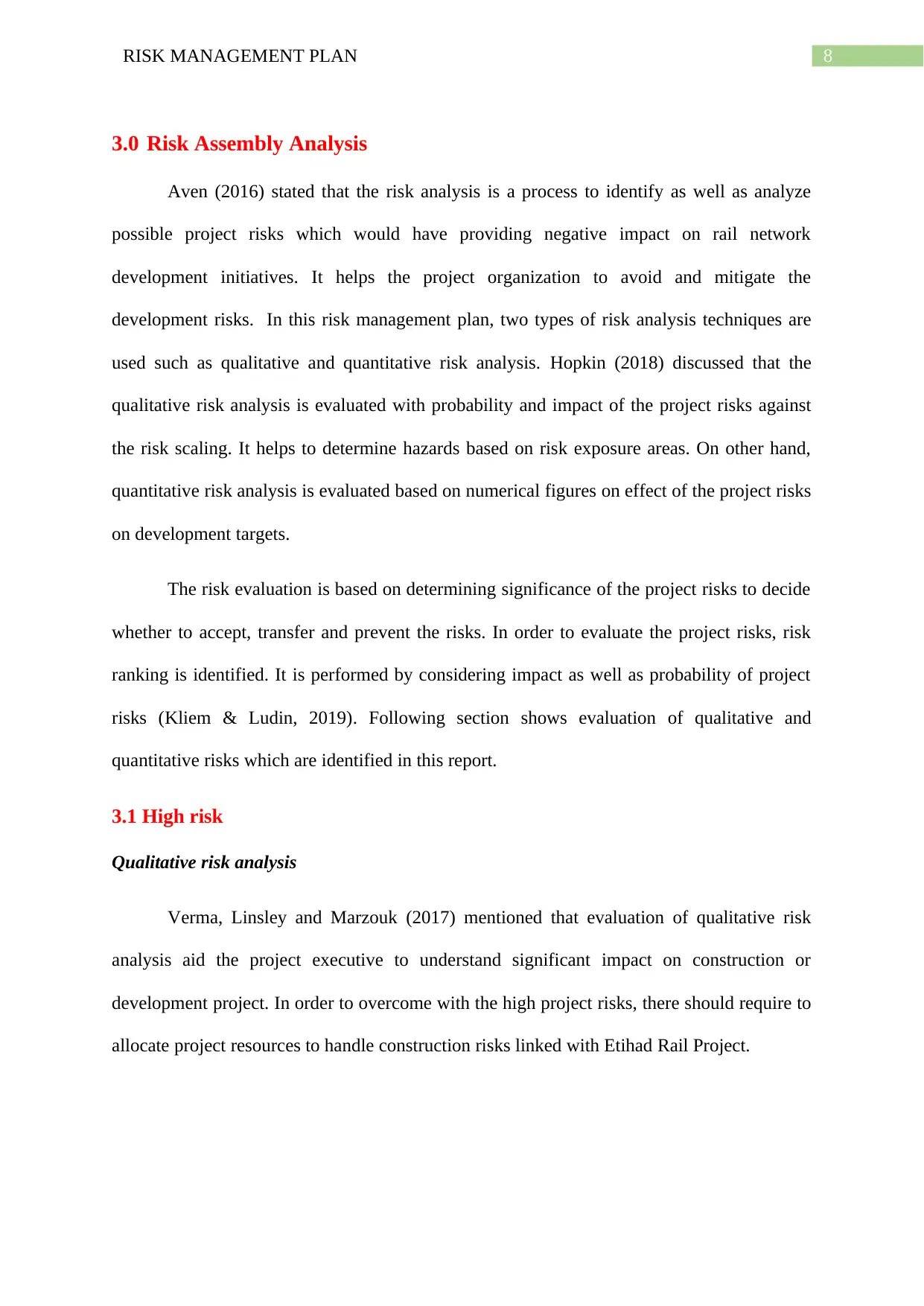
8RISK MANAGEMENT PLAN
3.0 Risk Assembly Analysis
Aven (2016) stated that the risk analysis is a process to identify as well as analyze
possible project risks which would have providing negative impact on rail network
development initiatives. It helps the project organization to avoid and mitigate the
development risks. In this risk management plan, two types of risk analysis techniques are
used such as qualitative and quantitative risk analysis. Hopkin (2018) discussed that the
qualitative risk analysis is evaluated with probability and impact of the project risks against
the risk scaling. It helps to determine hazards based on risk exposure areas. On other hand,
quantitative risk analysis is evaluated based on numerical figures on effect of the project risks
on development targets.
The risk evaluation is based on determining significance of the project risks to decide
whether to accept, transfer and prevent the risks. In order to evaluate the project risks, risk
ranking is identified. It is performed by considering impact as well as probability of project
risks (Kliem & Ludin, 2019). Following section shows evaluation of qualitative and
quantitative risks which are identified in this report.
3.1 High risk
Qualitative risk analysis
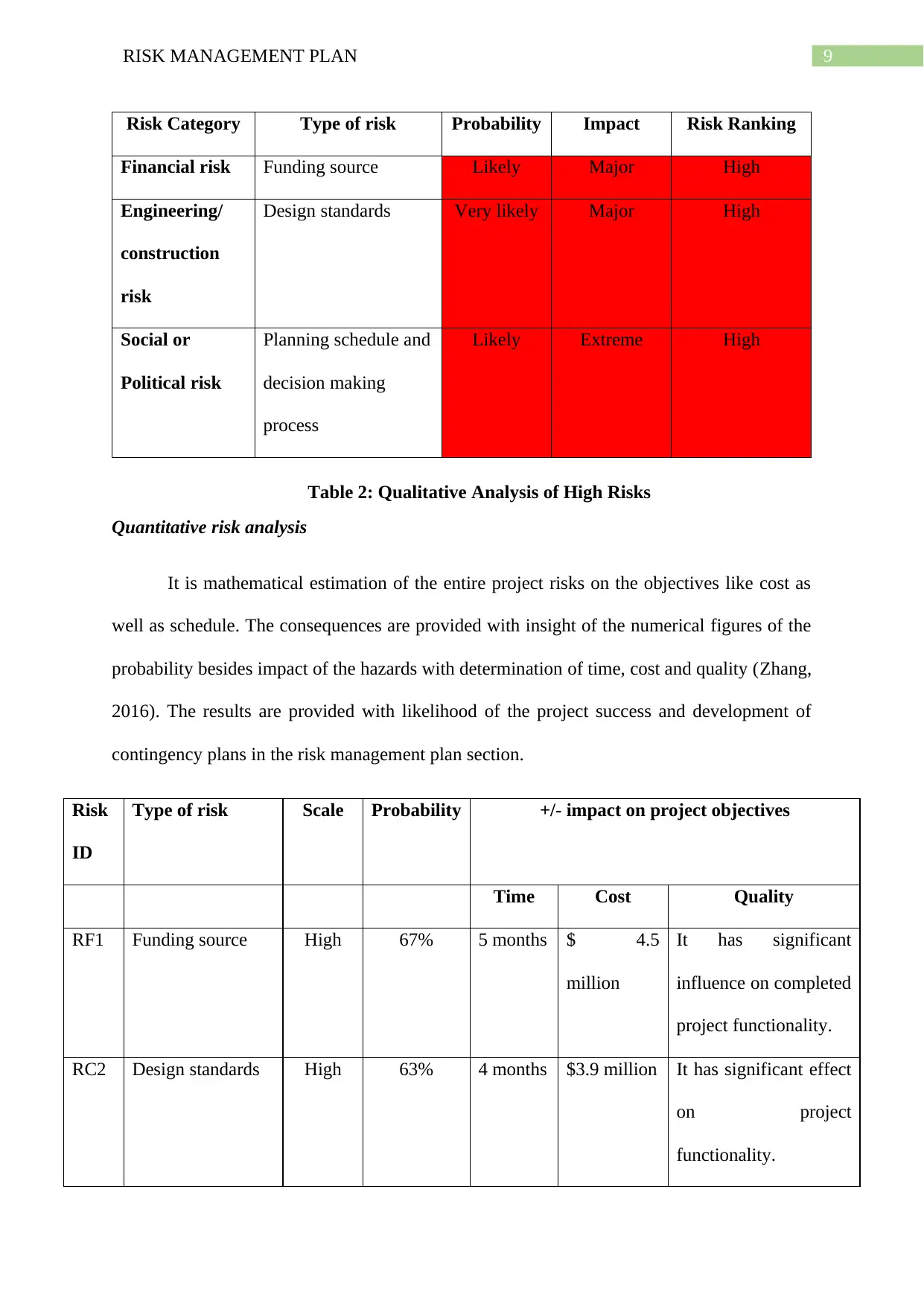
Verma, Linsley and Marzouk (2017) mentioned that evaluation of qualitative risk
analysis aid the project executive to understand significant impact on construction or
development project. In order to overcome with the high project risks, there should require to
allocate project resources to handle construction risks linked with Etihad Rail Project.
3.0 Risk Assembly Analysis
Aven (2016) stated that the risk analysis is a process to identify as well as analyze
possible project risks which would have providing negative impact on rail network
development initiatives. It helps the project organization to avoid and mitigate the
development risks. In this risk management plan, two types of risk analysis techniques are
used such as qualitative and quantitative risk analysis. Hopkin (2018) discussed that the
qualitative risk analysis is evaluated with probability and impact of the project risks against
the risk scaling. It helps to determine hazards based on risk exposure areas. On other hand,
quantitative risk analysis is evaluated based on numerical figures on effect of the project risks
on development targets.
The risk evaluation is based on determining significance of the project risks to decide
whether to accept, transfer and prevent the risks. In order to evaluate the project risks, risk
ranking is identified. It is performed by considering impact as well as probability of project
risks (Kliem & Ludin, 2019). Following section shows evaluation of qualitative and
quantitative risks which are identified in this report.
3.1 High risk
Qualitative risk analysis
Verma, Linsley and Marzouk (2017) mentioned that evaluation of qualitative risk
analysis aid the project executive to understand significant impact on construction or
development project. In order to overcome with the high project risks, there should require to
allocate project resources to handle construction risks linked with Etihad Rail Project.
⊘ This is a preview!⊘
Do you want full access?
Subscribe today to unlock all pages.
Trusted by 1+ million students worldwide
9RISK MANAGEMENT PLAN
Risk Category Type of risk Probability Impact Risk Ranking
Financial risk Funding source Likely Major High
Engineering/
construction
risk
Design standards Very likely Major High
Social or
Political risk
Planning schedule and
decision making
process
Likely Extreme High
Table 2: Qualitative Analysis of High Risks
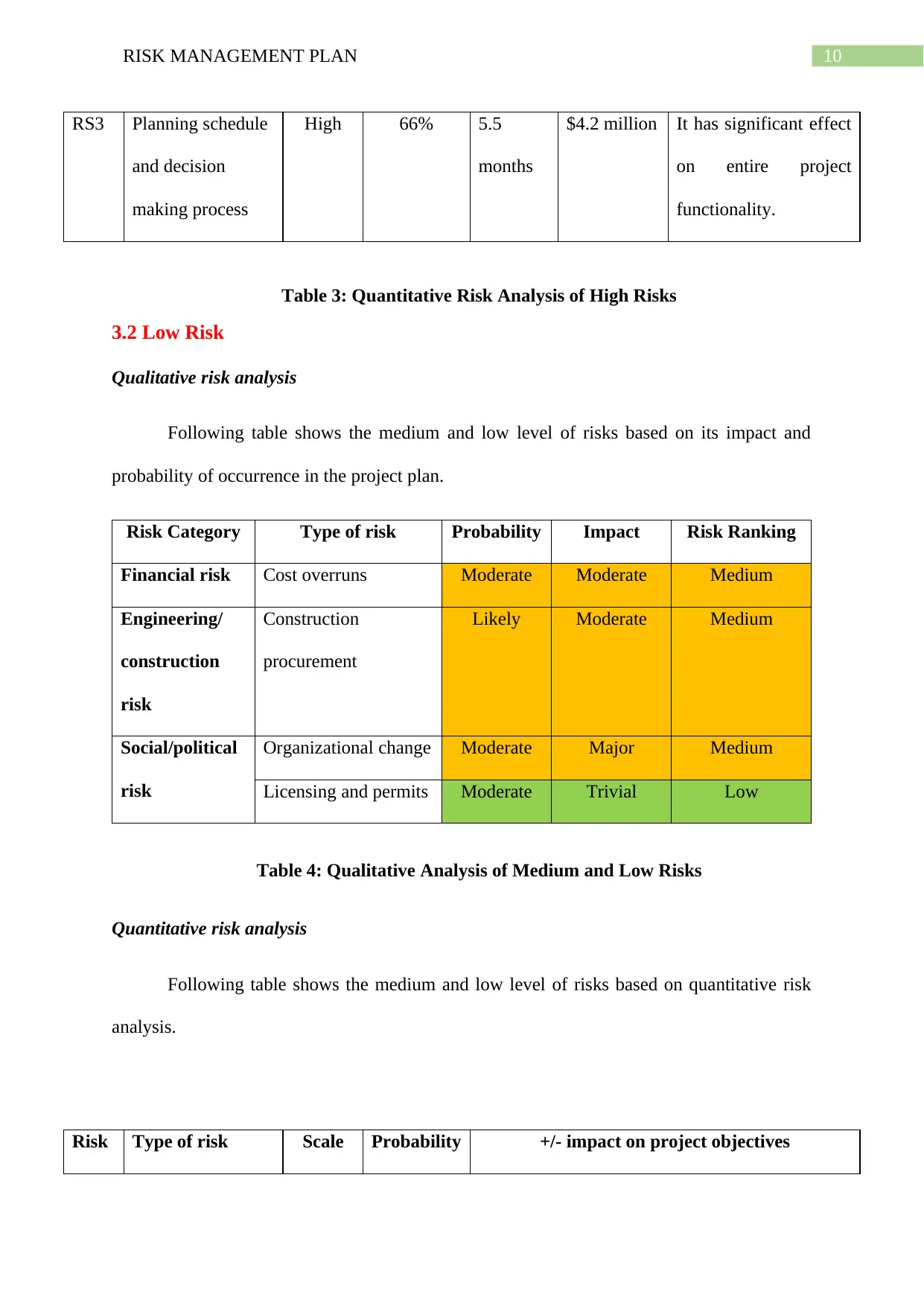
Quantitative risk analysis
It is mathematical estimation of the entire project risks on the objectives like cost as
well as schedule. The consequences are provided with insight of the numerical figures of the
probability besides impact of the hazards with determination of time, cost and quality (Zhang,
2016). The results are provided with likelihood of the project success and development of
contingency plans in the risk management plan section.
Risk
ID
Type of risk Scale Probability +/- impact on project objectives
Time Cost Quality
RF1 Funding source High 67% 5 months $ 4.5
million
It has significant
influence on completed
project functionality.
RC2 Design standards High 63% 4 months $3.9 million It has significant effect
on project
functionality.
Risk Category Type of risk Probability Impact Risk Ranking
Financial risk Funding source Likely Major High
Engineering/
construction
risk
Design standards Very likely Major High
Social or
Political risk
Planning schedule and
decision making
process
Likely Extreme High
Table 2: Qualitative Analysis of High Risks
Quantitative risk analysis
It is mathematical estimation of the entire project risks on the objectives like cost as
well as schedule. The consequences are provided with insight of the numerical figures of the
probability besides impact of the hazards with determination of time, cost and quality (Zhang,
2016). The results are provided with likelihood of the project success and development of
contingency plans in the risk management plan section.
Risk
ID
Type of risk Scale Probability +/- impact on project objectives
Time Cost Quality
RF1 Funding source High 67% 5 months $ 4.5
million
It has significant
influence on completed
project functionality.
RC2 Design standards High 63% 4 months $3.9 million It has significant effect
on project
functionality.
Paraphrase This Document
Need a fresh take? Get an instant paraphrase of this document with our AI Paraphraser
10RISK MANAGEMENT PLAN
RS3 Planning schedule
and decision
making process
High 66% 5.5
months
$4.2 million It has significant effect
on entire project
functionality.
Table 3: Quantitative Risk Analysis of High Risks
3.2 Low Risk
Qualitative risk analysis
Following table shows the medium and low level of risks based on its impact and
probability of occurrence in the project plan.
Risk Category Type of risk Probability Impact Risk Ranking
Financial risk Cost overruns Moderate Moderate Medium
Engineering/
construction
risk
Construction
procurement
Likely Moderate Medium
Social/political
risk
Organizational change Moderate Major Medium
Licensing and permits Moderate Trivial Low
Table 4: Qualitative Analysis of Medium and Low Risks
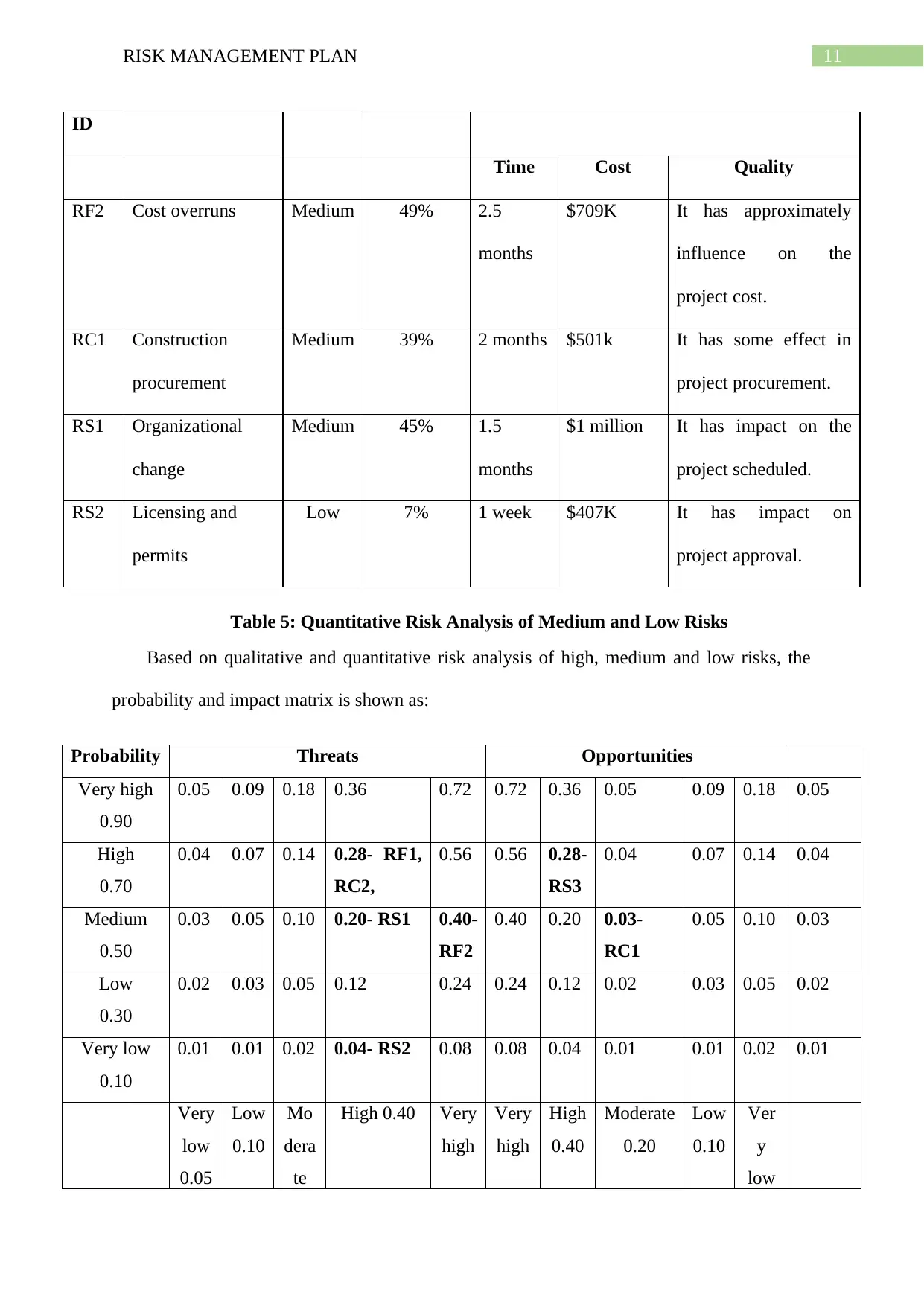
Quantitative risk analysis
Following table shows the medium and low level of risks based on quantitative risk
analysis.
Risk Type of risk Scale Probability +/- impact on project objectives
RS3 Planning schedule
and decision
making process
High 66% 5.5
months
$4.2 million It has significant effect
on entire project
functionality.
Table 3: Quantitative Risk Analysis of High Risks
3.2 Low Risk
Qualitative risk analysis
Following table shows the medium and low level of risks based on its impact and
probability of occurrence in the project plan.
Risk Category Type of risk Probability Impact Risk Ranking
Financial risk Cost overruns Moderate Moderate Medium
Engineering/
construction
risk
Construction
procurement
Likely Moderate Medium
Social/political
risk
Organizational change Moderate Major Medium
Licensing and permits Moderate Trivial Low
Table 4: Qualitative Analysis of Medium and Low Risks
Quantitative risk analysis
Following table shows the medium and low level of risks based on quantitative risk
analysis.
Risk Type of risk Scale Probability +/- impact on project objectives
11RISK MANAGEMENT PLAN
ID
Time Cost Quality
RF2 Cost overruns Medium 49% 2.5
months
$709K It has approximately
influence on the
project cost.
RC1 Construction
procurement
Medium 39% 2 months $501k It has some effect in
project procurement.
RS1 Organizational
change
Medium 45% 1.5
months
$1 million It has impact on the
project scheduled.
RS2 Licensing and
permits
Low 7% 1 week $407K It has impact on
project approval.
Table 5: Quantitative Risk Analysis of Medium and Low Risks
Based on qualitative and quantitative risk analysis of high, medium and low risks, the
probability and impact matrix is shown as:
Probability Threats Opportunities
Very high
0.90
0.05 0.09 0.18 0.36 0.72 0.72 0.36 0.05 0.09 0.18 0.05
High
0.70
0.04 0.07 0.14 0.28- RF1,
RC2,
0.56 0.56 0.28-
RS3
0.04 0.07 0.14 0.04
Medium
0.50
0.03 0.05 0.10 0.20- RS1 0.40-
RF2
0.40 0.20 0.03-
RC1
0.05 0.10 0.03
Low
0.30
0.02 0.03 0.05 0.12 0.24 0.24 0.12 0.02 0.03 0.05 0.02
Very low
0.10
0.01 0.01 0.02 0.04- RS2 0.08 0.08 0.04 0.01 0.01 0.02 0.01
Very
low
0.05
Low
0.10
Mo
dera
te
High 0.40 Very
high
Very
high
High
0.40
Moderate
0.20
Low
0.10
Ver
y
low
ID
Time Cost Quality
RF2 Cost overruns Medium 49% 2.5
months
$709K It has approximately
influence on the
project cost.
RC1 Construction
procurement
Medium 39% 2 months $501k It has some effect in
project procurement.
RS1 Organizational
change
Medium 45% 1.5
months
$1 million It has impact on the
project scheduled.
RS2 Licensing and
permits
Low 7% 1 week $407K It has impact on
project approval.
Table 5: Quantitative Risk Analysis of Medium and Low Risks
Based on qualitative and quantitative risk analysis of high, medium and low risks, the
probability and impact matrix is shown as:
Probability Threats Opportunities
Very high
0.90
0.05 0.09 0.18 0.36 0.72 0.72 0.36 0.05 0.09 0.18 0.05
High
0.70
0.04 0.07 0.14 0.28- RF1,
RC2,
0.56 0.56 0.28-
RS3
0.04 0.07 0.14 0.04
Medium
0.50
0.03 0.05 0.10 0.20- RS1 0.40-
RF2
0.40 0.20 0.03-
RC1
0.05 0.10 0.03
Low
0.30
0.02 0.03 0.05 0.12 0.24 0.24 0.12 0.02 0.03 0.05 0.02
Very low
0.10
0.01 0.01 0.02 0.04- RS2 0.08 0.08 0.04 0.01 0.01 0.02 0.01
Very
low
0.05
Low
0.10
Mo
dera
te
High 0.40 Very
high
Very
high
High
0.40
Moderate
0.20
Low
0.10
Ver
y
low
⊘ This is a preview!⊘
Do you want full access?
Subscribe today to unlock all pages.
Trusted by 1+ million students worldwide

1 out of 17


Related Documents


Your All-in-One AI-Powered Toolkit for Academic Success.
+13062052269
info@desklib.com
Available 24*7 on WhatsApp / Email
![[object Object]](/_next/static/media/star-bottom.7253800d.svg)
Unlock your academic potential
Copyright © 2020–2026 A2Z Services. All Rights Reserved. Developed and managed by ZUCOL.