Designing a Risk Management System for Construction Projects
VerifiedAdded on 2022/08/12
|13
|3503
|19
Project
AI Summary
This project focuses on designing and implementing a risk management system (RMS) for a construction project undertaken by AC Construction in Docklands, London. The assignment addresses the need to elevate the organization's risk maturity level from 1 (ad-hoc) to 3 (repeatable) in the short term and 4 (managed) in the long term, according to the Risk Maturity Model (RMM). The RMS development encompasses risk analysis, risk evaluation, and risk management phases. The risk analysis involves identifying and qualifying risks such as project delays, budget overruns, structural failures, and non-compliance, and then quantifying these risks to create a risk profile. The risk evaluation phase compares risk analysis outcomes against established criteria (human, property, and environmental risks) to determine risk acceptability and prioritize management strategies. The risk management phase outlines strategies for addressing identified risks, including proactive measures and contingency planning. The project also details the requirements for achieving RMM level 4, emphasizing staff development, standardization of processes, and continuous risk analysis using tools like the Seven Basic Tools of Quality, which are essential for long-term RMS effectiveness. The project provides a practical application of the RMS to a specific construction scenario, offering a comprehensive framework for managing risks in construction projects. It also highlights the importance of documentation, learning, and continuous improvement in risk management practices.
RISK MANAGEMENT FOR PROJECTS

Paraphrase This Document
Need a fresh take? Get an instant paraphrase of this document with our AI Paraphraser
Summary
AC construction intends to undertake a construction project in Docklands, London, adjacent to the
Thames, covering 14500 m 2. The project is obviously fraught with risks and given the present
RMM of 1, there is need to have a RMM of 3 for the project and a RMM level of 4 for future
projects. The RMS will entail risk analysis, risk evaluation, risk management done using the RMM
framework for scoring. The identified risks will be evaluated and a risk profile developed. For the
future, a level 4 RMM will be used, premised on staff development and competency, and the
standardization of processes in addition to having a robust RMS where risks are continuously
analyzed and resolved and tools such as the Seven basic Tools of Quality are used.
AC construction intends to undertake a construction project in Docklands, London, adjacent to the
Thames, covering 14500 m 2. The project is obviously fraught with risks and given the present
RMM of 1, there is need to have a RMM of 3 for the project and a RMM level of 4 for future
projects. The RMS will entail risk analysis, risk evaluation, risk management done using the RMM
framework for scoring. The identified risks will be evaluated and a risk profile developed. For the
future, a level 4 RMM will be used, premised on staff development and competency, and the
standardization of processes in addition to having a robust RMS where risks are continuously
analyzed and resolved and tools such as the Seven basic Tools of Quality are used.
Introduction
A Risk Management System is an important concept and feature for any project, especially in
construction projects because it provides a means by which an organization can manage roles,
players, processes, and relations in its operations. Using the Risk Management System (RMS), an
organization has a greater chance of meeting its objectives in the context of its values (Albert,
Hallowell and Kleiner, 2014; Caiado et al., 2016). This is achieved through establishing policies,
risk limits, and strategies necessary for controlling risks and enable these risks to be altered so they
do not adversely affect the execution of the project (Turskis, Gajzler and Dziadosz, 2012; Caiado et
al., 2016). The RMS is developed so that it fulfills and is aligned with the Risk maturity Model
(RMM): the RMM is a model outlining the main activities and indicators that make up an ERM
(enterprise risk management) program that is mature, sustainable , and repeatable. The RMM is a
framework for best practices in the management of risks, while at the same time also being a tool
for evaluating risk preparedness (RMS) (Oliva, 2016). Through the RMM, the ERM program
strengths can be evaluated and plans made to improve it.
This RMS is for the development of an office block in Docklands, London, adjacent to the Thames.
The office development for a shell and core will be done on an area of about 14500 m 2 that will be
no more than four stories high, have a 500 car basement parking, and the building will not occupy
the piece of land more than 75%. The site is near the London City Airport, although it is not situated
on the airports’ flight path. The client will undertake interior finishes and furnishing with a tenancy
agreement in place and the building will have a minimum usable floor area of 30,000 m 2. The
current situation of the organizations (we will call it A-Construction or AC) shows that it has a risk
maturity of level-1 which is termed ad-hoc according to the RMM. A better RMS system that will
qualify as a level 3 (‘Repeatable’) in the short term and to level 4 (‘managed’) (Antonucci, 2016),
in the long term, in the RMM is therefore developed in this paper and applied in the construction
project (Hopkinson, 2011).
RMS Development- at RMM Level 3
The RMM entails seven attributes that will ensure an RMS that is efficient and effective; these
attributes include;
Adopting an ERM- based process- Used to measure the risk culture in an organization and the
degree of board level/ executive level support for ERM (Curtis, Hefley and Miller, 2020).
management of ERM Process- This is used to measure the extent by which an organization has
adopted ERM methodology with respect to the organization culture as well as business decisions. It
also measures how well the program for managing risks adheres to best practices in order to
identify, assess, analyze, mitigate, and monitor risks (Curtis, Hefley and Miller, 2020).
A Risk Management System is an important concept and feature for any project, especially in
construction projects because it provides a means by which an organization can manage roles,
players, processes, and relations in its operations. Using the Risk Management System (RMS), an
organization has a greater chance of meeting its objectives in the context of its values (Albert,
Hallowell and Kleiner, 2014; Caiado et al., 2016). This is achieved through establishing policies,
risk limits, and strategies necessary for controlling risks and enable these risks to be altered so they
do not adversely affect the execution of the project (Turskis, Gajzler and Dziadosz, 2012; Caiado et
al., 2016). The RMS is developed so that it fulfills and is aligned with the Risk maturity Model
(RMM): the RMM is a model outlining the main activities and indicators that make up an ERM
(enterprise risk management) program that is mature, sustainable , and repeatable. The RMM is a
framework for best practices in the management of risks, while at the same time also being a tool
for evaluating risk preparedness (RMS) (Oliva, 2016). Through the RMM, the ERM program
strengths can be evaluated and plans made to improve it.
This RMS is for the development of an office block in Docklands, London, adjacent to the Thames.
The office development for a shell and core will be done on an area of about 14500 m 2 that will be
no more than four stories high, have a 500 car basement parking, and the building will not occupy
the piece of land more than 75%. The site is near the London City Airport, although it is not situated
on the airports’ flight path. The client will undertake interior finishes and furnishing with a tenancy
agreement in place and the building will have a minimum usable floor area of 30,000 m 2. The
current situation of the organizations (we will call it A-Construction or AC) shows that it has a risk
maturity of level-1 which is termed ad-hoc according to the RMM. A better RMS system that will
qualify as a level 3 (‘Repeatable’) in the short term and to level 4 (‘managed’) (Antonucci, 2016),
in the long term, in the RMM is therefore developed in this paper and applied in the construction
project (Hopkinson, 2011).
RMS Development- at RMM Level 3
The RMM entails seven attributes that will ensure an RMS that is efficient and effective; these
attributes include;
Adopting an ERM- based process- Used to measure the risk culture in an organization and the
degree of board level/ executive level support for ERM (Curtis, Hefley and Miller, 2020).
management of ERM Process- This is used to measure the extent by which an organization has
adopted ERM methodology with respect to the organization culture as well as business decisions. It
also measures how well the program for managing risks adheres to best practices in order to
identify, assess, analyze, mitigate, and monitor risks (Curtis, Hefley and Miller, 2020).
⊘ This is a preview!⊘
Do you want full access?
Subscribe today to unlock all pages.

Trusted by 1+ million students worldwide
Management of Risk Appetite- This analyzes the level of an organizations’ awareness of risks and
the applicable trade offs for risk and reward, definition of risk tolerances, risk accountability, and if
the organization can effectively close the gap between possible and actual risk (Curtis, Hefley and
Miller, 2020).
Root Cause Discipline- This evaluates the extent an organization can identify risks by their sources
(the root causes) vs looking at the outcomes and symptoms in lieu of the root causes (Vallabhaneni,
2019).
Uncovering Risks- This measures the coverage quality of the risk assessments undertaken and
evaluates methods used to examine risks and collect information about risks, the process used, and
whether the approach can uncover correlations and enterprise-wide trends (Vallabhaneni, 2019).
Performance management- This determines the level by which an organization carries out its
strategy and vision. It analyzes the strengths of planning, communication, and how core enterprise
goals are measured using a risk based process and how much there is deviation from expectations.
Business Sustainability and Resilience- This examines the extent of operational planning, business
continuity, and other activities related to sustainability and resilience are approached using a risk
based method (Zhao, Hwang and Low, 2013; Curtis, Hefley and Miller, 2020).
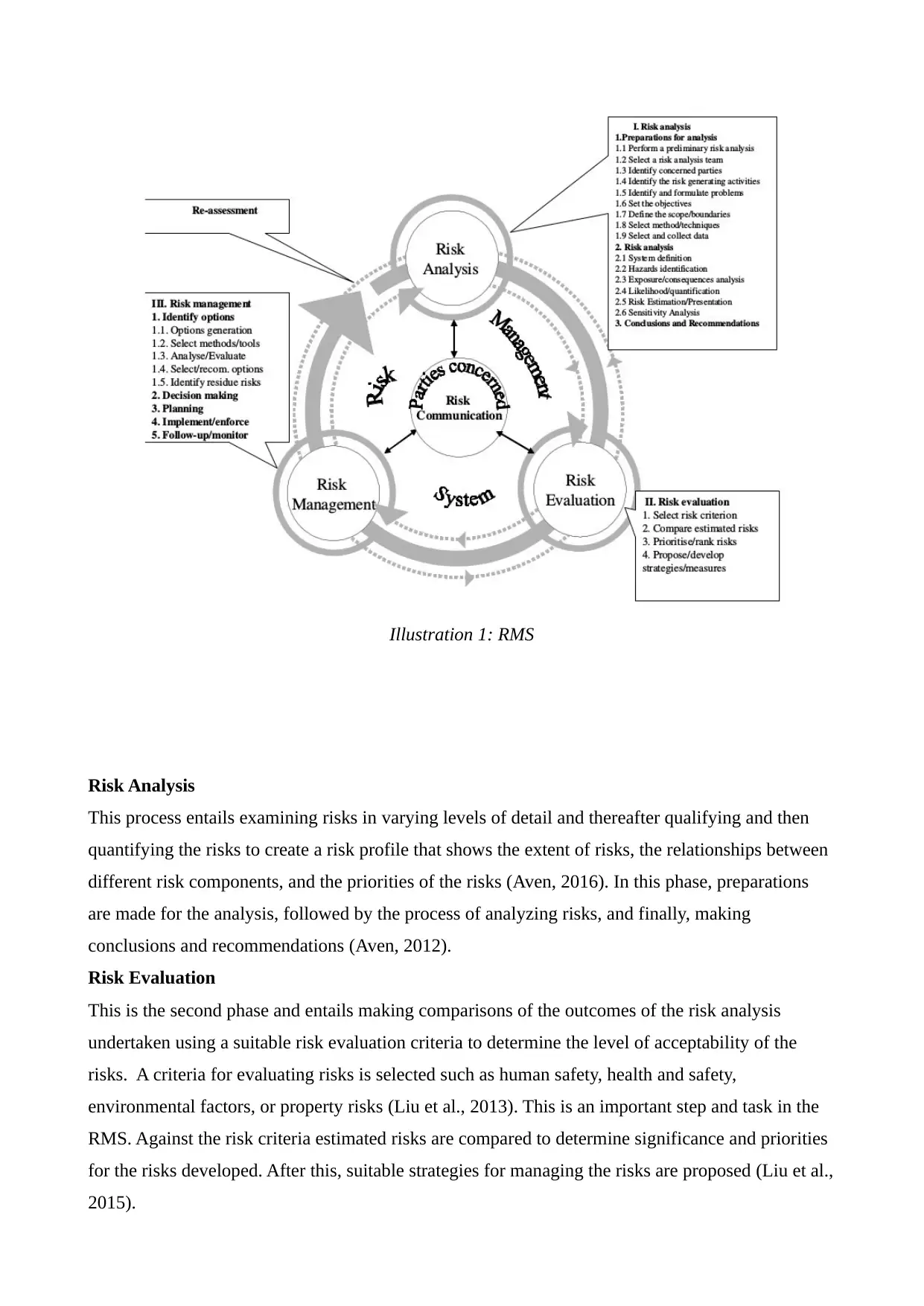
Risk Management System
The RMS will constitute three main phases namely the Risk analysis , the risk evaluation , and the
risk management (Dawson et al., 2014; Tupa et al., 2017). The RMS framework is shown in
Illustration 1 below;
the applicable trade offs for risk and reward, definition of risk tolerances, risk accountability, and if
the organization can effectively close the gap between possible and actual risk (Curtis, Hefley and
Miller, 2020).
Root Cause Discipline- This evaluates the extent an organization can identify risks by their sources
(the root causes) vs looking at the outcomes and symptoms in lieu of the root causes (Vallabhaneni,
2019).
Uncovering Risks- This measures the coverage quality of the risk assessments undertaken and
evaluates methods used to examine risks and collect information about risks, the process used, and
whether the approach can uncover correlations and enterprise-wide trends (Vallabhaneni, 2019).
Performance management- This determines the level by which an organization carries out its
strategy and vision. It analyzes the strengths of planning, communication, and how core enterprise
goals are measured using a risk based process and how much there is deviation from expectations.
Business Sustainability and Resilience- This examines the extent of operational planning, business
continuity, and other activities related to sustainability and resilience are approached using a risk
based method (Zhao, Hwang and Low, 2013; Curtis, Hefley and Miller, 2020).
Risk Management System
The RMS will constitute three main phases namely the Risk analysis , the risk evaluation , and the
risk management (Dawson et al., 2014; Tupa et al., 2017). The RMS framework is shown in
Illustration 1 below;
Paraphrase This Document
Need a fresh take? Get an instant paraphrase of this document with our AI Paraphraser
Risk Analysis
This process entails examining risks in varying levels of detail and thereafter qualifying and then
quantifying the risks to create a risk profile that shows the extent of risks, the relationships between
different risk components, and the priorities of the risks (Aven, 2016). In this phase, preparations
are made for the analysis, followed by the process of analyzing risks, and finally, making
conclusions and recommendations (Aven, 2012).
Risk Evaluation
This is the second phase and entails making comparisons of the outcomes of the risk analysis
undertaken using a suitable risk evaluation criteria to determine the level of acceptability of the
risks. A criteria for evaluating risks is selected such as human safety, health and safety,
environmental factors, or property risks (Liu et al., 2013). This is an important step and task in the
RMS. Against the risk criteria estimated risks are compared to determine significance and priorities
for the risks developed. After this, suitable strategies for managing the risks are proposed (Liu et al.,
2015).
Illustration 1: RMS
This process entails examining risks in varying levels of detail and thereafter qualifying and then
quantifying the risks to create a risk profile that shows the extent of risks, the relationships between
different risk components, and the priorities of the risks (Aven, 2016). In this phase, preparations
are made for the analysis, followed by the process of analyzing risks, and finally, making
conclusions and recommendations (Aven, 2012).
Risk Evaluation
This is the second phase and entails making comparisons of the outcomes of the risk analysis
undertaken using a suitable risk evaluation criteria to determine the level of acceptability of the
risks. A criteria for evaluating risks is selected such as human safety, health and safety,
environmental factors, or property risks (Liu et al., 2013). This is an important step and task in the
RMS. Against the risk criteria estimated risks are compared to determine significance and priorities
for the risks developed. After this, suitable strategies for managing the risks are proposed (Liu et al.,
2015).
Illustration 1: RMS
Risk Management
This phase makes effort to provide ways and means by which risks can be dealt with; it defines
available options and the applicable trade offs (Caiado et al., 2016). It entails developing
alternatives for decision making, making decisions, developing suitable plans, implementing the
decisions, and following up (monitoring) (Bai et al., 2014).
The following is the RMS as applied to AC in context of the RMM level 3 (Repeatable) for
immediate, short term period use.
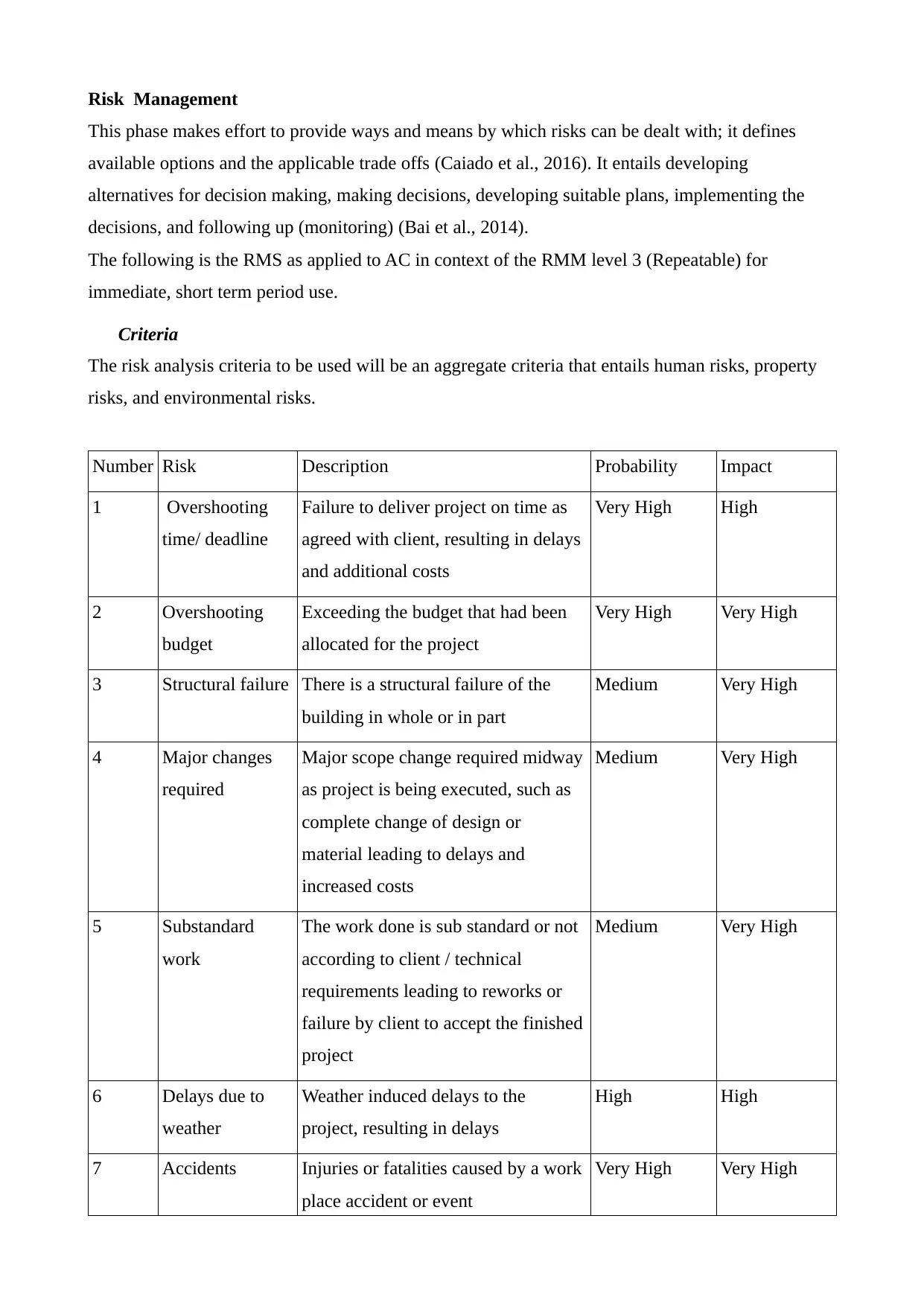
Criteria
The risk analysis criteria to be used will be an aggregate criteria that entails human risks, property
risks, and environmental risks.
Number Risk Description Probability Impact
1 Overshooting
time/ deadline
Failure to deliver project on time as
agreed with client, resulting in delays
and additional costs
Very High High
2 Overshooting
budget
Exceeding the budget that had been
allocated for the project
Very High Very High
3 Structural failure There is a structural failure of the
building in whole or in part
Medium Very High
4 Major changes
required
Major scope change required midway
as project is being executed, such as
complete change of design or
material leading to delays and
increased costs
Medium Very High
5 Substandard
work
The work done is sub standard or not
according to client / technical
requirements leading to reworks or
failure by client to accept the finished
project
Medium Very High
6 Delays due to
weather
Weather induced delays to the
project, resulting in delays
High High
7 Accidents Injuries or fatalities caused by a work
place accident or event
Very High Very High
This phase makes effort to provide ways and means by which risks can be dealt with; it defines
available options and the applicable trade offs (Caiado et al., 2016). It entails developing
alternatives for decision making, making decisions, developing suitable plans, implementing the
decisions, and following up (monitoring) (Bai et al., 2014).
The following is the RMS as applied to AC in context of the RMM level 3 (Repeatable) for
immediate, short term period use.
Criteria
The risk analysis criteria to be used will be an aggregate criteria that entails human risks, property
risks, and environmental risks.
Number Risk Description Probability Impact
1 Overshooting
time/ deadline
Failure to deliver project on time as
agreed with client, resulting in delays
and additional costs
Very High High
2 Overshooting
budget
Exceeding the budget that had been
allocated for the project
Very High Very High
3 Structural failure There is a structural failure of the
building in whole or in part
Medium Very High
4 Major changes
required
Major scope change required midway
as project is being executed, such as
complete change of design or
material leading to delays and
increased costs
Medium Very High
5 Substandard
work
The work done is sub standard or not
according to client / technical
requirements leading to reworks or
failure by client to accept the finished
project
Medium Very High
6 Delays due to
weather
Weather induced delays to the
project, resulting in delays
High High
7 Accidents Injuries or fatalities caused by a work
place accident or event
Very High Very High
⊘ This is a preview!⊘
Do you want full access?
Subscribe today to unlock all pages.
Trusted by 1+ million students worldwide
8 Non compliance Failure to comply with local, state, or
national guidelines, laws, or standards
including the height of building,
occupancy of construction site,
building regulation violations
Medium Very High
9 Environmental
laws violation
Failure to adhere to environmental
laws including conducting
environmental impact assessments
and pollution
Medium High
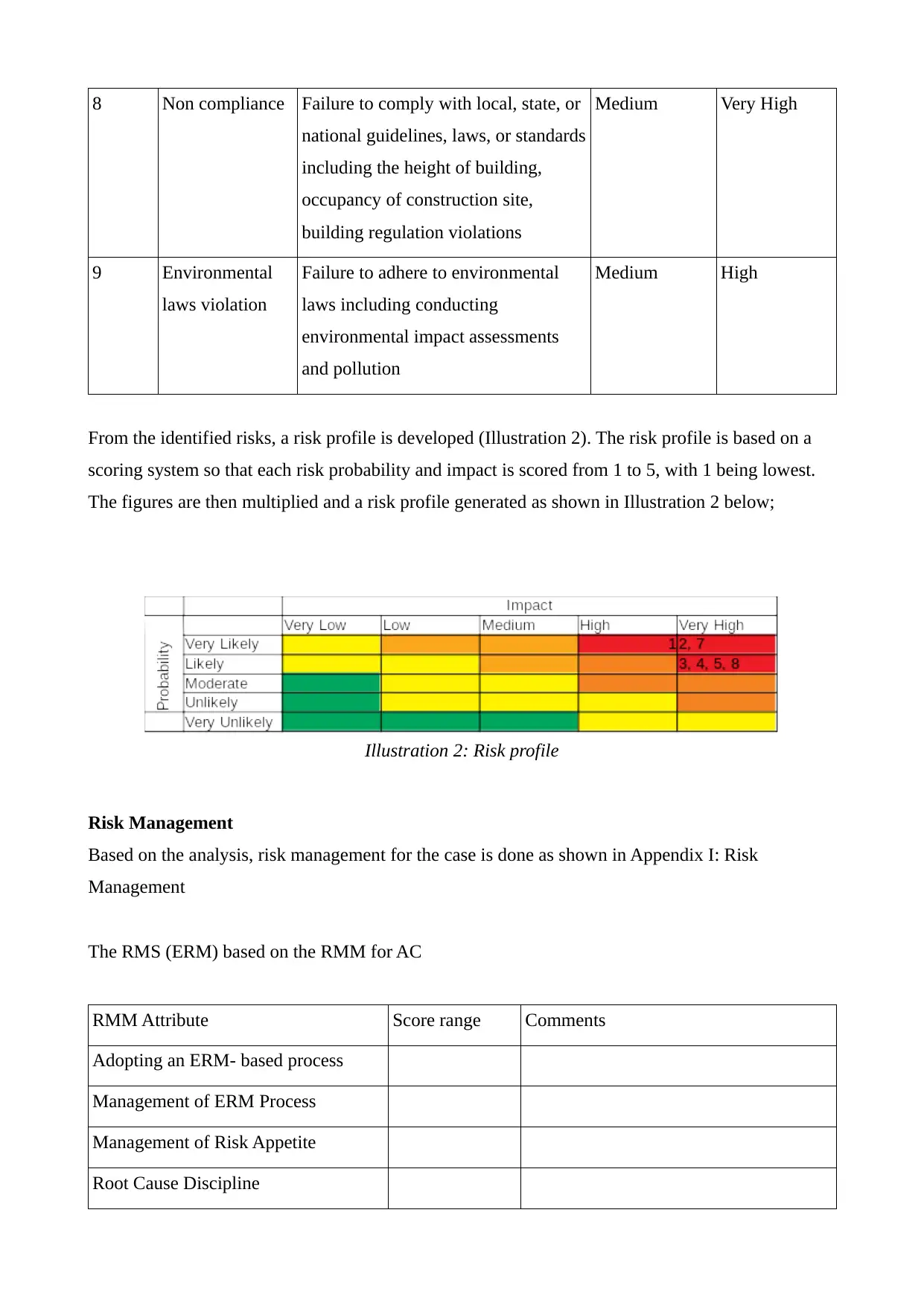
From the identified risks, a risk profile is developed (Illustration 2). The risk profile is based on a
scoring system so that each risk probability and impact is scored from 1 to 5, with 1 being lowest.
The figures are then multiplied and a risk profile generated as shown in Illustration 2 below;
Risk Management
Based on the analysis, risk management for the case is done as shown in Appendix I: Risk
Management
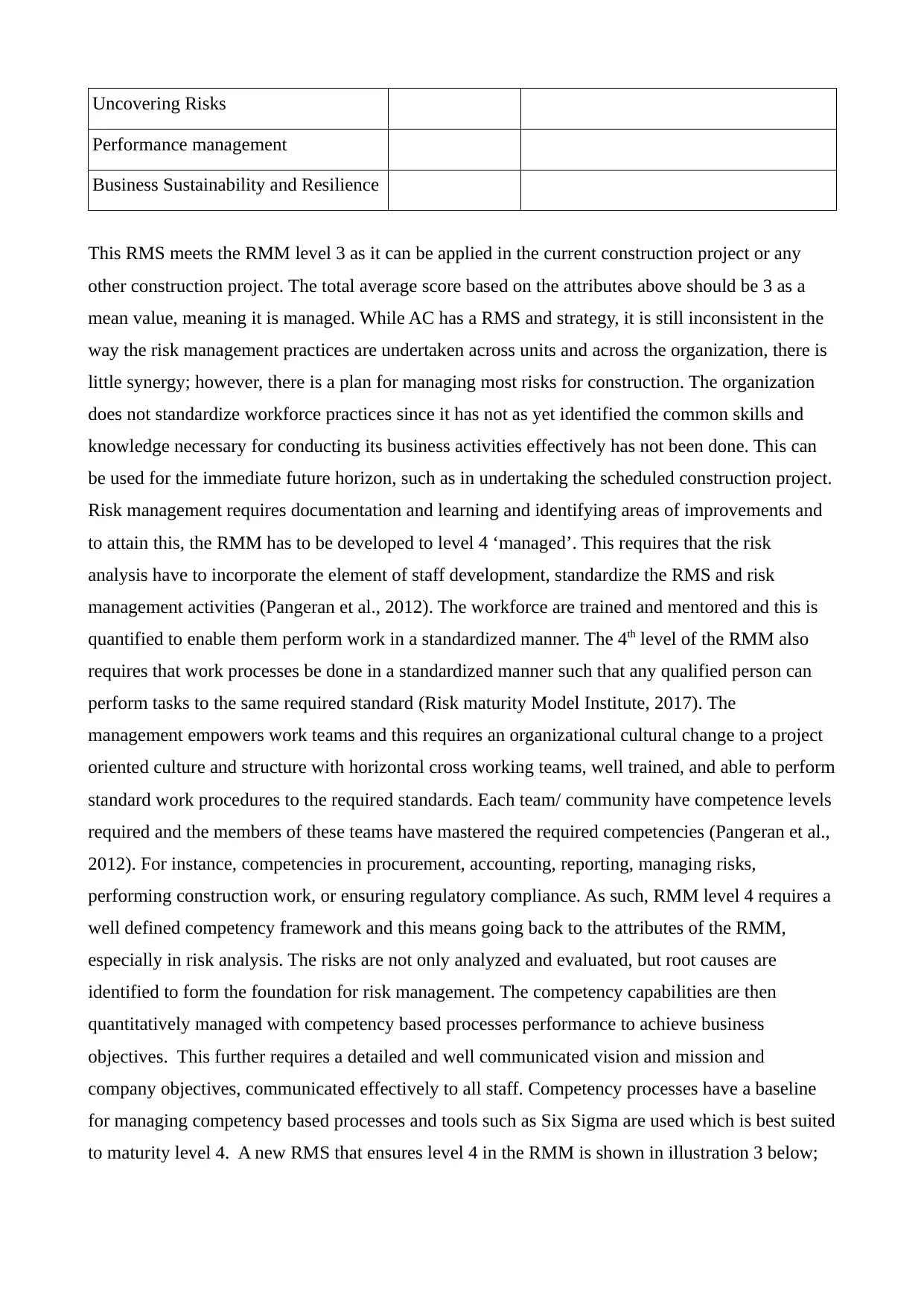
The RMS (ERM) based on the RMM for AC
RMM Attribute Score range Comments
Adopting an ERM- based process
Management of ERM Process
Management of Risk Appetite
Root Cause Discipline
Illustration 2: Risk profile
national guidelines, laws, or standards
including the height of building,
occupancy of construction site,
building regulation violations
Medium Very High
9 Environmental
laws violation
Failure to adhere to environmental
laws including conducting
environmental impact assessments
and pollution
Medium High
From the identified risks, a risk profile is developed (Illustration 2). The risk profile is based on a
scoring system so that each risk probability and impact is scored from 1 to 5, with 1 being lowest.
The figures are then multiplied and a risk profile generated as shown in Illustration 2 below;
Risk Management
Based on the analysis, risk management for the case is done as shown in Appendix I: Risk
Management
The RMS (ERM) based on the RMM for AC
RMM Attribute Score range Comments
Adopting an ERM- based process
Management of ERM Process
Management of Risk Appetite
Root Cause Discipline
Illustration 2: Risk profile
Paraphrase This Document
Need a fresh take? Get an instant paraphrase of this document with our AI Paraphraser
Uncovering Risks
Performance management
Business Sustainability and Resilience
This RMS meets the RMM level 3 as it can be applied in the current construction project or any
other construction project. The total average score based on the attributes above should be 3 as a
mean value, meaning it is managed. While AC has a RMS and strategy, it is still inconsistent in the
way the risk management practices are undertaken across units and across the organization, there is
little synergy; however, there is a plan for managing most risks for construction. The organization
does not standardize workforce practices since it has not as yet identified the common skills and
knowledge necessary for conducting its business activities effectively has not been done. This can
be used for the immediate future horizon, such as in undertaking the scheduled construction project.
Risk management requires documentation and learning and identifying areas of improvements and
to attain this, the RMM has to be developed to level 4 ‘managed’. This requires that the risk
analysis have to incorporate the element of staff development, standardize the RMS and risk
management activities (Pangeran et al., 2012). The workforce are trained and mentored and this is
quantified to enable them perform work in a standardized manner. The 4th level of the RMM also
requires that work processes be done in a standardized manner such that any qualified person can
perform tasks to the same required standard (Risk maturity Model Institute, 2017). The
management empowers work teams and this requires an organizational cultural change to a project
oriented culture and structure with horizontal cross working teams, well trained, and able to perform
standard work procedures to the required standards. Each team/ community have competence levels
required and the members of these teams have mastered the required competencies (Pangeran et al.,
2012). For instance, competencies in procurement, accounting, reporting, managing risks,
performing construction work, or ensuring regulatory compliance. As such, RMM level 4 requires a
well defined competency framework and this means going back to the attributes of the RMM,
especially in risk analysis. The risks are not only analyzed and evaluated, but root causes are
identified to form the foundation for risk management. The competency capabilities are then
quantitatively managed with competency based processes performance to achieve business
objectives. This further requires a detailed and well communicated vision and mission and
company objectives, communicated effectively to all staff. Competency processes have a baseline
for managing competency based processes and tools such as Six Sigma are used which is best suited
to maturity level 4. A new RMS that ensures level 4 in the RMM is shown in illustration 3 below;
Performance management
Business Sustainability and Resilience
This RMS meets the RMM level 3 as it can be applied in the current construction project or any
other construction project. The total average score based on the attributes above should be 3 as a
mean value, meaning it is managed. While AC has a RMS and strategy, it is still inconsistent in the
way the risk management practices are undertaken across units and across the organization, there is
little synergy; however, there is a plan for managing most risks for construction. The organization
does not standardize workforce practices since it has not as yet identified the common skills and
knowledge necessary for conducting its business activities effectively has not been done. This can
be used for the immediate future horizon, such as in undertaking the scheduled construction project.
Risk management requires documentation and learning and identifying areas of improvements and
to attain this, the RMM has to be developed to level 4 ‘managed’. This requires that the risk
analysis have to incorporate the element of staff development, standardize the RMS and risk
management activities (Pangeran et al., 2012). The workforce are trained and mentored and this is
quantified to enable them perform work in a standardized manner. The 4th level of the RMM also
requires that work processes be done in a standardized manner such that any qualified person can
perform tasks to the same required standard (Risk maturity Model Institute, 2017). The
management empowers work teams and this requires an organizational cultural change to a project
oriented culture and structure with horizontal cross working teams, well trained, and able to perform
standard work procedures to the required standards. Each team/ community have competence levels
required and the members of these teams have mastered the required competencies (Pangeran et al.,
2012). For instance, competencies in procurement, accounting, reporting, managing risks,
performing construction work, or ensuring regulatory compliance. As such, RMM level 4 requires a
well defined competency framework and this means going back to the attributes of the RMM,
especially in risk analysis. The risks are not only analyzed and evaluated, but root causes are
identified to form the foundation for risk management. The competency capabilities are then
quantitatively managed with competency based processes performance to achieve business
objectives. This further requires a detailed and well communicated vision and mission and
company objectives, communicated effectively to all staff. Competency processes have a baseline
for managing competency based processes and tools such as Six Sigma are used which is best suited
to maturity level 4. A new RMS that ensures level 4 in the RMM is shown in illustration 3 below;
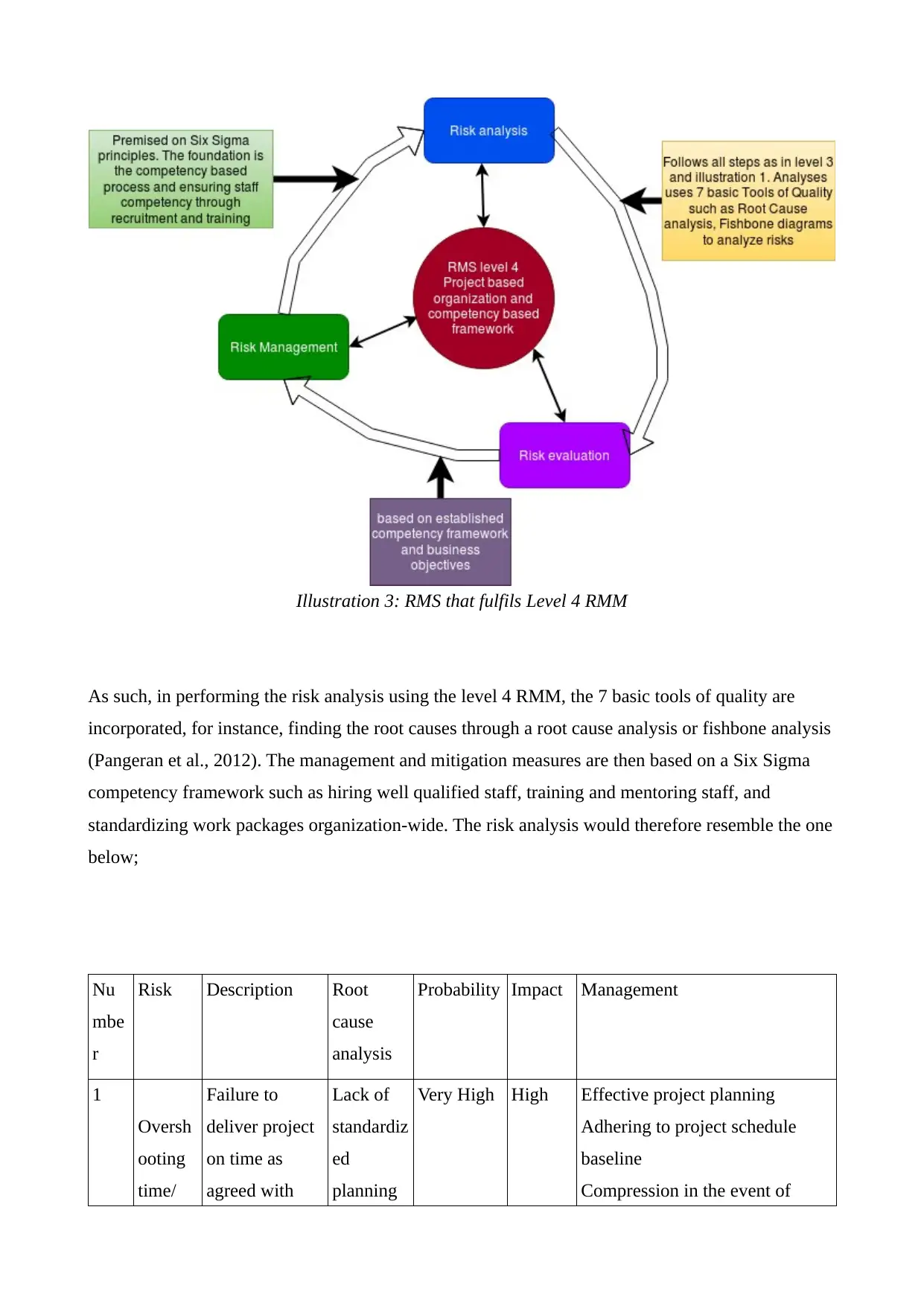
As such, in performing the risk analysis using the level 4 RMM, the 7 basic tools of quality are
incorporated, for instance, finding the root causes through a root cause analysis or fishbone analysis
(Pangeran et al., 2012). The management and mitigation measures are then based on a Six Sigma
competency framework such as hiring well qualified staff, training and mentoring staff, and
standardizing work packages organization-wide. The risk analysis would therefore resemble the one
below;
Nu
mbe
r
Risk Description Root
cause
analysis
Probability Impact Management
1
Oversh
ooting
time/
Failure to
deliver project
on time as
agreed with
Lack of
standardiz
ed
planning
Very High High Effective project planning
Adhering to project schedule
baseline
Compression in the event of
Illustration 3: RMS that fulfils Level 4 RMM
incorporated, for instance, finding the root causes through a root cause analysis or fishbone analysis
(Pangeran et al., 2012). The management and mitigation measures are then based on a Six Sigma
competency framework such as hiring well qualified staff, training and mentoring staff, and
standardizing work packages organization-wide. The risk analysis would therefore resemble the one
below;
Nu
mbe
r
Risk Description Root
cause
analysis
Probability Impact Management
1
Oversh
ooting
time/
Failure to
deliver project
on time as
agreed with
Lack of
standardiz
ed
planning
Very High High Effective project planning
Adhering to project schedule
baseline
Compression in the event of
Illustration 3: RMS that fulfils Level 4 RMM
⊘ This is a preview!⊘
Do you want full access?
Subscribe today to unlock all pages.
Trusted by 1+ million students worldwide
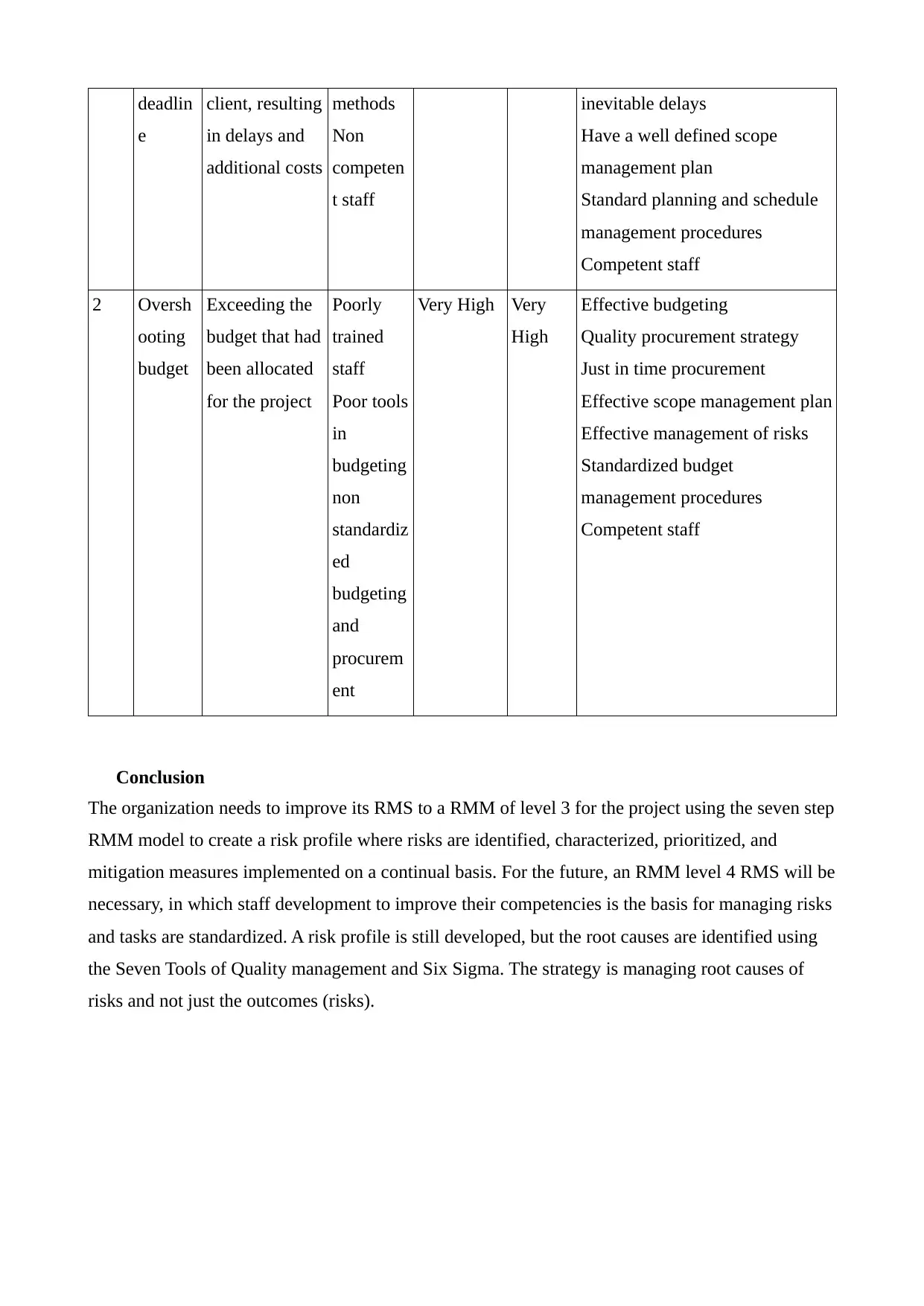
deadlin
e
client, resulting
in delays and
additional costs
methods
Non
competen
t staff
inevitable delays
Have a well defined scope
management plan
Standard planning and schedule
management procedures
Competent staff
2 Oversh
ooting
budget
Exceeding the
budget that had
been allocated
for the project
Poorly
trained
staff
Poor tools
in
budgeting
non
standardiz
ed
budgeting
and
procurem
ent
Very High Very
High
Effective budgeting
Quality procurement strategy
Just in time procurement
Effective scope management plan
Effective management of risks
Standardized budget
management procedures
Competent staff
Conclusion
The organization needs to improve its RMS to a RMM of level 3 for the project using the seven step
RMM model to create a risk profile where risks are identified, characterized, prioritized, and
mitigation measures implemented on a continual basis. For the future, an RMM level 4 RMS will be
necessary, in which staff development to improve their competencies is the basis for managing risks
and tasks are standardized. A risk profile is still developed, but the root causes are identified using
the Seven Tools of Quality management and Six Sigma. The strategy is managing root causes of
risks and not just the outcomes (risks).
e
client, resulting
in delays and
additional costs
methods
Non
competen
t staff
inevitable delays
Have a well defined scope
management plan
Standard planning and schedule
management procedures
Competent staff
2 Oversh
ooting
budget
Exceeding the
budget that had
been allocated
for the project
Poorly
trained
staff
Poor tools
in
budgeting
non
standardiz
ed
budgeting
and
procurem
ent
Very High Very
High
Effective budgeting
Quality procurement strategy
Just in time procurement
Effective scope management plan
Effective management of risks
Standardized budget
management procedures
Competent staff
Conclusion
The organization needs to improve its RMS to a RMM of level 3 for the project using the seven step
RMM model to create a risk profile where risks are identified, characterized, prioritized, and
mitigation measures implemented on a continual basis. For the future, an RMM level 4 RMS will be
necessary, in which staff development to improve their competencies is the basis for managing risks
and tasks are standardized. A risk profile is still developed, but the root causes are identified using
the Seven Tools of Quality management and Six Sigma. The strategy is managing root causes of
risks and not just the outcomes (risks).
Paraphrase This Document
Need a fresh take? Get an instant paraphrase of this document with our AI Paraphraser
References
Albert, A., Hallowell, M. and Kleiner, B. (2014). Enhancing Construction Hazard Recognition and
Communication with Energy-Based Cognitive Mnemonics and Safety Meeting Maturity Model:
Multiple Baseline Study. Journal of Construction Engineering and Management, 140(2),
p.04013042.
Antonucci, D. (2016). Risk maturity models (1st ed., p. 32). Kogan Page.
Aven, T. (2012). Foundations of risk analysis (1st ed.). Wiley.
Aven, T. (2016). Risk assessment and risk management: Review of recent advances on their
foundation. European Journal Of Operational Research, 253(1), 1-13.
https://doi.org/10.1016/j.ejor.2015.12.023
Bai, Y., Dai, Z., & Zhu, W. (2014). Multiphase Risk-Management Method and Its Application in
Tunnel Engineering. Natural Hazards Review, 15(2), 140-149.
https://doi.org/10.1061/(asce)nh.1527-6996.0000124
Caiado, R., Lima, G., Nascimento, D., Vieira Neto, J., & De Oliveira, R. (2016). GUIDELINES TO
RISK MANAGEMENT MATURITY IN CONSTRUCTION PROJECTS. Brazilian Journal Of
Operations & Production Management, 13(3), 372.
https://doi.org/10.14488/bjopm.2016.v13.n3.a14
Curtis, B., Hefley, W. and Miller, S. (2020). 3 Behavioral Characteristics of Maturity Levels |
Overview of the People Cabability Maturity Model | InformIT. [online] Informit.com. Available at:
http://www.informit.com/articles/article.aspx?p=25349&seqNum=4 [Accessed 21 Feb. 2020].
Dawson, D., Searle, A., & Paterson, J. (2014). Look before you (s)leep: Evaluating the use of
fatigue detection technologies within a fatigue risk management system for the road transport
industry. Sleep Medicine Reviews, 18(2), 141-152. https://doi.org/10.1016/j.smrv.2013.03.003
Hopkinson, M. (2011). The Project Risk Maturity Model (1st ed., p. 232). MPG Books Group.
Liu, H., Liu, L., & Liu, N. (2013). Risk evaluation approaches in failure mode and effects analysis:
A literature review. Expert Systems With Applications, 40(2), 828-838.
https://doi.org/10.1016/j.eswa.2012.08.010
Liu, W., Liu, S., & Sun, Y. (2015). Risk Evaluation of Water Inrush from Coal Floor Based on BP
Neural Network. Applied Mechanics And Materials, 744-746, 1728-1732.
https://doi.org/10.4028/www.scientific.net/amm.744-746.1728
Oliva, F. (2016). A maturity model for enterprise risk management. International Journal of
Production Economics, 173, pp.66-79.
Pangeran, M., Pribadi, K., Wirahadikusumah, R., & Notodarmojo, S. (2012). Assessing Risk
Management Capability of Public Sector Organizations Related to PPP Scheme Development for
Albert, A., Hallowell, M. and Kleiner, B. (2014). Enhancing Construction Hazard Recognition and
Communication with Energy-Based Cognitive Mnemonics and Safety Meeting Maturity Model:
Multiple Baseline Study. Journal of Construction Engineering and Management, 140(2),
p.04013042.
Antonucci, D. (2016). Risk maturity models (1st ed., p. 32). Kogan Page.
Aven, T. (2012). Foundations of risk analysis (1st ed.). Wiley.
Aven, T. (2016). Risk assessment and risk management: Review of recent advances on their
foundation. European Journal Of Operational Research, 253(1), 1-13.
https://doi.org/10.1016/j.ejor.2015.12.023
Bai, Y., Dai, Z., & Zhu, W. (2014). Multiphase Risk-Management Method and Its Application in
Tunnel Engineering. Natural Hazards Review, 15(2), 140-149.
https://doi.org/10.1061/(asce)nh.1527-6996.0000124
Caiado, R., Lima, G., Nascimento, D., Vieira Neto, J., & De Oliveira, R. (2016). GUIDELINES TO
RISK MANAGEMENT MATURITY IN CONSTRUCTION PROJECTS. Brazilian Journal Of
Operations & Production Management, 13(3), 372.
https://doi.org/10.14488/bjopm.2016.v13.n3.a14
Curtis, B., Hefley, W. and Miller, S. (2020). 3 Behavioral Characteristics of Maturity Levels |
Overview of the People Cabability Maturity Model | InformIT. [online] Informit.com. Available at:
http://www.informit.com/articles/article.aspx?p=25349&seqNum=4 [Accessed 21 Feb. 2020].
Dawson, D., Searle, A., & Paterson, J. (2014). Look before you (s)leep: Evaluating the use of
fatigue detection technologies within a fatigue risk management system for the road transport
industry. Sleep Medicine Reviews, 18(2), 141-152. https://doi.org/10.1016/j.smrv.2013.03.003
Hopkinson, M. (2011). The Project Risk Maturity Model (1st ed., p. 232). MPG Books Group.
Liu, H., Liu, L., & Liu, N. (2013). Risk evaluation approaches in failure mode and effects analysis:
A literature review. Expert Systems With Applications, 40(2), 828-838.
https://doi.org/10.1016/j.eswa.2012.08.010
Liu, W., Liu, S., & Sun, Y. (2015). Risk Evaluation of Water Inrush from Coal Floor Based on BP
Neural Network. Applied Mechanics And Materials, 744-746, 1728-1732.
https://doi.org/10.4028/www.scientific.net/amm.744-746.1728
Oliva, F. (2016). A maturity model for enterprise risk management. International Journal of
Production Economics, 173, pp.66-79.
Pangeran, M., Pribadi, K., Wirahadikusumah, R., & Notodarmojo, S. (2012). Assessing Risk
Management Capability of Public Sector Organizations Related to PPP Scheme Development for
Water Supply in Indonesia. Civil Engineering Dimension, 14(1).
https://doi.org/10.9744/ced.14.1.26-35
Risk maturity Model Institute. (2017). The RIMS RMM Explained. The RIMS Risk Maturity Model.
Retrieved 23 February 2020, from https://www.riskmaturitymodel.org/rims-risk-maturity-model-
rmm-for-erm/.
Tupa, J., Simota, J., & Steiner, F. (2017). Aspects of Risk Management Implementation for Industry
4.0. Procedia Manufacturing, 11, 1223-1230. https://doi.org/10.1016/j.promfg.2017.07.248
Turskis, Z., Gajzler, M. and Dziadosz, A. (2012). Reliability, Risk Management, and Contingency
of Construction Processes and Projects / Statybos Procesų Ir Projektų Patikimumas, Rizikos Ir
Atsitiktinumų Valdymas. Journal of Civil Engineering and Management, 18(2), pp.290-298.
Vallabhaneni, S. (2019). Wiley CIA Exam Review 2020, Part 1: Essentials of Internal Auditing (1st
ed., p. 21). John Wiley & Sons.
https://doi.org/10.9744/ced.14.1.26-35
Risk maturity Model Institute. (2017). The RIMS RMM Explained. The RIMS Risk Maturity Model.
Retrieved 23 February 2020, from https://www.riskmaturitymodel.org/rims-risk-maturity-model-
rmm-for-erm/.
Tupa, J., Simota, J., & Steiner, F. (2017). Aspects of Risk Management Implementation for Industry
4.0. Procedia Manufacturing, 11, 1223-1230. https://doi.org/10.1016/j.promfg.2017.07.248
Turskis, Z., Gajzler, M. and Dziadosz, A. (2012). Reliability, Risk Management, and Contingency
of Construction Processes and Projects / Statybos Procesų Ir Projektų Patikimumas, Rizikos Ir
Atsitiktinumų Valdymas. Journal of Civil Engineering and Management, 18(2), pp.290-298.
Vallabhaneni, S. (2019). Wiley CIA Exam Review 2020, Part 1: Essentials of Internal Auditing (1st
ed., p. 21). John Wiley & Sons.
⊘ This is a preview!⊘
Do you want full access?
Subscribe today to unlock all pages.
Trusted by 1+ million students worldwide

1 out of 13


Your All-in-One AI-Powered Toolkit for Academic Success.
+13062052269
info@desklib.com
Available 24*7 on WhatsApp / Email
![[object Object]](/_next/static/media/star-bottom.7253800d.svg)
Unlock your academic potential
Copyright © 2020–2026 A2Z Services. All Rights Reserved. Developed and managed by ZUCOL.