Detailed Risk Management Strategies for Equitable Funding Ltd
VerifiedAdded on 2020/07/22
|11
|3250
|123
Report
AI Summary
This report provides a comprehensive analysis of risk management practices, focusing on Equitable Funding Ltd. It begins by identifying various types of risks, including strategic, compliance, and operational risks, and their impact on organizations. The report then delves into the activities with high risk across different economic sectors. A significant portion is dedicated to a reference guide for junior colleagues, explaining business risks, the role of risk management, and the functions of different business units in managing risk. The report further evaluates organizational vulnerabilities to disruptions and explores crisis management and business continuity planning approaches. It includes an assessment of company activities to identify risk probabilities and evaluates the potential impact of identified risks, culminating in a risk management plan for mitigation. The report emphasizes strategies for maximizing recovery, product protection, and strategic planning to ensure business continuity. The report provides insights into how companies like Equitable Funding Ltd can effectively manage risks, maintain business continuity, and prepare for crisis situations.
RISK MANAGEMENT

Paraphrase This Document
Need a fresh take? Get an instant paraphrase of this document with our AI Paraphraser
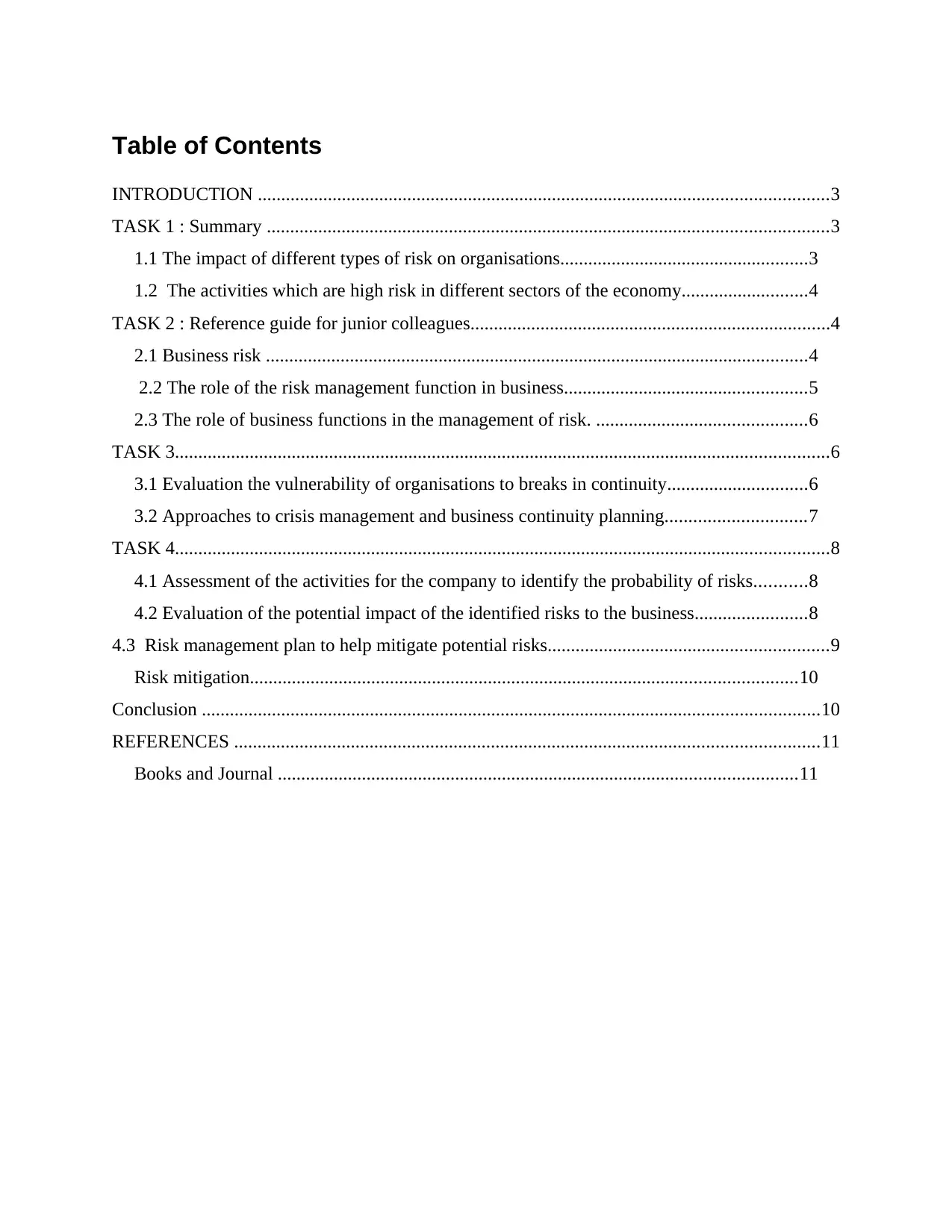
Table of Contents
INTRODUCTION ..........................................................................................................................3
TASK 1 : Summary ........................................................................................................................3
1.1 The impact of different types of risk on organisations.....................................................3
1.2 The activities which are high risk in different sectors of the economy...........................4
TASK 2 : Reference guide for junior colleagues.............................................................................4
2.1 Business risk ....................................................................................................................4
2.2 The role of the risk management function in business....................................................5
2.3 The role of business functions in the management of risk. .............................................6
TASK 3............................................................................................................................................6
3.1 Evaluation the vulnerability of organisations to breaks in continuity..............................6
3.2 Approaches to crisis management and business continuity planning..............................7
TASK 4............................................................................................................................................8
4.1 Assessment of the activities for the company to identify the probability of risks...........8
4.2 Evaluation of the potential impact of the identified risks to the business........................8
4.3 Risk management plan to help mitigate potential risks............................................................9
Risk mitigation.....................................................................................................................10
Conclusion ....................................................................................................................................10
REFERENCES .............................................................................................................................11
Books and Journal ...............................................................................................................11
INTRODUCTION ..........................................................................................................................3
TASK 1 : Summary ........................................................................................................................3
1.1 The impact of different types of risk on organisations.....................................................3
1.2 The activities which are high risk in different sectors of the economy...........................4
TASK 2 : Reference guide for junior colleagues.............................................................................4
2.1 Business risk ....................................................................................................................4
2.2 The role of the risk management function in business....................................................5
2.3 The role of business functions in the management of risk. .............................................6
TASK 3............................................................................................................................................6
3.1 Evaluation the vulnerability of organisations to breaks in continuity..............................6
3.2 Approaches to crisis management and business continuity planning..............................7
TASK 4............................................................................................................................................8
4.1 Assessment of the activities for the company to identify the probability of risks...........8
4.2 Evaluation of the potential impact of the identified risks to the business........................8
4.3 Risk management plan to help mitigate potential risks............................................................9
Risk mitigation.....................................................................................................................10
Conclusion ....................................................................................................................................10
REFERENCES .............................................................................................................................11
Books and Journal ...............................................................................................................11
INTRODUCTION
Risk is a part of our lives, every activity or task we perform has some risk involved.
Therefore, each and every organisation have various risk involved in their business operation.
This report identify and determine the various types of risk and the risk management functions of
Equitable Funding Ltd. The study will describe the ways in which the company assess and
manage the risk using different approaches of risk management. The report will also include the
strategies, drivers and impact of risks on a business and its functions. Furthermore, the
approaches of crisis management and business continuity will be described in the report.
TASK 1 : Summary
1.1 The impact of different types of risk on organisations
There are many types of risk involved within a business and its functions, these risks
have a great impact on the organisation's performance and profitability. The Equitable funding
gets affected with different risks which are as described below -
Strategic risk – Every organisation or company have a business plan based on the goals to
be achieved which is also known as business strategy. The various changes in the
business environment can make the business plan outdated or decrease the effectiveness
of the strategies this is the strategic risks. The company gets highly effected with this risk
as the plan becomes less effective and make the company to struggle in achieving its
business objectives and goals( Wiengarten and et.al, 2016).
Compliance risk – Another risk involved in the Equitable funding is the risk of
compliance or laws and regulations. Every company or organisation are applied with
certain laws and regulation that they need follow or apply in their business practices. The
change in the laws is a major risk for an organisation. It forces changing the business
operations and even the structure of the entire company.
Operational risks – These risks refers to an issue or failure of the daily business activities
and operations. Operations of an organisation can fail due to any reason such as technical
issues, employee strike etc. These risk also have a great impact on the overall operational
area of the business. For example is there is failure in the production area. The whole
functional department will face the issue and it will stop the flow of the business
operations.
Risk is a part of our lives, every activity or task we perform has some risk involved.
Therefore, each and every organisation have various risk involved in their business operation.
This report identify and determine the various types of risk and the risk management functions of
Equitable Funding Ltd. The study will describe the ways in which the company assess and
manage the risk using different approaches of risk management. The report will also include the
strategies, drivers and impact of risks on a business and its functions. Furthermore, the
approaches of crisis management and business continuity will be described in the report.
TASK 1 : Summary
1.1 The impact of different types of risk on organisations
There are many types of risk involved within a business and its functions, these risks
have a great impact on the organisation's performance and profitability. The Equitable funding
gets affected with different risks which are as described below -
Strategic risk – Every organisation or company have a business plan based on the goals to
be achieved which is also known as business strategy. The various changes in the
business environment can make the business plan outdated or decrease the effectiveness
of the strategies this is the strategic risks. The company gets highly effected with this risk
as the plan becomes less effective and make the company to struggle in achieving its
business objectives and goals( Wiengarten and et.al, 2016).
Compliance risk – Another risk involved in the Equitable funding is the risk of
compliance or laws and regulations. Every company or organisation are applied with
certain laws and regulation that they need follow or apply in their business practices. The
change in the laws is a major risk for an organisation. It forces changing the business
operations and even the structure of the entire company.
Operational risks – These risks refers to an issue or failure of the daily business activities
and operations. Operations of an organisation can fail due to any reason such as technical
issues, employee strike etc. These risk also have a great impact on the overall operational
area of the business. For example is there is failure in the production area. The whole
functional department will face the issue and it will stop the flow of the business
operations.
⊘ This is a preview!⊘
Do you want full access?
Subscribe today to unlock all pages.

Trusted by 1+ million students worldwide
1.2 The activities which are high risk in different sectors of the economy.
Risk is a common element involved in each and every business in almost every sector.
These risks are identified and analysed to reduce the rate of loss. The risk in different sectors are
as mentioned below -
Hospitality sector – The hospitality sector is a known to be a great part of the economy of
a country. The hospitality sector includes various hotels which provides effective services
to the guests or customers. There is a major risk in this sector which is the data privacy.
The hotels have a lot of information about their guests which needed to be protected by
cyber crime or theft. The cyber attack can be a major harm to the hospitality
sector(Bromiley and et.al, 2015).
Banking sector – The banking sector also involves many risks such as Market risks,
credit risks, Liquidity risk, Reputation risk etc. The change in equity price, foreign
exchange, interest rates etc are affecting the functionality of the banking sector which is
high risk for the banking organisations.
Manufacturing industry – The manufacturing industry is also an important of the
economy. The manufacturing sector also have a wide range of risks involved in the
business operations. Conflict mineral disclosure which drives regulatory risks,
Acquisitions and mergers risks which increases competition, Intellectual property
protection enhance data security risks etc are some high risks involved in the
manufacturing sector.
TASK 2 : Reference guide for junior colleagues
2.1 Business risk
A business risk refers to the possibility an organisation may have lower than analysed
profits and experience a loss rather than generating profit. These risks are affected by various
elements such as per-unit price, sales volume, competition, sale volume etc.
Nature of business risks
The nature of various risks can be described with relation to its various features which are
as described below -
Risk is a common element involved in each and every business in almost every sector.
These risks are identified and analysed to reduce the rate of loss. The risk in different sectors are
as mentioned below -
Hospitality sector – The hospitality sector is a known to be a great part of the economy of
a country. The hospitality sector includes various hotels which provides effective services
to the guests or customers. There is a major risk in this sector which is the data privacy.
The hotels have a lot of information about their guests which needed to be protected by
cyber crime or theft. The cyber attack can be a major harm to the hospitality
sector(Bromiley and et.al, 2015).
Banking sector – The banking sector also involves many risks such as Market risks,
credit risks, Liquidity risk, Reputation risk etc. The change in equity price, foreign
exchange, interest rates etc are affecting the functionality of the banking sector which is
high risk for the banking organisations.
Manufacturing industry – The manufacturing industry is also an important of the
economy. The manufacturing sector also have a wide range of risks involved in the
business operations. Conflict mineral disclosure which drives regulatory risks,
Acquisitions and mergers risks which increases competition, Intellectual property
protection enhance data security risks etc are some high risks involved in the
manufacturing sector.
TASK 2 : Reference guide for junior colleagues
2.1 Business risk
A business risk refers to the possibility an organisation may have lower than analysed
profits and experience a loss rather than generating profit. These risks are affected by various
elements such as per-unit price, sales volume, competition, sale volume etc.
Nature of business risks
The nature of various risks can be described with relation to its various features which are
as described below -
Paraphrase This Document
Need a fresh take? Get an instant paraphrase of this document with our AI Paraphraser
Opportunities for gaining are hidden within business risks – If the management of
Equitable Funding successfully able to manage and handle the business risks, they can
get effective opportunity to gain various benefits for the business.
Business risks depend upon time – Previously the business risks were limited and less but
in the present scenario there is very high competition, globalisation of the economy and
advanced technology which makes the business risks very severe(Wolke,2017)
Business risks depend on the size of the business enterprise – Small businesses less
exposed to various business risk as they are benefited with the flexible operations and
they may adapt the changes easily.
2.2 The role of the risk management function in business
The Risk management within an organisation such as the Equitable Funding Ltd performs
various functions in order avoid the risks involved in the business operations. The Risk
management performs various functions as described below -
Providing various methods to analyse and identify the financial impacts of loss to the
company, public, employees and the environment.
The Risk management also helps to examine the use of cost-effective and realistic
opportunities in order to balance the retention programs along with commercial
insurance.
The risk management professionals create various budgets such as the insurance budget,
risk management budget as well as help the organisation in allocating the premium and
claim costs to various division and departments(Almeida,Hankins and Williams,2017).
The risk manager also plays an important role in developing and maintaining the records
such as claim and loss experience, insurance policies etc.
The risk management helps to analyse or review important contracts, new activities for
insurance and loss determination and proposed facilities.
The risk management helps an organisation to prevent the loss or negative impact of any
new or exiting business activity performed by the business or firm. The risk management
identifies and implement different techniques to prevent or reduce any loss to the
business.
Equitable Funding successfully able to manage and handle the business risks, they can
get effective opportunity to gain various benefits for the business.
Business risks depend upon time – Previously the business risks were limited and less but
in the present scenario there is very high competition, globalisation of the economy and
advanced technology which makes the business risks very severe(Wolke,2017)
Business risks depend on the size of the business enterprise – Small businesses less
exposed to various business risk as they are benefited with the flexible operations and
they may adapt the changes easily.
2.2 The role of the risk management function in business
The Risk management within an organisation such as the Equitable Funding Ltd performs
various functions in order avoid the risks involved in the business operations. The Risk
management performs various functions as described below -
Providing various methods to analyse and identify the financial impacts of loss to the
company, public, employees and the environment.
The Risk management also helps to examine the use of cost-effective and realistic
opportunities in order to balance the retention programs along with commercial
insurance.
The risk management professionals create various budgets such as the insurance budget,
risk management budget as well as help the organisation in allocating the premium and
claim costs to various division and departments(Almeida,Hankins and Williams,2017).
The risk manager also plays an important role in developing and maintaining the records
such as claim and loss experience, insurance policies etc.
The risk management helps to analyse or review important contracts, new activities for
insurance and loss determination and proposed facilities.
The risk management helps an organisation to prevent the loss or negative impact of any
new or exiting business activity performed by the business or firm. The risk management
identifies and implement different techniques to prevent or reduce any loss to the
business.
2.3 The role of business functions in the management of risk.
The Equitable funding Ltd performs various functions which plays an important role in the
management of risk. The various functions performed by the business for managing the risk as
follows -
Strategic planning – Every business perform effective planning in order to perform various
organisational activities and achieve the business goals. The planning is an important part of
a business or organisation to perform, manage and organise the business activities which
can help the business or company to achieve the objectives and goals effectively. This helps
in reducing the operational risk of the business.
HRM functions – The Human resource management perform effective function to develop
and maintain workforce or human resources of the organisation. It is very important to
manage and organise the workforce in order to avoid risk of dis-functioning of the business
tasks.
Managerial functions – The management perform different significant managerial functions
within an organisation such as planning staffing, coordinating and controlling. The
management ensures that a company is working effectively with the fair practices with
respect to the laws and regulations.
TASK 3
3.1 Evaluation the vulnerability of organisations to breaks in continuity
Continuity involves incident prevention, surviving disruption and recovery planning and
company is to survive a period of disruption and recover from it. There are different types of
barriers which are not beneficial for the business. However, they can use some vulnerability of
the organisation, so they can able to run their business in regular basis(Glendon,Clarke and
McKenna,2016). There are number of vulnerability for the company which can be used by the
organisation. The various functions performed by the business for managing the continuity as
follows -
Maximise recovery: - Equality funding limited provide credit services to their entire
customers. When any company provide credit services to their customers, they maximise
their risk in the company. However, they should use some effective planning for reduce the
risk in the business. Along with this, company should use the planning of maximise the
recovery of the credit amount which is provided to their customers. There are number of
customers who are using the credit services of the company but some time some customers
are not able to pay their outstanding amount to the company. However, company can take
action against the customers, so they will pay their outstanding amount to the company.
The Equitable funding Ltd performs various functions which plays an important role in the
management of risk. The various functions performed by the business for managing the risk as
follows -
Strategic planning – Every business perform effective planning in order to perform various
organisational activities and achieve the business goals. The planning is an important part of
a business or organisation to perform, manage and organise the business activities which
can help the business or company to achieve the objectives and goals effectively. This helps
in reducing the operational risk of the business.
HRM functions – The Human resource management perform effective function to develop
and maintain workforce or human resources of the organisation. It is very important to
manage and organise the workforce in order to avoid risk of dis-functioning of the business
tasks.
Managerial functions – The management perform different significant managerial functions
within an organisation such as planning staffing, coordinating and controlling. The
management ensures that a company is working effectively with the fair practices with
respect to the laws and regulations.
TASK 3
3.1 Evaluation the vulnerability of organisations to breaks in continuity
Continuity involves incident prevention, surviving disruption and recovery planning and
company is to survive a period of disruption and recover from it. There are different types of
barriers which are not beneficial for the business. However, they can use some vulnerability of
the organisation, so they can able to run their business in regular basis(Glendon,Clarke and
McKenna,2016). There are number of vulnerability for the company which can be used by the
organisation. The various functions performed by the business for managing the continuity as
follows -
Maximise recovery: - Equality funding limited provide credit services to their entire
customers. When any company provide credit services to their customers, they maximise
their risk in the company. However, they should use some effective planning for reduce the
risk in the business. Along with this, company should use the planning of maximise the
recovery of the credit amount which is provided to their customers. There are number of
customers who are using the credit services of the company but some time some customers
are not able to pay their outstanding amount to the company. However, company can take
action against the customers, so they will pay their outstanding amount to the company.
⊘ This is a preview!⊘
Do you want full access?
Subscribe today to unlock all pages.
Trusted by 1+ million students worldwide
Through this process company can able to maximise their recovery for their business and it
will be very beneficial for the organisation(Cohen,Krishnamoorthy and Wright,2017).
Product protection: - Although planning for unforeseen events may seem simple, in reality it's
not. Company should manage their product and services in the business. Along with this,
they should protect their product, however customers will get the quality product and
services from the company. Through this process, company can manage the risk and run
their business in basis of continuity.
Strategic planning: - They should follow some effective planning, so they can able to reduce
the risk in the business. According to strategic planning they can make continuity strategies
and business continuity plans for reducing the risk and continuity of the business. Strategic
planing is very effective tool for the organisation.
3.2 Approaches to crisis management and business continuity planning.
In respect to solve the crisis management following approaches
Identify and isolate the issue- First employees have to detect the problem and identify
quickly so that an issue can be solve in less time.
Respond quickly- employee has to react quickly because timing is so important and
crucial role in that, also one cannot wait so long for the solution.
Set the Agenda- one has to take control and tell their own story and set the record first.
Hire a Professional- If the crises cannot be solved on their own, they should hire the
professionals to resolve the problem fast(Aven,2016).
Make changes and communicate what they are- if a company changes something related
to any product or apply new rules on employees to fix the problem, they should let the
employees know about it.
Reflect, Review & Resolve- Think about the problem which has occurred, review the
solution, and see how can the crisis be solved further.
Make a plan proactively, to effectively solve the problem.
TASK 4
4.1 Assessment of the activities for the company to identify the probability of risks
Risk analysis is a process that help company to identify and manage potential problems that
could undermine key business initiatives or project. Company can use some effective activities to
will be very beneficial for the organisation(Cohen,Krishnamoorthy and Wright,2017).
Product protection: - Although planning for unforeseen events may seem simple, in reality it's
not. Company should manage their product and services in the business. Along with this,
they should protect their product, however customers will get the quality product and
services from the company. Through this process, company can manage the risk and run
their business in basis of continuity.
Strategic planning: - They should follow some effective planning, so they can able to reduce
the risk in the business. According to strategic planning they can make continuity strategies
and business continuity plans for reducing the risk and continuity of the business. Strategic
planing is very effective tool for the organisation.
3.2 Approaches to crisis management and business continuity planning.
In respect to solve the crisis management following approaches
Identify and isolate the issue- First employees have to detect the problem and identify
quickly so that an issue can be solve in less time.
Respond quickly- employee has to react quickly because timing is so important and
crucial role in that, also one cannot wait so long for the solution.
Set the Agenda- one has to take control and tell their own story and set the record first.
Hire a Professional- If the crises cannot be solved on their own, they should hire the
professionals to resolve the problem fast(Aven,2016).
Make changes and communicate what they are- if a company changes something related
to any product or apply new rules on employees to fix the problem, they should let the
employees know about it.
Reflect, Review & Resolve- Think about the problem which has occurred, review the
solution, and see how can the crisis be solved further.
Make a plan proactively, to effectively solve the problem.
TASK 4
4.1 Assessment of the activities for the company to identify the probability of risks
Risk analysis is a process that help company to identify and manage potential problems that
could undermine key business initiatives or project. Company can use some effective activities to
Paraphrase This Document
Need a fresh take? Get an instant paraphrase of this document with our AI Paraphraser
identify the risk in the business. Organisation should know the physical risk of the company, so they
can know about the employees issues and manger decision in the organisation. Further, they should
have knowledge about location risk, so they can able to reduce the risk(McNeil,Frey and
Embrechts,2015).
When they identify the all risk in the business then they should prepare a risk management
plan, so they can able to reduce the all risk in the business. Moreover, they should know the all
issues and problems of the employees, so they will be able to resolve their problems in the
company. They are providing the credit services to their customers, so they should get then
information about the customers who are not paying their outstanding amount on time. However,
they will be ale to get outstanding amount from the unpaid customers. Through this process they can
identify the all risk which are facing by the company. Company should use these activities for the
business to identify the probability of risks.
4.2 Evaluation of the potential impact of the identified risks to the business
An organisational risk such as the operational risk, financial risk etc are needed to be
evaluated in order to make an effective plan for avoiding those risks. The evaluation of risk is
essential to analyse and identify the rate of loss or harm it can do to the business or company.
There are two tools use for the evaluation of risks which are as mentioned below -
Financial infrastructure Reputational marketing
Prioritising and scoring risks
Impact of the identified risks to the business of Equitable Funding Ltd
Once the company identified the risks they need to assess possible impacts of them. They
need to distinguish the minor risks from major ones because minor risks are acceptable whereas
major risks have to be managed fast(Pritchard and PMP,2014)
Analyse what is the level of risk
The company equitable funding Ltd. Should first analyse all types of the risks. For this first they
have to workout on the probability of happening the risks. This is known as level of the risk and
can be calculated by applying the formula:
Level of the risk= consequence x probability
Level of the risks can be determined by very low, acceptable, high and very high. It can be
analysed by what the company is doing to control the risks because these things can measure the
decrement of the level of the risk, however not completely eliminate them.
can know about the employees issues and manger decision in the organisation. Further, they should
have knowledge about location risk, so they can able to reduce the risk(McNeil,Frey and
Embrechts,2015).
When they identify the all risk in the business then they should prepare a risk management
plan, so they can able to reduce the all risk in the business. Moreover, they should know the all
issues and problems of the employees, so they will be able to resolve their problems in the
company. They are providing the credit services to their customers, so they should get then
information about the customers who are not paying their outstanding amount on time. However,
they will be ale to get outstanding amount from the unpaid customers. Through this process they can
identify the all risk which are facing by the company. Company should use these activities for the
business to identify the probability of risks.
4.2 Evaluation of the potential impact of the identified risks to the business
An organisational risk such as the operational risk, financial risk etc are needed to be
evaluated in order to make an effective plan for avoiding those risks. The evaluation of risk is
essential to analyse and identify the rate of loss or harm it can do to the business or company.
There are two tools use for the evaluation of risks which are as mentioned below -
Financial infrastructure Reputational marketing
Prioritising and scoring risks
Impact of the identified risks to the business of Equitable Funding Ltd
Once the company identified the risks they need to assess possible impacts of them. They
need to distinguish the minor risks from major ones because minor risks are acceptable whereas
major risks have to be managed fast(Pritchard and PMP,2014)
Analyse what is the level of risk
The company equitable funding Ltd. Should first analyse all types of the risks. For this first they
have to workout on the probability of happening the risks. This is known as level of the risk and
can be calculated by applying the formula:
Level of the risk= consequence x probability
Level of the risks can be determined by very low, acceptable, high and very high. It can be
analysed by what the company is doing to control the risks because these things can measure the
decrement of the level of the risk, however not completely eliminate them.
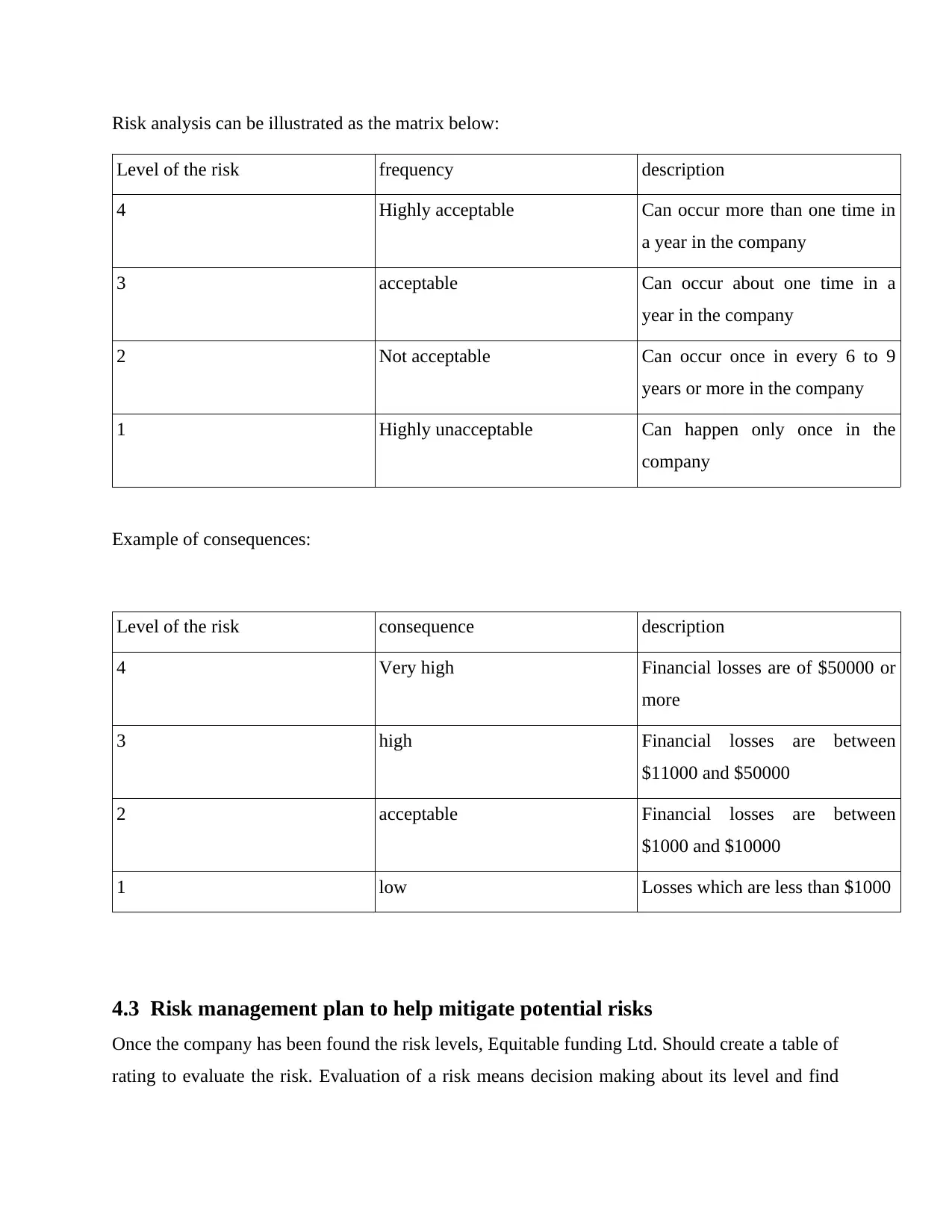
Risk analysis can be illustrated as the matrix below:
Level of the risk frequency description
4 Highly acceptable Can occur more than one time in
a year in the company
3 acceptable Can occur about one time in a
year in the company
2 Not acceptable Can occur once in every 6 to 9
years or more in the company
1 Highly unacceptable Can happen only once in the
company
Example of consequences:
Level of the risk consequence description
4 Very high Financial losses are of $50000 or
more
3 high Financial losses are between
$11000 and $50000
2 acceptable Financial losses are between
$1000 and $10000
1 low Losses which are less than $1000
4.3 Risk management plan to help mitigate potential risks
Once the company has been found the risk levels, Equitable funding Ltd. Should create a table of
rating to evaluate the risk. Evaluation of a risk means decision making about its level and find
Level of the risk frequency description
4 Highly acceptable Can occur more than one time in
a year in the company
3 acceptable Can occur about one time in a
year in the company
2 Not acceptable Can occur once in every 6 to 9
years or more in the company
1 Highly unacceptable Can happen only once in the
company
Example of consequences:
Level of the risk consequence description
4 Very high Financial losses are of $50000 or
more
3 high Financial losses are between
$11000 and $50000
2 acceptable Financial losses are between
$1000 and $10000
1 low Losses which are less than $1000
4.3 Risk management plan to help mitigate potential risks
Once the company has been found the risk levels, Equitable funding Ltd. Should create a table of
rating to evaluate the risk. Evaluation of a risk means decision making about its level and find
⊘ This is a preview!⊘
Do you want full access?
Subscribe today to unlock all pages.
Trusted by 1+ million students worldwide
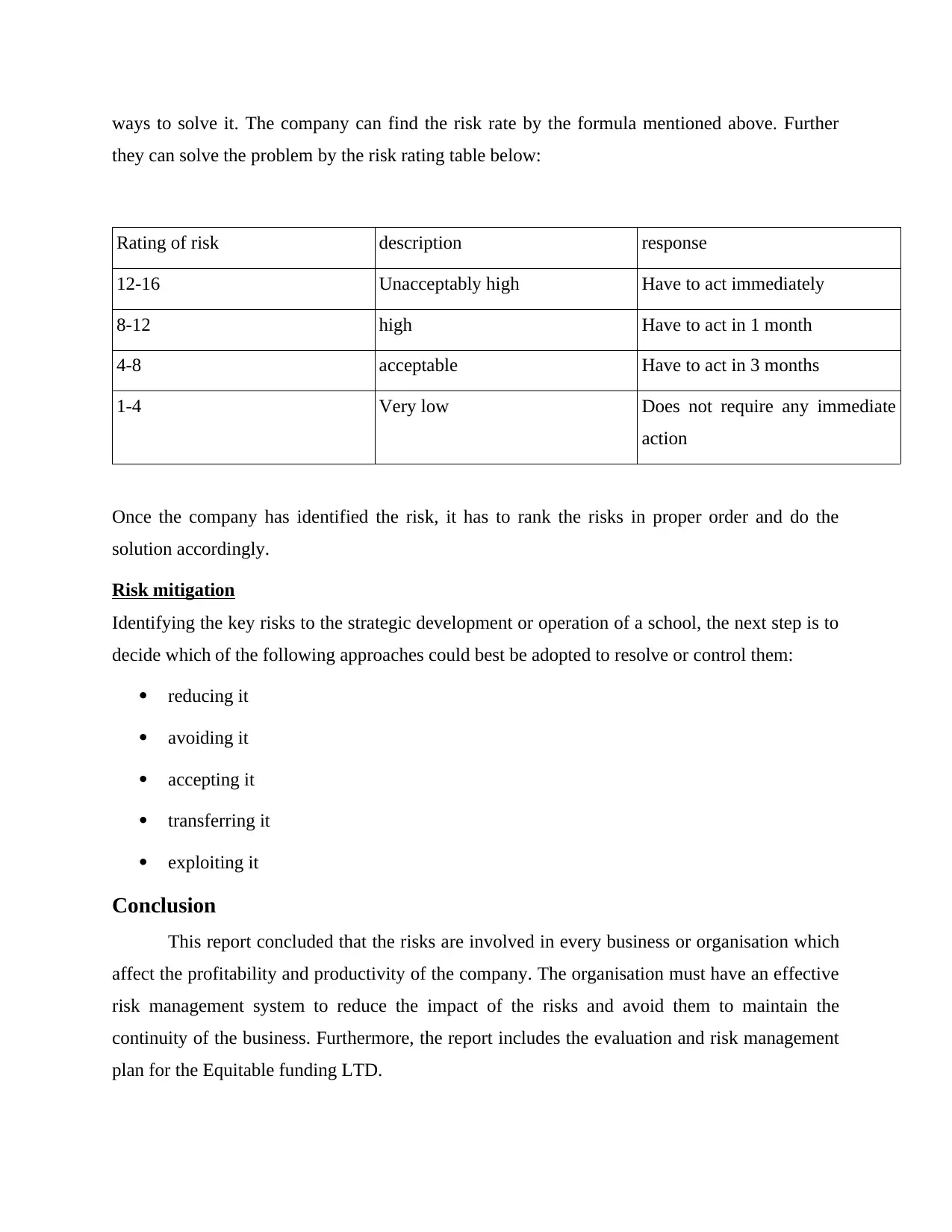
ways to solve it. The company can find the risk rate by the formula mentioned above. Further
they can solve the problem by the risk rating table below:
Rating of risk description response
12-16 Unacceptably high Have to act immediately
8-12 high Have to act in 1 month
4-8 acceptable Have to act in 3 months
1-4 Very low Does not require any immediate
action
Once the company has identified the risk, it has to rank the risks in proper order and do the
solution accordingly.
Risk mitigation
Identifying the key risks to the strategic development or operation of a school, the next step is to
decide which of the following approaches could best be adopted to resolve or control them:
reducing it
avoiding it
accepting it
transferring it
exploiting it
Conclusion
This report concluded that the risks are involved in every business or organisation which
affect the profitability and productivity of the company. The organisation must have an effective
risk management system to reduce the impact of the risks and avoid them to maintain the
continuity of the business. Furthermore, the report includes the evaluation and risk management
plan for the Equitable funding LTD.
they can solve the problem by the risk rating table below:
Rating of risk description response
12-16 Unacceptably high Have to act immediately
8-12 high Have to act in 1 month
4-8 acceptable Have to act in 3 months
1-4 Very low Does not require any immediate
action
Once the company has identified the risk, it has to rank the risks in proper order and do the
solution accordingly.
Risk mitigation
Identifying the key risks to the strategic development or operation of a school, the next step is to
decide which of the following approaches could best be adopted to resolve or control them:
reducing it
avoiding it
accepting it
transferring it
exploiting it
Conclusion
This report concluded that the risks are involved in every business or organisation which
affect the profitability and productivity of the company. The organisation must have an effective
risk management system to reduce the impact of the risks and avoid them to maintain the
continuity of the business. Furthermore, the report includes the evaluation and risk management
plan for the Equitable funding LTD.
Paraphrase This Document
Need a fresh take? Get an instant paraphrase of this document with our AI Paraphraser
REFERENCES
Books and Journal
McNeil, A.J., Frey, R. and Embrechts, P., 2015. Quantitative risk management: Concepts,
techniques and tools. Princeton university press.
Pritchard, C.L. and PMP, P.R., 2014. Risk management: concepts and guidance. CRC Press.
Glendon, A.I., Clarke, S. and McKenna, E., 2016. Human safety and risk management. Crc
Press.
Wolke, T., 2017. Risk Management. Walter de Gruyter GmbH & Co KG.
Almeida, H., Hankins, K.W. and Williams, R., 2017. Risk management with supply
contracts. The Review of Financial Studies, 30(12), pp.4179-4215.
Bromiley, P., McShane, M., Nair, A. and Rustambekov, E., 2015. Enterprise risk management:
Review, critique, and research directions. Long range planning, 48(4), pp.265-276.
Cohen, J., Krishnamoorthy, G. and Wright, A., 2017. Enterprise risk management and the
financial reporting process: The experiences of audit committee members, CFOs, and
external auditors. Contemporary Accounting Research, 34(2), pp.1178-1209.
Aven, T., 2016. Risk assessment and risk management: Review of recent advances on their
foundation. European Journal of Operational Research, 253(1), pp.1-13.
Wiengarten, F., Humphreys, P., Gimenez, C. and McIvor, R., 2016. Risk, risk management
practices, and the success of supply chain integration. International Journal of Production
Economics, 171, pp.361-370
Books and Journal
McNeil, A.J., Frey, R. and Embrechts, P., 2015. Quantitative risk management: Concepts,
techniques and tools. Princeton university press.
Pritchard, C.L. and PMP, P.R., 2014. Risk management: concepts and guidance. CRC Press.
Glendon, A.I., Clarke, S. and McKenna, E., 2016. Human safety and risk management. Crc
Press.
Wolke, T., 2017. Risk Management. Walter de Gruyter GmbH & Co KG.
Almeida, H., Hankins, K.W. and Williams, R., 2017. Risk management with supply
contracts. The Review of Financial Studies, 30(12), pp.4179-4215.
Bromiley, P., McShane, M., Nair, A. and Rustambekov, E., 2015. Enterprise risk management:
Review, critique, and research directions. Long range planning, 48(4), pp.265-276.
Cohen, J., Krishnamoorthy, G. and Wright, A., 2017. Enterprise risk management and the
financial reporting process: The experiences of audit committee members, CFOs, and
external auditors. Contemporary Accounting Research, 34(2), pp.1178-1209.
Aven, T., 2016. Risk assessment and risk management: Review of recent advances on their
foundation. European Journal of Operational Research, 253(1), pp.1-13.
Wiengarten, F., Humphreys, P., Gimenez, C. and McIvor, R., 2016. Risk, risk management
practices, and the success of supply chain integration. International Journal of Production
Economics, 171, pp.361-370

1 out of 11


Related Documents


Your All-in-One AI-Powered Toolkit for Academic Success.
+13062052269
info@desklib.com
Available 24*7 on WhatsApp / Email
![[object Object]](/_next/static/media/star-bottom.7253800d.svg)
Unlock your academic potential
Copyright © 2020–2026 A2Z Services. All Rights Reserved. Developed and managed by ZUCOL.