Risk and Perception Analysis Report: Course Name, Semester
VerifiedAdded on 2020/05/04
|18
|4708
|56
Report
AI Summary
This report presents a comprehensive analysis of risk and perception, examining various scenarios and models. Part A delves into different types of risks, including environmental, property, and pandemic risks, using case studies to illustrate each. It explores the causes and consequences of events such as coal mine explosions, airline accidents, and building collapses, highlighting the role of non-energy sources and natural disasters. Part B focuses on a time sequence model, analyzing the grounding of a ship and its implications. The analysis includes the potential consequences of the grounding, such as financial losses, environmental damage, and legal repercussions. The report discusses the responsibilities of various parties involved, including ship owners, navigators, and marine authorities. It also outlines the importance of insurance, risk management, and preventive measures to mitigate future occurrences and protect marine life. The report concludes with a discussion of the aftermath of such events, emphasizing the importance of pre-conditions, safety measures, and damage control to ensure a smooth compensation process and minimize negative impacts.
Risk and Perception Analysis 1
RISK AND PERCEPTION ANALYSIS
Student’s Name
Professor’s Name
University
City
Date
RISK AND PERCEPTION ANALYSIS
Student’s Name
Professor’s Name
University
City
Date

Paraphrase This Document
Need a fresh take? Get an instant paraphrase of this document with our AI Paraphraser
Risk and Perception Analysis 2
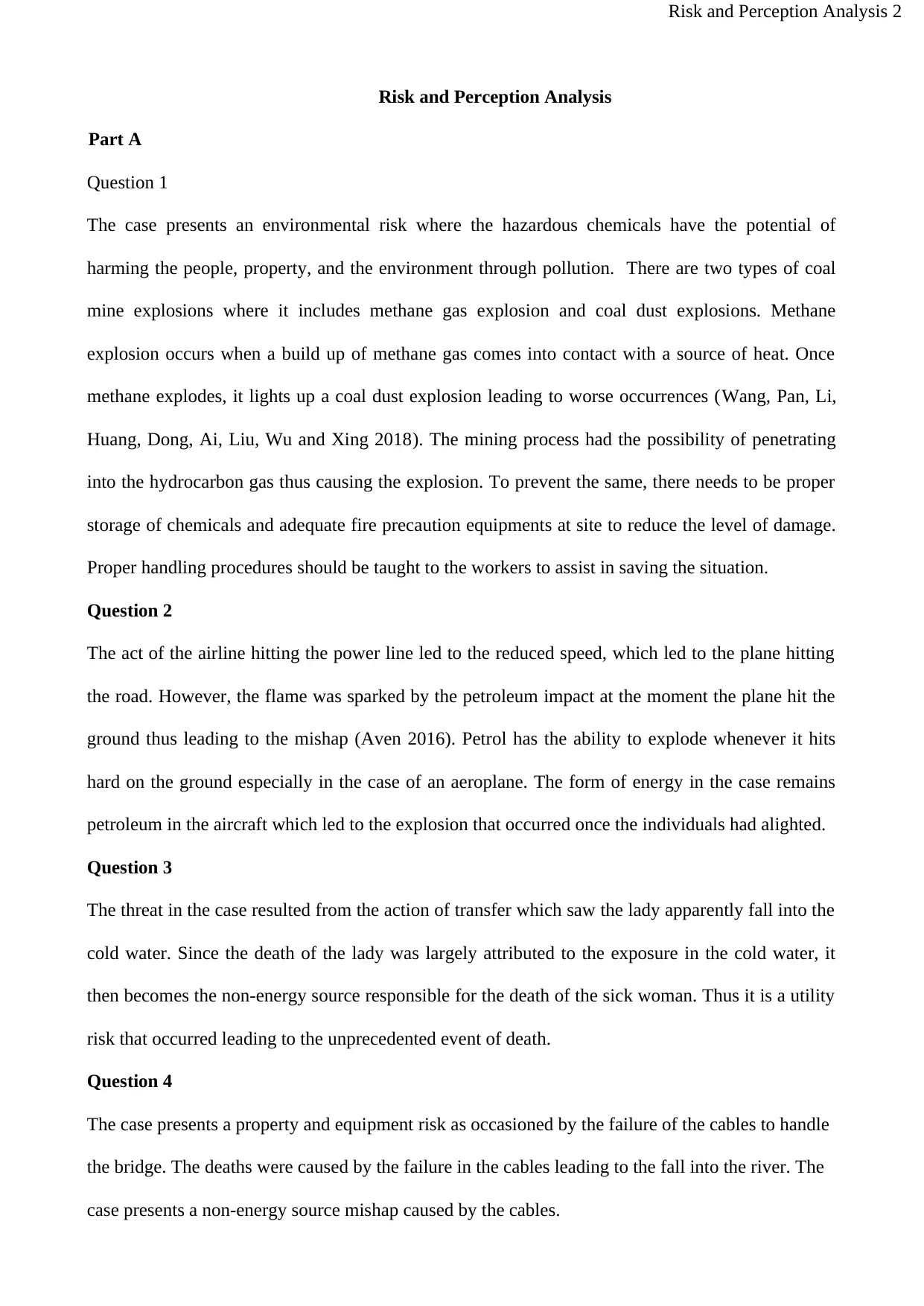
Risk and Perception Analysis
Part A
Question 1
The case presents an environmental risk where the hazardous chemicals have the potential of
harming the people, property, and the environment through pollution. There are two types of coal
mine explosions where it includes methane gas explosion and coal dust explosions. Methane
explosion occurs when a build up of methane gas comes into contact with a source of heat. Once
methane explodes, it lights up a coal dust explosion leading to worse occurrences (Wang, Pan, Li,
Huang, Dong, Ai, Liu, Wu and Xing 2018). The mining process had the possibility of penetrating
into the hydrocarbon gas thus causing the explosion. To prevent the same, there needs to be proper
storage of chemicals and adequate fire precaution equipments at site to reduce the level of damage.
Proper handling procedures should be taught to the workers to assist in saving the situation.
Question 2
The act of the airline hitting the power line led to the reduced speed, which led to the plane hitting
the road. However, the flame was sparked by the petroleum impact at the moment the plane hit the
ground thus leading to the mishap (Aven 2016). Petrol has the ability to explode whenever it hits
hard on the ground especially in the case of an aeroplane. The form of energy in the case remains
petroleum in the aircraft which led to the explosion that occurred once the individuals had alighted.
Question 3
The threat in the case resulted from the action of transfer which saw the lady apparently fall into the
cold water. Since the death of the lady was largely attributed to the exposure in the cold water, it
then becomes the non-energy source responsible for the death of the sick woman. Thus it is a utility
risk that occurred leading to the unprecedented event of death.
Question 4
The case presents a property and equipment risk as occasioned by the failure of the cables to handle
the bridge. The deaths were caused by the failure in the cables leading to the fall into the river. The
case presents a non-energy source mishap caused by the cables.
Risk and Perception Analysis
Part A
Question 1
The case presents an environmental risk where the hazardous chemicals have the potential of
harming the people, property, and the environment through pollution. There are two types of coal
mine explosions where it includes methane gas explosion and coal dust explosions. Methane
explosion occurs when a build up of methane gas comes into contact with a source of heat. Once
methane explodes, it lights up a coal dust explosion leading to worse occurrences (Wang, Pan, Li,
Huang, Dong, Ai, Liu, Wu and Xing 2018). The mining process had the possibility of penetrating
into the hydrocarbon gas thus causing the explosion. To prevent the same, there needs to be proper
storage of chemicals and adequate fire precaution equipments at site to reduce the level of damage.
Proper handling procedures should be taught to the workers to assist in saving the situation.
Question 2
The act of the airline hitting the power line led to the reduced speed, which led to the plane hitting
the road. However, the flame was sparked by the petroleum impact at the moment the plane hit the
ground thus leading to the mishap (Aven 2016). Petrol has the ability to explode whenever it hits
hard on the ground especially in the case of an aeroplane. The form of energy in the case remains
petroleum in the aircraft which led to the explosion that occurred once the individuals had alighted.
Question 3
The threat in the case resulted from the action of transfer which saw the lady apparently fall into the
cold water. Since the death of the lady was largely attributed to the exposure in the cold water, it
then becomes the non-energy source responsible for the death of the sick woman. Thus it is a utility
risk that occurred leading to the unprecedented event of death.
Question 4
The case presents a property and equipment risk as occasioned by the failure of the cables to handle
the bridge. The deaths were caused by the failure in the cables leading to the fall into the river. The
case presents a non-energy source mishap caused by the cables.

Risk and Perception Analysis 3
⊘ This is a preview!⊘
Do you want full access?
Subscribe today to unlock all pages.

Trusted by 1+ million students worldwide
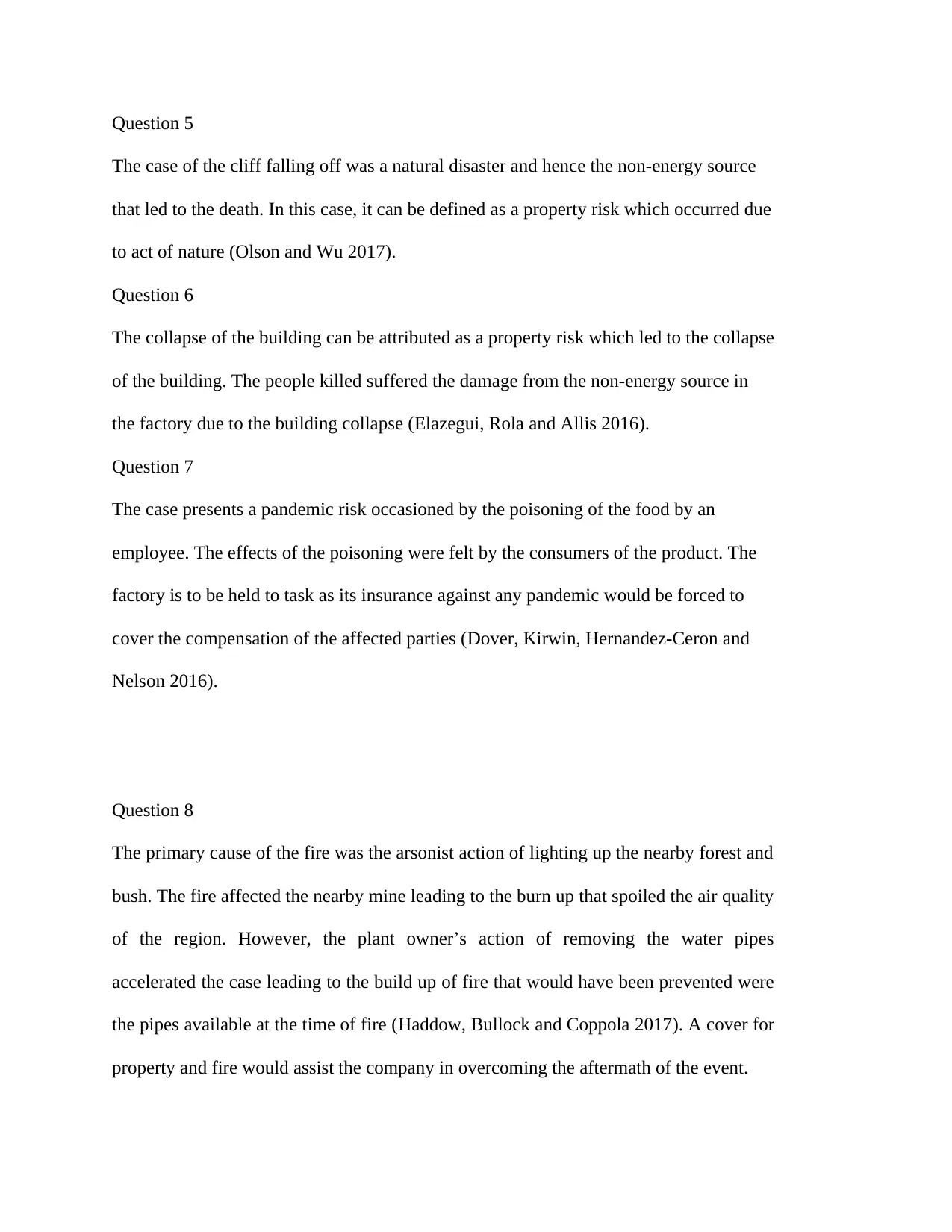
Question 5
The case of the cliff falling off was a natural disaster and hence the non-energy source
that led to the death. In this case, it can be defined as a property risk which occurred due
to act of nature (Olson and Wu 2017).
Question 6
The collapse of the building can be attributed as a property risk which led to the collapse
of the building. The people killed suffered the damage from the non-energy source in
the factory due to the building collapse (Elazegui, Rola and Allis 2016).
Question 7
The case presents a pandemic risk occasioned by the poisoning of the food by an
employee. The effects of the poisoning were felt by the consumers of the product. The
factory is to be held to task as its insurance against any pandemic would be forced to
cover the compensation of the affected parties (Dover, Kirwin, Hernandez-Ceron and
Nelson 2016).
Question 8
The primary cause of the fire was the arsonist action of lighting up the nearby forest and
bush. The fire affected the nearby mine leading to the burn up that spoiled the air quality
of the region. However, the plant owner’s action of removing the water pipes
accelerated the case leading to the build up of fire that would have been prevented were
the pipes available at the time of fire (Haddow, Bullock and Coppola 2017). A cover for
property and fire would assist the company in overcoming the aftermath of the event.
The case of the cliff falling off was a natural disaster and hence the non-energy source
that led to the death. In this case, it can be defined as a property risk which occurred due
to act of nature (Olson and Wu 2017).
Question 6
The collapse of the building can be attributed as a property risk which led to the collapse
of the building. The people killed suffered the damage from the non-energy source in
the factory due to the building collapse (Elazegui, Rola and Allis 2016).
Question 7
The case presents a pandemic risk occasioned by the poisoning of the food by an
employee. The effects of the poisoning were felt by the consumers of the product. The
factory is to be held to task as its insurance against any pandemic would be forced to
cover the compensation of the affected parties (Dover, Kirwin, Hernandez-Ceron and
Nelson 2016).
Question 8
The primary cause of the fire was the arsonist action of lighting up the nearby forest and
bush. The fire affected the nearby mine leading to the burn up that spoiled the air quality
of the region. However, the plant owner’s action of removing the water pipes
accelerated the case leading to the build up of fire that would have been prevented were
the pipes available at the time of fire (Haddow, Bullock and Coppola 2017). A cover for
property and fire would assist the company in overcoming the aftermath of the event.
Paraphrase This Document
Need a fresh take? Get an instant paraphrase of this document with our AI Paraphraser
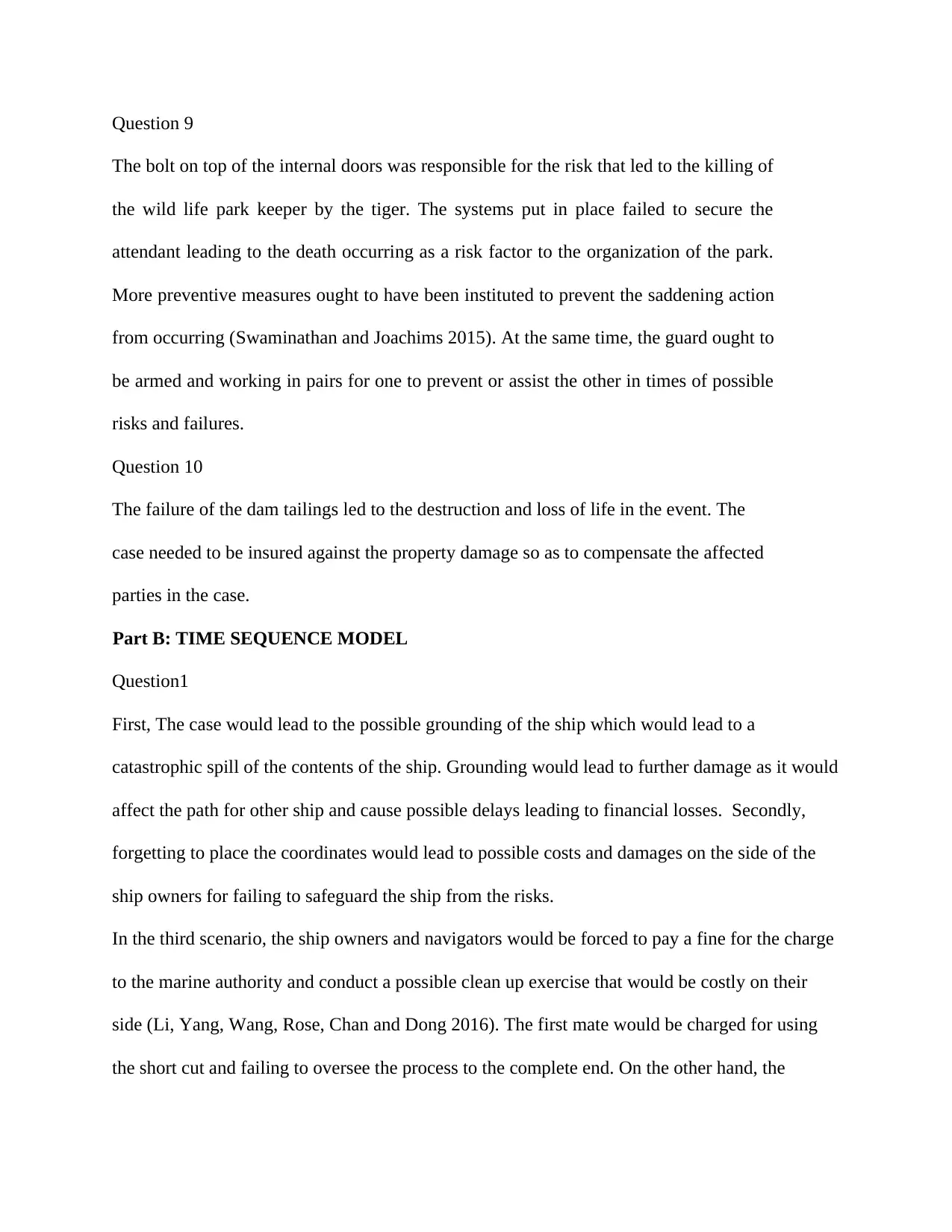
Question 9
The bolt on top of the internal doors was responsible for the risk that led to the killing of
the wild life park keeper by the tiger. The systems put in place failed to secure the
attendant leading to the death occurring as a risk factor to the organization of the park.
More preventive measures ought to have been instituted to prevent the saddening action
from occurring (Swaminathan and Joachims 2015). At the same time, the guard ought to
be armed and working in pairs for one to prevent or assist the other in times of possible
risks and failures.
Question 10
The failure of the dam tailings led to the destruction and loss of life in the event. The
case needed to be insured against the property damage so as to compensate the affected
parties in the case.
Part B: TIME SEQUENCE MODEL
Question1
First, The case would lead to the possible grounding of the ship which would lead to a
catastrophic spill of the contents of the ship. Grounding would lead to further damage as it would
affect the path for other ship and cause possible delays leading to financial losses. Secondly,
forgetting to place the coordinates would lead to possible costs and damages on the side of the
ship owners for failing to safeguard the ship from the risks.
In the third scenario, the ship owners and navigators would be forced to pay a fine for the charge
to the marine authority and conduct a possible clean up exercise that would be costly on their
side (Li, Yang, Wang, Rose, Chan and Dong 2016). The first mate would be charged for using
the short cut and failing to oversee the process to the complete end. On the other hand, the
The bolt on top of the internal doors was responsible for the risk that led to the killing of
the wild life park keeper by the tiger. The systems put in place failed to secure the
attendant leading to the death occurring as a risk factor to the organization of the park.
More preventive measures ought to have been instituted to prevent the saddening action
from occurring (Swaminathan and Joachims 2015). At the same time, the guard ought to
be armed and working in pairs for one to prevent or assist the other in times of possible
risks and failures.
Question 10
The failure of the dam tailings led to the destruction and loss of life in the event. The
case needed to be insured against the property damage so as to compensate the affected
parties in the case.
Part B: TIME SEQUENCE MODEL
Question1
First, The case would lead to the possible grounding of the ship which would lead to a
catastrophic spill of the contents of the ship. Grounding would lead to further damage as it would
affect the path for other ship and cause possible delays leading to financial losses. Secondly,
forgetting to place the coordinates would lead to possible costs and damages on the side of the
ship owners for failing to safeguard the ship from the risks.
In the third scenario, the ship owners and navigators would be forced to pay a fine for the charge
to the marine authority and conduct a possible clean up exercise that would be costly on their
side (Li, Yang, Wang, Rose, Chan and Dong 2016). The first mate would be charged for using
the short cut and failing to oversee the process to the complete end. On the other hand, the
second mate would be charged for failing to adhere to the instructions placed by the first mate
once he retired to rest leaving him in charge of designing and inserting the coordinates.
Question 2
In the first case, grounding would lead to more incurrence of financial costs due to the
damages on the side of the marine life and the authority. A lot of funds would be used in
the case in pulling out the ship from the place. On the other hand, it would lead to a
possible spillage of the oil thus damaging the marine life adversely.
Lack of proper control of the ship would lead to a possible deregistering or suspension
of the operating license on the firm or the specific people involved in the operations. As
such, it would damage them financially as their career would remain at risk after paying
the fines and facing possible trials (Cameron and Shah 2015).
Cleaning of the damages would cost the ship owners a great deal as well as catering for
the time loss of the cargo on transit. The insurance would charge them a fee apart from
guaranteeing the part of the loss occurred. In this case, it affects the overall operation of
the firm and the reputation among its customers.
Question 3
The event occurred when the lead team failed to turn at the waypoint required by the
intended course of the ship. The mix-up resulted from the change of the coordinates
occasioned by the change in shifts between the first and the change persons in charge.
once he retired to rest leaving him in charge of designing and inserting the coordinates.
Question 2
In the first case, grounding would lead to more incurrence of financial costs due to the
damages on the side of the marine life and the authority. A lot of funds would be used in
the case in pulling out the ship from the place. On the other hand, it would lead to a
possible spillage of the oil thus damaging the marine life adversely.
Lack of proper control of the ship would lead to a possible deregistering or suspension
of the operating license on the firm or the specific people involved in the operations. As
such, it would damage them financially as their career would remain at risk after paying
the fines and facing possible trials (Cameron and Shah 2015).
Cleaning of the damages would cost the ship owners a great deal as well as catering for
the time loss of the cargo on transit. The insurance would charge them a fee apart from
guaranteeing the part of the loss occurred. In this case, it affects the overall operation of
the firm and the reputation among its customers.
Question 3
The event occurred when the lead team failed to turn at the waypoint required by the
intended course of the ship. The mix-up resulted from the change of the coordinates
occasioned by the change in shifts between the first and the change persons in charge.
⊘ This is a preview!⊘
Do you want full access?
Subscribe today to unlock all pages.
Trusted by 1+ million students worldwide
Finding an alternative route was good but then the failure to insert the last coordinate on
the navigation map led to the risk that saw the ship grounded. As a result, it is alleged
that some level of oil spill on the reef thus damaging the ecological aspects of the
destination. The persons involved were then held responsible for the action where each
was to be charged a significant amount for the action leading to the grounding in an area
assumed to have a proper leeway (Peters, Schwartz and Lubell 2018).
The fact that both parties were aware of the coordinates and the use of the short cut to
the seaway led to the court proceedings where the possible charges would be conducted.
Meanwhile, the cleaning for the damages caused began at the cost of the ship owners as
it had to be treated with emergency to reduce the possible harm to the environment.
Question 4
The event led to a possible pollution, though not in worst case scenario. In this case, the
marine park officials can engage in a clean-up exercise funded by the ship owners to
cater for the damages committed by their action. The Great Barrier Reef was at risk of
the oil spillage that had to be removed in the shortest time possible to avert the damage
on the marine life. Since the evidence of the oil spillage pointed towards the Shen Neng
1, it was prudent that the persons involved cater for the cleanup and pay up for the
damage caused through their insurance risk management (McNeil, Frey and Embrechts
2015).
On-site assessment on the possible damage ought to be conducted to realize the level of damage
not only to the outside environment but also to the goods on transit within the ship (Suter 2016).
A count of the people inside has to be done and their safety ascertained to prevent damages in the
long-run. Persons within the ship have to be evacuated and restrictive measures placed to prevent
the navigation map led to the risk that saw the ship grounded. As a result, it is alleged
that some level of oil spill on the reef thus damaging the ecological aspects of the
destination. The persons involved were then held responsible for the action where each
was to be charged a significant amount for the action leading to the grounding in an area
assumed to have a proper leeway (Peters, Schwartz and Lubell 2018).
The fact that both parties were aware of the coordinates and the use of the short cut to
the seaway led to the court proceedings where the possible charges would be conducted.
Meanwhile, the cleaning for the damages caused began at the cost of the ship owners as
it had to be treated with emergency to reduce the possible harm to the environment.
Question 4
The event led to a possible pollution, though not in worst case scenario. In this case, the
marine park officials can engage in a clean-up exercise funded by the ship owners to
cater for the damages committed by their action. The Great Barrier Reef was at risk of
the oil spillage that had to be removed in the shortest time possible to avert the damage
on the marine life. Since the evidence of the oil spillage pointed towards the Shen Neng
1, it was prudent that the persons involved cater for the cleanup and pay up for the
damage caused through their insurance risk management (McNeil, Frey and Embrechts
2015).
On-site assessment on the possible damage ought to be conducted to realize the level of damage
not only to the outside environment but also to the goods on transit within the ship (Suter 2016).
A count of the people inside has to be done and their safety ascertained to prevent damages in the
long-run. Persons within the ship have to be evacuated and restrictive measures placed to prevent
Paraphrase This Document
Need a fresh take? Get an instant paraphrase of this document with our AI Paraphraser
their return to the ship until all the safety concerns have been duly completed. Further, health and
safety assessment on the marine life has to be conducted to assist determine the level of damage
and prepare for the damage control measures as per the insurance policies. Since the ship is
insured, it would be prudent to inform the insurance firm and have their personnel come on site
to perform the assessment and costing of the compensation to the marine authority.
In averting future occurrences, it is prudent that an intelligent control system should be adopted
to utilize communication technologies in monitoring and preventing future occurrences
(Pastorok, Bartell, Ferson and Ginzburg 2016). Placing the mechanism would assist in averting
more grounding of ship thus prevent damage on the marine life. Geo-fencing would also assist in
preventing access to restricted areas by either ship or any other foreign bodies that may cause a
havoc to the region. Watch towers should be created to provide proper communication and
warning signals to ship operators approaching restricted zones. In this way, future occurrences
would be prevented thus acting positively towards reducing risks for the marine life (Vidmar and
Perkovič 2018).
Question 5
The event already occurred thus the need to deal with the aftermath of the situation. In risk
assessment and management, pre-conditions involve the necessary checks to be conducted before
the overall beginning in handling an event. In this case, the safety measures have to be checked
to ascertain the person in charge of the accident in determining whether it was intentional or
accidental (Faure 2016). Afterward, the insurance firm and type of coverage has to be confirmed
to assist in the recovery process and damage control. All these factors assist in handling the
situation and ensuring a smooth compensation process from the insurance firm covering the ship
and its personnel.
safety assessment on the marine life has to be conducted to assist determine the level of damage
and prepare for the damage control measures as per the insurance policies. Since the ship is
insured, it would be prudent to inform the insurance firm and have their personnel come on site
to perform the assessment and costing of the compensation to the marine authority.
In averting future occurrences, it is prudent that an intelligent control system should be adopted
to utilize communication technologies in monitoring and preventing future occurrences
(Pastorok, Bartell, Ferson and Ginzburg 2016). Placing the mechanism would assist in averting
more grounding of ship thus prevent damage on the marine life. Geo-fencing would also assist in
preventing access to restricted areas by either ship or any other foreign bodies that may cause a
havoc to the region. Watch towers should be created to provide proper communication and
warning signals to ship operators approaching restricted zones. In this way, future occurrences
would be prevented thus acting positively towards reducing risks for the marine life (Vidmar and
Perkovič 2018).
Question 5
The event already occurred thus the need to deal with the aftermath of the situation. In risk
assessment and management, pre-conditions involve the necessary checks to be conducted before
the overall beginning in handling an event. In this case, the safety measures have to be checked
to ascertain the person in charge of the accident in determining whether it was intentional or
accidental (Faure 2016). Afterward, the insurance firm and type of coverage has to be confirmed
to assist in the recovery process and damage control. All these factors assist in handling the
situation and ensuring a smooth compensation process from the insurance firm covering the ship
and its personnel.
Question 6
The event is disastrous to the marine life, park officials, and the persons involved in the ship
management. First, the little spillage after the grounding could lead to a destruction of a few of
the animals and general habitat. As such, as the process of cleaning up is awaited, a significant
amount of damage would have occurred leading to losses. Secondly, the marine park officials
would be in for an explanation as some of them are expected at all times to be vigilant of the
occurrences within and nearby the reef region. In this respect, the persons in charge would face
possible fines, suspension, or even dismissal as a result of the occurrence (Torabi, Giahi, and
Sahebjamnia 2016). In any case this was observed, preventive measures and risk management
exercises were expected to be called in adequately to clean up the mess as the rest of the
compensation process awaited.
Thirdly, the human factor would suffer from the consequences of the same. The ship was
carrying commodities that were on transit, which as a result of the occurrence experienced a
possible delay leading to the losses and waste of time. Such incidents work negatively to the
reputation of a company thus leading to future consequences on its operations. At the same time,
financial damages have to be cleared both to the marine park and the ship owners. The ship
owners have to pay fines for the occurrence as well as cater for the compensation of the clean-up
exercise. At the same time, the persons responsible have to carry their own cross for the damages
done. Each party shall have to pay fines according to their responsibilities and the requirement of
the marine operations (Chevron 2017). Moreover, it might lead to their possible suspension and
even dismissal in case findings indicate the possibility of neglect to the duties at the work place
leading to the damage on marine life.
The event is disastrous to the marine life, park officials, and the persons involved in the ship
management. First, the little spillage after the grounding could lead to a destruction of a few of
the animals and general habitat. As such, as the process of cleaning up is awaited, a significant
amount of damage would have occurred leading to losses. Secondly, the marine park officials
would be in for an explanation as some of them are expected at all times to be vigilant of the
occurrences within and nearby the reef region. In this respect, the persons in charge would face
possible fines, suspension, or even dismissal as a result of the occurrence (Torabi, Giahi, and
Sahebjamnia 2016). In any case this was observed, preventive measures and risk management
exercises were expected to be called in adequately to clean up the mess as the rest of the
compensation process awaited.
Thirdly, the human factor would suffer from the consequences of the same. The ship was
carrying commodities that were on transit, which as a result of the occurrence experienced a
possible delay leading to the losses and waste of time. Such incidents work negatively to the
reputation of a company thus leading to future consequences on its operations. At the same time,
financial damages have to be cleared both to the marine park and the ship owners. The ship
owners have to pay fines for the occurrence as well as cater for the compensation of the clean-up
exercise. At the same time, the persons responsible have to carry their own cross for the damages
done. Each party shall have to pay fines according to their responsibilities and the requirement of
the marine operations (Chevron 2017). Moreover, it might lead to their possible suspension and
even dismissal in case findings indicate the possibility of neglect to the duties at the work place
leading to the damage on marine life.
⊘ This is a preview!⊘
Do you want full access?
Subscribe today to unlock all pages.
Trusted by 1+ million students worldwide
Part C Time Zone 1
Question 1
The simple linear model of time sequence can be used in describing conditions and
circumstances leading to possible mishaps. The simple linear model draws the
assumption that accidents occur as a result of the culmination of series of events or
circumstances which interact in a sequence with each other in a linear fashion. In this
respect, accidents can be prevented by eliminating one of the causes in the linear
sequence thus remaining risk free or reducing the risk altogether.
The reasoning in this case is justifiable given the sequence it follows and the issues that can be
avoided in mitigating risks. For instance, in the case of the ship grounding, there are several
aspects that occurred leading to the accident. The sequence to the cargo ship grounding on the
Great Barrier Reef after de-docking where the second plotted a course with the captain to use the
common short cut to the deep sea (Hopkin 2017). The coordinates were entered by the two into
the navigation system except the last one, a fact that was communicated to the first mate when
the second one went to rest. The mistake began where the first mate, upon being informed of the
task to enter the last coordinate forgot to do so hence leading to the wreck. The series observed
indicate that if one aspect was done right, it would have prevented the overall accident from
occurring. For instance, had the second mate who entered the coordinates with the captain
finished inserting the last coordinate before handing over to the first mate, the accident would not
have occurred. At the same time, the second mate would have prevented the accident from
occurring if he had followed the instructions and remembered to enter the last coordinate as
Question 1
The simple linear model of time sequence can be used in describing conditions and
circumstances leading to possible mishaps. The simple linear model draws the
assumption that accidents occur as a result of the culmination of series of events or
circumstances which interact in a sequence with each other in a linear fashion. In this
respect, accidents can be prevented by eliminating one of the causes in the linear
sequence thus remaining risk free or reducing the risk altogether.
The reasoning in this case is justifiable given the sequence it follows and the issues that can be
avoided in mitigating risks. For instance, in the case of the ship grounding, there are several
aspects that occurred leading to the accident. The sequence to the cargo ship grounding on the
Great Barrier Reef after de-docking where the second plotted a course with the captain to use the
common short cut to the deep sea (Hopkin 2017). The coordinates were entered by the two into
the navigation system except the last one, a fact that was communicated to the first mate when
the second one went to rest. The mistake began where the first mate, upon being informed of the
task to enter the last coordinate forgot to do so hence leading to the wreck. The series observed
indicate that if one aspect was done right, it would have prevented the overall accident from
occurring. For instance, had the second mate who entered the coordinates with the captain
finished inserting the last coordinate before handing over to the first mate, the accident would not
have occurred. At the same time, the second mate would have prevented the accident from
occurring if he had followed the instructions and remembered to enter the last coordinate as
Paraphrase This Document
Need a fresh take? Get an instant paraphrase of this document with our AI Paraphraser
instructed (Cole, Giné and Vickery 2017). The single omission of instructions led to the several
other series that occasioned the accident. Thus, the time sequence is applicable to the case and
can be used to justify the occurrences leading to the ship grounding.
Question 2
Time zone 1 reflects the actual location of the ship prior to the occurrence leading to the
grounding. Time zone 1 involved acts leading to the accident where the first mate fell off to rest
after supervising the hours of offloading and other activities at the port. Overworking at the first
zone is seen as a precursor to the accident as the second in command could not step in to assist.
People are not expected to work for long hours especially in cases where an assistant is available.
According to Bowers and Khorakian, 2014, it would be proper for the first in command to set the
coordinates with the captain to avert the possible omission of the last step to safety.
As such, the second in charge took the chance to enter the coordinates as the journey took off
while the first one rested. Along the way, the first mate rose to duty picking where the second
left. In this case, it can be assumed that the first mate did not have enough rest after the
numerous hours of staying awake. As a result, it might have led to the forgetting of the last
coordinate. The sequence from the second mate failing to complete the coding led to the possible
accident. In risk management, it is proper for one to begin and complete a setting stage before
handing over shifts to another person in charge. At the same time, it is proper to provide a brief
to the next person on shift and as well have the deliberations considered adequately. In this case,
the first mate picking from the latter failed to take in the instruction as he forgot to place the last
coordinate. Safety measures ought to have been considered to prevent the occurrence by
remaining keen and taking precautionary measures especially in coordinate points setting for
navigation (Lam 2014).
other series that occasioned the accident. Thus, the time sequence is applicable to the case and
can be used to justify the occurrences leading to the ship grounding.
Question 2
Time zone 1 reflects the actual location of the ship prior to the occurrence leading to the
grounding. Time zone 1 involved acts leading to the accident where the first mate fell off to rest
after supervising the hours of offloading and other activities at the port. Overworking at the first
zone is seen as a precursor to the accident as the second in command could not step in to assist.
People are not expected to work for long hours especially in cases where an assistant is available.
According to Bowers and Khorakian, 2014, it would be proper for the first in command to set the
coordinates with the captain to avert the possible omission of the last step to safety.
As such, the second in charge took the chance to enter the coordinates as the journey took off
while the first one rested. Along the way, the first mate rose to duty picking where the second
left. In this case, it can be assumed that the first mate did not have enough rest after the
numerous hours of staying awake. As a result, it might have led to the forgetting of the last
coordinate. The sequence from the second mate failing to complete the coding led to the possible
accident. In risk management, it is proper for one to begin and complete a setting stage before
handing over shifts to another person in charge. At the same time, it is proper to provide a brief
to the next person on shift and as well have the deliberations considered adequately. In this case,
the first mate picking from the latter failed to take in the instruction as he forgot to place the last
coordinate. Safety measures ought to have been considered to prevent the occurrence by
remaining keen and taking precautionary measures especially in coordinate points setting for
navigation (Lam 2014).
Part D Quantifying estimates of risk
The risk at hand involves a cargo ship that wrecked and ended up destroying
numerous goods and people leading to secondary damages over the place. The ship
carried 50 crew members and several cargo containers destined to different locations.
As an insured ship, there were several risks that occurred and had to be covered by
the insurance firm as compensation measures.
Question 1
Units of Exposure for the Risk
There are several units of exposure for the risk as earlier deliberated by the insurance firm. First
is the risk of losing containers and other goods on transit by the ship which have to be paid
according to the owners quantity. Secondly, payment to the crew members serves as a unit where
each individual has to be compensated following an accident (Harrington and Niehaus, 1999).
The third one is the marine life which have to be cleared and adequate assistance done to reduce
the harm or damage committed as a result of the damage.
(i) Question 2
The probability of such an occurrence remains low as several measures along the marine lines
are considered to ensure limited number of occurrences happen. As such, the probability of such
occurrences remains low.
Question 3
The frequency of occurrence for the various categories differ according to the preventive
measures placed. For instance, the frequency of a shipwreck remains lower as several watch
towers and guides exist to ensure warnings are sent in time. At the same time, frequency of risk
of deaths on crew members is reduced given the presence of motor boats and floaters that can be
The risk at hand involves a cargo ship that wrecked and ended up destroying
numerous goods and people leading to secondary damages over the place. The ship
carried 50 crew members and several cargo containers destined to different locations.
As an insured ship, there were several risks that occurred and had to be covered by
the insurance firm as compensation measures.
Question 1
Units of Exposure for the Risk
There are several units of exposure for the risk as earlier deliberated by the insurance firm. First
is the risk of losing containers and other goods on transit by the ship which have to be paid
according to the owners quantity. Secondly, payment to the crew members serves as a unit where
each individual has to be compensated following an accident (Harrington and Niehaus, 1999).
The third one is the marine life which have to be cleared and adequate assistance done to reduce
the harm or damage committed as a result of the damage.
(i) Question 2
The probability of such an occurrence remains low as several measures along the marine lines
are considered to ensure limited number of occurrences happen. As such, the probability of such
occurrences remains low.
Question 3
The frequency of occurrence for the various categories differ according to the preventive
measures placed. For instance, the frequency of a shipwreck remains lower as several watch
towers and guides exist to ensure warnings are sent in time. At the same time, frequency of risk
of deaths on crew members is reduced given the presence of motor boats and floaters that can be
⊘ This is a preview!⊘
Do you want full access?
Subscribe today to unlock all pages.
Trusted by 1+ million students worldwide

1 out of 18


Your All-in-One AI-Powered Toolkit for Academic Success.
+13062052269
info@desklib.com
Available 24*7 on WhatsApp / Email
![[object Object]](/_next/static/media/star-bottom.7253800d.svg)
Unlock your academic potential
Copyright © 2020–2026 A2Z Services. All Rights Reserved. Developed and managed by ZUCOL.