BK7101 - Risk and Utility: Risk Management, Utility & Insurance
VerifiedAdded on 2023/06/04
|19
|4076
|489
Report
AI Summary
This report provides an in-depth analysis of risk and utility within the construction industry, focusing on insurance financing and risk management strategies. It explores the application of utility theory in assessing risks faced by construction workers, differentiating between skilled and clumsy builders. The report includes calculations for insurance premiums, maximum premium charges, and the evaluation of different coverage plans. It also addresses the implications of market failures in insurance coverage. The analysis uses a case study approach, applying mathematical models to determine optimal insurance strategies and coverage plans for construction firms. This document is available on Desklib, a platform offering a wide range of study resources, including past papers and solved assignments.
RISK AND UTILITY
Student’s Name
Risk and Utility
Course Studied
Unit Title
Unit Code
Professor’s Name
Institutional Affiliation
Department
Date
Student’s Name
Risk and Utility
Course Studied
Unit Title
Unit Code
Professor’s Name
Institutional Affiliation
Department
Date

Paraphrase This Document
Need a fresh take? Get an instant paraphrase of this document with our AI Paraphraser
Risk and Utility
Introduction
In the construction industry most of the workers incur a lot of risk either the worker is
skilled or not, thus methods of risk analysis have been implemented based on the theory of utility
(Kast, and Lapied, 2006). The theory focuses on the following sectors:
Economic situation data
Construction condition data
Seasonality
Supply and demand relationship
Apart from these factors decision making, utility function, records and probability are
very crucial. Utility function is a method that has a great impact for the decision makers that
include the site manager of construction, construction engineer who make a lot of risk.
In addition, for an effective construction key decisions have to be taken at different stages
to prevent dilemmas that may erupt. What is fundamental is the knowledge of making
decisions toward certain risk that may be incurred during the construction of a building.
Utility theory can be applied in these forms:
Ranking of the constructors
Economic history, lending of the consumers, small business operations
Transfer of risks, flexibility, scenario methods
Life cycle building
integrative management and standardization
socio-economic system qualitative evaluation
equilibrium and game theory
Construction of utility faces unprecedented disruption coming from all corners that may
include the global workforce challenges, improvement of safety measures, increasing adverse
weather conditions, infrastructure cyber-attacks and problems that arise from distributed
generation (Trevor, 2004). The construction industry has great impact on the global economy
thus represents 6% of the entire global GDP and there is an estimate of 180 million construction
workers in the entire world and 75% come from the developing countries. However, calamities
Introduction
In the construction industry most of the workers incur a lot of risk either the worker is
skilled or not, thus methods of risk analysis have been implemented based on the theory of utility
(Kast, and Lapied, 2006). The theory focuses on the following sectors:
Economic situation data
Construction condition data
Seasonality
Supply and demand relationship
Apart from these factors decision making, utility function, records and probability are
very crucial. Utility function is a method that has a great impact for the decision makers that
include the site manager of construction, construction engineer who make a lot of risk.
In addition, for an effective construction key decisions have to be taken at different stages
to prevent dilemmas that may erupt. What is fundamental is the knowledge of making
decisions toward certain risk that may be incurred during the construction of a building.
Utility theory can be applied in these forms:
Ranking of the constructors
Economic history, lending of the consumers, small business operations
Transfer of risks, flexibility, scenario methods
Life cycle building
integrative management and standardization
socio-economic system qualitative evaluation
equilibrium and game theory
Construction of utility faces unprecedented disruption coming from all corners that may
include the global workforce challenges, improvement of safety measures, increasing adverse
weather conditions, infrastructure cyber-attacks and problems that arise from distributed
generation (Trevor, 2004). The construction industry has great impact on the global economy
thus represents 6% of the entire global GDP and there is an estimate of 180 million construction
workers in the entire world and 75% come from the developing countries. However, calamities
that faced during the construction have great impact in the economy thus construction utility has
been stagnant for the last 20 years.
Nevertheless, construction market has risk and finance shortage and these suppresses
levels of productivity, cost and waste introduction, low ability of industries to add value to the
built environment.
These are some of the risk that an individual may be facing that may include: natural
disasters, asset prices volatility nature, liability creation and fear of losses if one may venture
into the business (Kassack, 2017). In business they are risks that are insurable, non-insurable,
avoidable and non-avoidable. These are the major types of risk that we have:
Enterprise risk
Fundamental and particular risk
Pure and speculative risk
Enterprise risk focuses on all the risk that are faced in a business enterprise that is
inclusive of the strategic risk, speculative risk, financial risk, pure risk and operational risk.
Fundamental economy affects the entire economy and a large population of people while the
particular risk affects the individual people. Moreover, in speculative risk there is possibility of
making both profit and losses at the same time while pure risk only gives one platform of either
masking profit or loss. maximum amount of cash to be insured
1.0 Utility premium Assessment
In order for a building to be erected in an appropriate manner builders play major role in
it. In most of the occasions contractors and the investors that may have great interest in the
construction industry have major challenge in identifying between a clumsy builder and a best
builder. Clumsy builders may have obtained the ideas and gathered knowledge in the field of
construction without going to the technical institutions for proper training and certification. The
been stagnant for the last 20 years.
Nevertheless, construction market has risk and finance shortage and these suppresses
levels of productivity, cost and waste introduction, low ability of industries to add value to the
built environment.
These are some of the risk that an individual may be facing that may include: natural
disasters, asset prices volatility nature, liability creation and fear of losses if one may venture
into the business (Kassack, 2017). In business they are risks that are insurable, non-insurable,
avoidable and non-avoidable. These are the major types of risk that we have:
Enterprise risk
Fundamental and particular risk
Pure and speculative risk
Enterprise risk focuses on all the risk that are faced in a business enterprise that is
inclusive of the strategic risk, speculative risk, financial risk, pure risk and operational risk.
Fundamental economy affects the entire economy and a large population of people while the
particular risk affects the individual people. Moreover, in speculative risk there is possibility of
making both profit and losses at the same time while pure risk only gives one platform of either
masking profit or loss. maximum amount of cash to be insured
1.0 Utility premium Assessment
In order for a building to be erected in an appropriate manner builders play major role in
it. In most of the occasions contractors and the investors that may have great interest in the
construction industry have major challenge in identifying between a clumsy builder and a best
builder. Clumsy builders may have obtained the ideas and gathered knowledge in the field of
construction without going to the technical institutions for proper training and certification. The
⊘ This is a preview!⊘
Do you want full access?
Subscribe today to unlock all pages.

Trusted by 1+ million students worldwide
construction ideas from a clumsy builder in most occasions are obtained from observation from
more skilled builders.
Moreover, the construction managers and engineers should adopt and put into practice
the art of hiring construction firms that have builders who have undergone training in recognized
institutions that know the risk and challenges’ that an individual may encounter during
construction (Knox, Pollock, and Ritchie, 2011). The construction work is costly in most
scenarios if the amateurs are given duty and make mistakes thus it vital to find experienced and
skilled builders in that field of work that offer a clear competitive rates.
The calculations bellow illustrates the solutions to most of the questions asked under the
utility assessment section of this paper.
a) How Much Is Charged by Safe Build for Each Type of $1 In Medical
Coverage
Following the fact that Safe Build has to act fairly, charges on clumsy and skilled builders should
consider the probabilities of involvement into an accident of the two categories. However, the
probability of involvement into an accident is inversely proportional to the charges made.
Therefore, give $1 then:
The skilled builders should be charged
(100%-90%)/ 100*1
0.1*1
=$0.1
On the other hand, the clumsy boulders should be charged as follows
(100%-30%)/100*1
more skilled builders.
Moreover, the construction managers and engineers should adopt and put into practice
the art of hiring construction firms that have builders who have undergone training in recognized
institutions that know the risk and challenges’ that an individual may encounter during
construction (Knox, Pollock, and Ritchie, 2011). The construction work is costly in most
scenarios if the amateurs are given duty and make mistakes thus it vital to find experienced and
skilled builders in that field of work that offer a clear competitive rates.
The calculations bellow illustrates the solutions to most of the questions asked under the
utility assessment section of this paper.
a) How Much Is Charged by Safe Build for Each Type of $1 In Medical
Coverage
Following the fact that Safe Build has to act fairly, charges on clumsy and skilled builders should
consider the probabilities of involvement into an accident of the two categories. However, the
probability of involvement into an accident is inversely proportional to the charges made.
Therefore, give $1 then:
The skilled builders should be charged
(100%-90%)/ 100*1
0.1*1
=$0.1
On the other hand, the clumsy boulders should be charged as follows
(100%-30%)/100*1
Paraphrase This Document
Need a fresh take? Get an instant paraphrase of this document with our AI Paraphraser
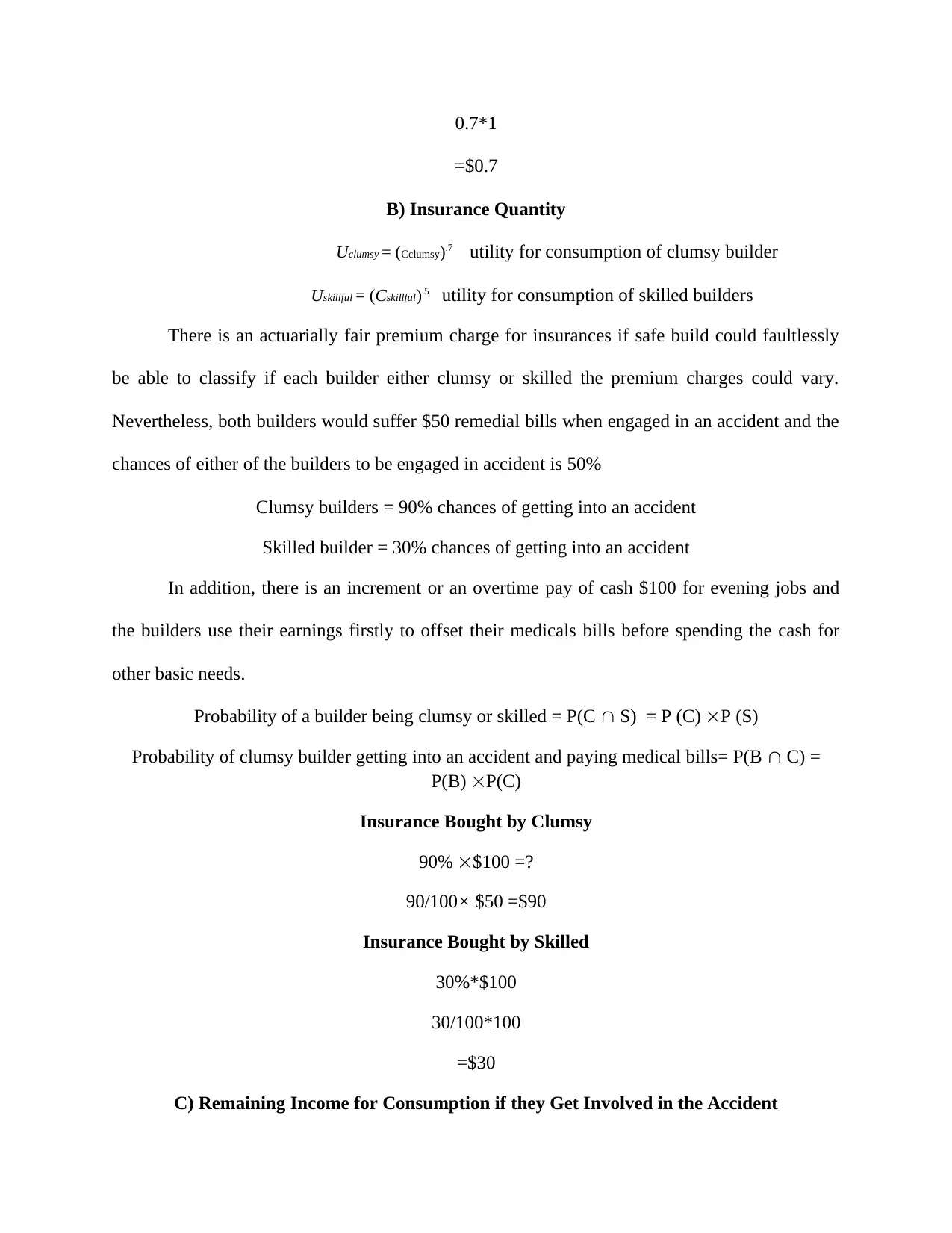
0.7*1
=$0.7
B) Insurance Quantity
Uclumsy = (Cclumsy).7 utility for consumption of clumsy builder
Uskillful = (Cskillful).5 utility for consumption of skilled builders
There is an actuarially fair premium charge for insurances if safe build could faultlessly
be able to classify if each builder either clumsy or skilled the premium charges could vary.
Nevertheless, both builders would suffer $50 remedial bills when engaged in an accident and the
chances of either of the builders to be engaged in accident is 50%
Clumsy builders = 90% chances of getting into an accident
Skilled builder = 30% chances of getting into an accident
In addition, there is an increment or an overtime pay of cash $100 for evening jobs and
the builders use their earnings firstly to offset their medicals bills before spending the cash for
other basic needs.
Probability of a builder being clumsy or skilled = P(C S) = P (C) P (S)
Probability of clumsy builder getting into an accident and paying medical bills= P(B C) =
P(B) P(C)
Insurance Bought by Clumsy
90% $100 =?
90/100× $50 =$90
Insurance Bought by Skilled
30%*$100
30/100*100
=$30
C) Remaining Income for Consumption if they Get Involved in the Accident
=$0.7
B) Insurance Quantity
Uclumsy = (Cclumsy).7 utility for consumption of clumsy builder
Uskillful = (Cskillful).5 utility for consumption of skilled builders
There is an actuarially fair premium charge for insurances if safe build could faultlessly
be able to classify if each builder either clumsy or skilled the premium charges could vary.
Nevertheless, both builders would suffer $50 remedial bills when engaged in an accident and the
chances of either of the builders to be engaged in accident is 50%
Clumsy builders = 90% chances of getting into an accident
Skilled builder = 30% chances of getting into an accident
In addition, there is an increment or an overtime pay of cash $100 for evening jobs and
the builders use their earnings firstly to offset their medicals bills before spending the cash for
other basic needs.
Probability of a builder being clumsy or skilled = P(C S) = P (C) P (S)
Probability of clumsy builder getting into an accident and paying medical bills= P(B C) =
P(B) P(C)
Insurance Bought by Clumsy
90% $100 =?
90/100× $50 =$90
Insurance Bought by Skilled
30%*$100
30/100*100
=$30
C) Remaining Income for Consumption if they Get Involved in the Accident
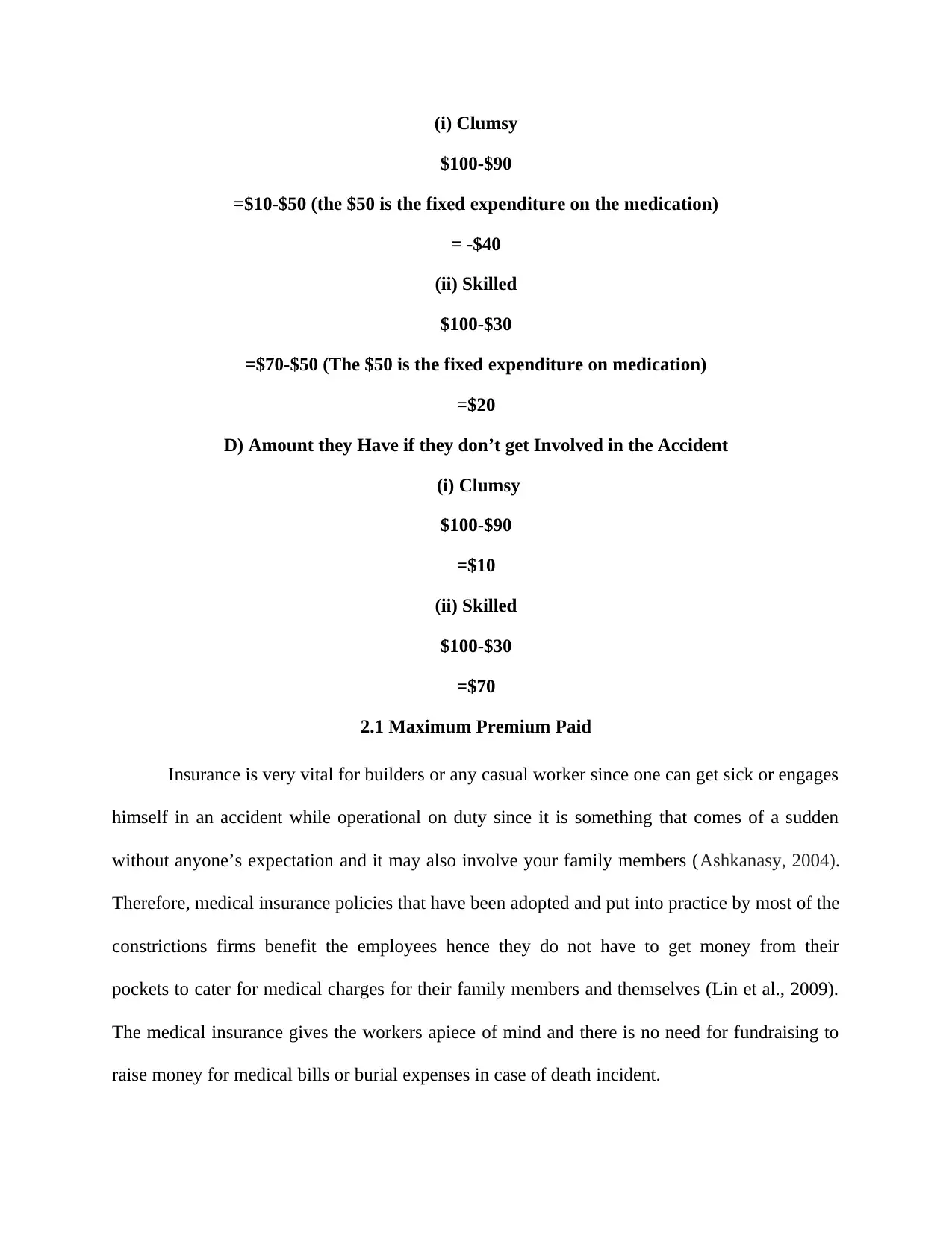
(i) Clumsy
$100-$90
=$10-$50 (the $50 is the fixed expenditure on the medication)
= -$40
(ii) Skilled
$100-$30
=$70-$50 (The $50 is the fixed expenditure on medication)
=$20
D) Amount they Have if they don’t get Involved in the Accident
(i) Clumsy
$100-$90
=$10
(ii) Skilled
$100-$30
=$70
2.1 Maximum Premium Paid
Insurance is very vital for builders or any casual worker since one can get sick or engages
himself in an accident while operational on duty since it is something that comes of a sudden
without anyone’s expectation and it may also involve your family members (Ashkanasy, 2004).
Therefore, medical insurance policies that have been adopted and put into practice by most of the
constrictions firms benefit the employees hence they do not have to get money from their
pockets to cater for medical charges for their family members and themselves (Lin et al., 2009).
The medical insurance gives the workers apiece of mind and there is no need for fundraising to
raise money for medical bills or burial expenses in case of death incident.
$100-$90
=$10-$50 (the $50 is the fixed expenditure on the medication)
= -$40
(ii) Skilled
$100-$30
=$70-$50 (The $50 is the fixed expenditure on medication)
=$20
D) Amount they Have if they don’t get Involved in the Accident
(i) Clumsy
$100-$90
=$10
(ii) Skilled
$100-$30
=$70
2.1 Maximum Premium Paid
Insurance is very vital for builders or any casual worker since one can get sick or engages
himself in an accident while operational on duty since it is something that comes of a sudden
without anyone’s expectation and it may also involve your family members (Ashkanasy, 2004).
Therefore, medical insurance policies that have been adopted and put into practice by most of the
constrictions firms benefit the employees hence they do not have to get money from their
pockets to cater for medical charges for their family members and themselves (Lin et al., 2009).
The medical insurance gives the workers apiece of mind and there is no need for fundraising to
raise money for medical bills or burial expenses in case of death incident.
⊘ This is a preview!⊘
Do you want full access?
Subscribe today to unlock all pages.
Trusted by 1+ million students worldwide
When selecting the suitable medical insurance policies, these are some of the observations that
one should put emphasis on:
medical treatment that cover both inpatient and outpatient treatment
the one that has the last expense cover that caters for the funeral expenses
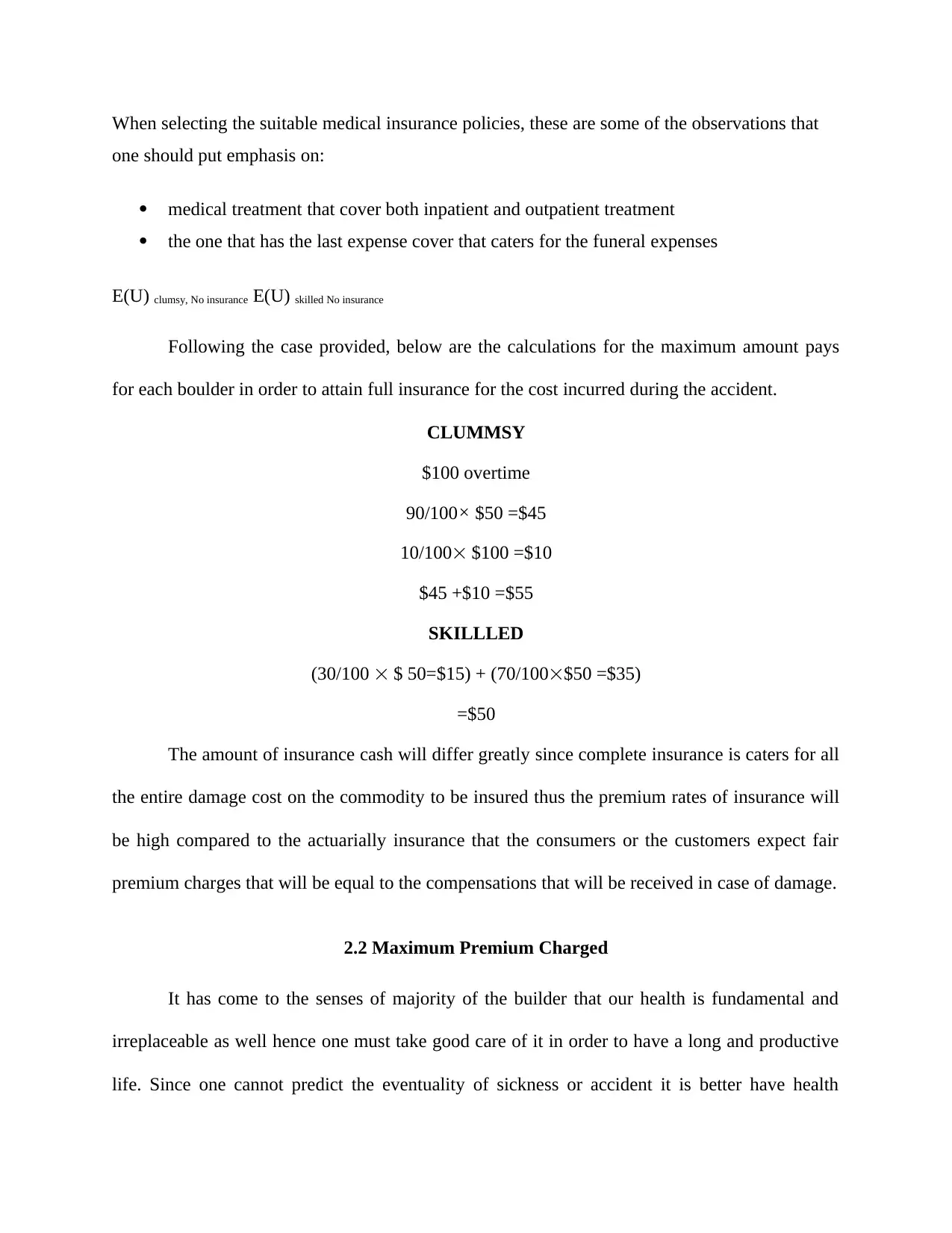
E(U) clumsy, No insurance E(U) skilled No insurance
Following the case provided, below are the calculations for the maximum amount pays
for each boulder in order to attain full insurance for the cost incurred during the accident.
CLUMMSY
$100 overtime
90/100× $50 =$45
10/100 $100 =$10
$45 +$10 =$55
SKILLLED
(30/100 $ 50=$15) + (70/100$50 =$35)
=$50
The amount of insurance cash will differ greatly since complete insurance is caters for all
the entire damage cost on the commodity to be insured thus the premium rates of insurance will
be high compared to the actuarially insurance that the consumers or the customers expect fair
premium charges that will be equal to the compensations that will be received in case of damage.
2.2 Maximum Premium Charged
It has come to the senses of majority of the builder that our health is fundamental and
irreplaceable as well hence one must take good care of it in order to have a long and productive
life. Since one cannot predict the eventuality of sickness or accident it is better have health
one should put emphasis on:
medical treatment that cover both inpatient and outpatient treatment
the one that has the last expense cover that caters for the funeral expenses
E(U) clumsy, No insurance E(U) skilled No insurance
Following the case provided, below are the calculations for the maximum amount pays
for each boulder in order to attain full insurance for the cost incurred during the accident.
CLUMMSY
$100 overtime
90/100× $50 =$45
10/100 $100 =$10
$45 +$10 =$55
SKILLLED
(30/100 $ 50=$15) + (70/100$50 =$35)
=$50
The amount of insurance cash will differ greatly since complete insurance is caters for all
the entire damage cost on the commodity to be insured thus the premium rates of insurance will
be high compared to the actuarially insurance that the consumers or the customers expect fair
premium charges that will be equal to the compensations that will be received in case of damage.
2.2 Maximum Premium Charged
It has come to the senses of majority of the builder that our health is fundamental and
irreplaceable as well hence one must take good care of it in order to have a long and productive
life. Since one cannot predict the eventuality of sickness or accident it is better have health
Paraphrase This Document
Need a fresh take? Get an instant paraphrase of this document with our AI Paraphraser
insurance and not use it rather not have the insurance but yawn for treatment when there is
shortage of cash.
Majority of the companies are trying to put measures that will ensure that the medical
insurance is affordable to all the employees (Pilbeam, 2018). Costs and premiums matter a lot
when choosing for best medical insurance cover but that does not mean that the builders should
rush for a lower rates insurance cover since it may provide an inferior medical cover at that low
cost. It’s advisable to closely and keenly examine the medical covers by making comparisons
before making any haste decision thus by ensuring that you get most the value of your money
(Deniz, 2006).
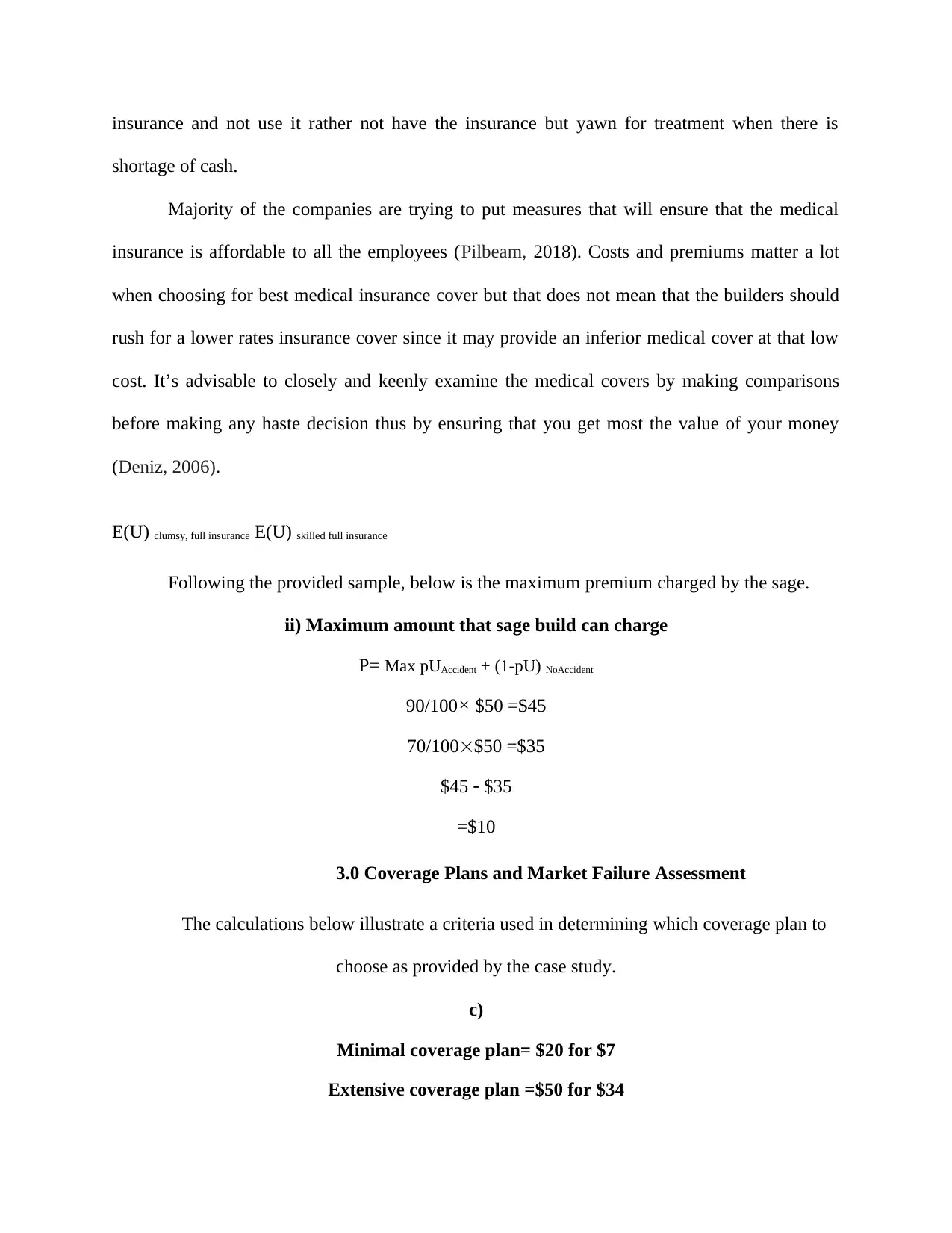
E(U) clumsy, full insurance E(U) skilled full insurance
Following the provided sample, below is the maximum premium charged by the sage.
ii) Maximum amount that sage build can charge
P= Max pUAccident + (1-pU) NoAccident
90/100× $50 =$45
70/100$50 =$35
$45 $35
=$10
3.0 Coverage Plans and Market Failure Assessment
The calculations below illustrate a criteria used in determining which coverage plan to
choose as provided by the case study.
c)
Minimal coverage plan= $20 for $7
Extensive coverage plan =$50 for $34
shortage of cash.
Majority of the companies are trying to put measures that will ensure that the medical
insurance is affordable to all the employees (Pilbeam, 2018). Costs and premiums matter a lot
when choosing for best medical insurance cover but that does not mean that the builders should
rush for a lower rates insurance cover since it may provide an inferior medical cover at that low
cost. It’s advisable to closely and keenly examine the medical covers by making comparisons
before making any haste decision thus by ensuring that you get most the value of your money
(Deniz, 2006).
E(U) clumsy, full insurance E(U) skilled full insurance
Following the provided sample, below is the maximum premium charged by the sage.
ii) Maximum amount that sage build can charge
P= Max pUAccident + (1-pU) NoAccident
90/100× $50 =$45
70/100$50 =$35
$45 $35
=$10
3.0 Coverage Plans and Market Failure Assessment
The calculations below illustrate a criteria used in determining which coverage plan to
choose as provided by the case study.
c)
Minimal coverage plan= $20 for $7
Extensive coverage plan =$50 for $34
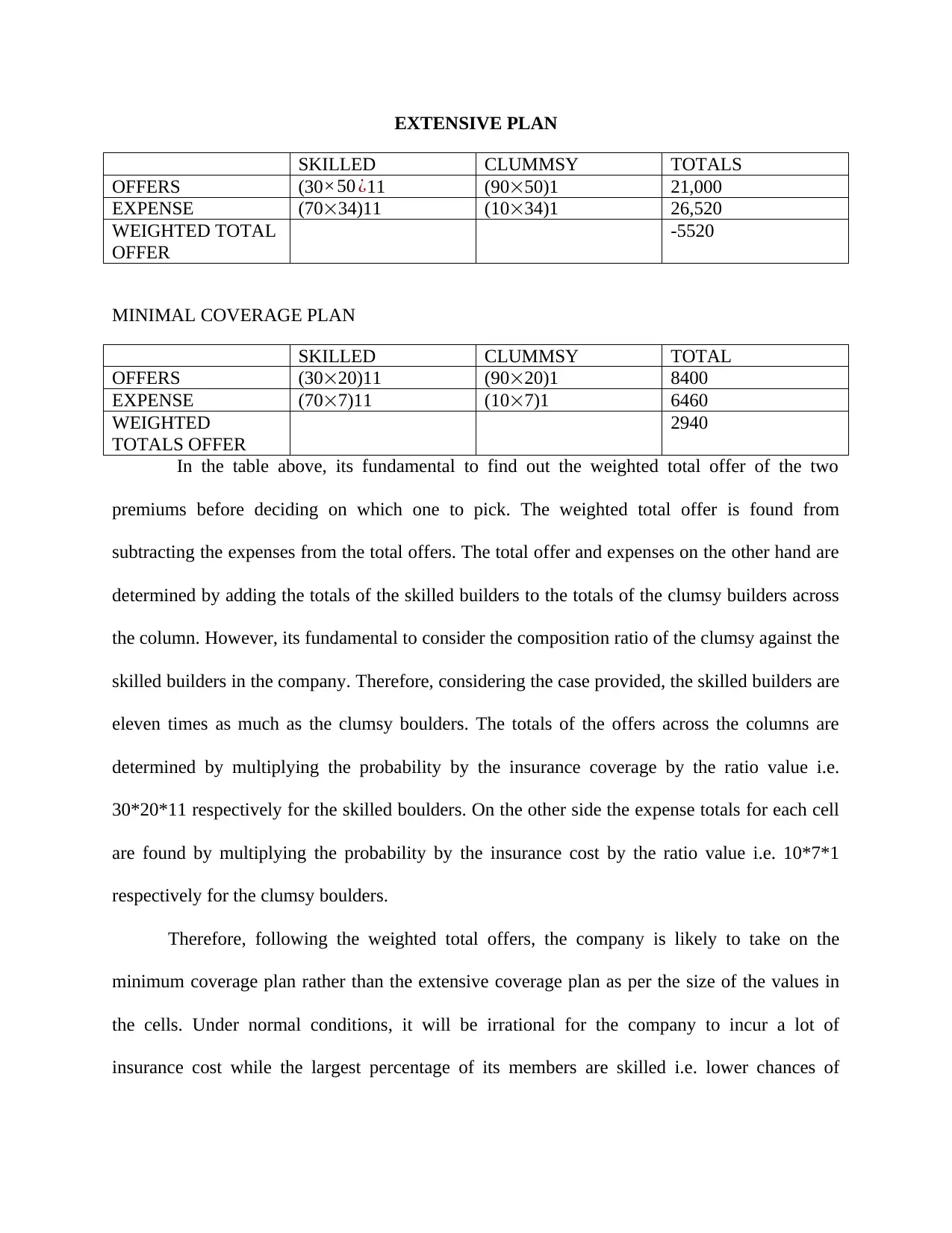
EXTENSIVE PLAN
SKILLED CLUMMSY TOTALS
OFFERS (30×50 ¿11 (9050)1 21,000
EXPENSE (7034)11 (1034)1 26,520
WEIGHTED TOTAL
OFFER
-5520
MINIMAL COVERAGE PLAN
SKILLED CLUMMSY TOTAL
OFFERS (3020)11 (9020)1 8400
EXPENSE (707)11 (107)1 6460
WEIGHTED
TOTALS OFFER
2940
In the table above, its fundamental to find out the weighted total offer of the two
premiums before deciding on which one to pick. The weighted total offer is found from
subtracting the expenses from the total offers. The total offer and expenses on the other hand are
determined by adding the totals of the skilled builders to the totals of the clumsy builders across
the column. However, its fundamental to consider the composition ratio of the clumsy against the
skilled builders in the company. Therefore, considering the case provided, the skilled builders are
eleven times as much as the clumsy boulders. The totals of the offers across the columns are
determined by multiplying the probability by the insurance coverage by the ratio value i.e.
30*20*11 respectively for the skilled boulders. On the other side the expense totals for each cell
are found by multiplying the probability by the insurance cost by the ratio value i.e. 10*7*1
respectively for the clumsy boulders.
Therefore, following the weighted total offers, the company is likely to take on the
minimum coverage plan rather than the extensive coverage plan as per the size of the values in
the cells. Under normal conditions, it will be irrational for the company to incur a lot of
insurance cost while the largest percentage of its members are skilled i.e. lower chances of
SKILLED CLUMMSY TOTALS
OFFERS (30×50 ¿11 (9050)1 21,000
EXPENSE (7034)11 (1034)1 26,520
WEIGHTED TOTAL
OFFER
-5520
MINIMAL COVERAGE PLAN
SKILLED CLUMMSY TOTAL
OFFERS (3020)11 (9020)1 8400
EXPENSE (707)11 (107)1 6460
WEIGHTED
TOTALS OFFER
2940
In the table above, its fundamental to find out the weighted total offer of the two
premiums before deciding on which one to pick. The weighted total offer is found from
subtracting the expenses from the total offers. The total offer and expenses on the other hand are
determined by adding the totals of the skilled builders to the totals of the clumsy builders across
the column. However, its fundamental to consider the composition ratio of the clumsy against the
skilled builders in the company. Therefore, considering the case provided, the skilled builders are
eleven times as much as the clumsy boulders. The totals of the offers across the columns are
determined by multiplying the probability by the insurance coverage by the ratio value i.e.
30*20*11 respectively for the skilled boulders. On the other side the expense totals for each cell
are found by multiplying the probability by the insurance cost by the ratio value i.e. 10*7*1
respectively for the clumsy boulders.
Therefore, following the weighted total offers, the company is likely to take on the
minimum coverage plan rather than the extensive coverage plan as per the size of the values in
the cells. Under normal conditions, it will be irrational for the company to incur a lot of
insurance cost while the largest percentage of its members are skilled i.e. lower chances of
⊘ This is a preview!⊘
Do you want full access?
Subscribe today to unlock all pages.
Trusted by 1+ million students worldwide
insurance. In such a case, it’s advisable for the company to secure less insurance coverage at a
lower cost since the company has lower probability for accidents.
Coverage plan is core for Sale builders and any investor regardless of it being minimal or
extensive plan. Suitable insurance plan is key mechanisms that have enabled societies and
organizations to be able to manage risk over a significant number of years. Insurance provides an
efficient channel of managing risk by providing both regulations of increasing risk behavior and
material damage compensation (Buchholz et al., 2006). Private insurance is a sector that was
established long ago within modern service economies and welfare organizations that has been
merged by co operations that are into making profits. Furthermore, these private insurance
organizations provide a wide range of financial support and adequate services to their clients.
Modern capitalist societies cannot operate without insurance either privately or provided by the
state since it provides a platform of risk taking and provides financial safety in case of any
uncertainty.
Nevertheless, market failure can be described any feature in both local and international
market that reduces the locative efficiency thus causes the resources to be expanded and
utilized in a way that does not maximize overall benefit to the society (Noe, et al., 2006).
Government intervention can increase economic welfare benefit in cases like that. Failure
market in the society has been triggered by the following factors:
Incomplete markets
Information asymmetries
Failure of competition
Flooding insurance in Germany was based on based on disaster financing scheme that
contributed to the governance objectives. This type of insurance focused on two key issues that is
compensation and reduction (Taub, and Wei, 2006). Flooding caused significant economic losses
lower cost since the company has lower probability for accidents.
Coverage plan is core for Sale builders and any investor regardless of it being minimal or
extensive plan. Suitable insurance plan is key mechanisms that have enabled societies and
organizations to be able to manage risk over a significant number of years. Insurance provides an
efficient channel of managing risk by providing both regulations of increasing risk behavior and
material damage compensation (Buchholz et al., 2006). Private insurance is a sector that was
established long ago within modern service economies and welfare organizations that has been
merged by co operations that are into making profits. Furthermore, these private insurance
organizations provide a wide range of financial support and adequate services to their clients.
Modern capitalist societies cannot operate without insurance either privately or provided by the
state since it provides a platform of risk taking and provides financial safety in case of any
uncertainty.
Nevertheless, market failure can be described any feature in both local and international
market that reduces the locative efficiency thus causes the resources to be expanded and
utilized in a way that does not maximize overall benefit to the society (Noe, et al., 2006).
Government intervention can increase economic welfare benefit in cases like that. Failure
market in the society has been triggered by the following factors:
Incomplete markets
Information asymmetries
Failure of competition
Flooding insurance in Germany was based on based on disaster financing scheme that
contributed to the governance objectives. This type of insurance focused on two key issues that is
compensation and reduction (Taub, and Wei, 2006). Flooding caused significant economic losses
Paraphrase This Document
Need a fresh take? Get an instant paraphrase of this document with our AI Paraphraser
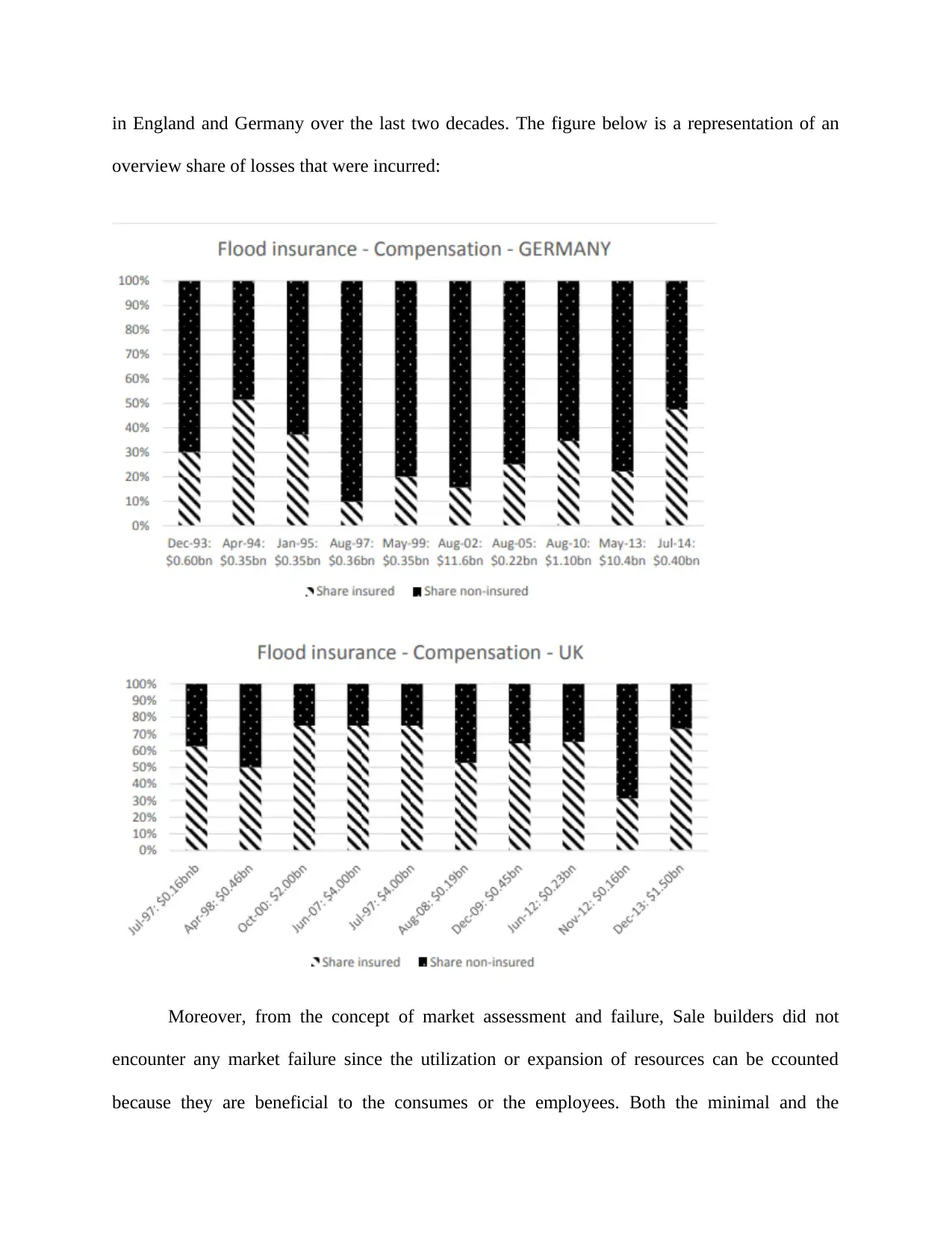
in England and Germany over the last two decades. The figure below is a representation of an
overview share of losses that were incurred:
Moreover, from the concept of market assessment and failure, Sale builders did not
encounter any market failure since the utilization or expansion of resources can be ccounted
because they are beneficial to the consumes or the employees. Both the minimal and the
overview share of losses that were incurred:
Moreover, from the concept of market assessment and failure, Sale builders did not
encounter any market failure since the utilization or expansion of resources can be ccounted
because they are beneficial to the consumes or the employees. Both the minimal and the
extensive coverage plans add value to the life of the builders despite the premium charge of the
inurance since lower income eraning individual could prefer that package of $20 and high
income individual could also prefer that package of $50 since they are affordable to them.
4.1 Utility Assessment and Choice
Preference eliciting techniques have emerged from a desire to understand consumer
demand for goods and services in the fields where it was not possible to use the revealed
preference data on the correct choices made by individual beings. Similarly, these platform has
arisen due to products and services not traded on market that may include the new products that
are under development and not yet commercially available to the people. When variation in both
service and the product formed is not available the possibility of isolation of each attributed
product from overall utility derived from the product is not there.
At this point the investors and contractors are required to make a choice over a number of
hypothetical alternatives and each of the alternatives is described by several features that are
referred to us attributes. These kind of method is theoretically based and its random utility theory
relies on the assumption of economic utility maximization and the assumption of economic
rationality (Hall et al. 2004). Discrete Choice Experiment method is used to estimate margin
valuations of attributes the willingness to pay for a change in unit for each of the attribute
approximated (Drummond et al., 2005). There results can be analyzed by subgroup of
individuals and it is possible to put into consideration the individual features that impacts the
marginal valuations.
Similarly, selecting and defining attributes need proper understanding of the population
that is being targeted its perspective and experience (Horrocks and Coast, 2007). Policy concerns
inurance since lower income eraning individual could prefer that package of $20 and high
income individual could also prefer that package of $50 since they are affordable to them.
4.1 Utility Assessment and Choice
Preference eliciting techniques have emerged from a desire to understand consumer
demand for goods and services in the fields where it was not possible to use the revealed
preference data on the correct choices made by individual beings. Similarly, these platform has
arisen due to products and services not traded on market that may include the new products that
are under development and not yet commercially available to the people. When variation in both
service and the product formed is not available the possibility of isolation of each attributed
product from overall utility derived from the product is not there.
At this point the investors and contractors are required to make a choice over a number of
hypothetical alternatives and each of the alternatives is described by several features that are
referred to us attributes. These kind of method is theoretically based and its random utility theory
relies on the assumption of economic utility maximization and the assumption of economic
rationality (Hall et al. 2004). Discrete Choice Experiment method is used to estimate margin
valuations of attributes the willingness to pay for a change in unit for each of the attribute
approximated (Drummond et al., 2005). There results can be analyzed by subgroup of
individuals and it is possible to put into consideration the individual features that impacts the
marginal valuations.
Similarly, selecting and defining attributes need proper understanding of the population
that is being targeted its perspective and experience (Horrocks and Coast, 2007). Policy concerns
⊘ This is a preview!⊘
Do you want full access?
Subscribe today to unlock all pages.
Trusted by 1+ million students worldwide

1 out of 19


Your All-in-One AI-Powered Toolkit for Academic Success.
+13062052269
info@desklib.com
Available 24*7 on WhatsApp / Email
![[object Object]](/_next/static/media/star-bottom.7253800d.svg)
Unlock your academic potential
Copyright © 2020–2026 A2Z Services. All Rights Reserved. Developed and managed by ZUCOL.