Dementia Patient Risks in Aged Care: Falls, Dysphagia, and Healthcare
VerifiedAdded on 2022/12/28
|12
|1017
|54
Report
AI Summary
This report focuses on the risks faced by dementia patients in aged care settings. It highlights accidental falls as a major concern, emphasizing the increased vulnerability of older adults with dementia. The report discusses the causes of falls, including balance issues, gait problems, psychological factors, medication side effects, vision problems, and joint pain. It outlines the role of aged care settings in fall prevention, such as implementing skid-resistant floors, using assistive devices like walkers, and ensuring proper lighting. The report also addresses dysphagia, or difficulty swallowing, in dementia patients, explaining its causes and interventions like diet modifications and assisted feeding. Primary healthcare interventions and screening, including vital sign management and behavioral assessments, are also discussed. Finally, the report emphasizes the importance of healthy aging education for both patients and their families. The conclusion summarizes the key risks and the benefits of aged care facilities in improving the quality of life for individuals with dementia.
RISKS ASSOCIATED WITH DEMENTIA
PATIENT IN AGED CARE
P R E S E N T E D B Y :
PATIENT IN AGED CARE
P R E S E N T E D B Y :
Paraphrase This Document
Need a fresh take? Get an instant paraphrase of this document with our AI Paraphraser

Accidental Fall among Older adults
with Dementia
Fall among the older adults are complex
yet multi-factorial issue
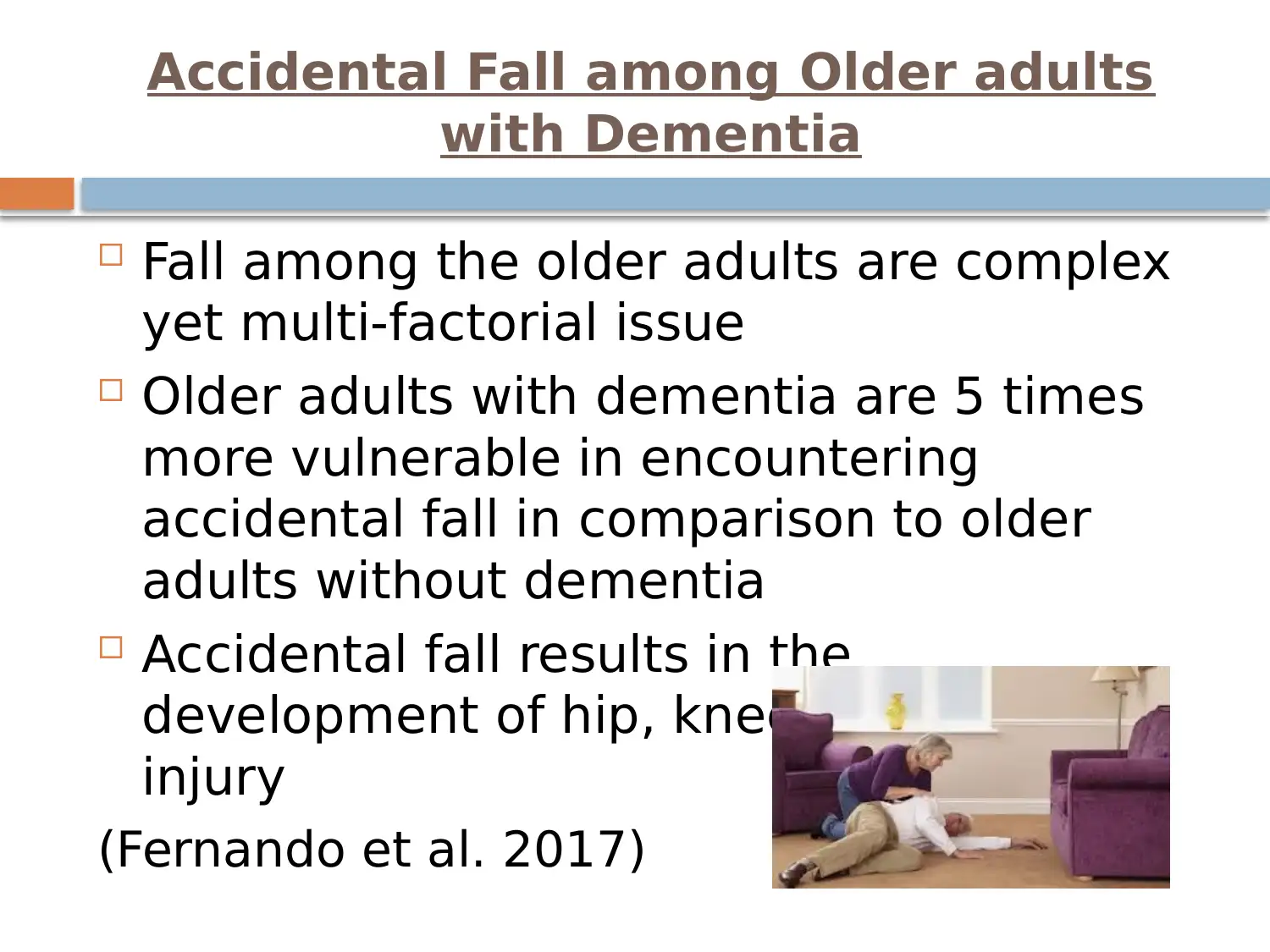
Older adults with dementia are 5 times
more vulnerable in encountering
accidental fall in comparison to older
adults without dementia
Accidental fall results in the
development of hip, knee spine or skull
injury
(Fernando et al. 2017)
with Dementia
Fall among the older adults are complex
yet multi-factorial issue
Older adults with dementia are 5 times
more vulnerable in encountering
accidental fall in comparison to older
adults without dementia
Accidental fall results in the
development of hip, knee spine or skull
injury
(Fernando et al. 2017)

Reasons for Accidental Fall
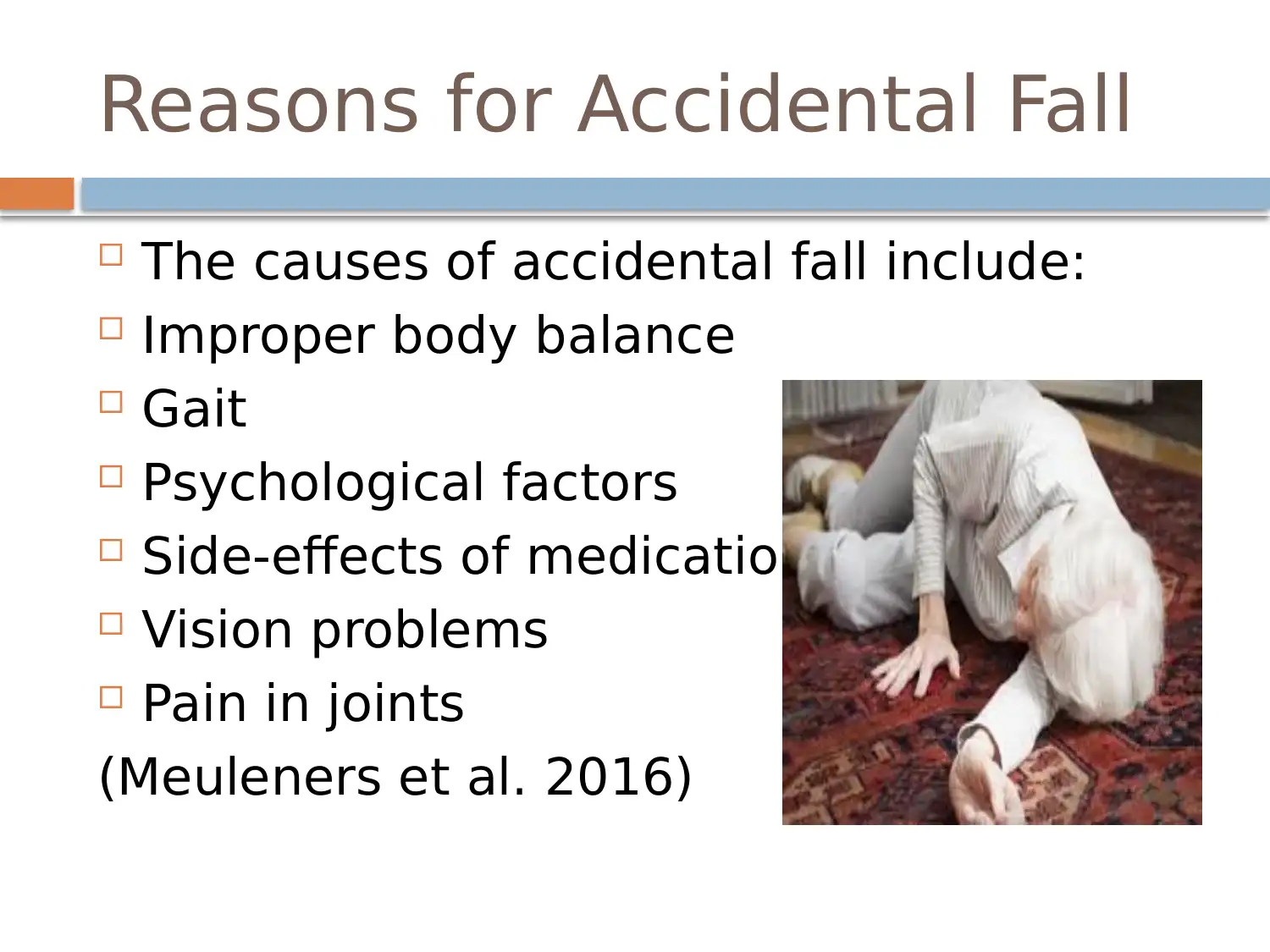
The causes of accidental fall include:
Improper body balance
Gait
Psychological factors
Side-effects of medications
Vision problems
Pain in joints
(Meuleners et al. 2016)
The causes of accidental fall include:
Improper body balance
Gait
Psychological factors
Side-effects of medications
Vision problems
Pain in joints
(Meuleners et al. 2016)
⊘ This is a preview!⊘
Do you want full access?
Subscribe today to unlock all pages.

Trusted by 1+ million students worldwide

Role of Aged Care Settings in
prevention of fall
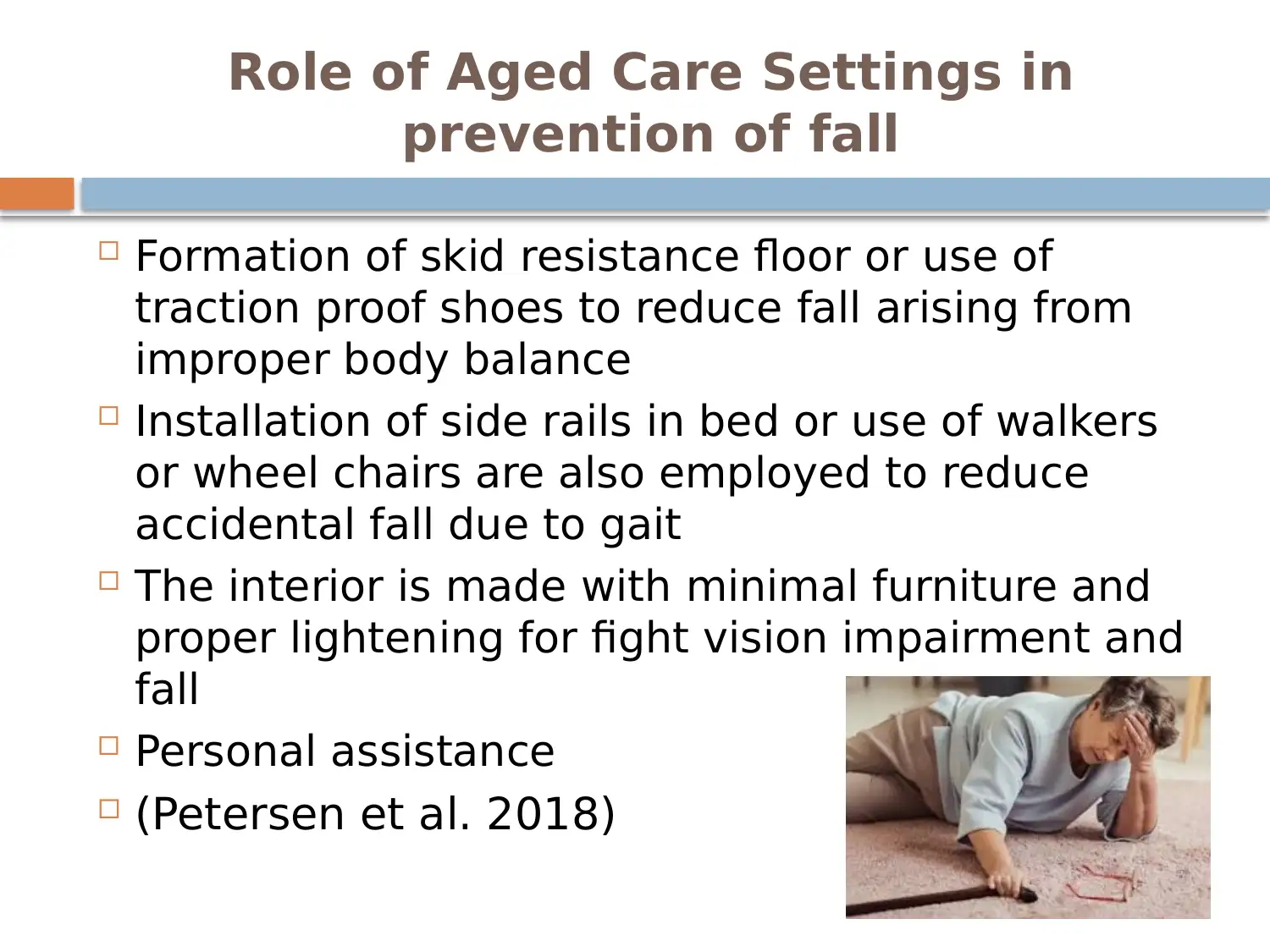
Formation of skid resistance floor or use of
traction proof shoes to reduce fall arising from
improper body balance
Installation of side rails in bed or use of walkers
or wheel chairs are also employed to reduce
accidental fall due to gait
The interior is made with minimal furniture and
proper lightening for fight vision impairment and
fall
Personal assistance
(Petersen et al. 2018)
prevention of fall
Formation of skid resistance floor or use of
traction proof shoes to reduce fall arising from
improper body balance
Installation of side rails in bed or use of walkers
or wheel chairs are also employed to reduce
accidental fall due to gait
The interior is made with minimal furniture and
proper lightening for fight vision impairment and
fall
Personal assistance
(Petersen et al. 2018)
Paraphrase This Document
Need a fresh take? Get an instant paraphrase of this document with our AI Paraphraser

Fall Risk Assessment
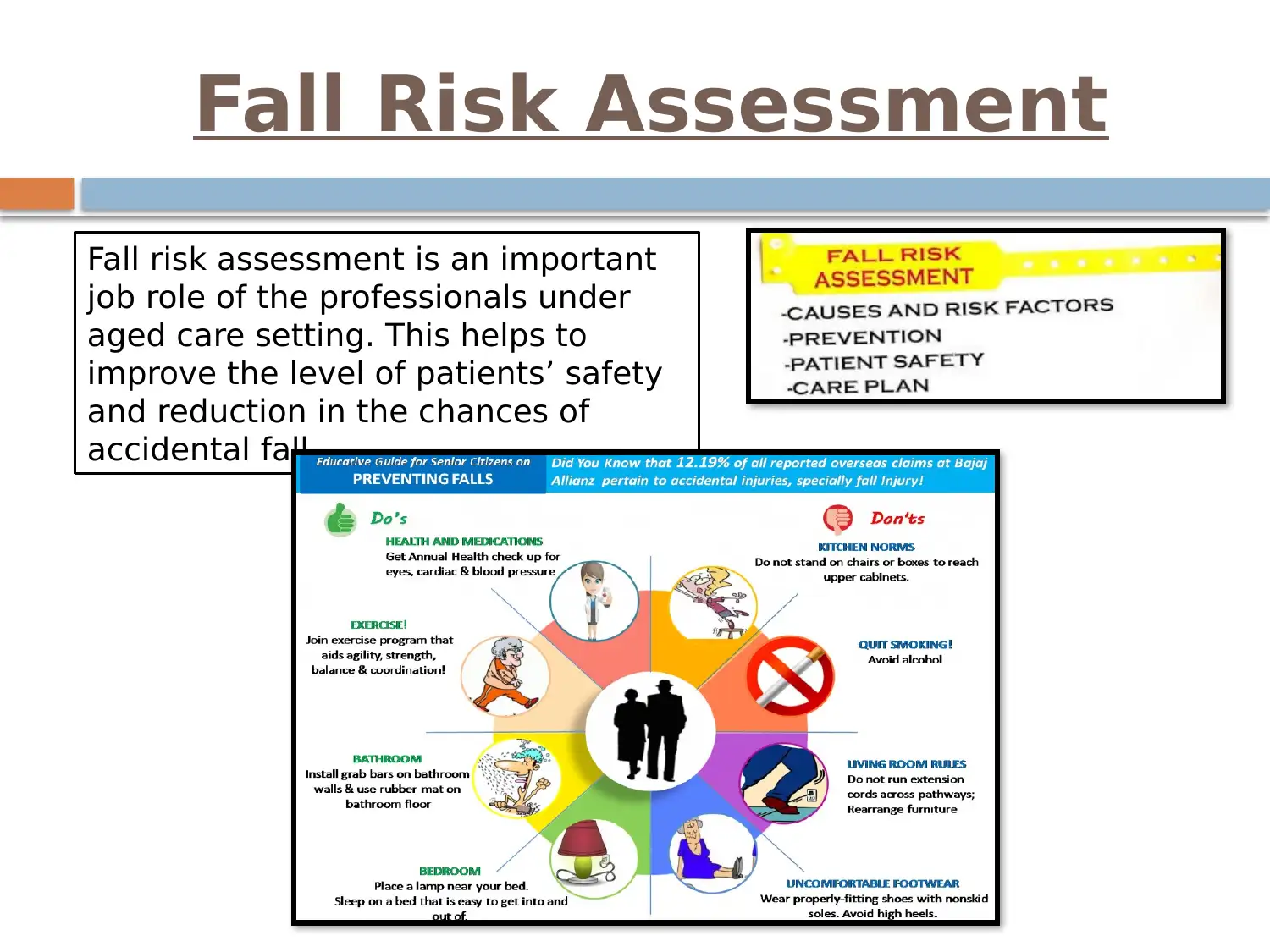
Fall risk assessment is an important
job role of the professionals under
aged care setting. This helps to
improve the level of patients’ safety
and reduction in the chances of
accidental fall
Fall risk assessment is an important
job role of the professionals under
aged care setting. This helps to
improve the level of patients’ safety
and reduction in the chances of
accidental fall

Dementia and Dysphagia
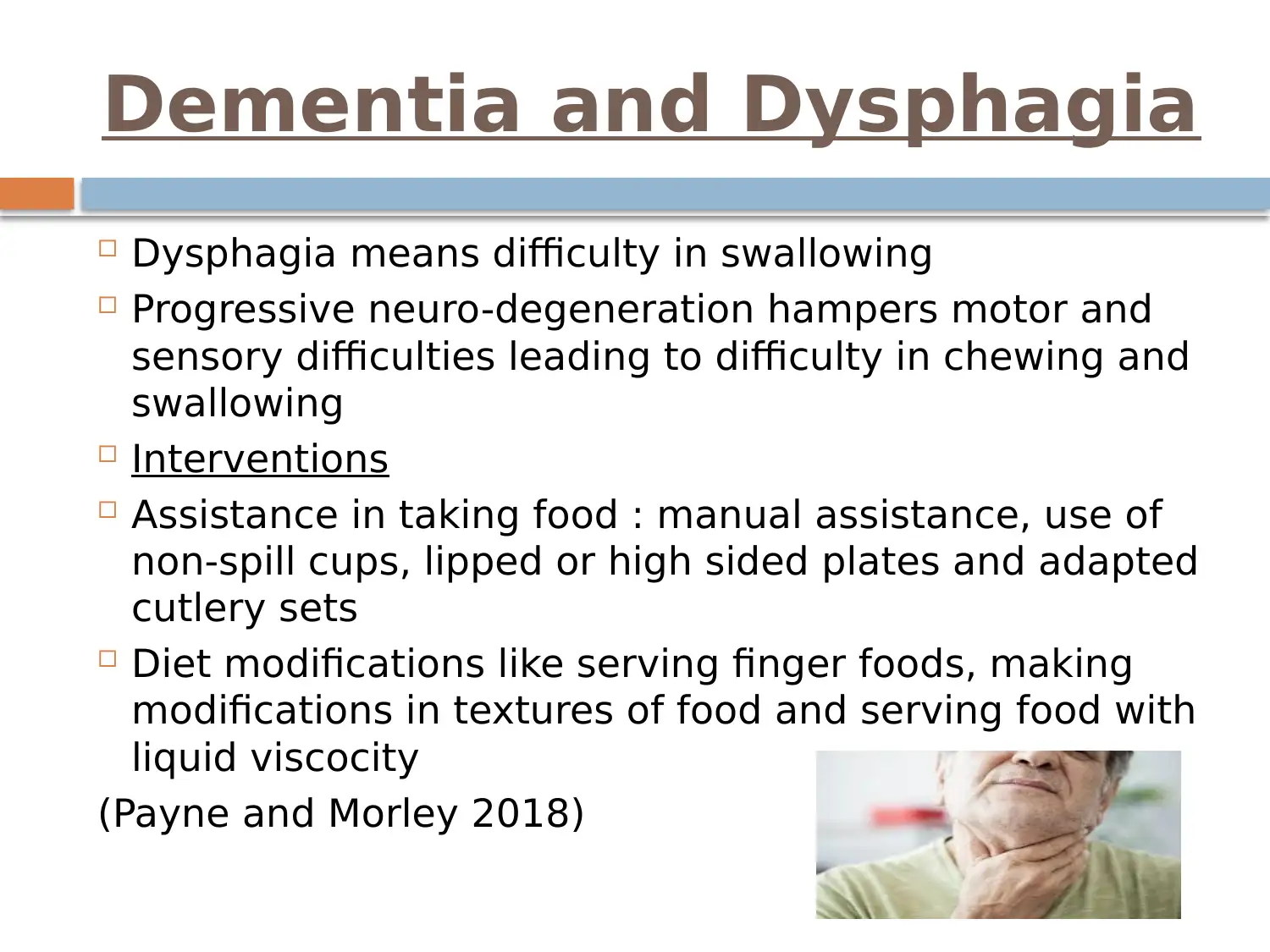
Dysphagia means difficulty in swallowing
Progressive neuro-degeneration hampers motor and
sensory difficulties leading to difficulty in chewing and
swallowing
Interventions
Assistance in taking food : manual assistance, use of
non-spill cups, lipped or high sided plates and adapted
cutlery sets
Diet modifications like serving finger foods, making
modifications in textures of food and serving food with
liquid viscocity
(Payne and Morley 2018)
Dysphagia means difficulty in swallowing
Progressive neuro-degeneration hampers motor and
sensory difficulties leading to difficulty in chewing and
swallowing
Interventions
Assistance in taking food : manual assistance, use of
non-spill cups, lipped or high sided plates and adapted
cutlery sets
Diet modifications like serving finger foods, making
modifications in textures of food and serving food with
liquid viscocity
(Payne and Morley 2018)
⊘ This is a preview!⊘
Do you want full access?
Subscribe today to unlock all pages.

Trusted by 1+ million students worldwide

Interventions of
Dysphagia
Other interventions
Reducing distractions, restricting
background noise, creating routines for
meal time (Payne and Morley 2018)
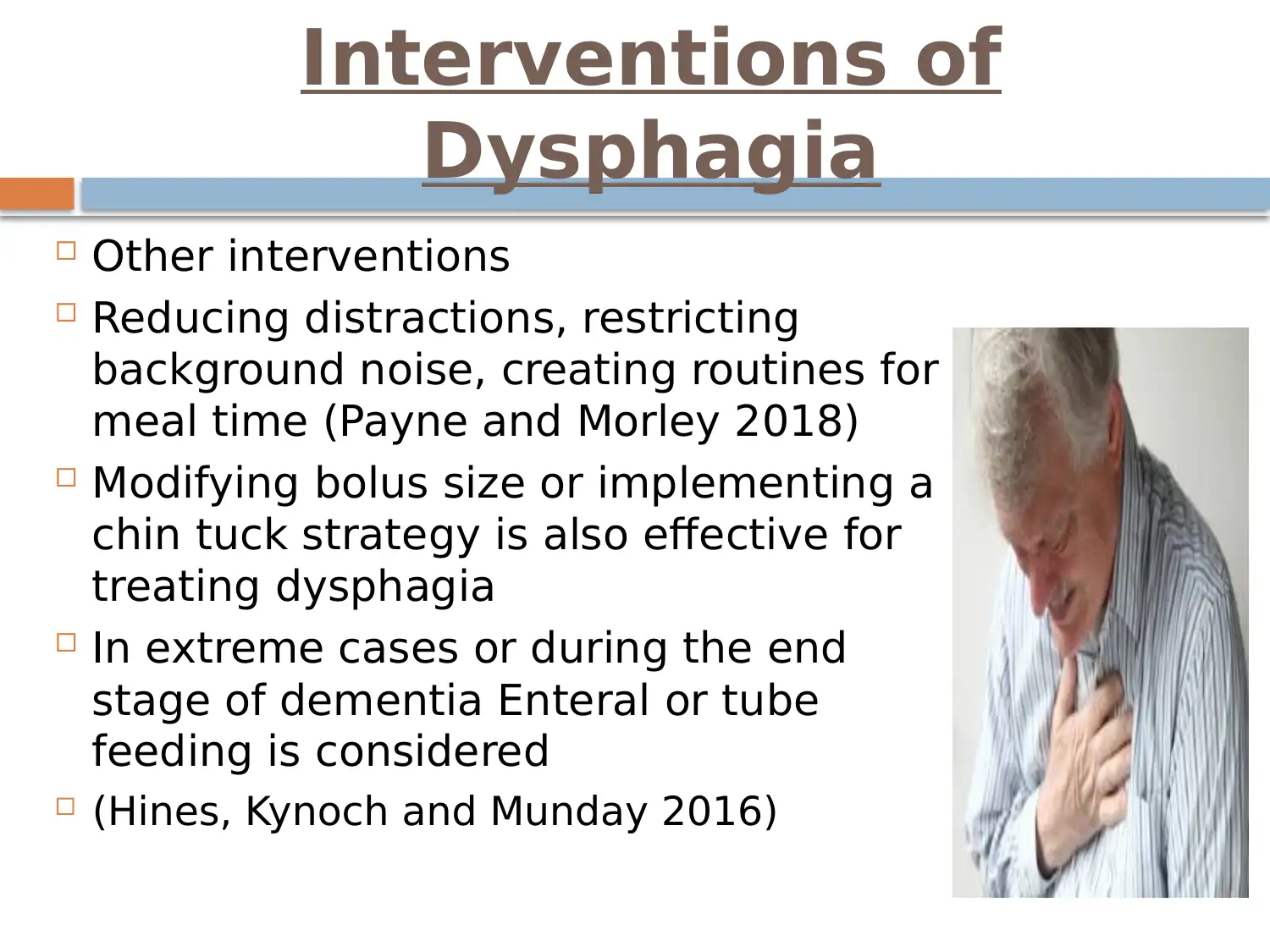
Modifying bolus size or implementing a
chin tuck strategy is also effective for
treating dysphagia
In extreme cases or during the end
stage of dementia Enteral or tube
feeding is considered
(Hines, Kynoch and Munday 2016)
Dysphagia
Other interventions
Reducing distractions, restricting
background noise, creating routines for
meal time (Payne and Morley 2018)
Modifying bolus size or implementing a
chin tuck strategy is also effective for
treating dysphagia
In extreme cases or during the end
stage of dementia Enteral or tube
feeding is considered
(Hines, Kynoch and Munday 2016)
Paraphrase This Document
Need a fresh take? Get an instant paraphrase of this document with our AI Paraphraser

Primary health care and
screening
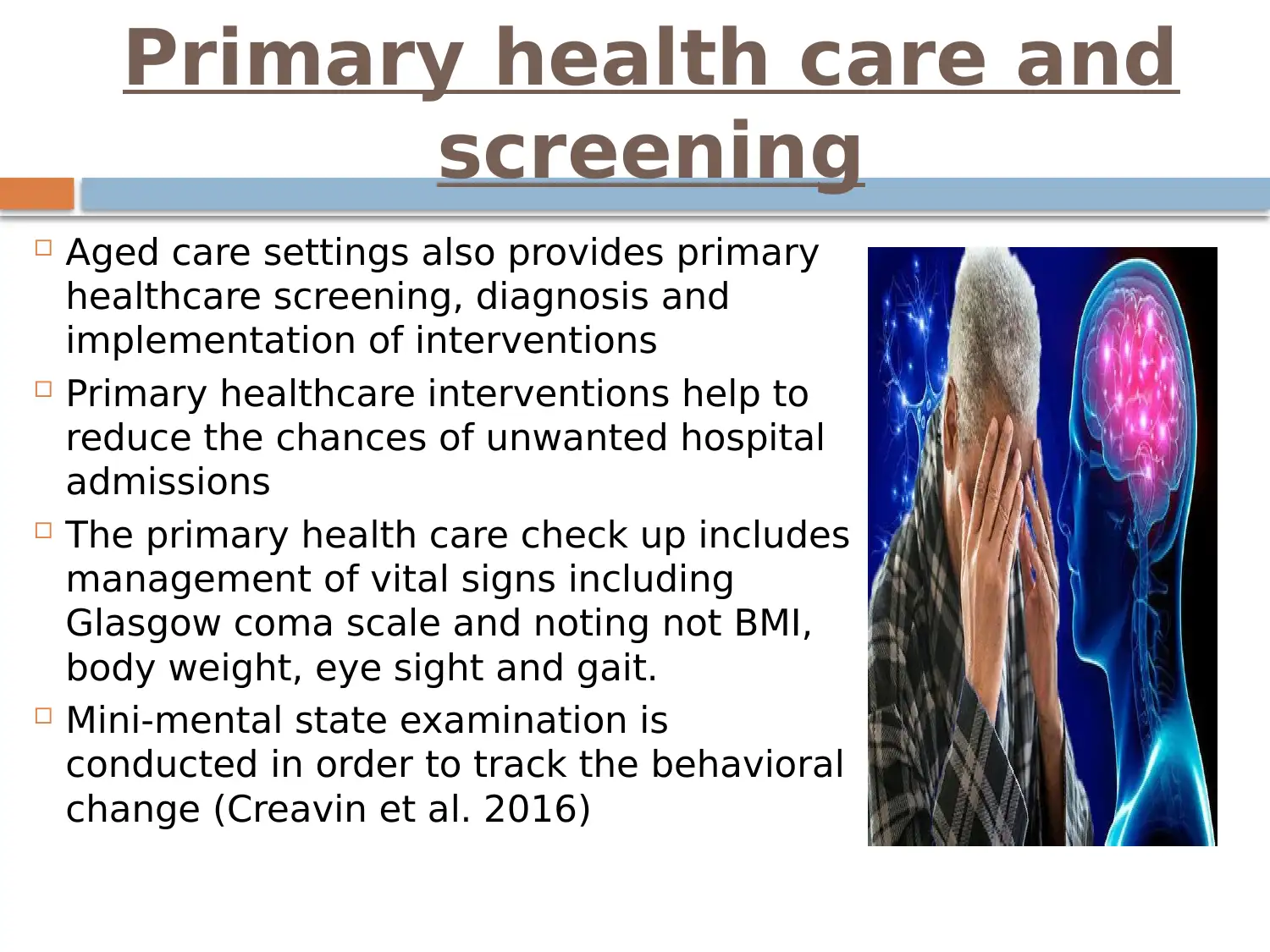
Aged care settings also provides primary
healthcare screening, diagnosis and
implementation of interventions
Primary healthcare interventions help to
reduce the chances of unwanted hospital
admissions
The primary health care check up includes
management of vital signs including
Glasgow coma scale and noting not BMI,
body weight, eye sight and gait.
Mini-mental state examination is
conducted in order to track the behavioral
change (Creavin et al. 2016)
screening
Aged care settings also provides primary
healthcare screening, diagnosis and
implementation of interventions
Primary healthcare interventions help to
reduce the chances of unwanted hospital
admissions
The primary health care check up includes
management of vital signs including
Glasgow coma scale and noting not BMI,
body weight, eye sight and gait.
Mini-mental state examination is
conducted in order to track the behavioral
change (Creavin et al. 2016)

Healthy aging
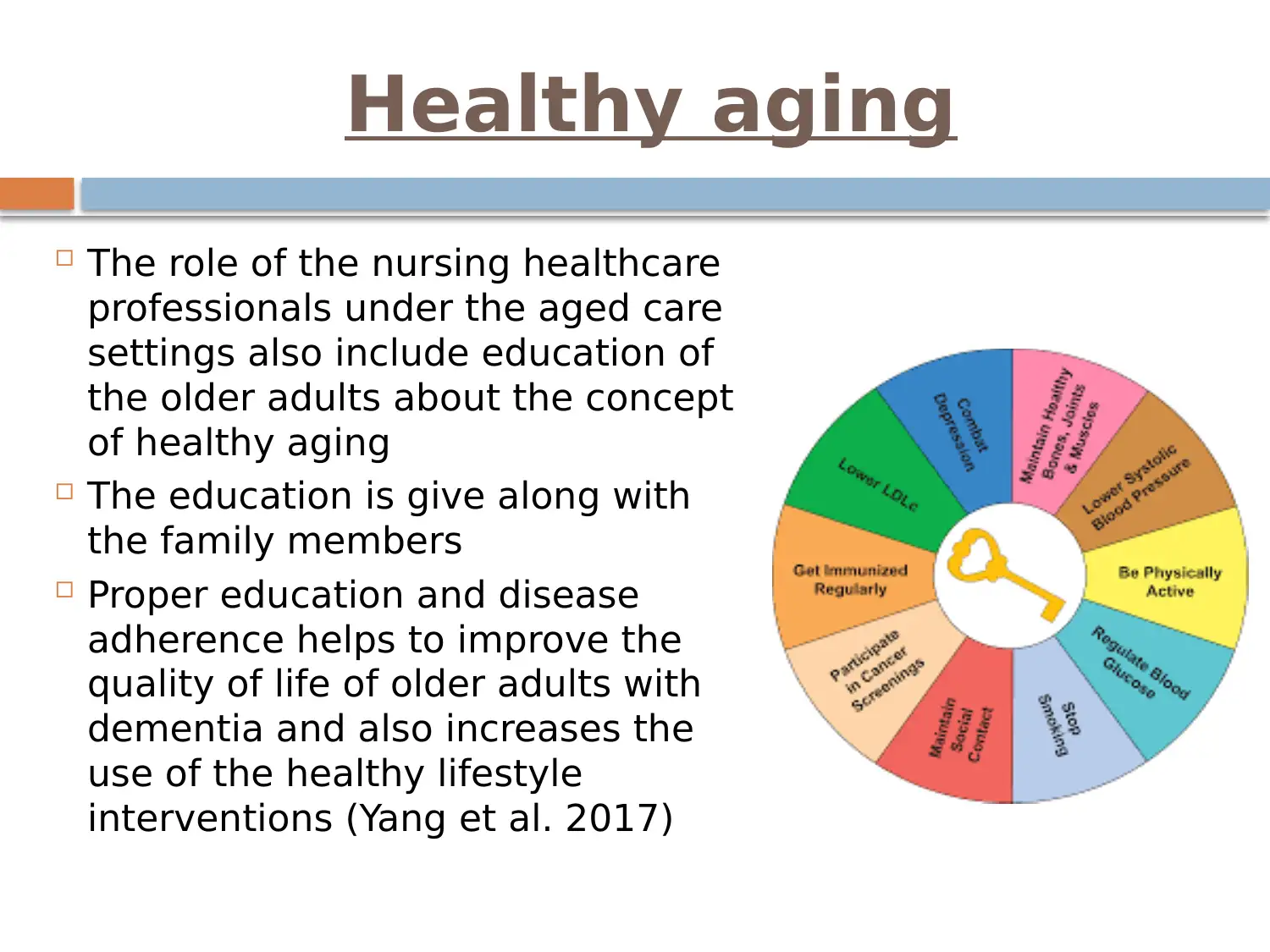
The role of the nursing healthcare
professionals under the aged care
settings also include education of
the older adults about the concept
of healthy aging
The education is give along with
the family members
Proper education and disease
adherence helps to improve the
quality of life of older adults with
dementia and also increases the
use of the healthy lifestyle
interventions (Yang et al. 2017)
The role of the nursing healthcare
professionals under the aged care
settings also include education of
the older adults about the concept
of healthy aging
The education is give along with
the family members
Proper education and disease
adherence helps to improve the
quality of life of older adults with
dementia and also increases the
use of the healthy lifestyle
interventions (Yang et al. 2017)
⊘ This is a preview!⊘
Do you want full access?
Subscribe today to unlock all pages.

Trusted by 1+ million students worldwide

Conclusion
Thus from the above discussion it can be
concluded that patients of dementia suffers fro
Accidental fall
Dysphagia
Other health related comorbidities
Staying under the aged care facility helps to
improve the quality of life of the older adults
with dementia and reducing the severity of the
diease
Thus from the above discussion it can be
concluded that patients of dementia suffers fro
Accidental fall
Dysphagia
Other health related comorbidities
Staying under the aged care facility helps to
improve the quality of life of the older adults
with dementia and reducing the severity of the
diease
Paraphrase This Document
Need a fresh take? Get an instant paraphrase of this document with our AI Paraphraser

References
Chang, Y.C., Wang, J.D., Chen, H.C. and Hu, S.C., 2017. Aerobic-synergized exercises may improve fall-related
physical fitness in older adults. The Journal of sports medicine and physical fitness, 57(5), pp.660-669.
Creavin, S.T., Wisniewski, S., Noel‐Storr, A.H., Trevelyan, C.M., Hampton, T., Rayment, D., Thom, V.M., Nash, K.J.,
Elhamoui, H., Milligan, R. and Patel, A.S., 2016. Mini‐Mental State Examination (MMSE) for the detection of
dementia in clinically unevaluated people aged 65 and over in community and primary care
populations. Cochrane Database of Systematic Reviews, (1).
Fernando, E., Fraser, M., Hendriksen, J., Kim, C.H. and Muir-Hunter, S.W., 2017. Risk factors associated with falls
in older adults with dementia: a systematic review. Physiotherapy Canada, 69(2), pp.161-170.
Hines, S., Kynoch, K. and Munday, J., 2016. Nursing interventions for identifying and managing acute dysphagia
are effective for improving patient outcomes: a systematic review update. Journal of Neuroscience
Nursing, 48(4), pp.215-223.
Meuleners, L.B., Fraser, M.L., Bulsara, M.K., Chow, K. and Ng, J.Q., 2016. Risk factors for recurrent injurious falls
that require hospitalization for older adults with dementia: a population based study. BMC neurology, 16(1),
p.188.
Payne, M. and Morley, J.E., 2018. Dysphagia, dementia and frailty. Access date: 13th June. Retrieved from:
https://link.springer.com/article/10.1007/s12603-018-1033-5
Petersen, J.D., Siersma, V.D., dePont Christensen, R., Storsveen, M.M., Nielsen, C.T. and Waldorff, F.B., 2018.
The risk of fall accidents for home dwellers with dementia—A register-and population-based case-control
study. Alzheimer's & Dementia: Diagnosis, Assessment & Disease Monitoring, 10, pp.421-428.
Smee, D.J., Pumpa, K., Falchi, M. and Lithander, F.E., 2015. The relationship between diet quality and falls risk,
physical function and body composition in older adults. The journal of nutrition, health & aging, 19(10),
pp.1037-1042.
Yang, L., Qi, X., Liu, W., Wang, Y., Ge, L. and Yao, H., 2017. Brief Discussion on Seniors Care Mode of Medical-
Seniors Care Integration in the View of Healthy Aging. Open Journal of Social Sciences, 5(06), p.37.
Chang, Y.C., Wang, J.D., Chen, H.C. and Hu, S.C., 2017. Aerobic-synergized exercises may improve fall-related
physical fitness in older adults. The Journal of sports medicine and physical fitness, 57(5), pp.660-669.
Creavin, S.T., Wisniewski, S., Noel‐Storr, A.H., Trevelyan, C.M., Hampton, T., Rayment, D., Thom, V.M., Nash, K.J.,
Elhamoui, H., Milligan, R. and Patel, A.S., 2016. Mini‐Mental State Examination (MMSE) for the detection of
dementia in clinically unevaluated people aged 65 and over in community and primary care
populations. Cochrane Database of Systematic Reviews, (1).
Fernando, E., Fraser, M., Hendriksen, J., Kim, C.H. and Muir-Hunter, S.W., 2017. Risk factors associated with falls
in older adults with dementia: a systematic review. Physiotherapy Canada, 69(2), pp.161-170.
Hines, S., Kynoch, K. and Munday, J., 2016. Nursing interventions for identifying and managing acute dysphagia
are effective for improving patient outcomes: a systematic review update. Journal of Neuroscience
Nursing, 48(4), pp.215-223.
Meuleners, L.B., Fraser, M.L., Bulsara, M.K., Chow, K. and Ng, J.Q., 2016. Risk factors for recurrent injurious falls
that require hospitalization for older adults with dementia: a population based study. BMC neurology, 16(1),
p.188.
Payne, M. and Morley, J.E., 2018. Dysphagia, dementia and frailty. Access date: 13th June. Retrieved from:
https://link.springer.com/article/10.1007/s12603-018-1033-5
Petersen, J.D., Siersma, V.D., dePont Christensen, R., Storsveen, M.M., Nielsen, C.T. and Waldorff, F.B., 2018.
The risk of fall accidents for home dwellers with dementia—A register-and population-based case-control
study. Alzheimer's & Dementia: Diagnosis, Assessment & Disease Monitoring, 10, pp.421-428.
Smee, D.J., Pumpa, K., Falchi, M. and Lithander, F.E., 2015. The relationship between diet quality and falls risk,
physical function and body composition in older adults. The journal of nutrition, health & aging, 19(10),
pp.1037-1042.
Yang, L., Qi, X., Liu, W., Wang, Y., Ge, L. and Yao, H., 2017. Brief Discussion on Seniors Care Mode of Medical-
Seniors Care Integration in the View of Healthy Aging. Open Journal of Social Sciences, 5(06), p.37.

⊘ This is a preview!⊘
Do you want full access?
Subscribe today to unlock all pages.

Trusted by 1+ million students worldwide
1 out of 12
Related Documents
Your All-in-One AI-Powered Toolkit for Academic Success.
+13062052269
info@desklib.com
Available 24*7 on WhatsApp / Email
Unlock your academic potential
Copyright © 2020–2026 A2Z Services. All Rights Reserved. Developed and managed by ZUCOL.