Corporate Finance and Business Valuation of River Island Report
VerifiedAdded on 2023/01/17
|17
|4722
|76
Report
AI Summary
This report provides a comprehensive analysis of the financial situation and business valuation of River Island Clothing Co. Ltd. It begins with an overview of the company's background and the external environment, including market trends and competitive forces. The report then delves into a detailed financial analysis, utilizing ratio analysis to assess liquidity, profitability, and efficiency. It explores the current and quick ratios, as well as the return on assets, to evaluate the company's financial health. The report also forecasts future revenue and profitability using the geometric mean method. Furthermore, the report discusses the weighted average cost of capital (WACC) calculation, which is crucial for determining the discount rate in the discounted cash flow (DCF) valuation. It explains the components of WACC, including the cost of equity and the cost of debt. The report then provides a qualitative assessment of the company's value using the DCF method, outlining the key assumptions and methodologies employed. It also includes sensitivity analysis to assess the impact of different assumptions on the valuation results. Finally, the report concludes with a critique of the valuation models and a summary of the key findings.

Corporate finance and the business valuation

Paraphrase This Document
Need a fresh take? Get an instant paraphrase of this document with our AI Paraphraser
Contents
Analysis of the current business and the financial situation of the river clothing co. ltd........................3
Background.......................................................................................................................................3
External environment........................................................................................................................3
Analysis.................................................................................................................................................3
Appraisal and assessment of the appropriate weighted average cost of capital......................................7
A qualitative assessment of the value using the discounted cash flow...................................................8
Key Assumptions in Valuation and Sensitivity Analysis.....................................................................11
Methodologies for Valuation of Shares...............................................................................................14
Conclusion...........................................................................................................................................14
References...........................................................................................................................................16
Analysis of the current business and the financial situation of the river clothing co. ltd........................3
Background.......................................................................................................................................3
External environment........................................................................................................................3
Analysis.................................................................................................................................................3
Appraisal and assessment of the appropriate weighted average cost of capital......................................7
A qualitative assessment of the value using the discounted cash flow...................................................8
Key Assumptions in Valuation and Sensitivity Analysis.....................................................................11
Methodologies for Valuation of Shares...............................................................................................14
Conclusion...........................................................................................................................................14
References...........................................................................................................................................16
Analysis of the current business and the financial situation of the river clothing co. ltd.
Background
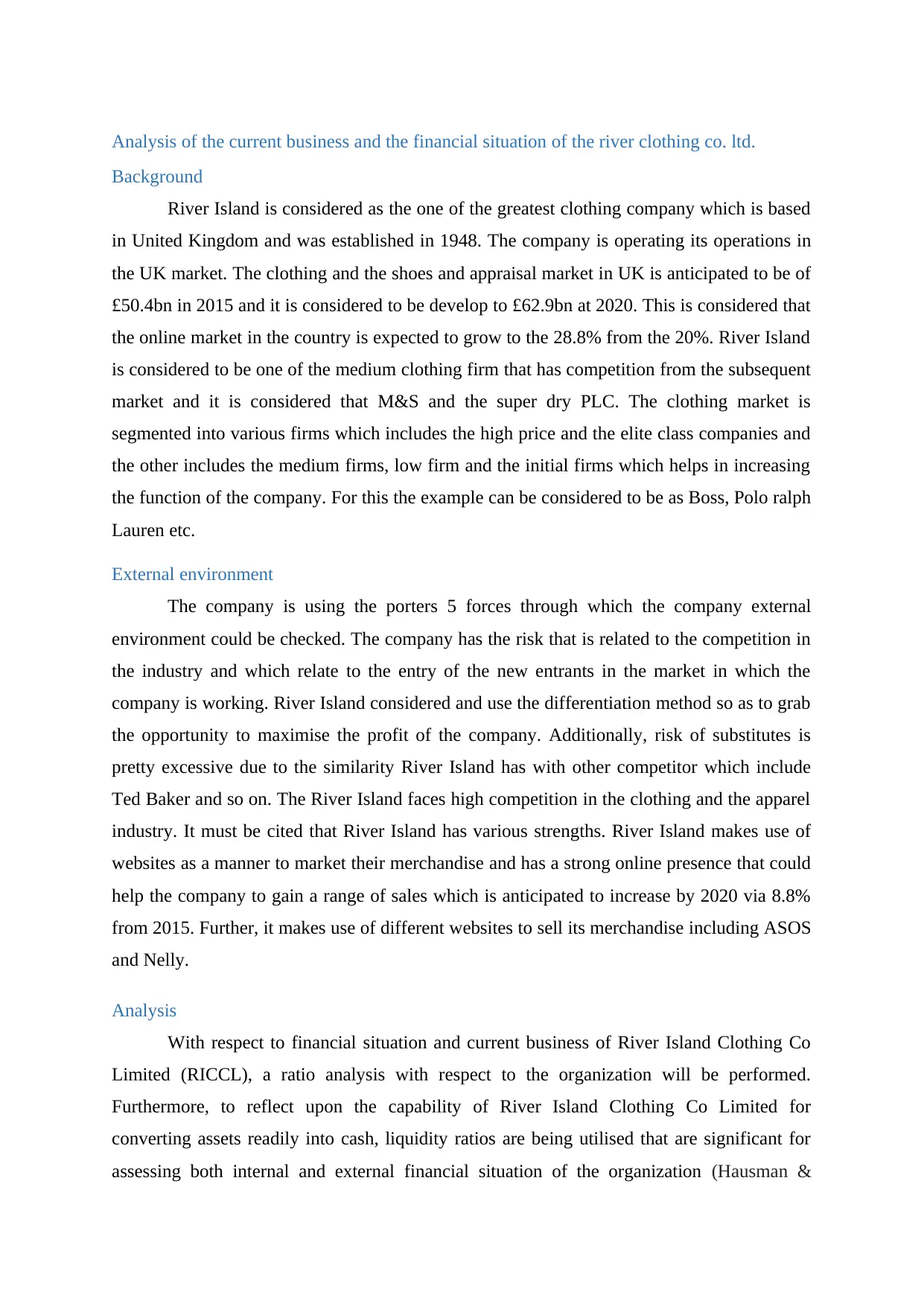
River Island is considered as the one of the greatest clothing company which is based
in United Kingdom and was established in 1948. The company is operating its operations in
the UK market. The clothing and the shoes and appraisal market in UK is anticipated to be of
£50.4bn in 2015 and it is considered to be develop to £62.9bn at 2020. This is considered that
the online market in the country is expected to grow to the 28.8% from the 20%. River Island
is considered to be one of the medium clothing firm that has competition from the subsequent
market and it is considered that M&S and the super dry PLC. The clothing market is
segmented into various firms which includes the high price and the elite class companies and
the other includes the medium firms, low firm and the initial firms which helps in increasing
the function of the company. For this the example can be considered to be as Boss, Polo ralph
Lauren etc.
External environment
The company is using the porters 5 forces through which the company external
environment could be checked. The company has the risk that is related to the competition in
the industry and which relate to the entry of the new entrants in the market in which the
company is working. River Island considered and use the differentiation method so as to grab
the opportunity to maximise the profit of the company. Additionally, risk of substitutes is
pretty excessive due to the similarity River Island has with other competitor which include
Ted Baker and so on. The River Island faces high competition in the clothing and the apparel
industry. It must be cited that River Island has various strengths. River Island makes use of
websites as a manner to market their merchandise and has a strong online presence that could
help the company to gain a range of sales which is anticipated to increase by 2020 via 8.8%
from 2015. Further, it makes use of different websites to sell its merchandise including ASOS
and Nelly.
Analysis
With respect to financial situation and current business of River Island Clothing Co
Limited (RICCL), a ratio analysis with respect to the organization will be performed.
Furthermore, to reflect upon the capability of River Island Clothing Co Limited for
converting assets readily into cash, liquidity ratios are being utilised that are significant for
assessing both internal and external financial situation of the organization (Hausman &
Background
River Island is considered as the one of the greatest clothing company which is based
in United Kingdom and was established in 1948. The company is operating its operations in
the UK market. The clothing and the shoes and appraisal market in UK is anticipated to be of
£50.4bn in 2015 and it is considered to be develop to £62.9bn at 2020. This is considered that
the online market in the country is expected to grow to the 28.8% from the 20%. River Island
is considered to be one of the medium clothing firm that has competition from the subsequent
market and it is considered that M&S and the super dry PLC. The clothing market is
segmented into various firms which includes the high price and the elite class companies and
the other includes the medium firms, low firm and the initial firms which helps in increasing
the function of the company. For this the example can be considered to be as Boss, Polo ralph
Lauren etc.
External environment
The company is using the porters 5 forces through which the company external
environment could be checked. The company has the risk that is related to the competition in
the industry and which relate to the entry of the new entrants in the market in which the
company is working. River Island considered and use the differentiation method so as to grab
the opportunity to maximise the profit of the company. Additionally, risk of substitutes is
pretty excessive due to the similarity River Island has with other competitor which include
Ted Baker and so on. The River Island faces high competition in the clothing and the apparel
industry. It must be cited that River Island has various strengths. River Island makes use of
websites as a manner to market their merchandise and has a strong online presence that could
help the company to gain a range of sales which is anticipated to increase by 2020 via 8.8%
from 2015. Further, it makes use of different websites to sell its merchandise including ASOS
and Nelly.
Analysis
With respect to financial situation and current business of River Island Clothing Co
Limited (RICCL), a ratio analysis with respect to the organization will be performed.
Furthermore, to reflect upon the capability of River Island Clothing Co Limited for
converting assets readily into cash, liquidity ratios are being utilised that are significant for
assessing both internal and external financial situation of the organization (Hausman &
⊘ This is a preview!⊘
Do you want full access?
Subscribe today to unlock all pages.

Trusted by 1+ million students worldwide
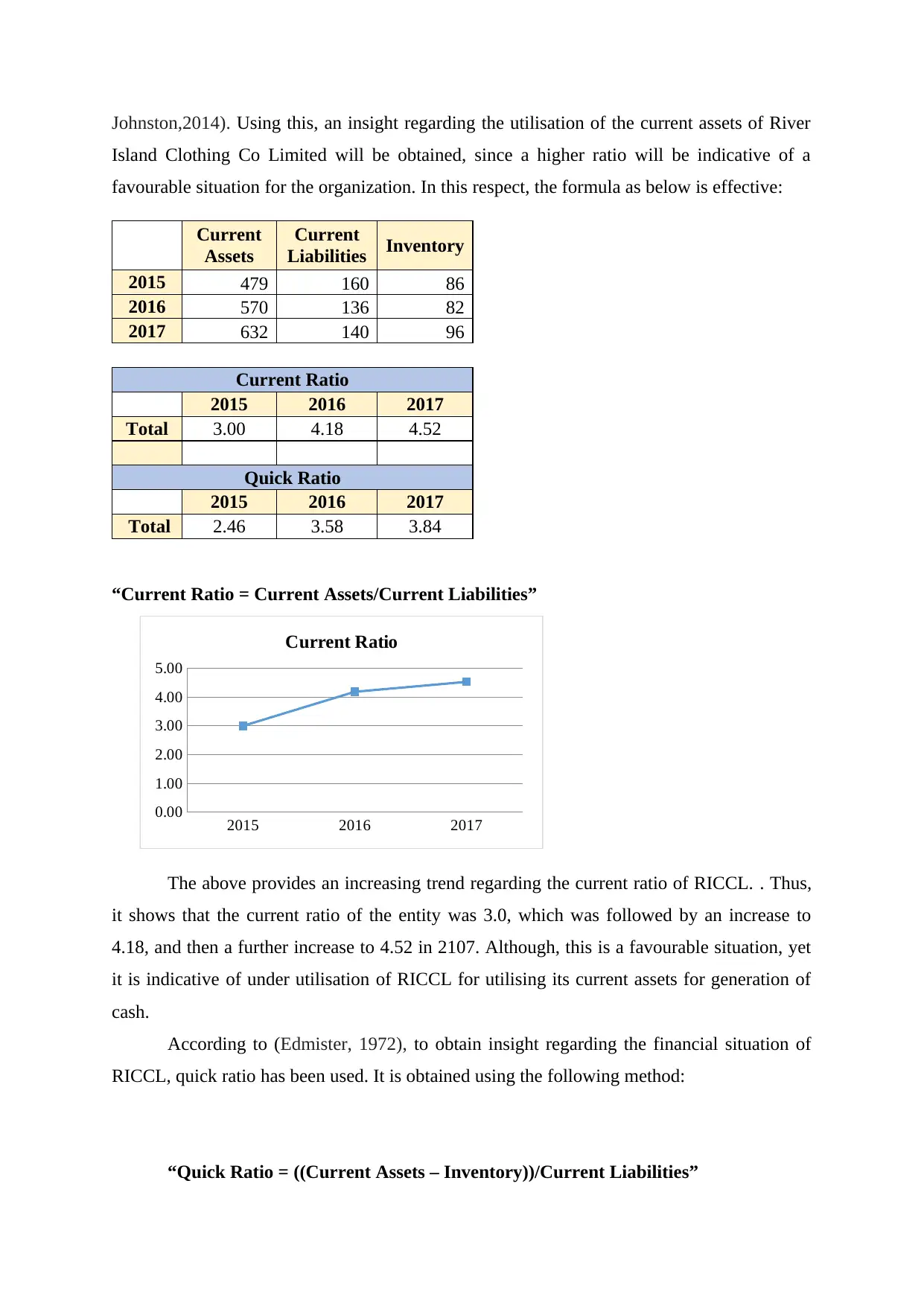
Johnston,2014). Using this, an insight regarding the utilisation of the current assets of River
Island Clothing Co Limited will be obtained, since a higher ratio will be indicative of a
favourable situation for the organization. In this respect, the formula as below is effective:
Current
Assets
Current
Liabilities Inventory
2015 479 160 86
2016 570 136 82
2017 632 140 96
Current Ratio
2015 2016 2017
Total 3.00 4.18 4.52
Quick Ratio
2015 2016 2017
Total 2.46 3.58 3.84
“Current Ratio = Current Assets/Current Liabilities”
2015 2016 2017
0.00
1.00
2.00
3.00
4.00
5.00
Current Ratio
The above provides an increasing trend regarding the current ratio of RICCL. . Thus,
it shows that the current ratio of the entity was 3.0, which was followed by an increase to
4.18, and then a further increase to 4.52 in 2107. Although, this is a favourable situation, yet
it is indicative of under utilisation of RICCL for utilising its current assets for generation of
cash.
According to (Edmister, 1972), to obtain insight regarding the financial situation of
RICCL, quick ratio has been used. It is obtained using the following method:
“Quick Ratio = ((Current Assets – Inventory))/Current Liabilities”
Island Clothing Co Limited will be obtained, since a higher ratio will be indicative of a
favourable situation for the organization. In this respect, the formula as below is effective:
Current
Assets
Current
Liabilities Inventory
2015 479 160 86
2016 570 136 82
2017 632 140 96
Current Ratio
2015 2016 2017
Total 3.00 4.18 4.52
Quick Ratio
2015 2016 2017
Total 2.46 3.58 3.84
“Current Ratio = Current Assets/Current Liabilities”
2015 2016 2017
0.00
1.00
2.00
3.00
4.00
5.00
Current Ratio
The above provides an increasing trend regarding the current ratio of RICCL. . Thus,
it shows that the current ratio of the entity was 3.0, which was followed by an increase to
4.18, and then a further increase to 4.52 in 2107. Although, this is a favourable situation, yet
it is indicative of under utilisation of RICCL for utilising its current assets for generation of
cash.
According to (Edmister, 1972), to obtain insight regarding the financial situation of
RICCL, quick ratio has been used. It is obtained using the following method:
“Quick Ratio = ((Current Assets – Inventory))/Current Liabilities”
Paraphrase This Document
Need a fresh take? Get an instant paraphrase of this document with our AI Paraphraser
2015 2016 2017
0.00
0.50
1.00
1.50
2.00
2.50
3.00
3.50
4.00
4.50
Quick Ratio
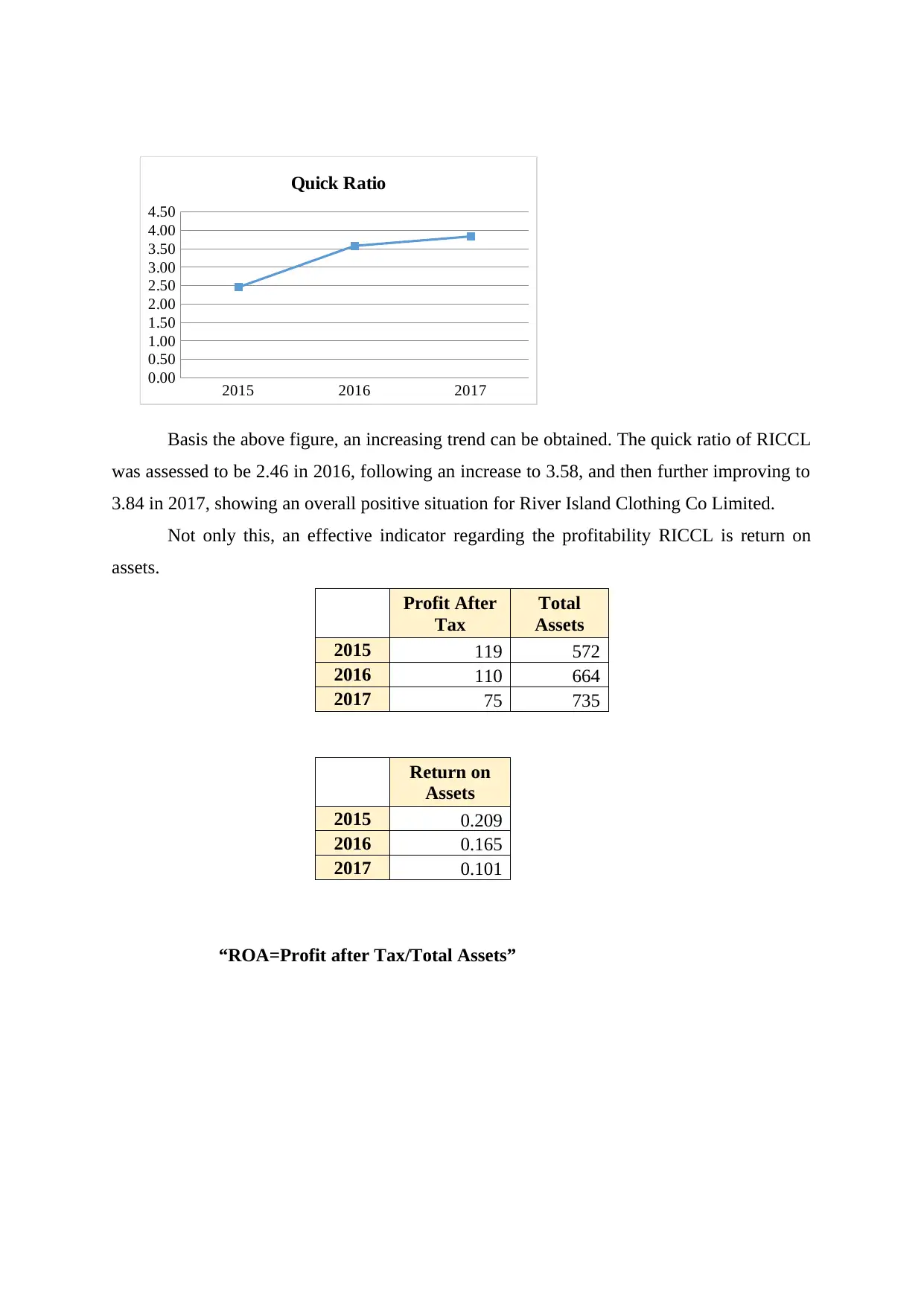
Basis the above figure, an increasing trend can be obtained. The quick ratio of RICCL
was assessed to be 2.46 in 2016, following an increase to 3.58, and then further improving to
3.84 in 2017, showing an overall positive situation for River Island Clothing Co Limited.
Not only this, an effective indicator regarding the profitability RICCL is return on
assets.
Profit After
Tax
Total
Assets
2015 119 572
2016 110 664
2017 75 735
Return on
Assets
2015 0.209
2016 0.165
2017 0.101
“ROA=Profit after Tax/Total Assets”
0.00
0.50
1.00
1.50
2.00
2.50
3.00
3.50
4.00
4.50
Quick Ratio
Basis the above figure, an increasing trend can be obtained. The quick ratio of RICCL
was assessed to be 2.46 in 2016, following an increase to 3.58, and then further improving to
3.84 in 2017, showing an overall positive situation for River Island Clothing Co Limited.
Not only this, an effective indicator regarding the profitability RICCL is return on
assets.
Profit After
Tax
Total
Assets
2015 119 572
2016 110 664
2017 75 735
Return on
Assets
2015 0.209
2016 0.165
2017 0.101
“ROA=Profit after Tax/Total Assets”
2015 2016 2017
0.000
0.050
0.100
0.150
0.200
0.250
Return on Assets
Return on Assets
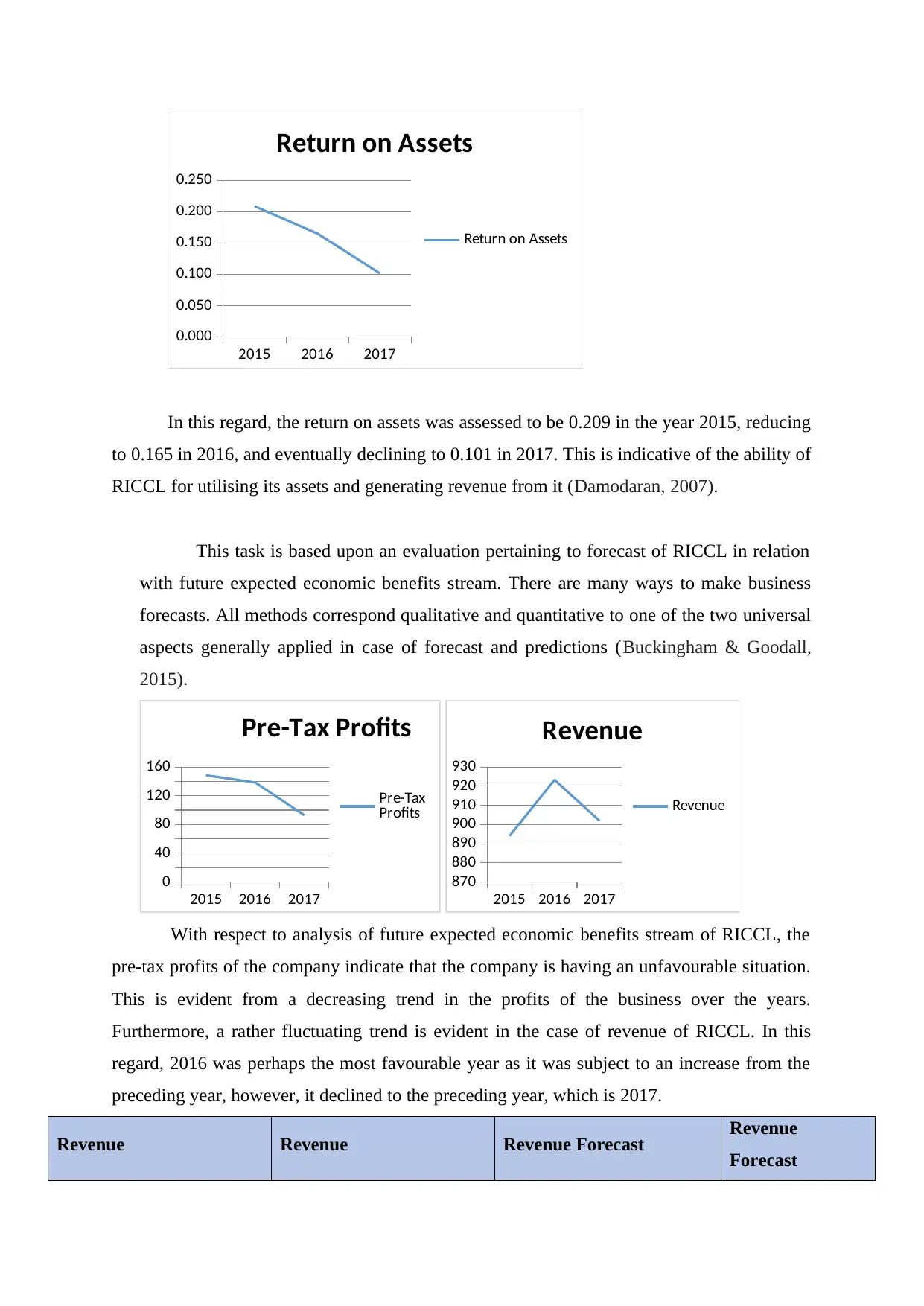
In this regard, the return on assets was assessed to be 0.209 in the year 2015, reducing
to 0.165 in 2016, and eventually declining to 0.101 in 2017. This is indicative of the ability of
RICCL for utilising its assets and generating revenue from it (Damodaran, 2007).
This task is based upon an evaluation pertaining to forecast of RICCL in relation
with future expected economic benefits stream. There are many ways to make business
forecasts. All methods correspond qualitative and quantitative to one of the two universal
aspects generally applied in case of forecast and predictions (Buckingham & Goodall,
2015).
2015 2016 2017
0
40
80
120
160
Pre-Tax Profits
Pre-Tax
Profits
2015 2016 2017
870
880
890
900
910
920
930
Revenue
Revenue
With respect to analysis of future expected economic benefits stream of RICCL, the
pre-tax profits of the company indicate that the company is having an unfavourable situation.
This is evident from a decreasing trend in the profits of the business over the years.
Furthermore, a rather fluctuating trend is evident in the case of revenue of RICCL. In this
regard, 2016 was perhaps the most favourable year as it was subject to an increase from the
preceding year, however, it declined to the preceding year, which is 2017.
Revenue Revenue Revenue Forecast Revenue
Forecast
0.000
0.050
0.100
0.150
0.200
0.250
Return on Assets
Return on Assets
In this regard, the return on assets was assessed to be 0.209 in the year 2015, reducing
to 0.165 in 2016, and eventually declining to 0.101 in 2017. This is indicative of the ability of
RICCL for utilising its assets and generating revenue from it (Damodaran, 2007).
This task is based upon an evaluation pertaining to forecast of RICCL in relation
with future expected economic benefits stream. There are many ways to make business
forecasts. All methods correspond qualitative and quantitative to one of the two universal
aspects generally applied in case of forecast and predictions (Buckingham & Goodall,
2015).
2015 2016 2017
0
40
80
120
160
Pre-Tax Profits
Pre-Tax
Profits
2015 2016 2017
870
880
890
900
910
920
930
Revenue
Revenue
With respect to analysis of future expected economic benefits stream of RICCL, the
pre-tax profits of the company indicate that the company is having an unfavourable situation.
This is evident from a decreasing trend in the profits of the business over the years.
Furthermore, a rather fluctuating trend is evident in the case of revenue of RICCL. In this
regard, 2016 was perhaps the most favourable year as it was subject to an increase from the
preceding year, however, it declined to the preceding year, which is 2017.
Revenue Revenue Revenue Forecast Revenue
Forecast
⊘ This is a preview!⊘
Do you want full access?
Subscribe today to unlock all pages.
Trusted by 1+ million students worldwide
2012 2013 2014 2015 2016 2017 2018 2019 2020 2021 2022
739.70 809.50 890.40 894.00 923.30 901.90 938.38 976.34 1015.83 1056.9
2 1099.67
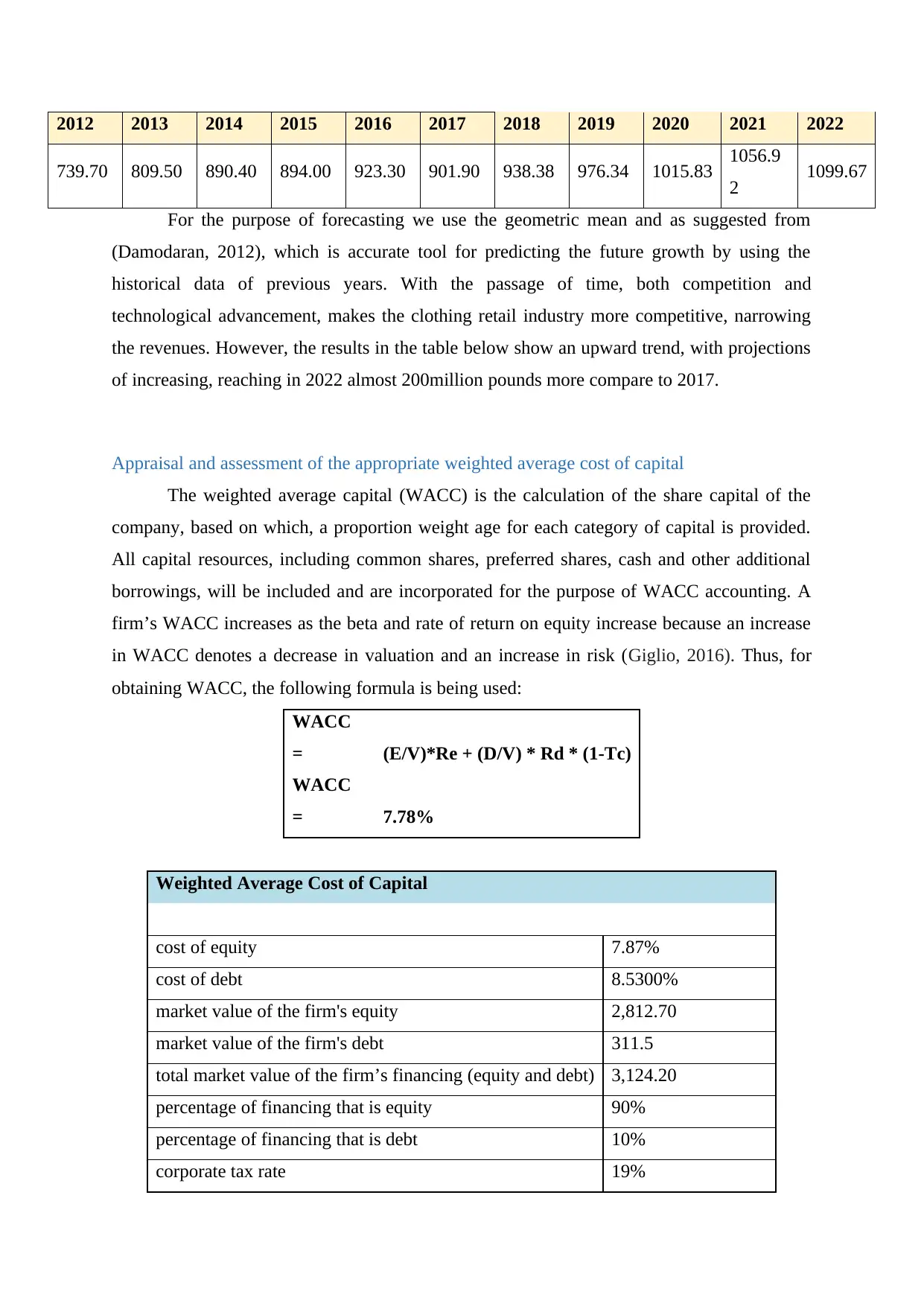
For the purpose of forecasting we use the geometric mean and as suggested from
(Damodaran, 2012), which is accurate tool for predicting the future growth by using the
historical data of previous years. With the passage of time, both competition and
technological advancement, makes the clothing retail industry more competitive, narrowing
the revenues. However, the results in the table below show an upward trend, with projections
of increasing, reaching in 2022 almost 200million pounds more compare to 2017.
Appraisal and assessment of the appropriate weighted average cost of capital
The weighted average capital (WACC) is the calculation of the share capital of the
company, based on which, a proportion weight age for each category of capital is provided.
All capital resources, including common shares, preferred shares, cash and other additional
borrowings, will be included and are incorporated for the purpose of WACC accounting. A
firm’s WACC increases as the beta and rate of return on equity increase because an increase
in WACC denotes a decrease in valuation and an increase in risk (Giglio, 2016). Thus, for
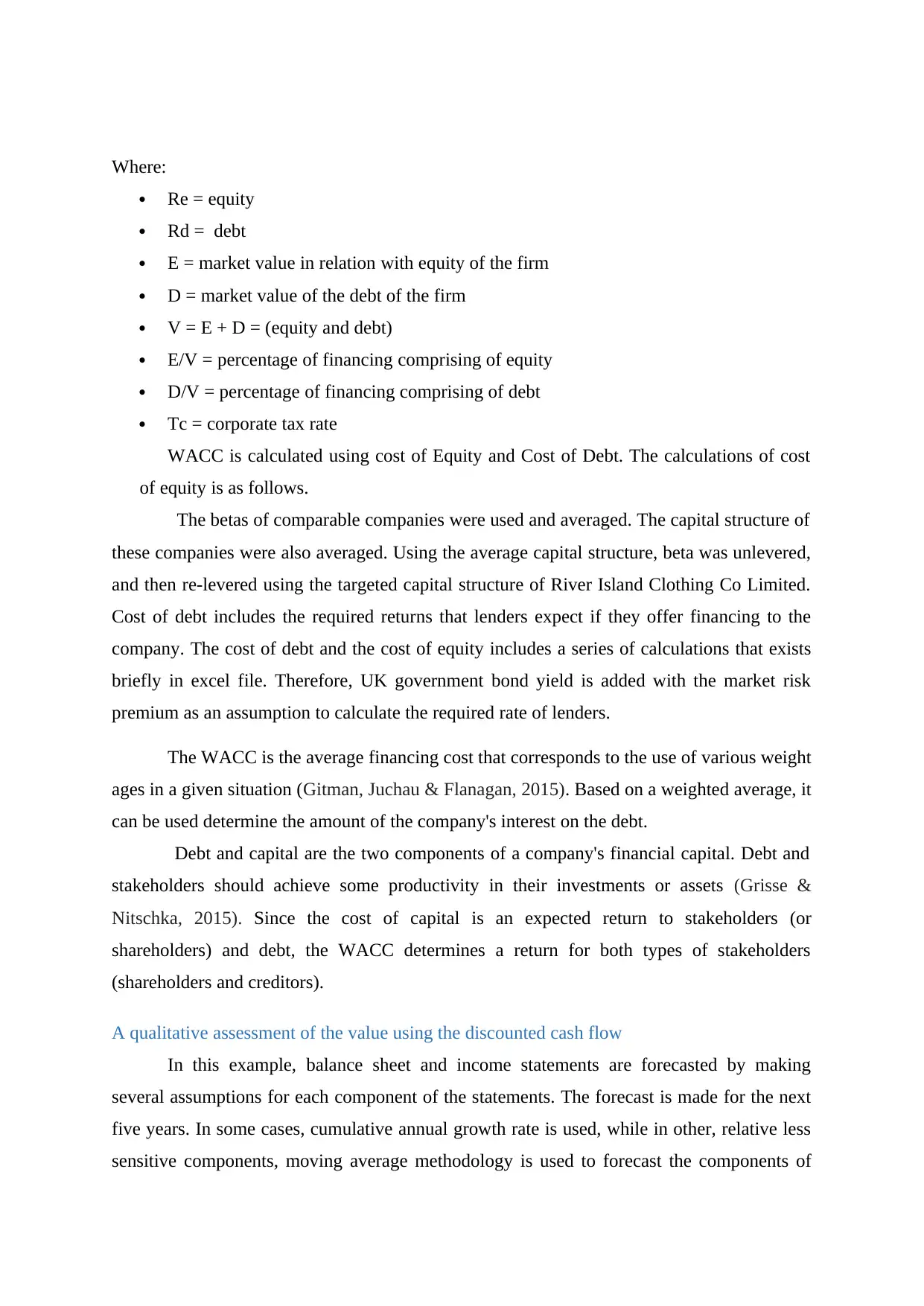
obtaining WACC, the following formula is being used:
WACC
= (E/V)*Re + (D/V) * Rd * (1-Tc)
WACC
= 7.78%
Weighted Average Cost of Capital
cost of equity 7.87%
cost of debt 8.5300%
market value of the firm's equity 2,812.70
market value of the firm's debt 311.5
total market value of the firm’s financing (equity and debt) 3,124.20
percentage of financing that is equity 90%
percentage of financing that is debt 10%
corporate tax rate 19%
739.70 809.50 890.40 894.00 923.30 901.90 938.38 976.34 1015.83 1056.9
2 1099.67
For the purpose of forecasting we use the geometric mean and as suggested from
(Damodaran, 2012), which is accurate tool for predicting the future growth by using the
historical data of previous years. With the passage of time, both competition and
technological advancement, makes the clothing retail industry more competitive, narrowing
the revenues. However, the results in the table below show an upward trend, with projections
of increasing, reaching in 2022 almost 200million pounds more compare to 2017.
Appraisal and assessment of the appropriate weighted average cost of capital
The weighted average capital (WACC) is the calculation of the share capital of the
company, based on which, a proportion weight age for each category of capital is provided.
All capital resources, including common shares, preferred shares, cash and other additional
borrowings, will be included and are incorporated for the purpose of WACC accounting. A
firm’s WACC increases as the beta and rate of return on equity increase because an increase
in WACC denotes a decrease in valuation and an increase in risk (Giglio, 2016). Thus, for
obtaining WACC, the following formula is being used:
WACC
= (E/V)*Re + (D/V) * Rd * (1-Tc)
WACC
= 7.78%
Weighted Average Cost of Capital
cost of equity 7.87%
cost of debt 8.5300%
market value of the firm's equity 2,812.70
market value of the firm's debt 311.5
total market value of the firm’s financing (equity and debt) 3,124.20
percentage of financing that is equity 90%
percentage of financing that is debt 10%
corporate tax rate 19%
Paraphrase This Document
Need a fresh take? Get an instant paraphrase of this document with our AI Paraphraser
Where:
Re = equity
Rd = debt
E = market value in relation with equity of the firm
D = market value of the debt of the firm
V = E + D = (equity and debt)
E/V = percentage of financing comprising of equity
D/V = percentage of financing comprising of debt
Tc = corporate tax rate
WACC is calculated using cost of Equity and Cost of Debt. The calculations of cost
of equity is as follows.
The betas of comparable companies were used and averaged. The capital structure of
these companies were also averaged. Using the average capital structure, beta was unlevered,
and then re-levered using the targeted capital structure of River Island Clothing Co Limited.
Cost of debt includes the required returns that lenders expect if they offer financing to the
company. The cost of debt and the cost of equity includes a series of calculations that exists
briefly in excel file. Therefore, UK government bond yield is added with the market risk
premium as an assumption to calculate the required rate of lenders.
The WACC is the average financing cost that corresponds to the use of various weight
ages in a given situation (Gitman, Juchau & Flanagan, 2015). Based on a weighted average, it
can be used determine the amount of the company's interest on the debt.
Debt and capital are the two components of a company's financial capital. Debt and
stakeholders should achieve some productivity in their investments or assets (Grisse &
Nitschka, 2015). Since the cost of capital is an expected return to stakeholders (or
shareholders) and debt, the WACC determines a return for both types of stakeholders
(shareholders and creditors).
A qualitative assessment of the value using the discounted cash flow
In this example, balance sheet and income statements are forecasted by making
several assumptions for each component of the statements. The forecast is made for the next
five years. In some cases, cumulative annual growth rate is used, while in other, relative less
sensitive components, moving average methodology is used to forecast the components of
Re = equity
Rd = debt
E = market value in relation with equity of the firm
D = market value of the debt of the firm
V = E + D = (equity and debt)
E/V = percentage of financing comprising of equity
D/V = percentage of financing comprising of debt
Tc = corporate tax rate
WACC is calculated using cost of Equity and Cost of Debt. The calculations of cost
of equity is as follows.
The betas of comparable companies were used and averaged. The capital structure of
these companies were also averaged. Using the average capital structure, beta was unlevered,
and then re-levered using the targeted capital structure of River Island Clothing Co Limited.
Cost of debt includes the required returns that lenders expect if they offer financing to the
company. The cost of debt and the cost of equity includes a series of calculations that exists
briefly in excel file. Therefore, UK government bond yield is added with the market risk
premium as an assumption to calculate the required rate of lenders.
The WACC is the average financing cost that corresponds to the use of various weight
ages in a given situation (Gitman, Juchau & Flanagan, 2015). Based on a weighted average, it
can be used determine the amount of the company's interest on the debt.
Debt and capital are the two components of a company's financial capital. Debt and
stakeholders should achieve some productivity in their investments or assets (Grisse &
Nitschka, 2015). Since the cost of capital is an expected return to stakeholders (or
shareholders) and debt, the WACC determines a return for both types of stakeholders
(shareholders and creditors).
A qualitative assessment of the value using the discounted cash flow
In this example, balance sheet and income statements are forecasted by making
several assumptions for each component of the statements. The forecast is made for the next
five years. In some cases, cumulative annual growth rate is used, while in other, relative less
sensitive components, moving average methodology is used to forecast the components of
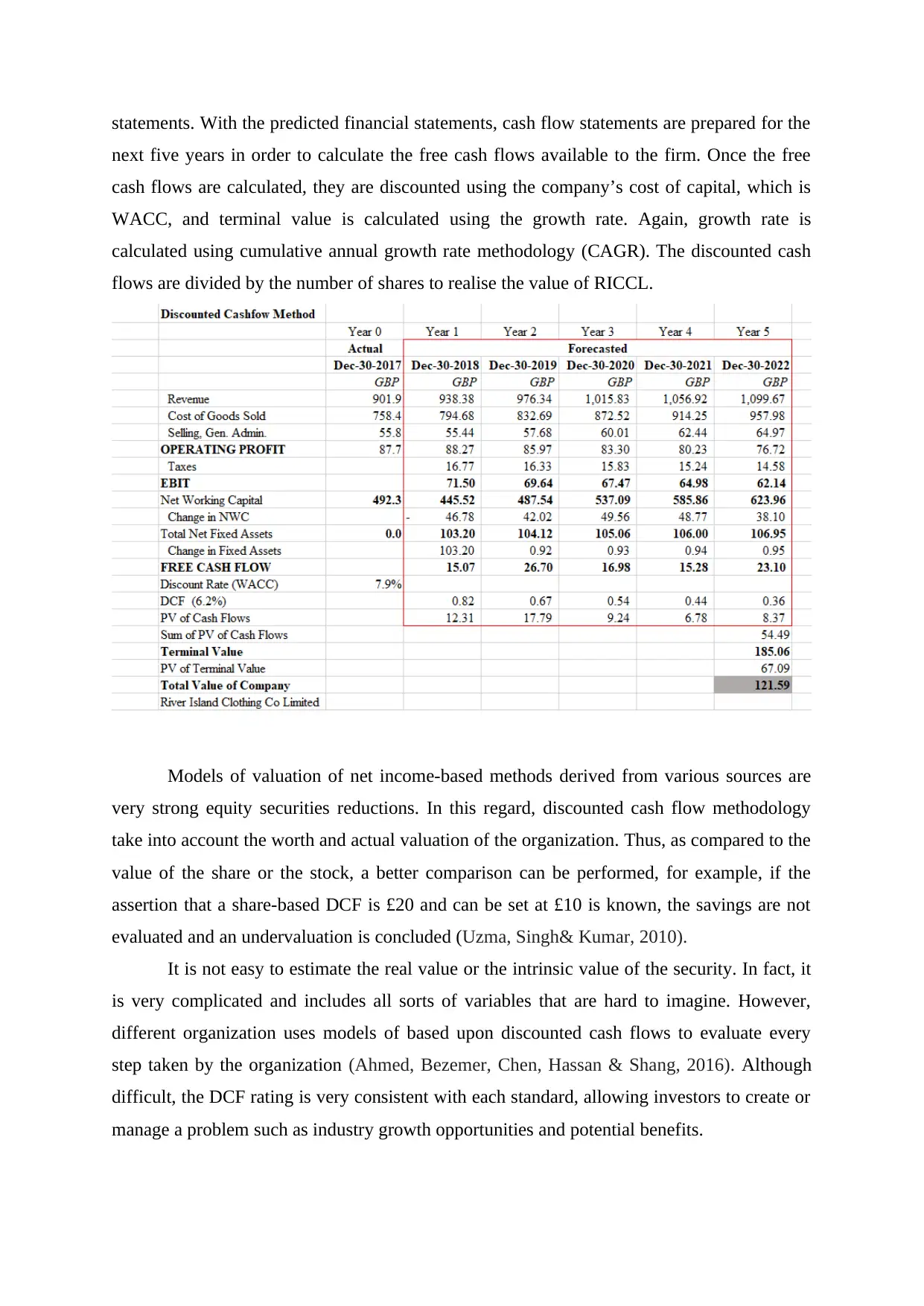
statements. With the predicted financial statements, cash flow statements are prepared for the
next five years in order to calculate the free cash flows available to the firm. Once the free
cash flows are calculated, they are discounted using the company’s cost of capital, which is
WACC, and terminal value is calculated using the growth rate. Again, growth rate is
calculated using cumulative annual growth rate methodology (CAGR). The discounted cash
flows are divided by the number of shares to realise the value of RICCL.
Models of valuation of net income-based methods derived from various sources are
very strong equity securities reductions. In this regard, discounted cash flow methodology
take into account the worth and actual valuation of the organization. Thus, as compared to the
value of the share or the stock, a better comparison can be performed, for example, if the
assertion that a share-based DCF is £20 and can be set at £10 is known, the savings are not
evaluated and an undervaluation is concluded (Uzma, Singh& Kumar, 2010).
It is not easy to estimate the real value or the intrinsic value of the security. In fact, it
is very complicated and includes all sorts of variables that are hard to imagine. However,
different organization uses models of based upon discounted cash flows to evaluate every
step taken by the organization (Ahmed, Bezemer, Chen, Hassan & Shang, 2016). Although
difficult, the DCF rating is very consistent with each standard, allowing investors to create or
manage a problem such as industry growth opportunities and potential benefits.
next five years in order to calculate the free cash flows available to the firm. Once the free
cash flows are calculated, they are discounted using the company’s cost of capital, which is
WACC, and terminal value is calculated using the growth rate. Again, growth rate is
calculated using cumulative annual growth rate methodology (CAGR). The discounted cash
flows are divided by the number of shares to realise the value of RICCL.
Models of valuation of net income-based methods derived from various sources are
very strong equity securities reductions. In this regard, discounted cash flow methodology
take into account the worth and actual valuation of the organization. Thus, as compared to the
value of the share or the stock, a better comparison can be performed, for example, if the
assertion that a share-based DCF is £20 and can be set at £10 is known, the savings are not
evaluated and an undervaluation is concluded (Uzma, Singh& Kumar, 2010).
It is not easy to estimate the real value or the intrinsic value of the security. In fact, it
is very complicated and includes all sorts of variables that are hard to imagine. However,
different organization uses models of based upon discounted cash flows to evaluate every
step taken by the organization (Ahmed, Bezemer, Chen, Hassan & Shang, 2016). Although
difficult, the DCF rating is very consistent with each standard, allowing investors to create or
manage a problem such as industry growth opportunities and potential benefits.
⊘ This is a preview!⊘
Do you want full access?
Subscribe today to unlock all pages.
Trusted by 1+ million students worldwide
The cash payment formula (DCF) is the cash amount in each phase divided by the
reduction in points (WACC) in relation to the number of times.
Components of DCF Model
Cash Flow (CF) - DCF Form - Cash Flow
Cash flow (CF) is the money that investors earn to block security (storage, savings,
etc.) for a certain period of time. When creating a financial framework for a business, CF is
often called cash flow analysis. When establishing the levy, the FC represents the public
interest and / or payments.
2nd prize Reduction Formula DCF
In the enterprise valuation, the discount rate is usually the average consumer price
index. Investors use WACC because they provide the returns they need to be able to count on
their investment in the company. The discount rate is the interest rate of the asset.
3. Hour (s) of the time Formula DCF - Season
Each cash circle is granted for a certain period. The usual times are years, places or
months. The times may be the same or different. If it is different, it will be displayed in
decimal format.
The basic idea of DCF is simple: the value of the stock market is equal to the present
value of all future tax rates. The problem lies in this idea. The first step in evaluating security
through DCF is to estimate the future revenue stream that the business will reach. Many
effects are used to estimate the tax flow, but the growth of future and future profits of the
company is one of the most important (Barnes, Mukherji, Mullen & Sood, 2017). The
prediction of these variables is not just about future intelligence. In fact, one can often believe
that the action is more valuable (or less) than the real action.
Relative Valuation
NEXT plc (LSE:NXT) 65.19 132.8 8657.2 10197.9 1162.17 5373 1.6 8.8
ASOS Plc (AIM:ASC) 38.6 83.8 3234.7 3179.8 182.11 3156.2 1.0 17.5
Marks and Spencer Group plc
(LSE:MKS)
3.77
1622.7 6117.6 8221.1 1475.06 13761 0.4 5.6
Burberry Group plc (LSE:BRBY) 25.55
408.6 10439.7 9599 770.14 3511.5 3.0 12.5
Market Data Financial Data Valuation
Company Name Market
Price Shares Outstanding Market
Capitalisation
Enterprise
Value EBITDA Sales Price to Sales EV to
EBITDA
Median 1.32 10.62
Mean 1.51 11.07
reduction in points (WACC) in relation to the number of times.
Components of DCF Model
Cash Flow (CF) - DCF Form - Cash Flow
Cash flow (CF) is the money that investors earn to block security (storage, savings,
etc.) for a certain period of time. When creating a financial framework for a business, CF is
often called cash flow analysis. When establishing the levy, the FC represents the public
interest and / or payments.
2nd prize Reduction Formula DCF
In the enterprise valuation, the discount rate is usually the average consumer price
index. Investors use WACC because they provide the returns they need to be able to count on
their investment in the company. The discount rate is the interest rate of the asset.
3. Hour (s) of the time Formula DCF - Season
Each cash circle is granted for a certain period. The usual times are years, places or
months. The times may be the same or different. If it is different, it will be displayed in
decimal format.
The basic idea of DCF is simple: the value of the stock market is equal to the present
value of all future tax rates. The problem lies in this idea. The first step in evaluating security
through DCF is to estimate the future revenue stream that the business will reach. Many
effects are used to estimate the tax flow, but the growth of future and future profits of the
company is one of the most important (Barnes, Mukherji, Mullen & Sood, 2017). The
prediction of these variables is not just about future intelligence. In fact, one can often believe
that the action is more valuable (or less) than the real action.
Relative Valuation
NEXT plc (LSE:NXT) 65.19 132.8 8657.2 10197.9 1162.17 5373 1.6 8.8
ASOS Plc (AIM:ASC) 38.6 83.8 3234.7 3179.8 182.11 3156.2 1.0 17.5
Marks and Spencer Group plc
(LSE:MKS)
3.77
1622.7 6117.6 8221.1 1475.06 13761 0.4 5.6
Burberry Group plc (LSE:BRBY) 25.55
408.6 10439.7 9599 770.14 3511.5 3.0 12.5
Market Data Financial Data Valuation
Company Name Market
Price Shares Outstanding Market
Capitalisation
Enterprise
Value EBITDA Sales Price to Sales EV to
EBITDA
Median 1.32 10.62
Mean 1.51 11.07
Paraphrase This Document
Need a fresh take? Get an instant paraphrase of this document with our AI Paraphraser
River Island
EBITDA Multiple EBITDA 83.3 922.1
Price to Sales Multiple Sales 921.4 1394.4
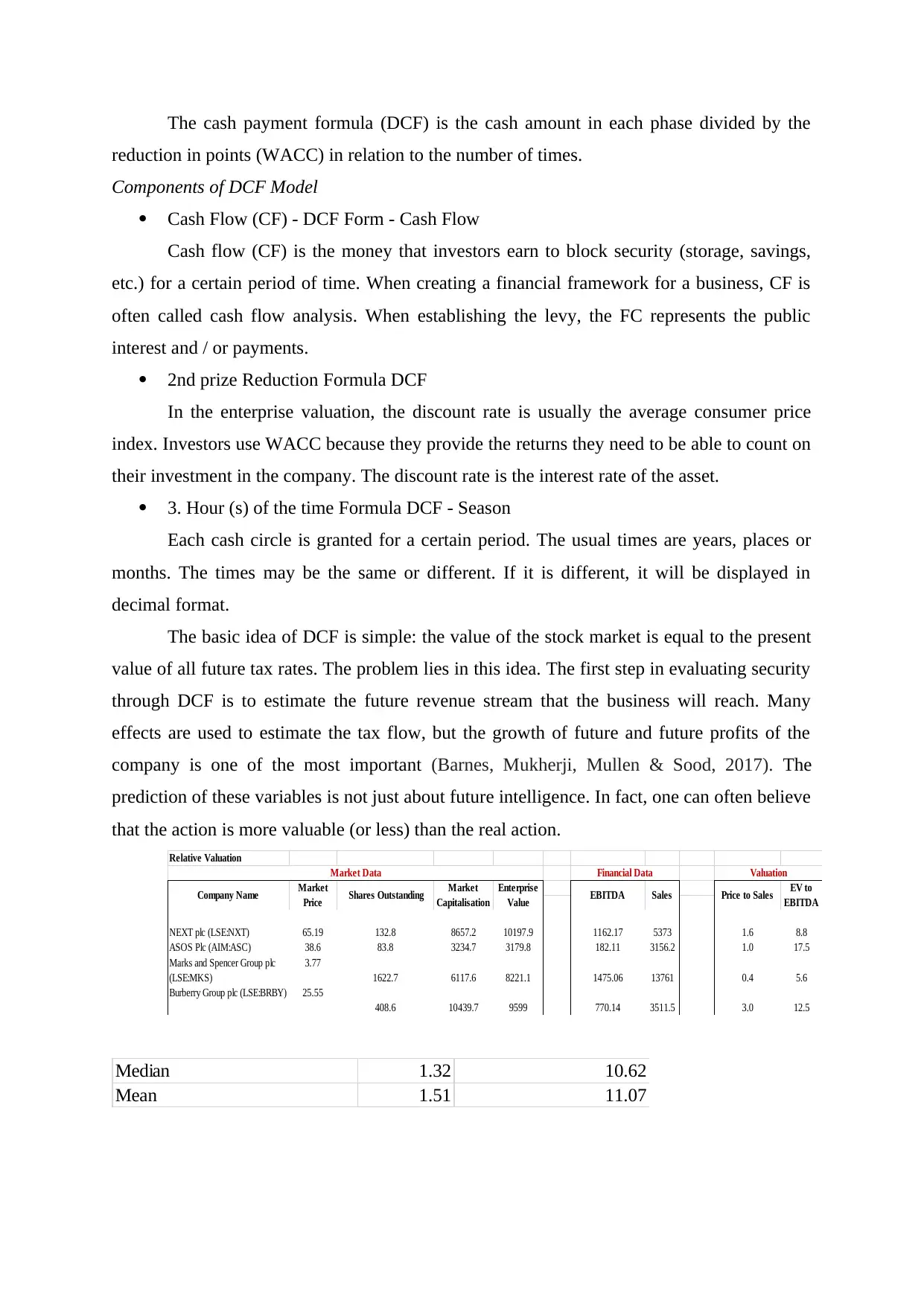
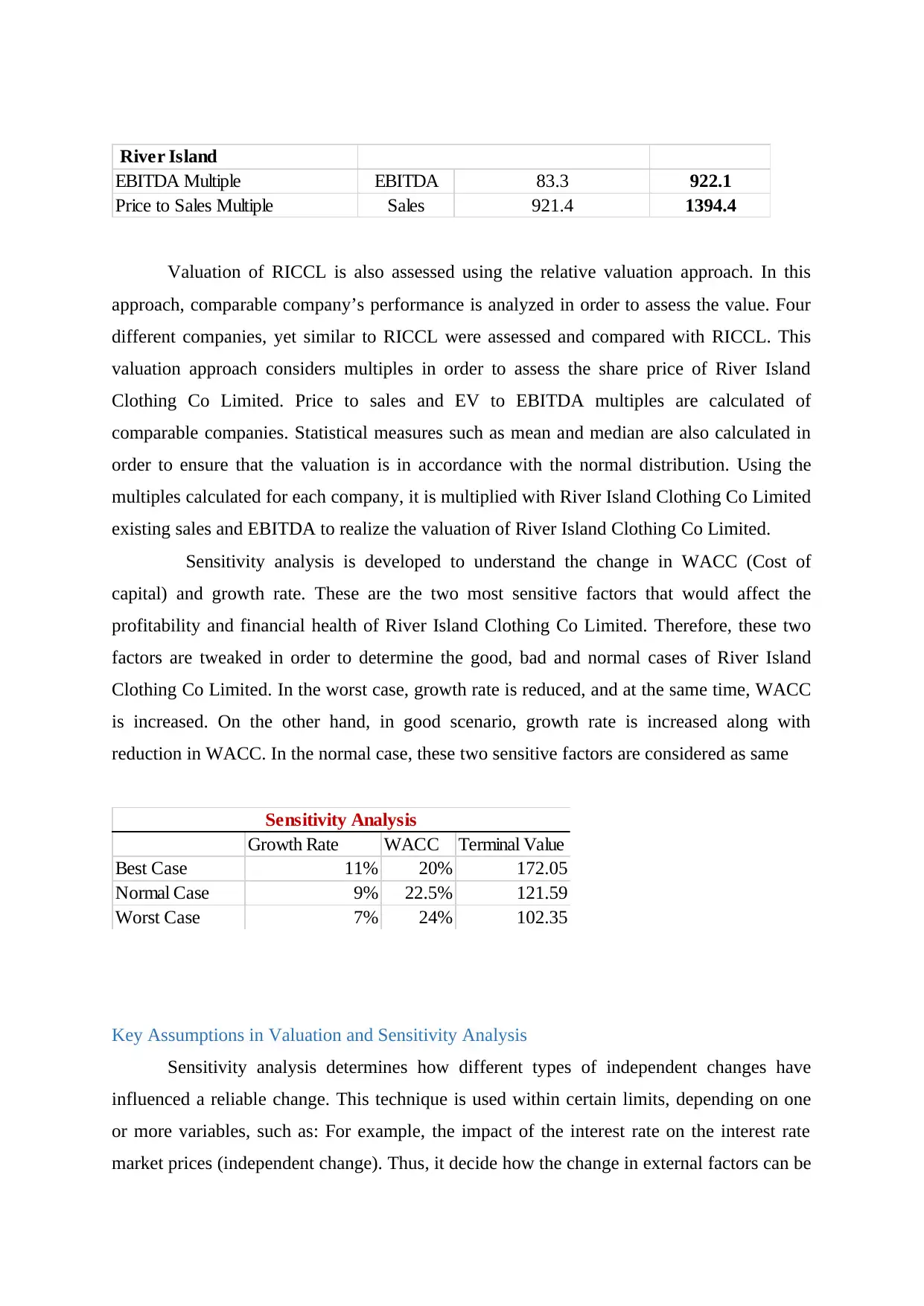
Valuation of RICCL is also assessed using the relative valuation approach. In this
approach, comparable company’s performance is analyzed in order to assess the value. Four
different companies, yet similar to RICCL were assessed and compared with RICCL. This
valuation approach considers multiples in order to assess the share price of River Island
Clothing Co Limited. Price to sales and EV to EBITDA multiples are calculated of
comparable companies. Statistical measures such as mean and median are also calculated in
order to ensure that the valuation is in accordance with the normal distribution. Using the
multiples calculated for each company, it is multiplied with River Island Clothing Co Limited
existing sales and EBITDA to realize the valuation of River Island Clothing Co Limited.
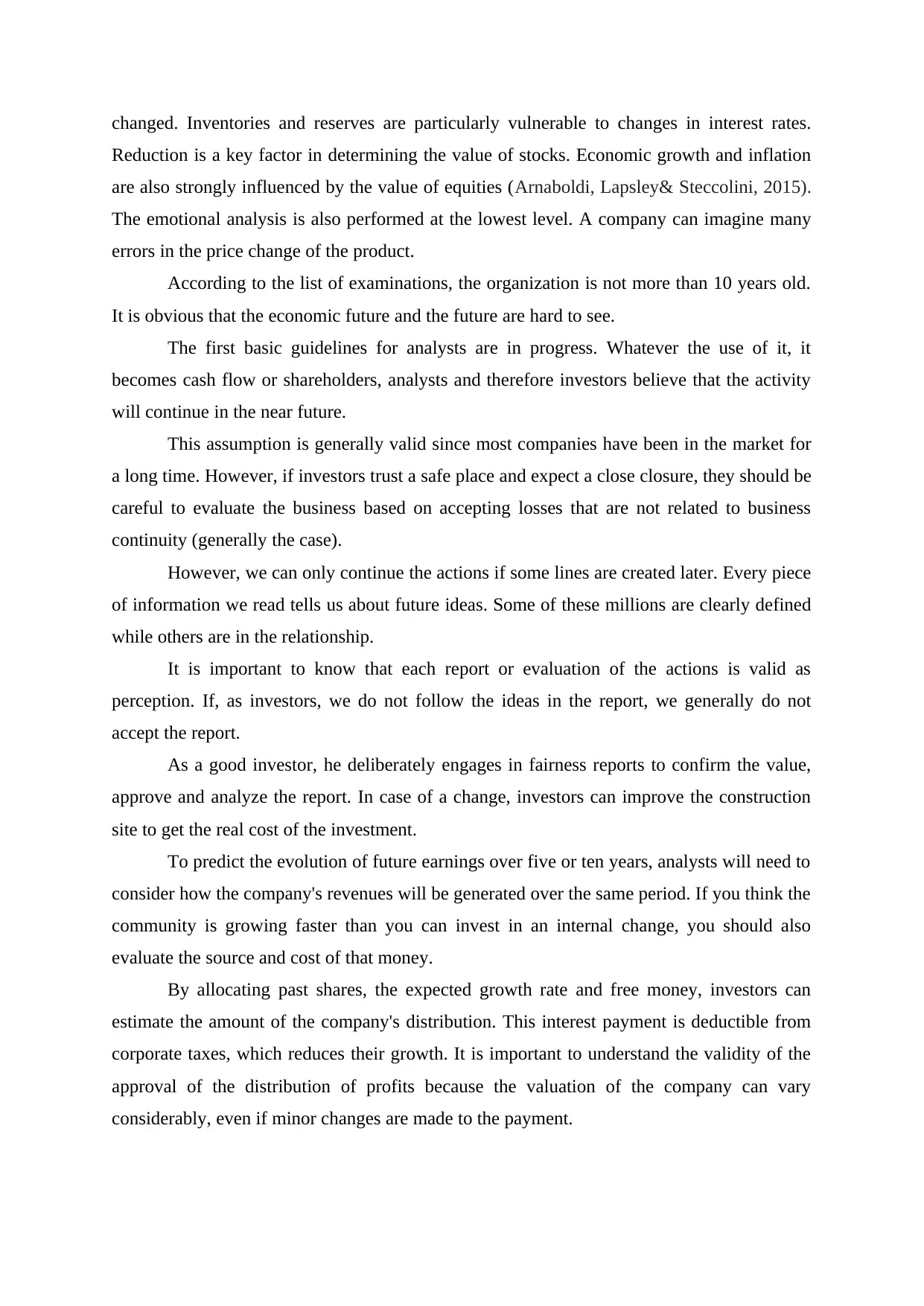
Sensitivity analysis is developed to understand the change in WACC (Cost of
capital) and growth rate. These are the two most sensitive factors that would affect the
profitability and financial health of River Island Clothing Co Limited. Therefore, these two
factors are tweaked in order to determine the good, bad and normal cases of River Island
Clothing Co Limited. In the worst case, growth rate is reduced, and at the same time, WACC
is increased. On the other hand, in good scenario, growth rate is increased along with
reduction in WACC. In the normal case, these two sensitive factors are considered as same
Growth Rate WACC Terminal Value
Best Case 11% 20% 172.05
Normal Case 9% 22.5% 121.59
Worst Case 7% 24% 102.35
Sensitivity Analysis
Key Assumptions in Valuation and Sensitivity Analysis
Sensitivity analysis determines how different types of independent changes have
influenced a reliable change. This technique is used within certain limits, depending on one
or more variables, such as: For example, the impact of the interest rate on the interest rate
market prices (independent change). Thus, it decide how the change in external factors can be
EBITDA Multiple EBITDA 83.3 922.1
Price to Sales Multiple Sales 921.4 1394.4
Valuation of RICCL is also assessed using the relative valuation approach. In this
approach, comparable company’s performance is analyzed in order to assess the value. Four
different companies, yet similar to RICCL were assessed and compared with RICCL. This
valuation approach considers multiples in order to assess the share price of River Island
Clothing Co Limited. Price to sales and EV to EBITDA multiples are calculated of
comparable companies. Statistical measures such as mean and median are also calculated in
order to ensure that the valuation is in accordance with the normal distribution. Using the
multiples calculated for each company, it is multiplied with River Island Clothing Co Limited
existing sales and EBITDA to realize the valuation of River Island Clothing Co Limited.
Sensitivity analysis is developed to understand the change in WACC (Cost of
capital) and growth rate. These are the two most sensitive factors that would affect the
profitability and financial health of River Island Clothing Co Limited. Therefore, these two
factors are tweaked in order to determine the good, bad and normal cases of River Island
Clothing Co Limited. In the worst case, growth rate is reduced, and at the same time, WACC
is increased. On the other hand, in good scenario, growth rate is increased along with
reduction in WACC. In the normal case, these two sensitive factors are considered as same
Growth Rate WACC Terminal Value
Best Case 11% 20% 172.05
Normal Case 9% 22.5% 121.59
Worst Case 7% 24% 102.35
Sensitivity Analysis
Key Assumptions in Valuation and Sensitivity Analysis
Sensitivity analysis determines how different types of independent changes have
influenced a reliable change. This technique is used within certain limits, depending on one
or more variables, such as: For example, the impact of the interest rate on the interest rate
market prices (independent change). Thus, it decide how the change in external factors can be
changed. Inventories and reserves are particularly vulnerable to changes in interest rates.
Reduction is a key factor in determining the value of stocks. Economic growth and inflation
are also strongly influenced by the value of equities (Arnaboldi, Lapsley& Steccolini, 2015).
The emotional analysis is also performed at the lowest level. A company can imagine many
errors in the price change of the product.
According to the list of examinations, the organization is not more than 10 years old.
It is obvious that the economic future and the future are hard to see.
The first basic guidelines for analysts are in progress. Whatever the use of it, it
becomes cash flow or shareholders, analysts and therefore investors believe that the activity
will continue in the near future.
This assumption is generally valid since most companies have been in the market for
a long time. However, if investors trust a safe place and expect a close closure, they should be
careful to evaluate the business based on accepting losses that are not related to business
continuity (generally the case).
However, we can only continue the actions if some lines are created later. Every piece
of information we read tells us about future ideas. Some of these millions are clearly defined
while others are in the relationship.
It is important to know that each report or evaluation of the actions is valid as
perception. If, as investors, we do not follow the ideas in the report, we generally do not
accept the report.
As a good investor, he deliberately engages in fairness reports to confirm the value,
approve and analyze the report. In case of a change, investors can improve the construction
site to get the real cost of the investment.
To predict the evolution of future earnings over five or ten years, analysts will need to
consider how the company's revenues will be generated over the same period. If you think the
community is growing faster than you can invest in an internal change, you should also
evaluate the source and cost of that money.
By allocating past shares, the expected growth rate and free money, investors can
estimate the amount of the company's distribution. This interest payment is deductible from
corporate taxes, which reduces their growth. It is important to understand the validity of the
approval of the distribution of profits because the valuation of the company can vary
considerably, even if minor changes are made to the payment.
Reduction is a key factor in determining the value of stocks. Economic growth and inflation
are also strongly influenced by the value of equities (Arnaboldi, Lapsley& Steccolini, 2015).
The emotional analysis is also performed at the lowest level. A company can imagine many
errors in the price change of the product.
According to the list of examinations, the organization is not more than 10 years old.
It is obvious that the economic future and the future are hard to see.
The first basic guidelines for analysts are in progress. Whatever the use of it, it
becomes cash flow or shareholders, analysts and therefore investors believe that the activity
will continue in the near future.
This assumption is generally valid since most companies have been in the market for
a long time. However, if investors trust a safe place and expect a close closure, they should be
careful to evaluate the business based on accepting losses that are not related to business
continuity (generally the case).
However, we can only continue the actions if some lines are created later. Every piece
of information we read tells us about future ideas. Some of these millions are clearly defined
while others are in the relationship.
It is important to know that each report or evaluation of the actions is valid as
perception. If, as investors, we do not follow the ideas in the report, we generally do not
accept the report.
As a good investor, he deliberately engages in fairness reports to confirm the value,
approve and analyze the report. In case of a change, investors can improve the construction
site to get the real cost of the investment.
To predict the evolution of future earnings over five or ten years, analysts will need to
consider how the company's revenues will be generated over the same period. If you think the
community is growing faster than you can invest in an internal change, you should also
evaluate the source and cost of that money.
By allocating past shares, the expected growth rate and free money, investors can
estimate the amount of the company's distribution. This interest payment is deductible from
corporate taxes, which reduces their growth. It is important to understand the validity of the
approval of the distribution of profits because the valuation of the company can vary
considerably, even if minor changes are made to the payment.
⊘ This is a preview!⊘
Do you want full access?
Subscribe today to unlock all pages.
Trusted by 1+ million students worldwide

1 out of 17


Related Documents


Your All-in-One AI-Powered Toolkit for Academic Success.
+13062052269
info@desklib.com
Available 24*7 on WhatsApp / Email
![[object Object]](/_next/static/media/star-bottom.7253800d.svg)
Unlock your academic potential
Copyright © 2020–2026 A2Z Services. All Rights Reserved. Developed and managed by ZUCOL.