RMIT's Strategic Management Report: Singapore Higher Education by 2030
VerifiedAdded on 2023/04/22
|25
|5747
|267
Report
AI Summary
This report provides an executive summary of RMIT University's strategic management plan, focusing on its goals for the Singapore higher education market by 2030. It begins with an overview of globalization's impact on higher education and the role of RMIT, a leading Australian university, in the international landscape. The report delves into the challenges and factors affecting RMIT's strategic decisions, including the influence of information and communication technology, the role of Artificial Intelligence, and the evolving expectations of students. It explores external and internal organizational analyses, including political, economic, social, technological, legal, and environmental factors, alongside RMIT's strengths, weaknesses, opportunities, and threats. The study considers various scenarios, such as champion, commercial, disruptor, and virtual university models, to recommend effective strategies for RMIT to achieve its objectives in Singapore's competitive higher education environment. The report examines the future of higher education in Singapore, emphasizing the importance of technology, student needs, and the university's reputation in attracting students.
Running Head: RMIT-SIM 0
Strategic Management
Student Details
2/18/2019
Strategic Management
Student Details
2/18/2019

Paraphrase This Document
Need a fresh take? Get an instant paraphrase of this document with our AI Paraphraser
RMIT-SIM 1
Executive Summary
Globalization drives and also driven by higher education. Higher education allows training
for the highly skilled employees and also contributes in the innovation and research which are
important for growth in global economy. Results of higher education lead to cross cultural
exchange and international collaboration. Royal Melbourne Institute of Technology (RMIT)
is a leading university of Australia, which was established in 1887. Since then due to
globalization, it has offshored to various countries and providing education to the students of
different countries through partnership with other institutes. Due to the cross border flows of
knowledge, ideas, faculty, and students along with advancements in information and
communication technology, changes in higher education environments have resulted. This
has increased the cooperation and competition and therefore, challenges are for RMIT to
develop strategies that make them higher education provider of students’ choice in Singapore
in the coming next 10 years that is by 2030. This report discusses about various challenges
and factors that need to be considered by the organization and also factors that influence
students in making their choice regarding higher studies. Then effective strategies will be
considered by RMIT to achieve their aim. The results of this study suggest four scenario to be
considered by RMIT which are champion, commercial, disruptor, and virtual university.
Executive Summary
Globalization drives and also driven by higher education. Higher education allows training
for the highly skilled employees and also contributes in the innovation and research which are
important for growth in global economy. Results of higher education lead to cross cultural
exchange and international collaboration. Royal Melbourne Institute of Technology (RMIT)
is a leading university of Australia, which was established in 1887. Since then due to
globalization, it has offshored to various countries and providing education to the students of
different countries through partnership with other institutes. Due to the cross border flows of
knowledge, ideas, faculty, and students along with advancements in information and
communication technology, changes in higher education environments have resulted. This
has increased the cooperation and competition and therefore, challenges are for RMIT to
develop strategies that make them higher education provider of students’ choice in Singapore
in the coming next 10 years that is by 2030. This report discusses about various challenges
and factors that need to be considered by the organization and also factors that influence
students in making their choice regarding higher studies. Then effective strategies will be
considered by RMIT to achieve their aim. The results of this study suggest four scenario to be
considered by RMIT which are champion, commercial, disruptor, and virtual university.
RMIT-SIM 2
Contents
Executive Summary...................................................................................................................1
Introduction................................................................................................................................4
RMIT University....................................................................................................................4
Literature Review.......................................................................................................................5
Future of Higher Education in Singapore..................................................................................6
Use of Information and Communication Technology for Higher Education........................7
Artificial Intelligence.............................................................................................................9
University of Future.............................................................................................................10
Analysis....................................................................................................................................12
External Organization Analysis...............................................................................................12
Political Factors....................................................................................................................13
Economic Factors.................................................................................................................13
Social Factors.......................................................................................................................14
Technological Factors..........................................................................................................14
Legal Factors........................................................................................................................14
Environmental Factors.........................................................................................................15
Internal organizational analysis................................................................................................15
Strengths...............................................................................................................................16
Contents
Executive Summary...................................................................................................................1
Introduction................................................................................................................................4
RMIT University....................................................................................................................4
Literature Review.......................................................................................................................5
Future of Higher Education in Singapore..................................................................................6
Use of Information and Communication Technology for Higher Education........................7
Artificial Intelligence.............................................................................................................9
University of Future.............................................................................................................10
Analysis....................................................................................................................................12
External Organization Analysis...............................................................................................12
Political Factors....................................................................................................................13
Economic Factors.................................................................................................................13
Social Factors.......................................................................................................................14
Technological Factors..........................................................................................................14
Legal Factors........................................................................................................................14
Environmental Factors.........................................................................................................15
Internal organizational analysis................................................................................................15
Strengths...............................................................................................................................16
⊘ This is a preview!⊘
Do you want full access?
Subscribe today to unlock all pages.

Trusted by 1+ million students worldwide
RMIT-SIM 3
Weaknesses..........................................................................................................................16
Opportunities........................................................................................................................17
Threats..................................................................................................................................17
Challenges emerging out of the external and internal analysis of the organization.................17
Conclusion................................................................................................................................18
References................................................................................................................................20
Weaknesses..........................................................................................................................16
Opportunities........................................................................................................................17
Threats..................................................................................................................................17
Challenges emerging out of the external and internal analysis of the organization.................17
Conclusion................................................................................................................................18
References................................................................................................................................20
Paraphrase This Document
Need a fresh take? Get an instant paraphrase of this document with our AI Paraphraser
RMIT-SIM 4
Introduction
RMIT University
Royal Melbourne Institute of Technology (RMIT) is a public research university located in
Melbourne city of Australia. This institute was founded by Francis Ormond in 1887. This was
started in response to the industrial revolution offering courses in technology, science, and
arts. Teaching methods used by the RMIT University uses innovative, broad range, and
modernised technology to enhance engagement which results in improvements in gaining
knowledge, and offering its vocational and higher education to other country students through
partnership with the local universities of that country such as Vietnam, Singapore, China,
Indonesia, and many other (RMIT University, 2019). Analysis of different studies has shown
that around 84,000 students have been enrolled by RMIT through different partner
universities and also around 10,000 highly-qualified professors all around the world to
improve teaching qualities. RMIT is aiming to make improvements in the interactive
learning.
RMIT has expanded its branches globally and offshored to three other different countries.
This expansion of the university is not an easy task and will raise many challenges for the
organization. It requires proper strategies and plan work to deal with these challenges in
different countries and remain competitive and sustainable. Students’ expectations from a
university are not only to experience the quality life there but to gain and experience practical
business skills that help them in getting placed in various good internship and higher paid
employments (Williams, 2014).
Introduction
RMIT University
Royal Melbourne Institute of Technology (RMIT) is a public research university located in
Melbourne city of Australia. This institute was founded by Francis Ormond in 1887. This was
started in response to the industrial revolution offering courses in technology, science, and
arts. Teaching methods used by the RMIT University uses innovative, broad range, and
modernised technology to enhance engagement which results in improvements in gaining
knowledge, and offering its vocational and higher education to other country students through
partnership with the local universities of that country such as Vietnam, Singapore, China,
Indonesia, and many other (RMIT University, 2019). Analysis of different studies has shown
that around 84,000 students have been enrolled by RMIT through different partner
universities and also around 10,000 highly-qualified professors all around the world to
improve teaching qualities. RMIT is aiming to make improvements in the interactive
learning.
RMIT has expanded its branches globally and offshored to three other different countries.
This expansion of the university is not an easy task and will raise many challenges for the
organization. It requires proper strategies and plan work to deal with these challenges in
different countries and remain competitive and sustainable. Students’ expectations from a
university are not only to experience the quality life there but to gain and experience practical
business skills that help them in getting placed in various good internship and higher paid
employments (Williams, 2014).
RMIT-SIM 5
RMIT started its partnership with SIM in 1987 and since then they have graduated around
24,000 RMIT-SIM students. This partnership started to make graduates to make able to
compete in today’s competitive environment of global job market (RMIT University, 2019).
This report discusses about the strategies and changes that RMIT can do to make itself higher
education provider of choice for the business students of Singapore by 2030.
Literature Review
Hawkins et al. (2004) in his studied suggested that while taking admission in any university,
students are making a purchase decision and there are three types of processes regarding
decision making process- limited, nominal, and extended. The involvement level of consumer
in decision making process enhances from nominal to limited and then to extended. However,
decisions regarding the choice of college include high level of involvement because it
requires several factors to be considered by students. Also, this decision made by student
involves a long-term and huge amount of investment and self-image of the student too.
Moreover, risk of making a wrong decision is also significant (Gopal, 2010).
This kind of risks is usually high when the purchase involves intangible services that have no
warranties and guarantees. As the higher education requires huge investments from the both
parents and students- parents invest their money and students invest their time, therefore the
perceived risk is high definitely and thus requires students to take suggestions and advices
from different groups or peers before making any decision about choosing their courses and
universities (ACUP, 2009).
RMIT started its partnership with SIM in 1987 and since then they have graduated around
24,000 RMIT-SIM students. This partnership started to make graduates to make able to
compete in today’s competitive environment of global job market (RMIT University, 2019).
This report discusses about the strategies and changes that RMIT can do to make itself higher
education provider of choice for the business students of Singapore by 2030.
Literature Review
Hawkins et al. (2004) in his studied suggested that while taking admission in any university,
students are making a purchase decision and there are three types of processes regarding
decision making process- limited, nominal, and extended. The involvement level of consumer
in decision making process enhances from nominal to limited and then to extended. However,
decisions regarding the choice of college include high level of involvement because it
requires several factors to be considered by students. Also, this decision made by student
involves a long-term and huge amount of investment and self-image of the student too.
Moreover, risk of making a wrong decision is also significant (Gopal, 2010).
This kind of risks is usually high when the purchase involves intangible services that have no
warranties and guarantees. As the higher education requires huge investments from the both
parents and students- parents invest their money and students invest their time, therefore the
perceived risk is high definitely and thus requires students to take suggestions and advices
from different groups or peers before making any decision about choosing their courses and
universities (ACUP, 2009).
⊘ This is a preview!⊘
Do you want full access?
Subscribe today to unlock all pages.
Trusted by 1+ million students worldwide
RMIT-SIM 6
Future of Higher Education in Singapore
Singapore is an island which is surrounded by other small islands. This small island consists
of a city which is also a country. But, apart from such a small area, one trip to this island
makes a person leave full of memories. It is because of either its exotic cuisine or the highly
technological and education level of people. This nation makes surprise everyone. Unlike
other countries which are rich in natural resources, great climate, and high population,
Singapore’s main source of economic growth is its education sector. This is the reason that
schools of Singapore are highly qualified. Higher education in Singapore is treated very
seriously like primary and secondary school education (SIM GE, 2019). Students are given
options of going in any universities for higher education that does not necessarily include
universities of country. Junior colleges and Millennia Institutes are the best choice for some
keen students who want diversity and flexibility in their chosen subjects. Singapore offers
subjects at three levels – Higher 1, Higher 2, and Higher 3, which can be catered according to
the abilities and interests of students (Tissot, 2018).
As compared with the education systems of 20 or 40 years ago, today’s education system are
way different. Higher education has gone through several changes all around the world due to
various reasons which can be summed up as processes of globalization, massification,
internationalisation, and commodification. It has been observed that and assumptions are
being made that of experiencing changes in education system in the coming few years more.
Education system in every corner of the world will continue on the path of transformation
with various speeds depending on the environment in which it operates. There is large
number of forces that plays vital role in the development of education system in the coming
Future of Higher Education in Singapore
Singapore is an island which is surrounded by other small islands. This small island consists
of a city which is also a country. But, apart from such a small area, one trip to this island
makes a person leave full of memories. It is because of either its exotic cuisine or the highly
technological and education level of people. This nation makes surprise everyone. Unlike
other countries which are rich in natural resources, great climate, and high population,
Singapore’s main source of economic growth is its education sector. This is the reason that
schools of Singapore are highly qualified. Higher education in Singapore is treated very
seriously like primary and secondary school education (SIM GE, 2019). Students are given
options of going in any universities for higher education that does not necessarily include
universities of country. Junior colleges and Millennia Institutes are the best choice for some
keen students who want diversity and flexibility in their chosen subjects. Singapore offers
subjects at three levels – Higher 1, Higher 2, and Higher 3, which can be catered according to
the abilities and interests of students (Tissot, 2018).
As compared with the education systems of 20 or 40 years ago, today’s education system are
way different. Higher education has gone through several changes all around the world due to
various reasons which can be summed up as processes of globalization, massification,
internationalisation, and commodification. It has been observed that and assumptions are
being made that of experiencing changes in education system in the coming few years more.
Education system in every corner of the world will continue on the path of transformation
with various speeds depending on the environment in which it operates. There is large
number of forces that plays vital role in the development of education system in the coming
Paraphrase This Document
Need a fresh take? Get an instant paraphrase of this document with our AI Paraphraser
RMIT-SIM 7
years including from urbanisation to technology, and the growth in this system will determine
the future of global education and its delivery mode (MOE, 2011).
Also it is challenge for the RMIT University to provide a level of education to the students
that fulfill their expectations and make them successful in getting their dream jobs. First, this
report is discussing about what could be challenges that RMIT would face during providing
quality education to the students of their choice in Singapore and then what solutions or
strategies will help the RMIT organization to resolve all these challenges and becoming
provider of higher education of students’ choice by 2030 (RMIT University, 2019).
The first step of making any strategy regarding education system, it is important to consider
the expectations of students from the education and its system. It is of significance to know
what the expectations of students before making any strategy are. A study on determining the
factors that influence the choice of students of any MBA program is considered to determine
expectations of students. The result of the study showed the reasons of choosing their study
programs and what influenced them to take their decision (Teng, 2016).
Use of Information and Communication Technology for Higher Education
Information and technology has advanced a lot and thus making every sector to make
changes in their processes. Technology has advanced to the extent where students are no
longer required to go to colleges for higher education as technology has made them enable to
access the education of their choice from any corner of the world. Therefore, it is the first
requirement or the implementation that should be adopted by RMIT in order to enhance
higher education in the university. Hence, organization should consider assumptions
regarding information technology and include these assumptions into their plans and missions
years including from urbanisation to technology, and the growth in this system will determine
the future of global education and its delivery mode (MOE, 2011).
Also it is challenge for the RMIT University to provide a level of education to the students
that fulfill their expectations and make them successful in getting their dream jobs. First, this
report is discussing about what could be challenges that RMIT would face during providing
quality education to the students of their choice in Singapore and then what solutions or
strategies will help the RMIT organization to resolve all these challenges and becoming
provider of higher education of students’ choice by 2030 (RMIT University, 2019).
The first step of making any strategy regarding education system, it is important to consider
the expectations of students from the education and its system. It is of significance to know
what the expectations of students before making any strategy are. A study on determining the
factors that influence the choice of students of any MBA program is considered to determine
expectations of students. The result of the study showed the reasons of choosing their study
programs and what influenced them to take their decision (Teng, 2016).
Use of Information and Communication Technology for Higher Education
Information and technology has advanced a lot and thus making every sector to make
changes in their processes. Technology has advanced to the extent where students are no
longer required to go to colleges for higher education as technology has made them enable to
access the education of their choice from any corner of the world. Therefore, it is the first
requirement or the implementation that should be adopted by RMIT in order to enhance
higher education in the university. Hence, organization should consider assumptions
regarding information technology and include these assumptions into their plans and missions
RMIT-SIM 8
for delivering education. Information technology has the ability of surprising students by
developing innovative methods of teaching and education (Alfaro & Ketels, 2016). One
example of using information and technology for providing the future education is in creation
of a library that consist of all which means all of the sciences, all of the histories, and all of
the philosophies ever written. This exactly includes all of the picture data, all of the text data,
all of the video, all of the audio, and all of the tabular information will be make available in
the form of electronically storage which can be reviewed in future. This vision is going to
bring tremendous changes in the future of higher education. RMIT thus can use technology
for the development of its position in the education market and among students of Singapore
(The Economist, 2019).
Today’s market is also known as info-tainment as the businesses are using various
combinations of computers, broadcasting, entertainment, and cable television to gain
advantage in this market (SMU, 2011). Online learning has done globalization of education
and this has decentralised schooling which means education providers who use out-of-date
techniques in education providing has lost their students to the institutes who invest good in
courses, staff, and facilities. Investments made wisely in this field helped them in attracting
new students. This development in information and communication technology is going to
increase in the coming future and thus competition will also increase for RMIT as
advancement in technology also provide students with variety of choices (SIM GE, 2019). A
recent article has shown that universities with higher prestige value and reputation are more
favourable among students and they are least likely to lose their students to the online
competitors. Hence, as RMIT has a global image since years and one of the most reputed
for delivering education. Information technology has the ability of surprising students by
developing innovative methods of teaching and education (Alfaro & Ketels, 2016). One
example of using information and technology for providing the future education is in creation
of a library that consist of all which means all of the sciences, all of the histories, and all of
the philosophies ever written. This exactly includes all of the picture data, all of the text data,
all of the video, all of the audio, and all of the tabular information will be make available in
the form of electronically storage which can be reviewed in future. This vision is going to
bring tremendous changes in the future of higher education. RMIT thus can use technology
for the development of its position in the education market and among students of Singapore
(The Economist, 2019).
Today’s market is also known as info-tainment as the businesses are using various
combinations of computers, broadcasting, entertainment, and cable television to gain
advantage in this market (SMU, 2011). Online learning has done globalization of education
and this has decentralised schooling which means education providers who use out-of-date
techniques in education providing has lost their students to the institutes who invest good in
courses, staff, and facilities. Investments made wisely in this field helped them in attracting
new students. This development in information and communication technology is going to
increase in the coming future and thus competition will also increase for RMIT as
advancement in technology also provide students with variety of choices (SIM GE, 2019). A
recent article has shown that universities with higher prestige value and reputation are more
favourable among students and they are least likely to lose their students to the online
competitors. Hence, as RMIT has a global image since years and one of the most reputed
⊘ This is a preview!⊘
Do you want full access?
Subscribe today to unlock all pages.
Trusted by 1+ million students worldwide
RMIT-SIM 9
universities of Australia, it should use better and smarter ways of marketing to promote its
reputation.
Understanding the needs of students will help RMIT to make policies and procedures that
provide their choice of education by 2030. Attracting students for their university is possible
when management of RMIT University knows about the factors that influence students the
most for making their decisions regarding their subject and university choice (SIM GE,
2019). It is known that reputation of the university is the significant factor in this case but
another important student recruitment strategy is thinking about the ‘what, whom, and in
what manner a university communicate.’ This requires the proper and sufficient
understanding of factors that really attracts students and making marketing strategies
according to those factors (Calderon, 2015).
Artificial Intelligence
Universities all around the world are experimenting different technologies to use Artificial
Intelligence in education system but most of these technologies have not succeeded yet.
Artificial Intelligence would help the university in conducting virtual classes. This
technology will change the entire scenario of teaching. This kind of classes will make
students feel they are sitting in the classroom even without going there. Recently a project
naming ‘The Mandarin Project’ is developed by collaboration of New York located RPI and
giant in technology IBM (Teng, 2016). This project aims to placing students in a virtual
world in order to practice Mandarin language skills through a simulated scenarios series
which includes taking a tai chi class or ordering breakfast in a café. The aim of the project is
universities of Australia, it should use better and smarter ways of marketing to promote its
reputation.
Understanding the needs of students will help RMIT to make policies and procedures that
provide their choice of education by 2030. Attracting students for their university is possible
when management of RMIT University knows about the factors that influence students the
most for making their decisions regarding their subject and university choice (SIM GE,
2019). It is known that reputation of the university is the significant factor in this case but
another important student recruitment strategy is thinking about the ‘what, whom, and in
what manner a university communicate.’ This requires the proper and sufficient
understanding of factors that really attracts students and making marketing strategies
according to those factors (Calderon, 2015).
Artificial Intelligence
Universities all around the world are experimenting different technologies to use Artificial
Intelligence in education system but most of these technologies have not succeeded yet.
Artificial Intelligence would help the university in conducting virtual classes. This
technology will change the entire scenario of teaching. This kind of classes will make
students feel they are sitting in the classroom even without going there. Recently a project
naming ‘The Mandarin Project’ is developed by collaboration of New York located RPI and
giant in technology IBM (Teng, 2016). This project aims to placing students in a virtual
world in order to practice Mandarin language skills through a simulated scenarios series
which includes taking a tai chi class or ordering breakfast in a café. The aim of the project is
Paraphrase This Document
Need a fresh take? Get an instant paraphrase of this document with our AI Paraphraser
RMIT-SIM 10
to making student feel that they are in China actually without the need of travelling there in
reality.
Similarly, RMIT can make use of Artificial Intelligence technology for developing the
classrooms of future which have 360-degree screen from floor to ceiling. Several other
technologies and be combined with this technology and use of animated characters will make
the learning of students more interesting (Calderon, 2015). Other technologies that can be
merged with artificial intelligence technology includes movement tracking, speech to text
conversion, and natural language processing that will create unique experience in learning.
Students would feel less embarrassed while making a mistake as they are talking to a
computer instead of a native speaker (Olds, 2014). It would provide them a more comfortable
and flexible environment in learning. Computer will provide them more accurate feedback
about their mistakes as compared to a native speaker. Native speaker, most of the times do
not provide feedback even. But using Artificial intelligence technology, immediate and quick
feedbacks will be given to students.
As technology is transforming everything from ones ways of thinking, living, working, and
playing at very fast speed and also on larger range, therefore, advancement in education
system should be done in this pace only to remain parallel with the technology. Advancement
in technology has raised the need of preparing and training today’s students with the skills of
tomorrow to thrive in coming future (Contact North, 2016).
to making student feel that they are in China actually without the need of travelling there in
reality.
Similarly, RMIT can make use of Artificial Intelligence technology for developing the
classrooms of future which have 360-degree screen from floor to ceiling. Several other
technologies and be combined with this technology and use of animated characters will make
the learning of students more interesting (Calderon, 2015). Other technologies that can be
merged with artificial intelligence technology includes movement tracking, speech to text
conversion, and natural language processing that will create unique experience in learning.
Students would feel less embarrassed while making a mistake as they are talking to a
computer instead of a native speaker (Olds, 2014). It would provide them a more comfortable
and flexible environment in learning. Computer will provide them more accurate feedback
about their mistakes as compared to a native speaker. Native speaker, most of the times do
not provide feedback even. But using Artificial intelligence technology, immediate and quick
feedbacks will be given to students.
As technology is transforming everything from ones ways of thinking, living, working, and
playing at very fast speed and also on larger range, therefore, advancement in education
system should be done in this pace only to remain parallel with the technology. Advancement
in technology has raised the need of preparing and training today’s students with the skills of
tomorrow to thrive in coming future (Contact North, 2016).
RMIT-SIM 11
University of Future
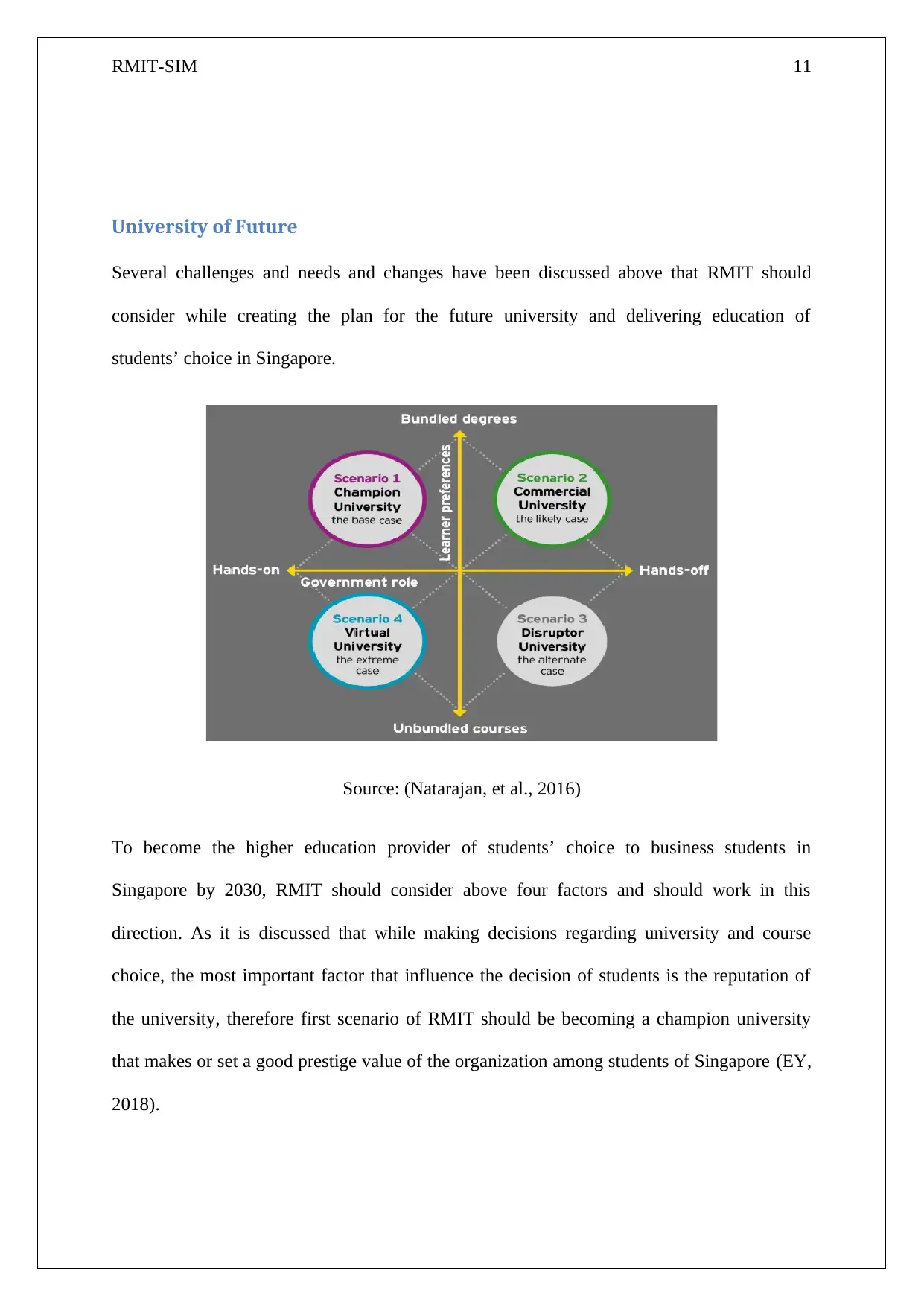
Several challenges and needs and changes have been discussed above that RMIT should
consider while creating the plan for the future university and delivering education of
students’ choice in Singapore.
Source: (Natarajan, et al., 2016)
To become the higher education provider of students’ choice to business students in
Singapore by 2030, RMIT should consider above four factors and should work in this
direction. As it is discussed that while making decisions regarding university and course
choice, the most important factor that influence the decision of students is the reputation of
the university, therefore first scenario of RMIT should be becoming a champion university
that makes or set a good prestige value of the organization among students of Singapore (EY,
2018).
University of Future
Several challenges and needs and changes have been discussed above that RMIT should
consider while creating the plan for the future university and delivering education of
students’ choice in Singapore.
Source: (Natarajan, et al., 2016)
To become the higher education provider of students’ choice to business students in
Singapore by 2030, RMIT should consider above four factors and should work in this
direction. As it is discussed that while making decisions regarding university and course
choice, the most important factor that influence the decision of students is the reputation of
the university, therefore first scenario of RMIT should be becoming a champion university
that makes or set a good prestige value of the organization among students of Singapore (EY,
2018).
⊘ This is a preview!⊘
Do you want full access?
Subscribe today to unlock all pages.
Trusted by 1+ million students worldwide

1 out of 25


Related Documents


Your All-in-One AI-Powered Toolkit for Academic Success.
+13062052269
info@desklib.com
Available 24*7 on WhatsApp / Email
![[object Object]](/_next/static/media/star-bottom.7253800d.svg)
Unlock your academic potential
Copyright © 2020–2026 A2Z Services. All Rights Reserved. Developed and managed by ZUCOL.