Legal Case Study: Analysis of Glenn Marc Bee v The Road Accident Fund

Verified

Added on  2023/04/20

|4
|1014
|417
Case Study
AI Summary
This case study provides a detailed analysis of Glenn Marc Bee v The Road Accident Fund, focusing on the application of the collateral source rule and its implications. The analysis references the landmark case of Rudman v Road Accident Fund, highlighting the court's decision to deviate from previous judgments based on the specific facts presented. The court upheld the initial ruling in favor of Glenn Marc Bee, emphasizing that damages awarded to a plaintiff should not be reduced by compensation received from third parties. The study also discusses the quantification of damages, the importance of factual evidence, and the court's consideration of expert opinions. Ultimately, the analysis concludes that courts must maintain flexibility and consider the unique circumstances of each case, rather than rigidly adhering to precedents. Access more case studies and solved assignments on Desklib.
Document Page
Running head: CASE STUDY ANALYSIS
CASE STUDY ANALYSIS
Name of the Student:
Name of the University:
Author Note:
tabler-icon-diamond-filled.svg

Paraphrase This Document

Need a fresh take? Get an instant paraphrase of this document with our AI Paraphraser
Document Page
1CASE STUDY ANALYSIS
Introduction:
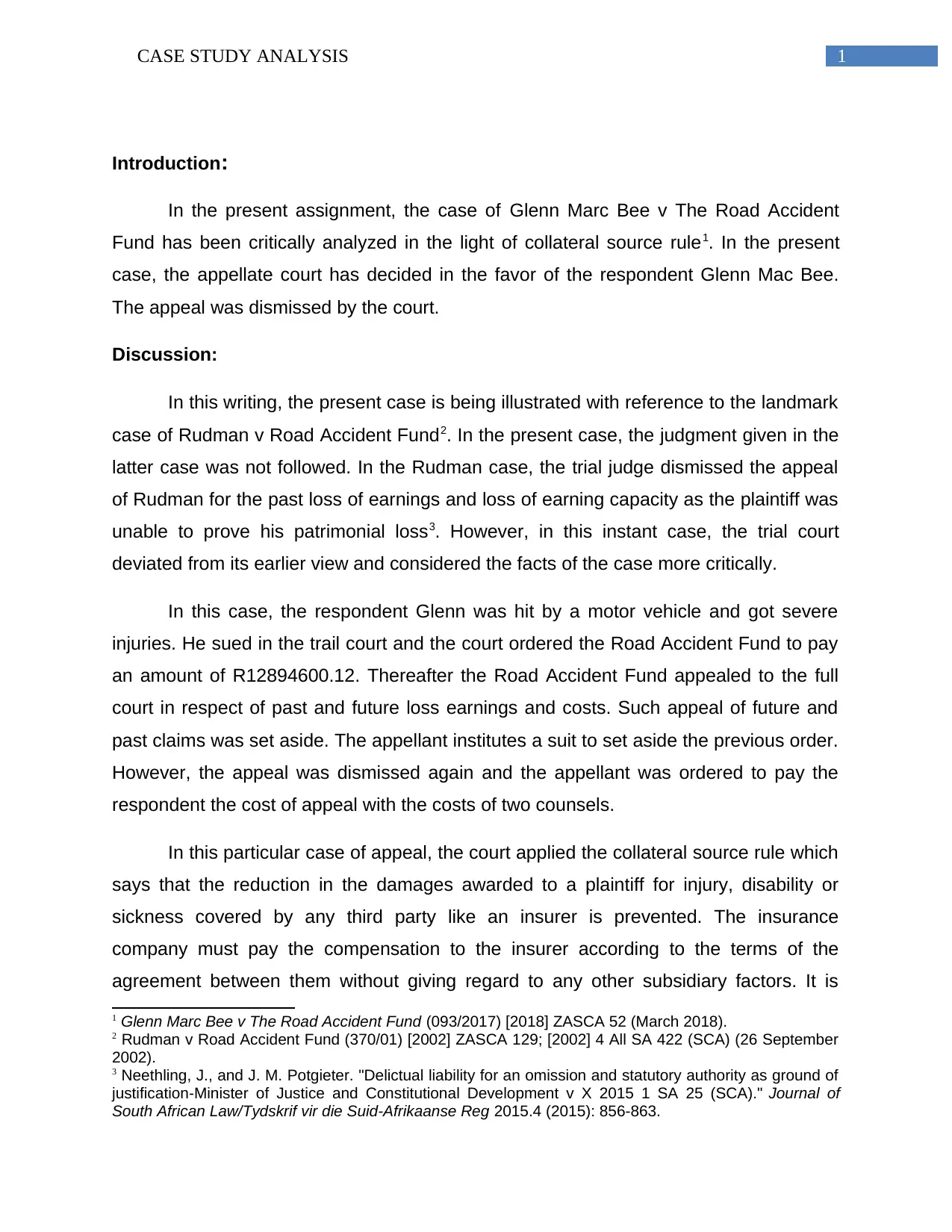
In the present assignment, the case of Glenn Marc Bee v The Road Accident
Fund has been critically analyzed in the light of collateral source rule1. In the present
case, the appellate court has decided in the favor of the respondent Glenn Mac Bee.
The appeal was dismissed by the court.
Discussion:
In this writing, the present case is being illustrated with reference to the landmark
case of Rudman v Road Accident Fund2. In the present case, the judgment given in the
latter case was not followed. In the Rudman case, the trial judge dismissed the appeal
of Rudman for the past loss of earnings and loss of earning capacity as the plaintiff was
unable to prove his patrimonial loss3. However, in this instant case, the trial court
deviated from its earlier view and considered the facts of the case more critically.
In this case, the respondent Glenn was hit by a motor vehicle and got severe
injuries. He sued in the trail court and the court ordered the Road Accident Fund to pay
an amount of R12894600.12. Thereafter the Road Accident Fund appealed to the full
court in respect of past and future loss earnings and costs. Such appeal of future and
past claims was set aside. The appellant institutes a suit to set aside the previous order.
However, the appeal was dismissed again and the appellant was ordered to pay the
respondent the cost of appeal with the costs of two counsels.
In this particular case of appeal, the court applied the collateral source rule which
says that the reduction in the damages awarded to a plaintiff for injury, disability or
sickness covered by any third party like an insurer is prevented. The insurance
company must pay the compensation to the insurer according to the terms of the
agreement between them without giving regard to any other subsidiary factors. It is
1 Glenn Marc Bee v The Road Accident Fund (093/2017) [2018] ZASCA 52 (March 2018).
2 Rudman v Road Accident Fund (370/01) [2002] ZASCA 129; [2002] 4 All SA 422 (SCA) (26 September
2002).
3 Neethling, J., and J. M. Potgieter. "Delictual liability for an omission and statutory authority as ground of
justification-Minister of Justice and Constitutional Development v X 2015 1 SA 25 (SCA)." Journal of
South African Law/Tydskrif vir die Suid-Afrikaanse Reg 2015.4 (2015): 856-863.
Document Page
2CASE STUDY ANALYSIS
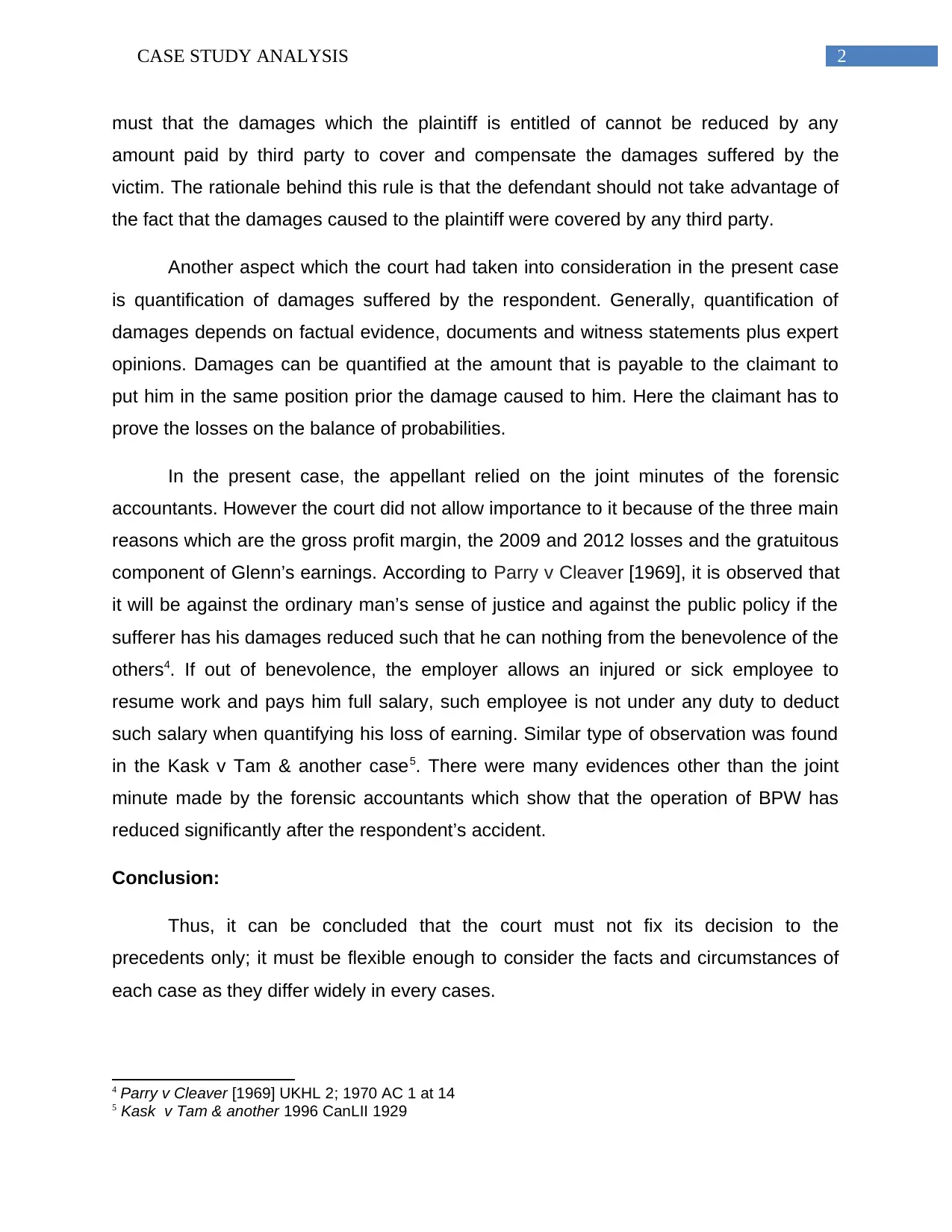
must that the damages which the plaintiff is entitled of cannot be reduced by any
amount paid by third party to cover and compensate the damages suffered by the
victim. The rationale behind this rule is that the defendant should not take advantage of
the fact that the damages caused to the plaintiff were covered by any third party.
Another aspect which the court had taken into consideration in the present case
is quantification of damages suffered by the respondent. Generally, quantification of
damages depends on factual evidence, documents and witness statements plus expert
opinions. Damages can be quantified at the amount that is payable to the claimant to
put him in the same position prior the damage caused to him. Here the claimant has to
prove the losses on the balance of probabilities.
In the present case, the appellant relied on the joint minutes of the forensic
accountants. However the court did not allow importance to it because of the three main
reasons which are the gross profit margin, the 2009 and 2012 losses and the gratuitous
component of Glenn’s earnings. According to Parry v Cleaver [1969], it is observed that
it will be against the ordinary man’s sense of justice and against the public policy if the
sufferer has his damages reduced such that he can nothing from the benevolence of the
others4. If out of benevolence, the employer allows an injured or sick employee to
resume work and pays him full salary, such employee is not under any duty to deduct
such salary when quantifying his loss of earning. Similar type of observation was found
in the Kask v Tam & another case5. There were many evidences other than the joint
minute made by the forensic accountants which show that the operation of BPW has
reduced significantly after the respondent’s accident.
Conclusion:
Thus, it can be concluded that the court must not fix its decision to the
precedents only; it must be flexible enough to consider the facts and circumstances of
each case as they differ widely in every cases.
4 Parry v Cleaver [1969] UKHL 2; 1970 AC 1 at 14
5 Kask v Tam & another 1996 CanLII 1929
Document Page
3CASE STUDY ANALYSIS
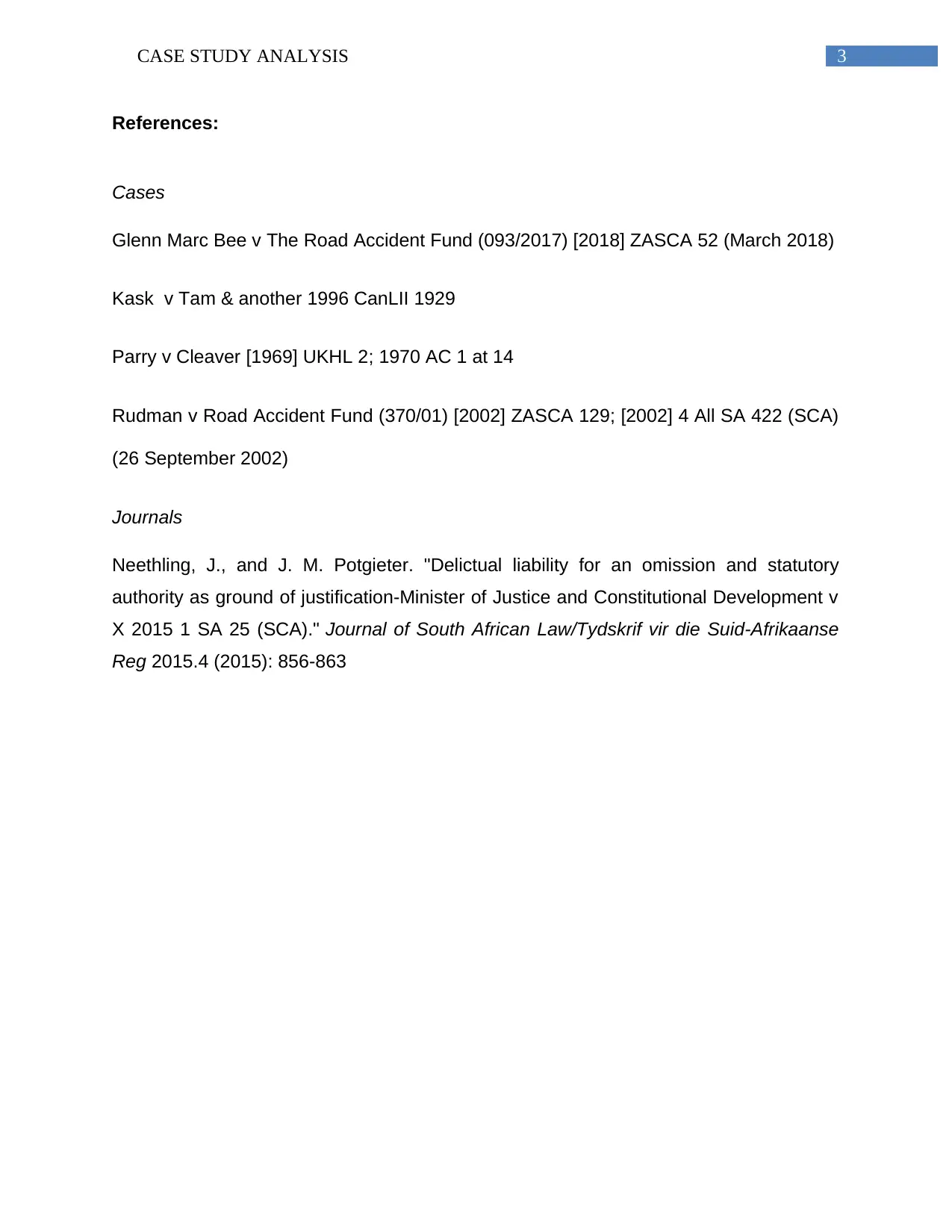
References:
Cases
Glenn Marc Bee v The Road Accident Fund (093/2017) [2018] ZASCA 52 (March 2018)
Kask v Tam & another 1996 CanLII 1929
Parry v Cleaver [1969] UKHL 2; 1970 AC 1 at 14
Rudman v Road Accident Fund (370/01) [2002] ZASCA 129; [2002] 4 All SA 422 (SCA)
(26 September 2002)
Journals
Neethling, J., and J. M. Potgieter. "Delictual liability for an omission and statutory
authority as ground of justification-Minister of Justice and Constitutional Development v
X 2015 1 SA 25 (SCA)." Journal of South African Law/Tydskrif vir die Suid-Afrikaanse
Reg 2015.4 (2015): 856-863
chevron_up_icon
1 out of 4
circle_padding
hide_on_mobile
zoom_out_icon
[object Object]