An Essay on Robert Rauschenberg's Postmodern Art and 'Combines'
VerifiedAdded on 2021/05/30
|7
|1519
|92
Essay
AI Summary
This essay delves into the realm of postmodern art, specifically examining the work of Robert Rauschenberg and his significant contributions to the movement. The analysis centers on Rauschenberg's innovative 'Combines,' which blend painting and sculpture, challenging traditional artistic boundaries. The essay explores his use of diverse materials, including everyday objects and commercial imagery, and his pioneering silkscreen techniques. It discusses the influence of Dadaism and Pop Art on his work, highlighting his response to Abstract Expressionism and his integration of popular culture into his art. The essay also touches on the evolution of his artistic style, from monochrome compositions to the incorporation of color and personal references, such as his collaborations with Merce Cunningham. Ultimately, the essay provides a comprehensive overview of Rauschenberg's impact on postmodern art and his unique approach to artistic expression.
Running head: POSTMODERN ART
POSTMODERN ART
Name of the Student
Name of the University
Author note:
POSTMODERN ART
Name of the Student
Name of the University
Author note:
Paraphrase This Document
Need a fresh take? Get an instant paraphrase of this document with our AI Paraphraser

1POSTMODERN ART
In the world of art, postmodernism was particularly a response against “modernism”
which had ruled art hypothesis and practice since the start of the twentieth century. The term
postmodernism is additionally generally used to portray difficulties and changes to set up
structures and belief frameworks that occurred in Western culture and traditions from the 1960s
onwards. The term “post modernism” was first utilized around 1970. As an art development
postmodernism to some degree challenges definition – as there is no single postmodern style or
hypothesis on which it is pivoted (Frith and Horne 2016). It grasps various ways to deal with art
making, and might be said in any case pop art in the 1960s and to grasp quite a bit of what took
after including “conceptual art, women's activist art, neo-expressionism” and the other forms of
art of the 1990s (Andreapoulos 2016).
One of the most famous postmodern artist Robert Rauschenberg was conceived as Milton
Ernest Rauschenberg in Port Arthur, Texas, the child of Dora Carolina (née Matson) and Ernest
R. Rauschenberg. Crafted by Robert Rauschenberg, whose "combines" in the 1950s were
harbingers of Pop Art and Installation craftsmanship, and made utilization of the gathering of
vast physical items, including plush toys, winged creatures and business photography,
exemplified this art movement. Leo Steinberg utilizes the term postmodernism in 1969 to portray
Rauschenberg's "flatbed" picture plane, containing a scope of social pictures and curios that had
not been perfect with the pictorial field of premodernist and modern painting. Craig Owens goes
further, recognizing the importance of Rauschenberg's work not as a portrayal of, in Steinberg's
view, "the move from nature to culture", yet as an exhibit of the inconceivability of tolerating
their opposition. Steven Best and Douglas Kellner distinguish Rauschenberg and Jasper Johns as
a component of the transitional stage, affected by Marcel Duchamp, amongst innovation and
In the world of art, postmodernism was particularly a response against “modernism”
which had ruled art hypothesis and practice since the start of the twentieth century. The term
postmodernism is additionally generally used to portray difficulties and changes to set up
structures and belief frameworks that occurred in Western culture and traditions from the 1960s
onwards. The term “post modernism” was first utilized around 1970. As an art development
postmodernism to some degree challenges definition – as there is no single postmodern style or
hypothesis on which it is pivoted (Frith and Horne 2016). It grasps various ways to deal with art
making, and might be said in any case pop art in the 1960s and to grasp quite a bit of what took
after including “conceptual art, women's activist art, neo-expressionism” and the other forms of
art of the 1990s (Andreapoulos 2016).
One of the most famous postmodern artist Robert Rauschenberg was conceived as Milton
Ernest Rauschenberg in Port Arthur, Texas, the child of Dora Carolina (née Matson) and Ernest
R. Rauschenberg. Crafted by Robert Rauschenberg, whose "combines" in the 1950s were
harbingers of Pop Art and Installation craftsmanship, and made utilization of the gathering of
vast physical items, including plush toys, winged creatures and business photography,
exemplified this art movement. Leo Steinberg utilizes the term postmodernism in 1969 to portray
Rauschenberg's "flatbed" picture plane, containing a scope of social pictures and curios that had
not been perfect with the pictorial field of premodernist and modern painting. Craig Owens goes
further, recognizing the importance of Rauschenberg's work not as a portrayal of, in Steinberg's
view, "the move from nature to culture", yet as an exhibit of the inconceivability of tolerating
their opposition. Steven Best and Douglas Kellner distinguish Rauschenberg and Jasper Johns as
a component of the transitional stage, affected by Marcel Duchamp, amongst innovation and

2POSTMODERN ART
postmodernism. These specialists utilized pictures of standard items, or the articles themselves,
in their work, while holding the reflection and painterly motions of high modernism.
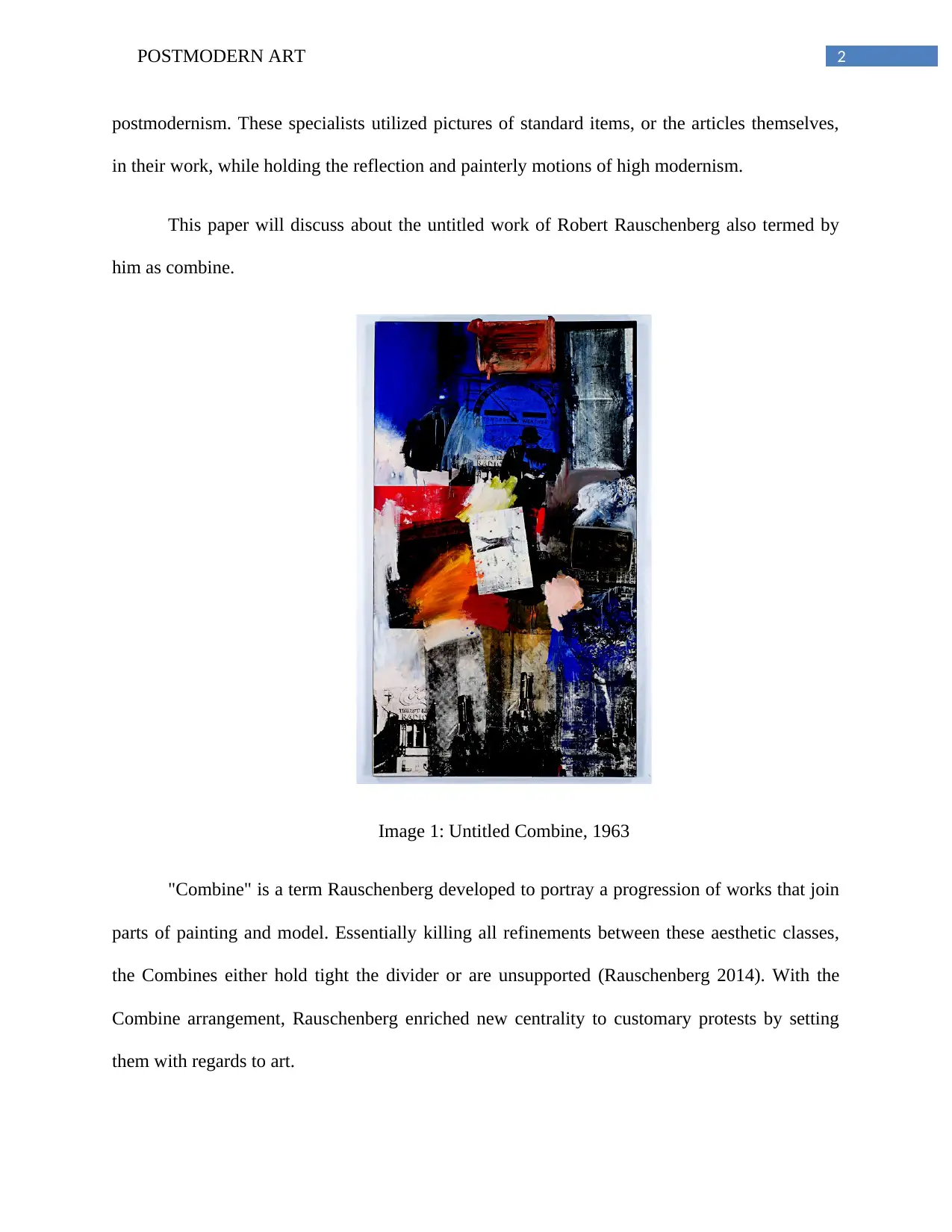
This paper will discuss about the untitled work of Robert Rauschenberg also termed by
him as combine.
Image 1: Untitled Combine, 1963
"Combine" is a term Rauschenberg developed to portray a progression of works that join
parts of painting and model. Essentially killing all refinements between these aesthetic classes,
the Combines either hold tight the divider or are unsupported (Rauschenberg 2014). With the
Combine arrangement, Rauschenberg enriched new centrality to customary protests by setting
them with regards to art.
postmodernism. These specialists utilized pictures of standard items, or the articles themselves,
in their work, while holding the reflection and painterly motions of high modernism.
This paper will discuss about the untitled work of Robert Rauschenberg also termed by
him as combine.
Image 1: Untitled Combine, 1963
"Combine" is a term Rauschenberg developed to portray a progression of works that join
parts of painting and model. Essentially killing all refinements between these aesthetic classes,
the Combines either hold tight the divider or are unsupported (Rauschenberg 2014). With the
Combine arrangement, Rauschenberg enriched new centrality to customary protests by setting
them with regards to art.
⊘ This is a preview!⊘
Do you want full access?
Subscribe today to unlock all pages.

Trusted by 1+ million students worldwide

3POSTMODERN ART
In 1962 Robert Rauschenberg first utilized economically created silkscreens to make
extensive configuration works of art in view of his own photos and discovered media pictures.
These silkscreens might be viewed as an augmentation of the exchange illustrations he executed
in the vicinity of 1958 and 1962, in which he straightforwardly exchanged the substance of daily
papers and magazines onto sheets of paper. Since he could photographically expand symbolism
on the silkscreens, this procedure liberated him from the scale confinements of the exchange
method and enabled him to effortlessly reuse pictures in differed settings. He wrote in the
winding content on his lithograph Autobiography (1968) that he "started silk screen
compositions to escape nature of articles and montage."
Rauschenberg frequently worked in grisaille while testing in another medium, and
distinctively, the soonest silkscreened artistic creations are in high contrast with resultant tones.
By August 1963, notwithstanding, he started to present splendid shading. These works of art,
including Untitled (1963), best exhibit the manners by which the artist use defects of the
silkscreen procedure, for example, subverting an ideal registry by not adjusting the screens or by
not utilizing the greater part of the hues in the four-shading process (blue, red, yellow, and dark).
The gestural utilization of shading in specific regions and the expansion of discovered things (a
method reminiscent of his prior Combines), like the metal and plastic questions in Untitled,
declare the works' handcrafted nature. His pieces additionally incorporate individual references.
In Untitled, Merce Cunningham, with whom Rauschenberg had worked together on theater and
ensemble outline since 1954, is the focal picture. The utilization of unmistakable prominent
symbolism and the use of a business strategy drove pundits to recognize Rauschenberg with
different specialists working in this figure of speech, including Andy Warhol, who additionally
started to utilize the silkscreen procedure in his work as of now.
In 1962 Robert Rauschenberg first utilized economically created silkscreens to make
extensive configuration works of art in view of his own photos and discovered media pictures.
These silkscreens might be viewed as an augmentation of the exchange illustrations he executed
in the vicinity of 1958 and 1962, in which he straightforwardly exchanged the substance of daily
papers and magazines onto sheets of paper. Since he could photographically expand symbolism
on the silkscreens, this procedure liberated him from the scale confinements of the exchange
method and enabled him to effortlessly reuse pictures in differed settings. He wrote in the
winding content on his lithograph Autobiography (1968) that he "started silk screen
compositions to escape nature of articles and montage."
Rauschenberg frequently worked in grisaille while testing in another medium, and
distinctively, the soonest silkscreened artistic creations are in high contrast with resultant tones.
By August 1963, notwithstanding, he started to present splendid shading. These works of art,
including Untitled (1963), best exhibit the manners by which the artist use defects of the
silkscreen procedure, for example, subverting an ideal registry by not adjusting the screens or by
not utilizing the greater part of the hues in the four-shading process (blue, red, yellow, and dark).
The gestural utilization of shading in specific regions and the expansion of discovered things (a
method reminiscent of his prior Combines), like the metal and plastic questions in Untitled,
declare the works' handcrafted nature. His pieces additionally incorporate individual references.
In Untitled, Merce Cunningham, with whom Rauschenberg had worked together on theater and
ensemble outline since 1954, is the focal picture. The utilization of unmistakable prominent
symbolism and the use of a business strategy drove pundits to recognize Rauschenberg with
different specialists working in this figure of speech, including Andy Warhol, who additionally
started to utilize the silkscreen procedure in his work as of now.
Paraphrase This Document
Need a fresh take? Get an instant paraphrase of this document with our AI Paraphraser

4POSTMODERN ART
In the mid 1950s, Rauschenberg propelled his creative vocation with arrangement of
monochrome compositions in dark, white, gold and red, highlighting shifted textural impacts
delivered by the marouflage and painting of daily paper. That being said he needed to abrogate
from art the hallowed rule of self-articulation. As the name proposes, the Combines are half and
half works that connect painting with composition and collection of an extensive variety of items
taken from regular daily existence. Neither canvases nor figures, however both without a
moment's delay, Rauschenberg's Combines attack the watchers' space, requesting their
consideration, as veritable visual riddles. From stuffed flying creatures to Coca-Cola bottles,
from daily paper to press photographs, texture, backdrop, entryways and windows, it is just as
the entire universe goes into his combinatorial procedure to unite with paint. A companion of
John Cage, Rauschenberg likewise appreciated sound, and in his later Combines, he created
analogies amongst music and visual expressions. Through his liking with Merce Cunningam and
move, a portion of his works progressed toward becoming stage stylistic layouts.
In the wake of the development of montage by Braque and Picasso, and in addition that
of Dadaist gathering, Rauschenberg rehashed these works on, giving them new effect in his
Combines. An offspring of Dada, Rauschenberg was impacted by the collections of Kurt
Schwitters, whose case drove him to recommend that art and life are however one. All things
considered, as Barbara Rose has called attention to, Rauschenberg's art drew its motivation from
the America of that time, and the artist was responding against Abstract Expressionism and its
objective of the supreme when he joined pictures from magazines or non-creative materials into
his works. Combines, where every component keeps up its own particular trustworthiness
without darkening the others. The present and the past, press photographs or generations of
In the mid 1950s, Rauschenberg propelled his creative vocation with arrangement of
monochrome compositions in dark, white, gold and red, highlighting shifted textural impacts
delivered by the marouflage and painting of daily paper. That being said he needed to abrogate
from art the hallowed rule of self-articulation. As the name proposes, the Combines are half and
half works that connect painting with composition and collection of an extensive variety of items
taken from regular daily existence. Neither canvases nor figures, however both without a
moment's delay, Rauschenberg's Combines attack the watchers' space, requesting their
consideration, as veritable visual riddles. From stuffed flying creatures to Coca-Cola bottles,
from daily paper to press photographs, texture, backdrop, entryways and windows, it is just as
the entire universe goes into his combinatorial procedure to unite with paint. A companion of
John Cage, Rauschenberg likewise appreciated sound, and in his later Combines, he created
analogies amongst music and visual expressions. Through his liking with Merce Cunningam and
move, a portion of his works progressed toward becoming stage stylistic layouts.
In the wake of the development of montage by Braque and Picasso, and in addition that
of Dadaist gathering, Rauschenberg rehashed these works on, giving them new effect in his
Combines. An offspring of Dada, Rauschenberg was impacted by the collections of Kurt
Schwitters, whose case drove him to recommend that art and life are however one. All things
considered, as Barbara Rose has called attention to, Rauschenberg's art drew its motivation from
the America of that time, and the artist was responding against Abstract Expressionism and its
objective of the supreme when he joined pictures from magazines or non-creative materials into
his works. Combines, where every component keeps up its own particular trustworthiness
without darkening the others. The present and the past, press photographs or generations of

5POSTMODERN ART
showstoppers of Western art, drawing and painting, pads and boxes are joined into his works, as
they endeavor to present "totality into the occasion".
After Combines came the Silkscreen time frame in which the picture and its
multiplication assumed an undeniably imperative position and existed together with painting.
Utilizing the dissolvable system to exchange pictures to silk, Rauschenberg permitted to his
enthusiasm for the photographic picture, which has never abandoned him, to ascend to the
surface (Krcma 2017). Having at first faltered between turning into a painter or a picture taker,
the art has in actuality figured out how to accommodate the two controls. These works built up
an inexorably close likeness to mirrors, on which is engraved, through various procedures of
utilizing press pictures (exchange, montage and composition), the historical backdrop of the
United States in the 1960s. The artist at that point changed nations and utilized the world as the
theme for his work. From silk to metal – the reflected or enameled aluminum of the Urban
Bourbon arrangement, copper for the Borealis arrangement, brushed aluminum for the Night
Shade arrangement of the 1990s – and to exchanges on paper for Waterworks (1992-93),
Rauschenberg has never stopped evaluating and benefitting as much as possible from the
distinctive imaginative potential outcomes of substrates, pictures and paint.
showstoppers of Western art, drawing and painting, pads and boxes are joined into his works, as
they endeavor to present "totality into the occasion".
After Combines came the Silkscreen time frame in which the picture and its
multiplication assumed an undeniably imperative position and existed together with painting.
Utilizing the dissolvable system to exchange pictures to silk, Rauschenberg permitted to his
enthusiasm for the photographic picture, which has never abandoned him, to ascend to the
surface (Krcma 2017). Having at first faltered between turning into a painter or a picture taker,
the art has in actuality figured out how to accommodate the two controls. These works built up
an inexorably close likeness to mirrors, on which is engraved, through various procedures of
utilizing press pictures (exchange, montage and composition), the historical backdrop of the
United States in the 1960s. The artist at that point changed nations and utilized the world as the
theme for his work. From silk to metal – the reflected or enameled aluminum of the Urban
Bourbon arrangement, copper for the Borealis arrangement, brushed aluminum for the Night
Shade arrangement of the 1990s – and to exchanges on paper for Waterworks (1992-93),
Rauschenberg has never stopped evaluating and benefitting as much as possible from the
distinctive imaginative potential outcomes of substrates, pictures and paint.
⊘ This is a preview!⊘
Do you want full access?
Subscribe today to unlock all pages.

Trusted by 1+ million students worldwide

6POSTMODERN ART
Reference:
Andreapoulos, Andreas. Art as theology: From the postmodern to the medieval. Routledge,
2016.
Frith, Simon, and Howard Horne. Art into pop. Vol. 2. Routledge, 2016.
Krcma, Ed. Rauschenberg/Dante: Drawing a Modern Inferno. Yale University Press, 2017.
Rauschenberg, Robert. Robert Rauschenberg: Collecting & Connecting. Nasher Museum of Art
at Duke University, 2014.
Reference:
Andreapoulos, Andreas. Art as theology: From the postmodern to the medieval. Routledge,
2016.
Frith, Simon, and Howard Horne. Art into pop. Vol. 2. Routledge, 2016.
Krcma, Ed. Rauschenberg/Dante: Drawing a Modern Inferno. Yale University Press, 2017.
Rauschenberg, Robert. Robert Rauschenberg: Collecting & Connecting. Nasher Museum of Art
at Duke University, 2014.
1 out of 7
Your All-in-One AI-Powered Toolkit for Academic Success.
+13062052269
info@desklib.com
Available 24*7 on WhatsApp / Email
Unlock your academic potential
Copyright © 2020–2025 A2Z Services. All Rights Reserved. Developed and managed by ZUCOL.