Robinson Crusoe: A Post-Colonial and Feminist Analysis Essay
VerifiedAdded on 2023/06/08
|20
|8484
|374
Essay
AI Summary
This essay explores post-colonial and feminist themes in Daniel Defoe's Robinson Crusoe, comparing it with J.M. Coetzee's Foe and Derek Walcott's Pantomime. It discusses the emergence of post-colonial literature and its focus on representing marginalized voices, referencing critics like Gayatri Spivak and Homi Bhabha. The essay analyzes how Robinson Crusoe, initially seen as an adventure story, can be interpreted through a post-colonial lens, examining themes of power, language, and 'otherness.' It also touches upon the concept of 'writing back' and the 'Robinsonade' subgenre, highlighting how modern authors reinterpret classic works to address contemporary issues and genealogical tensions between colonizers and the colonized, offering a deeper understanding of the novel's underlying complexities.
Running head: ROBINSON CRUSOE AND MODERN INTERPRETATIONS
Robinson Crusoe and Modern Interpretations
Name of the Student:
Name of the University:
Author’s Note:
Robinson Crusoe and Modern Interpretations
Name of the Student:
Name of the University:
Author’s Note:

Paraphrase This Document
Need a fresh take? Get an instant paraphrase of this document with our AI Paraphraser
1ROBINSON CRUSOE AND MODERN INTERPRETATIONS
“Until the lion learns how to write, every story will glorify the hunter.”
The above quoted lines of J. Nozipo Maraire from her famous work “Zenzele: A
Letter for My Daughter” published in the year 1996 provides an overview of the primary
reason why the many of the writers of the present times are increasingly turning towards the
genre of Postcolonial Literature1. The entire genre of Literature just like the other aspects of
the modern day would has undergone a significant amount of transformation in the recent
times. For example, one of the earliest written works of English Literature “Beowulf” is
concerned with the portrayal of the human deeds as well as the achievements of the legendary
war hero Beowulf2. However, in the succeeding ages it was seen that other themes like the
romanticism, existentialism, modernism, Post-Colonialism and others gained prominence
within the cannon of Modern Literature3. The genre of Post-Colonial Literature has emerged
as one of the most important ones in the modern times and it is generally seen that many
authors like J. M. Coetzee, Derek Walcott, Salman Rushdie and others are increasingly taking
the help of this particular cannon of Literature to raise the voices which have been suppressed
since the traditional times4. Gayatri Chakravorty Spivak, Homi K. Bhabha and other
preeminent postcolonial critics are of the viewpoint that the genre of Postcolonial Literature
is mainly concerned with the representation of the voices of the colonized as well as the
marginalized people whose voices since the traditional times have been suppressed by the
colonizers and the other dominating members of the human society5. The cannon of Post-
Colonialism is thus redolent with the various narratives of the atrocities that have been
committed by the colonizers against the native people and at the same time the manner in
1 Young, Robert JC. Postcolonialism: An historical introduction. (John Wiley & Sons, 2016), pp. 76.
2 Gouda, Frances, Theo D’haen, Sarah Bracke, Nadia Fadil, Isabel Hoving, Pamela Pattynama, Louise Viljoen et
al. The Postcolonial Low Countries: Literature, Colonialism, and Multiculturalism. (Lexington Books, 2012),
pp. 78.
3 Gouda, Frances, Theo D’haen, Sarah Bracke, Nadia Fadil, Isabel Hoving, Pamela Pattynama, Louise Viljoen et
al. The Postcolonial Low Countries: Literature, Colonialism, and Multiculturalism. (Lexington Books, 2012),
pp. 81.
4 McGillis, Roderick. Voices of the other: Children's literature and the postcolonial context. (Routledge, 2013),
pp. 187.
5 Spivak, Gayatri. The Spivak Reader: Selected Works of Gayati Chakravorty Spivak. (Routledge, 2013), pp. 34.
“Until the lion learns how to write, every story will glorify the hunter.”
The above quoted lines of J. Nozipo Maraire from her famous work “Zenzele: A
Letter for My Daughter” published in the year 1996 provides an overview of the primary
reason why the many of the writers of the present times are increasingly turning towards the
genre of Postcolonial Literature1. The entire genre of Literature just like the other aspects of
the modern day would has undergone a significant amount of transformation in the recent
times. For example, one of the earliest written works of English Literature “Beowulf” is
concerned with the portrayal of the human deeds as well as the achievements of the legendary
war hero Beowulf2. However, in the succeeding ages it was seen that other themes like the
romanticism, existentialism, modernism, Post-Colonialism and others gained prominence
within the cannon of Modern Literature3. The genre of Post-Colonial Literature has emerged
as one of the most important ones in the modern times and it is generally seen that many
authors like J. M. Coetzee, Derek Walcott, Salman Rushdie and others are increasingly taking
the help of this particular cannon of Literature to raise the voices which have been suppressed
since the traditional times4. Gayatri Chakravorty Spivak, Homi K. Bhabha and other
preeminent postcolonial critics are of the viewpoint that the genre of Postcolonial Literature
is mainly concerned with the representation of the voices of the colonized as well as the
marginalized people whose voices since the traditional times have been suppressed by the
colonizers and the other dominating members of the human society5. The cannon of Post-
Colonialism is thus redolent with the various narratives of the atrocities that have been
committed by the colonizers against the native people and at the same time the manner in
1 Young, Robert JC. Postcolonialism: An historical introduction. (John Wiley & Sons, 2016), pp. 76.
2 Gouda, Frances, Theo D’haen, Sarah Bracke, Nadia Fadil, Isabel Hoving, Pamela Pattynama, Louise Viljoen et
al. The Postcolonial Low Countries: Literature, Colonialism, and Multiculturalism. (Lexington Books, 2012),
pp. 78.
3 Gouda, Frances, Theo D’haen, Sarah Bracke, Nadia Fadil, Isabel Hoving, Pamela Pattynama, Louise Viljoen et
al. The Postcolonial Low Countries: Literature, Colonialism, and Multiculturalism. (Lexington Books, 2012),
pp. 81.
4 McGillis, Roderick. Voices of the other: Children's literature and the postcolonial context. (Routledge, 2013),
pp. 187.
5 Spivak, Gayatri. The Spivak Reader: Selected Works of Gayati Chakravorty Spivak. (Routledge, 2013), pp. 34.
2ROBINSON CRUSOE AND MODERN INTERPRETATIONS
which history has been appropriated to give leverage to the colonizers6. This essay will
discuss about the themes of post-colonialism, feminism and others in the particular context of
Daniel Defoe’s Robinson Crusoe, J.M. Coetzee’s Foe and Derek Walcott’s Pantomime.
Edward W. Said in his famous work “Orientalism” said that “Every empire, however,
tells itself and the world that it is unlike all other empires, that its mission is not to plunder
and control but to educate and liberate”7. The authors Bill Ashcroft, Gareth Griffiths and
Helen Tiffin in the book “The Empire Writes Back” take the help of the term Post-Colonial
Literature to specifically refer to the Literatures that have been developed from the
Commonwealth Literature of the Third World Literatures8. Furthermore, the authors try to
state the basic aim of the Post-Colonial Literature in the words that “The Labour of producing
a counter-discourse displacing imperialism dominative system of knowledge rests with those
engaged in developing a critique from outside its cultural hegemony”9. It is significant to note
that there are various traces of the cannon of Post-Colonialism Literature in the arsenal of
Literature since the traditional times. One of the most common examples that is being widely
used by the various experts to show that the genre of Post-Colonialism is a very old one
refers back to the 16th century England, namely the famous play of William Shakespeare “The
Tempest”10. In this particular work the relationship which Prospero shares with Caliban and
also Ariel clearly indicates the rudimentary existence of the traces of this particular genre of
Literature in the cannon of English Literature11. However, the genre of Literature under
discussion here gained a significant amount of prominence in the wide arena of Literature
6 Spivak, Gayatri. The Spivak Reader: Selected Works of Gayati Chakravorty Spivak. (Routledge, 2013), pp. 90.
7 Varisco, Daniel Martin. Reading Orientalism: Said and the unsaid. (University of Washington Press, 2017),
pp. 98.
8 Ashcroft, Bill, Gareth Griffiths, and Helen Tiffin. The empire writes back: Theory and practice in post-colonial
literatures. (Routledge, 2003), pp. 1.
9 Ashcroft, Bill, Gareth Griffiths, and Helen Tiffin. The empire writes back: Theory and practice in post-colonial
literatures. (Routledge, 2003), pp. 1.
10 Chew, Shirley, and David Richards, eds. A Concise Companion to Postcolonial Literature. (John Wiley &
Sons, 2013), pp. 67.
11 Chew, Shirley, and David Richards, eds. A Concise Companion to Postcolonial Literature. (John Wiley &
Sons, 2013), pp. 67.
which history has been appropriated to give leverage to the colonizers6. This essay will
discuss about the themes of post-colonialism, feminism and others in the particular context of
Daniel Defoe’s Robinson Crusoe, J.M. Coetzee’s Foe and Derek Walcott’s Pantomime.
Edward W. Said in his famous work “Orientalism” said that “Every empire, however,
tells itself and the world that it is unlike all other empires, that its mission is not to plunder
and control but to educate and liberate”7. The authors Bill Ashcroft, Gareth Griffiths and
Helen Tiffin in the book “The Empire Writes Back” take the help of the term Post-Colonial
Literature to specifically refer to the Literatures that have been developed from the
Commonwealth Literature of the Third World Literatures8. Furthermore, the authors try to
state the basic aim of the Post-Colonial Literature in the words that “The Labour of producing
a counter-discourse displacing imperialism dominative system of knowledge rests with those
engaged in developing a critique from outside its cultural hegemony”9. It is significant to note
that there are various traces of the cannon of Post-Colonialism Literature in the arsenal of
Literature since the traditional times. One of the most common examples that is being widely
used by the various experts to show that the genre of Post-Colonialism is a very old one
refers back to the 16th century England, namely the famous play of William Shakespeare “The
Tempest”10. In this particular work the relationship which Prospero shares with Caliban and
also Ariel clearly indicates the rudimentary existence of the traces of this particular genre of
Literature in the cannon of English Literature11. However, the genre of Literature under
discussion here gained a significant amount of prominence in the wide arena of Literature
6 Spivak, Gayatri. The Spivak Reader: Selected Works of Gayati Chakravorty Spivak. (Routledge, 2013), pp. 90.
7 Varisco, Daniel Martin. Reading Orientalism: Said and the unsaid. (University of Washington Press, 2017),
pp. 98.
8 Ashcroft, Bill, Gareth Griffiths, and Helen Tiffin. The empire writes back: Theory and practice in post-colonial
literatures. (Routledge, 2003), pp. 1.
9 Ashcroft, Bill, Gareth Griffiths, and Helen Tiffin. The empire writes back: Theory and practice in post-colonial
literatures. (Routledge, 2003), pp. 1.
10 Chew, Shirley, and David Richards, eds. A Concise Companion to Postcolonial Literature. (John Wiley &
Sons, 2013), pp. 67.
11 Chew, Shirley, and David Richards, eds. A Concise Companion to Postcolonial Literature. (John Wiley &
Sons, 2013), pp. 67.
⊘ This is a preview!⊘
Do you want full access?
Subscribe today to unlock all pages.

Trusted by 1+ million students worldwide
3ROBINSON CRUSOE AND MODERN INTERPRETATIONS
only in the later part of the 20th century not only with the Great Wars after which the majority
of the colonial nations of the world gained their liberation from the colonial yoke but also
with the emergence of various writers like Chinua Achebe, J. M. Coetzee, Derek Walcott,
Salman Rushdie, Conrad and others who took the help of the various Modernistic and Post-
Modernistic techniques to give representation to the voices which since the traditional times
have not only been suppressed but at the same time being rebuffed12.
As mentioned the genre of Literature has undergone much transformation in the
recent times and it is a reflection of this particular fact the literary style of “writing back” has
gained a significant amount of prominence in the present times. Thus, it is seen that the many
writers of the present times are increasingly turning towards the various classics to derive the
main theme or the storyline from there and to present them in the modern day setting. This is
sometimes been viewed as “Plagiarism” in the cannon of Literature13. One of the novels
which have been widely subjected to this particular process is Daniel Defoe’s “Robinson
Crusoe” and it is in the light of this particular act on the part of the writers that the term
“Robinsonade” has gained popularity in the recent times14. Some of the examples of the
works which have been composed taking the help of the process of Robinsonade are the
anonymous Ashton’s Memorial, The English Hermit by Peter Longueville and The Life and
Adventures of Peter Wilkins written by Robert Paltock15. Even in the 20th century J.M.
Coetzee’s “Foe” and Derek Walcott’s Pantomime are examples of the use of this particular
process. It is significant to note that most of these works apart from dwelling on the work of
Defoe are at the same time concerned with the representation of the concept of “otherness” as
well. Salman Rushdie in this particular context says that the basic idea behind these works
12 Ratti, Manav. The Postsecular Imagination: Postcolonialism, Religion, and Literature. (Routledge, 2013), pp.
156.
13 O'Malley, Andrew. Children's Literature, Popular Culture, and Robinson Crusoe. (Springer, 2012), pp. 23.
14 O'Malley, Andrew. Children's Literature, Popular Culture, and Robinson Crusoe. (Springer, 2012), pp. 27.
15 O'Malley, Andrew. Children's Literature, Popular Culture, and Robinson Crusoe. (Springer, 2012), pp. 27.
only in the later part of the 20th century not only with the Great Wars after which the majority
of the colonial nations of the world gained their liberation from the colonial yoke but also
with the emergence of various writers like Chinua Achebe, J. M. Coetzee, Derek Walcott,
Salman Rushdie, Conrad and others who took the help of the various Modernistic and Post-
Modernistic techniques to give representation to the voices which since the traditional times
have not only been suppressed but at the same time being rebuffed12.
As mentioned the genre of Literature has undergone much transformation in the
recent times and it is a reflection of this particular fact the literary style of “writing back” has
gained a significant amount of prominence in the present times. Thus, it is seen that the many
writers of the present times are increasingly turning towards the various classics to derive the
main theme or the storyline from there and to present them in the modern day setting. This is
sometimes been viewed as “Plagiarism” in the cannon of Literature13. One of the novels
which have been widely subjected to this particular process is Daniel Defoe’s “Robinson
Crusoe” and it is in the light of this particular act on the part of the writers that the term
“Robinsonade” has gained popularity in the recent times14. Some of the examples of the
works which have been composed taking the help of the process of Robinsonade are the
anonymous Ashton’s Memorial, The English Hermit by Peter Longueville and The Life and
Adventures of Peter Wilkins written by Robert Paltock15. Even in the 20th century J.M.
Coetzee’s “Foe” and Derek Walcott’s Pantomime are examples of the use of this particular
process. It is significant to note that most of these works apart from dwelling on the work of
Defoe are at the same time concerned with the representation of the concept of “otherness” as
well. Salman Rushdie in this particular context says that the basic idea behind these works
12 Ratti, Manav. The Postsecular Imagination: Postcolonialism, Religion, and Literature. (Routledge, 2013), pp.
156.
13 O'Malley, Andrew. Children's Literature, Popular Culture, and Robinson Crusoe. (Springer, 2012), pp. 23.
14 O'Malley, Andrew. Children's Literature, Popular Culture, and Robinson Crusoe. (Springer, 2012), pp. 27.
15 O'Malley, Andrew. Children's Literature, Popular Culture, and Robinson Crusoe. (Springer, 2012), pp. 27.
Paraphrase This Document
Need a fresh take? Get an instant paraphrase of this document with our AI Paraphraser
4ROBINSON CRUSOE AND MODERN INTERPRETATIONS
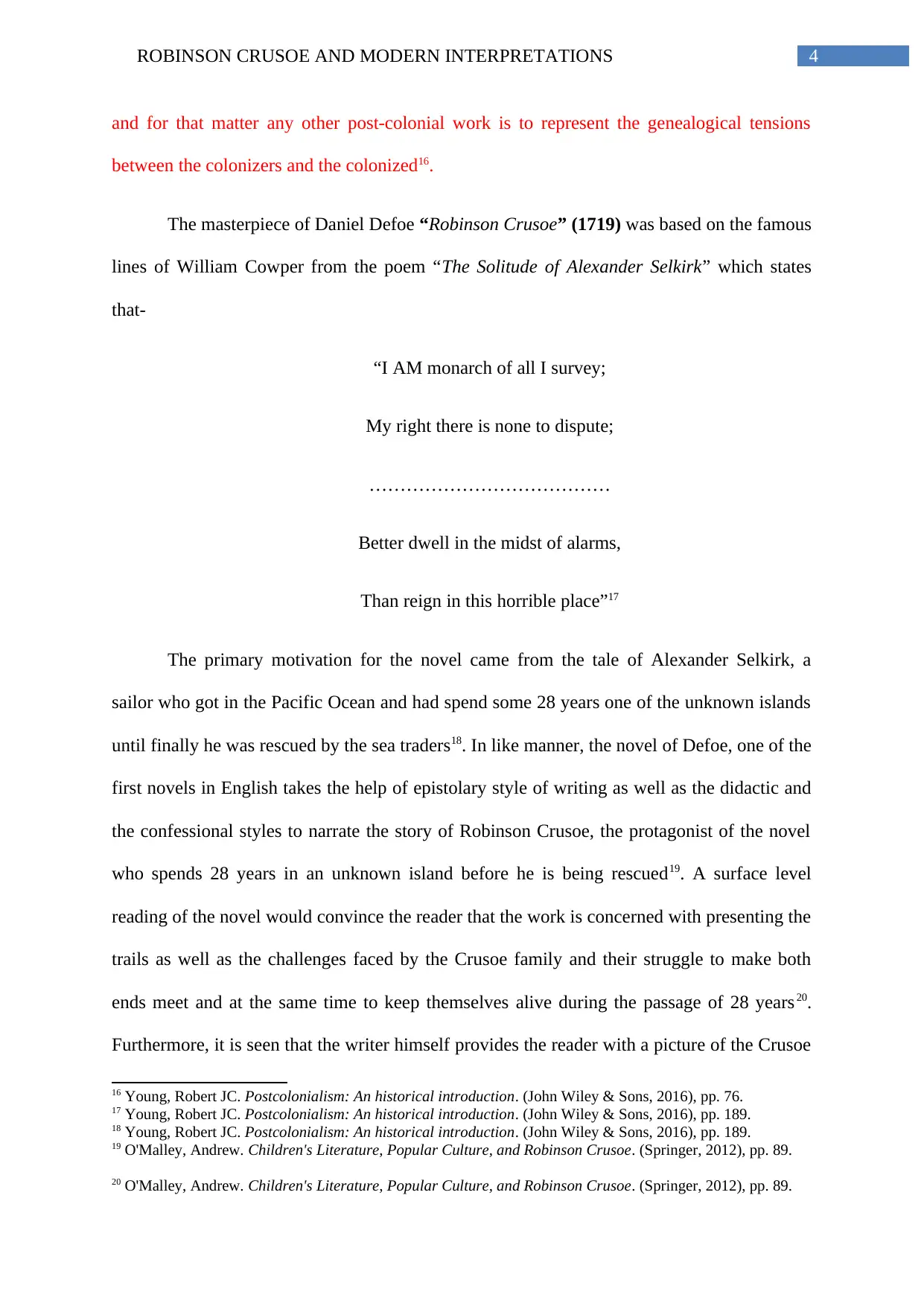
and for that matter any other post-colonial work is to represent the genealogical tensions
between the colonizers and the colonized16.
The masterpiece of Daniel Defoe “Robinson Crusoe” (1719) was based on the famous
lines of William Cowper from the poem “The Solitude of Alexander Selkirk” which states
that-
“I AM monarch of all I survey;
My right there is none to dispute;
…………………………………
Better dwell in the midst of alarms,
Than reign in this horrible place”17
The primary motivation for the novel came from the tale of Alexander Selkirk, a
sailor who got in the Pacific Ocean and had spend some 28 years one of the unknown islands
until finally he was rescued by the sea traders18. In like manner, the novel of Defoe, one of the
first novels in English takes the help of epistolary style of writing as well as the didactic and
the confessional styles to narrate the story of Robinson Crusoe, the protagonist of the novel
who spends 28 years in an unknown island before he is being rescued19. A surface level
reading of the novel would convince the reader that the work is concerned with presenting the
trails as well as the challenges faced by the Crusoe family and their struggle to make both
ends meet and at the same time to keep themselves alive during the passage of 28 years20.
Furthermore, it is seen that the writer himself provides the reader with a picture of the Crusoe
16 Young, Robert JC. Postcolonialism: An historical introduction. (John Wiley & Sons, 2016), pp. 76.
17 Young, Robert JC. Postcolonialism: An historical introduction. (John Wiley & Sons, 2016), pp. 189.
18 Young, Robert JC. Postcolonialism: An historical introduction. (John Wiley & Sons, 2016), pp. 189.
19 O'Malley, Andrew. Children's Literature, Popular Culture, and Robinson Crusoe. (Springer, 2012), pp. 89.
20 O'Malley, Andrew. Children's Literature, Popular Culture, and Robinson Crusoe. (Springer, 2012), pp. 89.
and for that matter any other post-colonial work is to represent the genealogical tensions
between the colonizers and the colonized16.
The masterpiece of Daniel Defoe “Robinson Crusoe” (1719) was based on the famous
lines of William Cowper from the poem “The Solitude of Alexander Selkirk” which states
that-
“I AM monarch of all I survey;
My right there is none to dispute;
…………………………………
Better dwell in the midst of alarms,
Than reign in this horrible place”17
The primary motivation for the novel came from the tale of Alexander Selkirk, a
sailor who got in the Pacific Ocean and had spend some 28 years one of the unknown islands
until finally he was rescued by the sea traders18. In like manner, the novel of Defoe, one of the
first novels in English takes the help of epistolary style of writing as well as the didactic and
the confessional styles to narrate the story of Robinson Crusoe, the protagonist of the novel
who spends 28 years in an unknown island before he is being rescued19. A surface level
reading of the novel would convince the reader that the work is concerned with presenting the
trails as well as the challenges faced by the Crusoe family and their struggle to make both
ends meet and at the same time to keep themselves alive during the passage of 28 years20.
Furthermore, it is seen that the writer himself provides the reader with a picture of the Crusoe
16 Young, Robert JC. Postcolonialism: An historical introduction. (John Wiley & Sons, 2016), pp. 76.
17 Young, Robert JC. Postcolonialism: An historical introduction. (John Wiley & Sons, 2016), pp. 189.
18 Young, Robert JC. Postcolonialism: An historical introduction. (John Wiley & Sons, 2016), pp. 189.
19 O'Malley, Andrew. Children's Literature, Popular Culture, and Robinson Crusoe. (Springer, 2012), pp. 89.
20 O'Malley, Andrew. Children's Literature, Popular Culture, and Robinson Crusoe. (Springer, 2012), pp. 89.
5ROBINSON CRUSOE AND MODERN INTERPRETATIONS
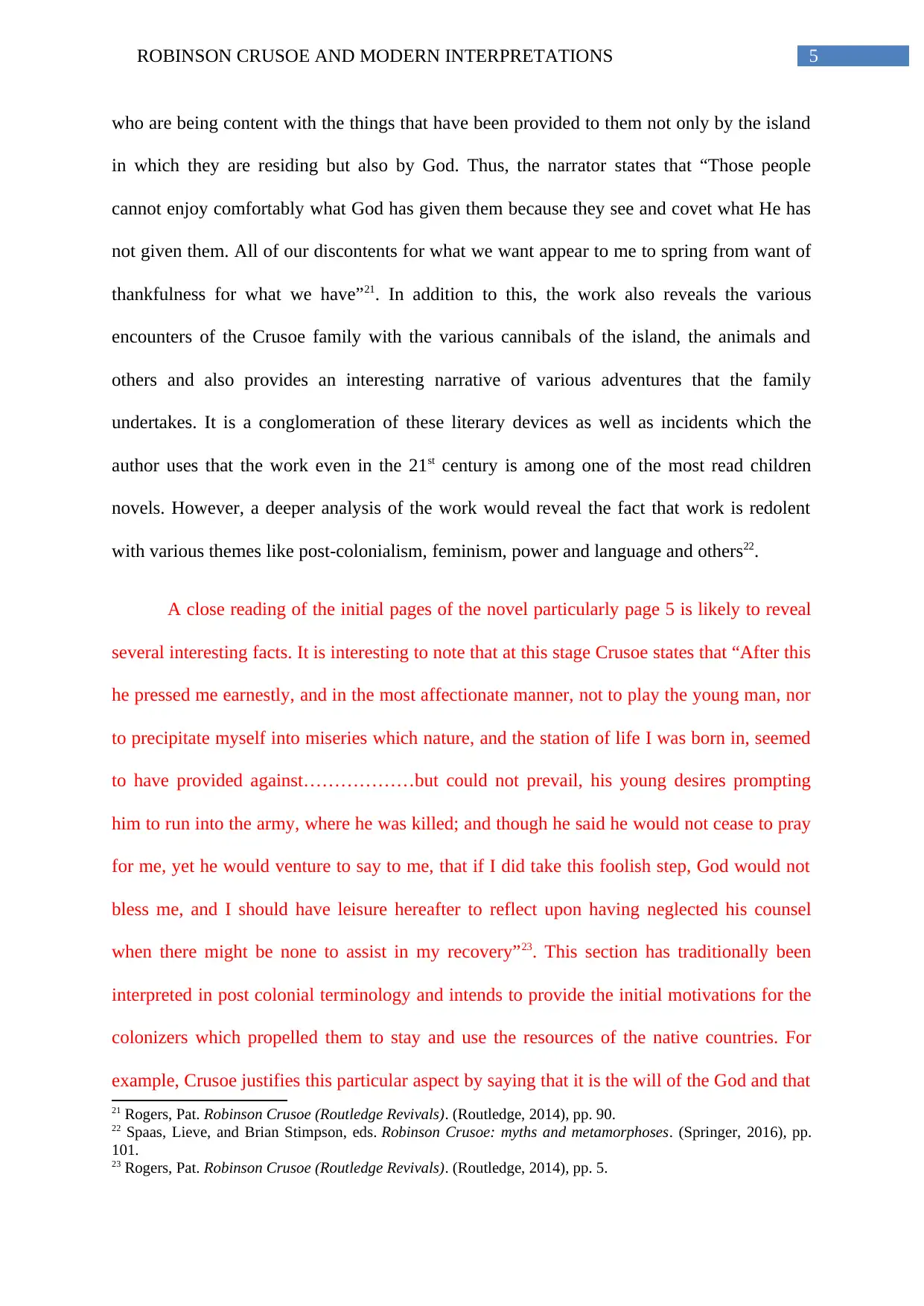
who are being content with the things that have been provided to them not only by the island
in which they are residing but also by God. Thus, the narrator states that “Those people
cannot enjoy comfortably what God has given them because they see and covet what He has
not given them. All of our discontents for what we want appear to me to spring from want of
thankfulness for what we have”21. In addition to this, the work also reveals the various
encounters of the Crusoe family with the various cannibals of the island, the animals and
others and also provides an interesting narrative of various adventures that the family
undertakes. It is a conglomeration of these literary devices as well as incidents which the
author uses that the work even in the 21st century is among one of the most read children
novels. However, a deeper analysis of the work would reveal the fact that work is redolent
with various themes like post-colonialism, feminism, power and language and others22.
A close reading of the initial pages of the novel particularly page 5 is likely to reveal
several interesting facts. It is interesting to note that at this stage Crusoe states that “After this
he pressed me earnestly, and in the most affectionate manner, not to play the young man, nor
to precipitate myself into miseries which nature, and the station of life I was born in, seemed
to have provided against………………but could not prevail, his young desires prompting
him to run into the army, where he was killed; and though he said he would not cease to pray
for me, yet he would venture to say to me, that if I did take this foolish step, God would not
bless me, and I should have leisure hereafter to reflect upon having neglected his counsel
when there might be none to assist in my recovery”23. This section has traditionally been
interpreted in post colonial terminology and intends to provide the initial motivations for the
colonizers which propelled them to stay and use the resources of the native countries. For
example, Crusoe justifies this particular aspect by saying that it is the will of the God and that
21 Rogers, Pat. Robinson Crusoe (Routledge Revivals). (Routledge, 2014), pp. 90.
22 Spaas, Lieve, and Brian Stimpson, eds. Robinson Crusoe: myths and metamorphoses. (Springer, 2016), pp.
101.
23 Rogers, Pat. Robinson Crusoe (Routledge Revivals). (Routledge, 2014), pp. 5.
who are being content with the things that have been provided to them not only by the island
in which they are residing but also by God. Thus, the narrator states that “Those people
cannot enjoy comfortably what God has given them because they see and covet what He has
not given them. All of our discontents for what we want appear to me to spring from want of
thankfulness for what we have”21. In addition to this, the work also reveals the various
encounters of the Crusoe family with the various cannibals of the island, the animals and
others and also provides an interesting narrative of various adventures that the family
undertakes. It is a conglomeration of these literary devices as well as incidents which the
author uses that the work even in the 21st century is among one of the most read children
novels. However, a deeper analysis of the work would reveal the fact that work is redolent
with various themes like post-colonialism, feminism, power and language and others22.
A close reading of the initial pages of the novel particularly page 5 is likely to reveal
several interesting facts. It is interesting to note that at this stage Crusoe states that “After this
he pressed me earnestly, and in the most affectionate manner, not to play the young man, nor
to precipitate myself into miseries which nature, and the station of life I was born in, seemed
to have provided against………………but could not prevail, his young desires prompting
him to run into the army, where he was killed; and though he said he would not cease to pray
for me, yet he would venture to say to me, that if I did take this foolish step, God would not
bless me, and I should have leisure hereafter to reflect upon having neglected his counsel
when there might be none to assist in my recovery”23. This section has traditionally been
interpreted in post colonial terminology and intends to provide the initial motivations for the
colonizers which propelled them to stay and use the resources of the native countries. For
example, Crusoe justifies this particular aspect by saying that it is the will of the God and that
21 Rogers, Pat. Robinson Crusoe (Routledge Revivals). (Routledge, 2014), pp. 90.
22 Spaas, Lieve, and Brian Stimpson, eds. Robinson Crusoe: myths and metamorphoses. (Springer, 2016), pp.
101.
23 Rogers, Pat. Robinson Crusoe (Routledge Revivals). (Routledge, 2014), pp. 5.
⊘ This is a preview!⊘
Do you want full access?
Subscribe today to unlock all pages.
Trusted by 1+ million students worldwide
6ROBINSON CRUSOE AND MODERN INTERPRETATIONS
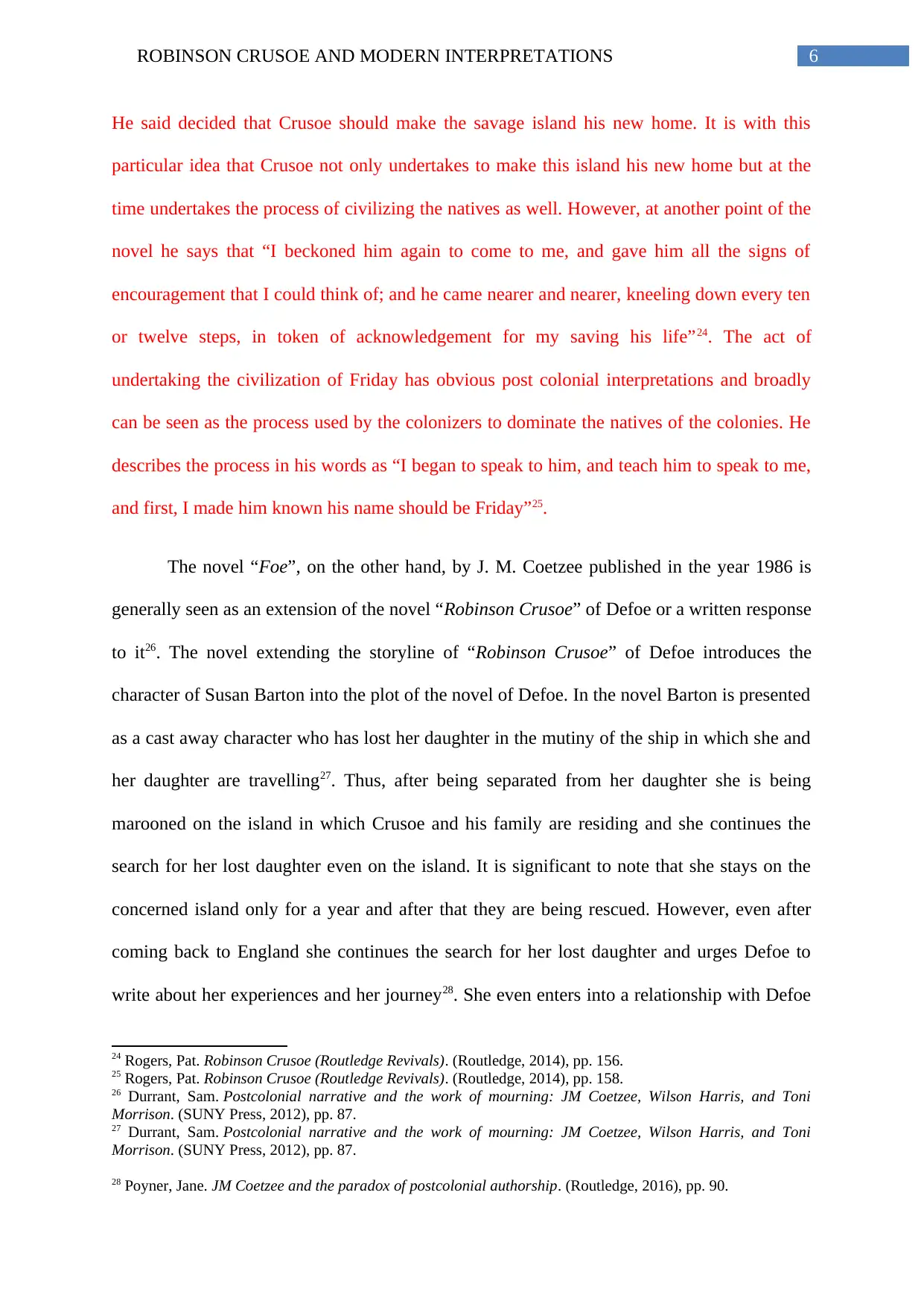
He said decided that Crusoe should make the savage island his new home. It is with this
particular idea that Crusoe not only undertakes to make this island his new home but at the
time undertakes the process of civilizing the natives as well. However, at another point of the
novel he says that “I beckoned him again to come to me, and gave him all the signs of
encouragement that I could think of; and he came nearer and nearer, kneeling down every ten
or twelve steps, in token of acknowledgement for my saving his life”24. The act of
undertaking the civilization of Friday has obvious post colonial interpretations and broadly
can be seen as the process used by the colonizers to dominate the natives of the colonies. He
describes the process in his words as “I began to speak to him, and teach him to speak to me,
and first, I made him known his name should be Friday”25.
The novel “Foe”, on the other hand, by J. M. Coetzee published in the year 1986 is
generally seen as an extension of the novel “Robinson Crusoe” of Defoe or a written response
to it26. The novel extending the storyline of “Robinson Crusoe” of Defoe introduces the
character of Susan Barton into the plot of the novel of Defoe. In the novel Barton is presented
as a cast away character who has lost her daughter in the mutiny of the ship in which she and
her daughter are travelling27. Thus, after being separated from her daughter she is being
marooned on the island in which Crusoe and his family are residing and she continues the
search for her lost daughter even on the island. It is significant to note that she stays on the
concerned island only for a year and after that they are being rescued. However, even after
coming back to England she continues the search for her lost daughter and urges Defoe to
write about her experiences and her journey28. She even enters into a relationship with Defoe
24 Rogers, Pat. Robinson Crusoe (Routledge Revivals). (Routledge, 2014), pp. 156.
25 Rogers, Pat. Robinson Crusoe (Routledge Revivals). (Routledge, 2014), pp. 158.
26 Durrant, Sam. Postcolonial narrative and the work of mourning: JM Coetzee, Wilson Harris, and Toni
Morrison. (SUNY Press, 2012), pp. 87.
27 Durrant, Sam. Postcolonial narrative and the work of mourning: JM Coetzee, Wilson Harris, and Toni
Morrison. (SUNY Press, 2012), pp. 87.
28 Poyner, Jane. JM Coetzee and the paradox of postcolonial authorship. (Routledge, 2016), pp. 90.
He said decided that Crusoe should make the savage island his new home. It is with this
particular idea that Crusoe not only undertakes to make this island his new home but at the
time undertakes the process of civilizing the natives as well. However, at another point of the
novel he says that “I beckoned him again to come to me, and gave him all the signs of
encouragement that I could think of; and he came nearer and nearer, kneeling down every ten
or twelve steps, in token of acknowledgement for my saving his life”24. The act of
undertaking the civilization of Friday has obvious post colonial interpretations and broadly
can be seen as the process used by the colonizers to dominate the natives of the colonies. He
describes the process in his words as “I began to speak to him, and teach him to speak to me,
and first, I made him known his name should be Friday”25.
The novel “Foe”, on the other hand, by J. M. Coetzee published in the year 1986 is
generally seen as an extension of the novel “Robinson Crusoe” of Defoe or a written response
to it26. The novel extending the storyline of “Robinson Crusoe” of Defoe introduces the
character of Susan Barton into the plot of the novel of Defoe. In the novel Barton is presented
as a cast away character who has lost her daughter in the mutiny of the ship in which she and
her daughter are travelling27. Thus, after being separated from her daughter she is being
marooned on the island in which Crusoe and his family are residing and she continues the
search for her lost daughter even on the island. It is significant to note that she stays on the
concerned island only for a year and after that they are being rescued. However, even after
coming back to England she continues the search for her lost daughter and urges Defoe to
write about her experiences and her journey28. She even enters into a relationship with Defoe
24 Rogers, Pat. Robinson Crusoe (Routledge Revivals). (Routledge, 2014), pp. 156.
25 Rogers, Pat. Robinson Crusoe (Routledge Revivals). (Routledge, 2014), pp. 158.
26 Durrant, Sam. Postcolonial narrative and the work of mourning: JM Coetzee, Wilson Harris, and Toni
Morrison. (SUNY Press, 2012), pp. 87.
27 Durrant, Sam. Postcolonial narrative and the work of mourning: JM Coetzee, Wilson Harris, and Toni
Morrison. (SUNY Press, 2012), pp. 87.
28 Poyner, Jane. JM Coetzee and the paradox of postcolonial authorship. (Routledge, 2016), pp. 90.
Paraphrase This Document
Need a fresh take? Get an instant paraphrase of this document with our AI Paraphraser
7ROBINSON CRUSOE AND MODERN INTERPRETATIONS
so that he complete the narrative of her experiences on that island but after continuous
periods of convincing Defoe just agrees to add a chapter dedicated to her experiences on the
island29. At the end of the novel it is seen that a girl who claims to be the lost daughter of
Barton surfaces and it is at this particular point of time that the novel ends. Commenting on
the journey and the hardships that Barton had faced at the island she says that “When I reflect
on my story I seem to exist only as the one who came, the one who witnessed, the one who
longed to be gone: a being without substance, a ghost beside the true body of Crusoe. Is that
the fate of all storytellers?”30. This is the basic overview of the entire novel which a surface
level reading of the novel is likely to provide the readers with. However, a close reading of
the novel would reveal the usage of various post-modernistic themes like post-colonialism,
feminism and others within the framework of the novel.
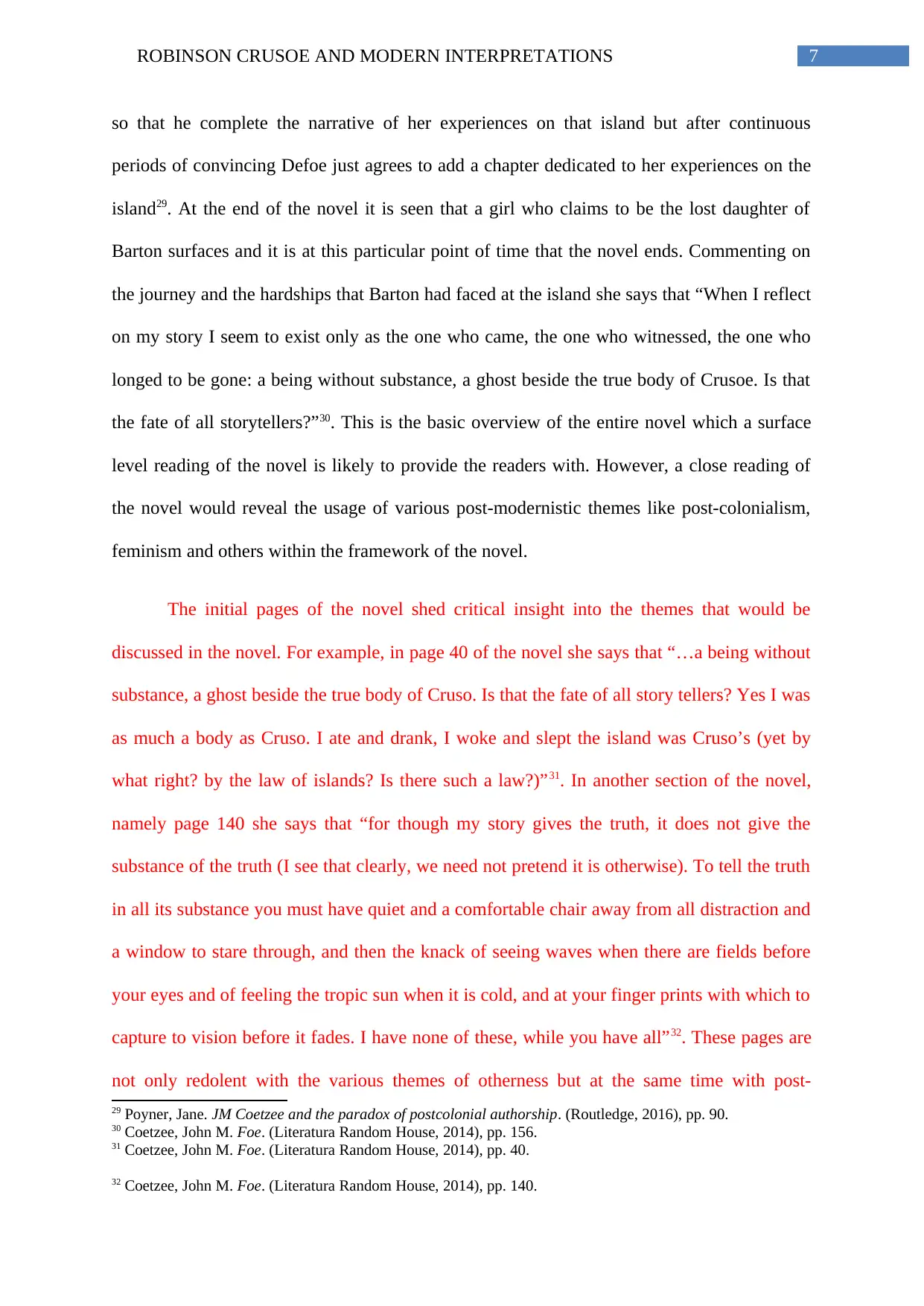
The initial pages of the novel shed critical insight into the themes that would be
discussed in the novel. For example, in page 40 of the novel she says that “…a being without
substance, a ghost beside the true body of Cruso. Is that the fate of all story tellers? Yes I was
as much a body as Cruso. I ate and drank, I woke and slept the island was Cruso’s (yet by
what right? by the law of islands? Is there such a law?)”31. In another section of the novel,
namely page 140 she says that “for though my story gives the truth, it does not give the
substance of the truth (I see that clearly, we need not pretend it is otherwise). To tell the truth
in all its substance you must have quiet and a comfortable chair away from all distraction and
a window to stare through, and then the knack of seeing waves when there are fields before
your eyes and of feeling the tropic sun when it is cold, and at your finger prints with which to
capture to vision before it fades. I have none of these, while you have all”32. These pages are
not only redolent with the various themes of otherness but at the same time with post-
29 Poyner, Jane. JM Coetzee and the paradox of postcolonial authorship. (Routledge, 2016), pp. 90.
30 Coetzee, John M. Foe. (Literatura Random House, 2014), pp. 156.
31 Coetzee, John M. Foe. (Literatura Random House, 2014), pp. 40.
32 Coetzee, John M. Foe. (Literatura Random House, 2014), pp. 140.
so that he complete the narrative of her experiences on that island but after continuous
periods of convincing Defoe just agrees to add a chapter dedicated to her experiences on the
island29. At the end of the novel it is seen that a girl who claims to be the lost daughter of
Barton surfaces and it is at this particular point of time that the novel ends. Commenting on
the journey and the hardships that Barton had faced at the island she says that “When I reflect
on my story I seem to exist only as the one who came, the one who witnessed, the one who
longed to be gone: a being without substance, a ghost beside the true body of Crusoe. Is that
the fate of all storytellers?”30. This is the basic overview of the entire novel which a surface
level reading of the novel is likely to provide the readers with. However, a close reading of
the novel would reveal the usage of various post-modernistic themes like post-colonialism,
feminism and others within the framework of the novel.
The initial pages of the novel shed critical insight into the themes that would be
discussed in the novel. For example, in page 40 of the novel she says that “…a being without
substance, a ghost beside the true body of Cruso. Is that the fate of all story tellers? Yes I was
as much a body as Cruso. I ate and drank, I woke and slept the island was Cruso’s (yet by
what right? by the law of islands? Is there such a law?)”31. In another section of the novel,
namely page 140 she says that “for though my story gives the truth, it does not give the
substance of the truth (I see that clearly, we need not pretend it is otherwise). To tell the truth
in all its substance you must have quiet and a comfortable chair away from all distraction and
a window to stare through, and then the knack of seeing waves when there are fields before
your eyes and of feeling the tropic sun when it is cold, and at your finger prints with which to
capture to vision before it fades. I have none of these, while you have all”32. These pages are
not only redolent with the various themes of otherness but at the same time with post-
29 Poyner, Jane. JM Coetzee and the paradox of postcolonial authorship. (Routledge, 2016), pp. 90.
30 Coetzee, John M. Foe. (Literatura Random House, 2014), pp. 156.
31 Coetzee, John M. Foe. (Literatura Random House, 2014), pp. 40.
32 Coetzee, John M. Foe. (Literatura Random House, 2014), pp. 140.
8ROBINSON CRUSOE AND MODERN INTERPRETATIONS
colonialism, feminism and others. It would be appropriate to say that she is a free woman
who chooses to exercise her right of freedom by way of writing her story. Furthermore, the
theme of power and language is also being used at this particular juncture since it is seen that
Defoe is not only uninterested in writing her story but at the same dissuades her from doing
so. At this particular juncture she also says that “In every story there is silence, some sight
concealed, some word unspoken, I believe. Till we have spoken the unspoken we have not
come to the heart of the story”33. This particular statement hints not only towards the
suppression of the voice of the subaltern but at the same time the suppression of the voice of
the females since the traditional times as well.
The play “Pantomime” by Derek Walcott (1978) is another play which takes the help
of the basic plot of the novel “Robinson Crusoe” of Defoe for the purpose of exploring
deeper themes34. A surface level reading of the play would reveal the in-charge of the
manager of a hotel, Trewe and the waiter of the same hotel trying to come up with diverse
kinds of means to ensure that the hotel after it is being opened would get adequate number of
visitors35. At the start of the play Trewe is shown to be engrossed in the reading of a play
which he intends to perform before the visitors of the hotel once the hotel starts and it is
interesting that this play is supposed to be an adaptation of Defoe’s “Robinson Crusoe”36. The
play presents the waiter, Jackson to be a practical individual who suggests to Treve instead of
focusing on the play for the entertainment of the visitors should rather focus on the
renovation of the hotel which is in a very bad condition at the current moment. However,
Treve soon convinces him to help him in the practice of the play and they even exchange the
33 Coetzee, John M. Foe. (Literatura Random House, 2014), pp. 141.
34 Pop, Titus. "Jamaican Creole as a Marker of Hybridity and Postcolonial Identity in Derek Walcott." (Texts &
Contexts Reloaded TCR :2012), pp. 64.
35 Pop, Titus. "Jamaican Creole as a Marker of Hybridity and Postcolonial Identity in Derek Walcott." (Texts &
Contexts Reloaded TCR :2012), pp. 64.
36 Yimbu, Emmanuel Nchia. "Oral Aesthetics and the Power of Symbols in the Plays of Derek Walcott and Bate
Besong." (Traektoriâ Nauki= Path of Science 2, no. 10 :2016), pp. 21.
colonialism, feminism and others. It would be appropriate to say that she is a free woman
who chooses to exercise her right of freedom by way of writing her story. Furthermore, the
theme of power and language is also being used at this particular juncture since it is seen that
Defoe is not only uninterested in writing her story but at the same dissuades her from doing
so. At this particular juncture she also says that “In every story there is silence, some sight
concealed, some word unspoken, I believe. Till we have spoken the unspoken we have not
come to the heart of the story”33. This particular statement hints not only towards the
suppression of the voice of the subaltern but at the same time the suppression of the voice of
the females since the traditional times as well.
The play “Pantomime” by Derek Walcott (1978) is another play which takes the help
of the basic plot of the novel “Robinson Crusoe” of Defoe for the purpose of exploring
deeper themes34. A surface level reading of the play would reveal the in-charge of the
manager of a hotel, Trewe and the waiter of the same hotel trying to come up with diverse
kinds of means to ensure that the hotel after it is being opened would get adequate number of
visitors35. At the start of the play Trewe is shown to be engrossed in the reading of a play
which he intends to perform before the visitors of the hotel once the hotel starts and it is
interesting that this play is supposed to be an adaptation of Defoe’s “Robinson Crusoe”36. The
play presents the waiter, Jackson to be a practical individual who suggests to Treve instead of
focusing on the play for the entertainment of the visitors should rather focus on the
renovation of the hotel which is in a very bad condition at the current moment. However,
Treve soon convinces him to help him in the practice of the play and they even exchange the
33 Coetzee, John M. Foe. (Literatura Random House, 2014), pp. 141.
34 Pop, Titus. "Jamaican Creole as a Marker of Hybridity and Postcolonial Identity in Derek Walcott." (Texts &
Contexts Reloaded TCR :2012), pp. 64.
35 Pop, Titus. "Jamaican Creole as a Marker of Hybridity and Postcolonial Identity in Derek Walcott." (Texts &
Contexts Reloaded TCR :2012), pp. 64.
36 Yimbu, Emmanuel Nchia. "Oral Aesthetics and the Power of Symbols in the Plays of Derek Walcott and Bate
Besong." (Traektoriâ Nauki= Path of Science 2, no. 10 :2016), pp. 21.
⊘ This is a preview!⊘
Do you want full access?
Subscribe today to unlock all pages.
Trusted by 1+ million students worldwide
9ROBINSON CRUSOE AND MODERN INTERPRETATIONS
roles of the master and the servant for the same purpose37. There are many expressions used
at this particular point of time which hints to racialism and the harsh effects of colonialism.
At this particular point of time Jackson even threatens to leave the job and go back to
England however when he comes go known about the condition of Treve he decides to stay
back and instead him to make the hotel a success. However, a deeper analysis of the novel
would show that the play-writer takes the help of a simple story to focus on deeper themes
like post-colonialism, racism and others.
A close analysis of the pages 4 to 10 of the play under discussion her reveals various
facets of racism, post-colonialism, power and language and others. For example, at various
points of these pages it is seen that Treve is more interested in maintaining his superior
position in comparison to Jackson rather than working together with him and it is a reflection
of this particular aspect that he is not comfortable with the role reversal of the master and the
slave. Furthermore, when Jackson actually gets inside the character of the master and starts to
feel more like the Crusoe of the famous novel Treve starts to feel uncomfortable as his
superior position by virtue of being the white skinned individual is being challenged. Thus,
the various dialogue exchanges between the two at this particular juncture are generally being
seen as a typical example of the power position that the colonizers tried to have over the
natives in the colonies. Furthermore, at this particular point of time it is also seen that Treve
takes the help of language to gain a superior position over Jackson.
A close analysis of the all three literary texts under discussion here would reveal the
fact that they have certain common factors among themselves. Firstly, all three takes the help
of the same story line in one way or the other. Secondly, all three of them tries to explore the
various themes related to the genres of post-colonialism, feminism, power and language and
37 Yimbu, Emmanuel Nchia. "Oral Aesthetics and the Power of Symbols in the Plays of Derek Walcott and Bate
Besong." (Traektoriâ Nauki= Path of Science 2, no. 10 :2016), pp. 21.
roles of the master and the servant for the same purpose37. There are many expressions used
at this particular point of time which hints to racialism and the harsh effects of colonialism.
At this particular point of time Jackson even threatens to leave the job and go back to
England however when he comes go known about the condition of Treve he decides to stay
back and instead him to make the hotel a success. However, a deeper analysis of the novel
would show that the play-writer takes the help of a simple story to focus on deeper themes
like post-colonialism, racism and others.
A close analysis of the pages 4 to 10 of the play under discussion her reveals various
facets of racism, post-colonialism, power and language and others. For example, at various
points of these pages it is seen that Treve is more interested in maintaining his superior
position in comparison to Jackson rather than working together with him and it is a reflection
of this particular aspect that he is not comfortable with the role reversal of the master and the
slave. Furthermore, when Jackson actually gets inside the character of the master and starts to
feel more like the Crusoe of the famous novel Treve starts to feel uncomfortable as his
superior position by virtue of being the white skinned individual is being challenged. Thus,
the various dialogue exchanges between the two at this particular juncture are generally being
seen as a typical example of the power position that the colonizers tried to have over the
natives in the colonies. Furthermore, at this particular point of time it is also seen that Treve
takes the help of language to gain a superior position over Jackson.
A close analysis of the all three literary texts under discussion here would reveal the
fact that they have certain common factors among themselves. Firstly, all three takes the help
of the same story line in one way or the other. Secondly, all three of them tries to explore the
various themes related to the genres of post-colonialism, feminism, power and language and
37 Yimbu, Emmanuel Nchia. "Oral Aesthetics and the Power of Symbols in the Plays of Derek Walcott and Bate
Besong." (Traektoriâ Nauki= Path of Science 2, no. 10 :2016), pp. 21.
Paraphrase This Document
Need a fresh take? Get an instant paraphrase of this document with our AI Paraphraser
10ROBINSON CRUSOE AND MODERN INTERPRETATIONS
others. Experts are of the viewpoint that all of these works seemed radical at the time of their
of their publication because of the fact that all them contained the kind of themes that not
only unsettled the common readers in a significant manner but at the same were too radical
for their times38. For example, Defoe was taking about the various precepts of post-
colonialism at a time when the concept or the various precepts of post-colonialism have not
been formulated in a concrete manner39. Coetzee talked about the concept of post-colonialism
and feminism at a time when the majority of the writers were trying to explore the boundaries
of modernism and post-modernism40. Walcott discussed about the concepts of post-
colonialism and racism at a time when these concepts were the lacuna of the majority of the
political unrests arising in the various nations of the world41. In addition to these, the works of
Coetzee and Walcott started a new trend in the cannon in the world of Literature, that is, the
practice of going back to the classical novels and using the story lines of those novels for the
creation of new ones. The opinion of Spivak is important to note in this particular context
when she says that “Pantomime and Foe both show how black male are under the control of
white men and how women are controlled by men and act as subordinates”.
One of the most important concepts in the cannon of post-colonialism is the concept
of subaltern and this particular concept was the lacuna of the article “Can the Subaltern
Speak?” of Gayatri Chakravorty Spivak42. The article talks about the voice of the subaltern
and what Spivak actually intends to mean by the phrase “voice of the subaltern” are the
voices of the marginalized people or the people who have been subjected to evil yolk of
colonialism43. More importantly in the article she says that “if, in the context of colonial
38 Young, Robert JC. Postcolonialism: An historical introduction. (John Wiley & Sons, 2016), pp. 189.
39 Grapard, Ulla, and Gillian Hewitson, eds. Robinson Crusoe's economic man: a construction and
deconstruction. (Routledge, 2012), pp. 78.
40 Neimneh, Shadi. "Postcolonial Feminism: Silence and Storytelling in JM Coetzee’s Foe.’." (Journal of
Language and Literature 5, no. 2 (2014): 2014), pp. 12.
41 Yimbu, Emmanuel Nchia. "Oral Aesthetics and the Power of Symbols in the Plays of Derek Walcott and Bate
Besong." (Traektoriâ Nauki= Path of Science 2, no. 10 :2016), pp. 21.
42 Spivak, Gayatri. The Spivak Reader: Selected Works of Gayati Chakravorty Spivak. (Routledge, 2013), pp. 90.
43 Spivak, Gayatri. The Spivak Reader: Selected Works of Gayati Chakravorty Spivak. (Routledge, 2013), pp. 90.
others. Experts are of the viewpoint that all of these works seemed radical at the time of their
of their publication because of the fact that all them contained the kind of themes that not
only unsettled the common readers in a significant manner but at the same were too radical
for their times38. For example, Defoe was taking about the various precepts of post-
colonialism at a time when the concept or the various precepts of post-colonialism have not
been formulated in a concrete manner39. Coetzee talked about the concept of post-colonialism
and feminism at a time when the majority of the writers were trying to explore the boundaries
of modernism and post-modernism40. Walcott discussed about the concepts of post-
colonialism and racism at a time when these concepts were the lacuna of the majority of the
political unrests arising in the various nations of the world41. In addition to these, the works of
Coetzee and Walcott started a new trend in the cannon in the world of Literature, that is, the
practice of going back to the classical novels and using the story lines of those novels for the
creation of new ones. The opinion of Spivak is important to note in this particular context
when she says that “Pantomime and Foe both show how black male are under the control of
white men and how women are controlled by men and act as subordinates”.
One of the most important concepts in the cannon of post-colonialism is the concept
of subaltern and this particular concept was the lacuna of the article “Can the Subaltern
Speak?” of Gayatri Chakravorty Spivak42. The article talks about the voice of the subaltern
and what Spivak actually intends to mean by the phrase “voice of the subaltern” are the
voices of the marginalized people or the people who have been subjected to evil yolk of
colonialism43. More importantly in the article she says that “if, in the context of colonial
38 Young, Robert JC. Postcolonialism: An historical introduction. (John Wiley & Sons, 2016), pp. 189.
39 Grapard, Ulla, and Gillian Hewitson, eds. Robinson Crusoe's economic man: a construction and
deconstruction. (Routledge, 2012), pp. 78.
40 Neimneh, Shadi. "Postcolonial Feminism: Silence and Storytelling in JM Coetzee’s Foe.’." (Journal of
Language and Literature 5, no. 2 (2014): 2014), pp. 12.
41 Yimbu, Emmanuel Nchia. "Oral Aesthetics and the Power of Symbols in the Plays of Derek Walcott and Bate
Besong." (Traektoriâ Nauki= Path of Science 2, no. 10 :2016), pp. 21.
42 Spivak, Gayatri. The Spivak Reader: Selected Works of Gayati Chakravorty Spivak. (Routledge, 2013), pp. 90.
43 Spivak, Gayatri. The Spivak Reader: Selected Works of Gayati Chakravorty Spivak. (Routledge, 2013), pp. 90.
11ROBINSON CRUSOE AND MODERN INTERPRETATIONS
production, the subaltern has no history and cannot speak, the subaltern as female is even
more deeply in shadow”. Furthermore, the non-fictional literary work “The Empire Writes
Back” of the authors Bill Ashcroft, Gareth Griffiths and Helen Tiffin also states that the
voices of the marginalized people or the ones who have been subjected to the evil process of
colonization have been suppressed or more appropriately rebuffed since the traditional
times44. It is significant to note that the colonizers in the name of following the concept of
“the white man’s burden” not only plundered the natural resources of the various colonial
countries of the world but at the same time robbed them of their cultural resources as well45.
More importantly, it is a generally concurred fact by the majority of the post-colonial
scholars that the national histories of the people who were subjected to the process of
colonialism were also appropriated to a great extent46. It is a reflection of this particular fact
that most of the literary texts of the world reveal the countries that have been subjected to the
process of colonialism as filled with people who not lived as savages but at the same time
needed the help of the white skinned people to get a certain amount of civilization in their
lives.
The novel “Robinson Crusoe” is redolent with the theme of post-colonialism which is
being reflected in the various dialogue exchanges of the main characters and also through
some of the actions of the main characters of the novel. For example, the theme of post-
colonialism becomes very prominent in the relationship that Crusoe shares with Friday and
also the manner in which he treats him during the entire course of the novel47. At the start of
the novel Friday is being presented as a savage who is used to the cannibalistic way of life48.
44 Chew, Shirley, and David Richards, eds. A Concise Companion to Postcolonial Literature. (John Wiley &
Sons, 2013), pp. 54.
45 Chew, Shirley, and David Richards, eds. A Concise Companion to Postcolonial Literature. (John Wiley &
Sons, 2013), pp. 47.
46 Davidson, Alistair. Antonio Gramsci: Towards an intellectual biography. (Brill, 2016), pp. 37.
47 Fallon, Ann Marie. Global Crusoe: comparative literature, postcolonial theory and transnational aesthetics.
(Ashgate Publishing, Ltd., 2013), pp. 89.
48 Fallon, Ann Marie. Global Crusoe: comparative literature, postcolonial theory and transnational aesthetics.
(Ashgate Publishing, Ltd., 2013), pp. 98.
production, the subaltern has no history and cannot speak, the subaltern as female is even
more deeply in shadow”. Furthermore, the non-fictional literary work “The Empire Writes
Back” of the authors Bill Ashcroft, Gareth Griffiths and Helen Tiffin also states that the
voices of the marginalized people or the ones who have been subjected to the evil process of
colonization have been suppressed or more appropriately rebuffed since the traditional
times44. It is significant to note that the colonizers in the name of following the concept of
“the white man’s burden” not only plundered the natural resources of the various colonial
countries of the world but at the same time robbed them of their cultural resources as well45.
More importantly, it is a generally concurred fact by the majority of the post-colonial
scholars that the national histories of the people who were subjected to the process of
colonialism were also appropriated to a great extent46. It is a reflection of this particular fact
that most of the literary texts of the world reveal the countries that have been subjected to the
process of colonialism as filled with people who not lived as savages but at the same time
needed the help of the white skinned people to get a certain amount of civilization in their
lives.
The novel “Robinson Crusoe” is redolent with the theme of post-colonialism which is
being reflected in the various dialogue exchanges of the main characters and also through
some of the actions of the main characters of the novel. For example, the theme of post-
colonialism becomes very prominent in the relationship that Crusoe shares with Friday and
also the manner in which he treats him during the entire course of the novel47. At the start of
the novel Friday is being presented as a savage who is used to the cannibalistic way of life48.
44 Chew, Shirley, and David Richards, eds. A Concise Companion to Postcolonial Literature. (John Wiley &
Sons, 2013), pp. 54.
45 Chew, Shirley, and David Richards, eds. A Concise Companion to Postcolonial Literature. (John Wiley &
Sons, 2013), pp. 47.
46 Davidson, Alistair. Antonio Gramsci: Towards an intellectual biography. (Brill, 2016), pp. 37.
47 Fallon, Ann Marie. Global Crusoe: comparative literature, postcolonial theory and transnational aesthetics.
(Ashgate Publishing, Ltd., 2013), pp. 89.
48 Fallon, Ann Marie. Global Crusoe: comparative literature, postcolonial theory and transnational aesthetics.
(Ashgate Publishing, Ltd., 2013), pp. 98.
⊘ This is a preview!⊘
Do you want full access?
Subscribe today to unlock all pages.
Trusted by 1+ million students worldwide

1 out of 20


Your All-in-One AI-Powered Toolkit for Academic Success.
+13062052269
info@desklib.com
Available 24*7 on WhatsApp / Email
![[object Object]](/_next/static/media/star-bottom.7253800d.svg)
Unlock your academic potential
Copyright © 2020–2026 A2Z Services. All Rights Reserved. Developed and managed by ZUCOL.