Negotiation Role Play and Analysis: Skills, BATNA, Value Creation
VerifiedAdded on 2023/06/10
|9
|2110
|51
Report
AI Summary
This report provides an analysis of a negotiation role play, focusing on key elements such as BATNA (Best Alternative to a Negotiated Agreement), personal and other parties’ interests and priorities, personal reservation value, target setting, and strategies for joint value creation. The report discusses the importance of understanding one's own and the other party's alternatives, interests, and reservation points in achieving a successful negotiation outcome. It also explores strategies for effectively advocating one's stance and creating joint value through highlighting achievements, stating vision, and building rapport. Furthermore, the report reflects on the learning experience gained through the negotiation process, including the importance of clear communication, confidence, and persuasion skills. The document concludes by emphasizing the significance of negotiation skills in professional development and effective communication with superiors. Desklib offers a wide range of similar solved assignments and past papers to aid students in their studies.
Negotiation Role Play
and Analysis
and Analysis
Paraphrase This Document
Need a fresh take? Get an instant paraphrase of this document with our AI Paraphraser

Table of Contents
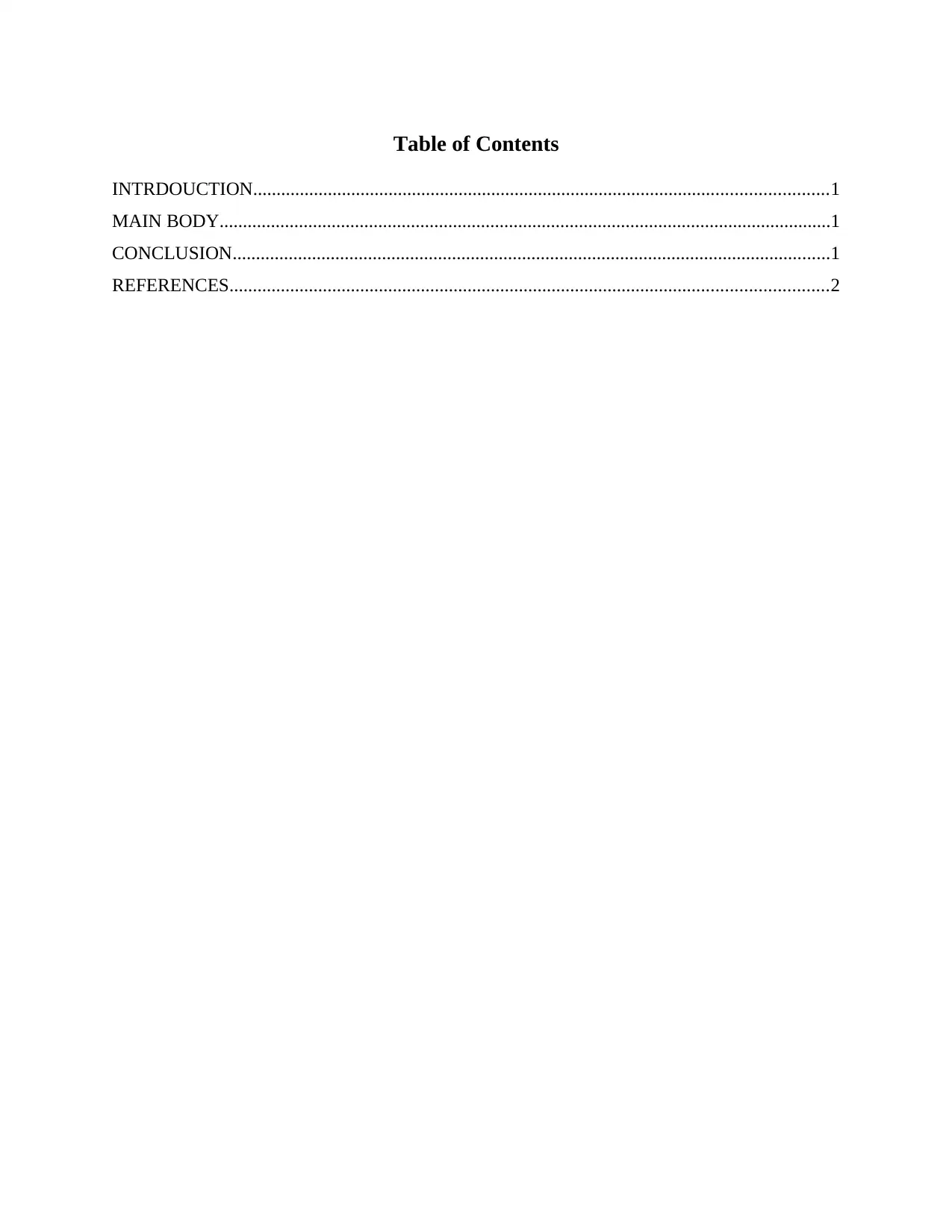
INTRDOUCTION...........................................................................................................................1
MAIN BODY...................................................................................................................................1
CONCLUSION................................................................................................................................1
REFERENCES................................................................................................................................2
INTRDOUCTION...........................................................................................................................1
MAIN BODY...................................................................................................................................1
CONCLUSION................................................................................................................................1
REFERENCES................................................................................................................................2

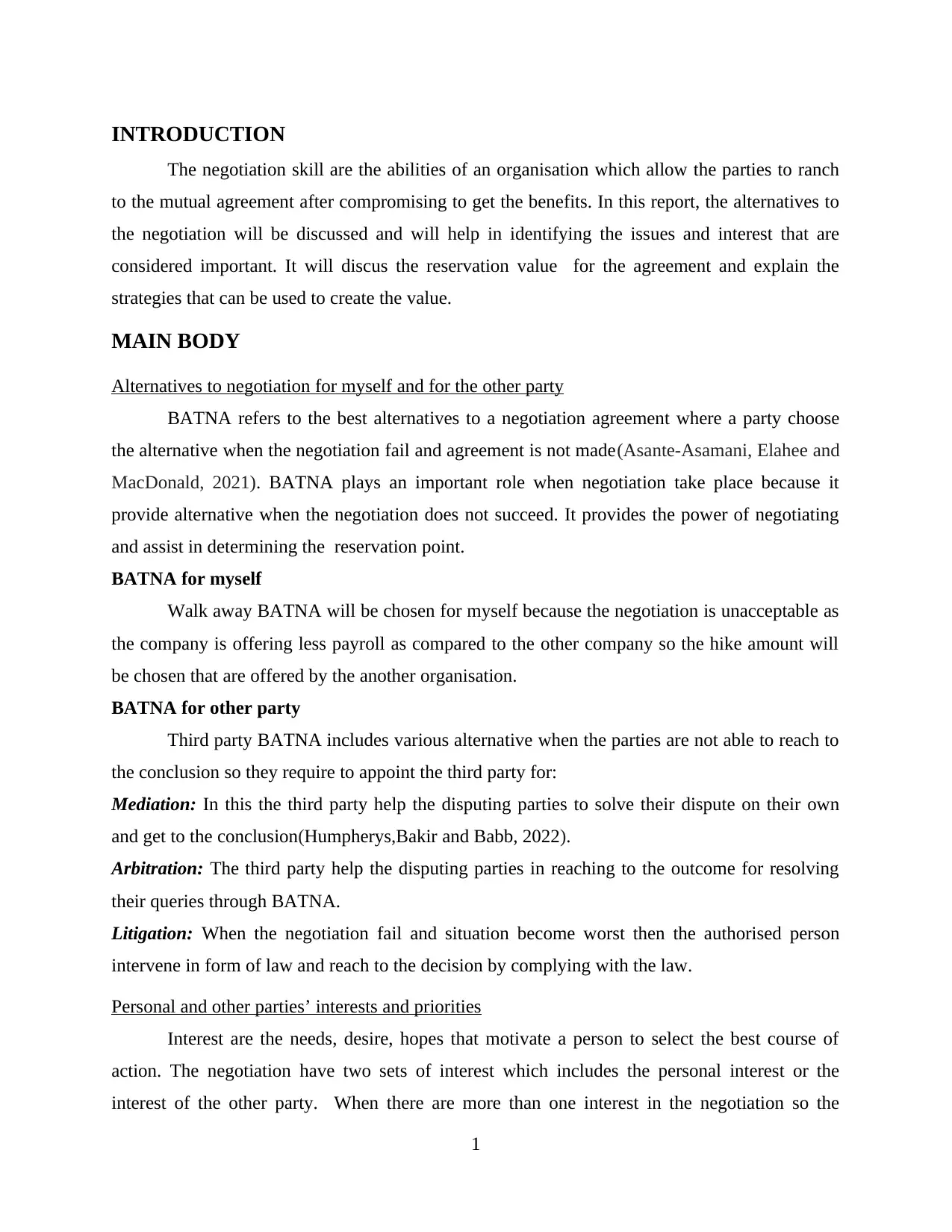
INTRODUCTION
The negotiation skill are the abilities of an organisation which allow the parties to ranch
to the mutual agreement after compromising to get the benefits. In this report, the alternatives to
the negotiation will be discussed and will help in identifying the issues and interest that are
considered important. It will discus the reservation value for the agreement and explain the
strategies that can be used to create the value.
MAIN BODY
Alternatives to negotiation for myself and for the other party
BATNA refers to the best alternatives to a negotiation agreement where a party choose
the alternative when the negotiation fail and agreement is not made(Asante-Asamani, Elahee and
MacDonald, 2021). BATNA plays an important role when negotiation take place because it
provide alternative when the negotiation does not succeed. It provides the power of negotiating
and assist in determining the reservation point.
BATNA for myself
Walk away BATNA will be chosen for myself because the negotiation is unacceptable as
the company is offering less payroll as compared to the other company so the hike amount will
be chosen that are offered by the another organisation.
BATNA for other party
Third party BATNA includes various alternative when the parties are not able to reach to
the conclusion so they require to appoint the third party for:
Mediation: In this the third party help the disputing parties to solve their dispute on their own
and get to the conclusion(Humpherys,Bakir and Babb, 2022).
Arbitration: The third party help the disputing parties in reaching to the outcome for resolving
their queries through BATNA.
Litigation: When the negotiation fail and situation become worst then the authorised person
intervene in form of law and reach to the decision by complying with the law.
Personal and other parties’ interests and priorities
Interest are the needs, desire, hopes that motivate a person to select the best course of
action. The negotiation have two sets of interest which includes the personal interest or the
interest of the other party. When there are more than one interest in the negotiation so the
1
The negotiation skill are the abilities of an organisation which allow the parties to ranch
to the mutual agreement after compromising to get the benefits. In this report, the alternatives to
the negotiation will be discussed and will help in identifying the issues and interest that are
considered important. It will discus the reservation value for the agreement and explain the
strategies that can be used to create the value.
MAIN BODY
Alternatives to negotiation for myself and for the other party
BATNA refers to the best alternatives to a negotiation agreement where a party choose
the alternative when the negotiation fail and agreement is not made(Asante-Asamani, Elahee and
MacDonald, 2021). BATNA plays an important role when negotiation take place because it
provide alternative when the negotiation does not succeed. It provides the power of negotiating
and assist in determining the reservation point.
BATNA for myself
Walk away BATNA will be chosen for myself because the negotiation is unacceptable as
the company is offering less payroll as compared to the other company so the hike amount will
be chosen that are offered by the another organisation.
BATNA for other party
Third party BATNA includes various alternative when the parties are not able to reach to
the conclusion so they require to appoint the third party for:
Mediation: In this the third party help the disputing parties to solve their dispute on their own
and get to the conclusion(Humpherys,Bakir and Babb, 2022).
Arbitration: The third party help the disputing parties in reaching to the outcome for resolving
their queries through BATNA.
Litigation: When the negotiation fail and situation become worst then the authorised person
intervene in form of law and reach to the decision by complying with the law.
Personal and other parties’ interests and priorities
Interest are the needs, desire, hopes that motivate a person to select the best course of
action. The negotiation have two sets of interest which includes the personal interest or the
interest of the other party. When there are more than one interest in the negotiation so the
1
⊘ This is a preview!⊘
Do you want full access?
Subscribe today to unlock all pages.

Trusted by 1+ million students worldwide

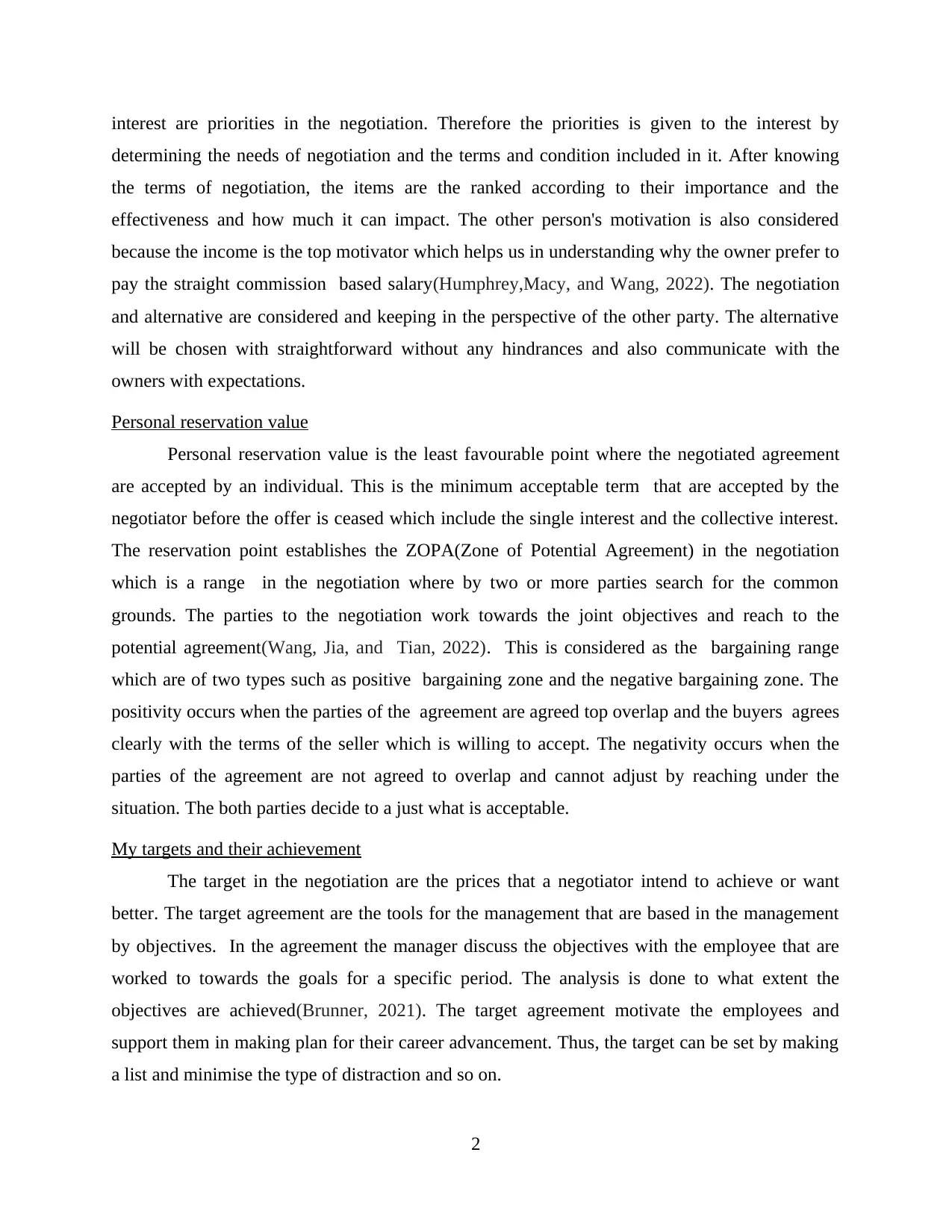
interest are priorities in the negotiation. Therefore the priorities is given to the interest by
determining the needs of negotiation and the terms and condition included in it. After knowing
the terms of negotiation, the items are the ranked according to their importance and the
effectiveness and how much it can impact. The other person's motivation is also considered
because the income is the top motivator which helps us in understanding why the owner prefer to
pay the straight commission based salary(Humphrey,Macy, and Wang, 2022). The negotiation
and alternative are considered and keeping in the perspective of the other party. The alternative
will be chosen with straightforward without any hindrances and also communicate with the
owners with expectations.
Personal reservation value
Personal reservation value is the least favourable point where the negotiated agreement
are accepted by an individual. This is the minimum acceptable term that are accepted by the
negotiator before the offer is ceased which include the single interest and the collective interest.
The reservation point establishes the ZOPA(Zone of Potential Agreement) in the negotiation
which is a range in the negotiation where by two or more parties search for the common
grounds. The parties to the negotiation work towards the joint objectives and reach to the
potential agreement(Wang, Jia, and Tian, 2022). This is considered as the bargaining range
which are of two types such as positive bargaining zone and the negative bargaining zone. The
positivity occurs when the parties of the agreement are agreed top overlap and the buyers agrees
clearly with the terms of the seller which is willing to accept. The negativity occurs when the
parties of the agreement are not agreed to overlap and cannot adjust by reaching under the
situation. The both parties decide to a just what is acceptable.
My targets and their achievement
The target in the negotiation are the prices that a negotiator intend to achieve or want
better. The target agreement are the tools for the management that are based in the management
by objectives. In the agreement the manager discuss the objectives with the employee that are
worked to towards the goals for a specific period. The analysis is done to what extent the
objectives are achieved(Brunner, 2021). The target agreement motivate the employees and
support them in making plan for their career advancement. Thus, the target can be set by making
a list and minimise the type of distraction and so on.
2
determining the needs of negotiation and the terms and condition included in it. After knowing
the terms of negotiation, the items are the ranked according to their importance and the
effectiveness and how much it can impact. The other person's motivation is also considered
because the income is the top motivator which helps us in understanding why the owner prefer to
pay the straight commission based salary(Humphrey,Macy, and Wang, 2022). The negotiation
and alternative are considered and keeping in the perspective of the other party. The alternative
will be chosen with straightforward without any hindrances and also communicate with the
owners with expectations.
Personal reservation value
Personal reservation value is the least favourable point where the negotiated agreement
are accepted by an individual. This is the minimum acceptable term that are accepted by the
negotiator before the offer is ceased which include the single interest and the collective interest.
The reservation point establishes the ZOPA(Zone of Potential Agreement) in the negotiation
which is a range in the negotiation where by two or more parties search for the common
grounds. The parties to the negotiation work towards the joint objectives and reach to the
potential agreement(Wang, Jia, and Tian, 2022). This is considered as the bargaining range
which are of two types such as positive bargaining zone and the negative bargaining zone. The
positivity occurs when the parties of the agreement are agreed top overlap and the buyers agrees
clearly with the terms of the seller which is willing to accept. The negativity occurs when the
parties of the agreement are not agreed to overlap and cannot adjust by reaching under the
situation. The both parties decide to a just what is acceptable.
My targets and their achievement
The target in the negotiation are the prices that a negotiator intend to achieve or want
better. The target agreement are the tools for the management that are based in the management
by objectives. In the agreement the manager discuss the objectives with the employee that are
worked to towards the goals for a specific period. The analysis is done to what extent the
objectives are achieved(Brunner, 2021). The target agreement motivate the employees and
support them in making plan for their career advancement. Thus, the target can be set by making
a list and minimise the type of distraction and so on.
2
Paraphrase This Document
Need a fresh take? Get an instant paraphrase of this document with our AI Paraphraser

Strategies for joint value and to advocate my stance
In order to take stance in the process of appraisal, the employee must be able to identify
their skills and abilities and proof their worth to HR. For effectively negotiating for rise in pay
one must adopt the following stated strategies:
Highlighting achievements: An individual must be able to communicate effectively and
strongly express their potential and how they deserve better by stating one's competence and
calibre.
Experience and knowledge in mining sector: One must proof their worth by convincing the
employer that the employee is highly experienced as he is working from three years in the
company. Thus replacement would result in opportunity costs (Manevska and et.al., 2018).
Stating vision: It is very important to state vision during negotiating for better pay and the
employee must be able to clearly define and establish his expectations. The employee must state
that he seeks growth and career development while working in a company and he must be
promoted and compensated fairly (Khan and Ebner, 2019).
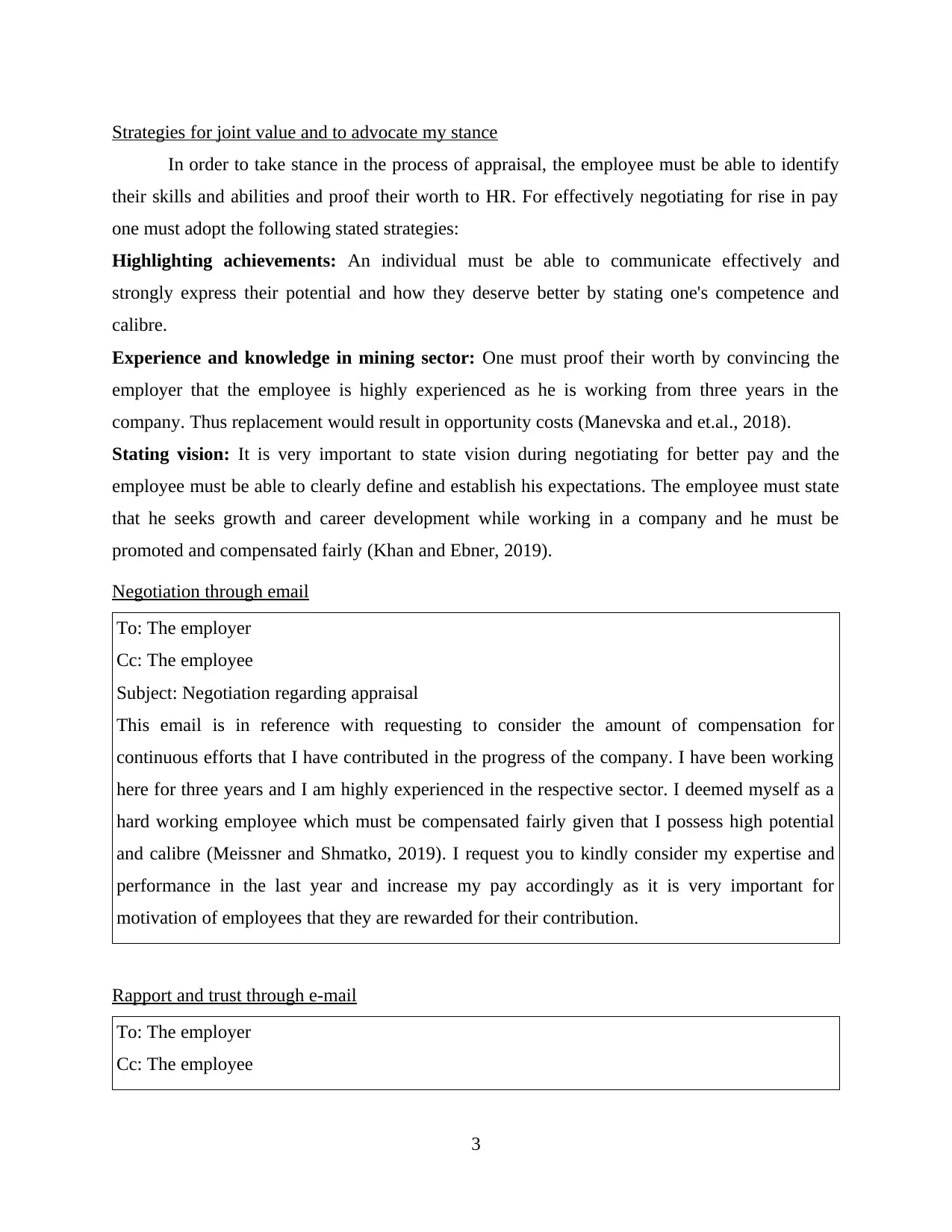
Negotiation through email
To: The employer
Cc: The employee
Subject: Negotiation regarding appraisal
This email is in reference with requesting to consider the amount of compensation for
continuous efforts that I have contributed in the progress of the company. I have been working
here for three years and I am highly experienced in the respective sector. I deemed myself as a
hard working employee which must be compensated fairly given that I possess high potential
and calibre (Meissner and Shmatko, 2019). I request you to kindly consider my expertise and
performance in the last year and increase my pay accordingly as it is very important for
motivation of employees that they are rewarded for their contribution.
Rapport and trust through e-mail
To: The employer
Cc: The employee
3
In order to take stance in the process of appraisal, the employee must be able to identify
their skills and abilities and proof their worth to HR. For effectively negotiating for rise in pay
one must adopt the following stated strategies:
Highlighting achievements: An individual must be able to communicate effectively and
strongly express their potential and how they deserve better by stating one's competence and
calibre.
Experience and knowledge in mining sector: One must proof their worth by convincing the
employer that the employee is highly experienced as he is working from three years in the
company. Thus replacement would result in opportunity costs (Manevska and et.al., 2018).
Stating vision: It is very important to state vision during negotiating for better pay and the
employee must be able to clearly define and establish his expectations. The employee must state
that he seeks growth and career development while working in a company and he must be
promoted and compensated fairly (Khan and Ebner, 2019).
Negotiation through email
To: The employer
Cc: The employee
Subject: Negotiation regarding appraisal
This email is in reference with requesting to consider the amount of compensation for
continuous efforts that I have contributed in the progress of the company. I have been working
here for three years and I am highly experienced in the respective sector. I deemed myself as a
hard working employee which must be compensated fairly given that I possess high potential
and calibre (Meissner and Shmatko, 2019). I request you to kindly consider my expertise and
performance in the last year and increase my pay accordingly as it is very important for
motivation of employees that they are rewarded for their contribution.
Rapport and trust through e-mail
To: The employer
Cc: The employee
3

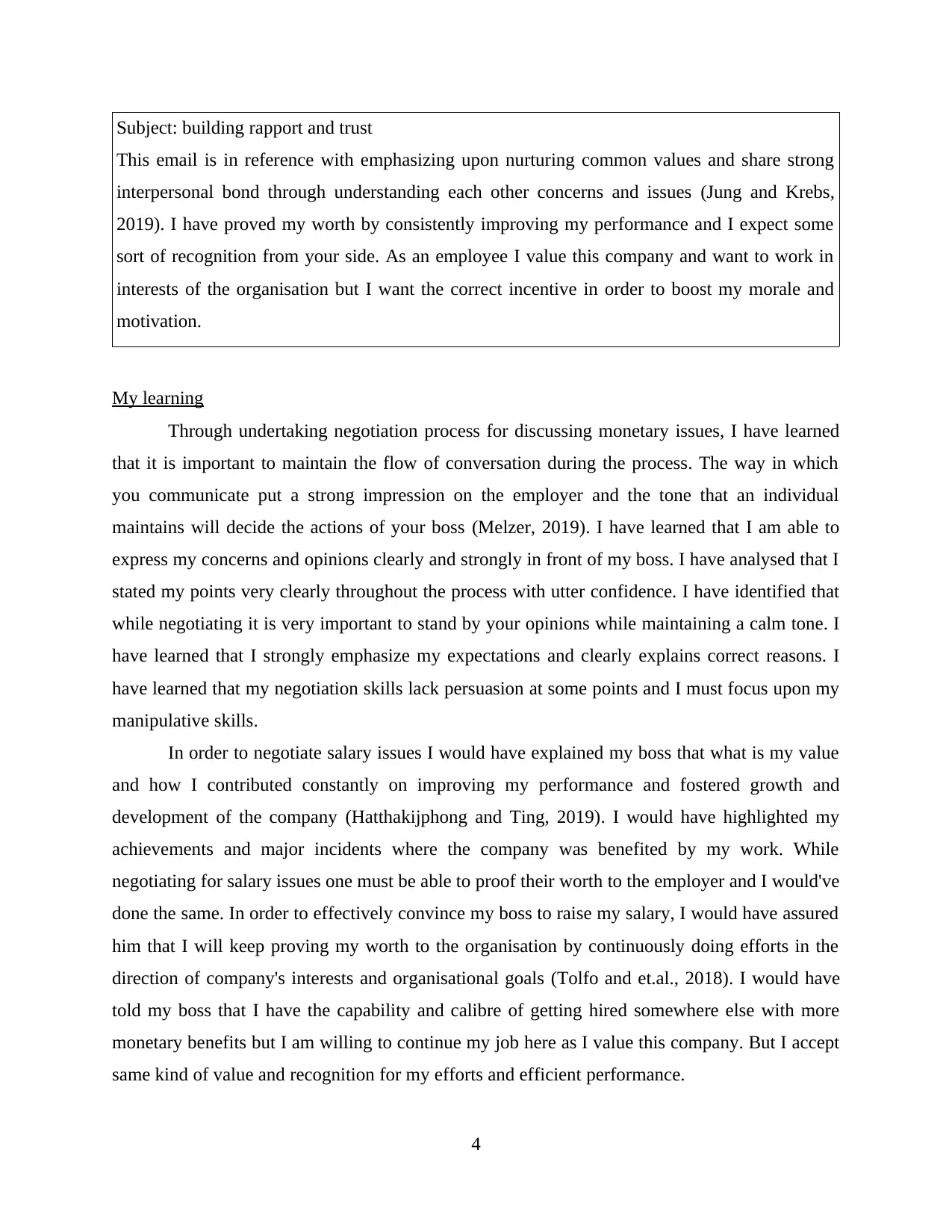
Subject: building rapport and trust
This email is in reference with emphasizing upon nurturing common values and share strong
interpersonal bond through understanding each other concerns and issues (Jung and Krebs,
2019). I have proved my worth by consistently improving my performance and I expect some
sort of recognition from your side. As an employee I value this company and want to work in
interests of the organisation but I want the correct incentive in order to boost my morale and
motivation.
My learning
Through undertaking negotiation process for discussing monetary issues, I have learned
that it is important to maintain the flow of conversation during the process. The way in which
you communicate put a strong impression on the employer and the tone that an individual
maintains will decide the actions of your boss (Melzer, 2019). I have learned that I am able to
express my concerns and opinions clearly and strongly in front of my boss. I have analysed that I
stated my points very clearly throughout the process with utter confidence. I have identified that
while negotiating it is very important to stand by your opinions while maintaining a calm tone. I
have learned that I strongly emphasize my expectations and clearly explains correct reasons. I
have learned that my negotiation skills lack persuasion at some points and I must focus upon my
manipulative skills.
In order to negotiate salary issues I would have explained my boss that what is my value
and how I contributed constantly on improving my performance and fostered growth and
development of the company (Hatthakijphong and Ting, 2019). I would have highlighted my
achievements and major incidents where the company was benefited by my work. While
negotiating for salary issues one must be able to proof their worth to the employer and I would've
done the same. In order to effectively convince my boss to raise my salary, I would have assured
him that I will keep proving my worth to the organisation by continuously doing efforts in the
direction of company's interests and organisational goals (Tolfo and et.al., 2018). I would have
told my boss that I have the capability and calibre of getting hired somewhere else with more
monetary benefits but I am willing to continue my job here as I value this company. But I accept
same kind of value and recognition for my efforts and efficient performance.
4
This email is in reference with emphasizing upon nurturing common values and share strong
interpersonal bond through understanding each other concerns and issues (Jung and Krebs,
2019). I have proved my worth by consistently improving my performance and I expect some
sort of recognition from your side. As an employee I value this company and want to work in
interests of the organisation but I want the correct incentive in order to boost my morale and
motivation.
My learning
Through undertaking negotiation process for discussing monetary issues, I have learned
that it is important to maintain the flow of conversation during the process. The way in which
you communicate put a strong impression on the employer and the tone that an individual
maintains will decide the actions of your boss (Melzer, 2019). I have learned that I am able to
express my concerns and opinions clearly and strongly in front of my boss. I have analysed that I
stated my points very clearly throughout the process with utter confidence. I have identified that
while negotiating it is very important to stand by your opinions while maintaining a calm tone. I
have learned that I strongly emphasize my expectations and clearly explains correct reasons. I
have learned that my negotiation skills lack persuasion at some points and I must focus upon my
manipulative skills.
In order to negotiate salary issues I would have explained my boss that what is my value
and how I contributed constantly on improving my performance and fostered growth and
development of the company (Hatthakijphong and Ting, 2019). I would have highlighted my
achievements and major incidents where the company was benefited by my work. While
negotiating for salary issues one must be able to proof their worth to the employer and I would've
done the same. In order to effectively convince my boss to raise my salary, I would have assured
him that I will keep proving my worth to the organisation by continuously doing efforts in the
direction of company's interests and organisational goals (Tolfo and et.al., 2018). I would have
told my boss that I have the capability and calibre of getting hired somewhere else with more
monetary benefits but I am willing to continue my job here as I value this company. But I accept
same kind of value and recognition for my efforts and efficient performance.
4
⊘ This is a preview!⊘
Do you want full access?
Subscribe today to unlock all pages.

Trusted by 1+ million students worldwide

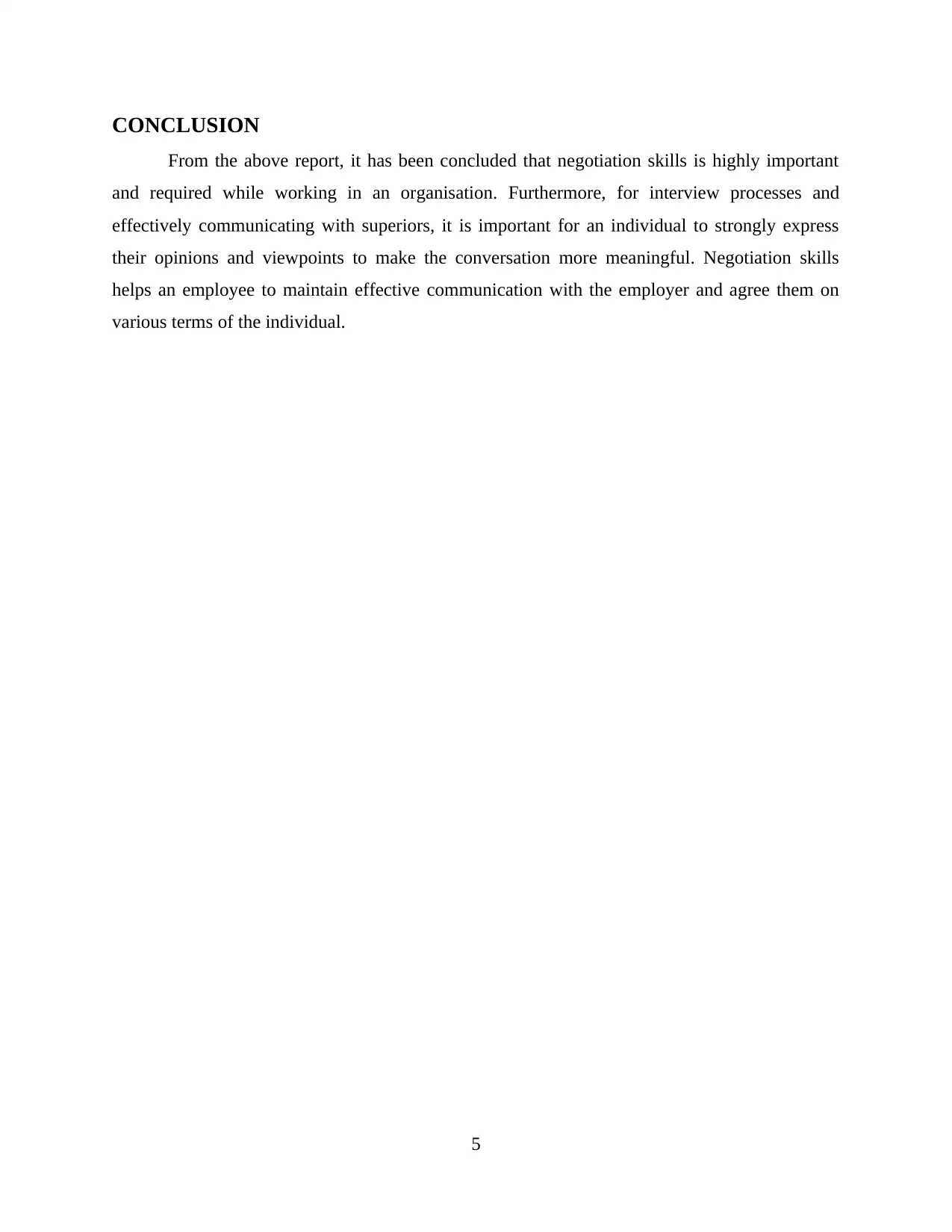
CONCLUSION
From the above report, it has been concluded that negotiation skills is highly important
and required while working in an organisation. Furthermore, for interview processes and
effectively communicating with superiors, it is important for an individual to strongly express
their opinions and viewpoints to make the conversation more meaningful. Negotiation skills
helps an employee to maintain effective communication with the employer and agree them on
various terms of the individual.
5
From the above report, it has been concluded that negotiation skills is highly important
and required while working in an organisation. Furthermore, for interview processes and
effectively communicating with superiors, it is important for an individual to strongly express
their opinions and viewpoints to make the conversation more meaningful. Negotiation skills
helps an employee to maintain effective communication with the employer and agree them on
various terms of the individual.
5
Paraphrase This Document
Need a fresh take? Get an instant paraphrase of this document with our AI Paraphraser

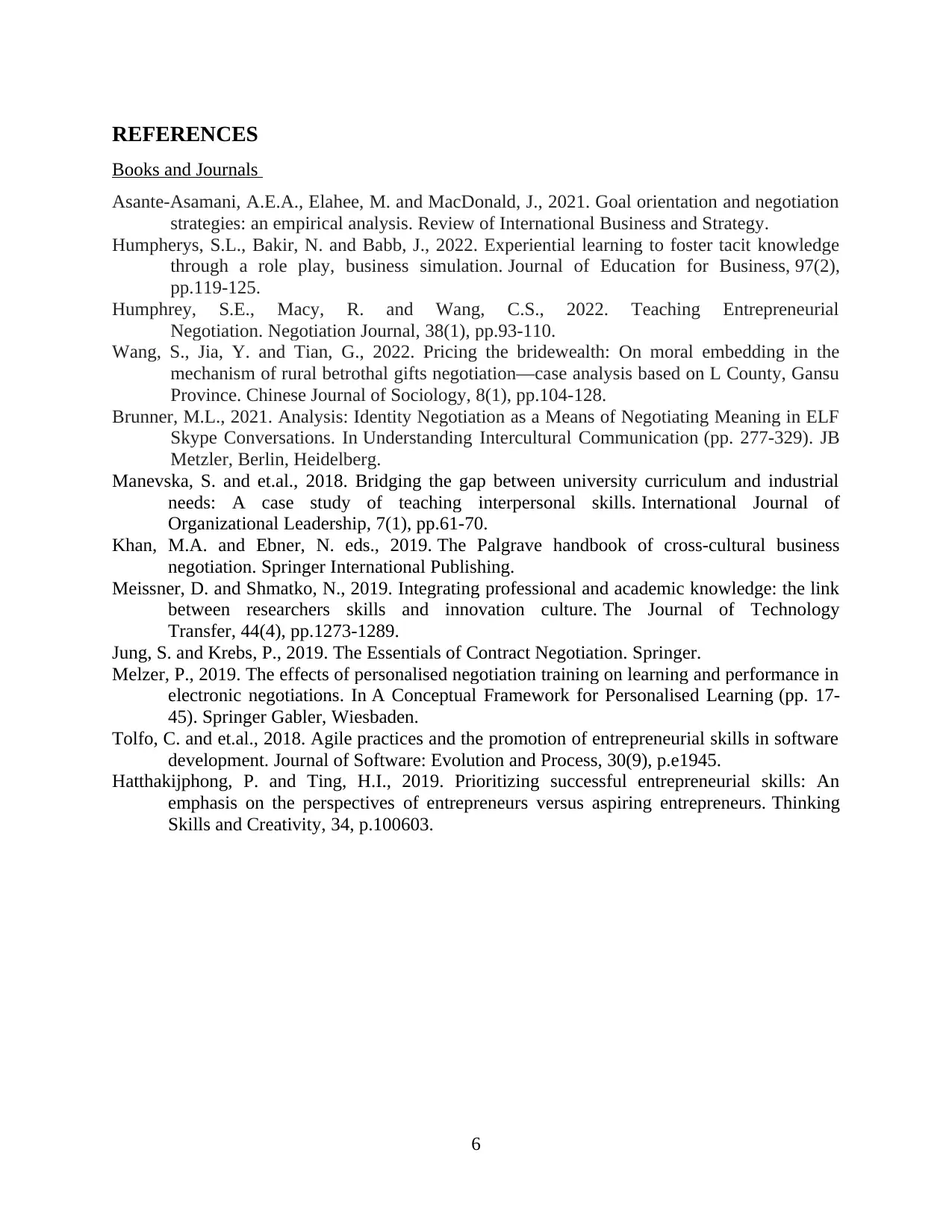
REFERENCES
Books and Journals
Asante-Asamani, A.E.A., Elahee, M. and MacDonald, J., 2021. Goal orientation and negotiation
strategies: an empirical analysis. Review of International Business and Strategy.
Humpherys, S.L., Bakir, N. and Babb, J., 2022. Experiential learning to foster tacit knowledge
through a role play, business simulation. Journal of Education for Business, 97(2),
pp.119-125.
Humphrey, S.E., Macy, R. and Wang, C.S., 2022. Teaching Entrepreneurial
Negotiation. Negotiation Journal, 38(1), pp.93-110.
Wang, S., Jia, Y. and Tian, G., 2022. Pricing the bridewealth: On moral embedding in the
mechanism of rural betrothal gifts negotiation—case analysis based on L County, Gansu
Province. Chinese Journal of Sociology, 8(1), pp.104-128.
Brunner, M.L., 2021. Analysis: Identity Negotiation as a Means of Negotiating Meaning in ELF
Skype Conversations. In Understanding Intercultural Communication (pp. 277-329). JB
Metzler, Berlin, Heidelberg.
Manevska, S. and et.al., 2018. Bridging the gap between university curriculum and industrial
needs: A case study of teaching interpersonal skills. International Journal of
Organizational Leadership, 7(1), pp.61-70.
Khan, M.A. and Ebner, N. eds., 2019. The Palgrave handbook of cross-cultural business
negotiation. Springer International Publishing.
Meissner, D. and Shmatko, N., 2019. Integrating professional and academic knowledge: the link
between researchers skills and innovation culture. The Journal of Technology
Transfer, 44(4), pp.1273-1289.
Jung, S. and Krebs, P., 2019. The Essentials of Contract Negotiation. Springer.
Melzer, P., 2019. The effects of personalised negotiation training on learning and performance in
electronic negotiations. In A Conceptual Framework for Personalised Learning (pp. 17-
45). Springer Gabler, Wiesbaden.
Tolfo, C. and et.al., 2018. Agile practices and the promotion of entrepreneurial skills in software
development. Journal of Software: Evolution and Process, 30(9), p.e1945.
Hatthakijphong, P. and Ting, H.I., 2019. Prioritizing successful entrepreneurial skills: An
emphasis on the perspectives of entrepreneurs versus aspiring entrepreneurs. Thinking
Skills and Creativity, 34, p.100603.
6
Books and Journals
Asante-Asamani, A.E.A., Elahee, M. and MacDonald, J., 2021. Goal orientation and negotiation
strategies: an empirical analysis. Review of International Business and Strategy.
Humpherys, S.L., Bakir, N. and Babb, J., 2022. Experiential learning to foster tacit knowledge
through a role play, business simulation. Journal of Education for Business, 97(2),
pp.119-125.
Humphrey, S.E., Macy, R. and Wang, C.S., 2022. Teaching Entrepreneurial
Negotiation. Negotiation Journal, 38(1), pp.93-110.
Wang, S., Jia, Y. and Tian, G., 2022. Pricing the bridewealth: On moral embedding in the
mechanism of rural betrothal gifts negotiation—case analysis based on L County, Gansu
Province. Chinese Journal of Sociology, 8(1), pp.104-128.
Brunner, M.L., 2021. Analysis: Identity Negotiation as a Means of Negotiating Meaning in ELF
Skype Conversations. In Understanding Intercultural Communication (pp. 277-329). JB
Metzler, Berlin, Heidelberg.
Manevska, S. and et.al., 2018. Bridging the gap between university curriculum and industrial
needs: A case study of teaching interpersonal skills. International Journal of
Organizational Leadership, 7(1), pp.61-70.
Khan, M.A. and Ebner, N. eds., 2019. The Palgrave handbook of cross-cultural business
negotiation. Springer International Publishing.
Meissner, D. and Shmatko, N., 2019. Integrating professional and academic knowledge: the link
between researchers skills and innovation culture. The Journal of Technology
Transfer, 44(4), pp.1273-1289.
Jung, S. and Krebs, P., 2019. The Essentials of Contract Negotiation. Springer.
Melzer, P., 2019. The effects of personalised negotiation training on learning and performance in
electronic negotiations. In A Conceptual Framework for Personalised Learning (pp. 17-
45). Springer Gabler, Wiesbaden.
Tolfo, C. and et.al., 2018. Agile practices and the promotion of entrepreneurial skills in software
development. Journal of Software: Evolution and Process, 30(9), p.e1945.
Hatthakijphong, P. and Ting, H.I., 2019. Prioritizing successful entrepreneurial skills: An
emphasis on the perspectives of entrepreneurs versus aspiring entrepreneurs. Thinking
Skills and Creativity, 34, p.100603.
6

7
⊘ This is a preview!⊘
Do you want full access?
Subscribe today to unlock all pages.

Trusted by 1+ million students worldwide
1 out of 9
Related Documents
Your All-in-One AI-Powered Toolkit for Academic Success.
+13062052269
info@desklib.com
Available 24*7 on WhatsApp / Email
Unlock your academic potential
Copyright © 2020–2025 A2Z Services. All Rights Reserved. Developed and managed by ZUCOL.