A Sociological Analysis of Women in Asian Cinema and Television
VerifiedAdded on 2023/01/19
|14
|4170
|35
Essay
AI Summary
This essay provides a sociological analysis of the role and treatment of women in Asian cinema, focusing on how films reflect and shape societal perceptions of gender. The essay examines the representation of women in several films, including 'Raise the Red Lantern,' 'The Dream of Eleuteria,' and 'The Myth,' to illustrate the challenges and limitations faced by women. The analysis considers the historical and cultural contexts of these films, highlighting themes of discrimination, limited opportunities, and the struggle for agency. The paper connects these cinematic portrayals to the broader position of women in contemporary Asian society, offering insights into the ongoing issues of gender inequality and the impact of film on social consciousness. The essay argues that these films serve as a reflection of the societal issues and the challenges faced by women in Asia.

Sociology
Asian Cinema and Television
Name
Professors’ name
Institution
Date
Asian Cinema and Television
Name
Professors’ name
Institution
Date

Paraphrase This Document
Need a fresh take? Get an instant paraphrase of this document with our AI Paraphraser
Sociology
Introduction
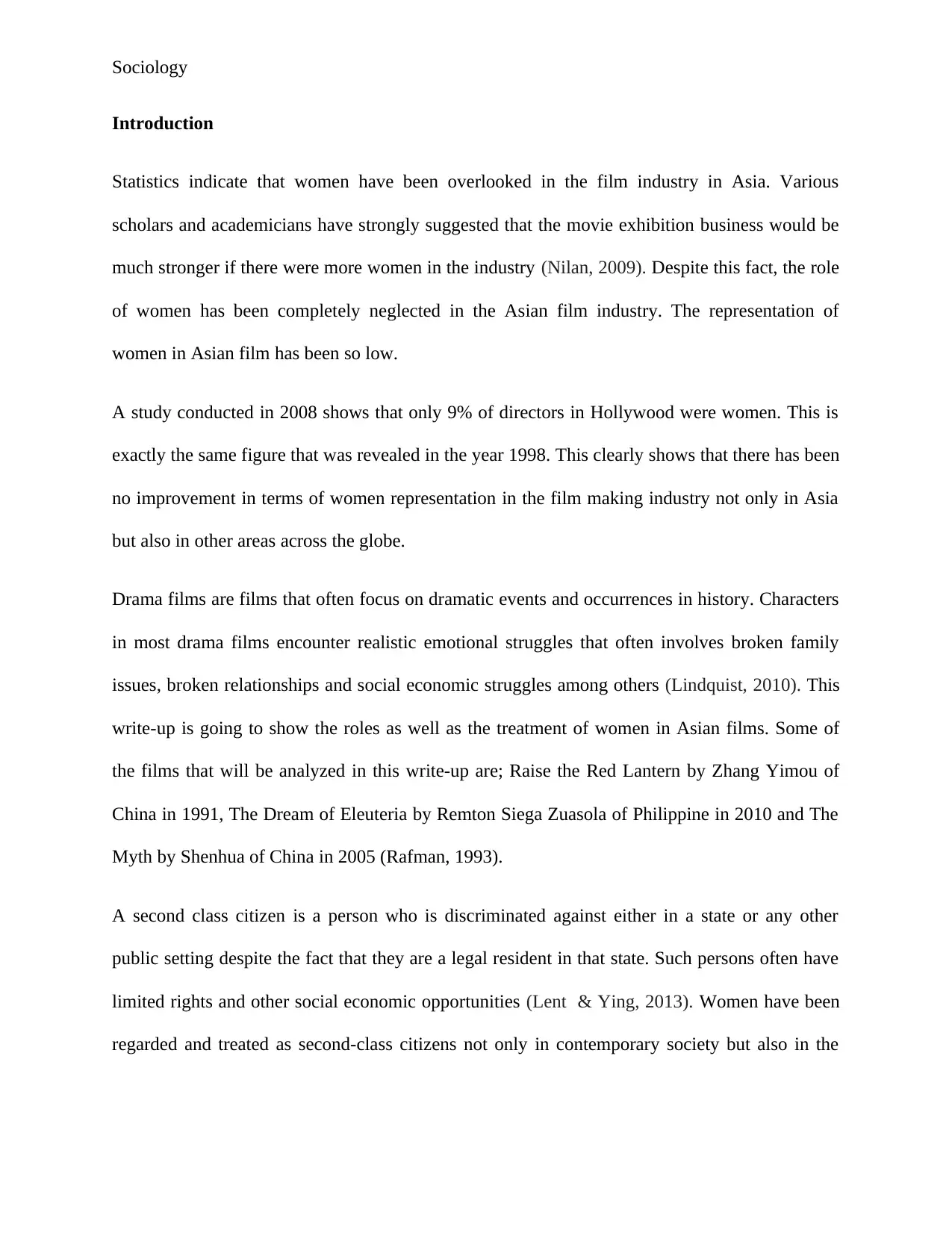
Statistics indicate that women have been overlooked in the film industry in Asia. Various
scholars and academicians have strongly suggested that the movie exhibition business would be
much stronger if there were more women in the industry (Nilan, 2009). Despite this fact, the role
of women has been completely neglected in the Asian film industry. The representation of
women in Asian film has been so low.
A study conducted in 2008 shows that only 9% of directors in Hollywood were women. This is
exactly the same figure that was revealed in the year 1998. This clearly shows that there has been
no improvement in terms of women representation in the film making industry not only in Asia
but also in other areas across the globe.
Drama films are films that often focus on dramatic events and occurrences in history. Characters
in most drama films encounter realistic emotional struggles that often involves broken family
issues, broken relationships and social economic struggles among others (Lindquist, 2010). This
write-up is going to show the roles as well as the treatment of women in Asian films. Some of
the films that will be analyzed in this write-up are; Raise the Red Lantern by Zhang Yimou of
China in 1991, The Dream of Eleuteria by Remton Siega Zuasola of Philippine in 2010 and The
Myth by Shenhua of China in 2005 (Rafman, 1993).
A second class citizen is a person who is discriminated against either in a state or any other
public setting despite the fact that they are a legal resident in that state. Such persons often have
limited rights and other social economic opportunities (Lent & Ying, 2013). Women have been
regarded and treated as second-class citizens not only in contemporary society but also in the
Introduction
Statistics indicate that women have been overlooked in the film industry in Asia. Various
scholars and academicians have strongly suggested that the movie exhibition business would be
much stronger if there were more women in the industry (Nilan, 2009). Despite this fact, the role
of women has been completely neglected in the Asian film industry. The representation of
women in Asian film has been so low.
A study conducted in 2008 shows that only 9% of directors in Hollywood were women. This is
exactly the same figure that was revealed in the year 1998. This clearly shows that there has been
no improvement in terms of women representation in the film making industry not only in Asia
but also in other areas across the globe.
Drama films are films that often focus on dramatic events and occurrences in history. Characters
in most drama films encounter realistic emotional struggles that often involves broken family
issues, broken relationships and social economic struggles among others (Lindquist, 2010). This
write-up is going to show the roles as well as the treatment of women in Asian films. Some of
the films that will be analyzed in this write-up are; Raise the Red Lantern by Zhang Yimou of
China in 1991, The Dream of Eleuteria by Remton Siega Zuasola of Philippine in 2010 and The
Myth by Shenhua of China in 2005 (Rafman, 1993).
A second class citizen is a person who is discriminated against either in a state or any other
public setting despite the fact that they are a legal resident in that state. Such persons often have
limited rights and other social economic opportunities (Lent & Ying, 2013). Women have been
regarded and treated as second-class citizens not only in contemporary society but also in the
Sociology
films industry in Asia. This paper will also shed some light on this issue and some roles of
women as depicted in the three films that have been mentioned above.
Body
An overview of films in Asia
According to Sea study which is a long-term initiative to research independent films in Southeast
Asia there was an estimate of about 122 independent films that were produced in Southeast Asia
in the year 2016. Out of the 122 films that were produced, drama films constituted of about
35.7% (Crane, 2014).
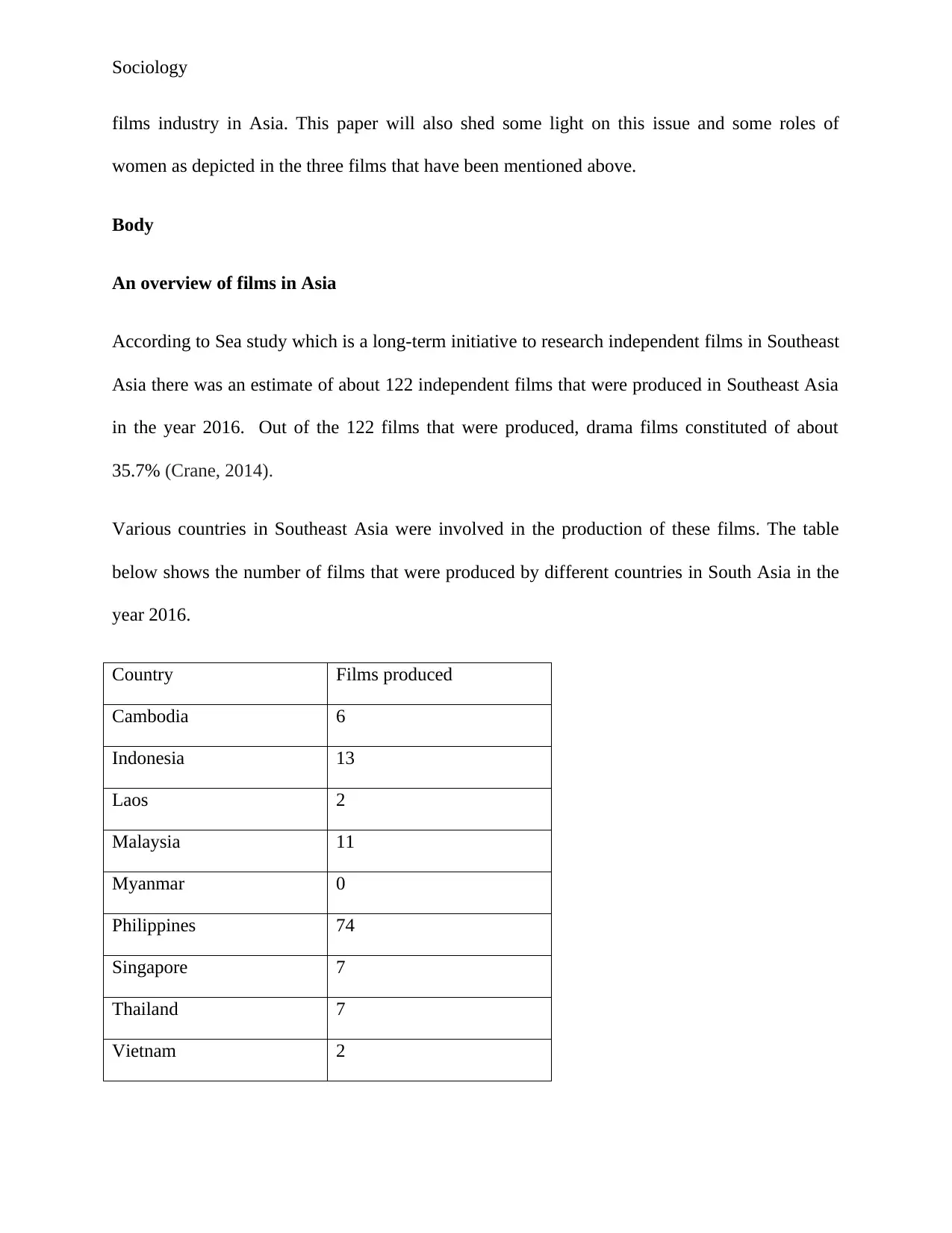
Various countries in Southeast Asia were involved in the production of these films. The table
below shows the number of films that were produced by different countries in South Asia in the
year 2016.
Country Films produced
Cambodia 6
Indonesia 13
Laos 2
Malaysia 11
Myanmar 0
Philippines 74
Singapore 7
Thailand 7
Vietnam 2
films industry in Asia. This paper will also shed some light on this issue and some roles of
women as depicted in the three films that have been mentioned above.
Body
An overview of films in Asia
According to Sea study which is a long-term initiative to research independent films in Southeast
Asia there was an estimate of about 122 independent films that were produced in Southeast Asia
in the year 2016. Out of the 122 films that were produced, drama films constituted of about
35.7% (Crane, 2014).
Various countries in Southeast Asia were involved in the production of these films. The table
below shows the number of films that were produced by different countries in South Asia in the
year 2016.
Country Films produced
Cambodia 6
Indonesia 13
Laos 2
Malaysia 11
Myanmar 0
Philippines 74
Singapore 7
Thailand 7
Vietnam 2
⊘ This is a preview!⊘
Do you want full access?
Subscribe today to unlock all pages.

Trusted by 1+ million students worldwide
Sociology
Various studies conducted have shown that the film industry in Southeast Asia is not nay near
towards challenging Hollywood films in economic terms (Iwabuchi, 2010). Despite this huge
difference, it is important to note that most of the cinemas and films in Southeast Asia are
culturally rich. In addition to this, these films are way far diverse in comparison to Hollywood
films (Butcher, 2012).
In recent years the film production in Southeast Asia has evolved, this is so because modern
films in the region have attracted so many viewers across the globe with different genders,
ethnicities class as well as nationality (Banks , 2014).The role of films in the region has been
revolutionized from mere entertainment to a tool that has been used to preserve the region's
traditions across all spheres from the tide of modernity.
Despite the fact that films are everywhere in contemporary Southeast Asia, there is mounting
evidence that clearly shows movie production in the region has been uneven. This is so because
of the significant disparities in the output evident that has been registered by different countries
in the region. Film production in a country like Burma has been really stagnant, this is far worse
in comparison to what production was like in the 1950s and 10960s where it was at its golden
age in the country. The number of films produced in Burma is very low in comparison to other
countries in the region such as the Philippines (Baumgärtel, 2011).
In addition to this, local film production has continued to suffer from so many challenges. Some
of the common challenges that local film production has experienced is the issue of outdated
technology.
Just like Burma, Cambodia is also struggling to build a film industry. This is a really big
difference in the early 1960s when Cambodia was experiencing a golden age in terms of film
Various studies conducted have shown that the film industry in Southeast Asia is not nay near
towards challenging Hollywood films in economic terms (Iwabuchi, 2010). Despite this huge
difference, it is important to note that most of the cinemas and films in Southeast Asia are
culturally rich. In addition to this, these films are way far diverse in comparison to Hollywood
films (Butcher, 2012).
In recent years the film production in Southeast Asia has evolved, this is so because modern
films in the region have attracted so many viewers across the globe with different genders,
ethnicities class as well as nationality (Banks , 2014).The role of films in the region has been
revolutionized from mere entertainment to a tool that has been used to preserve the region's
traditions across all spheres from the tide of modernity.
Despite the fact that films are everywhere in contemporary Southeast Asia, there is mounting
evidence that clearly shows movie production in the region has been uneven. This is so because
of the significant disparities in the output evident that has been registered by different countries
in the region. Film production in a country like Burma has been really stagnant, this is far worse
in comparison to what production was like in the 1950s and 10960s where it was at its golden
age in the country. The number of films produced in Burma is very low in comparison to other
countries in the region such as the Philippines (Baumgärtel, 2011).
In addition to this, local film production has continued to suffer from so many challenges. Some
of the common challenges that local film production has experienced is the issue of outdated
technology.
Just like Burma, Cambodia is also struggling to build a film industry. This is a really big
difference in the early 1960s when Cambodia was experiencing a golden age in terms of film
Paraphrase This Document
Need a fresh take? Get an instant paraphrase of this document with our AI Paraphraser
Sociology
production. Statistics indicate that more than 300 films were made in Cambodia. In recent years,
however, the films that are being produced in the country have fallen short of quality. They have
continued to suffer from poor production values as well as poor acting clichéd stories.
Based on the recent trends in terms of film production in the region, it is clear that film
production has taken a totally different path. Technology as well as resources have been
demonstrated by the increased quality of films in the region. Drama films have been in the rise in
the region. As mentioned earlier, studies indicate that 35.7% of the total films that were produced
in the region were drama films. Drama films have had an impact on contemporary society in
Southeast Asia (Tofighian, 2013). They have presented some of the cruelest and crucial life
challenges struggle that the society in the region has been facing.
Role and Treatment of Women in Asian Films and how it links with women in
contemporary society
Women in the films Raise the Red Lantern by Zhang Yimou of China in 1991, The Dream of
Eleuteria by Remton Siega Zuasola of Philippine in 2010 and The Myth by Shenhua of China in
2005 have had been depicted as an inferior gender. This is so because of the way they are being
addressed and treated in the films (Park, Song, Lee, 2014).
It is important to mention that women in all these films are being treated and regarded as a
second class citizen. In almost all cases in these films, women have had limited opportunities
both social as well as economic. Their representation in various leadership positions in these
films is also completely disorientated (Sasono, 2010).
In addition to this, women are depicted as self-sacrificing despite the fact that they faced abusive
treatment. Their role and treatment are also accompanied by a high degree of discrimination and
production. Statistics indicate that more than 300 films were made in Cambodia. In recent years,
however, the films that are being produced in the country have fallen short of quality. They have
continued to suffer from poor production values as well as poor acting clichéd stories.
Based on the recent trends in terms of film production in the region, it is clear that film
production has taken a totally different path. Technology as well as resources have been
demonstrated by the increased quality of films in the region. Drama films have been in the rise in
the region. As mentioned earlier, studies indicate that 35.7% of the total films that were produced
in the region were drama films. Drama films have had an impact on contemporary society in
Southeast Asia (Tofighian, 2013). They have presented some of the cruelest and crucial life
challenges struggle that the society in the region has been facing.
Role and Treatment of Women in Asian Films and how it links with women in
contemporary society
Women in the films Raise the Red Lantern by Zhang Yimou of China in 1991, The Dream of
Eleuteria by Remton Siega Zuasola of Philippine in 2010 and The Myth by Shenhua of China in
2005 have had been depicted as an inferior gender. This is so because of the way they are being
addressed and treated in the films (Park, Song, Lee, 2014).
It is important to mention that women in all these films are being treated and regarded as a
second class citizen. In almost all cases in these films, women have had limited opportunities
both social as well as economic. Their representation in various leadership positions in these
films is also completely disorientated (Sasono, 2010).
In addition to this, women are depicted as self-sacrificing despite the fact that they faced abusive
treatment. Their role and treatment are also accompanied by a high degree of discrimination and
Sociology
injustice. As a result of this, women feel powerless to change their current status in society in all
these films (Reeker, 2007).
The analysis of the role and treatment of women in these films will then be linked to the position
of women in contemporary society.
Role and treatment of women in the Rise of the Red Lantern by Zhang Yimou of China in
1991
The role and treatment of women in these particular films have been portrayed by various female
characters in the film. One of the women characters that have been used to clearly bring out the
role and treatment of women is a nineteen-year-old Songlian (Gong Li).
In this film, Gong Li faces so much trouble immediately at the beginning of the film. Gong Li is
a university student in China in the 1920s but she is forced to leave school as a direct
consequence of her father’s death and the financial difficulties that came thereafter.
Gong Li faces so many challenges ranging from social, economic and financial. As a result of the
many challenges that she faces, she opts to get married at a really early age and as far as she is
concerned, she marries only for the sake of money (Rosena, 2001).
After so many years of struggle, she finally finds herself confined into the walls of her new
husband’s Ma Jingwu ancestral home (Baumgärtel, 2011). In the first days of her arrival at her
husband’s home, Gong Li is treated so well. The movie clearly indicates some of the lavish staff
that she was pampered with such as a foot bath, foot massage, new clothing as well as a new
hairstyle. Gong Li was not the first woman to get married in that household. As a matter of fact,
she is the fourth woman to get married in that household. Well, during that time and the social
injustice. As a result of this, women feel powerless to change their current status in society in all
these films (Reeker, 2007).
The analysis of the role and treatment of women in these films will then be linked to the position
of women in contemporary society.
Role and treatment of women in the Rise of the Red Lantern by Zhang Yimou of China in
1991
The role and treatment of women in these particular films have been portrayed by various female
characters in the film. One of the women characters that have been used to clearly bring out the
role and treatment of women is a nineteen-year-old Songlian (Gong Li).
In this film, Gong Li faces so much trouble immediately at the beginning of the film. Gong Li is
a university student in China in the 1920s but she is forced to leave school as a direct
consequence of her father’s death and the financial difficulties that came thereafter.
Gong Li faces so many challenges ranging from social, economic and financial. As a result of the
many challenges that she faces, she opts to get married at a really early age and as far as she is
concerned, she marries only for the sake of money (Rosena, 2001).
After so many years of struggle, she finally finds herself confined into the walls of her new
husband’s Ma Jingwu ancestral home (Baumgärtel, 2011). In the first days of her arrival at her
husband’s home, Gong Li is treated so well. The movie clearly indicates some of the lavish staff
that she was pampered with such as a foot bath, foot massage, new clothing as well as a new
hairstyle. Gong Li was not the first woman to get married in that household. As a matter of fact,
she is the fourth woman to get married in that household. Well, during that time and the social
⊘ This is a preview!⊘
Do you want full access?
Subscribe today to unlock all pages.
Trusted by 1+ million students worldwide
Sociology
settings during that period, it was a common thing to have as many wives as possible, so this was
not a real deal (Higbee & Lim, 2010).
What is of interest here is the fact that all these mistresses were treated by their master (their
husband) according to their importance and value that they brought in the household. This is to
mention that women were treated with less relevance. It would be very correct to say that women
were treated just like objects of sexual pleasure and nothing significant was tagged to their role
in the film.
Based on the treatment of Gong Li and other women in the film (the other co-wifes) it is very
clear that women have been given a very low status in society. They are regarded as a second
class citizen in the sense that fewer opportunities are offered to them (Joo, 2011). In the film, we
clearly see that women have been limited in terms of the activities that they are engaged in in the
societies. This has been demonstrated by the fact that Gong Li and her co-wifes are just confined
in the walls of their husbands and do not take an active role in terms of development or any other
activity in that household.
Moreover, Gong Li is forced to drop out of school to get married because of some of the
challenges that she was facing upon her father's demise. She marries a husband who already has
many wives with the sole purpose of changing her social status (Jung, 2014).
Just like in the film, struggles are the same for women in contemporary society too. Women have
been subjected to so many struggles. Some of the reasons for the ill-treatment of women are
brought about by the fact that they do not command a suitable position in the social setting.
Role and Treatment of women in The Dream of Eleuteria by Remton Siega Zuasola of
Philippine in 2010
settings during that period, it was a common thing to have as many wives as possible, so this was
not a real deal (Higbee & Lim, 2010).
What is of interest here is the fact that all these mistresses were treated by their master (their
husband) according to their importance and value that they brought in the household. This is to
mention that women were treated with less relevance. It would be very correct to say that women
were treated just like objects of sexual pleasure and nothing significant was tagged to their role
in the film.
Based on the treatment of Gong Li and other women in the film (the other co-wifes) it is very
clear that women have been given a very low status in society. They are regarded as a second
class citizen in the sense that fewer opportunities are offered to them (Joo, 2011). In the film, we
clearly see that women have been limited in terms of the activities that they are engaged in in the
societies. This has been demonstrated by the fact that Gong Li and her co-wifes are just confined
in the walls of their husbands and do not take an active role in terms of development or any other
activity in that household.
Moreover, Gong Li is forced to drop out of school to get married because of some of the
challenges that she was facing upon her father's demise. She marries a husband who already has
many wives with the sole purpose of changing her social status (Jung, 2014).
Just like in the film, struggles are the same for women in contemporary society too. Women have
been subjected to so many struggles. Some of the reasons for the ill-treatment of women are
brought about by the fact that they do not command a suitable position in the social setting.
Role and Treatment of women in The Dream of Eleuteria by Remton Siega Zuasola of
Philippine in 2010
Paraphrase This Document
Need a fresh take? Get an instant paraphrase of this document with our AI Paraphraser
Sociology
In the film, the Dream of Eleuteria, the role, and treatment of women have been demonstrated by
various female characters. In this film, women have been regarded as second class citizens. This
has been clearly demonstrated by the female character Terya.
Terya is a woman that has played a very crucial in the film. She has been used to bring out the
aspect of ill-treatment of women and women discrimination in society. In the film, Terya married
a German national, Hans Kirschbaum. She was forced to marry Hans Kirschbaum not for love
but rather because she was completely fed up with the hardships in the Philippines.
The films clearly depict that Terya sees Hans as a man who would save her in life that she had
nowhere to go but just stuck in circles of poverty (Berry, 2013). She marries a foreigner with the
aim of running away from poverty. This clearly indicates that women are often considered with
less significance and the act of Terya getting married to a man not for love but for the sake of
running away from poverty depicts a case of lack of self-respect. In addition this the films also
indicates that the marriage between Hans and Terya got married for some other reasons.
What is of importance here is not the marriage between Terya and Hans but rather the
circumstances that surround their marriage. It is important to note that there are certain issues
about this marriage that makes it sound irrational. First and foremost, Hans is a very old man
who is way much older than Terya. Secondly, the marriage did not result as a feeling of mutual
love but rather it resulted as an arrangement that Terya’s mother had with a recruiter called
Ma’am Susie. There are a serious of events that, however, made Terya make up her mind into
marrying Hans but none of these were worth considering especially in making such a big
decision (Lee, 2008). Terya has a really had time in accepting her fate but she had no otherwise
because it was the only way that their family could get out of the debts that they were in.
In the film, the Dream of Eleuteria, the role, and treatment of women have been demonstrated by
various female characters. In this film, women have been regarded as second class citizens. This
has been clearly demonstrated by the female character Terya.
Terya is a woman that has played a very crucial in the film. She has been used to bring out the
aspect of ill-treatment of women and women discrimination in society. In the film, Terya married
a German national, Hans Kirschbaum. She was forced to marry Hans Kirschbaum not for love
but rather because she was completely fed up with the hardships in the Philippines.
The films clearly depict that Terya sees Hans as a man who would save her in life that she had
nowhere to go but just stuck in circles of poverty (Berry, 2013). She marries a foreigner with the
aim of running away from poverty. This clearly indicates that women are often considered with
less significance and the act of Terya getting married to a man not for love but for the sake of
running away from poverty depicts a case of lack of self-respect. In addition this the films also
indicates that the marriage between Hans and Terya got married for some other reasons.
What is of importance here is not the marriage between Terya and Hans but rather the
circumstances that surround their marriage. It is important to note that there are certain issues
about this marriage that makes it sound irrational. First and foremost, Hans is a very old man
who is way much older than Terya. Secondly, the marriage did not result as a feeling of mutual
love but rather it resulted as an arrangement that Terya’s mother had with a recruiter called
Ma’am Susie. There are a serious of events that, however, made Terya make up her mind into
marrying Hans but none of these were worth considering especially in making such a big
decision (Lee, 2008). Terya has a really had time in accepting her fate but she had no otherwise
because it was the only way that their family could get out of the debts that they were in.
Sociology
Well, marriage is something that should be treasured and considered with great importance. In
this file we see marriage has been brought about by the wrong reasons. Marriage should be done
as a result of mutual love as well as understanding, no other side agendas should be tied to the
institution of marriage (Prot et al, 2014).
As a result of the debts that Terya’s family had, Teyra was forced to get married to Hans. This
demonstrates that women are not respected in society and are treated as objects that could be
used to salvage a family in cases of difficulties. Terya was used despite the fact that she was
trying to save her family from the burden of debts.
In contemporary society, women are being treated just like objects. The dignity of women as
well as their role in society has been totally compromised. Women are been considered as
objects that could be used as an alternative in cases of crisis. They are regarded as a second class
citizen and are not provided with an opportunity to choose what is best for them but rather they
can be forced into decisions that they are not comfortable with and there would be any questions
asked.
Role and treatment of women in The Myth by Shenhua of China in 2005
In the film the Myth, a Korean princess named Ok-Soo is escorted to China by general Meng Yi
to serve as a concubine for Qin Shi Huang with the sole purpose to strengthen diplomatic
relationships between China and Korea. Along the way, quite a number of events arise but the
general, Meng Yi saves her. While Ok-Soo attends to some of the wounds that the general had
succumbed in the fight, she starts developing feelings for her. Despite the fact that general
Meeting Yi having same feelings towards the Korean princess, he steps back and reminds the
princess of her purpose of becoming a concubine for the interest of her people (Peichi, 2013).
Well, marriage is something that should be treasured and considered with great importance. In
this file we see marriage has been brought about by the wrong reasons. Marriage should be done
as a result of mutual love as well as understanding, no other side agendas should be tied to the
institution of marriage (Prot et al, 2014).
As a result of the debts that Terya’s family had, Teyra was forced to get married to Hans. This
demonstrates that women are not respected in society and are treated as objects that could be
used to salvage a family in cases of difficulties. Terya was used despite the fact that she was
trying to save her family from the burden of debts.
In contemporary society, women are being treated just like objects. The dignity of women as
well as their role in society has been totally compromised. Women are been considered as
objects that could be used as an alternative in cases of crisis. They are regarded as a second class
citizen and are not provided with an opportunity to choose what is best for them but rather they
can be forced into decisions that they are not comfortable with and there would be any questions
asked.
Role and treatment of women in The Myth by Shenhua of China in 2005
In the film the Myth, a Korean princess named Ok-Soo is escorted to China by general Meng Yi
to serve as a concubine for Qin Shi Huang with the sole purpose to strengthen diplomatic
relationships between China and Korea. Along the way, quite a number of events arise but the
general, Meng Yi saves her. While Ok-Soo attends to some of the wounds that the general had
succumbed in the fight, she starts developing feelings for her. Despite the fact that general
Meeting Yi having same feelings towards the Korean princess, he steps back and reminds the
princess of her purpose of becoming a concubine for the interest of her people (Peichi, 2013).
⊘ This is a preview!⊘
Do you want full access?
Subscribe today to unlock all pages.
Trusted by 1+ million students worldwide
Sociology
Well, in this film, we clearly see women are being disregarded and being treated as objects
and/or gifts for strengthening diplomatic relationships. This film has portrayed the inferiority of
women in society. It has presented women as people that can be used for various reasons in
society even without their due consent. In this film, the Korean princess Ok-Soo was forced into
being a concubine, something that she did not volunteer. She, however, had no choice but do as
she was told in order to strengthen diplomatic relationships between her people and those of Qin
Shi Huang.
Women here are regarded as inferior and objects that can just be used so as to bring peace and
strengthen diplomatic relationships between two dynasties. In this film, women are have been
rendered really powerless and despite the fact that they do not feel like doing what they are asked
to do, they just have to do it anyway because there are consequences that would follow if they do
not do what they are asked to (Cho, 2011). In this case, for instance, Ok-Soo did not want to be
turned into a concubine because she had developed feelings for general Meng Yi. The general
feels that he is obligated to take Ok-Soo to China as he was asked to despite the fact that he also
had developed feelings for her. Here, we see that women have succumbed to various situations
that they find it really hard to pull themselves out of. In most cases women often want to pull
themselves out of such absurd situations by they cannot because they are completely powerless
(López, 2015).
Conclusion
As depicted by the three films; Raise the Red Lantern by Zhang Yimou of China in 1991, The
Dream of Eleuteria by Remton Siega Zuasola of Philippine in 2010 and The Myth by Shenhua of
China in 2005, it is clear that women have been treated more than second class citizens because
Well, in this film, we clearly see women are being disregarded and being treated as objects
and/or gifts for strengthening diplomatic relationships. This film has portrayed the inferiority of
women in society. It has presented women as people that can be used for various reasons in
society even without their due consent. In this film, the Korean princess Ok-Soo was forced into
being a concubine, something that she did not volunteer. She, however, had no choice but do as
she was told in order to strengthen diplomatic relationships between her people and those of Qin
Shi Huang.
Women here are regarded as inferior and objects that can just be used so as to bring peace and
strengthen diplomatic relationships between two dynasties. In this film, women are have been
rendered really powerless and despite the fact that they do not feel like doing what they are asked
to do, they just have to do it anyway because there are consequences that would follow if they do
not do what they are asked to (Cho, 2011). In this case, for instance, Ok-Soo did not want to be
turned into a concubine because she had developed feelings for general Meng Yi. The general
feels that he is obligated to take Ok-Soo to China as he was asked to despite the fact that he also
had developed feelings for her. Here, we see that women have succumbed to various situations
that they find it really hard to pull themselves out of. In most cases women often want to pull
themselves out of such absurd situations by they cannot because they are completely powerless
(López, 2015).
Conclusion
As depicted by the three films; Raise the Red Lantern by Zhang Yimou of China in 1991, The
Dream of Eleuteria by Remton Siega Zuasola of Philippine in 2010 and The Myth by Shenhua of
China in 2005, it is clear that women have been treated more than second class citizens because
Paraphrase This Document
Need a fresh take? Get an instant paraphrase of this document with our AI Paraphraser
Sociology
of the limited opportunities that they are provided with (Turner, 2016). In addition to this,
women are also rendered powerless and cannot get themselves out of certain situations despite
the fact that they are not comfortable in these situations.
In the film, The dream of Eleureria, Terya I forced to marry Hans, an old German general in
order to settle her family debts. In the film, the Rise of the Red Lantern we see cases of arranged
marriage and a marriage where there are already other wives present. The same case happens in
the film the Myth where we see princess Ok-Soo is forced into becoming a concubine with the
aim of strengthening diplomatic relationships between two dynasties (Fithian, 2012).
I all these films, we see that the role and treatment of women are quite absurd. Women are not
provided with the right to make their own decisions. Circumstances force women into doing
things that they are not comfortable with.
The modern cinema has changed. It has changed in the sense that it represents the women's
function. It provides them with more opportunities and a series of choices as well as facilitating
their empowerment (Bloemraad, 2015).
References
of the limited opportunities that they are provided with (Turner, 2016). In addition to this,
women are also rendered powerless and cannot get themselves out of certain situations despite
the fact that they are not comfortable in these situations.
In the film, The dream of Eleureria, Terya I forced to marry Hans, an old German general in
order to settle her family debts. In the film, the Rise of the Red Lantern we see cases of arranged
marriage and a marriage where there are already other wives present. The same case happens in
the film the Myth where we see princess Ok-Soo is forced into becoming a concubine with the
aim of strengthening diplomatic relationships between two dynasties (Fithian, 2012).
I all these films, we see that the role and treatment of women are quite absurd. Women are not
provided with the right to make their own decisions. Circumstances force women into doing
things that they are not comfortable with.
The modern cinema has changed. It has changed in the sense that it represents the women's
function. It provides them with more opportunities and a series of choices as well as facilitating
their empowerment (Bloemraad, 2015).
References
Sociology
Banks, J. A. (2014). Diversity, group identity, and citizenship education in a global age. Journal
of Education, 194(3), 1-12.
Baumgärtel, T. (2011). Imagined communities, imagined worlds: Independent film from South
East Asia in the global mediascape. Transnational Cinemas, 2(1), 57-71.
Berry, C. (2013). “What’s big about the big film?”:“de-Westernizing” the blockbuster in Korea
and China. In Movie blockbusters (pp. 229-241).
Bloemraad, I. (2015). Theorizing and analyzing citizenship in multicultural societies. The
Sociological Quarterly, 56(4), 591-606.
Butcher, A. (2012). Students, soldiers, sports, sheep and the silver-screen: New Zealand's soft
power in ASEAN and Southeast Asia. Contemporary Southeast Asia, 249-273.
Cho, Y. (2011). Desperately seeking East Asia amidst the popularity of South Korean pop
culture in Asia. Cultural studies, 25(3), 383-404.
Crane, D. (2014). Cultural globalization and the dominance of the American film industry:
cultural policies, national film industries, and transnational film. International journal of
cultural policy, 20(4), 365-382.
Fithian, J 2012, ‘Women in, behind, and at the movies’, Boxoffice, vol. 148, no. 1, pp. 8-9,
Chicago.
Higbee, W., & Lim, S. H. (2010). Concepts of transnational cinema: towards a critical
transnationalism in film studies. Transnational cinemas, 1(1), 66.
Banks, J. A. (2014). Diversity, group identity, and citizenship education in a global age. Journal
of Education, 194(3), 1-12.
Baumgärtel, T. (2011). Imagined communities, imagined worlds: Independent film from South
East Asia in the global mediascape. Transnational Cinemas, 2(1), 57-71.
Berry, C. (2013). “What’s big about the big film?”:“de-Westernizing” the blockbuster in Korea
and China. In Movie blockbusters (pp. 229-241).
Bloemraad, I. (2015). Theorizing and analyzing citizenship in multicultural societies. The
Sociological Quarterly, 56(4), 591-606.
Butcher, A. (2012). Students, soldiers, sports, sheep and the silver-screen: New Zealand's soft
power in ASEAN and Southeast Asia. Contemporary Southeast Asia, 249-273.
Cho, Y. (2011). Desperately seeking East Asia amidst the popularity of South Korean pop
culture in Asia. Cultural studies, 25(3), 383-404.
Crane, D. (2014). Cultural globalization and the dominance of the American film industry:
cultural policies, national film industries, and transnational film. International journal of
cultural policy, 20(4), 365-382.
Fithian, J 2012, ‘Women in, behind, and at the movies’, Boxoffice, vol. 148, no. 1, pp. 8-9,
Chicago.
Higbee, W., & Lim, S. H. (2010). Concepts of transnational cinema: towards a critical
transnationalism in film studies. Transnational cinemas, 1(1), 66.
⊘ This is a preview!⊘
Do you want full access?
Subscribe today to unlock all pages.
Trusted by 1+ million students worldwide

1 out of 14


Your All-in-One AI-Powered Toolkit for Academic Success.
+13062052269
info@desklib.com
Available 24*7 on WhatsApp / Email
![[object Object]](/_next/static/media/star-bottom.7253800d.svg)
Unlock your academic potential
Copyright © 2020–2026 A2Z Services. All Rights Reserved. Developed and managed by ZUCOL.