Detailed Analysis of William Shakespeare's Romeo and Juliet

Verified

Added on  2022/10/01

|5
|1545
|233
Essay
AI Summary
This essay provides a detailed analysis of William Shakespeare's "Romeo and Juliet." It begins with an overview of the play's prologue, highlighting its structure as a sonnet and its foreshadowing of key themes like love, conflict, and tragedy. The essay examines the characters of Romeo and Juliet, emphasizing their youth and the impact of the family feud on their relationship. It explores the roles of supporting characters such as Benvolio, the Nurse, and Friar Laurence, and their influence on the unfolding events. Furthermore, the essay delves into Shakespeare's use of literary devices, including personification, symbolism (such as Juliet's ring and the stars), metaphors, and foreshadowing, to develop characters and advance the plot. The analysis also touches upon pivotal scenes like the balcony scene and the consequences of key events like Tybalt's death and Romeo's banishment. The essay concludes with a discussion of the play's tragic elements, including the Prince's judgment and the lovers' ultimate fate, emphasizing how the play is poisoned by the rivalry between the families.
Document Page
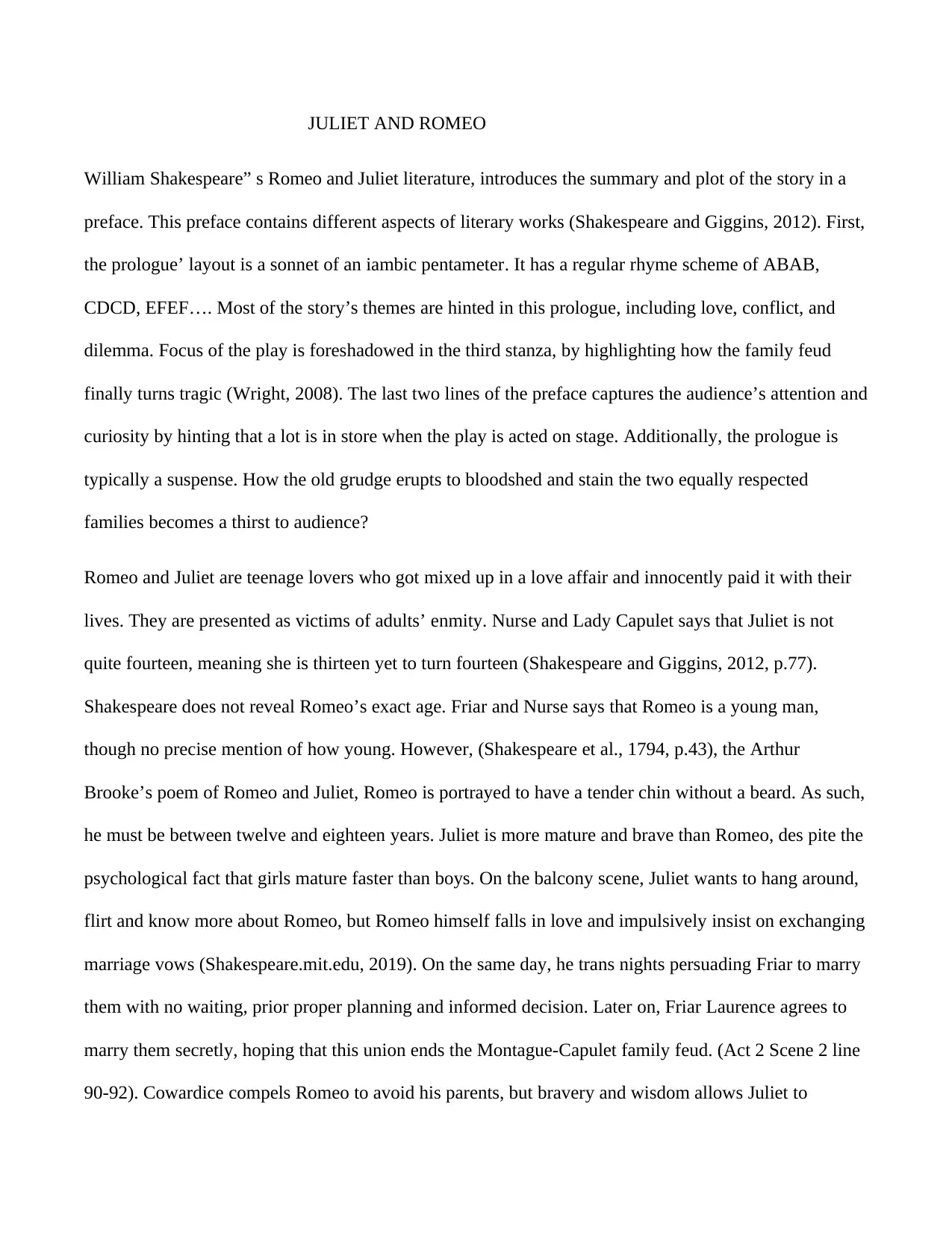
JULIET AND ROMEO
William Shakespeare” s Romeo and Juliet literature, introduces the summary and plot of the story in a
preface. This preface contains different aspects of literary works (Shakespeare and Giggins, 2012). First,
the prologue’ layout is a sonnet of an iambic pentameter. It has a regular rhyme scheme of ABAB,
CDCD, EFEF…. Most of the story’s themes are hinted in this prologue, including love, conflict, and
dilemma. Focus of the play is foreshadowed in the third stanza, by highlighting how the family feud
finally turns tragic (Wright, 2008). The last two lines of the preface captures the audience’s attention and
curiosity by hinting that a lot is in store when the play is acted on stage. Additionally, the prologue is
typically a suspense. How the old grudge erupts to bloodshed and stain the two equally respected
families becomes a thirst to audience?
Romeo and Juliet are teenage lovers who got mixed up in a love affair and innocently paid it with their
lives. They are presented as victims of adults’ enmity. Nurse and Lady Capulet says that Juliet is not
quite fourteen, meaning she is thirteen yet to turn fourteen (Shakespeare and Giggins, 2012, p.77).
Shakespeare does not reveal Romeo’s exact age. Friar and Nurse says that Romeo is a young man,
though no precise mention of how young. However, (Shakespeare et al., 1794, p.43), the Arthur
Brooke’s poem of Romeo and Juliet, Romeo is portrayed to have a tender chin without a beard. As such,
he must be between twelve and eighteen years. Juliet is more mature and brave than Romeo, des pite the
psychological fact that girls mature faster than boys. On the balcony scene, Juliet wants to hang around,
flirt and know more about Romeo, but Romeo himself falls in love and impulsively insist on exchanging
marriage vows (Shakespeare.mit.edu, 2019). On the same day, he trans nights persuading Friar to marry
them with no waiting, prior proper planning and informed decision. Later on, Friar Laurence agrees to
marry them secretly, hoping that this union ends the Montague-Capulet family feud. (Act 2 Scene 2 line
90-92). Cowardice compels Romeo to avoid his parents, but bravery and wisdom allows Juliet to
tabler-icon-diamond-filled.svg

Paraphrase This Document

Need a fresh take? Get an instant paraphrase of this document with our AI Paraphraser
Document Page
continue living with her own. She invites Romeo to meet her in her parents’ house without haste.
Additionally, In Act three, scene one, Romeo’s attempt to calm fight between Mercutio and Tybalt fails
so he instantly acts irrationally and kills Tybalt. In the tomb, Romeo gets impatient and leaves. Juliet, on
the other hand remains assertive by declining his father’s proposal to marry Paris (Shakespeare and
Giggins, 2012, p.39).
As the play unfolds, Shakespeare introduces Benvolio, Romeo’s cousin as an important character in his
literature, without which, the play would not have existed (Shaughnessy, 2011) It is through him that
Romeo met Juliet, and through him, Romeo gets banished from Verona. (Shakespeare and Giggins,
2012, p.101) He is depicted as an honest peacemaker. He tries to stop the fighting servants of Montague
and Capulets families.” Part, fools! Put up your swords, you know not what you do…” (1.1 54-55) He
further reports the exact incident to the Lord Montague without twisting or taking sides. Benvolio is a
true loyal friend of Romeo (Wright, 2008). He notices Romeo’s depression and wants to know the
matter. He advises Romeo not to be lustful, but find true love by examining other beauties. (1.1 217-
218) Benvolio gets pestered by Romeo’s state of grief and wishes to find out then help (Wright, 2008,
p.43-44). He is a problem solver, kind and caring.
Shakespeare uses personification, symbolism, metaphors and foreshadow as some of stylistic devices
throughout the play to build characters and continue the play’s plot. Juliet’s ring is mentioned trice in the
play for emphasize and to symbolize strong love bond between Romeo and Juliet, after wedding despite
being banished from Verona (Votaw, 2016). Precisely, Juliet declares her love for Romeo by presenting
him this ring as a love token. The ring also acts as an assurance to Romeo that Nurse was acting on
Juliet’s behalf, not Lord’s or Lady Capulet’s (Wright, 2008)
As the play unfolds, stars, as a symbol in the prologue builds a theme, throughout the play. Stars are
associated with fate, future, destiny or fortune. In the prologue, the lovers are introduced as “star-
Document Page
crossed” which foreshadows their doom tragedy. Lady Capulet refers to stars in the night as like lust in
the night. This denotes night romance as ill-fated for these lovers.
The poison vial in the play serves to imply that an innocent society can be poisoned and turned fetal by
another. Contextually, the love affair between the two innocent lovers was poisoned and turns tragic by
the rivalry amongst the Montague-Capulet family. Consequently, Juliet is warried of the failure of the
sleeping potion to work. This means she would succumb to her parents wish to marry Paris, which she is
against (McDonald, Nagar and Shakespeare, 2011)
In act two, scene two 2-3, the balcony scene, Romeo metaphorically says Juliet is the sun in the East.
This means Juliet is glorious, radiant, bright and a life giving being (Votaw, 2016)
As argued by (Wright, 2008), Shakespeare attributes human characters to non-living and non-human
objects, to enable readers make a more vivid description for emphasize and better understanding by
personification. In act 1 scene 1 174-175, Benvolio personifies love to be gentle and harmless, when
conversing with Romeo. In the same scene, 176-177, Romeo responds to their conversation by self-
defense saying that love is capable of luring and trapping someone despite being blind. In act 2 scene 3,
lines 37-38, Benvolio personifies care as uninvited guest that dwell in all people’s minds. As such, he is
advising Romeo not to succumb to worry, lest he would experience a series of sleepless nights. Lord
Capulet personifies earth to have swallowed all his children except Juliet, whom he is proud of. All his
children, except Juliet were dead and buried.
According to, (Shaughnessy, 2011), Friar Laurence foreshadows tragedy and warns Romeo to tread
softly and wisely, lest his hast, all-consuming love and violent delights would lead to violent ends. He
scolds Romeo of his foolishness. The lovers’ storm of emotions lastly turns a sour death. (2.6.9)
Document Page
Prince’s punishment to banish Romeo from Verona is unfair. Life without Verona walls means no life.
Death. This is according to Romeo in Act 3 Scene 3. This is true considering he will live alone in exile
without Juliet, after wedding, but no wedding night together. More painful than death. To street
brawlers, Prince Escalus announces that anyone who fights in the Capulet-Montague feud shall be put to
death.
tabler-icon-diamond-filled.svg

Paraphrase This Document

Need a fresh take? Get an instant paraphrase of this document with our AI Paraphraser
Document Page
References
Shakespeare, W. and Giggins, N. (2012). Romeo & Juliet. Kiwi Publications.
Shakespeare, W., Malone, E., Johnson, S., Steevens, G., Pope, A., Exshaw, J., Rowe, N. and Brooke, A.
(1794). The plays and poems of William Shakespeare. Dublin: Printed by John Exshaw.
Shaughnessy, R. (2011). The Routledge guide to William Shakespeare. Abingdon: Routledge.
SHAKESPEARE, W. (2019). TRAGEDY OF ROMEO AND JULIET. [S.l.]: BLURB.
Shakespeare.mit.edu. (2019). Romeo and Juliet: Entire Play. [online] Available at:
http://shakespeare.mit.edu/romeo_juliet/full.htm retrieved 6 Oct. 2019.
Votaw, K. (2016). If Opposites Attract, What Happened to Romeo & Juliet? (And Other Relationship
Myths Explored). PsycCRITIQUES, 6161(5252).
Wright, F. (2008). Shakespeare's ongoing composition according to modern editors. Wellington [N.Z.]:
Cultural and Political Booklets.
chevron_up_icon
1 out of 5
circle_padding
hide_on_mobile
zoom_out_icon
[object Object]