Comprehensive Report on Room Division Management in Hospitality Sector
VerifiedAdded on 2020/06/06
|9
|2359
|58
Report
AI Summary
This report comprehensively examines room division management within the hospitality sector. It begins by discussing accommodation and front office services, outlining the roles and responsibilities of staff, and exploring relevant legal and statutory requirements. The report then evaluates various services provided by the rooms division across different hospitality businesses. It delves into the importance of property interiors and design for effective management, analyzing critical aspects of planning and management of accommodation service functions, and key operational issues affecting business performance. Furthermore, the report addresses revenue/yield management activities, sales techniques to maximize revenue, and the purpose of forecasting and statistical data. Finally, it includes the calculation of room division performance indicators to measure the success of accommodation sales, providing a detailed analysis of the subject.
Room Divisions
Management
Management

Paraphrase This Document
Need a fresh take? Get an instant paraphrase of this document with our AI Paraphraser
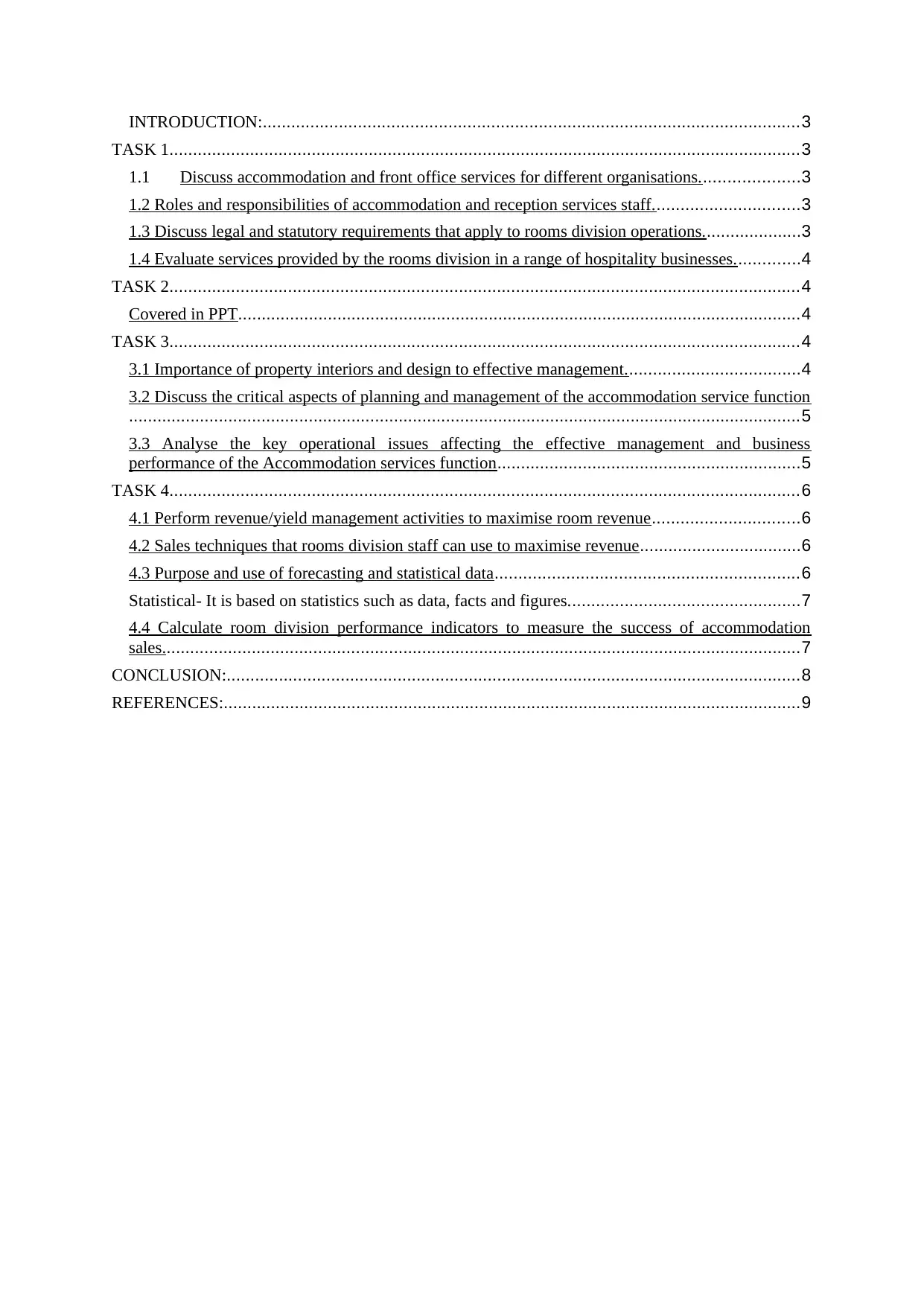
INTRODUCTION:.................................................................................................................3
TASK 1.....................................................................................................................................3
1.1 Discuss accommodation and front office services for different organisations.....................3
1.2 Roles and responsibilities of accommodation and reception services staff...............................3
1.3 Discuss legal and statutory requirements that apply to rooms division operations.....................3
1.4 Evaluate services provided by the rooms division in a range of hospitality businesses..............4
TASK 2.....................................................................................................................................4
Covered in PPT.......................................................................................................................4
TASK 3.....................................................................................................................................4
3.1 Importance of property interiors and design to effective management.....................................4
3.2 Discuss the critical aspects of planning and management of the accommodation service function
..............................................................................................................................................5
3.3 Analyse the key operational issues affecting the effective management and business
performance of the Accommodation services function................................................................5
TASK 4.....................................................................................................................................6
4.1 Perform revenue/yield management activities to maximise room revenue...............................6
4.2 Sales techniques that rooms division staff can use to maximise revenue..................................6
4.3 Purpose and use of forecasting and statistical data................................................................6
Statistical- It is based on statistics such as data, facts and figures.................................................7
4.4 Calculate room division performance indicators to measure the success of accommodation
sales.......................................................................................................................................7
CONCLUSION:.........................................................................................................................8
REFERENCES:..........................................................................................................................9
TASK 1.....................................................................................................................................3
1.1 Discuss accommodation and front office services for different organisations.....................3
1.2 Roles and responsibilities of accommodation and reception services staff...............................3
1.3 Discuss legal and statutory requirements that apply to rooms division operations.....................3
1.4 Evaluate services provided by the rooms division in a range of hospitality businesses..............4
TASK 2.....................................................................................................................................4
Covered in PPT.......................................................................................................................4
TASK 3.....................................................................................................................................4
3.1 Importance of property interiors and design to effective management.....................................4
3.2 Discuss the critical aspects of planning and management of the accommodation service function
..............................................................................................................................................5
3.3 Analyse the key operational issues affecting the effective management and business
performance of the Accommodation services function................................................................5
TASK 4.....................................................................................................................................6
4.1 Perform revenue/yield management activities to maximise room revenue...............................6
4.2 Sales techniques that rooms division staff can use to maximise revenue..................................6
4.3 Purpose and use of forecasting and statistical data................................................................6
Statistical- It is based on statistics such as data, facts and figures.................................................7
4.4 Calculate room division performance indicators to measure the success of accommodation
sales.......................................................................................................................................7
CONCLUSION:.........................................................................................................................8
REFERENCES:..........................................................................................................................9
INTRODUCTION:
Housekeeping and front office employees plays a crucial role in maintaining the rooms and
service quality. They are in direct contact with customers so they identify what are their
needs and demands (Langabeer, and Helton, 2015). In hospitality sector it is very important
to maintain room services to ensure that customers does not face any problem. Along with
room service these employees have different roles and responsibilities. They have to perform
daily operations to ensure proper arrangements of rooms. This report will show how front
office services and roles of reception staff. Also what sales techniques can be used to
maximise room occupancy.
TASK 1
1.1 Discuss accommodation and front office services for different organisations.
Accommodation- It means a place where travellers usually get sleeping facilities. It can also
include place for having some time for leisure. Hospitality sector offers accommodation
places in hotels, apartments, etc.
Front office- It is related to keeping and maintain records of each room service and details of
customer. It is often known as reception where a customer enquiry about services in hotel. the
person role is to take listen to customer problems and handle them. They deal with payments,
room allotting, etc.
1.2 Roles and responsibilities of accommodation and reception services staff.
There are various roles and responsibilities of front office staff in hotels. It depends upon
structure, type and size of hotel. This is described below:
Reservation supervisor- Its role is to ensure all activities are going on time. He is responsible
for organising staff shifts, monitoring bookings, etc.
Receptionist- This person welcomes guests or customer in the hotel. person greets guests and
keep records of all rooms (.Laudon,. and Laudon, 2016). Also, he assigns rooms to customer
and deal with payments.
Housekeeping- This person plays important part in this. The entire service quality and
hygiene of food remains in his hands. His role is to clean room and fulfil the needs of
Housekeeping and front office employees plays a crucial role in maintaining the rooms and
service quality. They are in direct contact with customers so they identify what are their
needs and demands (Langabeer, and Helton, 2015). In hospitality sector it is very important
to maintain room services to ensure that customers does not face any problem. Along with
room service these employees have different roles and responsibilities. They have to perform
daily operations to ensure proper arrangements of rooms. This report will show how front
office services and roles of reception staff. Also what sales techniques can be used to
maximise room occupancy.
TASK 1
1.1 Discuss accommodation and front office services for different organisations.
Accommodation- It means a place where travellers usually get sleeping facilities. It can also
include place for having some time for leisure. Hospitality sector offers accommodation
places in hotels, apartments, etc.
Front office- It is related to keeping and maintain records of each room service and details of
customer. It is often known as reception where a customer enquiry about services in hotel. the
person role is to take listen to customer problems and handle them. They deal with payments,
room allotting, etc.
1.2 Roles and responsibilities of accommodation and reception services staff.
There are various roles and responsibilities of front office staff in hotels. It depends upon
structure, type and size of hotel. This is described below:
Reservation supervisor- Its role is to ensure all activities are going on time. He is responsible
for organising staff shifts, monitoring bookings, etc.
Receptionist- This person welcomes guests or customer in the hotel. person greets guests and
keep records of all rooms (.Laudon,. and Laudon, 2016). Also, he assigns rooms to customer
and deal with payments.
Housekeeping- This person plays important part in this. The entire service quality and
hygiene of food remains in his hands. His role is to clean room and fulfil the needs of
⊘ This is a preview!⊘
Do you want full access?
Subscribe today to unlock all pages.

Trusted by 1+ million students worldwide
customer. Hotels sales and customer satisfaction is dependent on housekeeping. He ensures
comfort, safety, solicitude, etc. with guests.
1.3 Discuss legal and statutory requirements that apply to rooms division operations.
Legal requirements have to be followed by hotel in order to ensure safety of customers.
Government regulates these rules on hotels. There are various acts that is as follows:-
Health and safety act 1974- It states that every person is responsible for own well being and
others. Its purpose is to protect employees, guests, etc. effective training must be provided to
staff so that they can deal with this situation (Ivanov, 2014).
Fire Regulations Act 1971 –It consists rules and regulations that have to be followed by
every organisation involved in hospitality sector. The hotel premises must be having enough
equipment’s to deal with any situation related to fire. They should have smoke detectors, fire
alarms, fire extinguishers, etc.
Data Protection Act 1998- It states that all information and data of guests or customers
must be protected. Information such as name, age, address, etc. should not be disclosed to
anyone. Any violation of this act will result in legal action against that hotel.
1.4 Evaluate services provided by the rooms division in a range of hospitality businesses.
Hospitality sector is evolving at high rate. It is due to increase in variety of services from low
to high class. The services in this mostly depends upon needs of customers. It provides both
types of services. The basic services are similar in every hotel like rooms, food, etc. but
secondary services depends upon the needs of customers. Also, it can be classified as low and
high class. Luxury services includes spa shop, swimming pool, etc. abc hotel provides based
on customer needs. It is because individual needs differs from each other to a great extent
(Mills, and Broughton, 2016).
TASK 2
Covered in PPT
comfort, safety, solicitude, etc. with guests.
1.3 Discuss legal and statutory requirements that apply to rooms division operations.
Legal requirements have to be followed by hotel in order to ensure safety of customers.
Government regulates these rules on hotels. There are various acts that is as follows:-
Health and safety act 1974- It states that every person is responsible for own well being and
others. Its purpose is to protect employees, guests, etc. effective training must be provided to
staff so that they can deal with this situation (Ivanov, 2014).
Fire Regulations Act 1971 –It consists rules and regulations that have to be followed by
every organisation involved in hospitality sector. The hotel premises must be having enough
equipment’s to deal with any situation related to fire. They should have smoke detectors, fire
alarms, fire extinguishers, etc.
Data Protection Act 1998- It states that all information and data of guests or customers
must be protected. Information such as name, age, address, etc. should not be disclosed to
anyone. Any violation of this act will result in legal action against that hotel.
1.4 Evaluate services provided by the rooms division in a range of hospitality businesses.
Hospitality sector is evolving at high rate. It is due to increase in variety of services from low
to high class. The services in this mostly depends upon needs of customers. It provides both
types of services. The basic services are similar in every hotel like rooms, food, etc. but
secondary services depends upon the needs of customers. Also, it can be classified as low and
high class. Luxury services includes spa shop, swimming pool, etc. abc hotel provides based
on customer needs. It is because individual needs differs from each other to a great extent
(Mills, and Broughton, 2016).
TASK 2
Covered in PPT
Paraphrase This Document
Need a fresh take? Get an instant paraphrase of this document with our AI Paraphraser
TASK 3
3.1 Importance of property interiors and design to effective management.
The design of hotel and its rooms helps in attracting customers. It describes the hotel
environment. People mostly comes in hotel whose design are unique and attractive.
Objectives of interior design- It plays a crucial role in attracting the customer ( Huang, Ho,
and Chiu, 2014). An interior of hotel is the first thing guest observes when he enters. It
reflects hotel environment and cleanliness.
Design – Every hotel design needs to be different in order to attract customers. Every hotels
pays huge attention on this. They spend a lot of amount on making unique interior design.
Design of rooms- It is another important factor that customer considers while choosing hotel.
layout of rooms should be unique enough to attract customers (Loukopoulos, , Dismukes,
and Barshi, 2016). Design depends upon size and rating of hotels. Customer give reviews
that helps in retaining them.
3.2 Discuss the critical aspects of planning and management of the accommodation service
function
There are several services in hotel that have to be managed in order to maintain high
standards.
Type of linen- It refers to types of clothing material that is used in the hotel. it consists of bed
linen, towel, etc. If they will be more clean and silky customer will be more attracted towards
it. It generates value to room services (Boin, Stern, and Sundelius,2016).
Cleanliness- The success of hospitality sector is dependent on cleanliness of hotels. It plays a
vital role in retaining customers. Guests are more concerned towards cleanliness of rooms.
They notice this thing very deeply. Hotel must maintain its standard regarding cleanliness. A
five star hotel standards are based on this.
Maintenance- It refers to maintaining of various things like bathrooms, doors, windows, etc.
this is the responsibility of housekeeping department or staff to ensure proper maintenance of
these things. It puts a high impression on guest arriving in hotel. if there are any issues staff
must inform it to manager (Kotas,2014). Then accordingly actions can be taken to improve it.
3.3 Analyse the key operational issues affecting the effective management and business
performance of the Accommodation services function
3.1 Importance of property interiors and design to effective management.
The design of hotel and its rooms helps in attracting customers. It describes the hotel
environment. People mostly comes in hotel whose design are unique and attractive.
Objectives of interior design- It plays a crucial role in attracting the customer ( Huang, Ho,
and Chiu, 2014). An interior of hotel is the first thing guest observes when he enters. It
reflects hotel environment and cleanliness.
Design – Every hotel design needs to be different in order to attract customers. Every hotels
pays huge attention on this. They spend a lot of amount on making unique interior design.
Design of rooms- It is another important factor that customer considers while choosing hotel.
layout of rooms should be unique enough to attract customers (Loukopoulos, , Dismukes,
and Barshi, 2016). Design depends upon size and rating of hotels. Customer give reviews
that helps in retaining them.
3.2 Discuss the critical aspects of planning and management of the accommodation service
function
There are several services in hotel that have to be managed in order to maintain high
standards.
Type of linen- It refers to types of clothing material that is used in the hotel. it consists of bed
linen, towel, etc. If they will be more clean and silky customer will be more attracted towards
it. It generates value to room services (Boin, Stern, and Sundelius,2016).
Cleanliness- The success of hospitality sector is dependent on cleanliness of hotels. It plays a
vital role in retaining customers. Guests are more concerned towards cleanliness of rooms.
They notice this thing very deeply. Hotel must maintain its standard regarding cleanliness. A
five star hotel standards are based on this.
Maintenance- It refers to maintaining of various things like bathrooms, doors, windows, etc.
this is the responsibility of housekeeping department or staff to ensure proper maintenance of
these things. It puts a high impression on guest arriving in hotel. if there are any issues staff
must inform it to manager (Kotas,2014). Then accordingly actions can be taken to improve it.
3.3 Analyse the key operational issues affecting the effective management and business
performance of the Accommodation services function
It is very important to have a great impression on guest who arrives in hotel. it can be done by
maintaining high standards. The interior design of hotel in unique but design of rooms is very
old fashioned then it will create a poor impact on guests (Wang, Zhong, , Li, and Howard,
2014). it will be difficult for hotel to retain customers. For improving this, attractive flowers,
furniture, etc. can be perceived. It enables customer to have different experience. Similarly,
carpets, lines can be improved by keeping it clean and fresh.
TASK 4
4.1 Perform revenue/yield management activities to maximise room revenue
Hotels success depends upon how they do pricing of rooms. Also, by giving right pricing it
helps them to earn huge profits. Room occupancy can be maximised by applying the
technique of selling right room with right price. It enables hotel to retain customers. But
design of rooms must be changed in order to survive. Another way to increase this is
implementing policies (Turker, and Altuntas,., 2014). These polices will help in creating
specific that have to be followed by customers. For example- if any person cancel booking of
room then a specific amount have to be paid by him as cancellation fees. Similarly, a non
refundable policy will describe that at tie of booking room amount paid will not be refunded
again.
4.2 Sales techniques that rooms division staff can use to maximise revenue
There are various sales techniques that can be followed to maximise revenue. These are as
follows:-
Bottom up- It means providing high quality services to customers.
Top down- It is related to providing high quality services to high class people.
Cross selling- It means offering other services to customers.
Up selling- It means giving more services to clients who have already done registration.
4.3 Purpose and use of forecasting and statistical data
Forecasting refers to predicting the future sales based on past data, facts and figures. In
hospitality sector its purpose is to forecast sales on the basis of past actions. It is done to
develop strategies for future (Hill, Jones, . and Schilling 2014). Many hotels forecast its
sales to compare its performance. It helps them to improve their productivity by taking
maintaining high standards. The interior design of hotel in unique but design of rooms is very
old fashioned then it will create a poor impact on guests (Wang, Zhong, , Li, and Howard,
2014). it will be difficult for hotel to retain customers. For improving this, attractive flowers,
furniture, etc. can be perceived. It enables customer to have different experience. Similarly,
carpets, lines can be improved by keeping it clean and fresh.
TASK 4
4.1 Perform revenue/yield management activities to maximise room revenue
Hotels success depends upon how they do pricing of rooms. Also, by giving right pricing it
helps them to earn huge profits. Room occupancy can be maximised by applying the
technique of selling right room with right price. It enables hotel to retain customers. But
design of rooms must be changed in order to survive. Another way to increase this is
implementing policies (Turker, and Altuntas,., 2014). These polices will help in creating
specific that have to be followed by customers. For example- if any person cancel booking of
room then a specific amount have to be paid by him as cancellation fees. Similarly, a non
refundable policy will describe that at tie of booking room amount paid will not be refunded
again.
4.2 Sales techniques that rooms division staff can use to maximise revenue
There are various sales techniques that can be followed to maximise revenue. These are as
follows:-
Bottom up- It means providing high quality services to customers.
Top down- It is related to providing high quality services to high class people.
Cross selling- It means offering other services to customers.
Up selling- It means giving more services to clients who have already done registration.
4.3 Purpose and use of forecasting and statistical data
Forecasting refers to predicting the future sales based on past data, facts and figures. In
hospitality sector its purpose is to forecast sales on the basis of past actions. It is done to
develop strategies for future (Hill, Jones, . and Schilling 2014). Many hotels forecast its
sales to compare its performance. It helps them to improve their productivity by taking
⊘ This is a preview!⊘
Do you want full access?
Subscribe today to unlock all pages.
Trusted by 1+ million students worldwide
appropriate measures. Along with this forecasting helps in determining the success or failure
in the future. It is done in different sectors such as marketing, travel, etc. The tools used in
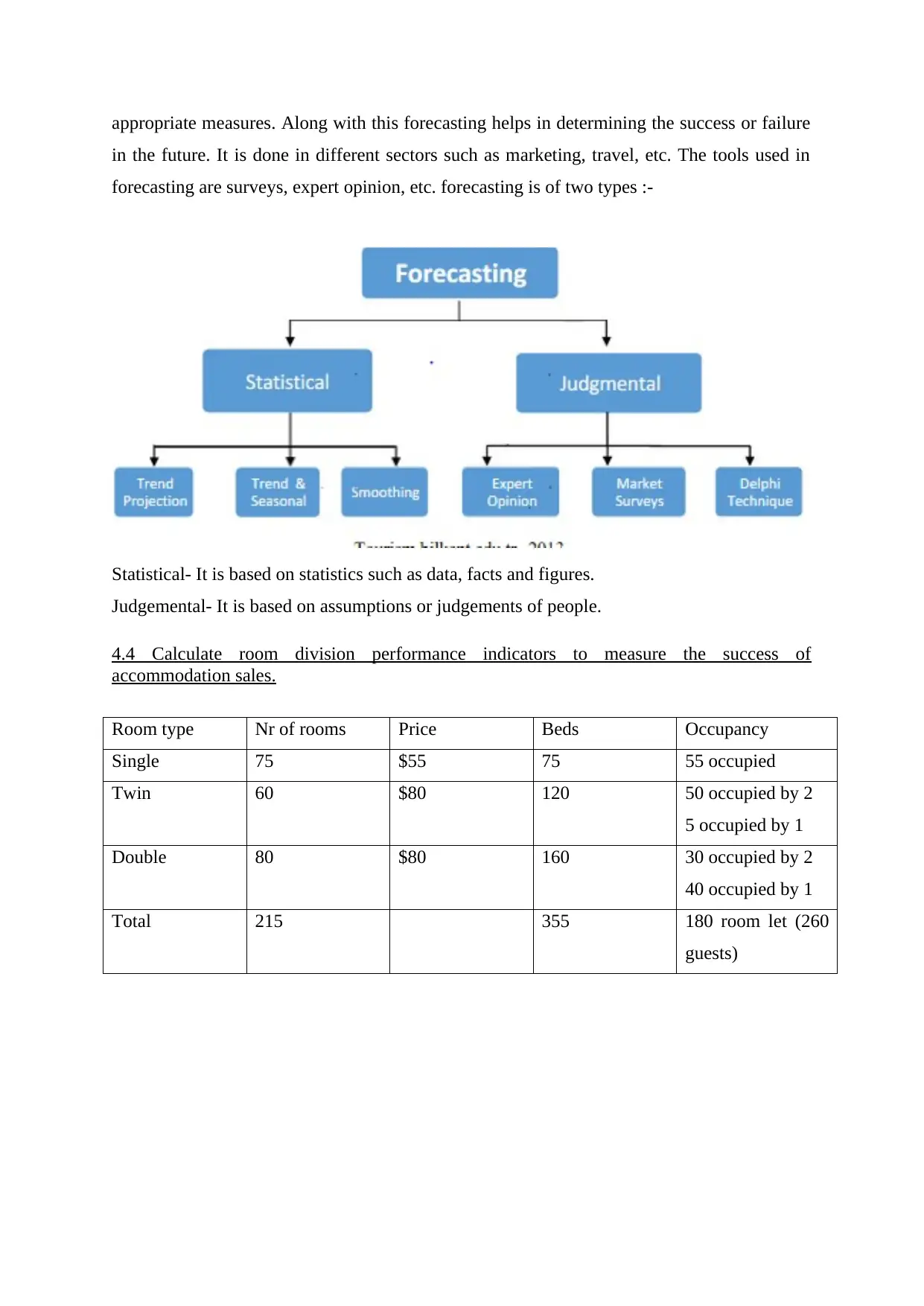
forecasting are surveys, expert opinion, etc. forecasting is of two types :-
Statistical- It is based on statistics such as data, facts and figures.
Judgemental- It is based on assumptions or judgements of people.
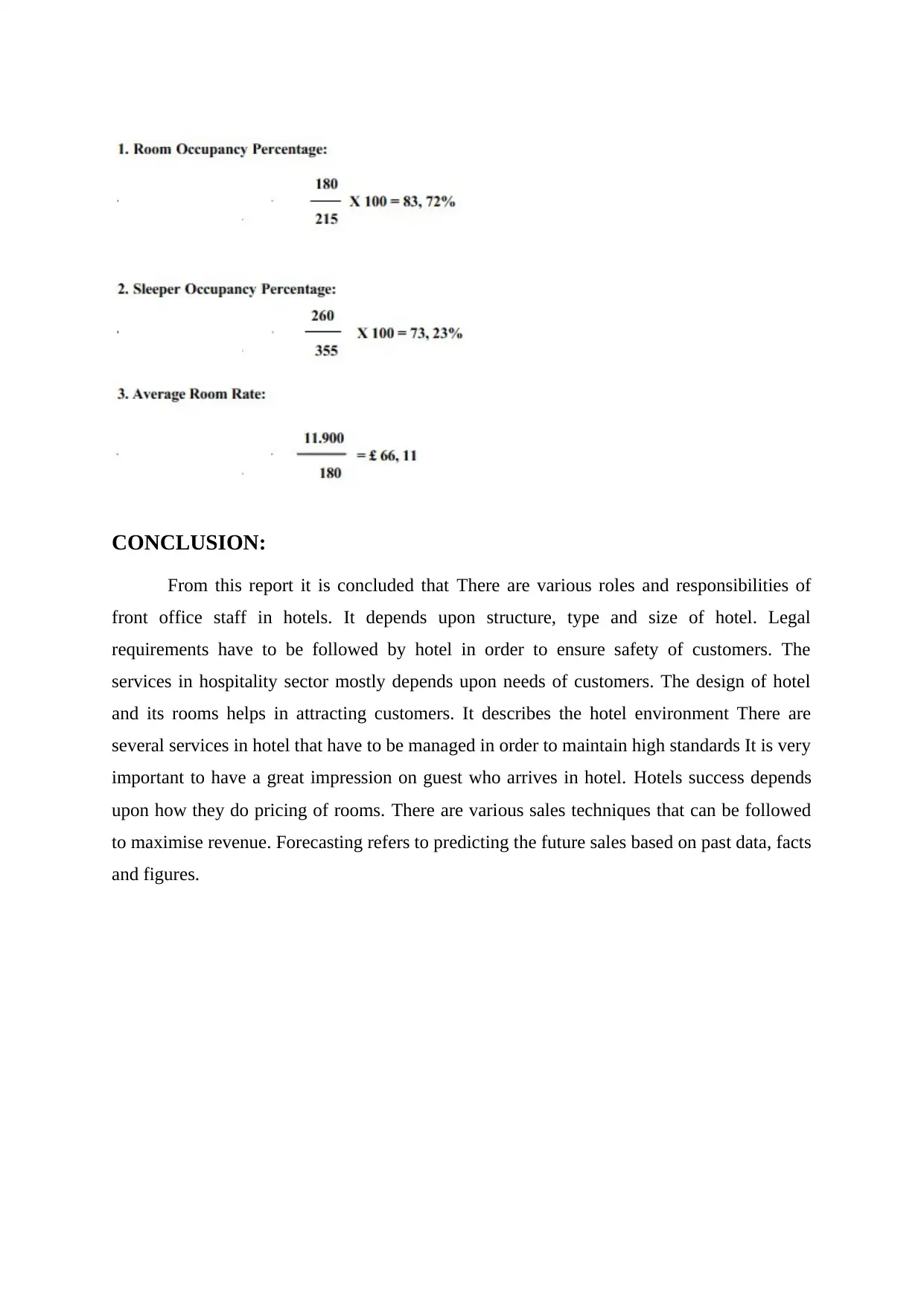
4.4 Calculate room division performance indicators to measure the success of
accommodation sales.
Room type Nr of rooms Price Beds Occupancy
Single 75 $55 75 55 occupied
Twin 60 $80 120 50 occupied by 2
5 occupied by 1
Double 80 $80 160 30 occupied by 2
40 occupied by 1
Total 215 355 180 room let (260
guests)
in the future. It is done in different sectors such as marketing, travel, etc. The tools used in
forecasting are surveys, expert opinion, etc. forecasting is of two types :-
Statistical- It is based on statistics such as data, facts and figures.
Judgemental- It is based on assumptions or judgements of people.
4.4 Calculate room division performance indicators to measure the success of
accommodation sales.
Room type Nr of rooms Price Beds Occupancy
Single 75 $55 75 55 occupied
Twin 60 $80 120 50 occupied by 2
5 occupied by 1
Double 80 $80 160 30 occupied by 2
40 occupied by 1
Total 215 355 180 room let (260
guests)
Paraphrase This Document
Need a fresh take? Get an instant paraphrase of this document with our AI Paraphraser
CONCLUSION:
From this report it is concluded that There are various roles and responsibilities of
front office staff in hotels. It depends upon structure, type and size of hotel. Legal
requirements have to be followed by hotel in order to ensure safety of customers. The
services in hospitality sector mostly depends upon needs of customers. The design of hotel
and its rooms helps in attracting customers. It describes the hotel environment There are
several services in hotel that have to be managed in order to maintain high standards It is very
important to have a great impression on guest who arrives in hotel. Hotels success depends
upon how they do pricing of rooms. There are various sales techniques that can be followed
to maximise revenue. Forecasting refers to predicting the future sales based on past data, facts
and figures.
From this report it is concluded that There are various roles and responsibilities of
front office staff in hotels. It depends upon structure, type and size of hotel. Legal
requirements have to be followed by hotel in order to ensure safety of customers. The
services in hospitality sector mostly depends upon needs of customers. The design of hotel
and its rooms helps in attracting customers. It describes the hotel environment There are
several services in hotel that have to be managed in order to maintain high standards It is very
important to have a great impression on guest who arrives in hotel. Hotels success depends
upon how they do pricing of rooms. There are various sales techniques that can be followed
to maximise revenue. Forecasting refers to predicting the future sales based on past data, facts
and figures.
REFERENCES:
Books and Journals:
Boin, A., Stern, E. and Sundelius, B., 2016. The politics of crisis management: Public
leadership under pressure. Cambridge University Press.
Hill, C.W., Jones, G.R. and Schilling, M.A., 2014. Strategic management: theory: an
integrated approach. Cengage Learning.
Huang, C.W., Ho, F.N. and Chiu, Y.H., 2014. Measurement of tourist hotels׳ productive
efficiency, occupancy, and catering service effectiveness using a modified two-stage
DEA model in Taiwan. Omega.48. pp.49-59.
Ivanov, S., 2014. Hotel revenue management: From theory to practice. Zangador.
Kotas, R., 2014. Management accounting for hotels and restaurants. Routledge.
Langabeer, J.R. and Helton, J.R., 2015. Health care operations management. Jones &
Bartlett Publishers.
Laudon, K.C. and Laudon, J.P., 2016. Management information system. Pearson Education
India.
Loukopoulos, L.D., Dismukes, R.K. and Barshi, I., 2016. The multitasking myth: Handling
complexity in real-world operations. Routledge.
Mills, J. and Broughton, V., 2016. Bliss Bibliographic Classification: Class T: Economics
Management of Economic Enterprises. Elsevier.
Turker, D. and Altuntas, C., 2014. Sustainable supply chain management in the fast fashion
industry: An analysis of corporate reports. European Management Journal. 32(5).
pp.837-849.
Wang, J., Zhong, X., Li, J. and Howard, P.K., 2014. Modeling and analysis of care delivery
services within patient rooms: A system-theoretic approach. IEEE Transactions on
Automation Science and Engineering.11(2). pp.379-393.
Books and Journals:
Boin, A., Stern, E. and Sundelius, B., 2016. The politics of crisis management: Public
leadership under pressure. Cambridge University Press.
Hill, C.W., Jones, G.R. and Schilling, M.A., 2014. Strategic management: theory: an
integrated approach. Cengage Learning.
Huang, C.W., Ho, F.N. and Chiu, Y.H., 2014. Measurement of tourist hotels׳ productive
efficiency, occupancy, and catering service effectiveness using a modified two-stage
DEA model in Taiwan. Omega.48. pp.49-59.
Ivanov, S., 2014. Hotel revenue management: From theory to practice. Zangador.
Kotas, R., 2014. Management accounting for hotels and restaurants. Routledge.
Langabeer, J.R. and Helton, J.R., 2015. Health care operations management. Jones &
Bartlett Publishers.
Laudon, K.C. and Laudon, J.P., 2016. Management information system. Pearson Education
India.
Loukopoulos, L.D., Dismukes, R.K. and Barshi, I., 2016. The multitasking myth: Handling
complexity in real-world operations. Routledge.
Mills, J. and Broughton, V., 2016. Bliss Bibliographic Classification: Class T: Economics
Management of Economic Enterprises. Elsevier.
Turker, D. and Altuntas, C., 2014. Sustainable supply chain management in the fast fashion
industry: An analysis of corporate reports. European Management Journal. 32(5).
pp.837-849.
Wang, J., Zhong, X., Li, J. and Howard, P.K., 2014. Modeling and analysis of care delivery
services within patient rooms: A system-theoretic approach. IEEE Transactions on
Automation Science and Engineering.11(2). pp.379-393.
⊘ This is a preview!⊘
Do you want full access?
Subscribe today to unlock all pages.
Trusted by 1+ million students worldwide

1 out of 9


Related Documents


Your All-in-One AI-Powered Toolkit for Academic Success.
+13062052269
info@desklib.com
Available 24*7 on WhatsApp / Email
![[object Object]](/_next/static/media/star-bottom.7253800d.svg)
Unlock your academic potential
Copyright © 2020–2026 A2Z Services. All Rights Reserved. Developed and managed by ZUCOL.