University Coursework: Comparing Round-Robin and Priority Schedulers
VerifiedAdded on 2023/04/21
|6
|1275
|405
Report
AI Summary
This report provides a comparative analysis of Round-Robin and Priority Scheduling algorithms. It begins by introducing the concepts of scheduling algorithms and their importance in managing computer processes. The report then delves into the specifics of each algorithm, explaining how Round-Robin allocates equal time slices to processes in a circular manner, while Priority Scheduling assigns priorities to processes for execution. An experiment is conducted to evaluate the efficiency of both algorithms, comparing their performance based on execution time and waiting time. The results of the experiment, presented in a tabulated format, show that Priority Scheduling generally outperforms Round-Robin, particularly when the number of processes increases. The report concludes by summarizing the findings and emphasizing the efficiency of Priority Scheduling over Round-Robin, especially in scenarios with multiple processes. References are included to support the analysis and findings.
Running head: COURSEWORK EXERCISE SHEET 2
Coursework Exercise Sheet 2
Name of the Student
Name of the University
Author’s Note
Coursework Exercise Sheet 2
Name of the Student
Name of the University
Author’s Note
Paraphrase This Document
Need a fresh take? Get an instant paraphrase of this document with our AI Paraphraser

1
COURSEWORK EXERCISE SHEET 2
Blog post on comparison of Round-Robin Scheduling and Priority
Scheduling
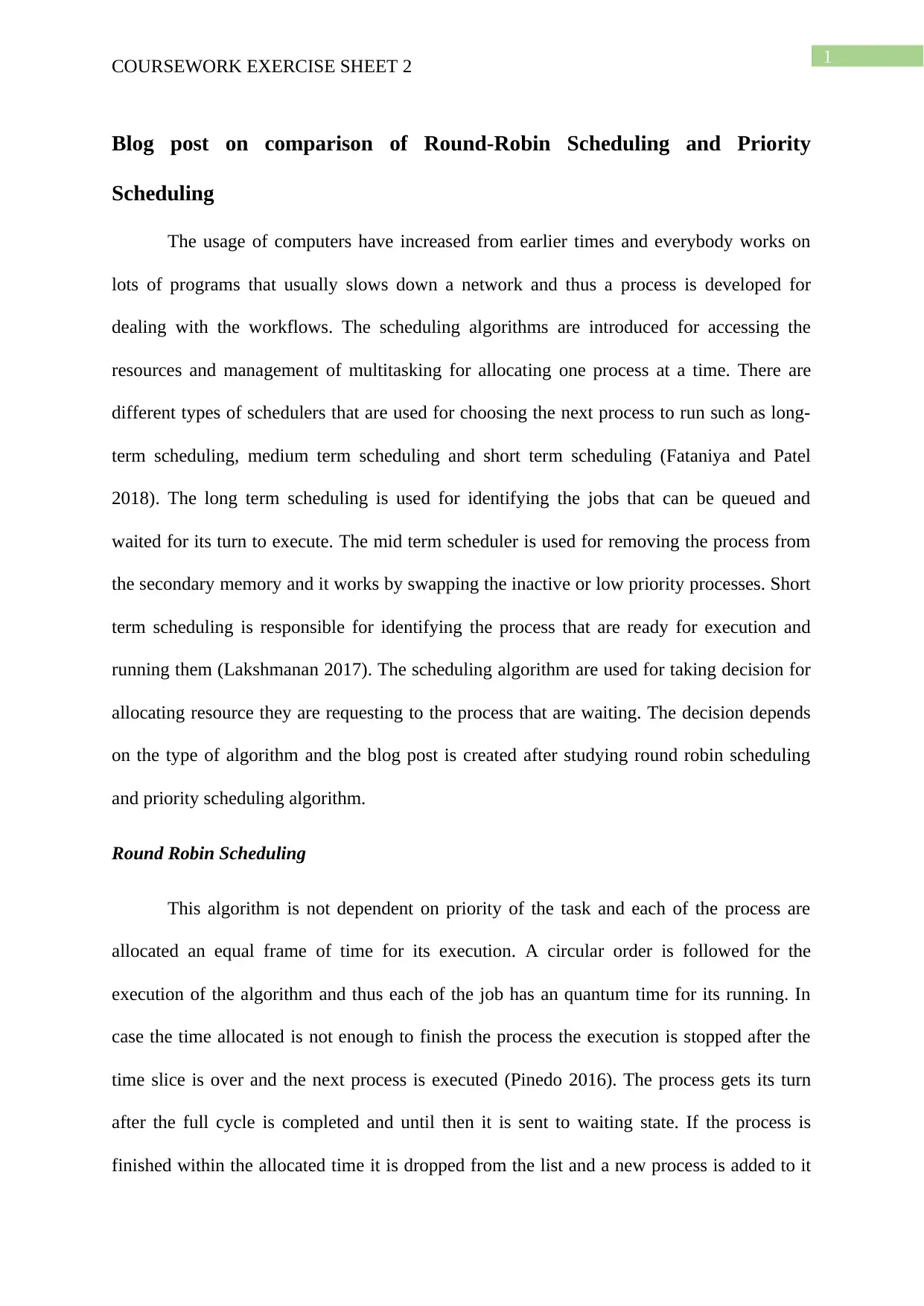
The usage of computers have increased from earlier times and everybody works on
lots of programs that usually slows down a network and thus a process is developed for
dealing with the workflows. The scheduling algorithms are introduced for accessing the
resources and management of multitasking for allocating one process at a time. There are
different types of schedulers that are used for choosing the next process to run such as long-
term scheduling, medium term scheduling and short term scheduling (Fataniya and Patel
2018). The long term scheduling is used for identifying the jobs that can be queued and
waited for its turn to execute. The mid term scheduler is used for removing the process from
the secondary memory and it works by swapping the inactive or low priority processes. Short
term scheduling is responsible for identifying the process that are ready for execution and
running them (Lakshmanan 2017). The scheduling algorithm are used for taking decision for
allocating resource they are requesting to the process that are waiting. The decision depends
on the type of algorithm and the blog post is created after studying round robin scheduling
and priority scheduling algorithm.
Round Robin Scheduling
This algorithm is not dependent on priority of the task and each of the process are
allocated an equal frame of time for its execution. A circular order is followed for the
execution of the algorithm and thus each of the job has an quantum time for its running. In
case the time allocated is not enough to finish the process the execution is stopped after the
time slice is over and the next process is executed (Pinedo 2016). The process gets its turn
after the full cycle is completed and until then it is sent to waiting state. If the process is
finished within the allocated time it is dropped from the list and a new process is added to it
COURSEWORK EXERCISE SHEET 2
Blog post on comparison of Round-Robin Scheduling and Priority
Scheduling
The usage of computers have increased from earlier times and everybody works on
lots of programs that usually slows down a network and thus a process is developed for
dealing with the workflows. The scheduling algorithms are introduced for accessing the
resources and management of multitasking for allocating one process at a time. There are
different types of schedulers that are used for choosing the next process to run such as long-
term scheduling, medium term scheduling and short term scheduling (Fataniya and Patel
2018). The long term scheduling is used for identifying the jobs that can be queued and
waited for its turn to execute. The mid term scheduler is used for removing the process from
the secondary memory and it works by swapping the inactive or low priority processes. Short
term scheduling is responsible for identifying the process that are ready for execution and
running them (Lakshmanan 2017). The scheduling algorithm are used for taking decision for
allocating resource they are requesting to the process that are waiting. The decision depends
on the type of algorithm and the blog post is created after studying round robin scheduling
and priority scheduling algorithm.
Round Robin Scheduling
This algorithm is not dependent on priority of the task and each of the process are
allocated an equal frame of time for its execution. A circular order is followed for the
execution of the algorithm and thus each of the job has an quantum time for its running. In
case the time allocated is not enough to finish the process the execution is stopped after the
time slice is over and the next process is executed (Pinedo 2016). The process gets its turn
after the full cycle is completed and until then it is sent to waiting state. If the process is
finished within the allocated time it is dropped from the list and a new process is added to it

2
COURSEWORK EXERCISE SHEET 2
and positioned at the end. Starvation cannot occur in this algorithm but a process can have to
wait too long for its completion.
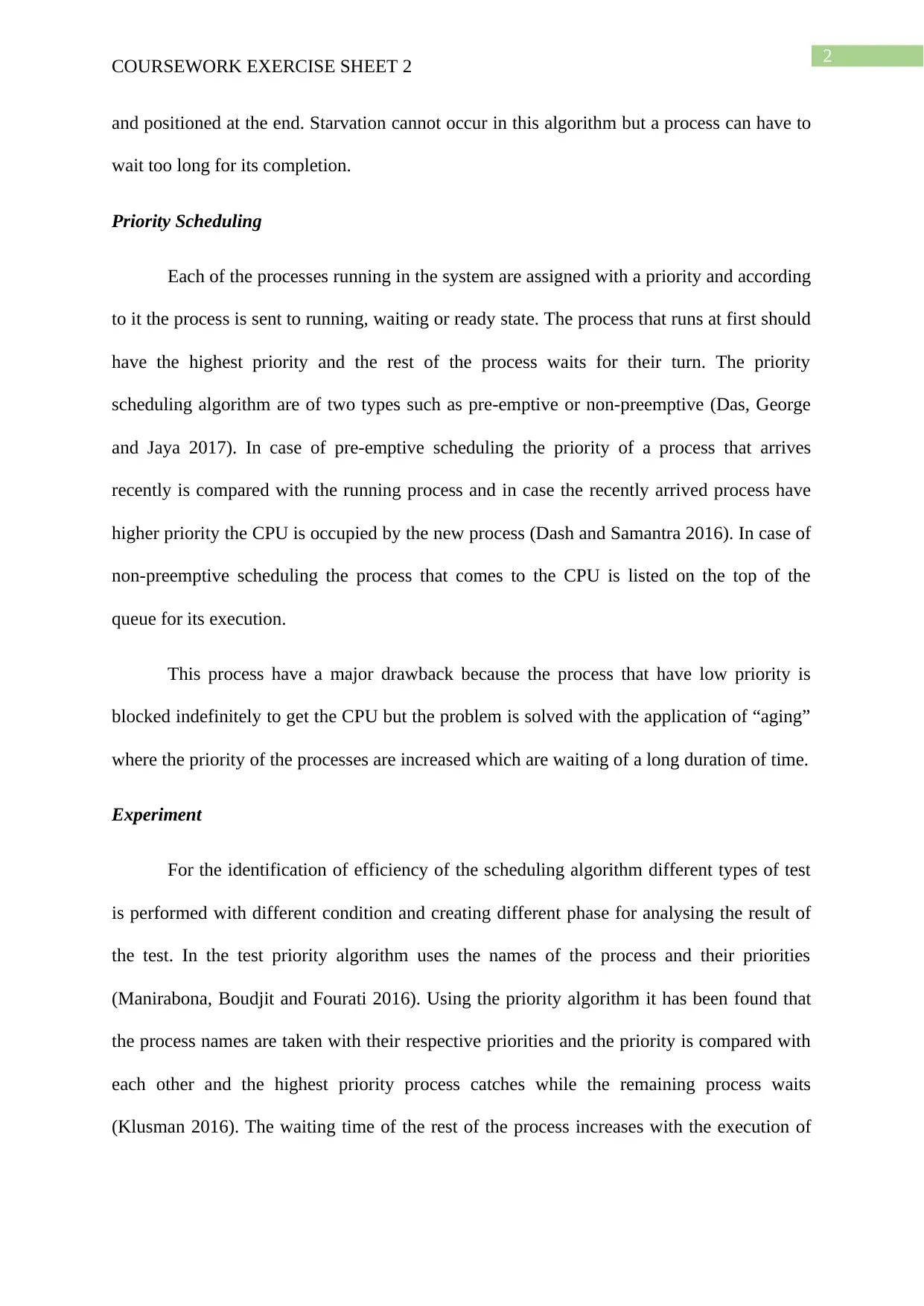
Priority Scheduling
Each of the processes running in the system are assigned with a priority and according
to it the process is sent to running, waiting or ready state. The process that runs at first should
have the highest priority and the rest of the process waits for their turn. The priority
scheduling algorithm are of two types such as pre-emptive or non-preemptive (Das, George
and Jaya 2017). In case of pre-emptive scheduling the priority of a process that arrives
recently is compared with the running process and in case the recently arrived process have
higher priority the CPU is occupied by the new process (Dash and Samantra 2016). In case of
non-preemptive scheduling the process that comes to the CPU is listed on the top of the
queue for its execution.
This process have a major drawback because the process that have low priority is
blocked indefinitely to get the CPU but the problem is solved with the application of “aging”
where the priority of the processes are increased which are waiting of a long duration of time.
Experiment
For the identification of efficiency of the scheduling algorithm different types of test
is performed with different condition and creating different phase for analysing the result of
the test. In the test priority algorithm uses the names of the process and their priorities
(Manirabona, Boudjit and Fourati 2016). Using the priority algorithm it has been found that
the process names are taken with their respective priorities and the priority is compared with
each other and the highest priority process catches while the remaining process waits
(Klusman 2016). The waiting time of the rest of the process increases with the execution of
COURSEWORK EXERCISE SHEET 2
and positioned at the end. Starvation cannot occur in this algorithm but a process can have to
wait too long for its completion.
Priority Scheduling
Each of the processes running in the system are assigned with a priority and according
to it the process is sent to running, waiting or ready state. The process that runs at first should
have the highest priority and the rest of the process waits for their turn. The priority
scheduling algorithm are of two types such as pre-emptive or non-preemptive (Das, George
and Jaya 2017). In case of pre-emptive scheduling the priority of a process that arrives
recently is compared with the running process and in case the recently arrived process have
higher priority the CPU is occupied by the new process (Dash and Samantra 2016). In case of
non-preemptive scheduling the process that comes to the CPU is listed on the top of the
queue for its execution.
This process have a major drawback because the process that have low priority is
blocked indefinitely to get the CPU but the problem is solved with the application of “aging”
where the priority of the processes are increased which are waiting of a long duration of time.
Experiment
For the identification of efficiency of the scheduling algorithm different types of test
is performed with different condition and creating different phase for analysing the result of
the test. In the test priority algorithm uses the names of the process and their priorities
(Manirabona, Boudjit and Fourati 2016). Using the priority algorithm it has been found that
the process names are taken with their respective priorities and the priority is compared with
each other and the highest priority process catches while the remaining process waits
(Klusman 2016). The waiting time of the rest of the process increases with the execution of
⊘ This is a preview!⊘
Do you want full access?
Subscribe today to unlock all pages.

Trusted by 1+ million students worldwide

3
COURSEWORK EXERCISE SHEET 2
each of the processes and it is found that the priority of the lowest priority task increases and
it gets executed.
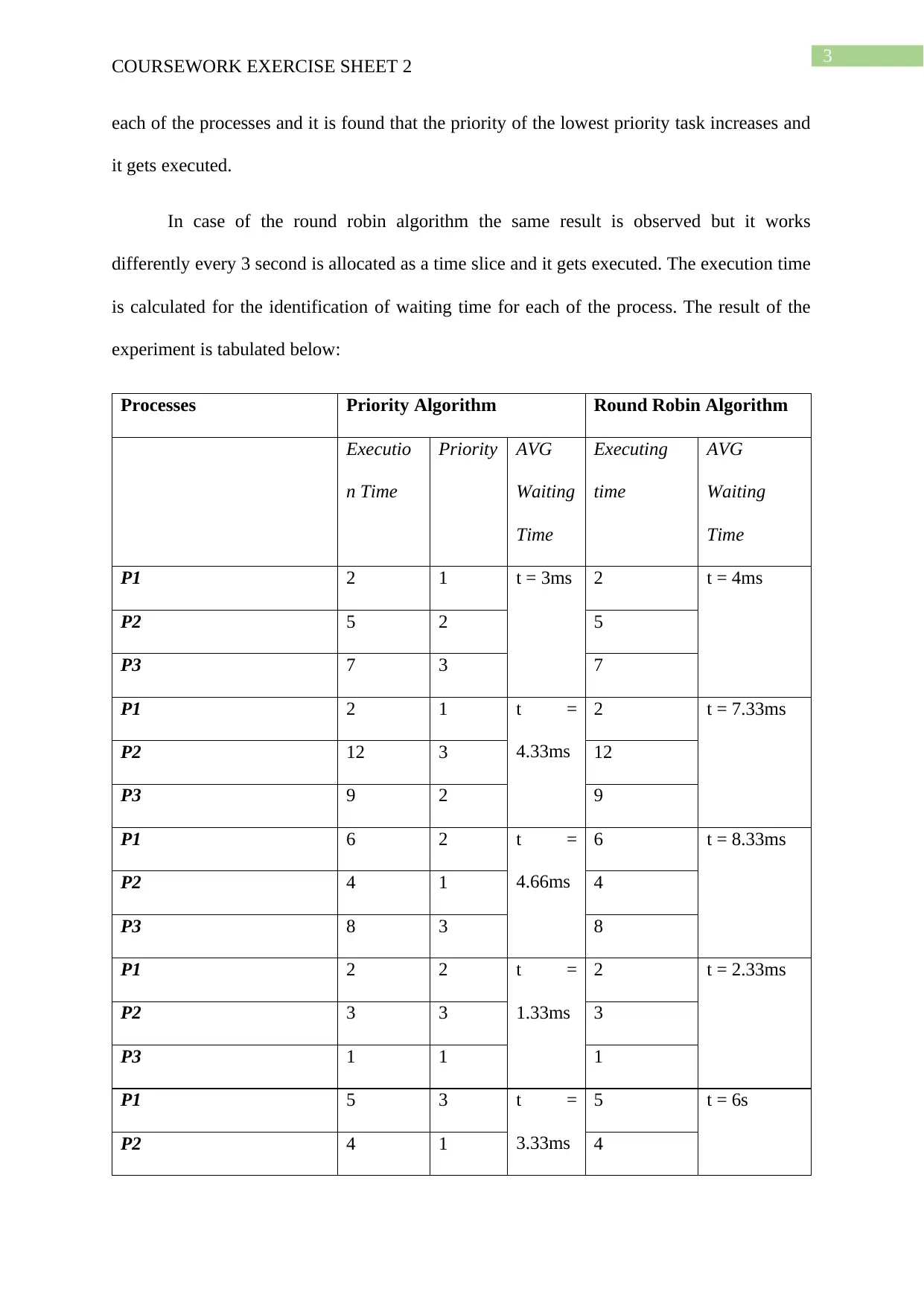
In case of the round robin algorithm the same result is observed but it works
differently every 3 second is allocated as a time slice and it gets executed. The execution time
is calculated for the identification of waiting time for each of the process. The result of the
experiment is tabulated below:
Processes Priority Algorithm Round Robin Algorithm
Executio
n Time
Priority AVG
Waiting
Time
Executing
time
AVG
Waiting
Time
P1 2 1 t = 3ms 2 t = 4ms
P2 5 2 5
P3 7 3 7
P1 2 1 t =
4.33ms
2 t = 7.33ms
P2 12 3 12
P3 9 2 9
P1 6 2 t =
4.66ms
6 t = 8.33ms
P2 4 1 4
P3 8 3 8
P1 2 2 t =
1.33ms
2 t = 2.33ms
P2 3 3 3
P3 1 1 1
P1 5 3 t =
3.33ms
5 t = 6s
P2 4 1 4
COURSEWORK EXERCISE SHEET 2
each of the processes and it is found that the priority of the lowest priority task increases and
it gets executed.
In case of the round robin algorithm the same result is observed but it works
differently every 3 second is allocated as a time slice and it gets executed. The execution time
is calculated for the identification of waiting time for each of the process. The result of the
experiment is tabulated below:
Processes Priority Algorithm Round Robin Algorithm
Executio
n Time
Priority AVG
Waiting
Time
Executing
time
AVG
Waiting
Time
P1 2 1 t = 3ms 2 t = 4ms
P2 5 2 5
P3 7 3 7
P1 2 1 t =
4.33ms
2 t = 7.33ms
P2 12 3 12
P3 9 2 9
P1 6 2 t =
4.66ms
6 t = 8.33ms
P2 4 1 4
P3 8 3 8
P1 2 2 t =
1.33ms
2 t = 2.33ms
P2 3 3 3
P3 1 1 1
P1 5 3 t =
3.33ms
5 t = 6s
P2 4 1 4
Paraphrase This Document
Need a fresh take? Get an instant paraphrase of this document with our AI Paraphraser

4
COURSEWORK EXERCISE SHEET 2
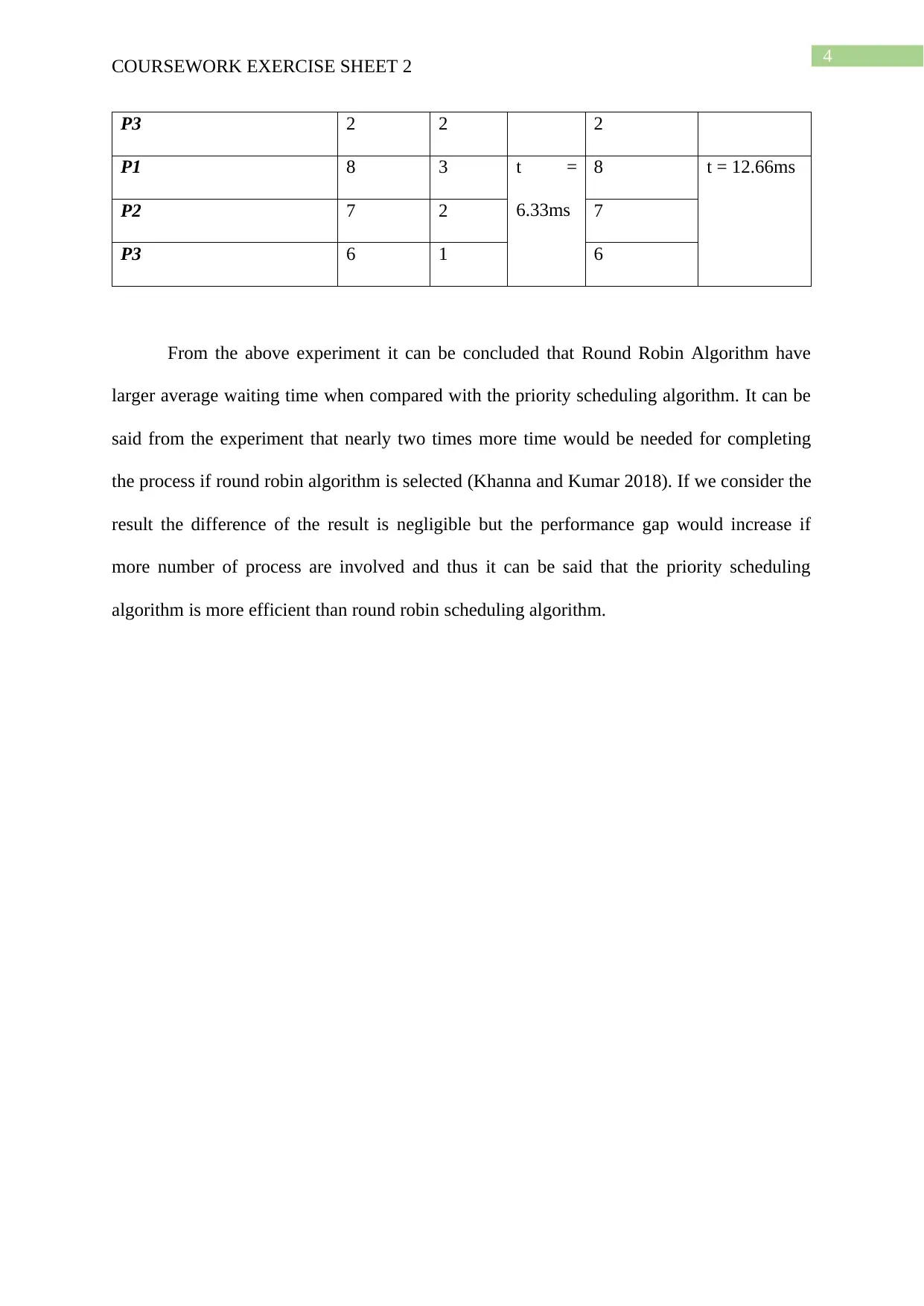
P3 2 2 2
P1 8 3 t =
6.33ms
8 t = 12.66ms
P2 7 2 7
P3 6 1 6
From the above experiment it can be concluded that Round Robin Algorithm have
larger average waiting time when compared with the priority scheduling algorithm. It can be
said from the experiment that nearly two times more time would be needed for completing
the process if round robin algorithm is selected (Khanna and Kumar 2018). If we consider the
result the difference of the result is negligible but the performance gap would increase if
more number of process are involved and thus it can be said that the priority scheduling
algorithm is more efficient than round robin scheduling algorithm.
COURSEWORK EXERCISE SHEET 2
P3 2 2 2
P1 8 3 t =
6.33ms
8 t = 12.66ms
P2 7 2 7
P3 6 1 6
From the above experiment it can be concluded that Round Robin Algorithm have
larger average waiting time when compared with the priority scheduling algorithm. It can be
said from the experiment that nearly two times more time would be needed for completing
the process if round robin algorithm is selected (Khanna and Kumar 2018). If we consider the
result the difference of the result is negligible but the performance gap would increase if
more number of process are involved and thus it can be said that the priority scheduling
algorithm is more efficient than round robin scheduling algorithm.

5
COURSEWORK EXERCISE SHEET 2
References
Das, N.K., George, M.S. and Jaya, P., 2017, April. Incorporating weighted round robin in
honeybee algorithm for enhanced load balancing in cloud environment. In Communication
and Signal Processing (ICCSP), 2017 International Conference on (pp. 0384-0389). IEEE.
Dash, A.R. and Samantra, S.K., 2016. An optimized round Robin CPU scheduling algorithm
with dynamic time quantum. arXiv preprint arXiv:1605.00362.
Fataniya, B. and Patel, M., 2018. Dynamic Time Quantum Approach to Improve Round
Robin Scheduling Algorithm in Cloud Environment.
Khanna, R. and Kumar, N., 2018. Load Balancing Approach for Proposed Hybrid Scheduling
Algorithm in Heterogeneous Networks. Current Trends in Signal Processing, 8(1), pp.1-9.
Klusman, R., 2016. Evaluation of scheduling algorithms for mixed criticality workloads on
multi-core embedded systems.
Lakshmanan, S., 2017. A Survey on Heterogeneous Resource Scheduling Algorithm in Cloud
Computing.
Manirabona, A., Boudjit, S. and Fourati, L.C., 2016, January. A priority-weighted round
robin scheduling strategy for a wban based healthcare monitoring system. In Consumer
Communications & Networking Conference (CCNC), 2016 13th IEEE Annual (pp. 224-229).
IEEE.
Pinedo, M.L., 2016. Scheduling: theory, algorithms, and systems. Springer.
COURSEWORK EXERCISE SHEET 2
References
Das, N.K., George, M.S. and Jaya, P., 2017, April. Incorporating weighted round robin in
honeybee algorithm for enhanced load balancing in cloud environment. In Communication
and Signal Processing (ICCSP), 2017 International Conference on (pp. 0384-0389). IEEE.
Dash, A.R. and Samantra, S.K., 2016. An optimized round Robin CPU scheduling algorithm
with dynamic time quantum. arXiv preprint arXiv:1605.00362.
Fataniya, B. and Patel, M., 2018. Dynamic Time Quantum Approach to Improve Round
Robin Scheduling Algorithm in Cloud Environment.
Khanna, R. and Kumar, N., 2018. Load Balancing Approach for Proposed Hybrid Scheduling
Algorithm in Heterogeneous Networks. Current Trends in Signal Processing, 8(1), pp.1-9.
Klusman, R., 2016. Evaluation of scheduling algorithms for mixed criticality workloads on
multi-core embedded systems.
Lakshmanan, S., 2017. A Survey on Heterogeneous Resource Scheduling Algorithm in Cloud
Computing.
Manirabona, A., Boudjit, S. and Fourati, L.C., 2016, January. A priority-weighted round
robin scheduling strategy for a wban based healthcare monitoring system. In Consumer
Communications & Networking Conference (CCNC), 2016 13th IEEE Annual (pp. 224-229).
IEEE.
Pinedo, M.L., 2016. Scheduling: theory, algorithms, and systems. Springer.
⊘ This is a preview!⊘
Do you want full access?
Subscribe today to unlock all pages.

Trusted by 1+ million students worldwide
1 out of 6
Related Documents
Your All-in-One AI-Powered Toolkit for Academic Success.
+13062052269
info@desklib.com
Available 24*7 on WhatsApp / Email
Unlock your academic potential
Copyright © 2020–2026 A2Z Services. All Rights Reserved. Developed and managed by ZUCOL.